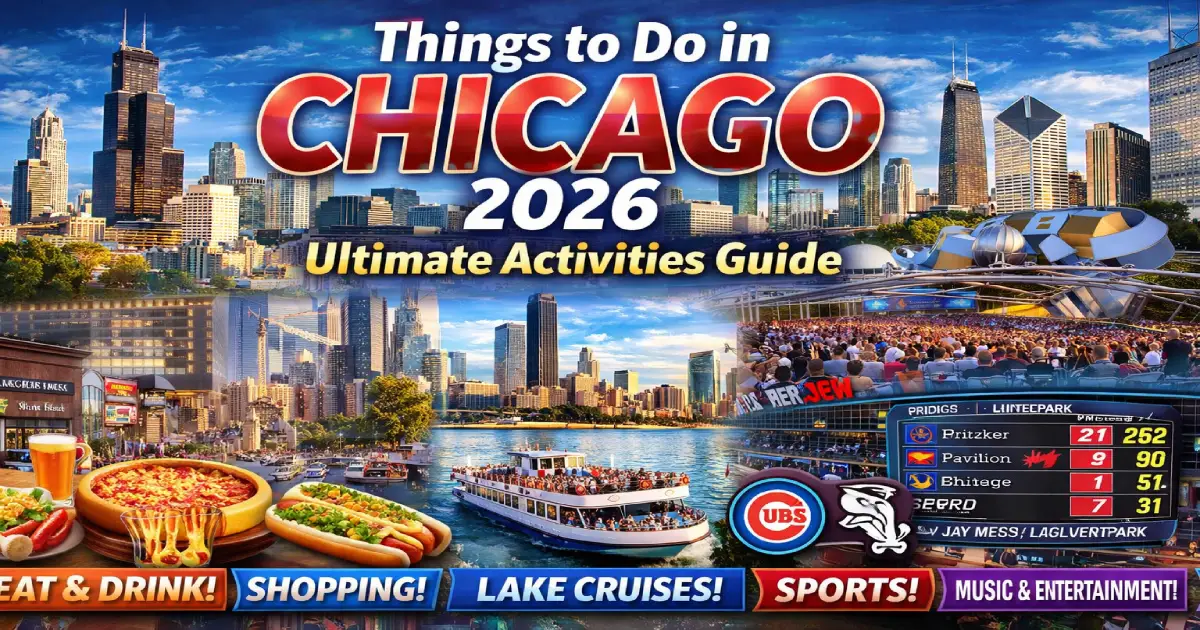
50 Best Things to Do in Chicago 2026: Ultimate Activities Guide
Published on : 21 Mar 2026
Things to Do in Chicago — Architecture, Deep Dish, Jazz, and the World’s Greatest Lakefront
By Travel Tourister | Updated March 2026
Chicago is the American city that does everything seriously — its architecture is the most significant in North America (the skyscraper was invented here, and the Chicago River corridor contains more important buildings per mile than any other American waterway), its food culture runs from the deepest deep-dish pizza on earth to the most Michelin-starred restaurants in the Midwest, its music heritage (blues, jazz, house music, gospel) has shaped American popular culture more completely than any other city outside New York, its lakefront (18 miles of publicly accessible Lake Michigan shoreline) is the finest urban waterfront in any American city without an ocean, and its neighborhoods — Wicker Park, Pilsen, Chinatown, Bronzeville, Lincoln Square, Logan Square — represent the full arc of American immigrant and cultural history compressed into a geography you can cycle in a single afternoon.
I’ve experienced Chicago across every season and every neighborhood — the architecture boat tour on the Chicago River in September when the buildings glow in the afternoon light, the Green Mill at midnight on a Tuesday when the jazz is serious and the cocktails are strong, the Maxwell Street Market on a Sunday morning in January when the Polish sausage vendor has been there since before you were born, the Art Institute’s Impressionist galleries on a rainy Wednesday afternoon in November, Cubs games at Wrigley Field in the afternoon when the ivy is green and the bleacher crowd is philosophical, the Chicago Blues Festival in June when Grant Park fills with the descendants of the Great Migration who brought the Delta blues north and made it city music, and the 95th floor of the Willis Tower’s Ledge — glass boxes extending 4.3 feet from the building with nothing but Chicago 1,353 feet below — which is genuinely terrifying and genuinely worth it.
This comprehensive 2026 guide breaks down Chicago’s 50 best activities using verified information from Choose Chicago, years of on-the-ground expertise, and honest assessments of what delivers genuinely memorable experiences. We organize activities by category — iconic Chicago, outdoor and lakefront, museums and arts, food and drink, music and entertainment, neighborhoods and culture, day trips, and unique Chicago — with realistic costs, timing, and strategic advice for experiencing the most complete American city.
Whether planning a 48-hour highlights weekend, a week-long deep dive into Chicago’s architecture and food culture, a family trip balancing the Field Museum with Navy Pier, a music lover’s journey through blues and jazz venues, or a neighborhood exploration of the city’s extraordinary immigrant cultural geography, this guide gives you the honest intelligence to experience Chicago at its absolute best.
Chicago Activities by Category
Category
Top Activities
Best Location
Cost Range
Iconic Chicago
Millennium Park, Architecture Tour, Willis Tower
The Loop, River North
Free–$32
Outdoor & Lakefront
Lakefront Trail, Navy Pier, Lincoln Park, Grant Park
Lake Michigan shoreline
Free–$20
Museums & Arts
Art Institute, Field Museum, Shedd Aquarium
Grant Park, Museum Campus
Free–$40
Food & Drink
Deep dish, Chicago dog, Italian beef, craft beer
Citywide
$5–$120
Music & Entertainment
Green Mill, Jazz Showcase, Blues venues, Second City
Andersonville, River North, Lincoln Park
$10–$60
Neighborhoods
Wicker Park, Pilsen, Bronzeville, Andersonville
Citywide
Free–$50
Iconic Chicago Experiences
1. Take a Chicago Architecture Boat Tour — MUST DO
Why It’s the #1 Chicago Experience: The Chicago Architecture Foundation Center River Cruise is the finest architectural tour in the world — a 90-minute narrated boat tour on the Chicago River through the downtown canyon of buildings that invented the modern skyscraper, explained by certified CAF docents who know every building’s history, architect, and structural innovation. Chicago’s skyline from the water is the most significant collection of modern architecture in North America, and the river boat vantage point is the only perspective that makes the full scope of the achievement comprehensible. Nothing else in Chicago delivers this combination of education, beauty, and genuine awe.
What You’ll See:
Chicago Tribune Tower (1925): The neo-Gothic tower with fragments of 140 famous buildings embedded in its lower walls — Notre Dame, the Parthenon, the Berlin Wall, and more
Marina City (1964, Bertrand Goldberg): The “corncob” towers — the most iconic mid-century residential buildings in Chicago, appearing in more films than any other Chicago building
333 W. Wacker Drive (1983, Kohn Pedersen Fox): The curved green glass tower that follows the river bend — the most photographed single building in Chicago
The Aqua Tower (2010, Jeanne Gang): The undulating white concrete balconies — the most celebrated recent building in Chicago, designed by the first woman to win the Architectural Review Award
Booking: Book in advance at architecture.org — tours sell out in summer. Evening tours (sunset) deliver the finest light on the buildings.
Cost: $52/adult, $28/child; evening tours $57; 90-minute duration; departs from Michigan Avenue bridge
2. Visit Millennium Park and Cloud Gate
Why Essential: Millennium Park is the finest urban park created in any American city in the 21st century — 24.5 acres of public space in the heart of Chicago containing Anish Kapoor’s Cloud Gate sculpture (the “Bean”), Jaume Plensa’s Crown Fountain (two 50-foot towers projecting Chicagoans’ faces with water cascading), the Jay Pritzker Pavilion (Frank Gehry’s outdoor music venue), and the Lurie Garden (a 2.5-acre native plant garden). All of it is free. All of it is available every day. The Bean’s distorted reflections of the Chicago skyline are one of the most photographed images in the world, and they are available to anyone who walks into the park.
Cloud Gate (the Bean): Anish Kapoor’s 110-ton polished steel sculpture — walk beneath it, photograph your reflection in the curved surface, and understand why public art at this scale matters ($0)
Crown Fountain: Two 50-foot LED towers projecting giant faces of 1,000 Chicago residents — water pours from the towers in summer; children play in the reflecting pool ($0)
Jay Pritzker Pavilion: Frank Gehry’s outdoor music venue — free summer concerts (Chicago Symphony Orchestra, jazz, world music) from June through September
Lurie Garden: 2.5 acres of native perennials — the most ecologically ambitious urban garden in the Chicago park system, free always
Cost: FREE; open daily; best photographed in early morning (8–9 AM) before crowds; 201 E. Randolph Street, The Loop
3. Ride to the Willis Tower Skydeck Ledge
The 103rd floor of the Willis Tower (formerly Sears Tower, 1973 — the world’s tallest building from 1973 to 1998) delivers a 360-degree view of four states from 1,353 feet: Illinois, Michigan, Indiana, and Wisconsin simultaneously visible on clear days
The Ledge: Four glass boxes extending 4.3 feet beyond the building’s face at 1,353 feet — standing on glass with nothing beneath you but Chicago requires a specific kind of courage and delivers a specific kind of memory ($0 with Skydeck admission)
Clear day visibility: 40–50 miles in all directions — the full extent of Lake Michigan visible to the northeast, the flat Illinois farmland extending to the southwest
Best time: Weekday morning arrivals (10–11 AM) for shortest queues; book online for $2–$3 discount
Cost: $30–$32/adult, $22–$24/child; book at theskydeck.com; closed for renovation — verify operating status before visiting
4. Explore the Art Institute of Chicago
Why It’s One of America’s Greatest Museums: The Art Institute of Chicago is one of the three finest art museums in the United States — housing Georges Seurat’s A Sunday on La Grande Jatte (1886), Grant Wood’s American Gothic, Edward Hopper’s Nighthawks, Georges Braque’s The Guitarist, and one of the finest collections of Impressionist paintings outside Paris, all within a 1893 Beaux-Arts building facing Michigan Avenue with the two bronze lion sculptures that are the most recognizable museum entrance in America.
Impressionist galleries: Monet’s Haystacks series, Renoir’s Acrobats at the Cirque Fernando, Seurat’s La Grande Jatte — one of the world’s finest Impressionist collections
American Gothic (Grant Wood, 1930): The most parodied painting in American history, genuinely moving in person — significantly smaller than most visitors expect
Nighthawks (Edward Hopper, 1942): The most evocative painting of American urban loneliness — the diner that inspired a thousand imitations
Thorne Miniature Rooms: 68 meticulously detailed miniature period rooms at 1:12 scale — the most unexpected and most technically astonishing exhibit in the museum
Cost: $25/adult, free for Illinois residents; free for Chicago residents on Thursday evenings; closed Tuesday; artic.edu
5. Walk the Chicago Riverwalk
The 1.25-mile Riverwalk along the south bank of the Chicago River from Lake Shore Drive to Lake Street — the finest urban waterfront promenade in any American inland city, completed in 2016, with restaurants, bars, kayak rentals, a marina, and the constant drama of Chicago’s architecture visible from water level
Chicago’s River Theater: The draw bridges raising for tall boats, the architecture tours passing at eye level, the building facades lit from below at night — the Riverwalk makes Chicago’s architecture comprehensible at human scale
Kayak and paddle board rentals: Chicago Riverwalk Kayak ($25–$35/hour) — the most distinctive self-guided architecture experience in the city
Best time: Summer evenings when the restaurants open and the architecture illuminates
6. See the View from the 360 Chicago Observation Deck (John Hancock)
The 94th floor of 875 N. Michigan Avenue (formerly the John Hancock Center) — a different perspective than the Willis Tower: you’re in the middle of the Magnificent Mile rather than the Loop, with the full North Shore lakefront visible, including Lincoln Park, Wrigleyville, and the lake extending to the horizon in every water-facing direction
TILT: The tilting window experience — glass panels on the observation deck tilt outward to 30 degrees, putting visitors face-down above Michigan Avenue at 1,000 feet ($5 additional surcharge)
The Signature Room (95th floor restaurant): The most famous view restaurant in Chicago — lunch is significantly more affordable than dinner, the view is identical
Cost: $25–$30/adult; 875 N. Michigan Avenue, Magnificent Mile; book at 360chicago.com
Outdoor & Lakefront Activities
7. Cycle or Walk the Lakefront Trail
Why It’s Essential: Chicago’s 18-mile Lakefront Trail — running from Ardmore Avenue on the North Shore to 71st Street on the South Side along the Lake Michigan shoreline — is the finest urban waterfront trail in America. No coastal city has 18 miles of publicly accessible lakefront with beaches, parks, marinas, and views of one of the world’s largest freshwater lakes all available free to anyone. The Chicago philosophy — all lakefront is public — is the city’s greatest civic achievement.
Cycling: The full 18-mile trail takes 2–3 hours at a casual pace; bike rentals available at Divvy bike-share stations throughout ($3.50/30 min) or from rental operators at Navy Pier and Oak Street Beach ($15–$30/hour)
Best segments: Lincoln Park to North Avenue Beach (North Side, most scenic); Grant Park to Museum Campus (Loop, most dramatic architecture backdrop); 57th Street Beach to Hyde Park (South Side, least crowded)
Swimming beaches: Oak Street Beach, North Avenue Beach, 57th Street Beach — free, lifeguards on duty June–August
Cost: FREE trail; Divvy bike $3.50/30 min; rental bikes $15–$30/hour; open year-round
8. Watch the Chicago River Dye Green (St. Patrick’s Day)
Chicago’s most uniquely Chicago annual tradition — the Chicago River is dyed emerald green every St. Patrick’s Day (third Saturday of March, not March 17), using a secret vegetable dye formula that has been jealously guarded by the Chicago Journeymen Plumbers Union since 1962
The dyeing itself (approximately 9 AM from the Michigan Avenue bridge) takes about 45 minutes to turn the river bright green — crowds line the Riverwalk and the Michigan Avenue and Wabash Avenue bridges from 8 AM
The Chicago St. Patrick’s Day Parade follows in the afternoon on Columbus Drive through Grant Park
Cost: FREE to watch from the bridges; best views from Michigan Avenue bridge and the Riverwalk
9. Kayak on the Chicago River
The most distinctive Chicago outdoor activity — paddling through the canyon of architecture on the Chicago River from the Riverwalk launch, with the buildings rising 40–60 stories on both sides and the draw bridges overhead
Urban Kayaks (Chicago Riverwalk): Guided tours and self-guided rentals — the 90-minute architecture tour by kayak is the most intimate version of the building tour available
Best time: Weekday mornings (less boat traffic); summer and early fall (May–October)
Chicago’s most visited attraction — the 3,300-foot municipal pier extending into Lake Michigan, with the 200-foot Centennial Wheel (Ferris wheel), the Chicago Shakespeare Theater, the Chicago Children’s Museum, amusement rides, restaurants, and the finest east-facing view of the Chicago skyline from the water
The Centennial Wheel: 200-foot gondola Ferris wheel over Lake Michigan — the most recognizable ride in Chicago ($18/adult)
Free attractions: The outdoor promenade, the Crystal Gardens (indoor botanical garden), and the Shakespeare Theater exterior are all free to access without attraction tickets
Fireworks: Free Wednesday and Saturday evening fireworks from the pier in summer (Memorial Day through Labor Day) — best viewed from the pier’s east end
1,208 acres of lakefront park on Chicago’s North Side — the Lincoln Park Zoo (one of the last major free urban zoos in America), the Lincoln Park Conservatory (free Victorian greenhouse), the Chicago History Museum, the Peggy Notebaert Nature Museum, the North Avenue Beach volleyball courts, and the finest urban green space in Chicago all within a single walkable park
Lincoln Park Zoo (free): One of the largest free metropolitan zoos in the world — 200+ species, excellent Great Ape House and African Journey exhibits, free daily year-round ($0)
Lincoln Park Conservatory: Four Victorian glass houses of tropical and temperate plants — free, open daily, one of the finest free greenhouse experiences in the Midwest
Cost: FREE park; Zoo free; Conservatory free; Chicago History Museum $19/adult
12. Enjoy Maggie Daley Park
The 20-acre park east of Millennium Park (connected via the elevated BP Bridge designed by Frank Gehry) — the finest children’s activity park in Chicago, with a climbing wall, the Park at Wrigley mini golf course (winter skating ribbon in winter), a miniature golf course, and a play garden of extraordinary imagination
Ice skating ribbon (November–March): A 606-foot winding skating ribbon through the park — $15/adult skate rental, the most distinctive urban ice skating experience in Chicago
Rock climbing wall (summer): Free with park admission — the longest artificial rock climbing wall in the Chicago park system
Cost: Free park; skating rental $15; play areas free; maggie daleypark.com
Museums & Arts Activities
13. Explore the Field Museum
Why It’s Chicago’s Finest Science Museum: The Field Museum is one of the world’s great natural history museums — housing Sue, the most complete Tyrannosaurus rex skeleton ever discovered (47 feet long, on permanent display in the main hall), the Egypt galleries with 23 mummies and an actual 5,000-year-old Egyptian tomb walk-through, and the Grainger Hall of Gems (the finest gem and mineral collection at any Midwest museum). The 1920 neoclassical building on the Museum Campus is the most architecturally imposing museum in Chicago.
Sue (T. rex): The most complete and best-preserved T. rex skeleton ever found — 67 million years old, 40.5 feet long, displayed in the Griffin Halls of Evolving Planet (admission included)
Inside Ancient Egypt: A genuine 5,000-year-old burial chamber transported from Egypt — walk through the actual tomb chambers
Grainger Hall of Gems: The Hope Diamond equivalent of the Midwest — meteorites, rare gems, and the finest geological collection accessible to the general public in the region
Cost: $30/adult, $22/child; Chicago residents free on specific days; fieldmuseum.org
14. Visit the Shedd Aquarium
One of the world’s finest inland aquariums — the John G. Shedd Aquarium on the Museum Campus houses beluga whales, dolphins, Pacific white-sided dolphins, sea otters, and the Caribbean Reef tank (a 90,000-gallon circular tank with 500+ fish visible from all sides) in a 1929 Greek Revival building on Lake Michigan
Wild Reef exhibit: A Philippine coral reef recreation with 500+ Indo-Pacific species — the most immersive aquarium experience in Chicago
4D theater: Sensory film experiences with seats that move, wind, and water spray — $5 additional
Cost: $40/adult, $30/child; book online at sheddaquarium.org for discount; Museum Campus parking $25
15. See the Adler Planetarium
America’s first planetarium (1930) — the Adler Planetarium on the Museum Campus delivers digital sky shows in two dome theaters alongside a permanent collection of historical astronomical instruments (including the most significant collection of antique telescopes and orreries at any US museum) and the finest view of the Chicago skyline from the Museum Campus peninsula
Skywatch (free, telescopes, Thursday evenings): Free public telescope viewing from the Adler’s terrace on clear Thursday evenings — the finest free sky-watching accessible from the Chicago lakefront
The Adler’s terrace view of the skyline: The most photographed Chicago skyline view from land — the full Loop visible across Monroe Harbor
Cost: $25/adult, $18/child; adlerplanetarium.org; Museum Campus, 1300 S. DuSable Lake Shore Drive
16. Attend a Performance at the Chicago Symphony Orchestra
One of the five finest orchestras in the world — the Chicago Symphony Orchestra’s home at Symphony Center (Orchestra Hall, 1904) on Michigan Avenue delivers the most acoustically accomplished classical music experience in the Midwest, with a permanent ensemble roster that includes musicians of international standing
Rush tickets: $35 available at the Symphony Center box office on performance days for seats $80+ in advance — the finest performing arts value in Chicago
The Chicago Symphony Chorus: The finest large choral ensemble in America, performing alongside the orchestra in major choral-orchestral works throughout the season
The finest free cultural institution in Chicago — the 1897 Beaux-Arts former main Chicago Public Library building on Michigan Avenue, now a free cultural center with rotating art exhibitions, free concerts (Wednesday lunchtime concerts, free), and the two most spectacular Tiffany stained glass domes in the world (the Preston Bradley Hall dome and the G.A.R. Rotunda dome)
Tiffany domes: The Preston Bradley Hall dome (38 feet in diameter, 30,000 pieces of Favrile glass) is the most spectacular public interior in Chicago — free to enter and photograph any weekday
Cost: FREE always; 78 E. Washington Street, The Loop; open Monday–Saturday; chicagoculturalcenter.org
18. Visit the Museum of Science and Industry
The finest science and industry museum in the United States — housed in the Palace of Fine Arts from the 1893 World’s Columbian Exposition in Hyde Park, the MSI contains the German U-505 submarine captured in WWII (the only WWII German submarine on display outside Germany), a coal mine simulation, a miniature model railroad of extraordinary detail, and the Omnimax dome theater
U-505 submarine: The most historically significant single museum object in Chicago — a WWII-era German submarine captured at sea in 1944, the only Type IXC submarine in existence outside Germany
The building itself: The only surviving major building from the 1893 World’s Fair — the most significant piece of 19th-century American public architecture in Chicago
Cost: $23/adult, $14/child; msichicago.org; Hyde Park (6 miles from downtown)
Food & Drink Activities
19. Eat Deep-Dish Pizza at Lou Malnati’s — MUST DO
Why Lou Malnati’s Is the Standard: Chicago deep-dish pizza — invented at Pizzeria Uno in 1943, perfected at Lou Malnati’s in 1971 — is a specific food experience available in authentic form only in Chicago. The deep-dish is not a thick pizza; it is a pizza baked in a buttered cast-iron pan with the cheese directly on the crust, the toppings on the cheese, and the chunky tomato sauce on top — the inverse of every other pizza on earth. Lou Malnati’s version (the Malnati Chicago Style, with sausage) is the benchmark against which all other deep-dish is measured.
Malnati Chicago Style: Sausage, dough, mozzarella, tomato sauce — the house standard, non-negotiable as first order ($22–$28 for small, serves 2)
The spinach deep-dish: The finest vegetarian deep-dish in Chicago — spinach, mushroom, mozzarella ($20–$26)
Wait times: 45–90 minutes for the pizza to bake — order a salad and beer, this is not fast food
Multiple locations: River North location most convenient for downtown visitors; all locations equally good
Cost: $22–$35/pizza (serves 2–4); walk-in friendly; loumalnatis.com for locations
20. Eat a Chicago-Style Hot Dog
Why Chicago Dog Culture Matters: The Chicago-style hot dog is one of the most specific regional food arguments in America — an all-beef frankfurter on a poppy seed bun with yellow mustard, chopped white onion, bright green sweet pickle relish, a dill pickle spear, tomato slices, sport peppers, and a dash of celery salt. Never ketchup. Never. Portillo’s is the most accessible chain; Gene & Jude’s in River Grove is the most purist; Superdawg Drive-In is the most atmospheric.
Portillo’s (multiple locations): The Chicago institution — Chicago dogs, Italian beef sandwiches, and the most beloved chocolate cake shake in the city
Gene & Jude’s (River Grove, 20 minutes west): The most purist Vienna Beef hot dog experience — no seats, no ketchup, no exceptions, and the finest hot dog in Greater Chicago
Superdawg Drive-In (Northwest Side): The 1948 carhop drive-in with Maurie and Flaurie (the giant hot dog mascots on the roof) — the most atmospheric Chicago hot dog experience
Cost: $4–$8; walk-in; multiple locations
21. Try an Italian Beef Sandwich
Chicago’s most polarizing and most genuinely addictive food — thin-sliced beef, slow-cooked in Italian seasoning broth, piled on a Turano roll, dipped in the beef broth (or “juiced”), with sweet or hot giardiniera. Al’s Beef (original location on Taylor Street since 1938) is the canonical destination; Portillo’s serves the most volume; Mr. Beef on Orleans is the neighborhood institution.
Ordering strategy: Order “dipped” (sandwich briefly submerged in the cooking broth), “sweet” or “hot” (giardiniera), and “wet” if you want it fully soaked
Al’s #1 Italian Beef (Taylor Street, 1938 original): The birthplace of the Italian beef sandwich — the most historically significant single restaurant in Chicago
Cost: $8–$12/sandwich; Al’s Beef: 1079 W. Taylor Street, Little Italy; walk-in
Chicago’s corner tavern is one of the finest urban bar institutions in America — a working-class neighborhood bar tradition that has survived gentrification in neighborhoods from Beverly to Bridgeport to Andersonville, serving cheap beer, excellent popcorn, and a specific sense of local belonging unavailable at any craft cocktail bar
The Rainbo Club (Wicker Park): The most beloved dive bar in Chicago — cheap Old Style beer, pool tables, the genuine Wicker Park neighborhood character that 30 years of gentrification has not displaced
Delilah’s (Lincoln Park): The finest whiskey bar-as-dive-bar in Chicago — 400+ whiskeys, punk rock on the jukebox, the most unexpected bar experience in the city
Cost: $4–$8/drink; walk-in; open late
23. Eat at the Chicago Farmers Market
The Green City Market (Lincoln Park, Wednesday and Saturday May–October) is the finest farmers market in the Midwest — the chef’s market where the city’s best restaurants source seasonal produce, with cooking demonstrations, prepared food vendors, and the most knowledgeable vendor-to-customer relationships at any Chicago market
Saturday morning: The full market in all its glory — arrive by 8 AM for the first pick of seasonal Michigan fruits, Illinois heritage vegetables, and Wisconsin artisan cheese
Saturday cooking demonstrations: James Beard Award-nominated chefs demonstrate seasonal recipes at the market pavilion — free, best viewed from the front row
Cost: Free entry; budget $20–$50 for produce and prepared food; Lincoln Park (may vary season to season — verify at greencitymarket.org)
24. Do the Chicago Craft Brewery Tour
Chicago has one of America’s finest urban craft brewing scenes — Goose Island (the founding Illinois craft brewery), Revolution Brewing (the most beloved neighborhood brewery), Half Acre Beer Company (the finest taproom experience), Dovetail Brewery (the most technically accomplished lager program), and Begyle Brewing are all within cycling distance of each other in the Logan Square and Ravenswood neighborhoods
Revolution Brewing (Logan Square): The most beloved Chicago craft brewery — Anti-Hero IPA, Eugene Porter, and the most atmospheric taproom in Chicago
Half Acre Beer Company (Lincoln Square): The finest taproom design in Chicago — Daisy Cutter Pale Ale and an ever-rotating seasonal program
Cost: $6–$9/pint; taprooms free to enter; Logan Square and Lincoln Square neighborhoods
Music & Entertainment Activities
25. See Live Jazz at the Green Mill
Why the Green Mill Is the Most Important Jazz Venue in Chicago: The Green Mill on Uptown’s Broadway Avenue has been open since 1907 — Al Capone’s favorite speakeasy during Prohibition (his booth is still marked), the birthplace of Chicago’s slam poetry movement in the 1980s, and the venue where the Chicago Jazz tradition is maintained most authentically every night of the week. The Champagne Velvet on draft, the Art Deco interior, and the Jazz Orchestra on Sunday nights beginning at 8 PM combine into one of the finest jazz evenings available in any American city.
Sunday Jazz Orchestra (8 PM): The weekly big band showcase — the finest regular jazz event in Chicago, $10 cover
Tuesday–Saturday: Rotating jazz acts, small group and solo piano — $6–$15 cover depending on the night and performer
Slam poetry (Sunday before jazz, 7 PM): The Uptown Poetry Slam — one of the original slam poetry events in America, still operating at the venue that invented the format
The bar: Champagne Velvet on draft, house Old Fashioneds — the cocktail program matches the historical atmosphere
Cost: $6–$15 cover; 4802 N. Broadway, Uptown; open daily until 4 AM
26. Attend the Chicago Blues Festival (June)
The largest free blues festival in the world — four days in Millennium Park and the surrounding Grant Park stages, featuring the finest living blues musicians from Chicago’s South and West Sides alongside international acts, attracting 500,000+ attendees annually in what is simultaneously the finest free music event in Chicago and one of the finest free music events in America
The Petrillo Music Shell stage: The main stage, where the headline acts perform — arrive an hour before the headline set for reasonable space
The smaller stages: The finest Chicago Blues Festival experience — wandering between the smaller stages where emerging and veteran Chicago blues musicians play to intimate crowds of genuine blues devotees
Cost: FREE; Millennium Park / Grant Park; second weekend of June annually; choosechicago.com for dates
27. See Comedy at Second City
The most historically significant comedy institution in America — Second City has been training improvisational comedians since 1959, graduating Bill Murray, John Belushi, Gilda Radner, Tina Fey, Stephen Colbert, Steve Carell, and dozens more who defined American comedy for 60 years
The Mainstage show: The current Second City ensemble performing the most recent full production — sketch comedy and improv of the highest quality ($28–$35)
The free late show: Saturday at midnight, Second City performs free improv following the paid shows — the most affordable and often most spontaneous Second City experience
Cost: $28–$35 Mainstage; free late show Saturday midnight; secondcity.com; Old Town neighborhood
28. Hear the Blues on the North and South Sides
Chicago blues is American music’s most important urban tradition — the Mississippi Delta blues brought north by the Great Migration, electrified, amplified, and performed in South and West Side clubs before spreading to London, where the Rolling Stones, Led Zeppelin, and Cream took it worldwide
BLUES Bar (North Clark): The most tourist-accessible blues bar — two floors of live blues seven nights a week, reasonable cover, good for first-time Chicago blues visitors
Buddy Guy’s Legends (South Loop): The venue owned by the last living master of Chicago blues — Buddy Guy performs here every January in a run of shows that is the single finest blues experience available in Chicago
Rosa’s Lounge (Northwest Side): The most authentic neighborhood blues bar — patronized by blues musicians and dedicated blues fans rather than tourists
Cost: $10–$20 cover; Buddy Guy’s Legends: 700 S. Wabash Avenue
29. Attend Lollapalooza (August, Grant Park)
One of the defining American music festivals — four days in Grant Park in early August with 170+ acts on eight stages across the lakefront park, headliners from every genre of popular music, and the specific energy of a music festival set against the Chicago skyline
Single-day tickets: $125–$175; 4-day passes $350–$400; book at lollapalooza.com when available (typically late winter)
Free viewing areas: Multiple Grant Park sight lines allow views of stages without paid admission — the festival’s presence transforms the entire downtown area for its duration
Cost: $125–$175/day; lollapalooza.com; Grant Park, early August annually
30. See a Cubs Game at Wrigley Field
Why Wrigley Field Is the Most Atmospheric Ballpark in America: Wrigley Field (1914 — the second-oldest active baseball park in America) is more than a sports venue; it is the physical manifestation of Chicago’s North Side identity — the hand-operated scoreboard, the ivy-covered outfield walls, the rooftop bleachers on Waveland and Sheffield Avenues, and the bleacher crowd whose philosophical relationship with baseball defeat produced a culture of cheerful persistence that won a World Series in 2016 for the first time since 1908. There is no other ballpark in America where the building, the neighborhood, the fans, and the ivy combine into this specific experience.
Bleacher seats: The most democratic and most atmospheric seats in the park — sun, wind, and the genuine Cubs faithful ($25–$45)
The ivy: Planted in 1937 by Bill Veeck — the outfield walls covered in Boston ivy and bittersweet are unique in professional baseball
Wrigleyville before the game: The bar-dense neighborhood around the park is as much the Cubs experience as the game itself — Murphy’s Bleachers and the Cubby Bear are the canonical pre-game institutions
Cost: $25–$200/ticket depending on seat and opponent; mlb.com/cubs; 1060 W. Addison Street, Wrigleyville
Neighborhood & Cultural Activities
31. Explore Wicker Park and Bucktown
Why Essential: The Wicker Park / Bucktown neighborhood on Chicago’s Near Northwest Side is the city’s most vibrant creative district — indie music venues, excellent independent restaurants, the finest vintage and independent retail in Chicago, and the neighborhood character that has survived 30 years of gentrification to remain genuinely Chicago rather than generically urban. Milwaukee Avenue through Wicker Park contains the highest concentration of excellent independent shops, bars, and restaurants per block of any Chicago neighborhood corridor.
The Rainbo Club: The neighborhood dive bar since 1947 — cheap Old Style, pool tables, the genuine Wicker Park soul
Piece Brewery and Pizzeria: The neighborhood pizza and craft beer institution — thin-crust New Haven-style pizza and excellent house-brewed beer
Myopic Books: The finest used bookshop in Chicago — three floors of used and rare books on Milwaukee Avenue
Milwaukee Avenue shopping: Independent clothing boutiques, vintage stores, and art galleries along the 1-mile Milwaukee Avenue corridor
Cost: Free to explore; budget $30–$70 for food, drinks, and shopping
32. Walk Through Pilsen
Chicago’s most vibrant Latino neighborhood — a Mexican-American community on the Near Southwest Side with the finest concentration of large-scale mural art in Chicago (the 16th Street corridor contains murals by internationally recognized Chicano artists), the National Museum of Mexican Art (free), and an independent restaurant scene of extraordinary authenticity and quality
National Museum of Mexican Art (free): The finest Mexican and Chicano art museum in the United States — free always, the most important free cultural institution in Pilsen
16th Street murals: Self-guided walk through decades of Chicano mural art — the most politically and artistically significant public art in Chicago
Birrieria Zaragoza: The finest birria restaurant in Chicago — a family operation on Pulaski serving goat birria that has been unchanged since the family brought the recipe from Jalisco
Cost: Free to explore; National Museum of Mexican Art free; budget $15–$35 for food
33. Discover Bronzeville
The historic center of Chicago’s African American cultural life — the South Side neighborhood where the Great Migration brought 500,000 Black Americans from the South between 1910 and 1970, producing the Chicago blues, gospel music, Ebony magazine, Jesse Owens, Gwendolyn Brooks, and the political leadership that produced Barack Obama’s Chicago career
DuSable Black History Museum and Education Center: The most important African American history museum in the Midwest — free on Thursday and Sunday, excellent permanent collection documenting Chicago’s Black cultural history
The Stroll (35th Street): The historic jazz and blues entertainment corridor — the block where Louis Armstrong, Muddy Waters, and Nat King Cole performed during the Great Migration era
Cost: Free to walk; DuSable Museum $10/adult, free Thursday and Sunday
34. Explore Logan Square
The most rapidly evolving Chicago neighborhood — Logan Square’s boulevards (Kedzie and Logan) are the finest remaining examples of Daniel Burnham’s grand boulevard system, lined with 1890s–1920s greystones and anchored by a collection of restaurants, bars, and independent cultural institutions that has made Logan Square Chicago’s most discussed dining neighborhood
The 606 Trail (The Bloomingdale Trail): A 2.7-mile elevated linear park built on a former rail line through Logan Square, Wicker Park, and Humboldt Park — the finest urban cycling and walking trail built in Chicago this century
Logan Square farmers market (Sunday, May–October): The finest neighborhood farmers market in Chicago — local produce, prepared food, and the Logan Square community at its most accessible
Cost: Free to explore; 606 trail free; budget $25–$60 for dining
35. Visit Andersonville
The former Swedish enclave on Chicago’s Far North Side — now one of the city’s finest neighborhood commercial strips, with excellent independent restaurants, the Women & Children First feminist bookshop, the Swedish American Museum, and the most LGBTQ-friendly neighborhood culture in Chicago outside Boystown
Clark Street corridor: 1 mile of independent restaurants, bars, and shops — the most walkable and most neighborhood-feeling commercial strip in Chicago
Women & Children First (since 1979): The most celebrated feminist bookshop in America — author events, excellent selection, a Chicago institution
Cost: Free to explore; budget $25–$60 for dining and shopping
Day Trip Activities
36. Visit the Indiana Dunes National Park (90 Minutes)
15,000 acres of Lake Michigan shoreline and dune wilderness 50 miles southeast of Chicago — National Park Service-designated dune ecosystem with 15+ miles of hiking trails, excellent swimming beaches (June–August), and the most dramatic natural landscape accessible from Chicago by public transit (South Shore Line train from Millennium Station)
Mount Baldy: A 126-foot “living dune” that migrates toward the forest at 4 feet per year — the most distinctive hike in the park, with panoramic Lake Michigan views from the summit
West Beach: The finest swimming beach in Indiana Dunes, with excellent facilities and reliable lifeguard coverage in summer
Cost: FREE national park entry; South Shore Line train $10–$14 each way; 90-minute drive or 2-hour train from Chicago
37. Take the Galena Historic District Trip (3 Hours)
The finest 19th-century small town in Illinois — Galena (3 hours northwest of Chicago on US-20) preserves an extraordinary collection of 1820s–1860s Federal and Greek Revival commercial and residential architecture, Ulysses S. Grant’s home (a National Historic Landmark), and one of the most intact historic main streets in the American Midwest
Main Street: A continuous 6-block collection of 1840s–1860s commercial buildings — the most complete 19th-century commercial streetscape in Illinois
Grant’s Home: The house presented to Ulysses Grant by the citizens of Galena after the Civil War — now a state historic site with guided tours ($5/adult)
Cost: Free to walk Galena; Grant’s Home $5; 3-hour drive from Chicago
38. Milwaukee Day Trip (90 Minutes North)
90 miles north of Chicago on I-94 — Milwaukee’s lakefront (Discovery World, Milwaukee Art Museum’s Calatrava-designed addition), the Miller Valley (the largest brewery tour in the Midwest, free), the Brady Street Polish and Italian neighborhood, and the finest Friday night fish fry tradition in America make it the finest day trip from Chicago available by train
Milwaukee Art Museum (Calatrava addition): The 2001 Quadracci Pavilion — a functioning moveable brise soleil that opens and closes like wings twice daily, the most architecturally dramatic recent building in the Midwest
Amtrak Hiawatha: 90-minute Chicago–Milwaukee train, $25–$35 each way — the most comfortable transit option
Cost: Amtrak $25–$35 each way; Milwaukee Art Museum $22; Miller Valley tour free; 90-minute drive or train
Unique Chicago Experiences
39. Walk the Chicago Pedway
The 40-block underground and skybridge pedestrian network connecting downtown Chicago buildings — a climate-controlled alternative to Chicago’s brutal winter streets, accessed through most Loop hotel lobbies and connecting the hotels, shopping, Union Station, and the Chicago Cultural Center through a network of tunnels, skywalks, and underground concourses
The Pedway map: Available at Chicago Cultural Center information desk — the most useful winter navigation tool in downtown Chicago
Best months: January–February when the Pedway transforms from an interesting infrastructure curiosity to a genuinely life-improving climate solution
Cost: FREE; open weekdays during business hours; weekend access varies
40. Attend the Chicago Air and Water Show (August)
The largest free air show in the United States — two days in August along the North Side lakefront (North Avenue Beach viewing area), with the US Navy Blue Angels, US Air Force Thunderbirds, and civilian aerobatic performers executing maneuvers above Lake Michigan to a crowd of 2 million people over the weekend
North Avenue Beach viewing area: The finest viewing — arrive early (8 AM) for beach front positions; 10 AM crowds are massive
Cost: FREE; North Avenue Beach, second weekend of August; choosechicago.com for dates
41. Ride the Chicago ‘L’ Train
The Chicago ‘L’ (elevated railway) is the most atmospheric urban transit system in America — the Brown Line through Wrigleyville and Ravenswood, the Pink Line through Pilsen and Little Village, and most spectacularly the Loop, where four elevated lines circle the central business district at second-floor level in a configuration unchanged since 1897
The Loop Elevated: Riding the Brown, Orange, Pink, or Purple Line around the Loop’s elevated oval — the closest thing to a free downtown tour available in Chicago, circling through the canyon of downtown buildings from 30 feet above the street
Brown Line north: The finest scenic L segment — from downtown through Lincoln Park, Wrigleyville, and Ravenswood in a single elevated ride
Cost: $2.50/ride; day pass $5; ventra app or transit card; 24/7 operation
42. See Architecture on the South Side
The most undervisited architectural tour in Chicago — Frank Lloyd Wright’s Robie House (1910) in Hyde Park is the most important Prairie Style house in the world; the Illinois Institute of Technology campus (Mies van der Rohe, 1940–1968) is the purest expression of International Style modernism on any American campus; and the Calumet Historic District preserves the finest collection of 19th-century industrialist mansions in Chicago
Frank Lloyd Wright’s Robie House (Hyde Park): The 1910 masterpiece of Prairie Style — the most significant work of residential architecture in America ($20 guided tour; robie house.org)
IIT campus (Mies van der Rohe): Crown Hall (1956) — the most important single building of the International Style in the United States
Cost: Robie House tour $20; IIT campus free to walk; Hyde Park
43. The Chicago Architecture Biennial
The most significant architecture and design exhibition in the Western Hemisphere — held biannually at the Chicago Cultural Center (free), bringing international architects and designers to installations across the city. Check choosechicago.com for the current year’s schedule
Free exhibitions in the Chicago Cultural Center: The primary venue, with large-scale installations in the building’s galleries and atrium spaces
Satellite installations: Architecture installations throughout the city’s neighborhoods during the Biennial period
Cost: FREE primary venue; choosechicago.com for Biennial schedule
44. Visit the 606 Trail (The Bloomingdale Trail)
Chicago’s elevated linear park — 2.7 miles of former elevated rail line converted to a park and trail through Logan Square, Wicker Park, and Humboldt Park, with art installations, native plantings, and views into the neighborhoods’ backyards and rooftops that are available from no street-level perspective
The Bloomingdale Trail Gateways: Seven access points with seating and public art — each offers a different neighborhood perspective on Chicago’s Northwest Side
Night cycling: The trail is lit and popular for evening cycling through the summer months
Cost: FREE; multiple access points in Logan Square and Wicker Park; the606.org
Family Activities
45. Chicago Children’s Museum (Navy Pier)
Three floors of interactive exhibits for children ages 0–12 at Navy Pier — WaterWays (the most popular exhibit, a water play environment), Dinosaur Expedition (fossil dig and paleontology), and the TurboBlast play structure of extraordinary complexity
Free for Illinois residents on Thursday 5–8 PM: The finest free family evening at Navy Pier
The Chicago Water Taxi service along the Chicago River — connecting Union Station, the Loop, Michigan Avenue, and the East Riverwalk with a water taxi service that provides the finest view of downtown Chicago’s river architecture from a moving boat at a fraction of the architecture tour cost
The entire river route: Approximately 10 minutes from Michigan Avenue to Union Station — $6 one way, $10 round trip, the finest $10 architectural tour in Chicago
One of the finest zoos in the American Midwest — Brookfield Zoo’s 216 acres house more than 2,300 animals in naturalistic habitat exhibits, with the Tropic World (the finest indoor rainforest habitat at any US zoo), the Living Coast (Pacific coast marine and bird ecosystems), and the Hamill Family Play Zoo for young children
Dolphin Discovery: Daily dolphin presentations in a 2,000-seat amphitheater — the most popular single event at Brookfield Zoo
Cost: $25/adult, $16/child; CTA Blue Line to 1st Avenue, then bus; czs.org/brookfield-zoo
Chicago Activities: Practical Tips
Topic
What to Know
Getting Around
Chicago’s CTA ‘L’ train and bus system is the most visitor-useful transit network in any American city outside New York. The Red Line connects O’Hare airport to downtown and Wrigleyville in 45 minutes ($2.50). The Brown Line serves Lincoln Square, Wicker Park, and Ravenswood. The Blue Line connects downtown to Wicker Park and Logan Square. Buy a Ventra card at any ‘L’ station or use the Ventra app. Day pass ($5) pays off after 2 rides. Taxis and Uber/Lyft for neighborhoods off the L.
Weather Strategy
Chicago’s weather is the most dramatic of any major American city. July–August: 80–88°F, excellent outdoor conditions, all lakefront activities peak. January–February: -5°F to 20°F with wind chill making it feel -20°F — the Chicago winter requires serious preparation (layering, insulated boots, wind-resistant outer shell). The architecture boat tour runs May–November. The lakefront trail is year-round for the hardy. Spring and fall (April–May, September–October) are Chicago’s finest months for walking and outdoor exploration.
Free Activities
Millennium Park (Cloud Gate, Crown Fountain, Jay Pritzker Pavilion free concerts), Chicago Riverwalk walk, Lakefront Trail, Lincoln Park Zoo, Lincoln Park Conservatory, Chicago Cultural Center (Tiffany domes), 606 Trail, Chicago Blues Festival (June), Chicago Air and Water Show (August), Navy Pier fireworks (summer Wednesday and Saturday), the ‘L’ Loop ride ($2.50), National Museum of Mexican Art (Pilsen), DuSable Black History Museum (free Thursday and Sunday), and the Chicago Pedway exploration.
Architecture Tour Booking
The Chicago Architecture Foundation River Cruise is the single most important Chicago activity booking — tours sell out 1–2 weeks ahead in summer (June–August) and should be booked immediately upon finalizing Chicago travel dates. Evening tours (best light) sell fastest. Book at architecture.org. Alternative: The Chicago Architecture Foundation building on N. Michigan Avenue offers walking tours of the Loop and specific neighborhoods — less crowded, equally excellent education.
Deep Dish Strategy
Deep-dish pizza takes 45–60 minutes to bake — order immediately upon seating. Lou Malnati’s, Giordano’s, and Pequod’s are the three most celebrated; Giordano’s is stuffed deep-dish (a different but related format); Pequod’s has a caramelized cheese crust that is technically closer to a pan pizza. Don’t eat deep-dish at tourist-trap restaurants on the Magnificent Mile. Lou Malnati’s River North and Bucktown locations consistently deliver the Malnati standard.
Chicago Card / CityPASS
Chicago CityPASS ($119/adult) covers Art Institute of Chicago, Field Museum, Shedd Aquarium, Adler Planetarium, and 360 Chicago observation deck — saves approximately 46% vs individual admission. Worth purchasing if visiting 4+ of these attractions. The Go Chicago Card (all-inclusive day pass, $99–$149/day) adds Architecture Foundation tour — the better value for visitors doing 6+ paid attractions per day.
Frequently Asked Questions: Things to Do in Chicago
What is the #1 thing to do in Chicago?
The Chicago Architecture Foundation River Cruise is the single most important Chicago activity — the 90-minute narrated boat tour through the Chicago River’s canyon of architecture introduces the city’s greatest achievement (the invention of the modern skyscraper and the subsequent development of 20th-century architecture along its riverbanks) in the most beautiful and most educational way available. No other Chicago activity delivers this combination of intellectual content, visual drama, and genuine Chicago-specific experience that cannot be replicated anywhere else on earth. For free activities, Millennium Park’s Cloud Gate is equally essential — but the architecture boat tour is the activity that most transforms how visitors understand and appreciate Chicago.
What can you do in Chicago for free?
An extraordinary amount: Millennium Park (Cloud Gate, Crown Fountain, Jay Pritzker Pavilion concerts), the Chicago Riverwalk walk, the 18-mile Lakefront Trail, Lincoln Park Zoo (one of the last major free urban zoos in America), Lincoln Park Conservatory, the Chicago Cultural Center’s Tiffany domes, the 606 Trail, the Chicago Blues Festival (June — largest free blues festival in the world), the Chicago Air and Water Show (August), Navy Pier fireworks (summer Wednesday and Saturday evenings), the Pilsen neighborhood mural tour, the National Museum of Mexican Art, and the DuSable Black History Museum (free Thursday and Sunday). The ‘L’ Loop ride is $2.50 — the cheapest architectural tour in Chicago. An extraordinary Chicago week can be built at minimal admission cost.
How many days do you need in Chicago?
Four to five days covers Chicago’s essential experiences: Day 1 — Architecture boat tour, Millennium Park (Cloud Gate + Crown Fountain), Chicago Riverwalk, deep-dish pizza at Lou Malnati’s; Day 2 — Art Institute of Chicago (half day), Museum Campus (Field Museum or Shedd), Grant Park; Day 3 — Wrigley Field game (April–September) or Willis Tower Skydeck, Wicker Park neighborhood exploration, Green Mill jazz evening; Day 4 — Lincoln Park, Lincoln Park Zoo, Andersonville or Logan Square neighborhood, craft brewery; Day 5 — Hyde Park (Robie House, Museum of Science and Industry), Bronzeville or Pilsen cultural exploration. Seven days adds Galena or Indiana Dunes day trip, Second City comedy, the Chicago Blues Festival (if visiting in June), and deeper neighborhood time.
Is Chicago good for outdoor activities?
Excellent in summer and fall — Chicago’s 18-mile lakefront trail, its 580 parks (more park acreage per capita than any US city), the 606 Trail, the Chicago River kayaking, the Lake Michigan beaches (Oak Street Beach, North Avenue Beach), and the immediate proximity to Indiana Dunes National Park make outdoor activity more accessible in Chicago than in almost any other large American city. The critical caveat: Chicago winter (November through March) is the most challenging urban winter in the continental United States. January wind chills of -20°F to -30°F are not unusual. All outdoor activities require serious preparation in winter, and the lakefront in January belongs only to the genuinely hardy. Visit May–October for the full outdoor Chicago experience.
What should I skip in Chicago?
Several Chicago activities consistently disappoint: (1) Deep-dish pizza at the tourist restaurants on Navy Pier or the Magnificent Mile — go to Lou Malnati’s River North or Pequod’s instead; (2) The architectural boat tours operated by non-Architecture Foundation operators on the river — some are significantly less educational than the CAF tour; (3) Navy Pier restaurants for a serious meal — the pier’s food is convenient but not among Chicago’s finest; (4) Chicago-style pizza from chains outside the city claiming to offer the authentic version; (5) Overpaying for an Uber everywhere — Chicago’s ‘L’ train is fast, frequent, and covers the vast majority of places visitors want to go; use it. Also skip: attempting more than one Museum Campus institution in a single afternoon without dining breaks — the Field Museum, Shedd, and Adler each require 2–3 hours, and trying to do all three in one day produces museum fatigue without retaining what any of them offered.
What food is Chicago most famous for?
Chicago’s food identity rests on three iconic dishes: (1) Deep-dish pizza — invented at Pizzeria Uno in 1943, perfected at Lou Malnati’s, this specific pizza format (cheese directly on crust, toppings on cheese, chunky tomato sauce on top, baked in a buttered cast-iron pan) exists authentically only in Chicago; (2) The Chicago-style hot dog — an all-beef frankfurter on a poppy seed bun with a specific seven-ingredient garnish (yellow mustard, white onion, neon green relish, pickle spear, tomato, sport peppers, celery salt — never ketchup); (3) The Italian beef sandwich — thin-sliced beef braised in Italian seasoning broth, served on a Turano roll, dipped in the cooking broth, with sweet or hot giardiniera. Beyond these three, Chicago’s Michelin-starred restaurant scene, its Polish and Eastern European immigrant food culture (kielbasa, pierogies, żurek), its Chinatown dim sum, and its Pilsen Mexican food all reward serious exploration.
Final Thoughts: Chicago Demands Engagement
After years of Chicago visits covering every activity from architecture boat tours to Green Mill midnight jazz, from Cubs bleacher afternoons to January midnight hot dogs at Gene & Jude’s in River Grove, three principles emerge for experiencing the most complete American city:
1. The architecture boat tour is not just an activity — it is the key that unlocks everything else in Chicago. The visitor who takes the 90-minute Chicago Architecture Foundation River Cruise before doing anything else will understand every subsequent Chicago experience differently: why the city’s grid is the way it is, why the Loop has the specific energy it has, why the Chicago River is the spine of a city rather than just a waterway, and why the Windy City’s nickname (actually referring to political boosterism, not the weather) was earned by a city that genuinely believed it was building the future. The boat tour is the Chicago orientation that makes the rest of the visit make sense. Take it first.
2. Chicago’s neighborhood culture is as important as its downtown attractions — and it requires the ‘L’ train to access properly. The visitor who stays in the Loop and River North will experience an excellent version of Chicago’s tourist infrastructure. The visitor who takes the Brown Line to Andersonville, the Blue Line to Wicker Park, the Pink Line to Pilsen, and the Green Line to Bronzeville will experience the actual Chicago — the neighborhoods where the Great Migration built a culture, where immigrant communities have maintained their food and music traditions across generations, where the finest independent restaurants in the city are feeding the people who actually live there. The ‘L’ is $2.50. The neighborhood experiences are free to explore. The combination is the most complete Chicago education available.
3. The Green Mill on a Sunday night is the most important single evening in Chicago. The Art Deco interior. The Champagne Velvet on draft. Al Capone’s booth. The slam poetry before the music. The Jazz Orchestra from 8 PM. The crowd that mixes Uptown regulars with jazz devotees who came from Tokyo to sit in this room. The knowledge that this specific combination of place, music, and atmosphere has been continuous since 1907 and will continue until something genuinely catastrophic intervenes. Nothing in Chicago — not the architecture, not the deep-dish, not the Bean — delivers more of the city’s essential character in a single evening. Go on a Sunday. Order the Champagne Velvet. Stay until closing at 4 AM if you can. This is Chicago at its most completely itself.
Chicago is the American city that takes everything seriously — its architecture, its food, its music, its sports, its cold, and its beauty. The city that invented the skyscraper, the deep-dish pizza, the Chicago blues, the Chicago hot dog, improvisational comedy, the world’s first nuclear reactor, the cell phone (Motorola, Chicago-based), and a specific philosophy of public space (all the lakefront, for everyone, always) is not a city of modest ambitions. Visit with equivalent ambition. The architecture boat tour first, then the Green Mill on Sunday, then everything else. Chicago will meet you there.
For current event listings, attraction hours, and Chicago visitor information, consult Choose Chicago, Do312 for live music and events, and Chicago Architecture Center for architecture tours and the Architecture Biennial schedule.
—
—
About Travel TouristerTravel Tourister’s Chicago specialists provide honest activity recommendations based on extensive exploration across every neighborhood, lakefront section, music venue, museum, and food institution the city offers — from the architecture boat tour that unlocks Chicago’s greatest achievement to the Green Mill Sunday jazz that reveals its most continuous cultural tradition. We understand Chicago rewards visitors who take the ‘L’ into the neighborhoods and engage the city’s genuine character rather than its tourist surface.Need help planning your Chicago activities itinerary? Contact our specialists who can recommend optimal ‘L’ train routes for neighborhood exploration, architecture tour booking strategies, deep-dish pizza decisions, Wrigley Field game tickets, Green Mill performance schedules, and day-trip combinations for any visit length or travel style. We help travelers experience the full Chicago — from the architecture boat tour to the midnight Chicago dog.
Posted By : Vinay
As a lead contributor for Travel Tourister, Vinay is dedicated to serving our Tier 1 audience (US, UK, Canada, Australia). His mission is to deliver precise, fact-checked news and actionable, data-driven articles that empower readers to make informed decisions, minimize travel risks, and maximize their adventure without compromising safety or budget.
Travel Tourister is a leading Travel portal where we introduce travellers to trusted travel agents to make their journey hasselfree, memorable And happy. Travel Tourister is a platform where travellers get Tour packages ,Hotel packages deals through trusted travel companies And hoteliers who are working with us across the world. We always try to find new and more travel agents and hoteliers from every nook and corners across the world so that you could compare the deals with different travel agents and hoteliers and book your tour or hotel with the one you have chosen according to your taste and budget.




 Call
Call Enquiry