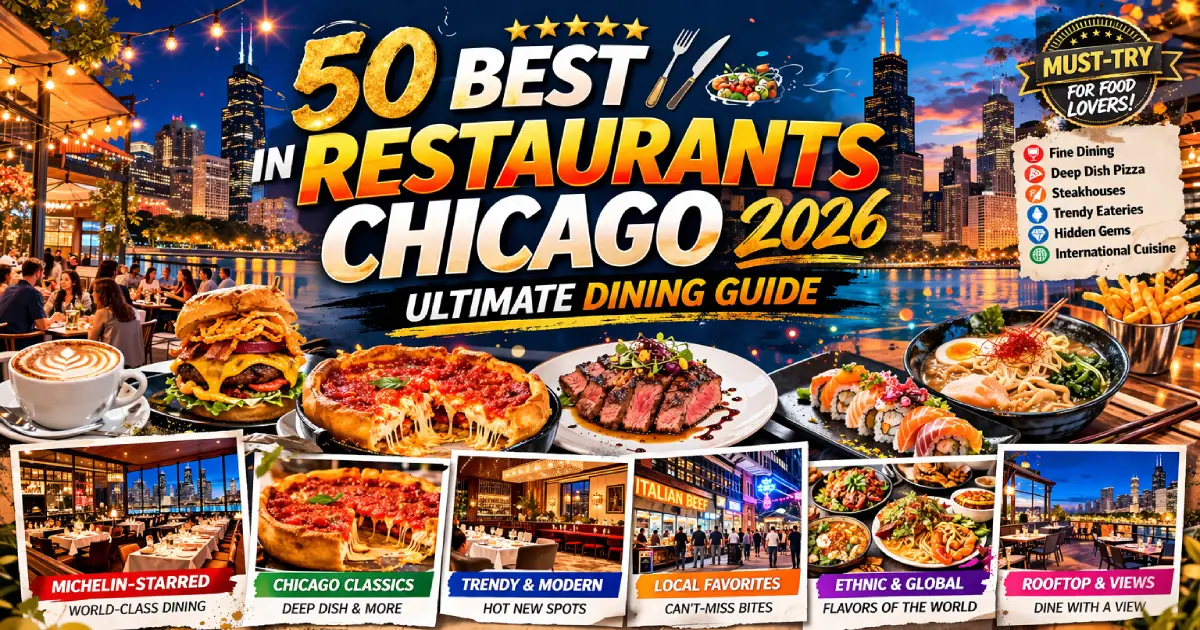
50 Best Restaurants in Chicago 2026: Ultimate Dining Guide
Published on : 21 Mar 2026
Best Restaurants in Chicago — From the World’s Most Innovative Fine Dining to the Perfect $5 Hot Dog
By Travel Tourister | Updated March 2026
Chicago’s restaurant scene is the most complete in America — a city where Grant Achatz’s Alinea delivers the most technically ambitious tasting menu on earth in the same city where the Maxwell Street hot dog has been grilled over charcoal since before Prohibition, where the Fulton Market District’s James Beard Award-nominated kitchens serve within walking distance of the Italian beef stand that invented its own food category in 1938, where Pilsen’s Mexican restaurants feed the community that built the neighborhood with preparations that carry no concessions to American taste preferences, and where the deep-dish pizza invented in 1943 is still being perfected at Lou Malnati’s in a buttered cast-iron pan that hasn’t changed its essential function since the day it was first used. No American city offers this range — from the world’s most technically sophisticated restaurant to the world’s most specific hot dog preparation — at this geographic density and this democratic accessibility.
I’ve eaten my way through Chicago across dozens of visits — the Alinea balloon dessert and the Vienna Beef hot dog from Gene & Jude’s in River Grove on the same day, the Sunday brunch at The Publican and the carnitas tacos at Birrieria Zaragoza in Pilsen on the same weekend, the tasting menu at Smyth and the Chicago-style deep-dish at Pequod’s in the same week. Each meal confirmed the same truth: Chicago’s finest restaurants are as likely to be a 30-seat West Loop tasting menu room as an 80-year-old Italian beef counter on Taylor Street, and the visitor who limits their dining to the Magnificent Mile hotel restaurants and the tourist-facing deep-dish chains has missed both the city’s most extraordinary culinary achievement and its most genuinely Chicago culinary soul.
This comprehensive 2026 guide covers Chicago’s 50 best restaurants using verified information from Michelin Guide Chicago, James Beard Foundation awards and nominations, years of on-the-ground dining expertise, and honest assessments of what delivers genuinely memorable meals. We organize restaurants by category — Michelin and fine dining, iconic Chicago food, neighborhood gems, global cuisines, pizza institutions, cocktail bars and late night, and budget essentials — with realistic costs, reservation guidance, and strategic advice for eating brilliantly across Chicago’s full extraordinary range.
Whether planning an Alinea anniversary dinner, a Fulton Market food crawl through The Publican and Girl & the Goat, a deep-dish pizza pilgrimage to Lou Malnati’s and Pequod’s, a Pilsen neighborhood taco tour, or a budget week eating Chicago’s iconic street foods at legendary prices, this guide gives you the honest intelligence to eat extraordinarily well in America’s most complete food city.
1. Alinea (Lincoln Park) — THE WORLD’S MOST INNOVATIVE RESTAURANT
Why It’s Essential: Grant Achatz’s Alinea has held three Michelin stars since the guide’s Chicago debut and has been named the best restaurant in North America on multiple occasions — a progressive tasting menu of 18–22 courses that treats cooking as a form of art, memory, and performance simultaneously. The dishes arrive without plates (painted directly on the table), as edible helium balloons, as fragrant smoke-filled pillows, and as courses that reconstruct smell, texture, and taste in combinations unavailable at any other restaurant on earth. Alinea is not the most comfortable fine dining experience in Chicago. It is the most extraordinary creative statement made through food anywhere in the world.
What to Expect:
The experience: 2.5–3.5 hours, 18–22 courses, no à la carte — the tasting menu is the only option and it changes entirely with each season
The Gallery (most creative format): A communal room with a single long table where dishes are presented on the table surface rather than on plates — the most immersive Alinea experience
The Salon (most intimate): A 12-seat room with service designed for groups — the quietest and most personalized Alinea format
The kitchen table: Watching Achatz’s kitchen from a table inside the preparation space — the most behind-the-scenes experience
The balloon dessert: An edible helium balloon of green apple taffy — the single dish most associated with Alinea and with Grant Achatz’s creative vision
Reservations: Tock (alinearestaurant.com); tickets purchased in advance like concert tickets, not traditional reservations; release dates announced on social media — book 4–8 weeks ahead for standard seating; specific Gallery and kitchen table dates sell out within hours of release
Cost: $235–$395/person depending on format and day; beverage pairings $85–$175 additional
2. Ever (West Loop) — Three Michelin Stars
Why Exceptional: Curtis Duffy’s West Loop tasting menu restaurant holds three Michelin stars — Duffy’s cooking (deeply influenced by his mentors Charlie Trotter and Grant Achatz, developed over decades at Avenues and Grace) is the most technically precise and most emotionally honest tasting menu in Chicago outside Alinea. The 10–12 course progression through seasonal Midwestern ingredients demonstrates a kitchen of extraordinary restraint and craft.
10–12 course tasting menu: $285–$325/person — the most precise cooking in Chicago outside Alinea
Vegetarian tasting menu: Available with advance notice — the finest all-vegetable tasting menu in Chicago
The beverage program: Among the finest wine and non-alcoholic pairing programs at any Chicago fine dining restaurant
John Shields and Karen Urie Shields’s West Loop tasting menu restaurant — the most farm-rooted Michelin-starred cooking in Chicago, with the kitchen maintaining deep relationships with specific Midwestern farms and foragers that determine the menu entirely based on what arrives each morning
The dining room above The Loyalist (their casual burger bar below): Two restaurants stacked in one building — the finest tasting menu in Chicago above one of the finest burgers in Chicago
8–10 course tasting menu: $195–$225/person — the most ingredient-honest fine dining in Chicago
Noah Sandoval’s West Loop tasting menu restaurant — a hidden-entrance fine dining room in the Fulton Market area delivering 12–16 courses of Pacific Northwest and Midwest-influenced cooking in an intimate 28-seat setting of extraordinary warmth and technical accomplishment
Hidden entrance: Oriole’s entrance is an unmarked door on a service alley — part of the restaurant’s commitment to a specific sense of discovery and intimacy
12–16 course tasting menu: $215–$265/person; the service-to-guest ratio is the finest at any Chicago tasting menu restaurant
5. Spiaggia (Magnificent Mile) — One Michelin Star
The Italian institution on Chicago’s Magnificent Mile — the most formally accomplished Italian restaurant in Chicago, with a career that helped define the Italian fine dining template in America and a current team maintaining standards of extraordinary consistency
House-made pastas: The kitchen’s primary strength — fresh pasta rolled daily, exceptional ragù preparations, the finest pasta dining in Chicago outside the Fulton Market district
Lake Michigan view dining room: The corner table overlooks Oak Street Beach and Lake Michigan — the finest restaurant view in Chicago proper
Sam Plotnick and Duncan Biddulph’s Wicker Park tasting menu restaurant — the most accessible in price among Chicago’s Michelin-starred tasting menu restaurants, serving 10–12 courses of American seasonal cooking in a 20-seat room of genuine intimacy and genuine technical ambition
10–12 courses: $145–$175/person — the most approachable entry to Chicago’s Michelin tasting menu experience
7. Lou Malnati’s Pizzeria (Multiple Locations) — BEST DEEP DISH
Why Lou Malnati’s Is the Standard: Chicago deep-dish pizza — invented at Pizzeria Uno in 1943, perfected at Lou Malnati’s in 1971 — is a specific food experience that exists in authentic form only in Chicago. The deep-dish is not a thick pizza; it is a pizza baked in a buttered cast-iron pan with the cheese directly on the crust, the toppings on the cheese, and the chunky tomato sauce on top — the inverse of every other pizza on earth. Lou Malnati’s Malnati Chicago Style (sausage, dough, mozzarella, tomato sauce) is the standard against which all deep-dish is measured. Every Chicagoan has a heated opinion about this. The truth is that Lou Malnati’s is the most consistent and most celebrated deep-dish operation in the city.
What to Order:
Malnati Chicago Style: Sausage, mozzarella, tomato sauce — the benchmark deep-dish preparation, non-negotiable as first order ($22–$28 for small, serves 2)
Lou’s salad: The house salad dressed with sweet basil vinaigrette — order while the pizza bakes ($8–$12)
Wait time: 45–60 minutes for the pizza to bake — this is the minimum, it cannot be shortened; order beer and the salad immediately
Thin crust option: If you need a comparison point, order one thin crust alongside the deep-dish — Malnati’s thin crust is also excellent
Best locations for visitors: River North (1120 N. State Street) most convenient downtown; Wrigleyville (958 W. Wrightwood) most atmospheric
Cost: $22–$35/pizza (serves 2–4); loumalnatis.com; walk-in friendly, reservations available
8. Pequod’s Pizza (Lincoln Park / Morton Grove)
The deep-dish alternative — Pequod’s caramelized cheese crust deep-dish is technically a different preparation from Lou Malnati’s (the cheese caramelizes around the outside of the pan, creating a crispy, charred crust ring) and has a devoted following that considers it superior
The caramelized crust: Cheese pressed against the pan wall, caramelizing during the bake to create a crispy, deeply savory ring that distinguishes Pequod’s from every other deep-dish operation
Lincoln Park location (2207 N. Clybourn): The original — a neighborhood bar and pizza operation that has been feeding Lincoln Park since 1971
Cost: $20–$32/pizza; walk-in only (no reservations); waits of 30–60 minutes are common at the Lincoln Park location on weekends
9. Al’s #1 Italian Beef (Taylor Street) — HISTORIC INSTITUTION
Why It’s Irreplaceable: Al Ferrari opened his Italian beef stand on Taylor Street in 1938 — and the original Taylor Street location is the birthplace of the Italian beef sandwich, the Chicago food category that rivals the deep-dish for civic identity. Thin-sliced beef, slow-braised in Italian seasoning broth, piled on a Turano roll, “dipped” in the cooking broth (the sandwich submerged briefly), with sweet or hot giardiniera — this preparation was invented at this specific location on this specific street and has never been substantially improved anywhere else.
Italian beef sandwich, dipped: Order it “dipped” (briefly submerged in the cooking broth), “hot” (hot giardiniera) — the canonical Al’s order ($9–$12)
The combo sandwich: Italian beef and Italian sausage on the same roll — the most filling version, the local lunch standard ($12–$15)
Standing room only: Al’s Taylor Street is counter service, standing, no seats — the most authentic beef experience in Chicago
Multiple locations: The Taylor Street original is the pilgrimage; all locations serve the same sandwich
Cost: $9–$15; walk-in; 1079 W. Taylor Street (original), Little Italy
10. Portillo’s (Multiple Locations)
The Chicago institution that is simultaneously a fast-food chain and a legitimate food destination — Portillo’s serves the Chicago-style hot dog (Vienna Beef on a poppy seed bun with the full seven-ingredient garnish), the Italian beef, and a chocolate cake shake that has developed an independent cult following in multiple countries
Chicago-style hot dog: The definitive accessible version — Vienna Beef, poppy seed bun, yellow mustard, white onion, neon green relish, dill pickle, tomato, sport peppers, celery salt ($4–$5)
Chocolate cake shake: Chocolate cake blended into a vanilla shake — the single most ordered Portillo’s item by non-locals who discover it ($6–$7)
Italian beef: The most accessible Italian beef in downtown Chicago — “dipped and hot” is the correct order
Cost: $8–$18/person; walk-in; multiple downtown and suburban locations; portillos.com
11. Gene & Jude’s (River Grove — 20 Minutes West)
The most purist Chicago-style hot dog experience in Greater Chicago — a 1946 River Grove operation serving Vienna Beef hot dogs with a specific short list of toppings (mustard, onion, relish, sport peppers — no tomato, no celery salt, no pickle) in a cash-only, no-ketchup, no-seat operation that has been unchanged for 75 years
The hot dog: $3.50 — Vienna Beef, steamed bun, mustard, onion, relish, sport peppers, french fries directly on the hot dog in the paper wrapper. Not a mistake. The fries go in the wrapper. This is Gene & Jude’s.
The attitude: Cash only, no ketchup, no modifications, no seats, no apologies — the most Chicago dining experience available in the western suburbs
Cost: $3.50/hot dog; cash only; 2720 N. River Road, River Grove; worth every mile
12. Giordano’s (Multiple Locations)
The stuffed deep-dish alternative — Giordano’s serves the “stuffed pizza” format (a layer of dough, a layer of fillings, a second layer of dough, tomato sauce on top) that is technically distinct from the standard deep-dish but equally Chicago and equally specific to this city
The stuffed pizza: Even more filling than standard deep-dish — the cheese and toppings are enclosed between two layers of dough, creating a pie of extraordinary depth
Cost: $22–$35/pizza; giordanos.com; multiple locations including Millennium Park area
13. Superdawg Drive-In (Northwest Side)
The 1948 carhop drive-in with Maurie and Flaurie — the giant hot dog characters on the roof in eternal flexing poses — serving Chicago-style hot dogs to carhop customers who call in from their cars at Narishanya and Milwaukee Avenues on the Northwest Side. The most atmospheric Chicago hot dog experience available anywhere.
The Superdawg: Vienna Beef hot dog in a Superdawg-branded poppy seed bun, in a box with crinkle fries, $7–$9 — the complete Superdawg experience that has been available since 1948
Carhop service: Order from the car, food delivered to your window — the most nostalgic food service format in Chicago, year-round
Cost: $7–$12/person; 6363 N. Milwaukee Avenue; open daily until midnight (weekends later)
Fulton Market & West Loop Restaurants
14. The Publican (West Loop) — MUST EAT
Why Essential: Paul Kahan’s West Loop oyster bar and beer hall is the restaurant that launched Fulton Market’s transformation into Chicago’s most exciting dining district and remains its most beloved institution — a long communal dining room of reclaimed wood and brick light, serving oysters, charcuterie, and whole-animal preparations alongside an extraordinary Belgian and craft beer list in a setting that is simultaneously formal in its ingredient commitment and entirely casual in its energy. The Sunday brunch is one of the finest meals in Chicago at any price.
Raw oyster selection: A rotating selection of Gulf Coast and East Coast oysters — the most carefully considered oyster program at any Chicago restaurant ($3.50–$4.50 each)
House charcuterie: The kitchen’s most celebrated preparation — terrines, rillettes, and cured meats of extraordinary quality, the foundation of the Publican meal ($20–$28)
Sunday brunch: The most celebrated brunch in West Loop — pork rinds with apple butter, house-made pastries, and whole-animal preparations at brunch pricing ($40–$65/person)
Belgian beer selection: The most comprehensive Belgian beer program in a Chicago restaurant setting
Reservations: OpenTable; 2–3 weeks ahead for weekend dinner; Cost: $60–$95/person
15. Girl & the Goat (West Loop)
Stephanie Izard’s James Beard Award-winning West Loop restaurant — the restaurant that established Izard as the most beloved chef in Chicago and remains the city’s most reliably excellent large-format sharing plates operation
Wood-roasted pig face: The most famous single dish in Chicago’s current restaurant scene — pork face, sunny side egg, pickled cherry peppers ($18–$22)
Sautéed green beans with fish sauce, cashews, and Thai basil: The vegetable dish that redefined vegetable side dishes in Chicago ($14–$16)
Reservations: OpenTable; 3–4 weeks ahead for prime-time weekend; Cost: $60–$95/person
16. Avec (West Loop)
Kahan’s Mediterranean-inflected West Loop wine bar — the 48-seat communal dining room that helped define Chicago’s small plates and natural wine aesthetic for the 2000s and 2010s, and remains one of the finest Mediterranean-focused casual restaurants in the city
Chorizo-stuffed medjool dates: The dish that launched a trend — wrapped in bacon, smoked paprika tomato sauce, the Avec signature since day one ($14–$16)
Communal seating: Long communal wood tables — the Avec format is dinner party rather than private dining; embrace or avoid based on preference
Reservations: OpenTable; walk-ins welcomed at the bar; Cost: $50–$80/person
17. Green Street Smoked Meats (West Loop)
The finest barbecue restaurant in Chicago proper — a West Loop operation serving wood-smoked brisket, pulled pork, and ribs of genuine Texas barbecue quality in the most barbecue-competitive neighborhood in the city
Brisket: The house standard — post-oak smoked, excellent bark, a fat cap that renders properly during the smoke ($20–$26/lb)
Hot links: The house sausage, made in-house — the finest Chicago smoked sausage at any restaurant in the West Loop
Cost: $25–$45/person; walk-in; 112 N. Green Street
18. Randolph Street Restaurant Row
The single block of Randolph Street between Halsted and Ogden contains more James Beard Award nominations per city block than any other street in Chicago — Blackbird (the restaurant that launched the West Loop dining scene in 1997), Bellemore, Proxi, and a rotation of celebrated concepts in a continuous expression of Chicago’s most ambitious restaurant neighborhood
Proxi (565 W. Randolph): Andrew Zimmerman’s global small plates concept — the most internationally diverse menu on Randolph Street, with preparations drawing from Southeast Asia, North Africa, and Latin America
Cost varies by restaurant: $55–$100/person at the block’s celebrated restaurants
Neighborhood Gems & Chef-Driven Restaurants
19. Big Star (Wicker Park) — MUST EAT
Why Essential: Paul Kahan’s Wicker Park taco bar is the most beloved casual restaurant in Chicago — a Mexican-inspired operation serving outstanding tacos (pork belly carnitas, smoked chicken, pork al pastor), exceptional frozen margaritas, and an extraordinary whiskey list in a honky-tonk bar setting with a covered outdoor patio that is the finest casual outdoor dining in Wicker Park. Big Star is where Chicago’s food industry workers eat on their nights off. That is the most reliable recommendation available.
Carnitas taco: Pork belly braised and crisped, corn tortilla, pickled jalapeños, cilantro, crema — the house standard, the finest carnitas taco in Chicago ($4–$5)
Pork al pastor: The al pastor taco from a trompo — rotating on the spit above the open kitchen, the most theatrical preparation ($4–$5)
Frozen margarita: The most celebrated frozen margarita in Chicago — fresh lime, quality tequila, a machine that has been perfected over years ($10–$12)
Whiskey selection: 400+ whiskeys — the taco bar with the most serious whiskey program in Wicker Park
Cost: $20–$40/person; walk-in only (no reservations); 1531 N. Damen Avenue, Wicker Park; open late
20. Hopleaf Bar (Andersonville)
The finest Belgian beer bar in Chicago — a 50+ Belgian beer program (draft and bottle), excellent moules frites, and the most reliably excellent casual dining in Andersonville in a warm, brick-walled neighborhood bar that has been the anchor of the Clark Street corridor since 1992
Moules frites: Mussels in multiple preparation styles (natural, cream and bacon, Roquefort) — the house signature, excellent with any of the Belgian ales ($22–$28)
Belgian beer list: The most comprehensive Belgian beer selection at any Chicago bar — Trappist ales, lambics, Flemish red ales, and saisons from the finest Belgian producers
Reservations: OpenTable for the dining room; walk-in bar seating; Cost: $35–$60/person
21. Lula Cafe (Logan Square)
The original farm-to-table restaurant in Chicago — Jason Hammel’s Logan Square café has been the reference point for seasonal, local, vegetable-forward cooking in Chicago since 1999, pioneering relationships with Illinois farms that the city’s finest restaurants now take as standard practice
Rotating seasonal menu: Changes entirely with each season and often with each week — the most ingredient-responsive menu in Chicago at casual restaurant pricing
Farm dinner (bimonthly): The ticketed farm dinner series where Hammel hosts dinners celebrating specific Illinois farms — the finest farm dinner series available in Chicago ($95–$125/person)
Reservations: OpenTable; Cost: $45–$70/person
22. Longman & Eagle (Logan Square)
The Michelin-starred gastropub that proved Logan Square was a serious dining neighborhood — whiskey bar, James Beard-nominated kitchen, and six rooms above the bar for overnight guests create the most complete neighborhood bar experience in Chicago
Wild boar sloppy joe: The dish that defined Longman & Eagle’s menu identity — house-ground boar, brioche bun, pickled cucumber ($16–$18)
Whiskey selection: 300+ whiskeys — the most comprehensive whiskey program at any Chicago gastropub
Reservations: OpenTable for dinner; walk-in brunch; Cost: $45–$75/person
23. Bristol (Bucktown)
Chris Pandel’s Bucktown neighborhood restaurant — a wood-fire kitchen serving seasonal American comfort food of genuine technical quality, the most reliably excellent mid-price neighborhood restaurant on the North Side
Wood-roasted half chicken: The house protein — butter-basted, wood-fired, served with seasonal accompaniments; the most ordered dish at Bristol for years ($28–$34)
Brunch: The most popular Bristol meal — wood-fired egg preparations, house pastries, and the neighborhood’s finest Bloody Mary
Reservations: OpenTable; Cost: $50–$80/person
24. Mindy’s Hot Chocolate (Bucktown)
Mindy Segal’s Bucktown dessert-focused restaurant — the James Beard Award winner whose restaurant centers the meal on pastry and dessert rather than treating them as afterthoughts, with a savory menu of genuine quality supporting a dessert program of extraordinary ambition
Hot chocolate: The house beverage that names the restaurant — a genuinely extraordinary hot chocolate program with multiple intensities and seasonal flavors ($8–$12)
Dessert tasting menu: The most ambitious pastry-focused menu in Chicago — 4–6 dessert courses from one of the finest pastry minds in American cooking
Why It’s the Most Authentic Mexican Restaurant in Chicago: The Zaragoza family’s weekend-only birria restaurant in the Pilsen/Archer Heights area is the finest Mexican food in Chicago — a family operation serving goat birria (slow-cooked in an adobo of dried chiles) that has been unchanged since the family brought the recipe from Jalisco, to a clientele of Chicago’s Mexican community that accepts no substitutes and no accommodations to non-Mexican taste preferences.
Goat birria: Slow-cooked goat in a complex dried chile adobo — the benchmark preparation in Chicago, served with handmade corn tortillas, cilantro, white onion, and house-made salsa ($14–$18)
Weekend only: Saturday and Sunday only (10 AM until sold out, typically by 1–2 PM) — arrive by 10:30 AM for guaranteed birria
No English menu concessions: The menu is in Spanish; the clientele is the Jalisco immigrant community of Chicago’s Southwest Side
Cost: $14–$22/person; 4852 S. Pulaski Road; cash only; Saturday and Sunday only
26. San Soo Gab San (Ravenswood)
The finest Korean barbecue restaurant in Chicago — a Ravenswood institution serving all-you-can-eat KBBQ to a clientele of Chicago’s Korean community, with charcoal grill tables, exceptional banchan (side dishes), and a quality of marinated short rib (galbi) that sets the standard for Chicago KBBQ
Galbi (short rib): Marinated and charcoal-grilled tableside — the house standard, the finest KBBQ cut in Chicago
All-you-can-eat format: $30–$40/person for the full KBBQ experience — the most efficient way to eat at San Soo Gab San
Cost: $30–$40/person; walk-in; 5247 N. Western Avenue, Ravenswood
27. Fat Rice (Logan Square)
Abraham Conlon and Adrienne Lo’s Logan Square restaurant celebrating the cuisine of Macau — the former Portuguese colony at the mouth of the Pearl River Delta, where Chinese, Portuguese, African, and Goan culinary traditions merged over 500 years into one of the world’s most distinctive regional cuisines
Arroz gordo (fat rice): The restaurant-naming dish — rice cooked in a clay pot with chicken, pork, clams, chorizo, and preserved vegetables, the most complex single preparation in the Fat Rice repertoire ($22–$28)
Piri piri chicken: The Portuguese-African chile preparation applied to a properly roasted half-chicken — the most beloved protein at Fat Rice
Reservations: OpenTable; Cost: $50–$80/person
28. Sushi Dokku (West Loop)
The finest sushi restaurant in Chicago — a West Loop operation serving Edomae-influenced nigiri of genuine technical quality, with the most carefully sourced fish from Japanese and domestic fisheries at any Chicago sushi restaurant
Omakase: $95–$145/person for the chef’s nigiri progression — the finest traditional sushi experience in Chicago
Signature rolls: The menu’s most accessible entry point — combinations of exceptional quality despite the non-traditional format
The finest Ethiopian restaurant in Chicago — an Uptown institution serving injera-based Ethiopian stews (wats and tibsi) in the traditional communal format, with the most flavorful berbere-spiced preparations available in Chicago’s Edgewater-Uptown Ethiopian corridor
Lamb tibs: Sautéed lamb with jalapeños, rosemary, and onion — the house favorite for meat preparations ($22–$26)
Vegetarian combination: The Ethiopian vegetarian tradition at its most complete — misir (lentils), gomen (collard greens), and tikel gomen (cabbage) over injera ($18–$22)
Reservations: OpenTable; Cost: $30–$50/person
30. Lao Sze Chuan (Chinatown)
The most celebrated Sichuan restaurant in Chicago — Tony Hu’s Chinatown flagship delivering the numbing-spicy Sichuan peppercorn cuisine of Chengdu with the full heat profile that the cuisine was designed to deliver, to a clientele of the Chicago Chinese community that expects and receives the genuine article
Ma po tofu: The silken tofu in the ground pork and Sichuan peppercorn sauce — the most famous Sichuan dish, the Lao Sze Chuan version is the benchmark in Chicago ($14–$18)
Dan dan noodles: Sesame paste, ground pork, Sichuan peppercorn — the Chengdu street food classic ($13–$16)
Reservations: OpenTable; Cost: $30–$55/person
Brunch & Breakfast Restaurants
31. The Bongo Room (Wicker Park / South Loop)
Chicago’s most beloved brunch destination — a Wicker Park institution serving inventive pancakes (brown butter and caramelized banana, dark chocolate and espresso), excellent egg preparations, and the most photographed brunch plates in the city to a weekend line that forms before the 9 AM opening
Brown butter caramelized banana pancakes: The house signature — the pancake that built the Bongo Room’s reputation and continues to justify the weekend wait
No reservations: Walk-in only; weekend waits 30–60 minutes; arrive at 9 AM for minimal wait
Cost: $15–$24/person; 1470 N. Milwaukee Avenue, Wicker Park; Saturday–Sunday brunch only
32. Jam (Logan Square)
Logan Square’s most creative brunch restaurant — a small café serving the most inventive egg and pancake preparations in the neighborhood, with a menu that changes seasonally based on what the kitchen wants to explore rather than what is conventionally expected at brunch
Ricotta pancakes with seasonal compote: The house signature pancake — lighter than conventional pancakes, seasonal fruit accompaniment, excellent every season
The Chicago brunch chain that originated the “frushi” concept (fruit sushi, fresh fruit rolled in sticky rice and cut into brunch-sized pieces) — a reliable and genuinely cheerful brunch operation with multiple Chicago locations and a menu of creative egg preparations at honest prices
Green eggs and ham: Green eggs (chive-spiked) and quality ham — the menu’s most fun preparation, consistently excellent
Cost: $16–$26/person; multiple Chicago locations; walk-in; weekend waits 30–45 minutes
Budget Dining & Street Food
34. Jim’s Original (Near West Side)
The Maxwell Street tradition since 1939 — Jim’s Original at the corner of South Union and West Maxwell Street is the surviving anchor of the Maxwell Street food culture, serving the Maxwell Street Polish (a grilled kielbasa on a bun with grilled onions and yellow mustard) and pork chop sandwiches 24 hours a day, every day
Maxwell Street Polish: Grilled kielbasa, French roll, grilled onions, yellow mustard — $7–$8, the most historically significant sandwich in Chicago
Pork chop sandwich: A bone-in pork chop on a roll — the street food innovation that distinguished Maxwell Street from every other Chicago street food tradition
Cost: $7–$12; 1250 S. Union Avenue; open 24 hours; cash only
35. Johnnie’s Beef (Elmwood Park — 20 Minutes West)
The most beloved Italian beef stand in the western suburbs — a 1960s Elmwood Park operation that produces the finest Italian beef in the Greater Chicago area, according to a specific subset of Italian beef devotees who have been making the pilgrimage since the restaurant opened
Italian beef, dipped and hot: The canonical Johnnie’s order — the beef is sliced thin in-house, the broth is maintained continuously, and the hot giardiniera is made to house specifications ($9–$12)
The strawberry Italian ice: The contrast to the beef — Italian ice in the tradition of the Italian-American West Side, the only possible dessert after Johnnie’s beef
Cost: $9–$15; 7500 W. North Avenue, Elmwood Park; walk-in; worth the drive
36. Kuma’s Corner (Avondale)
The heavy metal burger bar that became a Chicago institution — Kuma’s Corner in Avondale serves 16 signature burgers named after heavy metal bands (Mastodon, Slayer, Neurosis) with toppings of creative and caloric excess in a bar that plays metal at the volume it was meant to be played
Neurosis: 10-oz burger with braised short rib, red wine reduction, gruyère, arugula — the house showpiece ($18–$22)
Wait times: 1–2 hour waits on weekend evenings are common — arrive at 5 PM opening for immediate seating
Cost: $18–$26/person; 2900 W. Belmont Avenue, Avondale; walk-in only
37. Honey Butter Fried Chicken (Avondale)
The finest fried chicken restaurant in Chicago — Christine Cikowski and Josh Kulp’s Avondale operation has been the definitive Chicago fried chicken destination since 2013, serving pasture-raised, properly brined, properly fried chicken with honey butter that makes the case for what fried chicken can be when taken seriously
Fried chicken sandwich: The house standard — properly fried thigh, honey butter, house pickles, brioche bun ($14–$16)
Sides: The seasonal vegetable sides are as carefully considered as the chicken — the most vegetable-serious fried chicken restaurant in Chicago
Cost: $18–$30/person; 3361 N. Elston Avenue, Avondale; walk-in friendly
Pizza Beyond Deep Dish
38. Piece Brewery and Pizzeria (Wicker Park)
The New Haven-style thin crust pizza that provides the most interesting alternative to Chicago deep-dish — a Wicker Park brewery and pizzeria serving white clam pizza, tomato sauce-less preparations, and the coal-fired thin crust that the New Haven tradition (Pepe’s, Sally’s) established as one of America’s finest regional pizza styles
White clam pizza: Fresh clams, olive oil, garlic, fresh herbs on thin crust — the most celebrated non-standard pizza in Chicago ($20–$26)
House-brewed beer: The brewery produces some of the finest house beers at any Chicago pizza restaurant — the brewery is as serious as the kitchen
Cost: $25–$45/person; 1927 W. North Avenue, Wicker Park
39. Spacca Napoli (Ravenswood)
The most technically authentic Neapolitan pizza in Chicago — Jonathan Goldsmith’s Ravenswood pizzeria uses a wood-fired Stefano Ferrara oven imported from Naples, certified Neapolitan flour and San Marzano tomatoes, and bufala mozzarella brought in from Campania, producing the only pizza in Chicago that would be recognizable in Naples as genuinely Neapolitan
Margherita: The benchmark — San Marzano tomato, bufala mozzarella, fresh basil, the simplest test of the kitchen’s Neapolitan technique ($18–$22)
Reservations: OpenTable; Cost: $35–$60/person
40. Coalfire Pizza (West Town)
The coal-fired thin crust pizza that demonstrated Chicago could do thin crust as seriously as deep dish — a West Town operation using a coal-fired oven to produce a blistered, crispy-charred crust that rivals the best of New York or New Haven styles in a Chicago context
Margherita with fresh basil: The house standard — the coal fire produces a heat intensity that gas ovens cannot replicate
Cost: $20–$40/person; 1321 W. Grand Avenue, West Town
Cocktail Bars & Late Night Dining
41. The Violet Hour (Wicker Park)
The most historically significant cocktail bar in Chicago — a Wicker Park institution that, along with The Aviary, has defined Chicago’s cocktail culture for 15 years, with a menu of seasonally rotating house originals and pre-Prohibition classics in a distinctive no-signage entrance (look for the giant mural of the building) that has been a Wicker Park landmark since 2007
The seasonal menu: 12–15 house cocktails rotating entirely with the season — the most chef-driven cocktail menu in Chicago
No cell phones policy: The most enforced element of the Violet Hour experience — the phone-free atmosphere is genuine and consistent
Cost: $15–$20/cocktail; 1520 N. Damen Avenue, Wicker Park; walk-in; open until 2 AM
42. The Aviary (West Loop)
Grant Achatz and Nick Kokonas’s cocktail bar — the Alinea team’s approach to cocktails produces drinks of the same conceptual ambition as the restaurant’s food: drinks served in hand-blown glass spheres, drinks evolving during the 20 minutes of consumption, drinks incorporating liquid nitrogen and unexpected aromatics. The most technically ambitious cocktail program in America.
The cocktail experience: Not a “have a drink” visit but a designed sensory experience — budget 2 hours, order the full tasting menu of cocktails ($20–$35 each)
Walk-in only: No reservations for most seating; The Office (the private speakeasy below The Aviary) requires advance booking
Cost: $20–$35/cocktail; 955 W. Fulton Market, West Loop; open nightly
43. Delilah’s (Lincoln Park)
The finest whiskey bar-as-dive-bar in Chicago — 400+ whiskeys, punk rock on the jukebox, a photo booth, and the specific energy of a bar that has been entirely itself since 1993 without a single concession to trend, neighborhood change, or the expectations of people who wandered in from the Magnificent Mile
The whiskey list: 400+ bottles organized by region and style — the staff knowledge is genuine and the selection is the most personally curated at any Chicago bar
Cost: $6–$25/drink depending on whiskey; 2771 N. Lincoln Avenue; open until 2 AM (4 AM weekends)
44. The Green Mill (Uptown)
Already described in the Places section — worth emphasizing as a drinking destination independent of the jazz: the Champagne Velvet on draft, the Old Fashioneds, and the Art Deco bar of Al Capone’s favorite speakeasy form one of the finest bar experiences in America, available every night from 7 PM to 4 AM
Champagne Velvet: The pre-Prohibition American pilsner that is the house draft — the correct beer to drink in this room
Cost: $5–$12/drink; $6–$15 cover on jazz nights; 4802 N. Broadway, Uptown
Special Occasion & Unique Dining
45. The Loyalist (below Smyth, West Loop)
The basement burger bar below the two-Michelin-star Smyth — the most technically perfect burger in Chicago, served in a dark, low-ceilinged room that is the most atmospheric dining space in the West Loop
The Loyalist cheeseburger: House-ground beef, American cheese, pickles, secret sauce on a sesame bun — $18, the finest burger in Chicago by general consensus among the city’s food professionals
Reservations: No reservations — walk-in only; often an hour wait on weekend evenings; arrive at 5:30 PM opening
Cost: $18–$30/person; 177 N. Ada Street, West Loop; dinner only
46. Monteverde (West Loop)
Sarah Grueneberg’s Italian restaurant in the West Loop — the James Beard Award winner whose pasta program is the finest in Chicago, with an approach to regional Italian cooking that draws from the full range of the country’s pasta traditions rather than limiting to a single regional style
Cacio e pepe: Tonnarelli, Pecorino Romano, black pepper — the Roman classic, the finest version in Chicago ($22–$26)
Agnolotti del plin: The Piedmontese pinched pasta with braised filling — the most technically demanding pasta at Monteverde, consistently excellent
The most theatrical fine dining steakhouse in Chicago — a Gold Coast wood-fire operation producing steaks, whole fish, and rotisserie preparations of extraordinary quality in a room of genuine glamour, with a celebrity clientele and a “I Don’t Give a F*ck” tasting menu option (the kitchen sends its best work without a predetermined menu, $165/person)
Wood-fired prime tomahawk: The house showpiece — a 40-oz bone-in ribeye, wood-fire roasted, carved tableside ($120–$145)
The IDGAF menu: $165/person for the kitchen’s choice — the most theatrical tasting menu experience at a Chicago steakhouse
Rick Bayless’s fine dining Mexican restaurant — the only upscale Mexican restaurant in America to hold a Michelin star, serving regional Mexican cuisine of extraordinary depth and historical scholarship in a River North setting adjacent to the more casual Frontera Grill
Mole tasting: Multiple preparations of the complex Mexican chile-based sauce — the most comprehensive mole menu at any US restaurant
Rick Bayless’s casual Mexican restaurant — the James Beard Outstanding Restaurant winner serving regional Mexican food of genuine academic seriousness at casual restaurant prices, adjacent to the Michelin-starred Topolobampo
Tlayuda: The Oaxacan flatbread preparation — the Frontera version demonstrates Bayless’s commitment to regional authenticity at accessible pricing
Weekend brunch: The Frontera brunch is among the finest Mexican brunch available in the United States — huevos rancheros, chilaquiles, and tamales of genuine quality
Reservations: OpenTable; Cost: $40–$65/person
50. Arun’s (Northwest Side)
The finest Thai restaurant in Chicago — Arun Sampanthavivat’s Northwest Side restaurant has been the standard for refined Thai cuisine in the Midwest since 1985, with a 12-course prix-fixe tasting menu that treats Thai culinary tradition with the same reverence that Chicago’s finest French restaurants bring to their cuisines
12-course prix-fixe: $89/person — the most comprehensive Thai tasting menu available at any US restaurant outside New York, representing the full range of Thai regional cooking traditions
Alinea: Tock, purchase tickets 4–8 weeks ahead; specific formats sell out within hours of release — follow social media for release announcements. Ever and Smyth: Tock, 4–6 weeks ahead. Oriole: Tock, 5–6 weeks ahead. Temporis: Tock, 3–4 weeks. Girl & the Goat: OpenTable, 3–4 weeks ahead for weekend prime-time. The Publican: OpenTable, 2–3 weeks. Big Star, The Loyalist, Superdawg: Walk-in only. Chicago Restaurant Week (February and September): Book immediately upon announcement — the most celebrated restaurants fill within 24–48 hours.
Deep Dish Strategy
Deep-dish pizza takes 45–60 minutes to bake — order immediately upon seating, then salad and beer while waiting. Lou Malnati’s for consistency; Pequod’s for the caramelized crust; Giordano’s for the stuffed format. Do not order deep-dish at tourist-facing restaurants near Navy Pier or on the Magnificent Mile hotel strip — quality is significantly lower. The three serious deep-dish comparisons are Lou Malnati’s, Pequod’s, and Giordano’s; all other choices are secondary.
Chicago Restaurant Week
Chicago Restaurant Week occurs twice annually — typically the last two weeks of February and late September. 400+ restaurants offer prix-fixe menus at $25 (lunch), $30 (brunch), and $45–$55 (dinner), providing access to Alinea, Ever, Smyth, and the city’s finest restaurants at 40–60% of normal pricing. Book on the first day of announcement — celebrated restaurants fill within 24–48 hours. choosechicago.com announces the specific dates each year; set calendar alerts for the announcement.
Best Dining Neighborhoods
West Loop/Fulton Market: The Publican, Girl & the Goat, Smyth, Oriole, Avec, Green Street Smoked Meats — highest concentration of celebrated restaurants per block in Chicago. Wicker Park: Big Star, Violet Hour, Piece, Myopic Books café — finest casual dining. Logan Square: Lula Cafe, Longman & Eagle, Fat Rice, Jam — the neighborhood that most rewards extended exploration. Andersonville: Hopleaf, Svea — the most neighborhood-feeling dining strip. Pilsen: Birrieria Zaragoza — the most authentic Mexican food in Chicago.
Tipping
20% standard at sit-down restaurants. 22–25% at Michelin and fine dining (Alinea, Ever, Smyth, Oriole). 18–20% at casual restaurants (Big Star, The Publican bar). Street food and counter service: $1–$2 tip jar appreciated. Chicago’s restaurant workforce is expensive to live near — tip generously. Note: Some Chicago fine dining restaurants have moved to a no-tip service charge model (included in the ticket/menu price) — check individual restaurant websites.
Italian Beef Strategy
Order Italian beef “dipped” (the sandwich briefly submerged in the cooking broth), “hot” (hot giardiniera), and “combo” if you want sausage alongside. The three canonical options: Al’s Beef Taylor Street (the original, 1938), Portillo’s (most accessible downtown), Johnnie’s Beef Elmwood Park (the suburban pilgrimage). Never eat Italian beef at a tourist restaurant — quality drops precipitously; the genuine article requires the specific restaurant, not the category name on a menu.
Frequently Asked Questions: Best Restaurants in Chicago
What is the most famous restaurant in Chicago?
Alinea is the most internationally famous restaurant in Chicago and arguably the most acclaimed restaurant in America — three Michelin stars, multiple years as the top-ranked restaurant in North America on the World’s 50 Best list, and a 20-year commitment to progressive cuisine that has influenced every fine dining kitchen in the country. Lou Malnati’s is the most famous Chicago restaurant among Chicagoans themselves — the standard of deep-dish pizza that residents debate, defend, and order on their birthdays. Al’s Beef on Taylor Street is the most historically significant — the birthplace of the Italian beef sandwich, operating since 1938 at the same location. All three are “most famous” in different and equally valid senses of Chicago’s food identity.
What food is Chicago most famous for?
Chicago’s food identity rests on four pillars: (1) Deep-dish pizza — invented at Pizzeria Uno in 1943, the cast-iron pan pizza with cheese on the bottom and chunky tomato sauce on top is the most Chicago-specific food preparation and exists in authentic form only here; (2) The Chicago-style hot dog — an all-beef frankfurter on a poppy seed bun with seven specific ingredients (yellow mustard, white onion, neon green relish, pickle spear, tomato, sport peppers, celery salt — never ketchup); (3) The Italian beef sandwich — thin-sliced braised beef on a Turano roll, dipped in the cooking broth, invented at Al’s Beef on Taylor Street in 1938; (4) Michelin-starred fine dining — Chicago has the most Michelin-starred restaurants per capita of any American city, led by Alinea’s three stars and a constellation of one- and two-star kitchens that make it the most ambitious fine dining city in the American Midwest. The combination of street food authenticity and fine dining ambition is available in no other American city in this specific configuration.
Where do Chicago locals actually eat?
Locals eat at Big Star on their casual Tuesday nights (walk-in, carnitas tacos and frozen margaritas). They eat at The Loyalist burger when the Smyth tasting menu upstairs is beyond the week’s budget. They eat at Birrieria Zaragoza on Saturday mornings when the goat birria is worth the drive to Archer Heights. They eat at Gene & Jude’s on a Sunday afternoon when only the Maxwell Street Polish will do. They eat at Lula Cafe in Logan Square when the seasonal menu is worth photographing. They debate Lou Malnati’s vs. Pequod’s vs. Giordano’s as a civic ritual rather than a food decision. The common thread: neighborhood restaurants and food institutions that have been specifically, reliably, and authentically themselves for years — Big Star, Hopleaf, Lula Cafe, Longman & Eagle, Jim’s Original — rather than restaurants designed for visitors.
Is Chicago a good food city?
Chicago is the most complete food city in America — a city where the most technically ambitious restaurant in the world (Alinea) coexists with the most historically significant hot dog stand (Gene & Jude’s, 1946), where the finest Italian restaurant (Spiaggia) serves in the same neighborhood as the Polish-American Maxwell Street food tradition, where Rick Bayless’s Michelin-starred Topolobampo brings scholarly attention to Mexican regional cuisine in the same building as the casual Frontera Grill, and where the West Loop’s Fulton Market District contains more James Beard Award nominations per block than any other street in America. Chicago is the city that takes every food category seriously — the deep-dish is studied as carefully as the tasting menu, the Italian beef is as historically considered as the Michelin-starred pasta — and the result is a food culture of extraordinary depth and democratic range that is genuinely unlike any other in America.
What is the best cheap eat in Chicago?
The Chicago-style hot dog at Gene & Jude’s ($3.50, with fries in the wrapper) is the finest cheap eat per dollar in Greater Chicago — 75 years of preparation refinement for $3.50 represents a value-to-quality ratio unavailable anywhere else. Within Chicago proper: the carnitas taco at Big Star ($4–$5) is the finest taco value in the city. The Maxwell Street Polish at Jim’s Original ($7–$8) is the finest open-24-hours cheap eat. The Italian beef at Portillo’s ($8–$10, “dipped and hot”) is the most accessible good cheap sandwich in downtown Chicago. And the deep-dish at Lou Malnati’s ($22–$28 for a small pizza feeding two) is the finest inexpensive shared meal available anywhere in Chicago — $11–$14 per person for the most celebrated pizza in America represents extraordinary value at any price tier.
What is unique to Chicago’s food culture that you can’t find elsewhere?
Several Chicago food experiences are genuinely singular: (1) The Italian beef sandwich “dipped and hot” — invented at Al’s Beef Taylor Street in 1938, this preparation (beef in cooking broth, giardiniera) is available in authentic form only in Chicago and its immediate suburbs; (2) Chicago-style deep-dish in a buttered cast-iron pan from Lou Malnati’s or Pequod’s — the specific construction (cheese on bottom, sauce on top) is available elsewhere by name but not in authentic quality outside the city; (3) The Chicago-style hot dog with the specific seven-ingredient garnish that includes sport peppers and neon green relish — the preparation is so specific that it has developed a local enforcement culture (never ketchup) unavailable at any other regional food tradition; (4) Alinea’s Gallery format — the communal dining room where food is painted, built, and served directly on the table surface — a dining experience available only at this specific restaurant; (5) The Violet Hour’s no-cell-phones cocktail experience in its specific unmarked-entrance Wicker Park room — a piece of intentional hospitality design that cannot be replicated elsewhere.
Final Thoughts: Eating Chicago’s Full Range
After dozens of Chicago meals spanning the Alinea balloon dessert and the Gene & Jude’s Maxwell Street Polish, the Publican Sunday brunch and the Birrieria Zaragoza Saturday morning birria, the Girl & the Goat wood-roasted pig face and the Big Star carnitas taco — three principles emerge for eating brilliantly in America’s most complete food city:
1. Chicago’s food culture is defined by the coexistence of extraordinary ambition and extraordinary democracy — and both deserve equal respect. The visitor who eats at Alinea but skips the Italian beef at Al’s Taylor Street has eaten at the world’s most innovative restaurant but missed the dish that is as specifically and irreplaceably Chicago as the deep-dish or the hot dog. The visitor who eats Italian beef and deep-dish but avoids the West Loop tasting menu restaurants has eaten Chicago’s civic food identity but missed the extraordinary fine dining achievement that makes Chicago unique among American cities for restaurants at the highest level. Chicago’s food culture demands the full range — from Gene & Jude’s to Alinea, from Big Star’s carnitas to Smyth’s tasting menu — because the city built both with equal seriousness and both represent it with equal authenticity.
2. The deep-dish pizza is not a gimmick for tourists — it is a specific and genuinely extraordinary food preparation that exists in authentic form only in Chicago, and the decision about which restaurant to eat it at matters enormously. The tourist-facing deep-dish restaurants near Navy Pier and on the Magnificent Mile hotel strip produce an approximation of the genuine article. Lou Malnati’s, Pequod’s, and Giordano’s produce the actual thing — and the difference is significant enough that visiting Chicago and eating tourist-facing deep-dish rather than driving or taking the ‘L’ to a proper deep-dish institution is the equivalent of visiting Paris and eating a pre-packaged croissant from a train station rather than walking two blocks to a proper boulangerie. The deep-dish takes 45–60 minutes to bake. Order immediately. Wait with beer and the house salad. The wait is the preparation for the pizza; the pizza is worth the wait.
3. Big Star on a walk-in Tuesday night is the best $30 meal in Chicago — and the food industry workers eating carnitas tacos and frozen margaritas at the communal tables know it better than any food publication. Paul Kahan’s Wicker Park taco bar is where Chicago’s restaurant workers eat on their nights off, and the food industry’s off-night destination is the most reliable indicator of genuine quality available in any city’s dining ecosystem. The carnitas taco is $4–$5. The frozen margarita is $10. The whiskey list is 400 bottles deep. The outdoor patio is covered. The Big Star experience — tacos, margaritas, the honky-tonk soundtrack, the Wicker Park crowd, the 11 PM energy of a bar that is genuinely having the time it appears to be having — costs approximately $35 per person and delivers more of Chicago’s essential character than most $100 dinners. Find a walk-in Tuesday. Go to Big Star. Order carnitas and a margarita. This is also Chicago. This is also the best of Chicago. The two are not in conflict.
Chicago’s restaurants in 2026 are the expression of a city that has taken food seriously for as long as it has taken architecture seriously — which is to say, since the moment the city decided to rebuild itself after 1871, it decided to build something worth eating in as well. The result is a food culture of extraordinary depth, democratic range, and genuine ambition that is not adequately described by “deep-dish pizza and Italian beef” or by “Michelin stars and James Beard Awards.” It is described by the full arc — from Gene & Jude’s to Alinea, from Birrieria Zaragoza to The Publican — and the arc is worth eating in its entirety.
For current restaurant listings, Michelin star updates, and Chicago dining news, consult Michelin Guide Chicago, Eater Chicago for current openings and reviews, and Chicago Magazine Dining for the definitive local restaurant criticism.
—
—
About Travel TouristerTravel Tourister’s Chicago specialists provide honest restaurant recommendations based on extensive dining across every neighborhood, price tier, and cuisine category the city offers — from Alinea’s edible helium balloon to the Maxwell Street Polish at Jim’s Original at 2 AM, from Big Star’s carnitas tacos to Birrieria Zaragoza’s goat birria on Saturday mornings. We understand Chicago’s food culture demands the full range and rewards visitors who engage it without hierarchy.Need help planning your Chicago dining itinerary? Contact our specialists who can recommend optimal neighborhood restaurant clusters, Alinea ticket release strategies, Chicago Restaurant Week booking timing, deep-dish pizza decisions, Italian beef pilgrimage planning, and budget-to-Michelin dining combinations for any visit length or culinary interest. We help travelers eat the full Chicago — from Gene & Jude’s to Ever.
Posted By : Vinay
As a lead contributor for Travel Tourister, Vinay is dedicated to serving our Tier 1 audience (US, UK, Canada, Australia). His mission is to deliver precise, fact-checked news and actionable, data-driven articles that empower readers to make informed decisions, minimize travel risks, and maximize their adventure without compromising safety or budget.
Travel Tourister is a leading Travel portal where we introduce travellers to trusted travel agents to make their journey hasselfree, memorable And happy. Travel Tourister is a platform where travellers get Tour packages ,Hotel packages deals through trusted travel companies And hoteliers who are working with us across the world. We always try to find new and more travel agents and hoteliers from every nook and corners across the world so that you could compare the deals with different travel agents and hoteliers and book your tour or hotel with the one you have chosen according to your taste and budget.




 Call
Call Enquiry