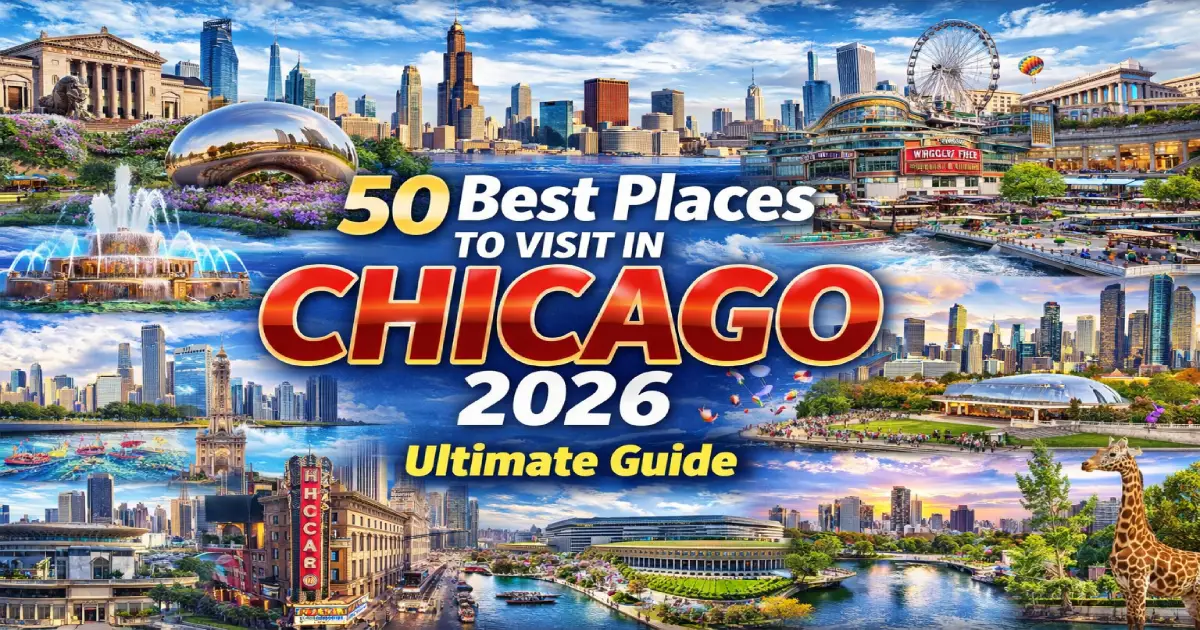
50 Best Places to Visit in Chicago 2026: Ultimate Guide
Published on : 21 Mar 2026
Places to Visit in Chicago — From World-Famous Landmarks to Hidden Neighborhood Gems
By Travel Tourister | Updated March 2026
Chicago’s places to visit span a range that consistently overwhelms and delights in equal measure — from Cloud Gate’s distorted reflections of the world’s most significant urban skyline to the Green Mill’s unbroken jazz tradition since 1907, from the Art Institute’s Seurat and Hopper to the Rothko-adjacent silence of the Chicago Cultural Center’s Tiffany domes (free, always), from Wrigley Field’s ivy-covered walls and hand-operated scoreboard to the Pilsen neighborhood’s 16th Street murals, which represent the most politically and artistically significant public art in the Midwest, from the Museum of Science and Industry’s captured German U-boat to the 606 Trail’s elevated perspective on the city’s finest Northwest Side neighborhoods. No American city of Chicago’s size distributes extraordinary places more democratically across its geography — the finest places in Chicago are in Hyde Park and Pilsen and Bronzeville and Andersonville as surely as they are in the Loop and River North, and the visitor who travels only between the Bean and Navy Pier has seen the city’s most photographed elements and missed its most essential character.
I’ve built a mental geography of Chicago’s best places across years of visits spanning every neighborhood, every season, and every cultural tradition the city contains — the Chicago Cultural Center on a January Tuesday morning when the Tiffany dome is the only thing visible above the snow-covered Millennium Park, the Green Mill on a Sunday night when the Jazz Orchestra fills Al Capone’s old speakeasy with the specific sound that this specific room has been producing since 1907, Frank Lloyd Wright’s Robie House in Hyde Park when the October light enters the Prairie Style windows at exactly the angle Wright calculated in 1910, the Maxwell Street Market on a Sunday morning in the Near West Side where the Polish sausage vendor has been occupying the same corner since before the expressway was built, and Wrigley Field on a September afternoon when the ivy is still green and the pennant race is alive and the bleacher crowd is exactly who the bleacher crowd has always been. Each visit confirmed that Chicago’s best places are available to anyone who looks for them — and that looking requires the willingness to take the ‘L’ into neighborhoods that the tourist maps mark only lightly.
This comprehensive 2026 guide covers Chicago’s 50 best places using verified information from Choose Chicago, years of neighborhood expertise, and honest assessments of which places deliver genuinely memorable experiences. We organize places by category — iconic landmarks, museums and cultural institutions, neighborhoods and districts, outdoor and lakefront places, music and entertainment venues, food destination places, hidden gems, and day trip destinations — with realistic visit times, costs, and strategic advice for building a Chicago itinerary that captures the full city.
Whether visiting for 48 hours or two weeks, for the first time or the tenth, this guide provides the honest, experience-backed intelligence to find Chicago’s best places — the ones that reveal why this city, for all its cold and its wind and its architectural ambition, is the most complete American city, and why people who leave it can never entirely stop thinking about it.
Chicago Places by Category
Category
Top Places
Best Area
Cost Range
Iconic Landmarks
Millennium Park, Art Institute, Willis Tower
The Loop, Grant Park
Free–$32
Museums & Culture
Field Museum, Shedd Aquarium, Chicago Cultural Center
Museum Campus, The Loop
Free–$40
Neighborhoods
Wicker Park, Pilsen, Bronzeville, Logan Square
Citywide
Free to explore
Outdoor & Lakefront
Chicago Riverwalk, Lincoln Park, Navy Pier
Lake Michigan shoreline
Free–$20
Music & Entertainment
Green Mill, Wrigley Field, Second City, Symphony Center
Uptown, Wrigleyville, Old Town, Loop
$6–$175
Hidden Gems
606 Trail, Robie House, Maxwell Street Market
Logan Square, Hyde Park, Near West Side
Free–$20
Iconic Landmarks & Must-See Places
1. Millennium Park — THE BEST FREE PLACE IN CHICAGO
Why It’s Essential: Millennium Park is the finest urban park built in any American city in the 21st century — 24.5 acres in the heart of Chicago containing Anish Kapoor’s Cloud Gate (the “Bean”), Jaume Plensa’s Crown Fountain, Frank Gehry’s Jay Pritzker Pavilion, and the Lurie Garden, all available free every day of the year. The Bean’s polished steel surface reflects the Chicago skyline in 110 tons of distorted, curved mirror — producing an endlessly variable image of the city that is simultaneously a world-famous artwork, a public gathering point, and a free photography destination that has been photographed more than any other public sculpture in America. Nothing in Chicago is more universally essential or more completely free.
Best Places Within Millennium Park:
Cloud Gate (The Bean): Anish Kapoor’s 110-ton polished stainless steel sculpture — walk beneath the “omphalos” arch, look up into the curved surface, and photograph the Chicago skyline in its distorted reflection. Best photographed at dawn (8 AM) before crowds form ($0)
Crown Fountain: Two 50-foot LED glass brick towers projecting the faces of 1,000 Chicago residents with water cascading in summer — the most democratic piece of public art in Chicago, featuring ordinary Chicagoans as the subject ($0)
Jay Pritzker Pavilion (Frank Gehry): The outdoor band shell hosting free Chicago Symphony Orchestra summer concerts — the steel ribbons of the bandshell frame the skyline behind the stage in a composition that is simultaneously architectural achievement and acoustic engineering ($0 lawn; assigned seating for some events)
Lurie Garden: 2.5 acres of native perennials — the most ecologically ambitious garden in the Chicago park system, free always, at its most beautiful in June–September bloom
McCormick Tribune Ice Rink (winter): Free skating on the rink in the shadow of Cloud Gate — bring skates or rent at the adjacent booth ($13 rental); open November–March
Cost: FREE always; open daily 6 AM–11 PM; 201 E. Randolph Street, The Loop
Best time: Dawn for Cloud Gate photography; summer evenings for Pritzker Pavilion concerts; winter for ice skating
2. The Chicago River and Riverwalk
Why It’s the Heart of Chicago: The Chicago River — the waterway that was reversed in 1900 to flow away from Lake Michigan rather than into it (one of the greatest engineering achievements of the 19th century) — is the spine of Chicago’s architectural achievement. The 1.25-mile Riverwalk along its south bank from Lake Shore Drive to Lake Street is the finest urban waterfront promenade in any American inland city, completed in 2016, with the building facades of the world’s most significant architectural corridor visible at water level from every point.
The Riverwalk promenade: Walk the full 1.25 miles from Lake Shore Drive to Lake Street — the architectural sequence from the Art Deco Tribune Tower to the modernist 333 W. Wacker Drive to the contemporary Aqua Tower is the finest continuous building tour accessible on foot in America
Kayak and paddleboard rental: Chicago Riverwalk Kayak at the Wacker Drive dock — paddle through the building canyon at water level, the most intimate architectural experience in Chicago ($25–$35/hour)
Riverwalk restaurants and bars (May–October): The Riverwalk’s seasonal food and drink operations transform it from a promenade into a social destination — the finest outdoor dining in downtown Chicago
The river at night: The buildings illuminated from below, the draw bridges lit, the water reflecting the glass towers — the most photographically dramatic version of Chicago’s architecture
Cost: FREE promenade; kayak $25–$35/hour; open year-round (restaurants seasonal)
3. The Art Institute of Chicago
Why One of America’s Great Places: The Art Institute of Chicago is one of the three finest art museums in the United States — housing Georges Seurat’s A Sunday on La Grande Jatte (the most technically analyzed painting in American collections), Grant Wood’s American Gothic, Edward Hopper’s Nighthawks, and one of the finest Impressionist collections outside Paris, all within an 1893 Beaux-Arts building that is itself one of Chicago’s finest architectural landmarks. The two bronze lion sculptures flanking the Michigan Avenue entrance have been one of Chicago’s most recognizable landmarks since 1894.
A Sunday on La Grande Jatte (Georges Seurat, 1886): The pointillist masterpiece — 6 feet tall, 10 feet wide, composed of millions of individual paint dots, the painting that defined Neo-Impressionism and inspired Sunday in the Park with George
Nighthawks (Edward Hopper, 1942): The most evocative painting of American urban loneliness — the diner, the four figures, the empty street outside — genuinely smaller than most visitors expect
Thorne Miniature Rooms: 68 rooms at 1:12 scale representing European and American interiors from medieval through 20th century — the most unexpectedly fascinating exhibit in the museum, requiring 30+ minutes that most visitors don’t budget
Modern Wing (Renzo Piano, 2009): The addition housing the museum’s 20th-century collection — the Griffin Court’s natural light management and the Nichols Bridgeway footbridge to Millennium Park are architectural achievements worth seeing independently
Cost: $25/adult, free for Illinois residents; free Thursday evenings; closed Tuesday; artic.edu
Time needed: 3–5 hours minimum; the museum is too large for complete coverage in a single day
4. Willis Tower Skydeck
The 103rd floor of the Willis Tower (1973 — the world’s tallest building from 1973 to 1998) — a 360-degree view of four states simultaneously (Illinois, Michigan, Indiana, Wisconsin) from 1,353 feet, delivered through floor-to-ceiling windows and The Ledge: four glass boxes extending 4.3 feet beyond the building’s face at 1,353 feet, with nothing beneath except Chicago
The Ledge: Standing on glass 1,353 feet above the city with only the glass between you and the street requires courage of a specific and memorable kind — the single most vertigo-inducing free experience (included with admission) in Chicago
Best time: Clear days, weekday mornings before 11 AM for shortest queues; sunset for city lights activation
Cost: $30–$32/adult, $22–$24/child; book at theskydeck.com; 233 S. Wacker Drive, The Loop
5. Chicago Cultural Center
Why It’s Chicago’s Most Undervisited Essential Place: The Chicago Cultural Center — the 1897 Beaux-Arts former main Chicago Public Library on Michigan Avenue — contains the two most spectacular Tiffany stained glass domes in the world: the Preston Bradley Hall dome (38 feet in diameter, 30,000 pieces of Favrile glass assembled into the image of a Renaissance zodiac ceiling) and the G.A.R. Rotunda dome. Both are free to see, every day the building is open. The building also hosts free rotating art exhibitions and free Wednesday lunchtime concerts. It is one of the finest free architectural and cultural experiences in any American city, and it is visited by a fraction of the tourists who stand in line for the Bean 200 feet away.
Preston Bradley Hall dome: 38-foot diameter Tiffany mosaic dome — the most spectacular public interior in Chicago, free to enter and photograph
G.A.R. Rotunda dome: The second Tiffany dome — smaller but equally beautiful, with the military imagery of the Civil War veterans organization that commissioned it
Free Wednesday lunchtime concerts: Classical, jazz, and world music performances from 12:15–1 PM every Wednesday — the finest free midday cultural event in downtown Chicago
Rotating art exhibitions: Free Chicago-focused contemporary art throughout the year
Cost: FREE always; 78 E. Washington Street, The Loop; open Monday–Saturday 10 AM–7 PM
6. Navy Pier
Chicago’s most visited tourist destination — the 3,300-foot municipal pier extending into Lake Michigan, with the 200-foot Centennial Wheel (Ferris wheel), the Chicago Shakespeare Theater, the Chicago Children’s Museum, and the finest east-facing view of the Chicago skyline from open water available to pedestrians
The lakefront view from the pier’s east end: The full Chicago skyline from water level, with Navy Pier as the foreground — the most dramatic freely accessible skyline photograph in Chicago ($0)
Free Wednesday and Saturday summer fireworks: Memorial Day through Labor Day, 10-minute fireworks show over the lake — best viewed from the pier’s east end or from the Lakefront Trail immediately north of the pier
Chicago Shakespeare Theater: One of Chicago’s finest resident theater companies, performing in a 500-seat courtyard theater designed after Shakespeare’s Globe
Why It’s Chicago’s Finest Science Museum: The Field Museum is one of the world’s great natural history museums — housing Sue, the most complete and best-preserved Tyrannosaurus rex skeleton ever discovered (on permanent display in the Griffin Halls of Evolving Planet), an Egyptian exhibit with a genuine 5,000-year-old tomb walk-through, and the Grainger Hall of Gems. The 1920 neoclassical building on the Museum Campus is the most architecturally imposing museum in Chicago and one of the finest Beaux-Arts civic buildings in the United States.
Sue (Tyrannosaurus rex): 67 million years old, 40.5 feet long — the most complete T. rex ever found; the skull alone weighs 600 pounds; displayed in the Griffin Halls of Evolving Planet
Inside Ancient Egypt: A 5,000-year-old burial chamber transported from Egypt — actual tomb chambers that visitors walk through, the most immersive Egyptian experience in the Midwest
Grainger Hall of Gems: The finest public gem and mineral collection in the Midwest — meteorites, rare gems, and the geological history of the Earth
The building itself: The 1920 Greek Revival facade facing Lake Michigan is the finest Beaux-Arts civic building in Chicago — the architectural setting is as significant as the collection
Cost: $30/adult, $22/child; fieldmuseum.org; Museum Campus, 1400 S. DuSable Lake Shore Drive
8. Shedd Aquarium
One of the world’s finest inland aquariums — the John G. Shedd Aquarium houses beluga whales, Pacific white-sided dolphins, sea otters, and the Caribbean Reef tank (a 90,000-gallon circular tank with 500+ fish visible from all sides) in a 1929 Greek Revival building on the Museum Campus
Wild Reef: A Philippine coral reef recreation with 500+ Indo-Pacific species — the most immersive aquarium habitat in Chicago, with sharks swimming overhead through a glass tunnel
Beluga whale habitat: Year-round indoor habitat with an outdoor pool — the Shedd’s most famous residents, viewable year-round
Cost: $40/adult, $30/child; book at sheddaquarium.org; Museum Campus
9. Adler Planetarium
America’s first planetarium (1930) on the Museum Campus — digital dome shows, a significant historical collection of astronomical instruments, and the finest view of the Chicago skyline from any Museum Campus location (the Adler’s eastern terrace delivers the full Loop skyline across Monroe Harbor)
The terrace view: The most photographed lakefront skyline view in Chicago — accessible free from the Adler’s outdoor terrace without purchasing museum admission
Free Thursday evening telescope viewing: Public stargazing from the Adler’s terrace on clear Thursdays
Cost: $25/adult; terrace view free; adlerplanetarium.org; Museum Campus
10. Museum of Science and Industry (Hyde Park)
The finest science and industry museum in the United States — housed in the only surviving major building from the 1893 World’s Columbian Exposition, containing the captured German U-505 submarine (the most historically significant single museum object in Chicago), the Omnimax theater, and a coal mine simulation of extraordinary educational value
U-505 submarine: A WWII-era German submarine captured at sea in 1944 by the USS Guadalcanal task group — the only Type IXC submarine preserved outside Germany, displayed in a below-grade hall that preserves the feel of a submarine base
The building: The Palace of Fine Arts from the 1893 World’s Fair — the most historically significant building in Hyde Park and the only remaining major structure from the Exhibition
Cost: $23/adult, $14/child; msichicago.org; Hyde Park (6 miles from downtown on the Metra Electric Line)
11. DuSable Black History Museum and Education Center (Bronzeville)
The most important African American history museum in the Midwest — founded in 1961 by Dr. Margaret Burroughs in the Washington Park neighborhood, documenting the African American experience in Chicago from the Great Migration through the present, with a permanent collection of extraordinary primary significance
The Great Migration galleries: The definitive documentation of the 1910–1970 movement of 500,000 Black Americans from the South to Chicago — the cultural transformation that produced the Chicago blues, gospel music, and Bronzeville’s extraordinary literary and artistic tradition
Free Thursday and Sunday: The finest museum free days in Chicago outside the Art Institute’s Thursday evenings
Cost: $10/adult; free Thursday and Sunday; dusablemuseum.org; Washington Park neighborhood
12. National Museum of Mexican Art (Pilsen)
The finest Mexican and Chicano art museum in the United States — free always, located in Chicago’s most vibrant Mexican-American neighborhood, housing a permanent collection of 10,000+ works spanning pre-Columbian through contemporary Chicano art
The Permanent Collection: Pre-Columbian artifacts, colonial religious art, Mexican modernist painting (Diego Rivera, José Clemente Orozco), and contemporary Chicano art of national significance — all free
The museum’s neighborhood context: Visiting the museum as part of a Pilsen neighborhood walk (16th Street murals, Birrieria Zaragoza for birria) provides the most complete picture of Chicago’s Mexican-American cultural geography
Cost: FREE always; nationalmuseumofmexicanart.org; 1852 W. 19th Street, Pilsen
Neighborhood Places
13. Wicker Park and Bucktown
Why Essential: Wicker Park and Bucktown on Chicago’s Near Northwest Side constitute the city’s most vibrant creative district — the neighborhood where Nelson Algren wrote A Walk on the Wild Side, where the 1990s Chicago alternative music scene incubated the bands that moved to major labels, and where Milwaukee Avenue still contains the highest concentration of independently owned shops, bars, and restaurants per block of any Chicago corridor. The Rainbo Club, Myopic Books, Piece Brewery, and the Saturday farmers market create a neighborhood identity that 30 years of gentrification has pressure but not destroyed.
Milwaukee Avenue corridor (from Division to North Avenue): The 1-mile corridor that defines Wicker Park — vintage stores, independent boutiques, music venues, and restaurants in a continuous commercial streetscape of remarkable quality
The Rainbo Club (1150 N. Damen): The neighborhood dive bar since 1947 — cheap Old Style beer, pool tables, the genuine Wicker Park soul; the bar where Nelson Algren drank and where the neighborhood’s literary identity continues
Myopic Books (1564 N. Milwaukee): Three floors of used and rare books — the finest used bookshop in Chicago, with a specialist knowledge of Chicago literature that makes it the most rewarding book shopping experience in the city
North Avenue and Damen: The intersection that anchors Bucktown’s finest restaurant concentration — Bristol, Mindy’s Hot Chocolate, and Big Star taco bar within a single block
Best time: Saturday afternoon through evening for full neighborhood energy; Sunday morning for the farmers market (May–October)
Getting there: Blue Line to Damen stop ($2.50)
Cost: Free to explore; budget $30–$70 for food, drinks, and shopping
14. Pilsen
Why It’s Chicago’s Most Culturally Rich Neighborhood: Pilsen on the Near Southwest Side is Chicago’s most vibrant Mexican-American neighborhood — a community that has maintained its cultural identity through decades of gentrification pressure, producing the finest concentration of large-scale mural art in the Midwest (the 16th Street corridor contains murals by internationally recognized Chicano artists), the National Museum of Mexican Art (free), and an independent restaurant scene of extraordinary authenticity.
16th Street mural corridor: Self-guided walk from Halsted to Western along 16th Street — murals by Chicano artists spanning multiple generations, from 1970s political murals to contemporary work of national recognition. The most significant public art in Chicago ($0)
National Museum of Mexican Art: Free, always — 10,000+ works of Mexican and Chicano art in the finest Mexican art institution in America
Birrieria Zaragoza (4852 S. Pulaski): The finest birria in Chicago — a family operation in the Little Village-Pilsen border area serving goat birria unchanged from the Jalisco recipe brought when the family immigrated ($12–$18)
Thalia Hall (1807 S. Allport): An 1893 Czech community hall converted into a music venue — the most architecturally beautiful mid-size music venue in Chicago
Getting there: Pink Line to 18th Street stop ($2.50)
Cost: Free to walk; museum free; budget $15–$35 for food
15. Bronzeville
The historic center of Chicago’s African American cultural life — the South Side neighborhood where the Great Migration built a civilization: the blues clubs of the Stroll (35th Street), the gospel churches of King Drive, the literary tradition of Gwendolyn Brooks and Richard Wright, the jazz venues where Louis Armstrong and Nat King Cole performed, and the political infrastructure that produced Harold Washington and shaped Barack Obama’s Chicago career
The Stroll (E. 35th Street): The historic entertainment corridor of the Great Migration era — the block where Louis Armstrong performed, where the Chicago blues was electrified, where 1920s–1940s Black Chicago built its cultural identity
Bronzeville Mural Arts: Large-scale murals documenting African American history along King Drive — a self-guided historical walk through the neighborhood’s documented past
Elmwood Cemetery and surrounding historic district: The Victorian cemetery where Chicago’s most significant African American citizens are buried — a landscape of extraordinary funerary sculpture and historical significance
Getting there: Green Line to 35th-Bronzeville-IIT stop
Cost: Free to explore
16. Andersonville
The former Swedish enclave on Chicago’s Far North Side — now one of the city’s finest neighborhood commercial strips, with excellent independent restaurants (Hopleaf Belgian beer bar, Svea for Swedish breakfast, La Paloma for Mexican), the Women & Children First feminist bookshop (since 1979), the Swedish American Museum, and the most genuinely LGBTQ-friendly neighborhood culture in Chicago
Clark Street corridor (5000–5700 blocks): 1 mile of independent restaurants, bars, and shops — the most walkable and most neighborhood-feeling commercial strip in Chicago
Women & Children First (5233 N. Clark): The most celebrated feminist bookshop in America — author events, excellent selection, the most politically engaged bookshop in Chicago
Hopleaf Bar (5148 N. Clark): The finest Belgian beer bar in Chicago — 50+ Belgian beers on draft and bottle, excellent mussels, the bar that defines Andersonville’s drinking culture
Getting there: Red Line to Berwyn stop ($2.50)
Cost: Free to explore; budget $25–$60 for food and drinks
17. Logan Square
Chicago’s most rapidly evolving neighborhood — the boulevards (Kedzie and Logan) lined with 1890s–1920s greystones, anchored by the most exciting restaurant and bar scene in Chicago, and bisected by the 606 Trail (the elevated linear park built on a former rail line)
Logan Square Boulevard (Logan Square to Kedzie): Daniel Burnham’s boulevard system at its finest — 100-foot-wide landscaped medians lined with mature elms and the finest 1890s–1920s residential architecture in the Northwest Side
The 606 Trail (Bloomingdale Trail): The elevated linear park connecting Logan Square, Wicker Park, and Humboldt Park — 2.7 miles of former rail line converted to parkland, with native plantings, art installations, and views into neighborhood rooftops unavailable from any street-level perspective
Logan Square Farmers Market (Sunday May–October): The neighborhood market that has become one of Chicago’s finest — local produce, excellent prepared food vendors, and the Logan Square creative community at its most accessible
Getting there: Blue Line to Logan Square stop ($2.50)
Cost: Free to explore; 606 Trail free; budget $25–$60 for dining
18. Hyde Park
The University of Chicago neighborhood on Chicago’s South Side — one of the most intellectually dense and architecturally significant neighborhoods in any American city, containing the Museum of Science and Industry, Frank Lloyd Wright’s Robie House, the Oriental Institute (free, world-class ancient Near East collection), the Smart Museum of Art (free), and the most significant bookshop district in Chicago (Seminary Co-op and Powell’s Used Books)
Robie House (Frank Lloyd Wright, 1910): The most important Prairie Style house in the world — $20 guided tours, the most significant work of residential architecture in America
Oriental Institute (free): The University of Chicago’s collection of ancient Egyptian, Mesopotamian, Persian, and Anatolian artifacts — one of the finest collections of ancient Near Eastern art at any US museum, free always
Seminary Co-op Bookstore: The finest academic bookshop in Chicago — a University of Chicago institution with the deepest scholarly selection in the city
Getting there: Metra Electric Line to 55th-56th-57th Street station ($3.75) or #6 Jackson Park Express bus
Cost: Free neighborhood; Robie House tour $20; Oriental Institute free; MSI $23
19. Chinatown
Chicago’s Chinatown on the South Side — one of the most intact and most community-rooted Chinese-American neighborhoods in America, with the Chinatown Square outdoor mall, authentic dim sum restaurants, an excellent range of Cantonese and Szechuan cooking, and the Chinatown Museum documenting the neighborhood’s 130-year history
Cermak and Wentworth intersection: The heart of Chinatown — the pagoda-roofed Chinatown Gate, the on-On Sun Company building (the oldest building in Chinatown, 1881), and the most concentrated restaurant and retail block in the neighborhood
Chinatown Bakery: Cantonese egg tarts, pineapple buns, and sesame balls from the neighborhood’s bakeries — the finest Chinese pastry experience in Chicago
Getting there: Red Line to Cermak-Chinatown stop ($2.50)
Cost: Free to explore; dim sum $20–$40/person
20. Boystown (Lakeview East)
The most historically significant LGBTQ neighborhood in the Midwest — the Halsted Street corridor from Belmont to Grace Street contains the greatest concentration of LGBTQ bars, restaurants, and community organizations in Chicago, producing the neighborhood energy that draws 1 million+ people to the Chicago Pride Parade every June
The Rainbow Pylons: 18 rainbow-colored steel pylons along Halsted Street from Belmont to Aldine — the most visible LGBTQ public art installation in Chicago
Sidetrack (3349 N. Halsted): The most celebrated LGBTQ bar in Chicago — video screens, themed nights, and the neighborhood anchor since 1982
Getting there: Red Line to Belmont stop ($2.50)
Cost: Free to explore; bars $5–$15/drink
Outdoor & Lakefront Places
21. Lincoln Park
Why It’s Chicago’s Most Essential Park: 1,208 acres of lakefront park on Chicago’s North Side — the Lincoln Park Zoo (free, one of the last major free urban zoos in America), the Lincoln Park Conservatory (free Victorian greenhouse), the Chicago History Museum, the Peggy Notebaert Nature Museum, the North Avenue Beach volleyball courts, the Diversey Harbor, and the finest continuous urban green space in Chicago. Lincoln Park is Chicago’s democratic gift to its North Side — free, always, for everyone.
Lincoln Park Zoo (free): One of the largest free metropolitan zoos in the world — 200+ species, excellent Great Ape House, African Journey, and the Kovler Lion House (the finest historic zoo building in Chicago), free every day of the year ($0)
Lincoln Park Conservatory (free): Four Victorian glass houses of tropical and temperate plants — the Palm House, Fern Room, Orchid House, and Show House, free daily, the finest free greenhouse experience in Chicago
North Avenue Beach: Chicago’s most popular beach — volleyball courts, beach house, cafe, and the most social lakefront energy of any Chicago beach in summer
Theater on the Lake (summer): The Chicago Park District’s free summer theater season — professional productions in the lakefront pavilion, free to most Chicago residents
Cost: FREE park; Zoo free; Conservatory free; Chicago History Museum $19
22. Grant Park and Museum Campus
Chicago’s “front yard” — 319 acres of lakefront park between Michigan Avenue and Lake Michigan, containing Millennium Park, Maggie Daley Park, the Museum Campus (Field Museum, Shedd Aquarium, Adler Planetarium), and Buckingham Fountain (the second-largest fountain in the world, free water and light show nightly in summer)
Buckingham Fountain: The 1927 Baroque Revival fountain — 1.5 million gallons of water, 133 jets, and a nightly colored light and water show from May through October ($0, runs every hour on the hour)
Museum Campus peninsula: The 57-acre lakefront campus connecting the Field Museum, Shedd Aquarium, and Adler Planetarium — the Adler’s terrace delivers the finest free skyline view in Chicago from land
Cost: FREE park; museums additional
23. Maggie Daley Park
The 20-acre park east of Millennium Park (connected via Frank Gehry’s BP Bridge) — the finest children’s activity park in Chicago, with a world-class climbing wall, the Park at Wrigley miniature golf course, an elaborate play garden, and the skating ribbon (November–March) that is the most distinctive winter outdoor activity in Chicago
Ice skating ribbon (November–March): A 606-foot winding ribbon through the park — $15 skate rental, the most photogenic winter outdoor activity in Chicago with the skyline as backdrop
Climbing wall (summer): Free with park admission — the longest artificial climbing wall in the Chicago park system
The 18-mile paved multi-use trail along the Lake Michigan shoreline from Ardmore Avenue to 71st Street — the finest urban waterfront trail in any American inland city, passing through 12 Chicago beaches, 6 harbors, and 4 major parks in a continuous public space that the city has protected from private development since 1836
The most democratic place in Chicago: 18 miles of publicly accessible lakefront, free to any person at any hour, with Lake Michigan stretching to the horizon in the east and the Chicago skyline rising behind in the west
Divvy bike-share stations throughout: $3.50/30 minutes — the most efficient way to cover the full trail length
Cost: FREE; Divvy bike $3.50/30 min; open year-round
Music & Entertainment Places
25. The Green Mill (Uptown) — THE MOST IMPORTANT CHICAGO PLACE
Why It’s Chicago’s Most Essential Single Place: The Green Mill Cocktail Lounge at 4802 N. Broadway in Uptown has been continuously open since 1907 — Al Capone’s favorite speakeasy during Prohibition, the birthplace of the American slam poetry movement in the 1980s, and the venue where the Chicago jazz tradition is maintained most authentically every night of the week. The Art Deco interior (curved mahogany bar, glass block windows, original light fixtures) has not changed materially since the 1930s. The Jazz Orchestra performs every Sunday from 8 PM. The bar is open daily from 7 PM to 4 AM. There is no more authentically continuous Chicago cultural place in existence.
Al Capone’s booth: The corner booth where Capone sat — still marked, still occupied on busy nights, still the most atmospheric seating in any Chicago bar
Sunday Jazz Orchestra (8 PM): The weekly big band showcase — $10 cover, the finest regular jazz event in Chicago
Uptown Poetry Slam (Sunday 7 PM, before jazz): The original American slam poetry event, still running at the venue that invented the format in 1986
Champagne Velvet on draft: The house beer — a pre-Prohibition-style American pilsner, the correct accompaniment to the music
Cost: $6–$15 cover depending on night; 4802 N. Broadway, Uptown; open daily 7 PM–4 AM
Getting there: Red Line to Lawrence stop ($2.50)
26. Wrigley Field (Wrigleyville)
Why It’s More Than a Ballpark: Wrigley Field (1914 — the second-oldest active baseball park in America) is the physical manifestation of Chicago’s North Side identity and the most atmospheric ballpark in America — the hand-operated scoreboard, the ivy-covered outfield walls (planted 1937 by Bill Veeck), the rooftop bleachers on Waveland and Sheffield Avenues, and the specific bleacher crowd culture that produced 108 years of philosophical defeat before the 2016 World Series championship that justified everything. No other building in Chicago more completely contains a specific community’s identity.
The ivy: Boston ivy and bittersweet covering the outfield brick walls — the most distinctive single feature of any ballpark in professional baseball, planted by Bill Veeck in 1937
The hand-operated scoreboard: The only manual scoreboard remaining in Major League Baseball — scores changed by hand by workers inside the scoreboard structure during games
Bleacher seats: The most democratic and most atmospheric seats — sun, wind, the outfield ivy directly in front, and the genuine Cubs faithful ($25–$45)
Wrigleyville before the game: The bar-dense neighborhood around the park — Murphy’s Bleachers (3655 N. Sheffield) and the Cubby Bear Lounge (1059 W. Addison) are the canonical pre-game institutions
Cost: $25–$200/ticket; mlb.com/cubs; 1060 W. Addison Street
Getting there: Red Line to Addison stop ($2.50) — the most satisfying transit arrival in Chicago sports
27. Symphony Center (Orchestra Hall)
The home of the Chicago Symphony Orchestra — one of the five finest orchestras in the world, performing in Orchestra Hall (1904, Daniel Burnham) on Michigan Avenue with the finest acoustics of any concert hall in the Midwest
Rush tickets: $35 at the box office after 10 AM on performance days — the finest performing arts value in Chicago, access to a world-class orchestra at a fraction of advance ticket pricing
The building: The 1904 Daniel Burnham-designed Michigan Avenue facade is one of the most significant Beaux-Arts buildings in Chicago
The most historically significant comedy institution in America — Second City has trained Bill Murray, John Belushi, Gilda Radner, Tina Fey, Stephen Colbert, and Steve Carell since 1959 in the improvisational comedy tradition that defines American comedy performance
The Mainstage show: The current ensemble’s full production — sketch and improv of the highest quality at 1616 N. Wells Street in Old Town ($28–$35)
Free Saturday midnight improv: The most affordable and often most spontaneous Second City experience — free following the paid Mainstage shows
Cost: $28–$35 Mainstage; free Saturday midnight late show; secondcity.com; Old Town
29. Buddy Guy’s Legends (South Loop)
The blues venue owned and operated by Buddy Guy — one of the last living masters of Chicago blues — at 700 S. Wabash Avenue in the South Loop, with nightly blues programming and Buddy Guy’s annual January residency (the most important blues event accessible from Chicago in any year)
Buddy Guy’s January residency: The most essential blues event in Chicago — the last surviving master of the Chicago blues tradition performing at his own venue, available only in January, to an audience that travels from around the world for the specific experience
Year-round programming: Nightly blues acts from 9 PM; food service throughout
Cost: $10–$25 cover; buddyguys.com; 700 S. Wabash Avenue, South Loop
30. Lyric Opera of Chicago (Civic Opera House)
One of America’s three most significant opera companies — the Lyric Opera of Chicago performs in the Civic Opera House (1929, Art Deco masterpiece on the Chicago River at Wacker Drive) with international casts and production values that rival the Metropolitan Opera
The Civic Opera House building itself: The 45-story Art Deco tower housing the opera house is one of Chicago’s finest buildings — the river-facing facade, the lobbies, and the auditorium are architectural landmarks independent of the performances
Rush tickets: Available at the box office on performance days — significantly discounted from advance pricing
Cost: $35–$175; lyricopera.org; 20 N. Wacker Drive
Hidden Gems & Local Favorites
31. The 606 Trail (Bloomingdale Trail)
Why It’s Chicago’s Most Distinctive Public Space: The 606 Trail — 2.7 miles of former elevated rail line converted to a linear park through Logan Square, Wicker Park, and Humboldt Park — is the finest urban trail built in Chicago this century and one of the most distinctive public spaces in any American city. From 17 feet above street level, the trail provides views into neighborhood rooftops, backyards, and community gardens that are available from no other perspective, alongside native plantings, public art installations, and the specific quiet of an elevated park above a functioning city.
Eastern terminus (Ashland and Bloomingdale): The Wicker Park entrance — the most scenic approach, immediately adjacent to the neighborhood’s finest bars and restaurants
Western terminus (N. Ridgeway): The Humboldt Park entrance — the quietest end, the most culturally specific neighborhood views
Art installations throughout: The 606’s commissioned art program produces consistently excellent site-specific works along the trail’s length
Night cycling: The trail is lit and popular for evening rides through summer
Cost: FREE; the606.org; multiple access points in Logan Square and Wicker Park
32. Frank Lloyd Wright’s Robie House (Hyde Park)
The 1910 masterpiece of the Prairie Style — Frederick C. Robie House on South Woodlawn Avenue in Hyde Park is the most important work of residential architecture in America, the building that established Frank Lloyd Wright’s international reputation and influenced every subsequent development in modern residential design
Guided tours: The only way to experience the interior — the horizontal emphasis, the cantilevered roof, the art glass windows, and the integration of interior and exterior space that define the Prairie Style at its most complete ($20/adult)
The exterior (free to view from the sidewalk): The most significant freely accessible architectural landmark in Hyde Park — the horizontal bands of Roman brick, the cantilevered rooflines, and the art glass windows visible from the street
Cost: $20/adult guided tour; exterior viewing free; flwright.org/robiehouse; 5757 S. Woodlawn Avenue, Hyde Park
33. Maxwell Street Market (Near West Side)
The Sunday open-air market descended from the legendary Maxwell Street Market (1912–1994) — one of the great American immigrant markets, the place where blues musicians played for quarters on the sidewalk and where every immigrant wave to Chicago sold its goods. The current Sunday market on Canal Street continues this tradition with food vendors, antique dealers, and the Polish sausage stand that has been the market’s most beloved institution since before most of its customers were born.
Polish sausage vendor: The market’s essential purchase — grilled kielbasa on a bun with grilled onions and yellow mustard, $5, available from 8 AM until sold out
Antique and vintage dealers: The finest Sunday outdoor antique market in Chicago — arrive early for the best selections
Sunday morning only, 7 AM–3 PM, year-round
Cost: FREE entry; 800 W. Maxwell Street, Near West Side; Sunday mornings only
34. Oriental Institute (Hyde Park)
The University of Chicago’s collection of ancient Egyptian, Mesopotamian, Persian, Anatolian, and Nubian artifacts — one of the finest collections of ancient Near Eastern art at any US museum, free always, containing objects of extraordinary rarity including the Megiddo Ivories, a 17-foot tall human-headed winged bull from the Khorsabad palace of Sargon II, and the most comprehensive Assyrian collection at any American museum
The Khorsabad Court: The massive stone lamassu (human-headed winged bull) from the 8th-century BC Assyrian palace — the most dramatic single object in the museum, 17 feet tall and 40,000 pounds
America’s finest independent research library — an 1893 Romanesque building on Washington Square Park in the Near North neighborhood, housing 1.5 million books and manuscripts of extraordinary rarity (first editions, medieval manuscripts, historical maps) in a free public reading room and a gallery with rotating free exhibitions of primary historical documents
Free public exhibitions: The Newberry’s first-floor gallery hosts rotating exhibitions of primary documents — letters, manuscripts, and maps from the collection available for public viewing without research credentials
Washington Square Park (adjacent): The neighborhood park known as Bughouse Square — historically the site of free-speech soapbox oratory, the most historically democratic outdoor space in Chicago
Cost: FREE exhibitions; newberry.org; 60 W. Walton Street; open Tuesday–Sunday
36. Garfield Park Conservatory
One of the largest and most magnificent public greenhouse complexes in the world — the 1907 Jens Jensen-designed Garfield Park Conservatory on Chicago’s West Side contains two acres of tropical plants under glass, with a Fern Room (one of the finest in any American greenhouse), a Palm House of extraordinary scale, and the most comprehensive cactus collection at any free public institution in Chicago
The Fern Room: The most atmospheric single greenhouse room in Chicago — 100-year-old tree ferns, hanging mosses, and a stream running through the Carboniferous forest recreation
Free always — one of the finest completely free architectural and horticultural experiences in Chicago
Cost: FREE; garfieldconservatory.org; 300 N. Central Park Avenue, Garfield Park; closed Monday–Tuesday
37. Graceland Cemetery
The finest Victorian cemetery in Chicago — a 119-acre landscape cemetery on the North Side containing the tombs and monuments of Chicago’s most significant architects, industrialists, and civic leaders, including Daniel Burnham, Louis Sullivan, Ludwig Mies van der Rohe, Marshall Field, Cyrus McCormick, and the Getty Tomb (Louis Sullivan’s masterwork of architectural ornament, 1890)
The Getty Tomb (Louis Sullivan, 1890): The most significant piece of architectural ornament in a Chicago cemetery — Sullivan’s Romanesque ornament at its peak, designed for the Carrie Eliza Getty mausoleum
Architecture walk: The cemetery contains tombs designed by nearly every significant Chicago architect of the 1890s–1930s — a self-guided architectural tour of extraordinary richness
Cost: FREE; open daily 8 AM–5 PM; 4001 N. Clark Street, Uptown
38. The Illinois Institute of Technology Campus (Bronzeville)
The Mies van der Rohe campus — Ludwig Mies van der Rohe designed the Illinois Institute of Technology campus between 1940 and 1968, producing the most concentrated collection of International Style modernist architecture in the United States, including Crown Hall (1956 — the most important single building of the International Style in America)
Crown Hall (SB Crown School of Architecture): The 1956 glass and steel pavilion — Mies’s most complete realization of the “universal space” concept, the single most important building of the International Style in the Western Hemisphere
Free campus: The IIT campus is open and freely walkable — Crown Hall and the surrounding buildings of the Mies campus can be explored without paying admission
Cost: FREE campus; Crown Hall and exterior viewing free; 3410 S. State Street, Bronzeville
Food Destination Places
39. The Publican (West Loop / Fulton Market)
Paul Kahan’s West Loop oyster bar and beer hall — the restaurant that launched the Fulton Market dining district and remains its most celebrated occupant, serving oysters, charcuterie, and whole-animal preparations in a communal dining room of extraordinary warmth and excellent beer selection
The Publican’s Sunday brunch: The finest brunch in the West Loop — house-cured charcuterie, oysters, and pork dishes of genuine technical ambition at brunch pricing
Cost: $65–$95/person; thepublicanrestaurant.com; 837 W. Fulton Market
40. Fulton Market District
Chicago’s most transformed neighborhood — the former meatpacking and produce district west of the Loop, now containing the most concentrated collection of ambitious restaurants in Chicago (The Publican, Girl & the Goat, Smyth, Green Street Smoked Meats), Google’s Chicago headquarters, and a density of culinary ambition that has made Fulton Market the most discussed dining destination in the Midwest
Randolph Street Restaurant Row: The block of Randolph Street between Halsted and Ogden contains more James Beard Award nominations per block than any other street in Chicago
Cost: Free to walk; dining $50–$120/person
41. Green City Market (Lincoln Park)
The finest farmers market in the Midwest — the chef’s market where Chicago’s best restaurants source seasonal produce, Wednesday and Saturday May–October in Lincoln Park, with cooking demonstrations by James Beard Award-nominated chefs and the most knowledgeable vendor-to-customer relationships at any Chicago market
Saturday morning cooking demos: Free demonstrations by the city’s finest chefs using market-sourced ingredients — the most accessible chef interaction available in Chicago
Cost: FREE entry; budget $20–$50 for produce and prepared food; Lincoln Park, Wednesday and Saturday (May–October)
Chicago Places: Practical Tips
Topic
What to Know
Transit Strategy
The CTA ‘L’ train is the most visitor-useful transit system in any American city outside New York — $2.50/ride, day pass $5. Red Line: O’Hare airport → Loop → Wrigleyville → Andersonville. Blue Line: Loop → Wicker Park → Logan Square. Pink Line: Loop → Pilsen. Green Line: Loop → Bronzeville. The ‘L’ Loop ride ($2.50) is the cheapest architectural tour in Chicago. Buy a Ventra card at any ‘L’ station or use the Ventra app.
Neighborhood Clustering
Group places geographically: Loop/Grant Park cluster (Millennium Park, Art Institute, Chicago Cultural Center, Chicago Riverwalk, Willis Tower); Museum Campus cluster (Field Museum, Shedd, Adler); North Side cluster (Lincoln Park Zoo, Wrigley Field, Andersonville, Green Mill); Northwest Side cluster (Wicker Park, Logan Square, 606 Trail); South Side cluster (Hyde Park, Bronzeville, Pilsen, Chinatown). Each cluster is a full day. Never attempt more than two clusters per day.
Free Places
Millennium Park (Cloud Gate, Crown Fountain, Pritzker Pavilion), Chicago Riverwalk walk, Lakefront Trail, Lincoln Park Zoo, Lincoln Park Conservatory, Chicago Cultural Center (Tiffany domes), National Museum of Mexican Art (Pilsen), DuSable Museum (free Thursday/Sunday), Oriental Institute (Hyde Park), Newberry Library exhibitions, Garfield Park Conservatory, Graceland Cemetery, IIT Mies campus, 606 Trail, Maxwell Street Market (free entry), Grant Park, Buckingham Fountain.
Architecture Priorities
The Chicago Architecture Foundation River Cruise ($52, book ahead) is the essential architectural orientation. Walking alternatives: the Chicago Architecture Foundation offers walking tours of the Loop and neighborhoods year-round. Free architectural highlights: Chicago Cultural Center (Tiffany domes), Civic Opera House exterior, Tribune Tower embedded stones, 333 W. Wacker Drive from the Riverwalk, IIT Crown Hall, Robie House exterior (free), Garfield Park Conservatory, and the Loop ‘L’ elevated structure itself.
Museum Free Days
Art Institute: Free Thursday evenings (Illinois residents); National Museum of Mexican Art: Always free; DuSable Black History Museum: Free Thursday and Sunday; Oriental Institute: Always free; Newberry Library exhibitions: Always free; Garfield Park Conservatory: Always free; Chicago Cultural Center: Always free; Lincoln Park Zoo: Always free; Lincoln Park Conservatory: Always free. Chicago residents have additional free museum days through the Chicago Cultural Experience pass — check individual museum websites for current schedules.
Booking Essential Experiences
Architecture boat tour: Book at architecture.org as soon as travel dates are finalized (sells out 2+ weeks ahead in summer). Robie House tours: Book at flwright.org/robiehouse 1–2 weeks ahead. Wrigley Field: Book at mlb.com/cubs 2–4 weeks ahead for summer weekend games. Second City Mainstage: Book at secondcity.com 1–2 weeks ahead. Alinea or tasting menu restaurants: Book 6–8 weeks ahead in summer; 2–3 weeks October–April. Green Mill: Walk-in always; arrive by 7:30 PM for Sunday Jazz Orchestra seating.
Frequently Asked Questions: Places to Visit in Chicago
What are the must-see places in Chicago?
Five places are genuinely non-negotiable for any Chicago visit: (1) Millennium Park — Cloud Gate, Crown Fountain, and the Jay Pritzker Pavilion in a free 24.5-acre park at the city’s center; (2) The Chicago Architecture Foundation River Cruise — the 90-minute boat tour through the canyon of buildings that invented the modern skyscraper; (3) The Art Institute of Chicago — one of the three finest art museums in America, with Seurat’s La Grande Jatte, Hopper’s Nighthawks, and the Thorne Miniature Rooms; (4) The Green Mill — the Art Deco jazz club where Al Capone drank, the Jazz Orchestra plays every Sunday, and the room has been continuously open since 1907; (5) A Chicago neighborhood beyond the Loop — Wicker Park, Pilsen, Bronzeville, or Andersonville each reveals the city’s genuine character more completely than any combination of downtown attractions. These five experiences, approached carefully, give a more complete picture of Chicago than any week of hotel-corridor tourism.
What is the most beautiful place in Chicago?
The Chicago Cultural Center’s Preston Bradley Hall dome — the 38-foot diameter Tiffany stained glass dome assembled from 30,000 pieces of Favrile glass is the most spectacular public interior in Chicago and one of the most beautiful rooms in any American building, available free every day the building is open. From a distance, the Cloud Gate reflects the skyline in curved polished steel in a way that is both beautiful and conceptually extraordinary. The Riverwalk at night — the buildings lit, the water reflecting, the draw bridges overhead — is the most dramatically beautiful outdoor space in downtown Chicago. And the 606 Trail in October, when the native plantings turn and the neighborhood rooftops are golden and the elevated perspective makes the Northwest Side comprehensible as geography — that is the most unexpectedly beautiful place in Chicago, available free to anyone who climbs the access ramp.
What places in Chicago are free?
An extraordinary number of Chicago’s finest places are free: Millennium Park (Cloud Gate, Crown Fountain, Pritzker Pavilion), the Chicago Riverwalk walk, the 18-mile Lakefront Trail, Lincoln Park Zoo (one of the largest free urban zoos in America), Lincoln Park Conservatory, the Chicago Cultural Center (Tiffany domes, concerts, exhibitions), the National Museum of Mexican Art (Pilsen), the DuSable Black History Museum (free Thursday and Sunday), the Oriental Institute (always free), the Newberry Library exhibitions (always free), the Garfield Park Conservatory (always free), Graceland Cemetery, the IIT Mies campus and Crown Hall exterior, the 606 Trail, Maxwell Street Market (free entry), Grant Park, Buckingham Fountain, and the Pilsen mural corridor. The Art Institute offers free Thursday evenings for Illinois residents. A complete and extraordinary week of Chicago cultural exploration is achievable at minimal admission cost.
What is unique to Chicago that you can’t find elsewhere?
Several Chicago places are genuinely singular: (1) The Green Mill — Al Capone’s speakeasy, the birthplace of slam poetry, the Sunday jazz tradition, continuously open since 1907 — this specific combination of history, architecture, and ongoing cultural function is unavailable anywhere else; (2) Wrigley Field’s ivy-covered outfield walls — planted in 1937, the only ivy-covered outfield walls in professional baseball; (3) The Chicago Architecture Foundation River Cruise through the canyon of architecture that invented the modern skyscraper — the river vantage point on this specific collection of buildings exists in no other city; (4) The Chicago Cultural Center’s Tiffany domes — free, always, and the finest stained glass interior in America; (5) The 606 Trail’s elevated perspective on the Northwest Side neighborhoods — a linear park built on a rail line that provides views into the city’s rooftop landscape unavailable from street level anywhere else; (6) Maxwell Street Market’s Sunday morning continuity — the descendant of the 1912 immigrant market where blues musicians played for quarters on the sidewalk.
How do you spend one perfect day in Chicago?
The optimal single-day Chicago itinerary: 7:30 AM — Cloud Gate at dawn, before the crowds arrive, the skyline reflected in the polished steel (free); 8:30 AM — Chicago Cultural Center, Preston Bradley Hall Tiffany dome, free (10 minutes from Cloud Gate on foot); 10 AM — Chicago Architecture Foundation River Cruise (book ahead; departs Michigan Avenue bridge; $52; 90 minutes — the essential Chicago orientation); 12 PM — Chicago Riverwalk walk and lunch at a Riverwalk restaurant or Chicago-style hot dog at Portillo’s; 2 PM — Art Institute of Chicago (Nighthawks, American Gothic, La Grande Jatte; 2 hours minimum; $25); 4:30 PM — walk or take the ‘L’ to Wicker Park (Blue Line to Damen, $2.50); 5 PM — Myopic Books browse (free) + Old Style beer at the Rainbo Club ($4); 7:30 PM — dinner in Wicker Park or Logan Square; 9 PM — Green Mill ($10 cover, Jazz Orchestra; stay as late as the music holds you). Total paid admission: approximately $90 for a day that covers Chicago’s greatest architectural achievement, finest art museum, most beloved jazz venue, and finest neighborhood character.
What places near Chicago are worth visiting?
Chicago’s day-trip geography offers genuine variety: Indiana Dunes National Park (50 miles southeast, accessible by South Shore Line commuter train — $10 each way) delivers 15,000 acres of Lake Michigan dune wilderness with excellent swimming beaches and dramatic hiking; Galena (160 miles northwest, 3 hours) preserves the finest 19th-century small town in Illinois, with Ulysses Grant’s house and a continuous collection of Federal and Greek Revival architecture; Milwaukee (90 miles north on I-94 or Amtrak, $25–$35 each way) offers the Calatrava-designed Milwaukee Art Museum addition, the Miller Valley free brewery tour, and the finest Friday fish fry tradition in America; Frank Lloyd Wright’s Fallingwater is 5 hours east in Pennsylvania — too far for a day trip but worth combining with a Pittsburgh visit; and the Illinois and Michigan Canal National Heritage Corridor (southwest of Chicago) offers the finest recreational trail cycling in the greater Chicago area through historic canal towns.
Final Thoughts: Chicago’s Places Reward Curiosity
After years of building a complete mental map of Chicago’s places — from the Green Mill’s Al Capone booth to the Pilsen mural corridor, from the 606 Trail’s elevated rooftop views to Crown Hall’s glass and steel perfection, from the Art Institute’s Nighthawks to the Chicago Cultural Center’s Tiffany dome — three principles emerge for visiting the most completely American city:
1. Chicago’s finest places are not concentrated in a tourist corridor — they require the ‘L’ train and a willingness to go where the city actually lives. The Green Mill is in Uptown, accessible by Red Line. The Pilsen murals are in Pilsen, accessible by Pink Line. Wrigley Field is in Wrigleyville, accessible by Red Line. The 606 Trail is in Logan Square and Wicker Park, accessible by Blue Line. Graceland Cemetery is in Uptown. The Garfield Park Conservatory is in Garfield Park. Frank Lloyd Wright’s Robie House is in Hyde Park. The finest free places in Chicago — the Oriental Institute, the National Museum of Mexican Art, the DuSable Museum, Maxwell Street Market — are in neighborhoods that the tourist map marks lightly. The ‘L’ goes to all of them for $2.50. The visitor who takes the ‘L’ into the neighborhoods and walks the commercial strips and the parks and the cemeteries of this city will find something that is genuinely Chicago and genuinely extraordinary, every time, in every season.
2. The Chicago Cultural Center is the most important free building in Chicago, and it is visited by a fraction of the tourists who stand in line for the Bean 200 feet away. The Preston Bradley Hall Tiffany dome — 38 feet in diameter, 30,000 pieces of Favrile glass, the most spectacular public interior in Chicago — is free to enter every weekday and Saturday. The Wednesday lunchtime concerts are free. The rotating art exhibitions are free. The building, which is one of the finest 1897 Beaux-Arts civic structures in America, is free to walk through and photograph. It is separated from Millennium Park by one city block and one set of traffic lights. The visitors standing in line for the Cloud Gate photograph while the Preston Bradley Hall dome receives 200 visitors per day instead of 20,000 represents the most sustained example of collective misallocation of tourist attention in any American city. Walk the block. Open the door. Look up.
3. The Green Mill on a Sunday night is the single place in Chicago that most completely contains the city’s essential character — and it costs $10 and opens at 7 PM. The Art Deco room. The Al Capone booth. The Champagne Velvet on draft. The Uptown Poetry Slam at 7 PM. The Jazz Orchestra at 8 PM. The specific quality of the light and the music and the crowd in a room that has been producing this exact experience continuously since 1907. There is no other place in Chicago — not the Bean, not Wrigley Field, not the Art Institute — that contains a more continuous, more authentically Chicago, more emotionally resonant history than the Green Mill on a Sunday night. It costs $10. It opens at 7 PM. It closes at 4 AM. Take the Red Line to Lawrence and walk two blocks west on Broadway. Sit in whatever booth is available. Order the Champagne Velvet. Stay for the music. This is Chicago at its most completely itself.
Chicago’s places — the ones that matter, the ones that reveal the city — are distributed with extraordinary generosity across the full geography of a city that has always believed that the lakefront belongs to everyone and that the finest art should be free and that the best music is played in a room where the audience is as serious about the music as the musicians. The visitor who walks past the tourist map into the neighborhoods, who takes the ‘L’ past its obvious stops to the places the locals know, who opens the door of the Chicago Cultural Center rather than the Willis Tower, who walks to the Green Mill rather than the nearest Hard Rock Café — that visitor will find a city that is profoundly worth finding. Chicago is always there, always completely itself, always ready for anyone who shows up with the intention of seeing it whole.
For current hours, event listings, and Chicago visitor information, consult Choose Chicago, individual museum websites for current exhibition and free admission schedules, and Chicago Architecture Center for boat tour booking and walking tour alternatives in every season.
—
—
About Travel TouristerTravel Tourister’s Chicago specialists provide honest place recommendations based on extensive exploration across every neighborhood, museum, jazz club, ballpark, architectural landmark, and hidden corner the city contains — from the Green Mill’s Al Capone booth to the Pilsen mural corridor, from the Chicago Cultural Center’s Tiffany domes to the 606 Trail’s elevated rooftop views. We understand that Chicago’s finest places require the ‘L’ train, a willingness to walk past the obvious, and the specific knowledge that the most extraordinary Chicago experiences are just as likely to be free as to cost $30.Need help planning your Chicago places itinerary? Contact our specialists who can recommend optimal ‘L’ train routes for neighborhood exploration, architecture boat tour booking strategies, museum district clustering plans, Green Mill jazz schedule timing, and day-trip combinations for any visit length or interest. We help travelers find the Chicago that most visitors miss — and it starts with the Chicago Cultural Center, 200 feet from the Cloud Gate.
Posted By : Vinay
As a lead contributor for Travel Tourister, Vinay is dedicated to serving our Tier 1 audience (US, UK, Canada, Australia). His mission is to deliver precise, fact-checked news and actionable, data-driven articles that empower readers to make informed decisions, minimize travel risks, and maximize their adventure without compromising safety or budget.
Travel Tourister is a leading Travel portal where we introduce travellers to trusted travel agents to make their journey hasselfree, memorable And happy. Travel Tourister is a platform where travellers get Tour packages ,Hotel packages deals through trusted travel companies And hoteliers who are working with us across the world. We always try to find new and more travel agents and hoteliers from every nook and corners across the world so that you could compare the deals with different travel agents and hoteliers and book your tour or hotel with the one you have chosen according to your taste and budget.




 Call
Call Enquiry