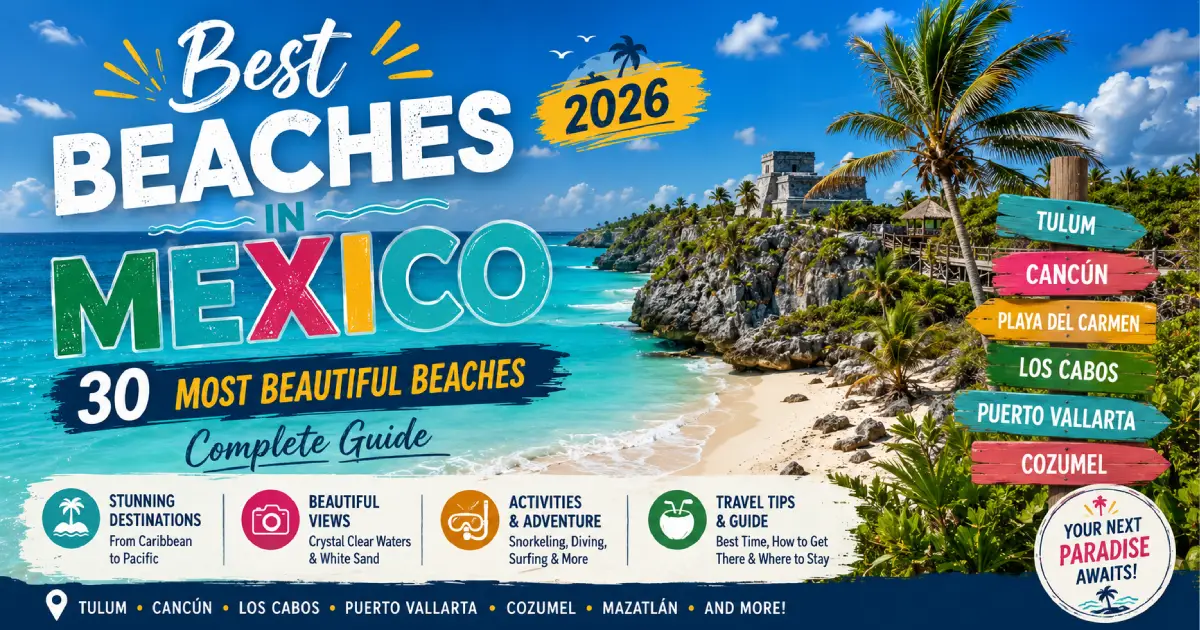
Best Beaches in Mexico 2026: 30 Most Beautiful Beaches Complete Guide
Published on : 30 May 2026
Best Beaches in Mexico — The World’s Most Diverse Beach Nation, Honestly Ranked
By Travel Tourister | Updated March 2026
Mexico has the most geographically diverse beach coastline accessible from the United States in a 4-hour flight — 5,800 miles of Pacific Ocean coast from Baja California’s gray whale lagoons to the Oaxacan surf breaks of Puerto Escondido, and 900 miles of Caribbean coast from the Cancun Hotel Zone’s instantly recognizable turquoise hotel corridor to the Yucatan’s most remotely positioned Caribbean cays. The country produces the most beach-type diversity of any single-nation beach tourism destination in the Americas: the turquoise lagoon beaches of the Yucatan (produced by the most shallow and the most white-sand-bottom Caribbean shelf accessible at any Mexican beach), the Pacific’s wild and surf-carved rocky coves of Oaxaca and Guerrero, the dramatic arch-framed beaches of Cabo San Lucas where the Pacific and the Sea of Cortez meet at the most geographically specific beach junction accessible in North America, the hidden beach of the Marietas Islands (accessible only by swimming through a 70-meter tunnel in a hollow volcanic island, the most specifically dramatic and the most Instagram-celebrated single beach access in the world), and the flat-water Caribbean-pink-tinged sand of Holbox Island (the most specifically flamingo-adjacent and the most specifically Caribbean-colors-complete island accessible as a beach day trip from any Yucatan resort).
This guide ranks the 30 best beaches in Mexico in 2026 — across the Caribbean, the Pacific, the Baja Peninsula, and the most hidden and the most specifically extraordinary secret beaches accessible in any Mexican state. For Mexico travel planning, see our 50 Things to Do in Mexico and Puerto Rico vs Cancun guides.
Best Mexico Beaches: Quick Overview by Region
Region
Best Beach
Water Character
Best For
Cancun / Riviera Maya
Playa Delfines, Playa del Carmen
Vivid turquoise, calm Caribbean
Resort swimming; snorkeling; families
Tulum
Playa Paraiso, Playa Ruinas
Turquoise with waves; palm-lined
Instagram; Mayan ruins backdrop
Isla Holbox
Holbox main beach, Punta Coco
Flat, shallow, crystal Caribbean
Couples; bohemian; whale sharks
Baja California Sur
Balandra Bay, Playa del Amor
Sea of Cortez turquoise and calm
Snorkeling; dramatic arches; scenic
Pacific (Nayarit/Jalisco)
Sayulita, Playa del Amor Marietas
Pacific swells; dramatic coves
Surfing; hidden beaches; bohemian
Oaxaca Coast
Playa Mazunte, Puerto Escondido
Wild Pacific; strong surf
Surfing; turtle nesting; off-grid
Bacalar / Yucatan Hidden
Bacalar Lagoon, Isla Contoy
Freshwater lagoon; pristine coral
Most unusual; off-the-beaten-path
Caribbean Mexico: The Yucatan Peninsula’s Best Beaches
1. Playa Delfines (Cancun) — BEST FREE PUBLIC BEACH IN CANCUN
Why It’s #1 in Cancun: Playa Delfines — the most panoramic and the most specifically public-facing beach in the Cancun Hotel Zone, at the southern end of the resort strip where the boulevard widens to the most open Atlantic horizon accessible from any Hotel Zone beach — is the most photogenically specific and the most immediately recognizable Cancun beach: the famous CANCUN sign (the most photographed single Cancun landmark, installed by the city government in the most visually strategic beach position accessible in the Hotel Zone), the widest section of beach in the entire 14-mile Hotel Zone, and the most open-ocean Caribbean wave set accessible without a resort wristband. Free public parking, free beach access, no resort guards enforcing wristband requirements — the most specifically democratic and the most specifically un-resort-controlled quality beach accessible in the Cancun Hotel Zone.
Water character: The most wave-exposed section of the Hotel Zone — the Caribbean waves at Delfines are the most surf-able (for bodyboarding) in the Hotel Zone but the most caution-appropriate for young children; the rip currents at Delfines are the most active on the Hotel Zone during winter cold fronts. Check the flag system (green = safe; yellow = caution; red = no swimming)
The CANCUN sign: The most photographed single Cancun photo opportunity — arrive before 8 AM for the most crowd-free sign photograph accessible in the Hotel Zone
Best time: Weekday mornings (7–10 AM) for the most crowd-free and the most photogenically lit beach experience
Cost: FREE; public parking available
Location: Boulevard Kukulcan km 17.5, Cancun Hotel Zone
Best For: The most photogenic free Cancun beach; bodyboarding; CANCUN sign photos
2. Playa Norte, Isla Mujeres — BEST BEACH NEAR CANCUN
Why It’s Outstanding: Playa Norte — the north beach of Isla Mujeres (the small island 8 miles offshore from Cancun, accessible by $10 roundtrip ferry from Puerto Juárez) — is the most consistently awarded and the most specifically calm-Caribbean-swimming beach accessible within a 30-minute boat ride of any Cancun hotel. The specific Playa Norte qualities: the beach faces northwest into the Cancun Channel, producing the calmest and the most genuinely bathtub-flat swimming water of any Mexican Caribbean beach accessible by ferry from a major resort city — the water at Playa Norte is the most consistently described as “walking into a swimming pool” by every visitor who has previously swum the more exposed Hotel Zone beaches. The sunset from Playa Norte (facing northwest, toward the Cancun skyline) is the most specifically spectacular and the most uniquely skyline-included Caribbean sunset accessible from any beach accessible from Cancun by public ferry.
Water: The most consistently calm and the most shallow-clear of any Cancun-adjacent Caribbean beach — knee-to-waist depth for 100+ feet from the shoreline, warm (82–85°F summer), crystal clear visibility to the white sand bottom
Ferry: UltraMar ferry from Puerto Juárez, $10 roundtrip; 15-minute crossing; runs every 30 minutes 5 AM–midnight
Isla Mujeres town: Golf cart the entire island ($25/hour) after the beach — the most specifically Caribbean small-town character and the most affordable seafood accessible within an hour of any Cancun hotel
Cost: FREE beach; $10 ferry roundtrip
Location: Isla Mujeres — 15-minute ferry from Puerto Juárez, Cancun
Best For: Best calm-water swimming near Cancun; sunset views of Cancun skyline; golf cart island exploration
3. Playa Paraiso, Tulum — MOST INSTAGRAM BEACH IN MEXICO
Why It’s Outstanding: Playa Paraiso — the beach directly below the Tulum Mayan ruins, accessible by a steep path from the archaeological zone or by a 30-minute walk from the Tulum beach club corridor — is the most specifically extraordinary and the most compositionally irreplaceable beach scene in Mexico: the 13th-century Castillo pyramid visible on the clifftop above the beach, palm trees framing the most turquoise Caribbean water in the most specifically jungle-meets-archaeological-site-meets-beach composition accessible at any Mexican beach. The specific Tulum beach experience: the beach is public (free access from the archaeological zone end or from the beach road) but the Tulum beach club corridor has privatized the most accessible sections with day-pass entry ($20–$80/person for beach club access including food and drink credit).
Archaeological site access: The most crowd-free Playa Paraiso access is from inside the Tulum ruins ($5 entry) — walk through the site to the beach path, descend to the beach at 8–9 AM before the beach clubs set up their chairs, and swim in the most specifically and most archaeologically-backdrop-complete beach accessible in Mexico
Beach clubs (day pass $20–$80): Papaya Playa Project and Mia Beach Club are the most celebrated Tulum beach club experiences — the most specifically bohemian and the most specifically Tulum-aesthetic day bed experiences accessible in the beach corridor
Water character: Caribbean turquoise with moderate waves — more wave-affected than Playa Norte but the most specifically warm and the most specifically clear accessible at any Tulum beach
Cost: Free from ruins ($5 entry); beach club day pass $20–$80
Location: Tulum Archaeological Zone beach, Tulum, Quintana Roo
Best For: Most dramatic beach photography in Mexico; Mayan ruins backdrop
4. Playa del Carmen (5th Avenue Beach)
Why It’s Notable: The beach running parallel to Playa del Carmen’s famous 5th Avenue pedestrian corridor — accessible from the beach access points between the tourist development and the Caribbean — is the most specifically social and the most specifically urban-adjacent Caribbean beach in the Riviera Maya: the most diverse crowd (international tourists, Mexican day-trippers, cruise ship passengers, and Playa del Carmen expats), the most volleyball-and-water-sport-activity-dense beach activity of any Riviera Maya beach town, and the most walking-beach-to-restaurant-to-shopping-to-nightlife transition of any Mexican Caribbean beach setting. The beach itself is narrower than the Hotel Zone but the turquoise water is the most consistently excellent of any Riviera Maya mainland beach.
Cost: FREE; beach chairs $10–$15/day
Location: Playa del Carmen, Quintana Roo — 1 hour south of Cancun
Best For: The most social and most activity-complete Riviera Maya beach town experience
5. Akumal Beach — Best Sea Turtle Snorkeling Beach
Why It’s Outstanding: Akumal — the “Place of the Turtles” in Mayan — is the most accessible and the most reliably turtle-populated free snorkel beach in Mexico: green sea turtles feed on the Akumal Bay seagrass daily in 5–10 feet of crystal-clear Caribbean water, accessible from the public beach access point ($0 entry, $10 gear rental) in the most directly and the most reliably turtle-encounter-productive shore snorkel accessible in the entire Riviera Maya. The bay’s protected semicircular reef creates the most calm and the most turtle-safe swimming conditions of any open Caribbean bay accessible by highway stop between Playa del Carmen and Tulum.
Cost: FREE beach access; snorkel gear rental $10
Location: Akumal, Quintana Roo — 25 miles south of Playa del Carmen on Highway 307
Best Time: Before 8 AM or after 3 PM for least crowded turtle encounters
6. Playa Ruinas, Tulum — Most Dramatic Clifftop Beach View
The beach directly below the main Castillo structure at the Tulum ruins — the most specifically cliff-and-turquoise-Caribbean composition accessible at any Mexican beach — is the most repeatedly photographed single Mexico beach view: the ancient Mayan stone directly above the most turquoise water and the most white sand accessible at any Tulum beach. The specific cliff beach below the Castillo is accessible by a steep path from inside the archaeological zone during the ruins’ open hours.
Cost: $5 ruins entry; beach access included
Location: Tulum Archaeological Zone, Tulum, Quintana Roo
7. Cozumel — Best Snorkeling Beach in Mexico
Why It’s Outstanding: Cozumel Island — accessible by 45-minute ferry from Playa del Carmen ($20 roundtrip) — is the most reef-immediately-adjacent and the most coral-diverse beach snorkeling destination in Mexico: the Chankanaab National Marine Park ($26/adult, includes snorkel equipment and park access) and the Palancar Beach Club (the most specifically Mesoamerican Barrier Reef-adjacent and the most coral-dense snorkel accessible from any Cozumel beach chair) collectively produce the most comprehensively extraordinary beach snorkeling accessible within a ferry ride of any major Mexico Caribbean resort city. The Cozumel west coast beaches (the most protected from Caribbean swells by the island’s position) are the most calm and the most turquoise-clear of any Cozumel beach section.
Chankanaab National Marine Park ($26/adult): The most family-appropriate and the most snorkel-complete beach park on Cozumel — the cenote-fed freshwater lagoon, the most consistently present sea turtles at the park’s snorkel reef, and the most comprehensive beach facility accessible at any Cozumel park make Chankanaab the most recommended first-Cozumel-visit beach experience
Paradise Beach Club (free entry, pay for chairs/food): The most social and the most activity-programmed Cozumel beach club accessible without a park fee — water trampolines, kayaks, and the most consistent Caribbean turquoise visible from the beach chairs
Cost: Ferry $20; Chankanaab $26/adult; Paradise Beach free entry
Location: Cozumel Island — 45-minute ferry from Playa del Carmen
Isla Holbox: Mexico’s Most Bohemian Beach Island
8. Holbox Main Beach — BEST UNDISCOVERED BEACH IN MEXICO
Why It’s Outstanding: Isla Holbox (the island whose name translates from Yucatec Mayan as “black hole”) — a car-free sand island at the northern tip of the Yucatan Peninsula, accessible by 30-minute ferry from the town of Chiquila (2 hours from Cancun) — produces the most specifically flat-water, the most specifically wide-sand, and the most specifically bohemian-Caribbean beach character accessible in Mexico: the Gulf of Mexico’s influence on the Holbox shoreline produces flat, shallow, and the most glass-surface water of any Mexico Caribbean island beach, a specific quality that makes the beach the most specifically social (golf carts on the sand, hammocks suspended in the water, the most specifically sunset-cocktail-in-the-shallows culture) and the most specifically photograph-flat-water-Caribbean of any Mexico beach accessible from Cancun.
Hammock bars: The most specifically Holbox and the most specifically Caribbean-cocktail-culture-photogenic feature — bars that set wooden hammocks in the shallow water so guests can drink while suspended over the transparent Caribbean; the most specifically and the most irreplaceably Holbox dining experience accessible in any Mexico beach town
Sunset point: The northwest tip of Holbox island (Punta Coco) produces the most specifically dramatic and the most flat-water-Caribbean sunset available from any Mexico island beach accessible by golf cart
Bioluminescence: Holbox Bay has low-level bioluminescence on new moon nights — less intense than Vieques’s Mosquito Bay but genuinely visible from the beach shallows on the darkest nights
Whale sharks (June–September): Holbox is the most accessible and the most tour-operator-rich base for the Afuera Bank whale shark snorkeling ($100–$130/person) — the most reliably accessible and the most legally managed whale shark encounter in the world
Cost: FREE beach; ferry from Chiquila $12 roundtrip
Location: Isla Holbox, Quintana Roo — 2 hours from Cancun (bus to Chiquila + 30-min ferry)
Best For: Most bohemian and most flat-water beach in Mexico; whale sharks June–Sept; hammock bars
9. Punta Cocos, Holbox — Best Holbox Sunset Beach
The western tip of Isla Holbox — 30 minutes by golf cart from the main Holbox town — produces the most dramatically flat-water and the most specifically flamingo-pond-adjacent sunset accessible at any Mexico island beach: the flamingo ponds behind the beach are occasionally visible from the beach shoreline, and the flat Gulf of Mexico water at Punta Cocos catches the sunset light in the most specifically glass-surface and the most dramatically gold-on-flat-water sunset photograph accessible in the Yucatan.
Cost: FREE; golf cart rental $25/hour in Holbox town
Location: West tip of Isla Holbox
Baja California: Mexico’s Most Dramatic Beach Peninsula
10. Balandra Bay (La Paz) — MOST BEAUTIFUL BEACH IN BAJA CALIFORNIA
Why It’s Outstanding: Balandra Bay — the most protected and the most specifically turquoise-on-white-sand bay accessible within a 30-minute drive of any Baja California city — is consistently rated among the most beautiful beaches in Mexico by every major Mexican travel publication: the shallow Sea of Cortez water (knee-to-waist depth for 200+ feet from the shoreline, the most consistently clear and the most consistently warm of any Baja California Sur bay beach), the mangrove-lined bay edges, and the most specifically white sand bottom producing the most vivid turquoise accessible at any non-Caribbean Mexico beach collectively make Balandra the most specifically Caribbean-looking beach accessible on the Pacific side of Mexico. Day-use permit required (free, booked at CONANP’s Balandra access portal online).
The Mushroom rock (La Roca Seta): The most specifically Balandra and the most photogenically irreplaceable single rock formation accessible at any Baja California beach — the mushroom-shaped sandstone rock balanced on its narrow base at low tide is the most cited Balandra photograph by any beach photography publication that has covered the Baja Peninsula
Water temperature: Sea of Cortez water at Balandra reaches 85°F in summer (August–September) — the warmest and the most specifically bath-like Pacific Mexico beach water accessible at any Baja California beach
Permit system: Day-use permits are required (free; book at the CONANP online reservation system or arrive at the gate by 7 AM — the most consistently available walk-up window at any Balandra visit day)
Cost: FREE (permit required); 30-minute drive from La Paz
Location: Balandra Bay, 20 km north of La Paz, Baja California Sur
Best For: Most beautiful beach in Baja; families; calm Sea of Cortez swimming; kayaking
11. Playa del Amor (Lover’s Beach), Cabo San Lucas — Most Dramatic Beach Setting
Why It’s Outstanding: Playa del Amor — the small beach at the very tip of the Baja California Peninsula, beneath El Arco’s dramatic natural arch where the Pacific Ocean and the Sea of Cortez meet — is the most specifically dramatic and the most compositionally irreplaceable beach setting in Mexico: the Pacific crashing on one side (the “Divorced Beach,” too rough for swimming), the calm Sea of Cortez water on the other (the “Lover’s Beach,” swimmable and the most turquoise accessible at any Cabo beach), and the El Arco arch framing both sides in the most geologically specific and the most internationally recognized single Baja California landmark. Accessible only by water taxi from the Cabo San Lucas marina ($15 roundtrip).
El Arco at the Land’s End: The most specifically Cabo and the most geologically dramatic natural arch accessible at any Mexico Pacific beach — the glass-bottom boat tour ($20/person) delivers the most sea-lion-proximate and the most arch-through-the-glass-bottom-view of El Arco accessible from any Cabo marina water tour
Sea lion colony: The most accessible and the most reliably present wild sea lion colony visible from any Cabo beach — the Lands End sea lions sunbathe on the rocks adjacent to El Arco and are visible from both the water taxi and from Playa del Amor
Cost: Water taxi $15 roundtrip from Cabo marina
Location: Land’s End, Cabo San Lucas, Baja California Sur
Best For: Most dramatic Baja beach; El Arco photography; sea lions
12. Playa Las Viudas (Twin Dolphins Beach), Los Cabos
Why It’s Notable: Las Viudas — the most accessible and the most secluded of the Los Cabos Corridor beaches between Cabo San Lucas and San José del Cabo — is the most specifically calm and the most specifically snorkel-accessible beach in the Los Cabos Corridor: the rocky points at both ends of the small sandy cove create a natural protected swimming area in the most calm and the most fish-populated nearshore waters accessible at any Los Cabos public beach. The most specifically crowd-free Los Cabos beach (the lack of a hotel on this section of the Corridor road means no resort chair operation and no wristband enforcement — the most authentically public beach in the Los Cabos area).
Cost: FREE
Location: Highway 1, between Cabo San Lucas and San José del Cabo
13. Playa Tecolote (La Paz)
Why It’s Notable: Tecolote — 15 miles north of La Paz on the Bay of La Paz — is the most directly ocean-facing and the most specifically Espíritu Santo Island-view beach accessible as a day trip from La Paz: the wide, pale-sand beach faces the most dramatically volcanic-island-dotted Sea of Cortez view accessible from any La Paz day beach, with Espíritu Santo Island and Los Islotes visible on the clearest days and the most consistently clear snorkeling accessible at any public La Paz area beach. The palapa restaurants serving the most specifically fresh-caught Baja sea bass ceviche ($14) and the most affordable freshwater showers ($2) make Tecolote the most complete La Paz day-beach facility accessible at any non-resort beach.
Cost: FREE beach; palapa restaurants $14–$25
Location: 15 miles north of La Paz city center
Pacific Mexico: Nayarit, Jalisco, and the Hidden Coast
14. Playa del Amor (Marietas Islands) — MOST HIDDEN BEACH IN MEXICO
Why It’s the Most Extraordinary: The Hidden Beach of the Marietas Islands — accessible only by swimming through a 70-meter underwater tunnel in the wall of a volcanic island 35 miles offshore from Puerto Vallarta — is the most specifically extraordinary and the most cinematically spectacular beach access available anywhere in the world: the beach exists entirely inside a collapsed volcanic crater, surrounded by 360-degree rock walls open to the sky, with the most specifically protected and the most specifically surreal beach swimming environment accessible at any ocean beach in Mexico. The government-regulated daily visitor quota (75 people maximum per day, the most strictly enforced single beach visitor limit in Mexico) makes advance booking (at the CONANP reservation portal, required weeks to months ahead in peak season) the most consequential single step in the Marietas Islands planning process.
The tunnel swim: The 70-meter swim through the volcanic rock passage (the most specifically Indiana Jones-adjacent beach access available in Mexico) requires a life jacket (provided), a guide, and the specific combination of tide and wave conditions that the authorized Marietas Islands tour operators monitor in real time — tours are cancelled if the tunnel conditions are too rough for safe passage
Booking: Through CONANP’s official reservation system or through an authorized Puerto Vallarta tour operator (Vallarta Adventures, Ocean Friendly Boats) — $120–$150/person for the full day tour including boat, snorkeling, and Hidden Beach time
Day-use quota: 75 visitors maximum per day (the most strictly enforced and the most specifically conservation-protective single Mexico beach visitor limit) — book 2–4 weeks ahead in peak season
Cost: $120–$150/person for full-day authorized tour from Puerto Vallarta
Location: Marietas Islands National Park — 35 miles offshore from Puerto Vallarta
Best For: Most extraordinary and most hidden beach in Mexico; serious bucket list
15. Sayulita Beach — Best Surf Town Beach in Mexico
Why It’s Outstanding: Sayulita — the most specifically bohemian and the most surf-culture-embedded beach town on Mexico’s Pacific coast, 25 miles north of Puerto Vallarta — produces the most specifically colorful and the most specifically Mexican-small-town-meets-international-surf-culture beach experience accessible on the Pacific: the consistent beach break waves (the most beginner-surf-appropriate and the most consistently surf-school-populated Pacific Mexico beach), the most colorfully painted village streets visible from the beach promenade, and the most specifically Pacific Mexico beach food culture (the tuna tostadas at El Itacate, the most cited single Sayulita food experience; the fish tacos at La Rustica at $4 each) produce the most socially complete and the most specifically atmospheric Pacific Mexico beach experience accessible within a 30-minute drive of any Puerto Vallarta hotel.
Surfing: The most beginner-appropriate and the most surf-lesson-equipped beach break in Pacific Mexico — Sayulita Surf School and multiple competing operators offer the most $50 90-minute beginner lessons accessible at any Pacific Mexico beach town
Town character: The most specifically Day of the Dead-mural-decorated and the most specifically Mexican-hippie-surf-town character accessible within 30 minutes of a major airport (Puerto Vallarta, direct from most US cities)
Cost: FREE beach; surf lesson $50; bus from Puerto Vallarta $2
Location: Sayulita, Nayarit — 25 miles north of Puerto Vallarta
Best For: Best surf town beach in Mexico; bohemian culture; beginners surfing
16. San Pancho (San Francisco) Beach, Nayarit
Why It’s Notable: San Pancho — 6 miles north of Sayulita, the most specifically un-touristy and the most specifically local-Mexican-village-character beach town accessible in the Nayarit Riviera — produces the most specifically wide Pacific beach and the most specifically unspoiled small-town-Mexico beach experience accessible within 30 minutes of Puerto Vallarta: the beach is the most expansive (300-foot width of grey-gold Pacific sand) of any Nayarit Riviera beach town, the most wave-exposed for bodyboarding, and the most specifically community-first village character (the polo ground, the community garden, and the most single-main-street town in the Nayarit beach corridor make San Pancho the most specifically “Mexico that hasn’t been fully discovered” beach town accessible from any Puerto Vallarta day trip).
Cost: FREE; 30-minute bus from Puerto Vallarta $2
Location: San Pancho, Nayarit — 6 miles north of Sayulita
17. Playa Carricitos (Punta Mita), Nayarit
Why It’s Notable: The most specifically dramatic and the most wild-Pacific-facing beach accessible on the Punta Mita peninsula — the wide, black-sand-tinged Pacific beach at Carricitos catches the most specifically powerful Pacific swell and produces the most dramatically foaming Pacific shorebreak accessible at any Nayarit beach without resort infrastructure. The most specifically cinematic and the most photogenically Pacific-wild of any Puerto Vallarta day-trip beach.
Cost: FREE; rental car or tour from Puerto Vallarta
Location: Punta Mita, Nayarit — 45 minutes from Puerto Vallarta
Oaxaca’s Pacific Coast: Mexico’s Most Wild Beaches
18. Playa Mazunte — BEST SECRET BEACH IN OAXACA
Why It’s Outstanding: Mazunte — the most specifically back-to-nature and the most specifically organic-cosmetics-cooperative small beach village on the Oaxacan Pacific coast (1.5 hours from Puerto Escondido, 6 hours from Oaxaca City) — produces the most specifically wild and the most specifically dramatic Pacific beach accessible in southern Mexico: the rocky headlands framing the wide Mazunte bay, the turtle nesting program (the village community operates the most important sea turtle protection program on the Pacific Mexican coast — the National Mexican Turtle Center adjacent to the beach protects olive ridley and leatherback nesting grounds in the most organized and the most community-operated turtle conservation program accessible to visitors in Oaxaca), and the specific off-grid character (the most solar-powered and the most specifically non-resort and the most specifically locally owned accommodation accessible at any Oaxacan beach) make Mazunte the most specifically authentic and the most specifically off-the-mass-tourism-corridor beach in southern Mexico.
Sunset point: The rocky headland at the bay’s west end produces the most specifically dramatic and the most Pacific-wild sunset accessible from any Oaxacan beach promontory — a 20-minute walk from the main beach through the most coastal scrub and the most specifically bioluminescent-plankton-wash tide pools
Turtle season (July–November): The most specifically olive ridley turtle nesting season on the Oaxacan Pacific — the National Mexican Turtle Center’s guided nighttime turtle nesting tours ($15/person) produce the most accessible and the most closely guided sea turtle nesting encounter accessible at any Mexican beach
Cost: FREE beach; turtle tour $15
Location: Mazunte, Oaxaca — 1.5 hrs from Puerto Escondido
Best For: Most wild and most off-grid Pacific beach; turtle nesting; off-the-beaten-path
19. Zicatela Beach (Puerto Escondido) — Best Surfing Beach in Mexico
Why It’s Outstanding: Zicatela Beach — the most internationally surf-celebrated and the most specifically pipeline-adjacent beach break in Mexico — is the most specifically advanced-surfer beach in the country: the beach break at Zicatela produces the most powerful and the most specifically barrel-forming waves accessible on the Mexican Pacific, with the El Pico surfing section producing waves of 15–25 feet (the most specifically Mexican Pipeline designation, the most frequently cited comparison to Hawaii’s Banzai Pipeline that any Pacific Mexico surf break has ever earned). The June–October swell season produces the most dramatically powerful and the most spectator-appropriate wave surfing accessible at any Mexican beach. Not recommended for swimming (the shorebreak at Zicatela is the most dangerous on the Mexican Pacific) — the most specifically observation-from-the-beach surf experience in Mexico.
Surf season: June–October (summer south swells, the most powerful and the most barrel-producing Zicatela surf season)
November–May: The most beginner-appropriate and the most manageable Zicatela conditions — surf schools operating from the beach’s north end ($45–$60/lesson) use the smaller swell season for the most safely structured beginner surf instruction accessible on the Oaxacan coast
Cost: FREE beach; surf lesson $45–$60
Location: Puerto Escondido, Oaxaca — direct flights from Mexico City (1 hour)
Best For: Most powerful surf in Mexico; advanced surfers; surf spectating; photography
20. Playa La Boquilla (Puerto Escondido)
Why It’s Notable: La Boquilla — the most calm and the most specifically swimming-appropriate beach accessible in the Puerto Escondido area (4 km from Zicatela’s dangerous break) — is the most protected and the most specifically lagoon-adjacent swimming beach in Puerto Escondido: the river mouth at La Boquilla creates a calm saltwater lagoon where the most specifically protected and the most bird-populated swimming area accessible in the Puerto Escondido area is available at no cost. The most specifically family-appropriate Puerto Escondido beach for the visitor who wants the Zicatela surf photography without the Zicatela swimming danger.
Cost: FREE
Location: 4 km from Puerto Escondido town center
Mexico’s Most Unique and Hidden Beaches
21. Bacalar Lagoon Beaches — MOST UNUSUAL MEXICO BEACH EXPERIENCE
Why It’s Extraordinary: Bacalar — the “Lagoon of Seven Colors,” a 42-kilometer freshwater lagoon 2 hours south of Tulum on Highway 307 — is the most specifically extraordinary and the most unusual “beach” experience in Mexico: not an ocean beach but a freshwater lake whose Caribbean-limestone geology produces the most specifically turquoise, blue, teal, and midnight blue gradations of any freshwater body in the Americas, visible simultaneously from the most lakeside-positioned dock or swimming pier of any Bacalar accommodation. The specific Bacalar colors: the variation in the lagoon’s depth (from 6 inches in the shallows to 100 feet in the Blue Channel) produces the most dramatic single-body-of-water color gradient accessible at any Mexican freshwater swimming destination.
Fort San Felipe ($4/adult): The most historically specific colonial fortification on any Mexican lake — the 18th-century Spanish fort built to protect the lagoon’s mahogany timber trade from British pirates; the most specifically Lake Bacalar view accessible from any elevated land position
Sailing tour ($40–$65/person): The most specifically Bacalar and the most lagoon-exploration-complete experience — catamaran or sailboat tours through the most colorful sections of the Lagoon of Seven Colors, with swimming stops in the most specifically turquoise sections of the lake accessible only by boat
Cost: FREE swimming at public docks; fort $4; sailing tour $40–$65
Location: Bacalar, Quintana Roo — 2 hours south of Tulum on Highway 307
Best For: Most unusual beach in Mexico; freshwater turquoise swimming; most unique photography
22. Isla Contoy — Most Pristine Uninhabited Island Beach in Mexico
Why It’s Outstanding: Isla Contoy — the uninhabited national park island 50 miles north of Cancun (accessible only by authorized tour boat, $120–$150/person from Isla Mujeres or Cancun) — is the most ecologically protected and the most specifically untouched Caribbean beach accessible from any major Mexico resort city: the island receives a maximum of 200 visitors per day (the most strictly enforced daily visitor quota of any Mexican Caribbean island), with pristine coral reef snorkeling, the most bird-nesting-colony-specific nature walking in the Yucatan (the island hosts the most significant frigatebird and brown pelican nesting colonies accessible in the Mexican Caribbean), and the most specifically Robinson-Crusoe white sand Caribbean beach accessible without a private yacht.
Cost: $120–$150/person (authorized tour only; maximum 200 visitors/day)
Location: 50 miles north of Cancun; 20 miles north of Isla Mujeres
Best For: Most pristine Caribbean beach in Mexico; serious nature seekers; snorkeling
23. Playa Xcacel — Best Turtle Nesting Beach on Mexico’s Caribbean Coast
Why It’s Notable: Xcacel — the most specifically turtle-nesting-protected and the most ecological-reserve-designated beach accessible without a boat on the Riviera Maya (Highway 307, between Tulum and Playa del Carmen) — is the most specifically loggerhead and green sea turtle-nesting beach on Mexico’s Caribbean coast with the most active protection program: the cenote adjacent to the beach (the most specifically sea-adjacent cenote accessible at any Riviera Maya public beach, where the freshwater mixes with saltwater at the cenote’s ocean-opening entrance) produces the most specifically extraordinary and the most specifically dual-ecosystem snorkel accessible at any Mexico highway-stop beach.
Cost: $3/person day use
Location: Highway 307 km 247, between Playa del Carmen and Tulum
24. Playa El Tecolote (Baja) — Best Whale Shark View Beach
The public beach on the Bay of La Paz — 15 miles north of La Paz — where whale shark snorkel tours depart to the La Paz Bay feeding zone (November–April, $65–$90/person). The beach itself is wide, pale, and the most specifically whale shark tour departure-accessible of any La Paz public beach, making it the most specifically strategically positioned beach for the visitor whose priority is the most affordable whale shark encounter accessible in the Baja Peninsula.
Cost: FREE beach; whale shark tour $65–$90
Location: 15 miles north of La Paz city center
25. Playa Las Gatas, Zihuatanejo — Most Protected Pacific Cove
Why It’s Notable: Las Gatas — accessible only by water taxi from Zihuatanejo’s town dock ($5 roundtrip, 10 minutes) — is the most specifically reef-protected and the most calm-Pacific-swimming beach accessible at any Guerrero state Pacific beach: the pre-Columbian stone reef breakwater (built by Tarascan king Calzontzin to protect the royal swimming beach, the most historically specific and the most genuinely ancient reef-engineering accessible at any Mexican Pacific beach) creates the most protected and the most family-swimmable Pacific cove in the Guerrero state. The most specifically calm and the most specifically coral-protected Pacific swimming accessible south of Puerto Vallarta.
Cost: FREE; water taxi $5 roundtrip
Location: Zihuatanejo, Guerrero — 5 hours from Acapulco; direct flights from Mexico City
More Essential Mexico Beaches
26. Playa Garrafon, Isla Mujeres — Best Snorkeling Experience from a Mexico Beach
The Garrafon Natural Reef Park ($59/adult all-inclusive) on the southern tip of Isla Mujeres — the most reef-immediately-adjacent and the most equipment-inclusive snorkel experience accessible from any Mexico beach park — delivers the most accessible and the most specifically Caribbean-reef-character snorkeling: the reef begins immediately at the water’s edge, the most colorful and the most diverse reef fish accessible from the Garrafon swimming zone, and the kayak, zip-line, and hammock-over-the-water amenities produce the most day-park-complete Isla Mujeres beach experience accessible.
Cost: $59/adult all-inclusive
Location: South tip, Isla Mujeres — ferry from Cancun
27. Playa Langosta, Cancun — Best Calm Swimming Beach in the Hotel Zone
Playa Langosta — the most consistently calm and the most family-specifically swimming-safe section of the Cancun Hotel Zone (the Nichupte Lagoon side of the hotel strip, where the beach faces northwest and is protected from the Caribbean’s easterly waves) — produces the most bathtub-flat and the most consistently safe swimming water of any Hotel Zone beach accessible to non-resort guests. Free public access from the public park at Boulevard Kukulcan km 5.
Cost: FREE; public access from Kukulcan km 5
Location: Cancun Hotel Zone km 5
28. Playa Zamas, Tulum — Best Boutique Tulum Beach
The most specifically boutique-hotel-beach and the most specifically Tulum-aesthetic beach property in the northern Tulum beach corridor — the Zamas Hotel’s beach club ($35 day pass with food and drink credit) produces the most specifically design-forward and the most specifically Tulum-palapa-aesthetic day beach experience accessible in the most northern section of the Tulum beach road, where the waves are more manageable and the sand is the widest accessible in the Tulum beach corridor.
Cost: $35 day pass
Location: Northern Tulum beach road, Tulum
29. Playa Manialtepec (Pink Flamingo Lagoon), Puerto Escondido
The most specifically bioluminescent and the most flamingo-adjacent freshwater lagoon accessible within 30 minutes of Puerto Escondido — the Manialtepec Lagoon tour (the most specifically bioluminescent tour accessible on the Oaxacan Pacific coast, $35/person, best on new moon nights) delivers both flamingo viewing (the American flamingos that feed in the lagoon November–March) and bioluminescent kayaking in the most oar-glowing and the most blue-green-biological-light-producing Pacific freshwater body accessible at any Oaxacan tour operation.
Cost: $35/person bioluminescent tour
Location: 18 km west of Puerto Escondido
30. Playa del Palmar, Ixtapa — Best All-Around Pacific Resort Beach
Playa del Palmar — the most extensively resort-lined and the most specifically Pacific-resort-infrastructure-complete beach in the Ixtapa/Zihuatanejo area — is the most consistently wave-swept and the most specifically boogie-board-appropriate Pacific beach in the Guerrero state resort corridor: the long crescent of dark gold Pacific sand, the most consistent small-wave surf, and the most specifically resort-promenade-and-beach-combination accessible in the most developed Guerrero Pacific resort setting produce the most comprehensively developed Pacific resort beach accessible in southern Mexico.
Cost: FREE public beach
Location: Ixtapa, Guerrero — direct flights from many US cities
Mexico Beach Planning Guide: Practical Tips
Topic
Essential Information
Best Time for Caribbean Beaches
November–April: Driest, most vivid water color, calmest seas. December–February: Most vivid turquoise in the Cancun Hotel Zone; coolest but perfectly swimmable water (76–78°F). May–June: Still excellent but more afternoon cloud. July–October: Hurricane season — travel insurance essential; still beautiful between storms.
Best Time for Pacific Beaches
November–May: Most sunny days, warmest water on the northern Pacific (Puerto Vallarta, Sayulita). June–October: Most powerful surf (Zicatela); whale sharks at Holbox; turtle nesting on Oaxacan coast. Baja: November–April for whale sharks; January–April for gray whales.
Beach Safety Flags
Mexico uses standardized beach flag system: 🟢 Green = Safe swimming; 🟡 Yellow = Exercise caution; 🔴 Red = No swimming (dangerous conditions); 🟣 Purple = Marine life (jellyfish, etc.). Always check the flag before entering water — Cancun Hotel Zone flags can change rapidly with cold fronts. Zicatela, Puerto Escondido is red flag or no-flag (swimming not permitted) when surf is active.
Beach Access Rights
All beaches in Mexico are federally owned public property — no resort can legally close a Mexican beach to the public. The 20-meter zone above the high tide line (the federal zone) is permanently public. Resorts may restrict access to their pool and beach chair areas with wristband systems but cannot block access to the water and the wet sand. If a resort guard blocks public beach access, request their hotel name and contact ZOFEMAT (the federal zone authority).
Sunscreen
Multiple Mexican marine protected areas (including Cozumel, the Marietas Islands, and some Cancun Hotel Zone sections) prohibit chemical sunscreens (oxybenzone, octinoxate) to protect coral reefs. Mineral-only sunscreen (zinc oxide or titanium dioxide base) is the most responsible and increasingly the most legally required beach preparation for any Mexico Caribbean reef snorkeling. Most beach vendors in Cancun and Playa del Carmen sell reef-safe alternatives.
Jellyfish Season
The Caribbean Mexican coast experiences jellyfish (medusa) blooms most frequently in August–October (warm water peak) and occasionally in December–January (Portuguese Man-of-War during cold fronts). Purple beach flags signal jellyfish presence. The Hotel Zone and Riviera Maya jellyfish blooms are typically brief (hours to days) and are cleared by the trade winds. Check the beach flag and the local resort’s jellyfish status before entering the water during these windows.
Frequently Asked Questions: Best Beaches in Mexico
What is the most beautiful beach in Mexico?
The most beautiful beach in Mexico is a subjective answer that depends entirely on the type of beauty the visitor prioritizes — but the most consistently awarded and the most internationally recognized answer is: Balandra Bay in La Paz (Baja California Sur) for the most turquoise and the most geologically specific freshwater-meeting-sea-of-cortez beauty; Playa del Amor (Hidden Beach) in the Marietas Islands for the most dramatically extraordinary and the most specifically unique access experience; and Playa Norte on Isla Mujeres for the most consistently calm and the most specifically Caribbean-swimming-perfect beach accessible by ferry from a major Mexico resort city. For the visitor specifically coming from Cancun: Playa Norte on Isla Mujeres ($10 ferry, 15 minutes) produces the most overwhelmingly beautiful single beach day accessible from any Cancun hotel on any budget.
Which Mexican beach is best for families?
The most family-appropriate Mexican beaches are concentrated in the areas with the calmest and the most shallow-water swimming: Playa Norte on Isla Mujeres (the most calm and the most genuinely safe for children of any Caribbean Mexico beach accessible from Cancun), Balandra Bay in La Paz (the most knee-depth-for-200-feet and the most specifically protected cove swimming accessible in Baja California), and the Chankanaab National Marine Park on Cozumel (the most family-programmed and the most snorkel-equipment-inclusive beach park accessible in the Riviera Maya) collectively represent the three most family-complete Mexican beach experiences accessible from the most popular Mexico resort cities.
What is the clearest water beach in Mexico?
The Mesoamerican Barrier Reef’s most pristine sections — Cozumel’s Palancar Reef (100+ foot visibility on calm days) and the Akumal Bay cenote-fed water (the most specifically freshwater-influenced and the most clarity-complete Caribbean snorkel accessible from shore) — produce the most specifically clear water accessible at any Mexico beach for underwater visibility. On the surface, Balandra Bay’s knee-depth clarity (sand bottom visible at any depth in the bay) and Playa Norte’s Isla Mujeres flat-water transparency (white sand bottom visible from standing depth throughout the swimming zone) produce the most specifically crystal-surface-clarity accessible at any Mexico wading and swimming beach.
Final Thoughts: Mexico’s Beaches Reward the Visitor Who Explores Beyond the Resort
Mexico’s beach landscape is the most specifically diverse and the most specifically rewarding in the Americas for the visitor who moves beyond the Hotel Zone: the Hidden Beach accessible only through a volcanic tunnel, the freshwater lagoon of seven colors, the gray whale petting in Baja California, the flamingo-adjacent flat water of Holbox, the turtle-protected wild shores of Mazunte, and the most powerfully beautiful pipeline surf of Zicatela collectively represent a beach landscape that no other single country in the Western Hemisphere produces at the same geographic range, the same cultural depth, and the same specifically Mexico-character-defining variety. The most beautiful Mexico beach is not necessarily the most famous. It is the one that matches the specific quality of beauty the visitor came to find — and Mexico has a beach for every version of that specific beauty accessible at any price, in any season, from any US or Canadian city within a 4-hour flight.
—
—
About Travel TouristerTravel Tourister’s Mexico beach specialists have explored beaches across the Yucatan Peninsula, Baja California, the Nayarit Riviera, the Oaxacan Pacific coast, and beyond — from Holbox’s hammock bars and Playa del Amor’s volcanic tunnel to Balandra Bay’s Mushroom Rock and Zicatela’s Pipeline — to provide the most honest and most comprehensive Mexico beach guide available for Tier 1 travelers in 2026.
—
Official Government & Tourism Resources
Visit Mexico — Official Mexico Tourism Board (Secretaría de Turismo) — Official Mexican federal government tourism resource covering beach destination information across all coastal Mexican states, current beach access regulations, marine protected area guidelines, and the most authoritative Mexico beach visitor resources from the Secretaría de Turismo.
US Department of State — Official Mexico Travel Advisory — Official US government state-by-state Mexico travel advisory covering current safety levels for Quintana Roo, Baja California Sur, Jalisco, Nayarit, Oaxaca, and Guerrero; beach-area safety information; and the most current guidance for American travelers visiting Mexico’s most popular beach destinations.
CONANP — National Commission of Natural Protected Areas (Official Mexico Government) — Official Mexican federal government resource for national marine park and protected area beach access, including Marietas Islands Hidden Beach reservation system, Isla Contoy visitor quota information, Balandra Bay day-use permits, and all current marine protected area visitor regulations for Mexico’s most ecologically sensitive beach destinations.
Posted By : Vinay
As a lead contributor for Travel Tourister, Vinay is dedicated to serving our Tier 1 audience (US, UK, Canada, Australia). His mission is to deliver precise, fact-checked news and actionable, data-driven articles that empower readers to make informed decisions, minimize travel risks, and maximize their adventure without compromising safety or budget.
Travel Tourister is a leading Travel portal where we introduce travellers to trusted travel agents to make their journey hasselfree, memorable And happy. Travel Tourister is a platform where travellers get Tour packages ,Hotel packages deals through trusted travel companies And hoteliers who are working with us across the world. We always try to find new and more travel agents and hoteliers from every nook and corners across the world so that you could compare the deals with different travel agents and hoteliers and book your tour or hotel with the one you have chosen according to your taste and budget.




 Call
Call Enquiry