50 Best Things to Do in Mexico 2026: Ultimate Activities Guide
Published on : 29 May 2026
Things to Do in Mexico — A Nation of Extraordinary Diversity, Honestly Explored
By Travel Tourister | Updated March 2026
Mexico is the most geographically diverse and the most culturally layered country accessible within a 4-hour flight of the United States — a nation of 130 million people spanning 760,000 square miles from the Sonoran Desert in the north to the Lacandón Jungle in the south, from the Pacific’s gray whale nurseries in Baja California to the Caribbean’s cenote-laced limestone shelf of the Yucatan Peninsula. Mexico contains the most UNESCO World Heritage Sites of any country in the Americas (35, more than any other nation in the Western Hemisphere), the most biologically diverse single-country insect population in the world, the most specifically Maya archaeological sites accessible as resort day trips of any country, and the most internationally exported single national cuisine (Mexican food was declared an Intangible Cultural Heritage of Humanity by UNESCO in 2010 — the first national cuisine to receive this designation) — all available at the most affordable price-per-experience ratio of any comparable destination accessible from the US and Canadian border corridor.
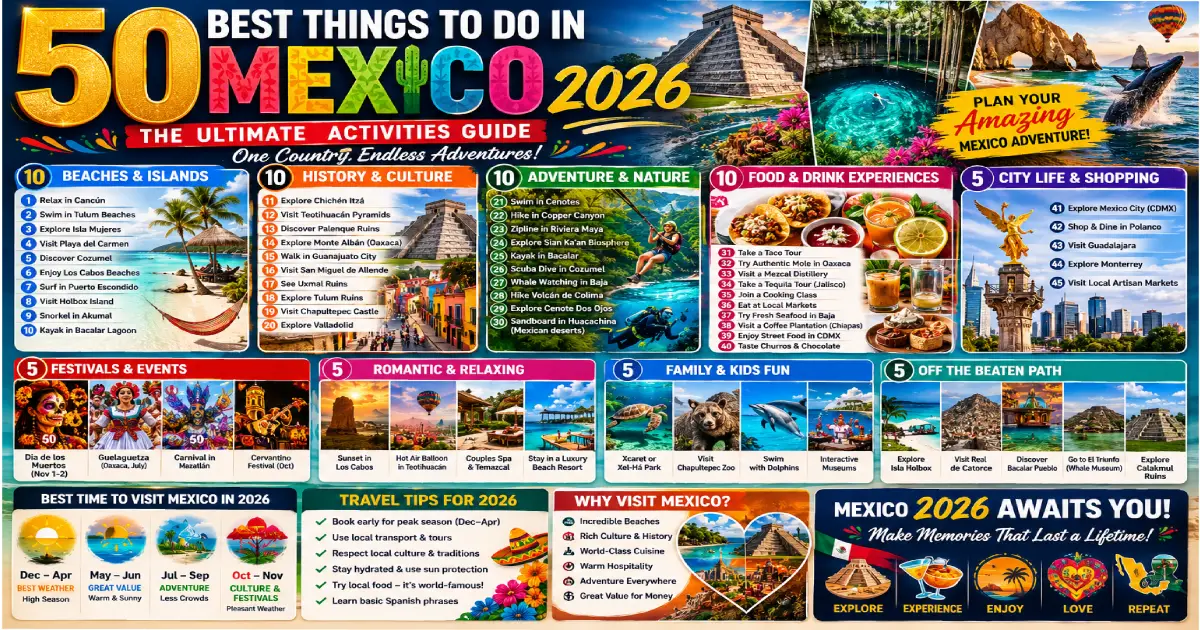
This guide covers the 50 best things to do in Mexico in 2026 — from the most iconic landmarks and the most specifically extraordinary natural experiences to the most authentic cultural encounters and the most honest practical tips for visiting safely and confidently. For regional comparisons, see our Puerto Rico vs Cancun guide.
Mexico Activities by Region
Region
Top Highlights
Best Base City
Season
Yucatan Peninsula
Chichén Itzá, cenotes, Tulum, Mérida
Cancun, Mérida, Playa del Carmen
November–April (dry)
Mexico City
Teotihuacan, Frida Kahlo, Zócalo, food
Mexico City (CDMX)
October–May (dry)
Oaxaca
Monte Albán, mole, mezcal, Day of the Dead
Oaxaca City
November–April; Oct for Día de Muertos
Baja California
Gray whale watching, Los Cabos, wine
La Paz, Cabo San Lucas
Jan–Apr (whale); Oct–May (Cabo)
Chiapas
Palenque, Sumidero Canyon, San Cristóbal
San Cristóbal de las Casas
November–May (dry)
Pacific Coast
Puerto Vallarta, turtle nesting, surfing
Puerto Vallarta, Mazatlán
November–May
The Yucatan Peninsula: Mexico’s Most Visited Region
1. Visit Chichén Itzá at Sunrise — THE MOST ESSENTIAL MEXICO EXPERIENCE
Why It’s #1: Chichén Itzá — one of the New Seven Wonders of the World, the most significant and the most extensively documented Mayan archaeological complex in Mexico — is the single most consequential cultural experience accessible in the entire country for any visitor arriving from a Caribbean or Yucatan base. The El Castillo pyramid (the 98-foot Kukulcan Temple with its precisely engineered equinox shadow-serpent effect), the Great Ball Court (the largest pre-Columbian ball court in the Americas, 545 feet long, where the game’s acoustics allow a whisper at one end to be heard at the other), the Cenote Sagrado (the Sacred Cenote where gold and jade objects — and human sacrifices — were deposited as offerings), and the Temple of Warriors collectively constitute the most intellectually rich and the most archaeologically significant single site accessible as a day trip from any Mexican resort city.
Beat the crowds: Arrive at opening (8 AM) — Chichén Itzá receives 3–4 million visitors per year, the most visited archaeological site in Mexico; the 8–10 AM window before tour buses arrive from Cancun produces the most crowd-free and the most photographically productive Chichén Itzá experience accessible without a private tour
Entry fee: $32/adult (federal zone) + $10 state fee = $42/adult total; open 8 AM–5 PM daily
From Cancun: 2.5 hours (organized tour $65–$85 with cenote stop, or rental car $45 fuel + toll)
Spring equinox (March 19–21): The most specifically dramatic and the most scientifically engineered single day at Chichén Itzá — the shadow serpent descending the El Castillo pyramid’s north staircase is only visible at the equinox. The most crowded single day at any Mexican archaeological site; arrive at 6 AM.
Cost: $42/adult entry; organized tour from Cancun $65–$85
Location: Tinúm, Yucatan — 2.5 hrs from Cancun, 1.5 hrs from Mérida
Best Time: November–April (cooler, drier); arrive at opening (8 AM) always
2. Swim in a Cenote — MOST UNIQUE MEXICO EXPERIENCE
Why It’s Essential: The Yucatan Peninsula’s 6,000+ cenotes — natural limestone sinkholes formed by the collapse of cave ceilings over underground rivers, producing freshwater swimming pools of extraordinary clarity and geological drama — are the most geographically specific and the most experientially irreplaceable natural feature of Mexico that is available nowhere else in the Americas at comparable scale. The most accessible and most spectacular cenotes near Cancun:
Cenote Ik Kil (adjacent to Chichén Itzá, $10/person): The most photographically famous and the most vertically dramatic cenote in the Yucatan — a 26-meter-deep circular sinkhole with hanging vines, cliff platforms, and the most specifically turquoise fresh water of any Yucatan cenote accessible on an organized tour. The ray of light effect (the single beam of sunlight penetrating the cenote’s circular opening and illuminating the pool below) is the most cited single Mexico nature photograph by any Yucatan visitor
Cenote Dos Ojos (near Tulum, $18/person): The most cave-diving and the most snorkel-complete cenote system in the Yucatan — the “Two Eyes” twin sinkholes connect to the world’s longest known underwater cave system, with guided snorkel tours through the most dramatically stalactite-lined underwater passages accessible without a dive certification
Gran Cenote (Tulum, $20/person): The most snorkeling-productive and the most turtle-populated open cenote near Tulum — freshwater turtles visible daily, stalactite formations visible through the crystal-clear water, the most specifically complete cenote snorkel experience accessible without a boat
Cenote Suytun (near Valladolid, $10/person): The most specifically photogenic and the most beam-of-light dramatic cenote for photography — the raised platform in the center of the turquoise pool positioned under the single skylight opening produces the most specifically extraordinary cenote portrait photograph accessible in the Yucatan
Cost: $10–$25/person entry
Location: Throughout the Yucatan Peninsula; most accessible from Cancun, Playa del Carmen, or Tulum
Best Time: 9–11 AM before tour group peak arrival
3. Explore the Tulum Ruins at Sunrise
Why It’s Outstanding: Tulum — the most photographically dramatic and the most specifically Caribbean-coast-positioned Mayan archaeological site in Mexico, where the El Castillo structure stands on a 40-foot cliff directly above the most turquoise Caribbean water accessible at any Mexican archaeological site — produces the most specifically extraordinary single archaeological photograph in Mexico: a 13th-century Mayan structure on a limestone cliff, with the turquoise Caribbean visible behind it and the jungle on either side. The sunrise viewing (timed entry opens at 8 AM; arrive at 7:30 AM for the queue) produces the most specifically extraordinary lighting and the most crowd-free experience before the day’s 5,000+ visitors arrive.
Timed entry reservation (recreation.gov equivalent — book through Mexico’s INAH portal, $5/person + $8 vehicle): Tulum’s timed entry system (introduced to manage the most overcrowded single Mexican archaeological site) requires advance booking for vehicle entry on peak days (December–April weekends)
From Playa del Carmen: 1 hour south on Highway 307; from Cancun: 1.5 hours
The beach below: The most specifically extraordinary combination — swim at the beach directly below the Tulum ruins after the archaeological site visit, where the most turquoise Mexican Caribbean water meets the most dramatic limestone cliff backdrop accessible at any Mexican beach
Cost: $5/person + $8 vehicle; open 8 AM–5 PM
Location: Tulum, Quintana Roo — 1 hr from Playa del Carmen, 1.5 hrs from Cancun
Best Time: 8–10 AM; avoid midday heat and peak crowds
4. Snorkel the Mesoamerican Barrier Reef at Cozumel
Why It’s Outstanding: The Mesoamerican Barrier Reef — the second-largest coral reef system in the world, running 620 miles along the Yucatan coast from Cancun to Honduras — produces the most specifically Caribbean-reef-character snorkeling and diving accessible in Mexico, and Cozumel Island (45-minute ferry from Playa del Carmen, $20 roundtrip) is the most accessible and the most reef-complete single dive destination on the entire reef system. The most specific Cozumel snorkel and dive sites: Palancar Reef (the most dramatic wall diving on the Western Caribbean corridor), Columbia Reef (the most coral-dense shallow snorkel accessible on any Cozumel day trip), and the Chankanaab National Marine Park ($26/adult, includes snorkel equipment, the most family-appropriate and the most sea turtle-reliable snorkel experience accessible on Cozumel).
Cost: Ferry $20 roundtrip; Chankanaab NMP $26/adult; dive 2-tank $85–$115
Location: Cozumel Island — 45-min ferry from Playa del Carmen
Best Time: November–April (clearest visibility, calmest seas)
5. Swim with Whale Sharks near Isla Holbox (June–September)
Why It’s Extraordinary: Isla Holbox — a car-free sand island off the north tip of the Yucatan Peninsula, 2 hours from Cancun — is the most accessible and the most reliably productive whale shark aggregation site in the world during the June–September feeding season. The whale sharks (the world’s largest fish, up to 40 feet long, filter-feeding on plankton in the warm Caribbean waters north of the Yucatan) aggregate in the Afuera Bank feeding area annually, and the guided snorkel tours ($100–$130/person) from Isla Holbox deliver the most accessible and the most reliably close in-water whale shark encounter accessible from any Mexican resort base.
Season: June 15–September 15 (peak July–August for the most whale shark density)
Tours: $100–$130/person from Isla Holbox; groups of maximum 8 swimmers per whale shark; the most strictly regulated in-water wildlife encounter accessible in Mexico to protect both the sharks and the swimmers
No touching policy: Mexican law prohibits touching whale sharks; the most responsible and the most specifically wildlife-protective single activity regulation accessible at any Mexico marine wildlife tour
Cost: $100–$130/person guided tour; $200+ from Cancun (ferry + tour package)
Location: Isla Holbox, Quintana Roo — 2 hrs from Cancun (bus + ferry)
Season: June 15–September 15
6. Explore the Walled City of Mérida
Why It’s Outstanding: Mérida — the capital of Yucatan state, founded in 1542 on the site of the Maya city of T’hó, with the most extensively preserved Spanish colonial architecture of any Mexican city outside Mexico City and Oaxaca — is the most specifically Mexican and the most specifically Yucatecan city accessible in the peninsula region: the Cathedral of San Ildefonso (the oldest operating cathedral in the Americas built on the Maya ruins of the city it replaced), the Sunday main square market (the most specifically local and the most Yucatecan cultural event accessible on any Mérida Sunday), and the Paseo de Montejo (the most Parisian-boulevard-influenced and the most specifically French-Second-Empire architecture-lined avenue accessible in any Mexican city) collectively produce the most culturally specific and the most historically layered city experience accessible in the Yucatan Peninsula. Mérida is 3.5 hours from Cancun and worth the journey specifically as a 2-night base for Chichén Itzá (1.5 hours) and Uxmal (1 hour) without the Cancun tourist corridor.
Cost: Free to explore; cathedral free; Sunday market free
Location: Mérida, Yucatan — 3.5 hrs from Cancun, 1.5 hrs from Chichén Itzá
7. Visit Uxmal — The Most Architecturally Beautiful Maya Site
Why It’s Notable: Uxmal — 62 miles south of Mérida — is the most architecturally refined and the most specifically Puuc-style Maya archaeological site in Mexico: the Pyramid of the Magician (the most elegantly curved and the most specifically distinctive Maya pyramid accessible in any Mexican archaeological site — oval rather than square at its base, the most technically specific and the most architecturally irreplaceable Maya pyramid form), the Governor’s Palace (considered by Frank Lloyd Wright to be the most beautiful single building in the Americas), and the Nunnery Quadrangle’s elaborate stone mosaic facades produce the most architecturally distinguished Mayan ruins accessible in Mexico outside of Chichén Itzá’s scale.
Cost: $20/adult; open 8 AM–5 PM
Location: 62 miles south of Mérida; day trip from Mérida (1 hour)
8. Explore Playa del Carmen and the 5th Avenue Pedestrian Corridor
Why It’s Notable: Playa del Carmen’s Quinta Avenida (5th Avenue) pedestrian corridor — the most specifically tourism-forward and the most comprehensively restaurant-and-shop-dense single street in the Riviera Maya — is the most social and the most walking-accessible single urban experience in the Mexican Caribbean, where the most international and the most specifically Riviera Maya nightlife, dining, and boutique shopping converge in a single pedestrian-only streetscape. The most specific 5th Avenue experiences: the rooftop mezcal bars, the most creative Mexican street food accessible in the Riviera Maya corridor, and the most specifically taco-vendor-density of any single street accessible between Cancun and Tulum.
Cost: Free to walk; tacos $3–$5; mezcal $8–$14
Location: Playa del Carmen, Quintana Roo — 1 hour south of Cancun
9. Day Trip to Valladolid
Why It’s Notable: Valladolid — the most specifically authentic and the most specifically non-touristy colonial city accessible within a 2-hour drive of Cancun — is the most honestly Mexican and the most specifically Yucatecan small city on the Cancun–Chichén Itzá–Mérida corridor: the bright colored facades of the central plaza, the most affordable and the most authentically Yucatecan lonchería lunch (the cochinita pibil tacos at the Bazar Municipal are the most cited Valladolid food experience by any returning visitor; $2–$3 each), and the Cenote Zaci (the most accessible in-town cenote in the Yucatan, $5 entry, inside the city limits) make Valladolid the most specifically off-the-Cancun-tour-bus and the most specifically authentic Yucatan experience accessible as a lunch stop between Cancun and Chichén Itzá.
Cost: Free to explore; Cenote Zaci $5; lunch $5–$12
Location: Valladolid, Yucatan — 2 hrs from Cancun, 45 min from Chichén Itzá
10. Snorkel with Sea Turtles at Akumal
Why It’s Outstanding: Akumal — the “Place of the Turtles” in Mayan, a small bay 25 miles south of Playa del Carmen — is the most accessible and the most reliably turtle-populated free snorkel destination in the Mexican Caribbean: green sea turtles feed on the seagrass beds in Akumal Bay daily, accessible by snorkeling from the public beach (free beach access, snorkel gear rental $10) in water of 5–10 feet depth that produces the most accessible and the most directly engaging turtle encounter of any Mexican Caribbean snorkel destination. The most specific Akumal note: arrive before 8 AM or after 3 PM to avoid the most crowded turtle-viewing windows and to experience the most undisturbed turtle behavior of any Akumal visit.
Cost: Free beach access; gear rental $10; tour from Playa $35–$55
Location: Akumal, Quintana Roo — 25 miles south of Playa del Carmen
Mexico City: The Americas’ Greatest Capital
11. Climb Teotihuacan at Sunrise — MOST SPECTACULAR MEXICO CITY DAY TRIP
Why It’s Essential: Teotihuacan — the pre-Aztec city 30 miles northeast of Mexico City, containing the Pyramid of the Sun (the third-largest pyramid in the world by volume, 216 feet tall, the most dramatically scalable and the most physically imposing single archaeological structure accessible in North America) and the Pyramid of the Moon (the most geometrically precise and the most specifically avenue-terminus-positioned of the Teotihuacan structures) — is the most overwhelmingly scaled and the most specifically ancient-civilization-awe-inspiring archaeological site accessible from any major North American city. The Avenue of the Dead (the most specifically named street in any archaeological site — 1.5 miles of processional avenue connecting the Pyramid of the Moon to the Ciudadela complex) and the Temple of Quetzalcoatl’s feathered serpent stone carvings produce the most comprehensively extraordinary single archaeological day accessible from Mexico City.
Sunrise visit strategy: The site opens at 9 AM officially, but the most crowd-free and the most spectacularly lit Pyramid of the Sun photographs are accessible from the surrounding agricultural area (accessible on foot before opening). Tour operators offer early access sunrise visits from Mexico City ($65–$85/person, the most specifically dawn-light-on-the-pyramids experience accessible without queuing)
From Mexico City: 1 hour by suburban bus (Autobuses Mexico-San Juan Teotihuacan from Terminal Norte, $3 each way, the most affordable and the most locally authentic transport) or taxi ($35–$50 each way)
Climb the Pyramid of the Sun: The 248 steps are the most physically demanding and the most specifically worthwhile single staircase climb accessible in any Mexican archaeological site; the summit view of the entire Teotihuacan complex (10 square kilometers) is the most panoramic and the most overwhelming archaeological site view accessible from any pyramid summit in North America
Cost: $6/adult entry; bus $3 each way from Mexico City
Location: San Juan Teotihuacan — 1 hour from Mexico City
Best Time: Arrive at opening (9 AM) on weekdays; avoid Sunday crowds
12. Visit the Frida Kahlo Museum (La Casa Azul)
Why It’s Outstanding: The Frida Kahlo Museum in Coyoacán — the most emotionally specific and the most personally revealing artist’s home accessible as a museum in the Americas — is Frida Kahlo’s actual birthplace and childhood home, preserved with the most specifically intimate and the most personally historically contextual exhibition accessible at any Latin American museum: Kahlo’s personal belongings (her clothing, her medicine cabinet with 3,000+ prescription bottles documenting the physical suffering that informed her entire artistic output), her working studio, Diego Rivera’s studio in the adjacent building, and the most specific collection of Kahlo’s correspondence and personal artifacts in any single institution. The Blue House’s cobalt blue facade is the most specifically photographed and the most immediately recognizable museum exterior in Mexico City.
Advance tickets mandatory: Book at museofridakahlo.org.mx a minimum of 2 weeks ahead in peak season — the museum limits daily visitors strictly, and walk-up admission is not available in December–April
Combined with Coyoacán: The most specifically charming and the most locally bohemian neighborhood in Mexico City — the Sunday artisan market, the most specifically Mexico City-local tlayuda and quesadilla street food, and the most colonial-era town square character accessible in any CDMX neighborhood make a Coyoacán afternoon the most complete Frida Kahlo visit
Cost: $18/adult; advance booking mandatory (museofridakahlo.org.mx)
Location: Londres 247, Coyoacán, Mexico City
Hours: 10 AM–5:30 PM; closed Monday
Transport: Metro to Coyoacán station (the most affordable) or Uber ($8–$12 from Centro Histórico)
13. Explore the Zócalo and Mexico City’s Historic Center
Why It’s Essential: The Zócalo — Mexico City’s main plaza, the most historically consequential urban square in the Americas (the site of the Aztec city of Tenochtitlan’s most sacred ceremonial center, and subsequently of the Spanish colonial capital’s most important civic buildings) — is the largest and the most historically layered urban plaza in the Western Hemisphere: the Metropolitan Cathedral (the most architecturally imposing and the most structurally idiosyncratic cathedral in the Americas, sinking unevenly into the drained lake bed beneath it), the National Palace (Diego Rivera’s most celebrated mural cycle — the History of Mexico — covers the main staircase walls in the most publicly accessible and the most nationally consequential Mexican mural art accessible anywhere), and the Templo Mayor (the excavated Aztec ceremonial center visible beneath the Centro Histórico’s colonial street grid, the most specifically extraordinary dual-civilization archaeology accessible in any American capital city).
National Palace murals (free): Diego Rivera’s History of Mexico mural cycle is the most specifically and the most nationally important artwork in Mexico — accessible free during the National Palace’s visitor hours (9 AM–5 PM daily). The most productive mural viewing strategy: arrive when the palace opens to have the main staircase less crowded
Templo Mayor ($7/adult): The Aztec ceremonial center beneath the Colonial streets — the most specifically juxtaposed ancient/colonial archaeology accessible in any major American city; the museum houses the most significant Aztec artifacts excavated from the site, including the most celebrated single Aztec artwork (the Coyolxauhqui Stone)
Cost: Zócalo free; National Palace free; Templo Mayor $7
Location: Centro Histórico, Mexico City (Metro: Zócalo)
Best Time: Weekday mornings; Sunday is the most festive (free museum day) and the most crowded
14. Visit the Anthropology Museum (MNAM)
Why It’s Outstanding: The National Museum of Anthropology in Chapultepec Park — the most significant and the most comprehensively collection-complete museum in Latin America — houses the most important single collection of pre-Columbian artifacts accessible in any museum in the world: the Aztec Sun Stone (the most reproduced and the most universally recognized single object in Mexican cultural heritage, incorrectly called the “Aztec Calendar” in most tourist-facing descriptions), the Jade mask of Pakal (the most technically exquisite single artifact from the most significant Mayan royal burial), and the most complete Olmec colossal head collection accessible in a single museum (the most mysterious and the most culturally consequential large-scale sculpture of the ancient Americas). The museum’s 23 rooms cover every major pre-Columbian culture in Mexico — the most complete single-building survey of 3,000 years of Mexican civilization accessible in any institution.
Cost: $5/adult; free Sunday for Mexican nationals; open 9 AM–7 PM; closed Monday
Location: Paseo de la Reforma and Gandhi, Chapultepec, Mexico City (Metro: Auditorio or Chapultepec)
15. Eat at the Mercado de San Juan and Roma/Condesa Neighborhoods
Why It’s Essential: Mexico City is the most specifically diverse and the most internationally celebrated food city in Latin America — the most Michelin-adjacent and the most James Beard-recognized Mexican restaurant concentration outside of New York’s Mexican diaspora restaurants, and the most specifically authentic and the most locally irreplaceable taco, tlayuda, and torta culture accessible in any single Latin American metropolis. The most specific CDMX food experiences:
Mercado de San Juan (Centro Histórico): The most gourmet-focused and the most internationally sourced covered market in Mexico City — the most specifically cheese, charcuterie, and specialty seafood market in CDMX, where the freshest tuna tostadas ($4), the most specifically Oaxacan-sourced tlayudas ($6), and the most Japanese-Mexican fusion accessible at any Mexico City market stall are available in the most specifically market-foodie-forward single address in the Centro
Al Pastor taco (everywhere, $1–$2): The most specifically Mexico City and the most quintessentially Mexican street food — marinated pork on a vertical trompo spit with pineapple, available at every corner from every taquero in the city at the most affordable and the most specifically capital-city-authentic price
Roma Norte restaurant scene ($30–$65/person): The most nationally and internationally acclaimed new Mexico City fine dining and casual dining restaurants are concentrated in the Roma Norte neighborhood — Contramar (the most celebrated single Mexico City lunch restaurant, the red and green tuna tostada the most cited single CDMX dish by any food publication), Quintonil (the most nationally recognized contemporary Mexican tasting menu, the most James Beard Award-recognized CDMX restaurant in 2026), and Pujol (Chef Enrique Olvera’s flagship, the most internationally ranked and the most specifically mole-aged menu accessible in Mexican fine dining — the Mole Madre, aged 1,000+ days, is the most specifically celebrated single Mexican restaurant dish accessible in any 2026 Latin America fine dining context)
Cost: $1–$3 street tacos; $30–$65 Roma casual dining; $150–$200 Pujol tasting menu
Location: Centro Histórico (mercado); Roma Norte and Condesa (restaurants)
Oaxaca: Mexico’s Cultural and Culinary Capital
16. Explore Oaxaca City and its Markets — BEST FOOD DESTINATION IN MEXICO
Why It’s Outstanding: Oaxaca City — the most specifically food-culture-celebrated and the most culinary-heritage-rich city in Mexico, in a state that has been producing the most internationally recognized Mexican cuisine for 3,000 years — is the single best food destination in Latin America according to virtually every major food publication that has ranked Latin American cities in the past decade. The most specific Oaxacan food experiences:
Mercado Benito Juárez: The most specifically Oaxacan and the most sensory-complete food market in Mexico — the tlayudas (large crunchy tortillas with black beans, Oaxacan cheese, and meat), the most chocolate-specific and the most mole-ingredient-sourcetracing market in any Mexican city, and the most affordable sit-down Oaxacan breakfast accessible ($8–$12) produce the most specifically irreplaceable single Mexico City morning food experience accessible on any market visit day
Mole negro ($15–$25/plate): Oaxaca’s mole negro is the most complex and the most specifically Oaxacan of the seven moles — containing 20–30 ingredients including chilhuacle negro, chocolate, banana, and the most specifically regional chile combination, cooked for the most hours and carrying the most generational knowledge of any Mexican mole preparation accessible in its home state
Mezcal tasting ($5–$15/flight): Oaxaca produces the most artisanal and the most agave-diverse mezcal in Mexico — the palenques (traditional mezcal distilleries) accessible in the Sierra Juárez villages surrounding Oaxaca City produce the most specifically single-village and the most agave-variety-specific mezcal accessible in any organized mezcal tour from any Mexican city
Cost: Mercado free entry; meal $8–$15; mezcal flight $5–$15
Location: Oaxaca City — 1-hour flight from Mexico City or 6-hour overnight bus
17. Climb Monte Albán at Sunrise
Why It’s Outstanding: Monte Albán — the Zapotec city built on a flattened mountain ridge 6 miles from Oaxaca City, inhabited from 500 BC to 700 AD and the most dramatically positioned and the most archaeologically complete pre-Columbian city accessible in southern Mexico — delivers the most panoramic single valley view accessible from any Mexican archaeological site: the Oaxaca Valley visible in three directions from the leveled mountain summit, with the most specifically Zapotec observatory (the most early-astronomical-observation-specific structure accessible in any Mexican ruin) and the most complete ball court-and-platform complex accessible in Oaxaca State. Arrive at opening (8 AM); tour buses from Oaxaca City arrive from 10 AM.
Cost: $5/adult; open 8 AM–5 PM
Location: 6 miles from Oaxaca City; taxi $8–$12 from centro
18. Attend the Guelaguetza Festival (July) or Day of the Dead (November 1–2)
Why These Are Extraordinary: The Guelaguetza (held the last two Mondays of July in Oaxaca) is the most specifically Oaxacan and the most UNESCO-recognized traditional dance and community ceremony accessible in Mexico — the most elaborately costumed and the most regionally diverse traditional folk dance festival accessible in any Mexican state, with participants from the most 16 culturally distinct Oaxacan communities in the most traditionally specific clothing and the most specifically regional dance form accessible in a single Oaxaca City amphitheater performance. The Day of the Dead in Oaxaca (November 1–2) is the most specifically celebrated and the most publicly accessible version of Mexico’s most internationally recognized cultural tradition — the graveside altars in the San Felipe Panteón, the most elaborate candlelit offerings, and the most specifically Oaxacan cultural blending of pre-Columbian and Catholic traditions produce the most emotionally specific and the most culturally irreplaceable single Mexico cultural event of any calendar year.
Guelaguetza tickets: $25–$80/person; book 6+ months ahead for July dates
Day of the Dead: Free to attend public cemetery vigils; hotel prices double in Oaxaca November 1–2
Baja California and the Pacific Coast
19. Touch Gray Whales in Baja California (January–April) — MOST EXTRAORDINARY MEXICO WILDLIFE EXPERIENCE
Why It’s Extraordinary: The gray whale lagoons of Baja California Sur — Laguna San Ignacio and Magdalena Bay, where gray whale mothers and calves come to the boats and actively seek contact with humans during the January–April calving and nursing season — produce the most specifically extraordinary and the most emotionally overwhelming wildlife encounter accessible anywhere in the Americas. The gray whale mothers approach the small skiff boats and present their calves to be touched by the human passengers — lifting the calves out of the water toward the boat occupants in the most specifically trust-implying and the most emotionally impossible-to-process whale behavior accessible at any wildlife destination in the world. This is the only location on earth where wild whales actively initiate physical contact with human visitors.
Laguna San Ignacio (most remote, most pristine): The most UNESCO-protected and the most specifically whale-contact-productive lagoon in Baja California — the 3-day/2-night land-based camp accessible from San Ignacio town (5 hours from Guerrero Negro) is the most specifically extraordinary and the most logistically committed whale encounter experience in Baja
Magdalena Bay (most accessible from Cabo): The most accessible and the most tour-operator-connected gray whale encounter accessible from Los Cabos — day-tour packages from Cabo ($350–$450/person including transport and boat time) deliver the most efficiently accessed gray whale petting experience in Baja California
Season: January 15 – April 15 (peak February–March for the most mother-calf contact behavior)
Cost: Day tour from Cabo $350–$450/person; 3-day camp from $550/person
Season: January 15 – April 15
20. Visit El Arco at Land’s End, Cabo San Lucas
Why It’s Notable: El Arco — the most globally recognized natural arch accessible from any Mexican Pacific resort city, at the very tip of the Baja California Peninsula where the Pacific Ocean meets the Sea of Cortez — is the most specifically Los Cabos and the most photographically irreplaceable single natural landmark accessible from any major Mexico Pacific coast resort. The glass-bottom boat tour ($20/person, the most affordable and the most sea-lion-proximate approach to El Arco) or the water taxi from the Cabo San Lucas marina ($15 roundtrip) deliver the most complete Arch and sea lion colony experience accessible from the Cabo marina.
Cost: Water taxi $15 roundtrip or glass-bottom boat $20
Location: Cabo San Lucas, Baja California Sur
21. Ride the Copper Canyon Train (El Chepe)
Why It’s Outstanding: The Ferrocarril Chihuahua al Pacífico — the Copper Canyon Railway, universally called “El Chepe” — is the most dramatically scenic and the most specifically engineering-ambitious railway journey accessible in the Americas: 396 miles from Los Mochis on the Pacific coast to Chihuahua in the Chihuahuan Desert, crossing the Sierra Tarahumara mountains through 37 bridges and 86 tunnels and past the Barrancas del Cobre (Copper Canyon system — four times the volume and comparable depth to the Grand Canyon, the most dramatically scaled canyon system accessible in Mexico). The most specifically recommended sections: the 3–4 day slow journey from Los Mochis to Creel (stopping at Divisadero for the most panoramic canyon view accessible from any El Chepe station platform) is the most spectacular and the most culturally complete Copper Canyon experience.
Cost: $100–$200 full route economy class; book at chepe.mx
Location: Los Mochis to Chihuahua; most scenic section Los Mochis to Creel
Duration: 15–16 hours full route; most visitors do 3–4 day journey with stops
22. Swim with Sea Lions in the Sea of Cortez (La Paz)
Why It’s Outstanding: La Paz — the capital of Baja California Sur, 2 hours north of Cabo San Lucas — sits on the most biologically productive sea in the world (Jacques Cousteau called the Sea of Cortez “the world’s aquarium”), producing the most accessible and the most wildlife-dense marine snorkeling accessible in any Mexican bay: sea lion colonies at Espíritu Santo Island (the most specifically personable and the most human-interaction-seeking sea lions accessible at any snorkel destination in Mexico), whale sharks in the La Paz Bay feeding zone (November–April, the most reliably accessible whale shark snorkeling accessible in the Baja region), and hammerhead sharks at the El Bajo seamount (the most specifically dramatic and the most internationally celebrated dive site accessible from La Paz).
Cost: Sea lion snorkel tour $85–$120/person; whale shark tour $65–$90/person
Location: La Paz, Baja California Sur — 2 hours from Cabo
Season: Sea lions year-round; whale sharks November–April
Chiapas and Southern Mexico
23. Explore the Palenque Ruins in the Jungle
Why It’s Outstanding: Palenque — the most jungle-embedded and the most architecturally elegant major Maya archaeological site accessible in Mexico — is the most specifically atmospheric and the most specifically dramatic of any Maya ruin in the country: the towering Temple of the Inscriptions (where the most celebrated single royal burial in the Americas — Pakal the Great’s jade mask-covered sarcophagus — was discovered in 1952), the Palace complex with its unique four-story tower (the most specifically observation-tower-like Maya structure accessible in any Chiapas archaeological site), and the most extensive carved inscriptions of any Maya site (the Temple of the Inscriptions’ 620-glyph inscription panel is the most detailed and the most historically informative single Maya stone text accessible at any Mexican archaeological site) emerge from the most dramatic jungle backdrop of any Mexican Mayan ruin. The howler monkeys audible from the site provide the most specifically atmospheric soundtrack.
Cost: $8/adult; open 8 AM–4:45 PM
Location: Palenque, Chiapas — 1.5 hrs from Villahermosa airport; overnight bus from Mexico City (12 hours)
24. See the Sumidero Canyon (Cañón del Sumidero)
Why It’s Outstanding: The Sumidero Canyon near Tuxtla Gutiérrez — a 3,000-foot-deep river canyon carved by the Grijalva River through the Chiapas highland, accessible by 2-hour boat tour from the Chiapa de Corzo dock — is the most dramatically scaled and the most specifically accessible river canyon accessible in southern Mexico: the 3,000-foot vertical walls rise directly from the river level in the most compressed vertical-to-water ratio accessible at any Mexican canyon, with the Christmas Tree formation (a perpetually moss-covered overhang shaped by the constant spray of a waterfall that grows greener and more specifically tree-shaped each season) and the spider monkey colonies visible on the canyon walls from the boat deck.
Cost: Boat tour $15–$20/person from Chiapa de Corzo
Location: Chiapa de Corzo, Chiapas — 15 min from Tuxtla Gutiérrez
25. Wander San Cristóbal de las Casas
Why It’s Notable: San Cristóbal de las Casas — at 7,200 feet elevation in the Chiapas Highlands, the most specifically indigenous-culture-present and the most politically historically specific city in southern Mexico (the Zapatista uprising of January 1, 1994 began in this city) — is the most dramatically mountain-lit and the most architecturally colonial-combined-with-indigenous-market-culture city in southern Mexico: the Templo de Santo Domingo’s elaborate Baroque facade and the adjacent indigenous textile market (the most specifically Tzotzil-culture-woven and the most ethically sourced handcraft market accessible in any Mexican highland city) produce the most culturally specific and the most authentically indigenous-craft-forward single Mexico city market experience accessible in Chiapas.
Cost: Free to explore; market crafts $15–$80; accommodation from $35/night
Location: San Cristóbal de las Casas, Chiapas — 1.5 hrs from Palenque (mountain road)
More Essential Mexico Activities
26. Visit the Monarch Butterfly Biosphere Reserve (November–March)
The most specifically extraordinary and the most numerically overwhelming wildlife spectacle accessible in North America — 200–500 million monarch butterflies overwinter in the oyamel fir forests of Michoacán (200 miles west of Mexico City), coating every branch and trunk in the most densely populated butterfly grove accessible on any continent. The El Rosario sanctuary ($5/adult) produces the most accessible and the most butterfly-dense viewing in the reserve. Season: November 15 – March 15.
Cost: $5 sanctuary entry + $8 horse rental to reach the grove; organized tour from Mexico City $85–$120/person
Season: November–March
27. Explore Puerto Vallarta’s Old Town (Zona Romántica)
Puerto Vallarta’s Zona Romántica — the most specifically cobblestone and the most Pacific Coast-charming neighborhood in Mexico’s busiest Pacific resort city — delivers the most specifically LGBTQ+-welcoming and the most specifically expat-integrated beach resort town character accessible on the Mexican Pacific: the Los Muertos Beach (the most specifically community-beach and the most attended public beach in Vallarta), the Malecón sculpture boardwalk (the most architecturally ambitious public art promenade accessible at any Mexican Pacific city), and the most specifically seafood taco street food (the most fresh-Pacific-catch fish and shrimp tacos at $3–$4 each from the Lazaro Cárdenas market stalls) make Puerto Vallarta’s old town the most complete and the most character-specific Pacific Mexico city experience accessible from any US Pacific connection.
Cost: Free to explore; fish tacos $3–$4; hotel from $80/night
Location: Puerto Vallarta, Jalisco — direct flights from most US West Coast cities
28. Visit the Agua Azul Waterfalls (Chiapas)
Agua Azul — the most specifically turquoise and the most dramatically tiered waterfall system accessible in southern Mexico (the limestone mineral content produces the most specifically electric-blue waterfall color accessible at any Mexican natural attraction) — is a 2-hour drive from Palenque and the most specifically photogenic and the most immediately visually extraordinary single nature day trip accessible in Chiapas.
Cost: $5/person; organized tour from Palenque $25–$40
Location: 2 hours from Palenque, Chiapas
29. Tour a Tequila Distillery in Jalisco
The town of Tequila in Jalisco — the original and the most historically specific tequila production center in Mexico — is accessible as a day trip from Guadalajara (1 hour) on the most specifically tequila-experience-complete heritage train (the Jose Cuervo Express, $130/person roundtrip including distillery tour and unlimited tequila tasting, the most specifically fun and the most appropriately named single train in Mexico). The Jose Cuervo La Rojeña distillery (the oldest operating tequila distillery in the world, established 1795) and the Herradura Estate (the most artisanal and the most award-winning single distillery accessible on the Tequila town tour circuit) produce the most comprehensively educational tequila heritage experience accessible in Mexico.
Cost: Jose Cuervo Express $130/person (all-inclusive); distillery tour only $15–$25
Location: Tequila, Jalisco — 1 hour from Guadalajara
30. Experience Semana Santa (Holy Week) in Taxco or Pátzcuaro
Mexico’s Semana Santa (Holy Week, the week before Easter) is the most specifically and the most publicly Catholic and the most theatrically processional religious week accessible in any Spanish-speaking country outside of Seville, Spain. Taxco (the most specifically silver-mining and the most dramatically hillside-colonial city in Guerrero state, 2.5 hours from Mexico City) hosts the most elaborately flagellant and the most specifically penance-processional Semana Santa accessible in central Mexico. Pátzcuaro in Michoacán hosts the most specifically indigenous-Purépecha-combined with Catholic Semana Santa accessible in western Mexico.
Cost: Free to attend public processions
2026 Holy Week: April 6–12 (Easter Sunday April 13)
Additional 20 Things to Do in Mexico
31. Snorkel at Xel-Há Park (Riviera Maya)
The most child-friendly and the most snorkel-complete natural aquatic park accessible in the Riviera Maya — the Xel-Há inlet (where a freshwater river meets the Caribbean, producing the most fish-diverse brackish snorkel environment accessible at any Riviera Maya attraction) is an all-inclusive day park ($89/adult including equipment, food, and activities) that produces the most specifically comprehensive and the most relaxed family snorkeling day accessible in Mexico’s Caribbean.
Cost: $89/adult all-inclusive; $45/child
Location: Highway 307, between Tulum and Playa del Carmen
Yaxchilán — the Maya city on an oxbow bend of the Usumacinta River on the Guatemala border, accessible only by 45-minute motorized canoe from Frontera Corozal — is the most remotely positioned and the most dramatically river-jungle-embedded Maya site in Mexico, producing the most specifically adventure-archaeological and the most howler-monkey-soundtrack-accompanied ruin visit accessible in any Mexican state.
Cost: $8 entry + $40 boat roundtrip; guided tour from Palenque $85/person
33. Explore Guanajuato City
Guanajuato — the most specifically labyrinthine and the most dramatically pedestrian-tunnel-networked colonial city in Mexico, built in a narrow ravine where the streets are so narrow that multiple sections of the city move through underground tunnels originally built as drainage canals — is the most architecturally unexpected and the most specifically non-linear urban experience accessible in central Mexico. The Festival Cervantino (October, the most internationally celebrated Latin American theater and arts festival) and the Mummy Museum (the most specifically morbidly fascinating and the most tourist-debated single attraction in any Mexican UNESCO city) make Guanajuato the most specifically culturally active and the most architecturally unique colonial city accessible in Mexico’s Bajío region.
Cost: Free to explore; Mummy Museum $4; 4-hour bus from Mexico City
34. Day Trip to Tepoztlán from Mexico City
Tepoztlán — the most specifically mystical-reputation-forward and the most dramatically pyramid-topped-cliff-ringed small town accessible within 1.5 hours of Mexico City — delivers the most dramatically positioned Aztec pyramid in the closest distance to the capital (the Tepozteco pyramid, 1,200 feet above the town, a 2-hour hike producing the most panoramic Morelos valley view accessible from any Mexico City day trip mountain) and the most specifically alternative-healing and the most metaphysical-market-forward Sunday tianguis (the most eclectic and the most specifically spiritual-wellness-product-specific market) accessible in any Mexico City weekend day trip destination.
Cost: Pyramid entry $3; bus from TAPO terminal $5 each way
35. Visit Izamal, the Yellow City (Yucatan)
Izamal — entirely painted in the most specifically ochre-yellow and the most colonial-Mexico-signature color, a single-color-painted colonial city on Mayan pyramid foundations in the northern Yucatan — is the most specifically monochromatic and the most uniquely atmospheric colonial city accessible as a day trip from Mérida (1 hour). Pope John Paul II visited Izamal in 1993; the Convento de San Antonio de Padua (built on the foundations of a Mayan pyramid, the most specifically layered colonial religious site in the Yucatan) and the intact Kinich Kakmó pyramid (freely walkable in the center of town, the most accessible Mayan pyramid within a colonial city in Mexico) make Izamal the most specifically visually extraordinary single-color city day trip accessible from Mérida.
Cost: Free to explore; horse carriage tour $15/hour
Location: 1 hour east of Mérida
36–50. More Essential Mexico Activities
36. Surf at Puerto Escondido (Oaxaca coast): The Mexican Pipeline — the most powerful and the most specifically barrel-wave-producing beach break accessible in the Americas outside of Hawaii’s Banzai Pipeline; the Zicatela Beach break is the most internationally surfing-celebrated Mexican wave. Season: June–October for the most powerful swells; November–May for more manageable conditions. ($40–$60/lesson for beginners)
37. Visit Hierve el Agua Petrified Waterfalls (Oaxaca): The most surreal and the most specifically mineral-deposit-produced natural formation in Mexico — the calcium-carbonate-encrusted cliffs that appear to be frozen waterfalls over the Oaxacan valley, with the most specifically extraordinary mineral pool bathing ($5 entry) accessible from any Oaxacan day trip.
38. Explore the Lacandón Jungle and Bonampak Murals (Chiapas): The most specifically intact and the most culturally significant surviving Maya fresco paintings — the Bonampak murals (Room 1’s war and tribute scenes are the most specifically narrative and the most colorfully preserved Maya painting accessible in any Mexican site, accessible only by 3-hour dirt road from Palenque or by small plane)
39. Visit the Mitla Archaeological Zone (Oaxaca): The most specifically Zapotec-mosaic-decorated and the most architecturally geometric Maya/Zapotec site accessible from Oaxaca City (45 minutes, $3 entry) — the stone mosaic panels are the most specifically intricate decorative stone work accessible in any southern Mexico archaeological site
40. Whale watch in Banderas Bay (Puerto Vallarta, December–March): Humpback whale mothers and calves in the most specifically Pacific Mexico whale nursery accessible from any Puerto Vallarta marina — $65–$85/person, 3–4 hours, the most reliable humpback encounter accessible on the Mexican Pacific coast
41. Visit Guadalajara and the Tlaquepaque artisan district: The most specifically craft-market-complete and the most traditionally Talavera-pottery-accessible artisan neighborhood in western Mexico — the Tlaquepaque shopping district is the most artisan-shop-dense and the most specifically handcraft-forward single neighborhood accessible from any major Mexican city (1 hour by road from Puerto Vallarta; 20 minutes from Guadalajara city center)
42. Cenote Dzitnup near Valladolid ($5): The most accessible and the most photogenically extraordinary cenote accessible under $10 in the Yucatan — the vaulted ceiling opening produces the most specifically beam-of-light photography accessible without a tour operator
43. Eat mole at the source in Oaxaca (Itanoni or Los Danzantes): The most specifically mole-negro-authentic and the most traditional-preparation-forward mole accessible in any Oaxacan restaurant — Itanoni’s tlayuda ($10) uses the most heirloom-corn-specific and the most locally-indigenous-grain-variety masa accessible in any Oaxacan restaurant
44. Visit Isla Mujeres from Cancun ($10 ferry): The most accessible and the most specifically Caribbean-character island accessible from the Cancun Hotel Zone — golf cart the entire island ($25/hour), swim the Caribbean’s most accessible sea turtle feeding ground at the Garrafon Natural Reef Park, and eat the most fresh-caught whole fish ($20) at the most specifically local seafood restaurant on the island’s southern Playa Lancheros
45. Take a cooking class in Oaxaca or Mexico City ($65–$95/person): The most specifically hands-on and the most culturally immersive culinary education accessible in Mexico — La Casa de los Sabores in Oaxaca (the most specifically mole-focused and the most locally-ingredient-market-preceded cooking class) and Eat Mexico’s CDMX street food cooking class (the most specifically Mexico City street food culture-forward) are the most consistently praised single-day cooking experiences accessible in Mexico
46. Visit Cenote Angelita near Tulum (halocline dive, $80): The most specifically mysterious and the most scientifically extraordinary single underwater experience in the Yucatan — a 60-meter-deep cenote where fresh water and salt water meet in a hydrogen sulfide cloud that produces the appearance of an underwater river visible from 30 meters depth; the most specifically recommended single dive in Mexico for experienced divers
47. Explore the Zócalo of Oaxaca on Sunday (free): The most festive and the most specifically local-culture-visible Sunday in any Mexican colonial city — the marimba band, the traditional clothing vendors, and the most specifically Oaxacan street food density of any Sunday market produce the most authentically Oaxacan public square experience accessible at any city’s free public event
48. Kayak the mangroves of Celestún (Yucatan, flamingos): The Celestún Biosphere Reserve’s mangrove estuary — the most accessible and the most flamingo-populated coastal wetland accessible as a day trip from Mérida (1.5 hours) — delivers American flamingo flocks of 10,000+ in the peak October–March season from the most specifically quiet and the most wildlife-immersive motorized boat tour accessible in the Yucatan ($20/person, Celestún boat cooperatives)
49. Night visit to Teotihuacan under the stars (special events): The most specifically atmospheric and the most dramatically lit version of Mexico’s most visited archaeological site — Teotihuacan’s “Noche de Estrellas” (Night of Stars) events, held on specific dates throughout the year, allow access to the pyramids under a projection mapping light show ($15–$25/person, check INAH calendar for 2026 dates)
50. Take the ferry to Holbox and watch the bioluminescence: Isla Holbox’s bioluminescent bay (accessible by kayak or swimming from the Holbox beach at night, free, most intense at new moon) — the most accessible and the most affordable bioluminescent experience in Mexico, significantly less intense than Vieques’s Mosquito Bay but genuinely extraordinary in its own right on the darkest nights of the Holbox calendar
Practical Tips for Visiting Mexico
Topic
Essential Information
Passport
Valid US passport required for all Mexico entry; valid for 6+ months beyond travel dates. FMM tourist card (free, issued on arrival or included in airline ticket) required for stays over 7 days at some border crossings.
Safety
US State Department issues state-by-state advisories — Quintana Roo (Cancun/Tulum) Level 2; Mexico City Level 2; Oaxaca Level 2; Chiapas Level 3 (specific areas). Most tourist destinations are safe in daylight; use licensed taxis or Uber; never take unofficial taxis from airports; stay in tourist zones after dark. Purchase comprehensive travel insurance for any Mexico trip.
Tap Water
Do NOT drink tap water anywhere in Mexico — use purified bottled water (agua purificada) for drinking and teeth brushing. Ice in tourist restaurants and hotels is purified; street ice varies. Most traveler’s diarrhea in Mexico is from street food or uncooked vegetables washed in tap water; start with cooked foods and upscale restaurants if your digestive system is sensitive.
Currency
Mexican Peso (MXN); current rate approximately 17–18 MXN per USD (2026). US dollars accepted at most tourist venues but at unfavorable rates — exchange at airport bank kiosks (most convenient though slightly less favorable) or use ATMs at bank branches (most favorable rate, use Banamex, BBVA, or Santander ATMs for the most reliable and the most scam-avoiding experience). Inform your US bank before travel to avoid card freezes.
Best Time to Visit
November–April: Best for Yucatan, Mexico City, Oaxaca, Baja (whale season Jan–Apr). June–September: Best for whale sharks (Holbox), gray whales (Nov–Apr Baja), monarch butterflies (Nov–Mar Michoacán). July–August: Most crowded and most expensive everywhere. Day of the Dead (Nov 1–2): Best for Oaxaca cultural experience.
Tipping
10–15% at restaurants; 20% at tourist-oriented establishments; $1–$2 per bag for hotel porters; $1 per round for bar service; always tip tour guides ($5–$20 per person per day depending on length and quality). Tipping is the most consequential single financial-respect gesture accessible in any Mexico service interaction — the service industry relies on tips and the most specifically appreciated single visitor behavior is the most consistently and the most generously applied gratuity.
Frequently Asked Questions: Things to Do in Mexico
What is the most famous thing to do in Mexico?
Visiting Chichén Itzá — one of the New Seven Wonders of the World — is the single most famous and the most internationally recognized Mexico tourism activity. The El Castillo pyramid at Chichén Itzá is the most photographed building in the Americas and the most specifically Mexico-identified single image in global travel photography. The most productive Chichén Itzá visit: arrive at opening (8 AM), spend 2–3 hours before tour buses arrive, combine with a cenote swim and Valladolid lunch for the most complete Yucatan day trip accessible from Cancun.
What are the best things to do in Mexico for first-time visitors?
The most specifically recommended first Mexico visit combines Chichén Itzá (most famous landmark), a cenote swim (most unique experience), Tulum ruins (most photographically extraordinary), and a local taco or mole meal (most culturally irreplaceable) in a 7-day Yucatan-based itinerary accessible from Cancun. Mexico City deserves a separate trip — the Teotihuacan pyramids, the Frida Kahlo Museum, and the Pujol/Quintonil/Contramar restaurant scene collectively produce the most culturally complete Mexican capital experience accessible in a 4-day CDMX visit.
Is Mexico safe to visit in 2026?
Mexico is safe for tourists in the well-traveled tourist areas — Cancun/Riviera Maya (Quintana Roo Level 2), Mexico City (Level 2), Oaxaca (Level 2), Puerto Vallarta (Jalisco Level 3 — specific areas), Baja California Sur/Los Cabos (Level 2) are all destinations where the vast majority of the most millions of annual American visitors experience no safety incidents. Apply standard international travel awareness: use Uber or licensed taxis exclusively, never accept rides from unofficial airport taxi drivers, stay in tourist zones after midnight, keep possessions secure in crowded markets, and purchase comprehensive travel insurance for all Mexico trips. Check the US State Department’s most current state-by-state Mexico advisory at travel.state.gov before any Mexico trip.
Final Thoughts: Mexico Rewards the Curious Visitor
Mexico is the most geographically diverse, the most historically layered, and the most specifically culinary-heritage-rich country accessible within a 4-hour flight of the continental United States — a country that has been producing the world’s most specifically UNESCO-designated national cuisine, the most dramatically cenote-laced limestone peninsula, the most accessible single New Wonder of the World, and the most specifically extraordinary gray whale-baby-petting experience accessible in any mammal-human interaction in the natural world, simultaneously, for a nation of visitors who consistently underestimate the country by reducing it to the Cancun Hotel Zone and the most expensive hotel breakfast of any all-inclusive in the Western Hemisphere.
Chichén Itzá at 8 AM before the tour buses arrive. A cenote swim in Dos Ojos’s crystal-clear cave water. The Frida Kahlo Blue House on a Tuesday morning with advance tickets. A gray whale’s calf presented to your boat by its mother in Laguna San Ignacio in February. The mole negro at Itanoni in Oaxaca. The Pyramid of the Sun summit at Teotihuacan with the entire valley visible below. The Copper Canyon from the El Chepe train window. These are the most specifically and the most irreplaceably Mexican experiences accessible anywhere in the Americas — and the most honest reason to visit a country that has always been more than the most famous beach and the most famous pyramid that most international visitors see first and sometimes last.
—
—
About Travel TouristerTravel Tourister’s Mexico specialists have traveled extensively across the Yucatan Peninsula, Mexico City, Oaxaca, Baja California, and Chiapas — from Chichén Itzá at sunrise and Dos Ojos cenote snorkeling to the Frida Kahlo Museum, Oaxacan mole negro at source, and the Magdalena Bay gray whale encounter — to provide the most honest and most comprehensive Mexico activities guide available for Tier 1 travelers in 2026.
—
Posted By: Vinay
As a lead contributor for Travel Tourister, Vinay is dedicated to serving our Tier 1 audience (US, UK, Canada, Australia). His mission is to deliver precise, fact-checked travel guidance and actionable, data-driven articles that empower readers to make informed decisions, minimize travel risks, and maximize their adventures without compromising safety, experience quality, or budget.
—
Official Government & Tourism Resources
Visit Mexico — Official Mexico Tourism Board (Secretaría de Turismo) — Official Mexican federal government tourism resource covering all regional destinations, current entry requirements for US, UK, Canadian, and Australian citizens, attraction listings across all Mexican states, and the most authoritative Mexico visitor guidance from the federal Secretaría de Turismo.
US Department of State — Official Mexico Travel Advisory — Official US government state-by-state Mexico travel advisory covering current safety levels for Quintana Roo, Mexico City, Oaxaca, Jalisco, Chiapas, and Baja California Sur; emergency contact information for US citizens in Mexico; and the most current entry requirement and health guidance for American travelers visiting any Mexican state.
CDC Travelers’ Health — Official Mexico Health Guidance (US Government) — Official US Centers for Disease Control resource covering vaccination recommendations for Mexico travel, food and water safety guidance, Zika and dengue current risk levels by Mexican region, and the most authoritative health preparation information for any Mexico trip including Yucatan, Chiapas, and Oaxaca.
Posted By : Vinay
As a lead contributor for Travel Tourister, Vinay is dedicated to serving our Tier 1 audience (US, UK, Canada, Australia). His mission is to deliver precise, fact-checked news and actionable, data-driven articles that empower readers to make informed decisions, minimize travel risks, and maximize their adventure without compromising safety or budget.
Travel Tourister is a leading Travel portal where we introduce travellers to trusted travel agents to make their journey hasselfree, memorable And happy. Travel Tourister is a platform where travellers get Tour packages ,Hotel packages deals through trusted travel companies And hoteliers who are working with us across the world. We always try to find new and more travel agents and hoteliers from every nook and corners across the world so that you could compare the deals with different travel agents and hoteliers and book your tour or hotel with the one you have chosen according to your taste and budget.






 Call
Call Enquiry