San Diego vs Los Angeles: Which SoCal City Should You Visit? (2026 Guide)
Published on : 11 May 2026
San Diego vs Los Angeles — Southern California’s Two Greatest Cities, Honestly Compared
By Travel Tourister | Updated May 2026
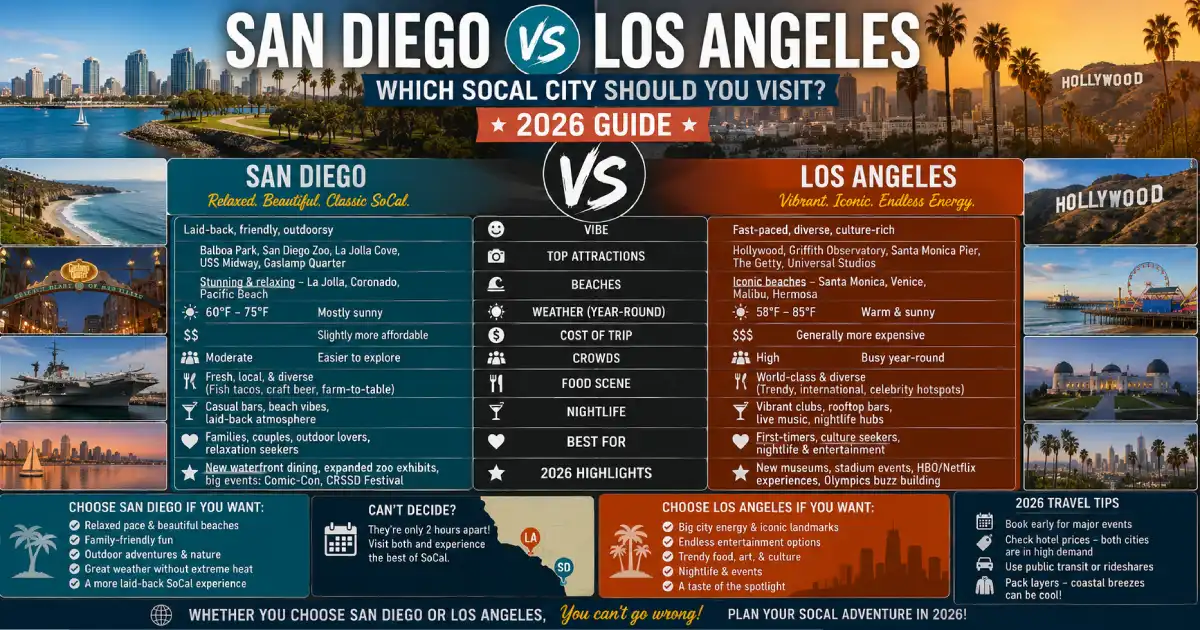
San Diego and Los Angeles sit 120 miles apart on the Southern California coast — close enough to drive between them in under 2 hours on I-5 without traffic (a qualifier that requires immediate acknowledgment: Los Angeles traffic is the most consequential single planning variable in any SoCal trip, and “without traffic” between San Diego and LA at 5 PM on a Friday means 3–4 hours rather than 2), and separated by the most specific character difference available in California city comparisons: San Diego is the most relaxed, the most genuinely beach-life-integrated, and the most specifically sun-drenched livable city in the United States — a city whose year-round weather (70°F average, the most consistently perfect urban climate in America) and whose beach access (70 miles of Pacific coastline within city limits, from the Silver Strand to Black’s Beach) and whose craft beer scene (the most brewery-per-capita dense major American city) and whose Balboa Park (the most culturally generous single urban park in the US, with 17 museums in a single National Historic Landmark complex, 13 of them free on rotating Tuesday schedules) collectively produce the most genuinely livable and the most specifically relaxed major American city experience accessible in the continental United States. Los Angeles is the most culturally ambitious, the most globally influential, the most entertainment-industry-saturated, and the most sprawling major American city — a metro area of 13 million people spread across 503 square miles that produces more of America’s exported cultural identity (film, television, music, fashion) than any other single metropolitan area in the world, with the Getty Center’s Meier architecture and Impressionist collection, the Hollywood Sign, the Griffith Observatory, the world’s most celebrated studio backlots, and a restaurant scene that has been the most diverse in California and the most James Beard-adjacent outside New York for a decade.
Choosing between them for a Southern California trip is the most specifically productive West Coast city planning decision available — because San Diego and Los Angeles are genuinely different in pace, cost, beach quality, cultural ambition, entertainment industry access, and the specific experience of being in each city. This guide breaks down every meaningful category honestly for the visitor choosing between SoCal’s two finest cities.
For more US city guides, see our Miami vs New York and Dallas vs Austin guides.
The Most Important Facts First
Key Fact
🌊 San Diego
🎬 Los Angeles
Population (City)
1.4 million
4 million city / 13 million metro
Average Year-Round Temp
70°F — most consistent climate in the US
65–75°F — excellent but more variable
Miles of Beach
70 miles of Pacific coastline in city limits
75 miles of coastline (LA County)
Nearest Airport
San Diego Int’l (SAN) — 3 miles from downtown
LAX — 18 miles from Hollywood; also BUR, LGB, ONT
Midrange Hotel (per night)
$155–$280 (downtown/beach areas)
$195–$380 (Hollywood/Santa Monica)
Traffic
Manageable — significant but not LA-level
Most congested city in the US — plan everything around traffic
Craft Breweries
150+ — most per capita of any major US city
Growing scene; less celebrated than SD
Zoo / Wildlife
San Diego Zoo — #1 rated zoo in the world
LA Zoo (good but not SD-level)
Mexico Border
Tijuana 30 min — most crossed border in world
Tijuana 2.5 hours south
City Character
Relaxed beach city — most livable in America
Ambitious, sprawling — entertainment capital of the world
Quick Verdict: San Diego vs Los Angeles
Category
🌊 San Diego Wins
🎬 Los Angeles Wins
Winner
Best Beaches
Coronado, La Jolla, Pacific Beach, Mission Beach
Malibu, Santa Monica, Venice, Zuma
🌊 San Diego (calmer water, better swimming)
Weather Consistency
70°F average year-round — most consistent in US
Excellent but more June Gloom; inland areas hotter
🌊 San Diego
Zoo
San Diego Zoo — #1 in the world, giant pandas
LA Zoo — good but outclassed by SD
🌊 San Diego
Craft Beer
Most per capita in US — Ballast Point, Stone, Societe
Growing scene; less celebrated
🌊 San Diego
Hollywood & Entertainment
Not available
Hollywood Sign, studio tours, Walk of Fame, celebrity culture
🎬 Los Angeles
Art Museums
Balboa Park museums (13 free Tuesdays)
Getty Center (free always!), LACMA, The Broad, MOCA
🎬 Los Angeles
Food Scene
Best fish tacos in California, craft beer pairings, Baja-Med cuisine
Most diverse food city on West Coast — every cuisine; most Michelin stars in California
🎬 Los Angeles
Hotel Cost
$155–$280 midrange
$195–$380 midrange
🌊 San Diego
Traffic & Stress
Manageable; SAN airport 3 miles from downtown
Most congested US city — LAX to Hollywood can be 90 min
🌊 San Diego
Balboa Park
Most culturally generous urban park in US — 17 museums, free Tuesdays
Griffith Park (larger; Observatory, hiking)
🌊 San Diego
Snorkeling & Wildlife
La Jolla Cove sea lions, snorkeling, leopard sharks
Whale watching (Dec–Apr) from Long Beach/San Pedro
🌊 San Diego
Mexico Day Trip
Tijuana 30 min — most crossed border in world
Tijuana 2.5 hours — less practical day trip
🌊 San Diego
Overall City Scale
Manageable, human-scale — see most in 3–4 days
Vast — needs 7+ days to scratch the surface
🌊 San Diego (efficiency); 🎬 LA (breadth)
San Diego: America’s Most Livable City
The Weather: 70°F and Perpetually Perfect
San Diego’s climate is the most consistently and the most specifically perfect of any major American city — a Mediterranean climate producing an average year-round temperature of 70°F, fewer than 40 rainy days per year, and the specific perpetual sunshine that has made “America’s Finest City” (the official San Diego nickname that the city uses without irony and delivers without apology) the most specifically weather-perfect urban environment in the continental United States. The climate comparison with Los Angeles: both cities are excellent; San Diego is more consistent. Los Angeles has “June Gloom” — the marine layer that covers the LA coastal areas in low cloud from May through early July, producing grey mornings that burn off by noon but that significantly reduce the first-impression beach experience for the visitor who arrives in June expecting the postcard-blue California sky. San Diego has its own June Gloom but less intense and less prolonged. Inland Los Angeles areas (Pasadena, Burbank, the San Fernando Valley) routinely reach 95–100°F in summer while the San Diego coast sits at 72°F on the same day. The weather verdict is honest: both cities are among the finest weather cities in the US; San Diego is more consistently perfect across all 12 months.
San Diego’s Beaches: The Best Swimming Beaches in California
San Diego’s beaches are the most swimming-friendly and the most water-temperature-accessible of any Southern California beach city — the San Diego Bight’s geography creates calmer, warmer water conditions than the more exposed Los Angeles County beaches, and the variety (from the elegant Silver Strand at Coronado to the bohemian chaos of Pacific Beach to the dramatic sea caves of La Jolla to the nude beach at Black’s) is the most complete single-city beach range in California.
Coronado Beach: Consistently rated among the top 5 beaches in the United States by Dr. Beach — the broad white sand beach on the Coronado Peninsula, with the 1888 Hotel del Coronado as the most historically specific Victorian resort hotel backdrop accessible at any California beach. The most photographically extraordinary and the most physically wide beach in San Diego, with the downtown skyline visible across the bay and the Pacific waves rolling in on the beach’s ocean side. Free access; $10 parking at the main Coronado Beach lot.
La Jolla Cove: The most ecologically specific and the most wildlife-rich beach experience in San Diego — the protected marine reserve at La Jolla Cove produces the most reliably accessible sea lion colony (300+ California sea lions on the adjacent Children’s Pool and La Jolla Cove rocks, the most accessible wild pinniped viewing in any California city), the most consistent and the most fish-rich shore snorkeling (the underwater canyon dropping from the cove’s edge produces the most diverse marine life visible from the surface), and the specific La Jolla geological drama (the Sunny Jim Cave, accessible through a carved tunnel at La Jolla Cove — the most specifically La Jolla tourist experience at $5/adult). Free beach access; seasonal leopard shark nursery in the summer shallows (the most accessible shark encounter at any California beach — completely harmless, genuinely extraordinary).
Pacific Beach and Mission Beach: The most energetic and the most specifically beach-lifestyle-forward San Diego beaches — the Mission Beach Boardwalk (a 3-mile beachfront promenade with beach volleyball courts, bike rentals, and the Belmont Park amusement rides) and the Pacific Beach bar and restaurant corridor produce the most specifically Southern California beach-town cultural experience accessible in San Diego’s beach corridor.
Ocean Beach: The most locally authentic and the most community-specific San Diego beach neighborhood — the OB Pier (the longest pier on the US West Coast), the Wednesday farmers market (the longest continuously running street fair in San Diego), and the specific anti-gentrification, pro-dog, pro-hippie character that makes Ocean Beach the most specifically beloved local neighborhood in San Diego by its residents.
Balboa Park: The Most Generous Urban Park in America
Balboa Park — the 1,200-acre urban cultural park in central San Diego, declared a National Historic Landmark and containing 17 museums, 15 gardens, the Old Globe Theatre, the San Diego Zoo, multiple performance venues, and the most complete collection of Spanish Colonial Revival architecture accessible at any US park — is the single most culturally generous and the most comprehensively rewarding urban park in the United States. The free Tuesday museum rotation (each of the park’s 13 free-to-residents museums offers free admission to all visitors on a specific Tuesday of the month — check balboapark.org for the current schedule) is the most specifically San Diego cultural value accessible to any visitor, and the park’s combination of the San Diego Museum of Art, the San Diego Natural History Museum, the Timken Museum of Art (the most undervisited and the most completely free permanent collection museum in California, with genuine Old Masters including Rembrandt, Rubens, and Zurbarán), and the Mingei International Museum makes Balboa Park the most rewarding single urban park cultural afternoon accessible in any California city.
San Diego Zoo: The Best Zoo in the World
The San Diego Zoo — consistently ranked the #1 zoo in the world by USA Today, TripAdvisor, and the most reliable zoo quality metrics accessible — is San Diego’s most unambiguous single attraction superlative and the most compelling single reason for families to choose San Diego over Los Angeles if a world-class zoo is on the agenda. The specific San Diego Zoo advantages: the most naturalistic and the most expansive enclosures accessible at any US zoo (the gorilla enclosure, the elephant habitat, and the Africa Rocks biome are the most specifically naturalistic at any American zoo), the bamboo grove giant pandas (the most reliably visible and the most consistently active giant panda population at any North American zoo in 2026), and the aerial gondola that provides the most panoramic zoo viewing accessible without walking a single trail ($65/adult general admission, free to San Diego residents with ID). The San Diego Zoo Safari Park in Escondido (30 miles north) is a separate facility with the most expansive African savanna enclosures accessible at any North American safari park — the most specifically African-landscape wildlife viewing in the United States at $65/adult.
Craft Beer: America’s Craft Beer Capital
San Diego is the most brewery-per-capita dense major American city — 150+ craft breweries in a city of 1.4 million, producing the most specifically craft-beer-focused brewing culture accessible at any US city at comparable population scale. The specific San Diego brewing institutions: Ballast Point (the most nationally distributed and the most specifically San Diego-associated craft beer brand — the Sculpin IPA is the most awarded single California craft beer), Stone Brewing (the most architecturally spectacular brewery in Southern California — the Stone Brewing World Bistro and Gardens in Escondido is the most brewery-campus-complete and the most beer-garden-specific dining accessible in San Diego), Societe Brewing (the most technically precise and the most beer-geek-celebrated taproom in the city), and the North Park Brewing neighborhood (the most walkable craft brewery district in San Diego, with 6 taprooms accessible on foot from the North Park main street). The most productive San Diego craft beer day: take the North Park Brewing neighborhood walking tour, starting at Hamilton’s Tavern (the most beer-selection-complete craft beer bar in San Diego, with 30+ taps of local and national craft beer) and moving to North Park Beer Co, Belching Beaver, and Tiger! Tiger! over an afternoon that requires $20–$30 in beer purchases and no designated driver planning.
Los Angeles: The Entertainment Capital of the World
Hollywood and the Entertainment Industry
Los Angeles is the most specifically Hollywood-saturated and the most entertainment-industry-proximate major American city — the only US city where the film and television industry is the most dominant single economic and cultural force, producing the most globally distributed American entertainment content from the most historically significant and the most currently active production infrastructure accessible in the world. The specific LA entertainment experiences:
Hollywood Sign: The most globally recognized US landmark after the Statue of Liberty — the best free viewing is from the Griffith Observatory (park and hike, free) or the Lake Hollywood Park (the most specifically photo-positioned public viewpoint accessible without hiking). The sign itself is not accessible to visitors (private land); the most dramatic close view requires the 3.3-mile Brush Canyon Trail from Griffith Park ($12 parking).
Warner Bros. Studio Tour (Burbank): The most genuinely behind-the-scenes and the most currently production-active studio tour accessible in Los Angeles — the 2.5-hour walking cart tour ($75/adult) delivers active soundstages, the most complete prop warehouse accessible to the public (the Central Perk couch from Friends, the Batmobile, the ER ambulance), and the most specifically working-Hollywood experience accessible to any LA visitor. Book 1–2 weeks ahead for weekend dates.
Universal Studios Hollywood: The most theme-park-complete and the most production-history-integrated studio tour accessible in Los Angeles — the Studio Tour tram ride through active backlot sets (the Bates Motel from Psycho, the War of the Worlds airplane wreckage, the King Kong 360° experience) combined with the Wizarding World of Harry Potter, the Fast & Furious Supercharged ride, and the Jurassic World attraction produce the most comprehensively immersive theme park experience accessible in Southern California outside Anaheim. $109–$140/adult online.
The Hollywood Walk of Fame: 2,600+ stars on Hollywood Boulevard and Vine Street sidewalks — free to walk, the most visited pedestrian attraction in Los Angeles (10 million annual visitors), and the most specifically Hollywood and the most symbol-of-entertainment-industry-culture single street accessible in any American city.
The Getty Center: The Most Spectacular Free Museum in America
The Getty Center — Richard Meier’s 1997 travertine-and-steel hilltop complex in Brentwood, accessed by a free tram from the parking structure below — is the most architecturally extraordinary and the most specifically generous museum in the United States: free admission always (parking $20), with a permanent collection including the most complete Van Gogh Irises accessible in the Western US (purchased by the Getty Trust in 1987 for $53.9 million, then the most expensive single painting ever sold), the most impressive Impressionist and Post-Impressionist collection accessible in Southern California, and the most panoramic Los Angeles Basin and Pacific Ocean view accessible from any museum terrace in the state. The Central Garden (designed by Robert Irwin, the most site-specifically conceived permanent garden at any US museum) and the Getty Villa in Malibu (the separate Greek and Roman antiquities collection in a recreation of the Villa dei Papiri, free with advance reservation) collectively constitute the most accessible and the most architecturally extraordinary free museum experience in the United States.
Los Angeles Beaches: More Famous, More Scene-Forward
Los Angeles’s beaches — Santa Monica, Venice, Malibu, Manhattan Beach, Zuma — are the most globally recognized and the most cinema-famous California beach locations, even if not the most swimming-friendly by water temperature or clarity standards.
Santa Monica Beach and Pier: The most cinematically recognized beach in Southern California — the Santa Monica Pier’s Pacific Wheel (the world’s first solar-powered Ferris wheel, the most specifically LA beach landmark since 1909), the 3rd Street Promenade (the most pedestrian-complete outdoor shopping and dining corridor adjacent to any LA beach), and the beach volleyball culture that has been the most nationally and internationally recognized beach sport culture in California since the 1980s. Free beach access; $12–$20 pier parking.
Venice Beach Boardwalk: The most specifically eccentric and the most counterculture-specific beach promenade in California — the Venice Boardwalk’s muscle beach (the outdoor weight-lifting area where Arnold Schwarzenegger trained in the 1970s, the most historically and the most bodybuilding-culturally specific outdoor gym in the world), the street performers, the medical marijuana dispensaries (the most Venice-character-specific commercial signage accessible at any California beach), and the specific Venice human tapestry that is the most socially observed and the most anthropologically specific beach experience in LA. Free to walk.
Malibu beaches: The most celebrity-adjacent and the most dramatically backed California beaches — El Matador State Beach (the most photographically extraordinary of the Malibu beaches, with sea stacks, sea arches, and the most specifically dramatic geology accessible at any LA-area beach) is the most worth the 30-mile drive from Santa Monica.
LA Food Scene: Most Diverse on the West Coast
Los Angeles’s food scene is the most diverse and the most James Beard-celebrated on the West Coast — a reflection of the most ethnically diverse metropolitan population in California (the most Korean population outside Korea in Los Angeles’s Koreatown, the most Persian food outside Iran in Westwood, the most Ethiopian food on the West Coast in Little Ethiopia on Fairfax Avenue, and the most authentic Mexican street food tradition of any US city outside San Antonio in East Los Angeles’s taco trucks).
Koreatown: The most authentic and the most restaurant-dense Korean food corridor in the United States — the 24-hour Korean barbecue, the most consistently excellent sundubu jjigae (soft tofu stew), and the specific Koreatown late-night culture (the PC bangs, the karaoke rooms, and the pojangmacha-adjacent drinking culture) make Koreatown the most specifically Korean and the most genuinely irreplaceable single food neighborhood in Los Angeles
Jonathan Gold’s legacy (Grand Central Market): The late LA food critic’s most celebrated discovery ground — the Grand Central Market at 3rd and Broadway in downtown LA houses the most diverse and the most specifically LA casual food vendors accessible in a single building: Eggslut, Wexler’s Deli, Horse Thief BBQ, and the most specifically taco and tamale vendors in the downtown corridor
Nobu Malibu: The most scenically positioned and the most celebrity-attended restaurant in Los Angeles — the ocean-over-the-Pacific view from the Malibu deck, the most specifically LA fine dining experience accessible from any waterfront restaurant in the city ($85–$150/person)
Griffith Observatory and LA Hikes
The Griffith Observatory — the 1935 Art Deco observatory on the south-facing slope of Mount Hollywood in Griffith Park, with the most panoramic Los Angeles Basin view accessible at any free public facility in the city — is the most specifically James Dean (Rebel Without a Cause was filmed here), the most specifically Instagram-specific, and the most democratically accessible viewpoint in Los Angeles: free admission always, the Samuel Oschin Planetarium shows $9/adult, and the most specific Los Angeles horizon (from downtown’s glass towers to the Pacific Ocean to the Hollywood Hills to the San Fernando Valley) accessible from any single city viewpoint. The most productive Griffith Park hike: the 3.3-mile round-trip trail to the Hollywood Sign viewpoint, the 4.7-mile Griffith Observatory to Hollywood Sign loop, or the Ferndell Nature Museum trail (the most specifically family-appropriate and the most shaded trail in Griffith Park).
San Diego vs Los Angeles: Food
San Diego Food — Fish Tacos, Baja-Med Cuisine, and Craft Beer Pairing
San Diego’s food identity is the most specifically Baja California-influenced and the most craft-beer-paired of any California city — a cuisine tradition built on the proximity to the Mexican border (30 minutes to Tijuana, the most crossed international border in the world, producing the most specifically Tijuana-influenced food culture accessible in any US city) and the fishing culture of the Pacific coast (the fish taco, an invention attributed to Ensenada’s fish taco stands, is the most specifically Baja-San Diego food preparation and the most culturally embedded single dish in the city’s casual food identity).
Hodad’s (Ocean Beach): The most beloved burger in San Diego — the license-plate-covered walls, the bus seats as dining booths, and the half-pound Hodad’s burger with the most generously proportioned toppings accessible at any San Diego casual restaurant ($15–$20/person) make it the most specifically Ocean Beach and the most locally legendary casual restaurant in the city
Oscar’s Mexican Seafood (multiple locations): The most consistently excellent fish taco in San Diego — the battered fish (mahi-mahi, typically), the cabbage slaw, the crema, and the house salsa verde in a warm corn tortilla at $3–$4 each produce the most specifically Baja-San Diego food experience accessible at the most honest price in the city
Addison (Carmel Valley): San Diego’s only Michelin 2-star restaurant — the most ambitious fine dining accessible in the city, with the most locally sourced California coastal tasting menu ($295/person) that represents the most nationally recognized culinary achievement accessible in San Diego’s fine dining tier
Little Italy Farmers Market (Saturday mornings): The most attended and the most locally beloved weekend farmers market in San Diego — the most complete collection of California-grown produce, the most artisanal food vendors, and the most community-attended single San Diego weekly event accessible without a ticket
San Diego vs Los Angeles: Cost Comparison
Cost Category
🌊 San Diego
🎬 Los Angeles
Cheaper?
Midrange Hotel (per night)
$155–$280
$195–$380
🌊 San Diego
Budget Hotel (per night)
$95–$145
$120–$180
🌊 San Diego
Casual Dinner (per person)
$20–$45
$25–$55
🌊 San Diego
San Diego Zoo / Universal
San Diego Zoo $65/adult
Universal Studios $109–$140/adult
🌊 San Diego
Free Museums
Balboa Park free Tuesdays (rotating); Timken always free
Getty Center always free; The Broad free Thursdays
🤝 Tie (both excellent free options)
Parking (daily)
$10–$25 downtown; beach parking $10
$15–$40 Hollywood/Santa Monica; valet common
🌊 San Diego
Fish Taco / Street Food
Fish taco $3–$4 (Oscar’s); craft beer pint $7–$9
Taco truck $3–$5; Koreatown BBQ $25–$40/person
🤝 Tie at street food level
7-Day Total (per person, midrange)
~$1,800–$2,800
~$2,300–$3,600
🌊 San Diego (15–25% cheaper)
Cost verdict: San Diego is 15–25% cheaper overall — the hotel differential ($40–$100/night less than comparable LA areas), the lower parking costs, and the more affordable zoo admission vs Universal Studios combine to make San Diego meaningfully more affordable for most visitor types. The Getty Center’s always-free admission partially offsets LA’s cost disadvantage in the museum category.
San Diego vs Los Angeles: The LA Traffic Reality
The most consequential single planning variable in any Los Angeles visit is the most underestimated — and the honest assessment of Los Angeles traffic is the most important single practical fact in this entire comparison. Los Angeles has the most congested roadways of any US city by virtually every metric — the Texas Transportation Institute’s Urban Mobility Report, INRIX’s traffic scorecard, and TomTom’s global congestion index consistently rank Los Angeles as the most traffic-impacted major American city, with the 405, the 101, and the 10 freeways producing the most specifically LA-character traffic jams that have entered American cultural mythology as shorthand for frustrated motion.
The practical implications for the LA visitor:
LAX to Hollywood in rush hour: 18 miles, 60–90 minutes at 5 PM on any weekday — budget 2 hours to be safe
Santa Monica to Universal Studios: 12 miles, 45–75 minutes at midday on a summer Saturday
The rule: Every LA activity requires a traffic assessment — check Google Maps with the “depart at” setting for your planned departure time and add 25% to the estimated travel time for any destination in the 8–10 AM or 4–7 PM windows
The strategy: Stay in the neighborhood closest to your primary activities; the visitor who stays in Hollywood for the studio tour, walks to the Walk of Fame, and takes the metro to Griffith Park will have a dramatically better LA experience than the visitor who drives from Santa Monica to Universal to Downtown in a single day
San Diego’s traffic is significant but manageable by any US city standard — the comparison is not “traffic vs no traffic” but “manageable traffic vs the most consequential traffic planning requirement of any US major city visit.”
Who Should Visit San Diego?
Choose San Diego if you:
Want the most swimming-friendly, the most weather-consistent, and the most beach-lifestyle-integrated California beach experience — Coronado Beach’s Dr. Beach top-5 rating and La Jolla Cove’s sea lion colony are the most specifically beach-destination rewarding accessible in Southern California
Are bringing families with children who specifically want the world’s best zoo — the San Diego Zoo’s naturalistic enclosures, the giant pandas, and the gondola overview are the most specifically family-complete zoo experience accessible in the United States
Want the most craft beer-per-capita city in America — 150+ breweries, the North Park brewing district walkable tour, and the Stone Brewing World Bistro garden are the most comprehensive craft beer landscape accessible at any US city
Want Balboa Park’s 17 museums with free Tuesday admissions — the most culturally generous and the most comprehensively rewarding single urban park in the United States
Want a Tijuana day trip — the most crossed international border in the world is 30 minutes from downtown San Diego; the Revolution Avenue tacos and the Tijuana craft beer scene (Zona Norte’s booming craft brewery corridor) are the most accessible Mexican border cultural experience from any US city
Want a more relaxed, less traffic-stressed, and more human-scale California city experience — San Diego covers its essential attractions in 3–4 days without the traffic-planning complexity that makes Los Angeles the most logistically demanding major US city
Are on a tighter budget — San Diego is 15–25% cheaper than Los Angeles across hotels, parking, and major attractions
Who Should Visit Los Angeles?
Choose Los Angeles if you:
Want the Hollywood film and television industry experience — the Warner Bros. Studio Tour, the Hollywood Walk of Fame, the Hollywood Sign, and the specific entertainment-industry-saturated culture of a city that produces the most globally distributed American entertainment content are available only in Los Angeles
Want the Getty Center — the most architecturally extraordinary and the most specifically generous free museum in the United States, with the Van Gogh Irises and the most panoramic Los Angeles Basin view accessible at any free public institution
Want the most diverse food city on the West Coast — Koreatown’s 24-hour Korean barbecue, East LA’s Oaxacan taco trucks, Little Ethiopia’s tibs and injera, and the most Michelin-starred restaurant concentration in California are all accessible from the same city
Want Universal Studios Hollywood — the most theme-park-complete studio experience accessible in Southern California, with the Wizarding World of Harry Potter and the backlot Studio Tour in a single destination
Want the Griffith Observatory’s free panoramic LA view and the most specifically Los Angeles hiking — the Runyon Canyon, the Griffith Park trails, and the Baldwin Hills Scenic Overlook produce the most urban-to-wilderness hiking accessible in any California city without leaving the city limits
Have 7+ days in Southern California — Los Angeles rewards extended stays in ways that its traffic complexity punishes short trips; the visitor with a week can cover Hollywood, Santa Monica, the Getty, Koreatown, and a Malibu day without feeling rushed
Are interested in the entertainment industry, celebrity culture, and the specific Los Angeles social character that has been the subject of more American cultural production than any other city in history
Can You Visit Both San Diego and Los Angeles?
Yes — and the 120-mile I-5 corridor between them is the most efficient SoCal multi-city combination accessible in the United States. The most practical routing:
7-day SoCal trip: Fly into LAX (Los Angeles 3–4 days — Hollywood, Getty, Venice Beach, Griffith Observatory) → drive or take the Pacific Surfliner Amtrak train (2.5–3 hours, $37–$65, the most scenic coastal train ride in California) to San Diego → San Diego 3 days (Zoo, Balboa Park, Coronado, La Jolla, craft beer, fish tacos) → fly out of SAN
Add Disneyland (Anaheim): Disneyland is located between LA and San Diego (35 miles from each) — the most efficiently positioned major theme park for a SoCal multi-city combination trip; one Disney day fits naturally into the LA–San Diego routing
The Pacific Surfliner recommendation: The Amtrak Pacific Surfliner train between Los Angeles (Union Station) and San Diego (Santa Fe Depot) is the most specifically recommended transportation for this city pair — it eliminates the I-5 traffic concern entirely, runs along the coast through Oceanside and Del Mar (the most Pacific Ocean-adjacent train ride accessible on the West Coast), and delivers you to San Diego’s downtown Gaslamp Quarter-adjacent Santa Fe Depot without a rental car complication. $37–$65 each way; books at amtrak.com.
San Diego vs Los Angeles: Practical Tips
Topic
🌊 San Diego
🎬 Los Angeles
Best Time to Visit
September–November (best weather, Comic-Con July, Craft Beer Week May); any month is honestly excellent
September–November (clearest weather after June Gloom burns off, best hiking); March–May (pre-summer crowds)
Worst Time
June–July (marine layer/June Gloom most persistent, though less than LA); peak summer crowds at Zoo and beaches
June–July (June Gloom most persistent on coast; inland heat 95–100°F; peak tourist crowds at all Hollywood attractions)
Best Area to Stay
Gaslamp Quarter (most walkable, nightlife access); Little Italy (most restaurant-dense, most neighborhood character); Mission Hills/North Park (most local, most craft beer)
Hollywood (most central for studio/Walk of Fame/Observatory); Santa Monica (beach access, walkable promenade); Silver Lake/Los Feliz (most local character, closest to Griffith Park)
Don’t Miss
La Jolla Cove sea lions at 7 AM (free, most wild before crowds); Balboa Park free Tuesday (check schedule); North Park brewery walk (Thursday–Saturday afternoon)
Getty Center on arrival day (free, most panoramic LA view); Griffith Observatory sunset (free — best Hollywood Sign view + LA basin panorama); Grand Central Market lunch ($10–$15)
Free Highlights
La Jolla Cove (free), Balboa Park grounds (free), beaches (free), Cabrillo National Monument tidepools (free first Sundays), Old Town walk (free)
Getty Center (free), Griffith Observatory (free), Hollywood Walk of Fame (free), The Broad (free Thursday evenings), Venice Boardwalk (free)
Traffic Strategy (LA)
N/A — San Diego traffic manageable
Use Google Maps “depart at” feature for every trip; avoid 8–10 AM and 4–7 PM freeway driving; the Metro Rail to Griffith Park area and Downtown LA eliminates the most congested driving sections
Mexico Day Trip (San Diego)
Tijuana: park at San Ysidro (free on US side), walk across the border ($0), take Uber in Tijuana to Avenida Revolución ($3), eat birria tacos ($3–$4 each) and visit the Cervecería Fauna craft brewery (the most celebrated Tijuana craft beer, $5/pint). Return by walking back across — the most affordable and the most specifically border-cultural half-day accessible from any US city.
Tijuana is 2.5 hours from LA — impractical day trip without a car; Mexico accessible via Tijuana from San Diego is the more efficient routing for the visitor doing the SoCal combination.
Frequently Asked Questions: San Diego vs Los Angeles
Is San Diego or Los Angeles better for families?
San Diego wins for most families — the San Diego Zoo (the #1 rated zoo in the world, with giant pandas and the most naturalistic enclosures in the US at $65/adult), the Balboa Park museums (free Tuesday admissions, 17 institutions in a single park), the calm and warm Coronado Beach (the safest and the most family-appropriate swimming beach in Southern California), and the Legoland California in Carlsbad (30 miles north of San Diego, the most Lego-specific family theme park in the United States at $95–$110/adult) collectively produce the most comprehensively family-rewarding and the most family-budget-friendly Southern California city. Los Angeles is excellent for families who specifically want Universal Studios Hollywood and the Hollywood entertainment industry experience — and the Warner Bros. Studio Tour is the most genuinely educational and the most specifically behind-the-scenes family experience accessible in LA. San Diego is the more relaxed and the more affordably complete family city; LA is the more entertainment-industry-specific family experience.
Is San Diego or Los Angeles cheaper?
San Diego is cheaper across all categories — hotels ($40–$100/night less than comparable LA properties), parking ($10–$25 vs $15–$40 in LA), major attractions (Zoo $65 vs Universal $109–$140), and the overall cost-of-living stress that makes LA the most budget-intensive of the two SoCal cities. The single most significant free attraction balance: the Getty Center (LA, always free) partially offsets LA’s cost disadvantage in the museum category; Balboa Park’s free Tuesday rotation adds a significant free museum value to San Diego. The honest overall verdict: San Diego is 15–25% cheaper per trip day across all categories, and the budget-conscious Tier 1 international traveler will find San Diego the more financially rewarding of the two SoCal city visits without meaningfully sacrificing beach quality, cultural depth, or natural beauty.
Do I need a car in San Diego or Los Angeles?
You need a car (or reliable rideshare) in both cities, with important nuances. San Diego without a car is manageable but limiting — the Gaslamp Quarter, Little Italy, Balboa Park, and the downtown waterfront are walkable from a central downtown hotel; the beaches (Coronado requires a ferry or $3 trolley ride; La Jolla requires a 25-minute bus or $15 Uber from downtown) and the Zoo (a $10 Uber from downtown) are all accessible without a rental car if you plan carefully. Balboa Park is walkable from the downtown hotels. Los Angeles without a car is significantly more challenging — the Metro Rail reaches Hollywood, Koreatown, and Downtown but does not serve Santa Monica, Malibu, or the Westside neighborhoods without a bus transfer that can take 60+ minutes. The most practical LA approach: rent a car for the Getty Center and Malibu days (no transit alternative); use the Metro for Hollywood and Griffith Park days; use Uber for Santa Monica and Venice Beach evenings.
Which has better beaches — San Diego or Los Angeles?
San Diego wins on beach quality for swimming — the San Diego Bight’s calmer water conditions, the warmer Pacific temperatures (68–72°F vs LA’s 62–68°F in summer), and the specific Coronado Beach’s white sand quality collectively make San Diego’s beaches the more swimming-friendly and the more consistently warm Southern California beach experience. Los Angeles wins on beach fame and cultural scene — Malibu’s celebrity culture, Venice Beach’s boardwalk eccentricity, and Santa Monica’s pier and promenade produce the more globally recognized and the more cinematically famous California beach experience. The practical comparison: the visitor who wants to actually swim in the ocean will be more comfortable and more pleased at Coronado or La Jolla. The visitor who wants to walk the most cinematic California boardwalk will find Santa Monica and Venice more culturally specific and more cinematically recognizable.
Final Verdict: San Diego vs Los Angeles
San Diego and Los Angeles are Southern California’s two greatest city destinations — different enough that choosing between them is the most specifically productive SoCal trip planning decision available, and both excellent enough that the informed visitor will not be disappointed. The most honest single-sentence verdict:
Choose San Diego if you want the most relaxed, the most weather-perfect, the most beach-swimming-friendly, the most craft-beer-rich, the most zoo-complete, and the most specifically livable Southern California city experience — Coronado Beach’s Dr. Beach top-5 rating accessible by $1 ferry, La Jolla Cove’s sea lion colony at 7 AM before the crowds arrive, the San Diego Zoo’s giant pandas in the most naturalistic enclosures of any US zoo, Balboa Park’s 17 museums with free Tuesday admissions, the North Park craft brewery walking tour at $7 per pint, and the Tijuana day trip (park at San Ysidro, walk across, eat birria tacos for $4 each, return) that is the most affordable and the most specifically border-cultural half-day accessible from any major US city. San Diego is the most genuinely livable American city — the city that most residents choose to never leave and that most visitors leave wishing they had more days to spend. Come for the zoo. Stay for the beer. Return for the weather, which will be 70°F and sunny whenever you arrive and whenever you depart.
Choose Los Angeles if you want the most globally influential, the most entertainment-industry-saturated, the most culturally ambitious, and the most food-diverse major California city — the Hollywood Sign visible from the free Griffith Observatory at sunset, the Getty Center’s Van Gogh Irises and Meier architecture on the most panoramic LA hilltop free always, the Warner Bros. Studio Tour’s active soundstages and Central Perk couch, Koreatown’s 24-hour Korean barbecue at midnight, Universal Studios’ Wizarding World of Harry Potter, and the specific Los Angeles sprawl that has been producing the world’s most globally distributed entertainment content from the same sun-drenched basin of low-density development for more than a century. Los Angeles is not the most comfortable American city. It is not the most walkable. It is not the cheapest. It is the most influential — the city that has shaped the world’s understanding of what America looks like, sounds like, and aspires to be, from the most prolific single cultural production infrastructure in the history of commercial entertainment. Plan around the traffic. Use the Getty as your first afternoon. Eat in Koreatown after the studio tour. Drive to Malibu on the morning when the PCH is clear and the Pacific is flat and the celebrity houses on the hillside above the highway make the most specifically Los Angeles landscape visible from any California road.
Both cities are genuinely extraordinary. San Diego is the more relaxed and the more affordably complete. Los Angeles is the more ambitious and the more globally consequential. The best SoCal trip includes both — and the Pacific Surfliner train between them, running along the coast through Del Mar with the Pacific visible from the window and San Diego appearing below as the train rounds the last coastal curve, is the most specifically beautiful train ride in California and worth every one of its $37 one-way dollars.
—
For the most current visitor information, road conditions, park hours, and travel planning resources for San Diego and Los Angeles, consult these official government sources:
San Diego Tourism Authority — Official San Diego Tourism (City-Supported) — Official San Diego destination marketing organization covering hotel listings, Balboa Park free Tuesday museum schedules, San Diego Zoo information, beach access conditions, Tijuana border crossing guidance, and all current San Diego visitor resources.
Discover Los Angeles — Official Los Angeles Tourism (City-Supported) — Official Los Angeles tourism authority covering Hollywood studio tour bookings, Getty Center visitor information, Griffith Park hours, LA Metro transit maps, and all current Los Angeles visitor resources maintained by the Los Angeles Tourism and Convention Board.
California Department of Transportation (Caltrans) — Official State Government — Official California state government resource for real-time highway traffic conditions on I-5 and I-405 (the most critical San Diego–Los Angeles corridor roads), Sig-Alerts, road closures, and the most authoritative current traffic information for the Southern California freeway system.
—
About Travel TouristerTravel Tourister’s California specialists have extensively explored both San Diego and Los Angeles — from La Jolla Cove at 7 AM and the North Park craft brewery walk to the Getty Center’s Van Gogh Irises and the Warner Bros. Studio Tour’s Central Perk couch — to provide the most honest and most specific comparison available for Tier 1 travelers choosing between Southern California’s two greatest and most genuinely different city destinations.Need help planning your SoCal trip? Our specialists can help you build the optimal San Diego or Los Angeles itinerary, plan the Tijuana day trip from San Diego, book the Warner Bros. Studio Tour, time your Balboa Park free Tuesday visit, and build the most efficient LA–San Diego Pacific Surfliner combination for any trip length or travel style.
Posted By : Vinay
As a lead contributor for Travel Tourister, Vinay is dedicated to serving our Tier 1 audience (US, UK, Canada, Australia). His mission is to deliver precise, fact-checked news and actionable, data-driven articles that empower readers to make informed decisions, minimize travel risks, and maximize their adventure without compromising safety or budget.
Travel Tourister is a leading Travel portal where we introduce travellers to trusted travel agents to make their journey hasselfree, memorable And happy. Travel Tourister is a platform where travellers get Tour packages ,Hotel packages deals through trusted travel companies And hoteliers who are working with us across the world. We always try to find new and more travel agents and hoteliers from every nook and corners across the world so that you could compare the deals with different travel agents and hoteliers and book your tour or hotel with the one you have chosen according to your taste and budget.




 Call
Call Enquiry