Chicago vs New York: Which City Is Right for You? (2026 Guide)
Published on : 12 May 2026
Chicago vs New York — America’s Two Greatest Interior Cities, Finally Compared Honestly
By Travel Tourister | Updated May 2026
Chicago and New York are the two most debated American city comparisons in the English-speaking world — a rivalry that is simultaneously a matter of architecture (Chicago invented the skyscraper and maintains the most architecturally self-conscious urban skyline in America; New York has more skyscrapers and the more globally iconic silhouette), food (Chicago deep dish vs New York pizza is the most specifically argued single-dish rivalry in American culinary culture, with both cities producing genuinely extraordinary and genuinely different pizza traditions that reward the visitor who eats both without declaring either inferior), cost (Chicago is consistently 25–35% cheaper than New York for hotels, restaurants, and entertainment, making it the most financially rewarding major American city visit accessible in the Midwest), and character (Chicago is the most specifically Midwestern in its directness, its lakefront relationship, and its neighborhood-by-neighborhood cultural identity; New York is the most specifically and the most globally recognized American urban intensity).
Both cities are genuinely extraordinary. Both have world-class art museums — the Art Institute of Chicago (which houses the most significant Impressionist collection in the Western Hemisphere outside of Paris, including Seurat’s A Sunday on La Grande Jatte and Grant Wood’s American Gothic) and the Metropolitan Museum of Art in New York (the largest art museum in the Western Hemisphere and the most comprehensive single art institution in the Americas). Both have architecturally extraordinary skylines that reward the visitor who looks up. Both have food scenes that are the most nationally and internationally celebrated of any American city outside of the other. Both have neighborhoods that produce the most genuinely local and the most specifically city-character-revealing experiences accessible to any visitor who leaves the tourist corridor. Choosing between them is one of the most productive city planning decisions available — because the right choice, made honestly on the basis of what each city actually delivers, produces one of the most rewarding urban travel experiences in the world.
For more US city comparisons, see our Miami vs New York and San Diego vs Los Angeles guides.
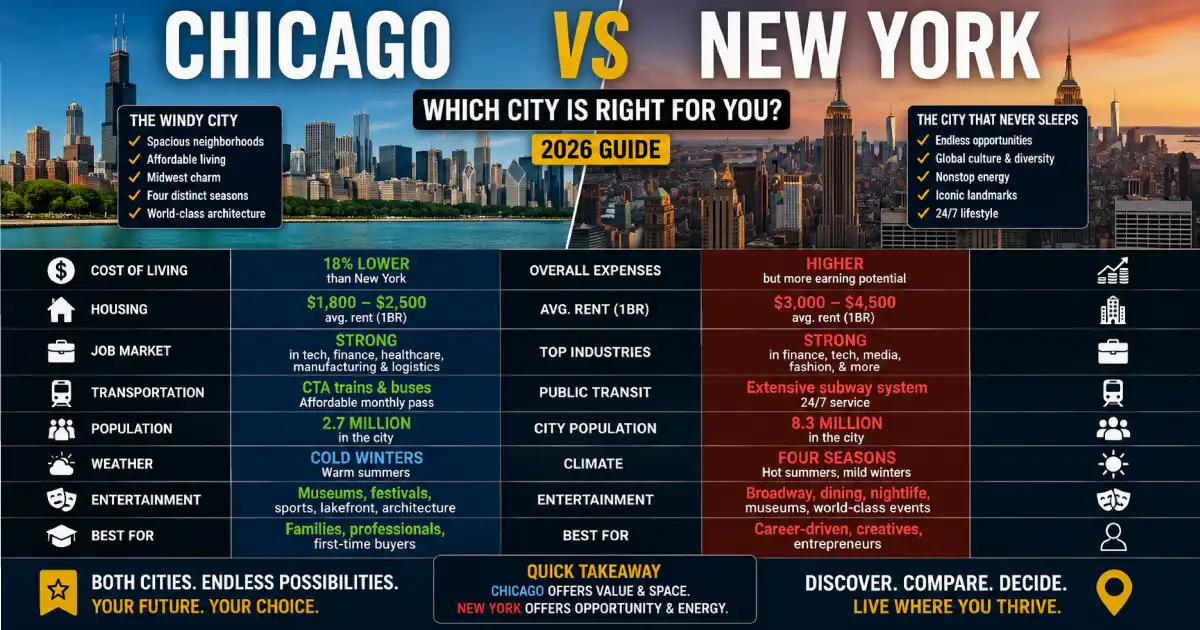
The Most Important Facts First
Key Fact
🏙️ Chicago
🗽 New York
Population (City)
2.7 million (3rd largest US city)
8.3 million (largest US city)
Nickname
The Windy City; The Second City; City of Big Shoulders
The Big Apple; The City That Never Sleeps
Climate
Four seasons — brutal winters (-5°F possible); spectacular summers
Four seasons — cold winters (20°F); hot summers (90°F)
Nearest Major Airport
O’Hare (ORD) 17 miles; Midway (MDW) 10 miles
JFK 15 miles; EWR 10 miles; LGA 8 miles
Midrange Hotel (per night)
$145–$260 (downtown/Magnificent Mile)
$225–$420 (Manhattan midrange)
Transit System
The ‘L’ elevated train — excellent; $2.50/ride; 24-hr service on key lines
NYC Subway — best in US; $2.90/ride; 24-hr all lines
Best Known For
Architecture, deep dish pizza, blues/jazz, lakefront, improv comedy
Broadway, the Met, Central Park, the slice, Wall Street, global influence
Cost vs Each Other
25–35% cheaper than New York across all categories
Most expensive major US city
Lakefront / Beach
26 miles of Lake Michigan lakefront — free public beaches
Coney Island accessible; not a beach city
Flight from London (LHR)
~8.5 hours direct to ORD
~7 hours direct to JFK
Quick Verdict: Chicago vs New York
Category
🏙️ Chicago Wins
🗽 New York Wins
Winner
Architecture
Birthplace of skyscraper; most architecturally self-aware skyline in America
More skyscrapers; more globally iconic silhouette
🏙️ Chicago (quality); 🗽 NY (scale)
Hotel Cost
$145–$260/night midrange
$225–$420/night Manhattan
🏙️ Chicago
Deep Dish Pizza
Giordano’s, Lou Malnati’s, Pizzeria Uno (invented here 1943)
No equivalent
🏙️ Chicago
NY-Style Pizza Slice
Good but not NY-level
$3 slice — most specific New York food at any price
🗽 New York
Impressionist Art
Art Institute — finest Impressionist collection in Western Hemisphere outside Paris
Met is larger overall; MoMA wins modern
🏙️ Chicago (Impressionism specifically)
Overall Museums
Art Institute, Field Museum, Shedd Aquarium, Adler Planetarium
Broadway — most significant theater district in the world
🗽 New York
Improv Comedy
Second City — birthplace of modern improv; most historically significant
Good improv scene; Second City dominates the tradition
🏙️ Chicago
Food Diversity
Chicago Polish, Mexican Pilsen, Chinese Chinatown — excellent
Most diverse food city in the world — every cuisine represented
🗽 New York
Iconic Landmarks
The Bean, Willis Tower Skydeck, Navy Pier, Millennium Park
Statue of Liberty, Empire State Building, Central Park, Brooklyn Bridge
🗽 New York (more globally iconic)
Architecture Tours
Chicago Architecture Center river cruise — finest architecture tour in US
Good walking tours; no equivalent river cruise
🏙️ Chicago
Chicago: The City That Invented the Skyscraper and Never Stopped Showing Off
Chicago Architecture: The Most Self-Conscious Skyline in America
Chicago invented the skyscraper — the 1885 Home Insurance Building (since demolished, but credited as the first skyscraper by engineering historians for its iron and steel frame construction) was built in Chicago because the 1871 Great Fire had burned the city’s wooden building stock and the rebuilt city chose to experiment with the structural innovation that would define 20th-century urban form worldwide. The specific Chicago architecture legacy accessible to 2026 visitors:
The Chicago Architecture Center River Cruise ($55/adult, 90 minutes): The most comprehensive and the most specifically rewarding single architecture experience accessible in any American city — the Chicago River runs through the downtown Loop in a 90-degree channel that positions the most significant 20th-century commercial buildings in the world within a single boat’s viewing arc. The certified docent narrates the specific buildings: the Wrigley Building (1924, Spanish Renaissance), the Tribune Tower (1925, Gothic Revival with stones embedded from world landmarks), the Marina City corncob towers (1964, Bertrand Goldberg), the 333 West Wacker Drive (1983, green-glass river-curve building), and the most complete post-1960 modernist commercial architecture visible from water anywhere in the United States. The most essential single Chicago experience at any price.
Willis Tower Skydeck ($32/adult): The Skydeck’s glass-bottom Ledge boxes — 1,353 feet above the street, the most specifically vertigo-inducing glass-floor experience accessible at any US skyscraper — and the 360-degree Chicago panorama (Lake Michigan visible to the east, the Illinois prairie visible to the west) make the Willis Tower the most panoramically dramatic skyscraper experience accessible in a non-New York American city.
The Loop architecture walk (free): The most rewarding self-guided architecture walk accessible in any American downtown — the Sullivan Center’s Louis Sullivan ornamental ironwork (the most significant commercial architectural decorative program in the US), the Rookery Building’s Frank Lloyd Wright-redesigned interior (free to enter the lobby), and the Monadnock Building’s 1891 masonry construction (the last major load-bearing masonry skyscraper ever built) all accessible within a 6-block walk of the Chicago Architecture Center.
Millennium Park and the Chicago Lakefront: The Greatest Free Urban Civic Space in America
Millennium Park — the 24.5-acre park opened in 2004 at the northeast corner of the Loop, featuring Anish Kapoor’s Cloud Gate sculpture (universally called “The Bean,” the most photographed single public artwork in the United States by Instagram posts), Frank Gehry’s Jay Pritzker Pavilion (the most acoustically sophisticated outdoor amphitheater accessible in any American urban park, with a steel trellis extending 4,000 square feet above the Great Lawn to distribute sound), and the Crown Fountain (the interactive video fountain with 50-foot glass block towers projecting Chicagoans’ faces from which water spouts) — is the most culturally ambitious and the most specifically Chicago civic public space investment accessible in any American park.
Beyond Millennium Park: Chicago’s 26 miles of free public lakefront — Daniel Burnham’s 1909 Plan of Chicago established the lakefront as permanently public (the most consequential single urban planning decision in American city history, predating the more celebrated New York parks by decades in its democratic completeness) — produces the most extensively accessible free urban waterfront in America: the Museum Campus (the Art Institute, the Field Museum, the Shedd Aquarium, and the Adler Planetarium in a single lakeside complex), the 606 Elevated Trail (the Chicago answer to New York’s High Line, a 2.7-mile elevated trail through the Wicker Park and Humboldt Park neighborhoods), and the North Avenue Beach (the most attended free urban beach in the Midwest, with beach volleyball, a lakefront running path, and the most specifically Chicago lakefront culture accessible at any city beach).
The Art Institute of Chicago: The Finest Impressionist Collection in the Western Hemisphere Outside Paris
The Art Institute of Chicago — the most specifically Impressionist-focused and the most technically superlative of any American art museum in the specific Impressionist and Post-Impressionist categories — is Chicago’s most culturally consequential single institution and the museum that most specifically justifies a Chicago visit for any art-focused international traveler. The specific Art Institute collection superlatives: Seurat’s A Sunday on La Grande Jatte (the most specifically celebrated single Pointillist painting in the world, 6.9 by 10.1 feet, taking Seurat two years to complete, the most visited single artwork in the Art Institute), Grant Wood’s American Gothic (the most parodied and the most reproduced American painting in history), Edward Hopper’s Nighthawks (the most specifically American and the most cinematically referenced single American painting of the 20th century), and the most complete collection of Monet’s Water Lilies panels accessible in any single American museum. Admission $30/adult; free to Illinois residents; the Michigan Avenue facade is the most monumental Beaux-Arts museum exterior in Chicago.
Chicago Food: Deep Dish, Italian Beef, and the Tavern-Style Revolution
Chicago’s food identity is the most specifically Chicago and the most unapologetically Chicago of any American city food culture — built on the specific innovations (the deep dish pizza, the Italian beef sandwich, the Chicago hot dog, the tavern-style thin crust pizza that Chicago residents actually eat when they’re not performing for tourists) and the immigrant food communities (the Polish pierogi and kielbasa of Milwaukee Avenue, the Mexican tacos and birria of Pilsen and Little Village, the Chinese dim sum of Chinatown at Cermak and Wentworth) that make Chicago the most specifically Midwestern-immigrant food city in the United States.
Lou Malnati’s deep dish pizza: The most beloved and the most consistently excellent deep dish pizza in Chicago — the butter-crust, the chunky tomato sauce on top (inverted from every other pizza tradition in the world, with sauce above cheese rather than below), and the specific Lou Malnati’s sausage blend in the most generous quantity accessible at any Chicago deep dish pizzeria. $22–$30 for a personal deep dish. The most specifically Chicago dining experience accessible to any visitor, requiring a 45-minute wait for a fresh-baked pizza that rewards every minute of patience.
Al’s #1 Italian Beef (multiple locations): The most historically significant and the most specifically Chicago sandwich — thin-sliced seasoned beef on Italian bread, dipped in the au jus (the “dipped” preparation is the most Chicago of any Italian beef preparation style), giardiniera (hot pickled vegetable relish, the most specifically Chicago condiment in any food culture) or sweet peppers. $10–$13. The most affordably authentic Chicago lunch available at any price.
The Chicago hot dog (no ketchup — ever): The most specifically rule-governed single American food preparation — a Vienna Beef hot dog in a poppy seed bun with yellow mustard, neon green relish, chopped white onion, tomato slices, a pickle spear, sport peppers, and celery salt; the only rule in Chicago hot dog culture that produces community enforcement is the absolute prohibition of ketchup. “Dragged through the garden” is the most specifically Chicago food description accessible at any hot dog stand. $4–$6 at any Chicago hot dog stand. Free cultural experience of watching a Chicagoan react to someone asking for ketchup.
Alinea (Lincoln Park): The most celebrated and the most technically ambitious fine dining restaurant in Chicago — Grant Achatz’s three-Michelin-star tasting menu ($365–$415/person) is the most nationally and internationally recognized Chicago fine dining experience and the most specifically avant-garde American restaurant accessible in any Midwestern city. Book 8–12 weeks ahead. The most ambitious single dinner experience available in Chicago at any price.
Pilsen neighborhood Mexican food: The most authentic and the most community-embedded Mexican food culture in Chicago — the Pilsen neighborhood’s 18th Street corridor produces the most specifically Mexican and the most genuinely taqueria-format tacos, tamales, and tortas accessible in any Chicago neighborhood at the most honest prices ($3–$5 per taco, cash).
Chicago Blues, Jazz, and Second City
Chicago’s music and performance culture is the most specifically historically significant of any Midwestern American city — built on three traditions that are the most distinctly Chicago and the most nationally consequential of any single American city’s cultural output in the 20th century:
Chicago Blues (Buddy Guy’s Legends, Kingston Mines): The most historically specific American music tradition — the electric Chicago blues (Muddy Waters, Howlin’ Wolf, Little Walter, Buddy Guy — the most consequential single electric guitar influence on British rock, directly influencing the Rolling Stones, the Yardbirds, and Led Zeppelin) is performed most consistently at Buddy Guy’s Legends (700 S. Wabash, the most historically significant active blues club in Chicago, owned by the last surviving first-generation Chicago electric blues legend, $10–$20 cover) and Kingston Mines (the most continuously operating blues club in Chicago, open until 4 AM on weekends). The most historically grounded live music experience accessible in any American Midwestern city.
Second City (1616 N. Wells Street, Old Town): The most historically consequential improvisational comedy theater in American history — the alma mater of Bill Murray, John Belushi, Dan Aykroyd, Gilda Radner, Tina Fey, Stephen Colbert, Steve Carell, and virtually every significant American comedy talent of the last 50 years. The mainstage show ($35–$55) and the e.t.c. stage’s experimental shows ($20–$35) produce the most specifically Chicago performance experience accessible at any entertainment venue in the city. The most rewarding and the most specifically Chicago evening accessible in the Old Town neighborhood at any price.
New York: The Most Culturally Consequential City in the Western Hemisphere
New York’s Museum Landscape: Unmatched in the Americas
New York’s museum concentration is the most comprehensive and the most globally significant in the Western Hemisphere — the Met (largest art museum in the Americas, 5,000 years of human art), MoMA (most influential modern art museum in the world, with Starry Night, Les Demoiselles d’Avignon, and Campbell’s Soup Cans), the Guggenheim (Frank Lloyd Wright’s 1959 spiral building, the most architecturally specific museum in New York), the Whitney (most complete American art collection in the US), and the Brooklyn Museum (second largest art museum in New York) collectively produce the most museum-complete single-city experience in the Americas. The specific New York museum advantages over Chicago: MoMA’s modern art collection (the Art Institute’s modern collection is excellent but does not have MoMA’s Picasso, Matisse, and Warhol depth), the Met’s ancient Egyptian collection (the Temple of Dendur — the only complete ancient Egyptian temple in the Western Hemisphere, reassembled inside the Met’s Sackler Wing in a glass-enclosed gallery — is the most specifically and most physically overwhelming ancient world artifact accessible in any American museum), and the overall museum density (8 significant museums accessible in a single day’s walking within a 20-block stretch of Fifth Avenue).
Broadway: The World’s Most Significant Theater District
Broadway — 41 professional theaters in the Times Square and Theater District neighborhoods of Midtown Manhattan, producing the most commercially significant and the most artistically ambitious English-language theater in the world — is New York’s most specifically non-replicable cultural institution. The specific Broadway access strategies for the budget-conscious visitor:
TKTS booth (Father Duffy Square, Times Square): Same-day and next-day tickets at 25–50% discount for most Broadway shows; opens at 3 PM for evening performances, 10 AM for matinees. The most consistently reliable discount Broadway ticket source accessible without a lottery app.
Digital lottery (Hamilton, Hadestown, The Lion King): The most in-demand single show lottery — Hamilton’s $10 digital lottery (available daily via the official Hamilton app) is the most financially extraordinary Broadway ticket accessible at any price point. Results announced 2 hours before showtime; winning is statistically unlikely but costs nothing to enter.
Student rush tickets: Most Broadway shows offer $30–$40 rush tickets to students with valid ID at the box office when it opens (10 AM); the most consistently affordable full-price Broadway option available.
Chicago has genuinely world-class regional theater — Steppenwolf Theatre Company (the most nationally celebrated regional theater company in the US, co-founded by Gary Sinise and John Malkovich, with a Broadway production track record that rivals any regional theater in America) and the Goodman Theatre (the most technically ambitious and the most physically complete theater facility in the Midwest) collectively produce a Chicago theater scene that is the most significant regional theater community in the United States. It is not Broadway. Nothing is Broadway except Broadway.
New York’s Iconic Landmarks
Statue of Liberty and Ellis Island (free Staten Island Ferry for exterior view; $24/adult for ferry to island): The most globally recognized American landmark and the most emotionally specific for the 40% of Americans whose ancestors passed through Ellis Island’s immigration halls
Central Park (free always): 843 acres of Frederick Law Olmsted’s 1858 masterwork — the most influential urban park design in American history, the most visited urban park in the United States at 42 million annual visitors, and the most specifically “New York in the movies” landscape accessible at any price
Brooklyn Bridge (free always): The 1.3-mile walk across the 1883 Gothic-tower suspension bridge, with lower Manhattan’s skyline framed in the bridge’s cable geometry — the most specifically New York free experience accessible at any hour
The High Line (free always): The 1.45-mile elevated park on a former West Side freight railroad — the most influential urban park repurposing project of the 21st century, free always, with the Hudson River and Midtown skyline views from 30 feet above the Meatpacking District street level
Empire State Building Observatory ($44/adult): The 102-story 1931 Art Deco building whose 86th-floor open deck observatory — the most cinematically referenced single viewpoint in New York — delivers the most dramatically 360-degree Manhattan view accessible without a reservation requirement 365 days per year
Chicago vs New York: The Deep Dish vs Slice Debate
The Chicago deep dish vs New York pizza slice debate is the most specifically argued and the most culturally embedded food rivalry in American culinary culture — and the honest assessment requires acknowledging that both are genuinely extraordinary and genuinely different foods rather than different versions of the same food.
Chicago deep dish (Giordano’s, Lou Malnati’s, Pizzeria Uno): A 2-inch-deep buttered crust filled with mozzarella cheese, sausage or other toppings, and chunky tomato sauce applied on top (uniquely inverted from every other pizza tradition), baked for 45 minutes in a deep circular pan — the most specifically filling, the most substantial, and the most specifically Chicago pizza preparation accessible in the world. It requires a knife and fork, takes 45 minutes from order to table, and produces the most specifically satisfied and the most specifically immobilized post-meal experience accessible at any American pizza restaurant. One slice is one meal. Two slices is a challenge. Three slices is a declaration.
New York pizza slice (Di Fara, Joe’s Pizza, Lucali): An 18-inch diameter thin-crust pizza cut into 8 triangular slices, each $3–$4, held folded in half lengthwise while walking — the most accessible, the most specifically urban, and the most functionally integrated single-meal food tradition in any American city. New York pizza’s crust is the most specifically charred-bottom and the most appropriately chewy of any American pizza style; the sauce-to-cheese ratio is the most precisely calibrated for the walking-consumption format that makes it the most specifically New York food of any preparation at any price. Lucali in Brooklyn ($28–$35 for a whole pie, cash only, BYOB, the most celebrated single pizza restaurant in New York) is worth a 2-hour wait. Joe’s Pizza on Carmine Street ($3.50/slice) is worth walking to at any hour. Both are worth eating on the same New York trip.
The honest verdict: Chicago deep dish is the most specifically extraordinary pizza experience accessible in America when judged as a standalone dining event. New York pizza is the most specifically integrated into the fabric of daily life. Neither is superior to the other because they are not competing for the same role in the food culture that produced them. Eat both. Argue neither.
Chicago vs New York: The Lakefront vs Central Park
Chicago’s 26-mile free public lakefront is the most consequential single urban planning achievement in American history for public access — Daniel Burnham’s 1909 Plan of Chicago, which established the entire lakefront as permanently public and perpetually free from private development, produced the most extensively accessible urban waterfront in America. The Lake Michigan shoreline running from Rogers Park in the north to South Shore in the south provides: 26 free public beaches (North Avenue Beach is the most attended; Montrose Beach is the most ecologically complete with the Montrose Point Bird Sanctuary), the Museum Campus’s lakeside position (the Art Institute, Field Museum, Shedd Aquarium, and Adler Planetarium all visible from the lakefront path), and the specific Lake Michigan horizon that produces the most ocean-like freshwater view accessible in any American inland city — because Lake Michigan is large enough (22,300 square miles) that the opposite shore is not visible from Chicago, producing a horizon that is genuinely and specifically oceanic in its visual character.
New York’s Central Park is the most celebrated and the most visited urban park in the United States at 42 million annual visitors — 843 acres of Olmsted’s most specifically influential landscape design, containing the Bethesda Fountain (the most cinematically specific water feature in any American park), the Bow Bridge (the most photographed bridge in New York), Strawberry Fields (the most specifically John Lennon-memorial landscape accessible in any American park), and the Conservatory Garden (the most formal and the most horticulturally specific section of the park, free always). Central Park is the most completely realized urban park in American history. Chicago’s lakefront is the most generously public urban waterfront in American history. Both are the most specifically rewarding outdoor spaces in their respective cities and both produce different but equally compelling arguments for the cities they serve.
Chicago vs New York: Cost Comparison
Cost Category
🏙️ Chicago
🗽 New York
Cheaper?
Midrange Hotel (per night)
$145–$260
$225–$420
🏙️ Chicago (significantly)
Budget Hotel (per night)
$95–$145
$160–$240
🏙️ Chicago
Casual Dinner (per person)
$22–$45
$28–$60
🏙️ Chicago
Iconic Street Food
Chicago hot dog $4–$6; Italian beef $10–$13
Pizza slice $3–$4; Halal cart $8–$10; bagel $2–$4
🗽 New York (pizza slice wins value)
Transit (per day)
CTA ‘L’ $2.50/ride; $5 day pass; $20 weekly
NYC Subway $2.90/ride; $34 weekly unlimited
🏙️ Chicago (day pass $5 vs $34/week)
Architecture Tour
CAC River Cruise $55 (most essential Chicago experience)
No direct equivalent; walking tours $25–$35
🗽 New York (free walking equivalent)
Art Museum
Art Institute $30/adult (free Chicago residents)
Met $30 suggested; MoMA $30; many free options
🤝 Tie
Second City / Broadway
Second City $35–$55
Broadway $80–$350 (TKTS $50–$150)
🏙️ Chicago
7-Day Total (per person, midrange)
~$1,900–$2,900
~$2,800–$4,500
🏙️ Chicago (25–35% cheaper)
Cost verdict: Chicago is 25–35% cheaper than New York across every cost category — the hotel differential ($80–$160/night less than comparable Manhattan properties) is the most consequential single saving, representing $560–$1,120 over a 7-night stay. Chicago’s $5 CTA day pass provides unlimited daily transit at a fraction of New York’s $34 weekly cost. Second City tickets ($35–$55) are the most affordable world-class performance experience accessible in any American major city. The budget-conscious Tier 1 international traveler who wants a genuinely world-class American city experience at the most honest price should choose Chicago — it is the most specifically financially rewarding major city visit available east of the Mississippi.
Chicago vs New York: Weather
Both cities have cold winters — but Chicago’s cold is of a categorically different character than New York’s and requires honest acknowledgment rather than minimization.
Chicago winter: January averages 26°F; wind chill can reduce effective temperature to -20°F or colder on the most extreme polar vortex days (the polar vortex events of 2019 and 2024 produced wind chills of -50°F in Chicago — the most specifically dangerous cold accessible in any major American city). The lakefront in January is the most specifically wind-exposed urban public space in America — the “Windy City” nickname, though historically attributed to politics rather than meteorology, is meteorologically accurate at the lakefront in January and February. The practical implication: a Chicago visit in January or February requires the most serious cold-weather clothing preparation of any major American city visit and limits outdoor sightseeing to the intervals between heated transit connections.
Chicago summer: July averages 84°F with lake breezes producing the most specifically comfortable summer afternoons accessible in any Midwestern city — the lake effect that makes Chicago’s winters the most brutal also makes its summers the most pleasant of any major Midwestern city, with the lake breeze reducing the heat index by 5–10°F compared to Chicago’s inland suburbs on the same summer afternoon. The Chicago Jazz Festival (August, Grant Park, free), the Chicago Blues Festival (June, Grant Park, free), the Lollapalooza music festival (July, Grant Park, $350–$400 4-day pass), and the Taste of Chicago food festival (July, Grant Park, free admission) make summer the most culturally programmed and the most festival-dense season in the Chicago annual calendar.
Best Chicago visiting months: May–June (spring, perfect weather, before summer crowds) and September–October (fall, the most beautiful lakefront weather, the most color in the Lincoln Park trees, and the most specifically rewarding outdoor dining season). Avoid January and February unless specifically prepared for the most dramatically cold major American city experience accessible in the continental US.
Chicago’s Best Neighborhoods
The Loop (downtown): The most architecturally concentrated and the most culturally dense — the Chicago Architecture Center, the Art Institute, Millennium Park, the Chicago Cultural Center (the most architecturally extraordinary free municipal building in America, with two stained glass Tiffany domes), and the elevated ‘L’ tracks that give the Loop its name are all within a 6-block walking circuit
Wicker Park and Bucktown: The most creative and the most independently-owned-restaurant-dense Chicago neighborhoods — the Milwaukee Avenue corridor’s vintage clothing stores, the most independent bookstores per block in Chicago, and the most specifically Chicago artistic community accessible in any neighborhood north of the Loop
Logan Square: The most rapidly developing and the most food-scene-celebrated Chicago neighborhood — the Logan Square Boulevard’s greystone apartment buildings, the most James Beard-nominated restaurant density in Chicago outside the River North restaurant row, and the most specifically young-professional and creative community character in the city’s northwest quadrant
Pilsen: The most specifically Mexican-American and the most culturally authentic Chicago neighborhood — the 18th Street mural corridor (the most concentrated Mexican-American public art accessible in any Chicago neighborhood), the National Museum of Mexican Art (the most significant Mexican-American art museum in the United States, free always), and the most authentic and the most affordable Mexican food accessible in Chicago
Lincoln Park: The most specifically Chicago residential neighborhood for visitors — the Lincoln Park Zoo (the most attended free zoo in the United States, free always), the Peggy Notebaert Nature Museum, and the North Avenue Beach produce the most complete family-accessible day without a car accessible in any Chicago neighborhood north of downtown
Who Should Visit Chicago?
Choose Chicago if you:
Want the most rewarding architecture experience accessible in any American city — the Chicago Architecture Center River Cruise ($55) is the most essential single American city architecture experience available at any price, delivering the most consequential 20th-century commercial architecture from the most perfectly positioned waterway viewing corridor
Want the finest Impressionist art collection in the Western Hemisphere outside of Paris — the Art Institute’s Seurat, Hopper, and Wood paintings are the most specifically celebrated American museum Impressionist holdings accessible in any US city outside New York
Want the most affordably excellent major American city experience — 25–35% cheaper than New York across every cost category, with comparable or superior cultural depth in the architecture, blues music, improv comedy, and food categories
Want deep dish pizza at Lou Malnati’s or Giordano’s — the most specifically Chicago single food experience and the most irreplaceable culinary reason to visit the city
Want Second City improv comedy — the birthplace of the American improv comedy tradition, the alma mater of 50 years of the most celebrated American comedians, for $35–$55 per ticket
Want the most free public lakefront in America — 26 miles of beaches, trails, and parks guaranteed permanently public by Burnham’s 1909 plan, including Lincoln Park Zoo (always free)
Are visiting in summer for the free festivals — Chicago Blues Festival and Chicago Jazz Festival (both free, Grant Park) are the most culturally specific and the most financially extraordinary free summer events accessible in any American major city
Who Should Visit New York?
Choose New York if you:
Are making your first major US city visit from the UK, Canada, or Australia — New York is the most globally recognized, the most culturally iconic, and the most specifically “American” city in the world’s consciousness; the Statue of Liberty, Broadway, and Central Park are the most universally recognized American symbols and all require New York specifically
Want Broadway — the most significant English-language theater in the world; Chicago’s Steppenwolf is genuinely world-class regional theater; it is not Broadway and cannot be substituted for it
Want the most comprehensive museum landscape in the Americas — the Met’s 5,000 years, MoMA’s Starry Night, the Guggenheim’s Wright spiral, and the Whitney’s American art collection collectively constitute the most museum-complete single-city experience in the Western Hemisphere
Want the most globally diverse food city in the world — New York’s 800+ spoken languages produce the most complete and the most internationally authentic food landscape accessible in any American city
Want the Brooklyn Bridge walk, the Empire State Building, and the Staten Island Ferry Statue of Liberty view — the most globally recognized American landmark experiences are concentrated in New York and unavailable elsewhere
Want to combine with other East Coast cities — New York is the most logistically central East Coast hub for Amtrak to Boston (3.5 hours), Philadelphia (1.5 hours), and Washington DC (2.5 hours)
Can You Visit Both Chicago and New York?
Yes — and for the Tier 1 international visitor with 10–14 days in the United States, combining Chicago and New York produces the most complete American city experience accessible east of the Mississippi. The routing:
10-day combination: Fly into Chicago O’Hare (ORD) → Chicago 4–5 days (Architecture River Cruise, Art Institute, Lou Malnati’s deep dish, Second City, lakefront, Blues on Halsted) → fly Chicago to New York ($80–$160 one-way, 2.5 hours on American/United/Delta) or Amtrak Lake Shore Limited (18 hours overnight, $75–$145, most scenic overnight train between the cities) → New York 5–6 days (Statue of Liberty, Met, MoMA, Brooklyn Bridge, Broadway show, Central Park, food tour) → fly home from JFK
Open jaw routing: Fly into Chicago (ORD) from London/Toronto/Sydney, fly home from New York (JFK) — the most logistically efficient international routing for the 10-day Chicago + New York combination that eliminates backtracking entirely
Chicago vs New York: Practical Tips
Topic
🏙️ Chicago
🗽 New York
Best Time to Visit
May–June (perfect weather, pre-summer crowds); September–October (fall, best lake weather); July for festivals (Blues Fest, Jazz Fest — FREE)
September–November (fall foliage, best weather, most active theater season); April–June (spring bloom, comfortable temperatures)
Worst Time
January–February (most brutal cold of any major US city — polar vortex real, wind chill -20°F possible; outdoor activities severely limited)
January–February (cold but manageable with correct clothing; July–August for heat + peak tourist crowds)
Best Area to Stay
The Loop (most central, Art Institute walking distance, $145–$220/night); River North (most restaurant-dense, $160–$250/night); Lincoln Park (most neighborhood character, $130–$200/night)
Midtown Manhattan (most central, most expensive); Upper West Side (Central Park access, slightly less); Williamsburg Brooklyn (most affordable, great subway, most creative character)
Don’t Miss
Architecture Center River Cruise ($55 — the most essential single Chicago experience); Chicago Cultural Center interior (free — Tiffany domes); Pilsen Mexican food (cash, $3–$5 tacos)
Staten Island Ferry at sunset (free — best Statue of Liberty view, zero cost); TKTS booth same-day Broadway; Grand Central Terminal ceiling (free — most beautiful Beaux-Arts interior in the US)
Free Highlights
Millennium Park (Bean + Pritzker Pavilion, free); Chicago Cultural Center (Tiffany domes, free); Lincoln Park Zoo (always free — most attended free zoo in US); Lakefront Trail (26 miles, free); Chicago Blues Festival June (free); Chicago Jazz Festival August (free)
Central Park (free); High Line (free); Brooklyn Bridge walk (free); Staten Island Ferry (free); Times Square walk (free); Grand Central Terminal (free); Top of the Rock Observation Deck — skip if budget-conscious (Empire State is comparable at $44)
Transit Tips
CTA ‘L’ $2.50/ride; $5 24-hour pass; the Blue Line from O’Hare to downtown Loop ($2.50) is the most affordable and the most efficient airport-to-center transit of any major US city airport
NYC Subway $2.90/ride; 7-day unlimited $34; download the MTA app for real-time train status; avoid taxis from JFK — AirTrain + subway ($10.50 total) or LIRR ($20) are the most efficient airport connections
Frequently Asked Questions: Chicago vs New York
Is Chicago or New York better for a first-time US visit?
New York is the better first US city visit for most international travelers from the UK, Canada, and Australia — the Statue of Liberty, Broadway, Central Park, and the Brooklyn Bridge are the most globally recognized American cultural symbols and all require New York specifically. The shorter flight from London (7 hours vs 8.5 hours to Chicago) and the more logistically central position for East Coast Amtrak connections (Boston, Philadelphia, Washington DC) additionally favor New York for the first-time US visitor. Chicago is the most rewarding second US city visit — the architecture (genuinely not available at New York’s concentrated quality), the deep dish pizza (irreplaceable at any other location), and the 25–35% cost savings over New York collectively make Chicago the most financially rewarding and the most architecturally surprising major American city for the visitor who has already established New York as their US city baseline.
Is Chicago really cheaper than New York?
Yes — Chicago is 25–35% cheaper than New York across hotel, restaurant, transit, and entertainment categories. The hotel differential ($80–$160/night less for comparable properties) is the most consequential single saving over a 7-night stay ($560–$1,120). The Chicago ‘L’ Blue Line from O’Hare to downtown costs $2.50 — the most affordable airport-to-city-center transit connection of any major American airport. Second City tickets ($35–$55) vs Broadway ($80–$350) represent the most significant single entertainment cost differential between the two cities. Deep dish pizza at Lou Malnati’s ($22–$30 for a personal pie) vs comparable New York dining is roughly equivalent; the Chicago hot dog ($4–$6) vs the New York pizza slice ($3–$4) are both the most specifically affordable iconic city foods accessible in their respective cities. The overall 7-day budget comparison: approximately $1,900–$2,900/person for Chicago vs $2,800–$4,500/person for New York at comparable quality levels. Chicago is genuinely cheaper. New York is genuinely worth its premium for specific experiences (Broadway, the Met, the Statue of Liberty) that Chicago does not replicate.
Which city has better pizza — Chicago or New York?
Both cities have the best pizza in the United States — the honest answer acknowledges that they are different foods rather than competing versions of the same food. Chicago deep dish at Lou Malnati’s or Giordano’s is the most filling, the most specifically extraordinary dining event, and the most irreplaceable Chicago culinary experience: the butter crust, the chunky inverted tomato sauce, and the 45-minute wait produce a pizza that is simultaneously a meal, an occasion, and a statement about the Midwestern appetite for abundance. New York pizza at Joe’s or Di Fara is the most functional, the most accessible, and the most integrated into daily urban life: the $3.50 slice eaten folded while walking between subway stations is simultaneously a meal, a tradition, and the most specifically New York food ritual accessible at any price. Visit both cities. Eat both pizzas. Argue the comparison with genuine conviction and zero expectation of resolution.
What is Chicago most famous for that New York doesn’t have?
Chicago has four genuinely irreplaceable advantages over New York: (1) The Architecture Center River Cruise — the most concentrated and the most masterfully explained American architectural achievement accessible from a single boat in a 90-minute circuit, unavailable in any comparable format in New York; (2) Deep dish pizza — the most specifically Chicago food, invented here in 1943 at Pizzeria Uno, unavailable in any genuine form outside the Chicago metropolitan area; (3) Second City improv comedy — the birthplace and the most historically consequential ongoing production of the American improv comedy tradition, graduating the most consequential American comedy talent of the last 50 years; (4) Free lakefront — 26 miles of permanently public Lake Michigan shoreline, including Lincoln Park Zoo (always free), the most generous permanent public waterfront commitment of any major American city. None of these four things is available in New York at any price.
Final Verdict: Chicago vs New York
Chicago and New York are the two greatest American cities east of the Mississippi — genuinely different in character, cost, and cultural emphasis, and both deserving of the most specific and the most earnest engagement any traveler can offer. The most honest single-sentence verdict:
Choose Chicago if you want the most architecturally extraordinary, the most financially generous, and the most specifically Midwestern-character American city experience accessible in the United States — the Architecture Center River Cruise that explains 140 years of American architectural innovation from a boat moving through the most significant urban canyon in the country, the Art Institute’s Seurat and Hopper and Wood paintings in the most specifically Impressionist-weighted museum in the Western Hemisphere outside Paris, the Lou Malnati’s deep dish that requires 45 minutes of your patience and rewards it with the most filling and the most specifically Chicago pizza accessible in any American city, the Second City improv stage that launched more consequential American comedy careers than any other single address in the United States, the free Chicago Blues Festival in Grant Park in June where the specific electric blues tradition that produced the Rolling Stones and Led Zeppelin is performed free of charge within sight of Anish Kapoor’s Cloud Gate, and the 26 miles of permanently public Lake Michigan shoreline that Daniel Burnham guaranteed to the public in 1909 and that every Chicagoan uses every summer as freely and as specifically as if they invented the lake themselves. Chicago is 25–35% cheaper than New York. It is the most architecturally extraordinary American city. It is the best food city in America that is not New York. It is the birthplace of the skyscraper, the electric blues, and the improv comedy form. It is the city that invented the river cruise architecture tour and the deep dish pizza and the Lincoln Park Zoo free admission policy and has been delivering all three without apology since the last century. Go to Chicago. Take the river cruise first. Eat the deep dish second. Argue about the pizza third. Thank the city for being 35% cheaper than New York the entire time.
Choose New York if you want the most globally recognized, the most culturally consequential, and the most specifically iconic American city experience in the world — the Statue of Liberty from the free Staten Island Ferry at sunset with the entire harbor visible behind it, the Met’s 5,000 years of human art on a suggested-admission Friday evening when the Temple of Dendur is lit by the Sackler Wing skylights and the Egyptian wing is quiet and ancient and specifically extraordinary, the Broadway performance accessed through the TKTS booth for $80 that will be the most specifically live-theater experience of any year in which it occurs, the Brooklyn Bridge walk at 7 AM when the lower Manhattan skyline is framed in the cable geometry and the East River is moving below and the city is the most quietly specific it ever is before the tourist corridor arrives, and the $3 pizza slice eaten folded at the Joe’s Pizza window on Carmine Street at any hour of any day that is the most specifically and the most irreducibly New York single food moment accessible in the world. New York is more expensive than Chicago. It is the most consequential city in the Western Hemisphere. It is the city that has been producing the most significant cultural, financial, artistic, and media output of any American city for 200 years. It is worth the premium. Book the Broadway lottery. Eat the slice. Take the free ferry. Stand on the Brooklyn Bridge at dawn. Understand that you are in the city that every other city in the world measures itself against — and that no amount of Midwestern honesty about the architecture or the price of deep dish pizza changes the fact that New York is, and has always been, the city that the world most specifically means when it says “America.”
Both cities are genuinely extraordinary. Chicago is the more affordable and the more architecturally specific. New York is the more iconic and the more globally consequential. The best American life includes both — and the overnight Lake Shore Limited Amtrak train between them, which departs Chicago Union Station at 9:30 PM and arrives New York Penn Station at 3:15 PM the following afternoon having passed through Indiana, Ohio, Pennsylvania, and New Jersey in a rolling landscape that is the most specifically interior-American visible from any rail window east of the Mississippi, costs $75 and is the most romantically specific single transportation decision available in the Chicago–New York comparison.
—
For the most current visitor information, event calendars, transit maps, and travel planning resources for Chicago and New York, consult these official government sources:
Choose Chicago — Official Chicago Tourism (City of Chicago) — Official Chicago Convention and Tourism Corporation resource covering hotel listings, Architecture Center River Cruise booking, Chicago Blues Festival and Jazz Festival schedules, Millennium Park event calendar, neighborhood guides, and all current Chicago visitor resources backed by the City of Chicago.
NYC Tourism + Conventions — Official New York City Tourism — Official New York City government tourism resource covering Manhattan hotel listings, Broadway TKTS booth information, NYC subway maps and MetroCard purchasing, Central Park seasonal events, Staten Island Ferry schedules, and all current New York City visitor resources.
Chicago Transit Authority (CTA) — Official Chicago Public Transit — Official Chicago city government transit resource covering the ‘L’ elevated train system maps, Ventra card purchasing, O’Hare and Midway airport Blue and Orange Line connections, current service alerts, and all official CTA transit information for navigating Chicago without a car.
—
About Travel TouristerTravel Tourister’s US city specialists have extensively explored both Chicago and New York — from the Architecture Center River Cruise and Lou Malnati’s deep dish to the Met’s Impressionist galleries and the Brooklyn Bridge at dawn — to provide the most honest and most specific comparison available for Tier 1 travelers from the UK, Canada, and Australia choosing between America’s two greatest interior cities.Need help planning your Chicago or New York trip? Our specialists can help you build the optimal itinerary, book the Architecture Center River Cruise, time your Chicago Blues Festival visit, plan the Broadway TKTS strategy, and build the most efficient Chicago–New York combination for any trip length or travel style.
Posted By : Vinay
As a lead contributor for Travel Tourister, Vinay is dedicated to serving our Tier 1 audience (US, UK, Canada, Australia). His mission is to deliver precise, fact-checked news and actionable, data-driven articles that empower readers to make informed decisions, minimize travel risks, and maximize their adventure without compromising safety or budget.
Travel Tourister is a leading Travel portal where we introduce travellers to trusted travel agents to make their journey hasselfree, memorable And happy. Travel Tourister is a platform where travellers get Tour packages ,Hotel packages deals through trusted travel companies And hoteliers who are working with us across the world. We always try to find new and more travel agents and hoteliers from every nook and corners across the world so that you could compare the deals with different travel agents and hoteliers and book your tour or hotel with the one you have chosen according to your taste and budget.




 Call
Call Enquiry