Published on : 07 Sep 2026
By Travel Tourister | Updated Sep 2026
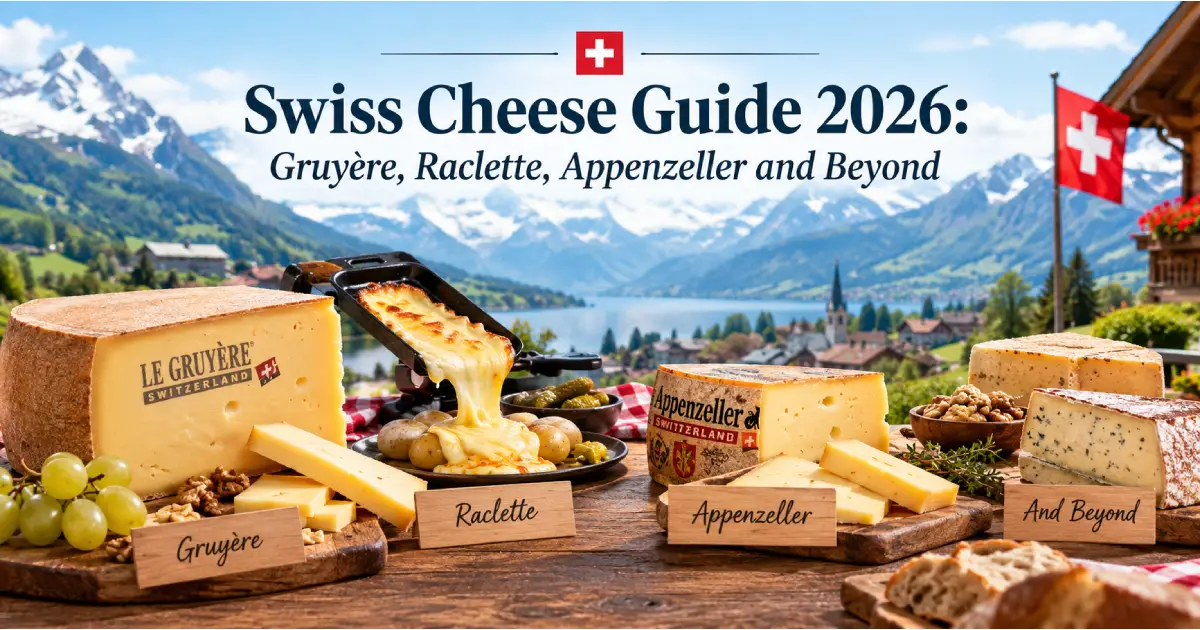
Switzerland produces approximately 200 named cheese varieties from approximately 70,000 tonnes of annual cheese production — an extraordinary output for a country of 8.7 million people, representing one of the highest per-capita cheese production rates in the world and the most internationally recognized national cheese tradition outside France. The Swiss cheese landscape is fundamentally organized around the concept of AOC (Appellation d’Origine Contrôlée) or AOP (Appellation d’Origine Protégée in its EU-harmonized designation) — the geographic designation system that protects the names of specific cheeses and requires that designated cheeses be produced within specified geographic zones using specified traditional methods, specific milk sources (exclusively from Swiss cows in most designations, often from specific regional breeds), and specific aging parameters that cannot be compromised without forfeiting the designation.
Understanding Swiss cheese for the 2026 visitor requires knowing two fundamental distinctions that the tourist market frequently obscures: the difference between authentic AOC/AOP Swiss cheeses (produced under rigorous geographic and methodological controls that genuinely create the flavor differences between a Gruyère from the Gruyères valley and a similar cheese produced elsewhere without the designation) and the generic “Swiss cheese” category (the industrially-produced mild yellow cheese sold internationally under the generic name that bears no specific relationship to any Swiss AOC product), and the difference between the various major Swiss cheeses themselves (Gruyère, Emmental, Appenzeller, Raclette du Valais, Vacherin Fribourgeois, Sbrinz, and others each having fundamentally different flavor profiles, aging requirements, and culinary applications that the generic “Swiss cheese” category erases). This guide covers Switzerland’s most important cheeses — their production geography, aging characteristics, flavor profiles, traditional uses, and where to experience them most authentically as a 2026 visitor.
For related guides, see our Best Fondue Restaurants in Switzerland 2026, Switzerland Travel Guide 2026, and Best Places to Visit in Switzerland 2026.
| Cheese | Region | AOC/AOP | Aging | Flavor Profile | Primary Use |
|---|---|---|---|---|---|
| Gruyère AOP | Fribourg, Vaud, Neuchâtel | Yes (AOP) | 5–18+ months | Nutty, slightly sweet, complex | Fondue, cooking, table |
| Emmental AOP | Bernese Emmental | Yes (AOP) | 4–14+ months | Mild, buttery, characteristic holes | Table, sandwiches |
| Appenzeller | Appenzell | Yes (trademark) | 3–8+ months | Pungent, herbal (secret brine) | Table, fondue |
| Raclette du Valais AOP | Valais | Yes (AOP) | 3–6+ months | Rich, creamy, slightly tangy | Raclette, melting |
| Vacherin Fribourgeois AOP | Fribourg | Yes (AOP) | 6 weeks–3 months | Soft, creamy, complex | Fondue (moitié-moitié) |
| Sbrinz AOP | Central Switzerland | Yes (AOP) | 18 months–3+ years | Hard, intense, piquant | Grated, sliced thin |
| Tilsiter | Eastern Switzerland | Partially | 2–6 months | Mild to medium, slightly tangy | Table, sandwiches |
| Vacherin Mont-d’Or AOP | Vaud (Jura) | Yes (AOP) | 3 weeks minimum | Very soft, runny, complex | Baked, spoonable |
| Tête de Moine AOP | Franches-Montagnes | Yes (AOP) | 2.5 months minimum | Aromatic, slightly pungent | Girolle-shaved rosettes |
| L’Etivaz AOP | Vaud (Pays-d’Enhaut) | Yes (AOP) | 5–12+ months | Rich, complex, alpage character | Table, fondue |
Production region: The Gruyère district of the Fribourg canton, extending into parts of Vaud, Neuchâtel, Jura, and Bern cantons | Milk: Raw cow’s milk (Fribourgeoise, Holstein, and Red Holstein breeds) | Aging: Minimum 5 months (doux/mild), 8 months (mi-salé/semi-salted), 10 months (salé/salted), 18 months (vieux/old), 24+ months (réserve) | Rind: Natural, hard, brown-orange | Paste: Firm, smooth, few or no holes (unlike Emmental) | AOP since: 2001
Gruyère is Switzerland’s most internationally exported and most globally recognized authentic Swiss cheese — a hard mountain cheese with a complex, slightly nutty, gently sweet flavor that deepens in both intensity and complexity as aging progresses from the relatively mild 5-month minimum to the intensely piquant réserve versions aged 24 months or beyond. The specific Gruyère character derives from the combination of the milk’s specific quality (the Fribourgeois and Vaud mountain pastures producing milk with specific fat and protein composition), the raw milk production (pasteurization is specifically prohibited by the AOP designation, the raw milk’s live bacteria cultures contributing specific flavor compounds that pasteurized milk production cannot replicate), and the traditional copper kettle production (the copper’s specific interaction with the milk’s proteins during heating contributes specific flavor compounds absent from stainless steel production).
The Gruyère terroir: The AOC designation’s geographic limits (the Gruyère district of Fribourg and adjacent areas) are not merely administrative — the specific combination of the Fribourgeois breed’s milk character, the Prealps’ botanical diversity (the summer pastures’ specific herb and wildflower composition contributing to the milk’s flavor complexity), and the production traditions maintained by the dairy cooperatives and individual fromageries within the zone creates a cheese that cannot be fully replicated outside these specific conditions despite the best intentions of non-Swiss producers using similar methods.
How to identify authentic Gruyère AOP: The word “Gruyère” in Swiss block letters on the rind, the AOP logo, and ideally the specific fromagerie name and production date stamped into the rind during production. The rind should be natural and firm (not waxed or plastic-coated — the AOP designation prohibits artificial rind treatments), brown-orange in color, and slightly rough in texture.
Aging stages and flavor:
Traditional uses:
Where to buy authentic Gruyère AOP:
Insider tips: The Gruyère AOP’s most frequently encountered counterfeits outside Switzerland — cheese labeled “Gruyere” (without accent, produced outside Switzerland) — is legally sold in several markets, most notably the United States (where a 2021 court ruling allowed American producers to use the name without geographic restriction). Authentic Swiss Gruyère AOP can be identified by the AOP logo and the Swiss block-letter “Gruyère” stamp on the rind — if purchasing outside Switzerland, look for “Switzerland” as the country of origin alongside the AOP designation.
Production region: The Emmental valley of Canton Bern, extending into parts of Fribourg, Lucerne, and Schwyz | Milk: Raw cow’s milk | Aging: Minimum 4 months (for AOP designation); 8–14 months for premium versions | Rind: Natural, hard, yellow-brown | Paste: Semi-hard to hard, yellow, characteristic large round holes | AOP since: 2006 (though produced continuously since the 13th century)
Emmental is arguably the world’s most visually recognized cheese — the large, round, regularly spaced holes (Augen — “eyes” in German, referring to their mirror-like appearance when the light catches them correctly) that appear on virtually every cartoon, emoji, and pictographic representation of “cheese” globally are specifically Emmental’s characteristic. The holes (produced by carbon dioxide gas released by specific bacteria — Propionibacterium freudenreichii — during the aging process, the gas forming bubbles within the paste that leave the characteristic spherical cavities) are not merely decorative but are specifically an indicator of correct production conditions — the right size holes (a 1–4 cm diameter in premium Emmental) indicating proper bacterial activity, temperature control during production, and correct aging conditions.
The Emmental AOP vs. generic “Swiss cheese”: The generic “Swiss cheese” sold internationally (mild, yellow, large-holed, often described as “Emmental-style”) is produced throughout Europe and North America without geographic restriction — it bears a family resemblance to authentic Emmental AOP but lacks the raw milk character, the specific bacterial cultures of the Emmental valley, and the production discipline that the AOP designation requires. Authentic Emmental AOP is specifically printed on the rind, is available predominantly in Switzerland and specialty importers elsewhere, and has a noticeably more complex flavor than the generic variety.
The flavor profile: Authentic Emmental AOP has a mild, buttery, slightly sweet flavor with the specific “haylike” note that the Emmental valley’s summer pasture milk produces — less pungent and less complex than Gruyère at equivalent aging, more accessible to mild-flavor preferences, and more suitable as a standalone table cheese for those who find stronger cheeses challenging.
Aging stages:
Where to see Emmental AOP made: The Emmental Schaukäserei (the show cheese dairy in Affoltern im Emmental — accessible by regional train from Bern in approximately 45 minutes) provides live Emmental production observation throughout the day, with the traditional copper kettle production, the cutting and pressing process, and the cheese cave (where aging wheels are visible on the shelves) all accessible to visitors. One of Switzerland’s finest food production visits, free to visit the production viewing area (CHF 3–5 for the tasting).
Production region: Appenzell Innerrhoden and Ausserrhoden, St. Gallen (northeastern Switzerland) | Milk: Raw cow’s milk | Aging: 3 months (Classic/Silver label), 4–6 months (Surchoix/Gold label), 6+ months (Extra/Black label) | Rind: Natural, rubbed with secret herbal brine | Paste: Semi-hard, pale yellow, small irregular holes | Protection: Registered trademark of the Appenzeller cheese cooperative
Appenzeller is Switzerland’s most specifically mysterious major cheese — the herbal brine (Sulz or Kräutersulz) that is applied to the rind during aging has been produced by a secret recipe maintained by the Appenzeller cheese cooperative since 1891, with only two people at any given time knowing the complete formula (comprising approximately 25 herbs, roots, and spices, applied in a specific sequence over the aging period). The brine’s specific herbal character penetrates from the rind progressively into the paste during aging — the Classic (silver label) version mildly herbal, the Extra (black label) version intensively aromatic throughout.
The specific Appenzeller character: The herbal brine’s penetration creates a cheese whose flavor profile differs from all other major Swiss cheeses — the specific combination of the raw milk’s lactic complexity with the herbal notes of the brine creates what Appenzell marketing describes as “the tastiest Swiss cheese” (a claim that reflects Appenzeller’s more assertive flavor character rather than necessarily superior quality relative to aged Gruyère or Vacherin Fribourgeois). The cheese’s pungency (stronger than Gruyère, significantly stronger than Emmental) makes it the most polarizing of the major Swiss cheeses — intensely appealing to those who prefer complex, assertive cheese and overwhelming for those who prefer milder flavors.
The three aging levels and their flavor:
Where to experience authentic Appenzeller: The Appenzeller Schaukäserei (Show Cheese Dairy) in Stein AR (accessible by bus from Appenzell village — the Appenzellerbahn train included in Swiss Travel Pass to Appenzell, then local bus) provides the most complete Appenzeller production experience — the live cheese-making demonstration, the brine preparation and application observation (the secret formula’s specific ingredient list is not revealed even at the show dairy, but the application process is visible), and the direct retail shop with all three aging levels available for purchase and tasting.
Production region: Valais canton exclusively | Milk: Raw cow’s milk (Herens breed specifically in the traditional production, though now also Holstein and other breeds) | Aging: Minimum 3 months, typically 4–6 months for table raclette service | Rind: Natural, moist, slightly orange (from the regular rind washing during aging) | Paste: Semi-soft to semi-hard, pale yellow, creamy | AOP since: 2007
Raclette du Valais AOP is the world’s most specifically “scraped” cheese — the name “raclette” derives from the French “racler” (to scrape), referring to the traditional preparation in which the cheese is held beside a heat source (traditionally an open fire, now typically a specialized raclette grill or dedicated raclette lamp), the exposed face melted until bubbling, and the melted layer scraped directly onto the plate. The Raclette du Valais AOP designation protects specifically the Valais canton’s production from the generic “raclette” category — a significant distinction, as generic raclette cheese is produced throughout Switzerland, France, and other countries using pasteurized milk and without the Valais’s specific terroir character.
The Raclette du Valais AOP character: The Valais’s specific combination of mountain pasture botany (the Herens breed’s traditional pasturing on the high-altitude Valais Alps above 2,000 meters in summer, consuming specific high-altitude plant species that contribute specific flavor compounds to the milk), the raw milk production (pasteurization prohibited by the AOP designation), and the traditional washed-rind aging (the rind washed with brine during aging producing the characteristic orange coloring and the specific aromatic surface character) creates a cheese with more flavor complexity and more Valais-specific character than generic raclette alternatives.
The raclette preparation tradition: The traditional Valais raclette service (a half-wheel of Raclette du Valais AOP held beside a wood fire or under a dedicated infrared lamp, the melted layer scraped onto a plate with boiled potatoes, cornichons, and pickled onions as the traditional accompaniments) represents one of Switzerland’s most specifically social food traditions — the sequential scraping and serving (each diner receiving successive scrapings as the cheese melts progressively, the service continuing until the half-wheel is consumed) creating a meal that extends over hours rather than the 30 minutes of a conventional fondue service.
Where to eat authentic Raclette du Valais AOP:
The Raclette du Valais AOP vs. generic raclette: The flavor difference between Raclette du Valais AOP and generic raclette cheese (readily apparent in side-by-side comparison) is the most straightforward demonstration of the AOC/AOP system’s value available in Swiss cheese — the generic version milder, flatter, and less complex; the Valais AOP version more pungent, more mineral, and more specifically mountain-dairy in character.
Production region: Fribourg canton exclusively | Milk: Raw cow’s milk | Aging: 6 weeks minimum (vacherin à fondue), 3 months (table versions) | Rind: Natural, washed rind, orange-brown | Paste: Soft to semi-soft, creamy, pliable | AOP since: 2005
Vacherin Fribourgeois AOP is the less internationally famous partner in the moitié-moitié fondue formula — a soft, creamy Fribourgeois cheese that provides the melting character and textural creaminess that Gruyère alone doesn’t deliver in fondue preparation. Without Vacherin Fribourgeois, fondue made from pure Gruyère would be stringier and less smooth; without Gruyère, pure Vacherin fondue would lack the flavor complexity and the structural body that makes the preparation hold together through a full meal.
The Vacherin Fribourgeois exists in two primary forms: the vacherin à fondue (specifically produced for fondue use, aged only 6 weeks and maintaining the very soft, creamy texture that melts most smoothly) and the table versions (aged 3+ months, firmer, more complex flavor, appropriate as a standalone cheese with wine). The fondue version is the commercially dominant form — most Vacherin Fribourgeois production is specifically targeted at the fondue market.
The flavor profile: Milder than Gruyère, softer, with a specific lactic and slightly tangy character that reflects the shorter aging period of the fondue version. The table versions (aged longer) develop more complex, slightly nutty character that becomes interesting as a standalone cheese in a way that the fondue version’s relatively neutral flavor doesn’t achieve.
Where to find Vacherin Fribourgeois AOP: More difficult to find outside Switzerland than Gruyère (the cheese’s softer texture makes export more challenging — it does not survive long transport as well as the harder varieties), Vacherin Fribourgeois is most specifically available in Swiss supermarkets, Fribourg-area specialty shops, and the Fribourg farmers’ markets where local producers sell directly.
Production region: Central Switzerland (Lucerne, Nidwalden, Obwalden, Schwyz, Uri cantons, and adjacent areas) | Milk: Raw cow’s milk | Aging: Minimum 18 months (most sold at 24–36 months) | Rind: Natural, hard, dark brown | Paste: Very hard, granular, straw-yellow | AOP since: 2002
Sbrinz is Switzerland’s oldest cheese and its hardest — a cheese whose production tradition predates Gruyère and Emmental by centuries (historical records document Sbrinz-like cheese trading in the Alpine passes since the 15th century), whose minimum 18-month aging produces the hardest paste of any major Swiss cheese, and whose specific character (the granular, crystalline texture of very long-aged hard cheese, the intensely concentrated and piquant flavor) makes it Switzerland’s closest equivalent to Italian Parmigiano-Reggiano — a comparison that Sbrinz producers sometimes resist but that usefully communicates the cheese’s fundamental character to visitors unfamiliar with it.
The Sbrinz character: At 24+ months, Sbrinz is intensely flavored — piquant, complex, with the crystalline texture of amino acid crystals that long-aging produces in hard cheeses. The traditional preparation (not grating, as with Parmesan, but slicing very thinly using a specific curved Sbrinz knife to produce translucent, almost transparent slices that are eaten separately or rolled around olives or charcuterie) emphasizes the cheese’s texture and concentrated flavor in a way that grating would partly obscure.
Where to find authentic Sbrinz AOP: Less internationally exported than Gruyère or Emmental, Sbrinz is most specifically available in Central Switzerland’s specialty shops and larger Swiss supermarkets. The Sbrinz route (a specifically developed agricultural tourism route through the Central Swiss production zone — sbrinzroute.ch) connects visitors with individual Sbrinz producers, the aging caves, and the traditional production dairies.
Production region: Le Chenit and other municipalities of the Vallée de Joux, Vaud canton | Milk: Raw cow’s milk | Aging: Minimum 3 weeks | Rind: Natural, washed, wrinkled, orange | Paste: Very soft, runny when fully ripe, ivory | AOP since: 2003 | Season: September–April only
Vacherin Mont-d’Or (not to be confused with Vacherin Fribourgeois — two entirely different cheeses sharing the Vacherin name) is Switzerland’s most specifically seasonal cheese and its softest — a cheese produced exclusively from September through April (the specific milk produced during the indoor winter feeding period, the summer pasture milk being reserved for Gruyère production in the same zone), sold in the specific spruce bark band that contains the cheese’s very soft, runny-when-ripe paste, and traditionally prepared either spoonable straight from the box at room temperature or baked (the whole box placed in the oven for 20 minutes, the cheese melting completely into a fondue-like consistency for communal dipping).
The specific Vacherin Mont-d’Or experience: The cheese at peak ripeness (3–5 weeks after production, the paste soft enough to flow when a spoon is inserted but maintaining enough structure to be scooped rather than poured) represents one of the most complex flavor experiences in the Swiss cheese world — the spruce bark band contributing specific resinous aromatic compounds to the outer paste layers, the raw milk’s winter character producing a specific richness that summer milk doesn’t match, and the washed rind’s specific bacterial flora creating the most assertive aroma of any major Swiss cheese.
The baked preparation (Fondue Vacherin): The whole Vacherin Mont-d’Or box (spruce bark included — the bark provides the container for the melting) baked in the oven at 180°C for 20 minutes produces a fondue-like melted cheese for communal dipping — one of Switzerland’s most specifically seasonal food pleasures, available only from September through April and requiring genuinely ripe cheese (under-ripe Mont-d’Or bakes to a rubbery rather than runny consistency that the preparation loses its specific appeal without).
Where to find Vacherin Mont-d’Or AOP: Available in Swiss supermarkets and cheese shops September through April exclusively — the seasonal production calendar is one of the cheese’s most marketing-discussed characteristics. The specific Swiss supermarket season (the first Mont-d’Or of each year appearing in September) is sometimes celebrated by Swiss cheese communities as a seasonal culinary event comparable to Beaujolais Nouveau in wine culture.
Production region: Franches-Montagnes district of the Jura canton, and adjacent Bernese Jura | Milk: Raw cow’s milk | Aging: Minimum 2.5 months | Rind: Natural, hard | Paste: Semi-hard, ivory-yellow | AOP since: 2001 | Special equipment: The Girolle (a rotating blade device for creating cheese rosettes)
Tête de Moine (literally “Monk’s Head” — the cheese’s cylindrical shape and the method of scraping from the top resembling the tonsure of a monk) is Switzerland’s most visually theatrical cheese — a cheese specifically designed to be served in thin, ruffled rosette shapes produced by the Girolle (a proprietary device invented in 1981, consisting of a central spike that anchors to the cheese wheel and a rotating blade that shaves paper-thin circular slices that curl into the characteristic rosette shape under the blade’s pressure).
The specific Tête de Moine character: a relatively complex flavor profile for a 2.5-month aged semi-hard cheese (the raw milk and the Jura mountains’ specific pasture botany contributing more complexity than the aging period alone would typically produce), the specific aroma that the Girolle’s shaving releases (the large surface area of the thin rosette exposing more volatile aromatic compounds than a conventional slice), and the distinctive textural experience of the very thin, slightly curled shaving that the rosette format creates.
The Girolle and its role: The Girolle is specifically patented and specifically designed for Tête de Moine — it cannot be substituted with any other slicing tool without losing the rosette format that defines the cheese’s serving identity. Most Swiss specialty cheese shops, hotel breakfast operations, and restaurants with Tête de Moine on the menu provide Girolle-shaved service — the device’s specific blade angle creates the rosette’s curl that cannot be replicated by conventional knife slicing.
Where to experience Tête de Moine AOP: The Musée de la Tête de Moine in Bellelay (the Jura village where the Bellelay monastery — whose 12th-century monks developed the cheese — stands) provides the most historically complete Tête de Moine context, while Swiss hotel breakfast buffets (where the Girolle is a common fixture) provide the most immediately accessible regular experience.
Production region: The Pays-d’Enhaut district of Vaud canton (the Alpine pastures above Château-d’Oex and the adjacent area) | Milk: Raw cow’s milk, produced exclusively at alpage (high-altitude summer pasture) from May through October | Aging: Minimum 5 months, typically 8–12+ months | Production: Wood fire only — gas or electric prohibited | AOP since: 2000
L’Etivaz AOP is Switzerland’s most specifically artisanal major cheese — a Gruyère-family cheese produced exclusively on high-altitude summer pastures (alpage) in the Pays-d’Enhaut, using exclusively wood-fire heated copper kettles (gas or electric heating specifically prohibited by the AOP designation, the wood fire’s specific heat distribution contributing to the cheese’s flavor character), exclusively during the summer alpage period (May through October, when the cows graze on the high-altitude pastures that provide the milk’s specific botanical complexity).
The specific L’Etivaz character: more complex and more “mountain” in character than the valley-production Gruyère — the alpage milk’s specific botanical diversity (the high-altitude Vaud pastures above 1,200 meters producing milk with a higher concentration of specific fatty acids and aromatic precursors than the valley-farm milk used for standard Gruyère production), the wood fire’s specific heat character, and the small-producer scale (approximately 130 alpage producers, each making cheese from their own cows’ milk exclusively) creating a more individually varied and more specifically terroir-expressive cheese than the larger-scale Gruyère production allows.
Where to buy L’Etivaz AOP: Direct from the L’Etivaz cooperative (l-etivaz.ch — the producers’ cooperative in the village of L’Etivaz, in the Pays-d’Enhaut above Lake Geneva, accessible by MOB Golden Pass train from Montreux) or from Swiss specialty cheese shops that specifically stock AOP mountain cheeses. L’Etivaz is less widely available than Gruyère internationally but available in major Swiss supermarkets and specialty importers in several countries.
The Fribourg canton produces Gruyère AOP and Vacherin Fribourgeois AOP — the two cheeses that together constitute the moitié-moitié fondue formula, making Fribourg the specific geographic birthplace of Switzerland’s most internationally recognized cheese preparation. The Gruyères valley (whose medieval village gives the cheese its name) and the surrounding fromageries constitute the world’s most concentrated zone of AOC hard-cheese production by density of significant individual cheeses.
Key Fribourg cheese destinations:
The Valais produces Raclette du Valais AOP and various unnamed mountain cheeses specific to individual valleys — the most specifically mountain-pastoral cheese tradition in Switzerland, reflecting the high-altitude summer pasture character of the Valais Alps above 2,000 meters.
Key Valais cheese destinations:
Appenzell produces the eponymous Appenzeller and maintains the most specifically distinctive single-cheese production tradition of any Swiss region — the herbal brine’s secret formula creating a cheese unlike anything else in the Swiss landscape.
Key Appenzell cheese destinations:
The Emmental valley in Canton Bern gives its name to Switzerland’s most visually recognized cheese — a pastoral Pre-Alpine valley whose specific dairy farming tradition has been producing the distinctive holed cheese since the 13th century.
Key Emmental cheese destinations:
The Jura canton and the Jura mountains produce Tête de Moine AOP and Vacherin Mont-d’Or AOP — two of Switzerland’s most distinctive specialty cheeses whose specific character reflects the Jura’s specific cheese-making monastery tradition.
Migros and Coop (Switzerland’s two dominant supermarket chains, with branches in every Swiss city and most towns) maintain comprehensive Swiss cheese selections including:
The supermarket selection represents the most cost-effective way to purchase authentic Swiss AOC cheese — prices at supermarkets are typically 20–30% below specialty cheese shops for equivalent products.
Specialty cheese shops (present in all major Swiss cities, often near the main market squares or in historic covered markets) offer:
Buying cheese directly at the production dairy (fromagerie) or from individual farmers provides:
Swiss cheese (particularly hard varieties like Gruyère, Emmental, Sbrinz, and Appenzeller) transports well in carry-on or checked luggage:
EU customs: Switzerland is not in the EU, but Swiss cheese can be brought into EU countries in personal quantities without declaration. UK: Personal importation of Swiss cheese for personal use is permitted without restriction. US: Commercially produced, pasteurized cheese can be imported; raw milk cheese aged less than 60 days cannot. Most Gruyère AOP (minimum 5 months aging) qualifies; very young cheeses may not.
| Term | Meaning |
|---|---|
| AOP / AOC | Appellation d’Origine Protégée / Contrôlée — geographic designation protecting authentic cheese |
| Alpage | High-altitude summer pasture; alpage cheese produced exclusively during summer mountain grazing |
| Caquelon | The ceramic fondue pot in which fondue is prepared and served |
| Emmental holes (Augen) | The characteristic holes in Emmental cheese — literally “eyes” in German |
| Fromagerie | Cheese dairy — the production facility where milk is converted to cheese |
| Girolle | The rotating blade device for serving Tête de Moine in rosette form |
| Kirsch | Cherry eau-de-vie added to fondue to prevent the cheese from separating |
| Moitié-moitié | The fondue formula of 50% Gruyère + 50% Vacherin Fribourgeois |
| Raclette | Both the cheese (Raclette du Valais AOP) and the preparation (melted and scraped) |
| Réserve | Extra-aged cheese (applied to Gruyère aged 24+ months) |
| Vacherin | A soft cheese family — Vacherin Fribourgeois (firmer, for fondue) and Vacherin Mont-d’Or (very soft, seasonal) are completely different cheeses |
About Travel Tourister Travel Tourister’s destination specialists have tasted Swiss cheese at source across the country — from Gruyères village moitié-moitié fondue and Valais raclette half-wheel scrapings through Appenzell Schaukäserei brine-rubbing observations and Emmental valley production visits to Tête de Moine Girolle demonstrations, Vacherin Mont-d’Or winter bakings, and Sbrinz paper-thin slicing at Central Swiss specialty shops — to deliver the most complete and practically useful Swiss cheese guide for 2026 visitors.
Posted By : Vinay
Latest Article
2nd Floor, 39, Above Kirti Club, DLF Industrial Area, Kirti Nagar, New Delhi, Delhi 110015



Travel Tourister is a leading Travel portal where we introduce travellers to trusted travel agents to make their journey hasselfree, memorable And happy. Travel Tourister is a platform where travellers get Tour packages ,Hotel packages deals through trusted travel companies And hoteliers who are working with us across the world. We always try to find new and more travel agents and hoteliers from every nook and corners across the world so that you could compare the deals with different travel agents and hoteliers and book your tour or hotel with the one you have chosen according to your taste and budget.
Copyright © Travel Tourister, India. All Rights Reserved

 Call
Call Enquiry