Published on : 19 Mar 2026
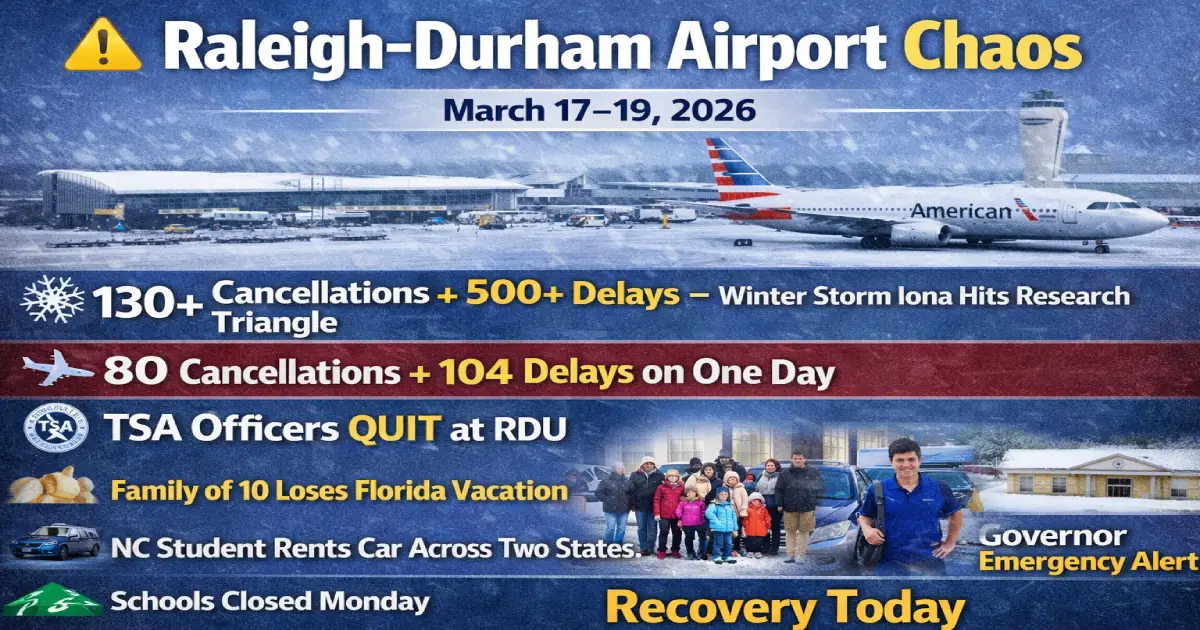
Breaking: Winter Storm Iona didn’t just hit Minneapolis and Chicago. It sliced through the Research Triangle — and Raleigh-Durham International Airport (RDU) absorbed some of the most concentrated flight chaos of any mid-sized US airport during the entire Spring Break 2026 disruption cycle. Between Monday March 16 and Wednesday March 18, RDU recorded more than 130 cancellations and 500+ delays — including a single day when FlightAware confirmed 80 flight cancellations and 104 delays at RDU alone. On its worst day, RDU was posting a cancellation rate among the highest percentages of impacted flights of any regional airport in the nation — a staggering figure for an airport that serves one of America’s most economically dynamic metropolitan regions.
The human cost was immediate and vivid. Michael White — part of a family of ten — watched two flights cancel on two different airlines while his kids waited to fly to Universal Studios Orlando. “We’re supposed to be vacationing in Orlando at Universal, so we have the theme park, the hotel, the tickets everything paid for, and we’re going to lose a day and a half,” he told CBS17 from inside the terminal. “Now try and explain that to the kids. We’ll have to get them some extra ice cream or something like that to make up for that.”
NC Central University student Moe Johnson had a different experience — he decided not to wait for a rebooked flight at all. Stranded trying to get home from Miami, he rented a car and drove through two states. “We drove through two states where we had two flights,” he told ABC11. His verdict on what really caused the chaos: “I don’t really think the weather was the real main factor.” He was pointing at the DHS shutdown — and the data backs him up. A source inside RDU told ABC11 that nearly half a dozen TSA workers at RDU have submitted resignation notices — and that the number is expected to grow in the days ahead.
Today, March 19, conditions at RDU are improving and the airport is entering recovery. But the damage from three days of severe disruption is still being felt across the Research Triangle’s business, academic and tourism community. Here is the complete picture.
Published: March 19, 2026 (Wednesday — Recovery Day 1 at RDU) Three-day total (March 16–18): 130+ cancellations + 500+ delays Worst single-day cancellations (March 17): 80 cancellations + 104 delays = 184 disruptions Monday March 16 (first impact): 100+ delays + dozens of cancellations (CBS17/WNCN) About 25% of all RDU flights delayed on Monday (CBS17/WNCN) Worst affected routes: New York area airports, Washington D.C., Boston, Chicago, Atlanta Governor Josh Stein: Emergency alert issued — 74 mph wind gusts forecast Schools closed: Raleigh + Chapel Hill closed Monday March 16 TSA at RDU: Nearly half a dozen officers submitted resignation notices (ABC11 source) Nationwide TSA callout Sunday: Topped 10% — highest single-day rate ever (Transportation Secretary confirmed) Nationwide TSA resignations total: 300+ (Secretary Sean Duffy confirmed) RDU airport operations: Technically remained open throughout — no full airport closure Today March 19: Improving — storm cleared Tuesday night, recovery beginning RDU nonstop destinations: 80 total (66 domestic + 14 international) Research Triangle population: 2+ million — Raleigh, Durham, Chapel Hill, Cary, Morrisville
The same weather system that had already cancelled 3,500+ flights nationally on Monday began moving into North Carolina on Sunday afternoon. For RDU, the critical period was Sunday evening through Monday — when the combination of severe thunderstorms, high winds and the storm system’s tornado threat created the most dangerous flight operations window.
More than 100 flights were delayed and dozens more canceled at Raleigh-Durham International Airport Monday after severe weather moved through the Triangle and a large part of the East Coast. Around a quarter of all flights were delayed at RDU Monday, with travelers going to and from several major airports along the East Coast the most impacted.
Governor Josh Stein’s emergency alert — issued before Monday morning — was the signal to everyone in the Triangle that this was not a normal weather event:
✈️ Wind gusts forecast up to 74 mph — the highest wind event in the Research Triangle in years ✈️ Schools in Raleigh and Chapel Hill closed Monday March 16 — the first weather-related school closure in the area since the January ice storms ✈️ Residents urged to enable emergency alerts on their phones ✈️ Road conditions around RDU — in Morrisville on the Raleigh-Durham border — were dangerous enough that airport approach roads were compromised for ground crews
Around a quarter of all flights were delayed at RDU Monday — a figure that in absolute terms represents approximately 60–80 individual delayed departures and arrivals, plus the cascading effect on connecting passengers whose inbound flights were already running hours late from Chicago, Atlanta or New York.
The storm’s impact at RDU was driven primarily by atmospheric instability rather than snow and ice. Strong upper level winds and bands of thunderstorms have reduced the window for safe departures and arrivals, limited usable runway configurations, and constrained the number of aircraft controllers can move per hour.
At the terminal, the human consequences were unfolding in real time. Michael White described the moment his family realised their Florida Spring Break was falling apart: “I woke up at 4 o’clock in the morning, got here, got on the plane, went to sleep and I woke up and everyone’s getting their stuff, I’m like, okay I’m at my next destination, everybody’s like, no we’re still in Raleigh.” After cancellations on two different airlines, the family of ten faced the choice between renting a car or flying out the next day — losing an entire first day and a half of their Universal Orlando vacation.
Tuesday was RDU’s worst day of the entire crisis. Raleigh–Durham International Airport has logged 104 newly delayed flights and 80 cancellations, according to real-time tracking data and publicly available airline information.
80 cancellations in a single day at RDU represents a near-historic disruption event for an airport of its size and volume. RDU is not Chicago O’Hare — it typically processes approximately 300–350 daily departures and arrivals in total. An 80-cancellation day means that roughly 25–30% of the airport’s entire daily schedule simply did not operate.
This volume of disruption is significant for a fast-growing but still mid-sized airport that serves the Research Triangle region of North Carolina. With a mixture of business travelers, university traffic, and leisure passengers, the concentration of delays and cancellations at Raleigh–Durham is rippling through itineraries that extend across the country.
Routes most severely affected: Routes linking RDU to major East Coast and Midwestern hubs appear to have absorbed the brunt of the cancellations. Flights to and from New York area airports, Washington, Boston, Chicago, and Atlanta showed elevated disruption as the same storm complex tightened capacity at multiple ends of those routes. When weather simultaneously reduces arrival rates at both a hub and spoke airport, schedules quickly unravel and recovery becomes more complex.
Forecasts for central North Carolina suggest that the most intense thunderstorm activity tied to the current storm complex will gradually shift eastward late on March 18, with improving conditions expected into March 19.
However, the operational legacy of three disrupted days persisted. After a large, multi-day disruption, it can take airlines several additional days to reposition aircraft and crews, especially when the storm’s footprint is as broad as this system’s. Residual delays, scattered cancellations, and last-minute schedule changes at RDU are therefore possible even after skies visibly improve, particularly on routes dependent on aircraft arriving from still-recovering hubs in the Midwest and Northeast.
The weather was the trigger. But the DHS shutdown was the accelerant.
A source told ABC11 that nearly half a dozen TSA workers at RDU have submitted their notices to leave, and that the number is expected to grow in the days ahead. As the partial government shutdown enters its second month, air traffic controllers and TSA officers continue to work without pay. According to Transportation Secretary Sean Duffy, more than 300 TSA agents have resigned since the partial federal government shutdown. On Sunday alone, the agency said the nationwide callout rate topped 10%, marking the highest single-day figure the agency has ever recorded.
“Nearly half a dozen” is a small absolute number at an airport of RDU’s size — but the trajectory matters. RDU is a medium-sized airport with a correspondingly smaller TSA workforce than Atlanta or Houston. Losing five or six experienced screeners from a checkpoint that typically runs 40–60 active agents per shift represents a meaningful percentage reduction in RDU’s screening capacity.
The implications for the Research Triangle’s primary aviation gateway:
✈️ Fewer open security lanes during peak periods ✈️ Longer wait times even on days with no weather disruption ✈️ Reduced buffer for high-volume travel days (Wolfpack games, ACC Tournament, Duke graduation, UNC commencement — all events that generate RDU surges) ✈️ Ongoing risk of additional resignations as the shutdown extends toward the 60+ day cliff (Senate recess March 30 means no deal before April 10 at earliest)
NC Central University student, Moe Johnson, was set to arrive at RDU from his spring break trip to Miami. However, he was forced to rent a car because of travel disruptions. “We drove through two states where we had two flights. I don’t really think the weather was the real main factor.”
Moe’s assessment is analytically accurate. At RDU on Sunday March 16, the nationwide TSA callout rate topped 10% — the highest ever recorded. Weather created the demand spike. TSA staffing gaps turned that demand into a crisis.
Raleigh-Durham International Airport is not just a regional hub. It is the primary aviation gateway for one of the most economically and intellectually significant metropolitan regions in North America.
The Research Triangle:
The Research Triangle — encompassing Raleigh, Durham, Chapel Hill, Cary, Morrisville and surrounding communities — is home to:
🎓 Three major research universities — Duke University, UNC Chapel Hill, NC State University — with a combined student population exceeding 110,000 and global academic connections that generate substantial international and domestic air travel 🔬 Research Triangle Park (RTP) — one of the largest and most prestigious science and technology research parks in the world, home to IBM, Cisco, NetApp, Novo Nordisk, Biogen, SAS Institute, and hundreds of smaller biotech, pharma and technology firms 💉 Life sciences hub — the Triangle is one of the top-three US life sciences centres, generating high volumes of business travel to Boston, San Francisco, New York, Washington D.C. and international pharma capitals 🏀 ACC Basketball capital — Duke, UNC, NC State all play in the ACC; the ACC Tournament and NCAA Tournament generate massive short-burst travel demand at RDU ☀️ Spring Break gateway — RDU serves as a primary departure point for Triangle residents flying to Florida, the Caribbean, Mexico and beach destinations during spring break
A three-day disruption at RDU during Spring Break and NCAA Tournament overlap is not a local inconvenience. It cascades into: Duke patient families missing medical appointments, Biogen scientists missing conferences, Spring Break families losing prepaid resort days, and thousands of students unable to return to or from their breaks on schedule.
Airlines serving Raleigh–Durham preemptively canceled a significant share of their scheduled operations for March 17 and March 18, especially during the afternoon and evening periods when the strongest storms and wind shear were forecast. These cancellations affected both mainline and regional flights, including key connections to major hubs such as Atlanta, Chicago, Newark, and Washington.
Routes most severely affected March 16–18:
✈️ RDU → ATL (Atlanta): Delta’s primary RDU hub feed — hit on both ends (ATL had 500+ cancellations this week, RDU was disrupted simultaneously) ✈️ RDU → EWR/JFK/LGA (New York area): American, United, JetBlue, Delta — all three New York metro airports disrupted simultaneously with RDU ✈️ RDU → DCA/IAD (Washington D.C.): Reagan National was under active ground stop Monday; Dulles disrupted — RDU connections to D.C. were among the first to be pre-cancelled ✈️ RDU → BOS (Boston): Both ends disrupted — Boston’s storm impact compounded RDU’s ✈️ RDU → ORD (Chicago): O’Hare had 500+ cancellations Monday — any RDU feed into O’Hare connections was effectively severed ✈️ RDU → MCO/TPA/MIA (Florida): Spring Break routes — these are the cancellations that produced the family of ten’s Universal Orlando loss, and thousands of similar stories across the Triangle
Transcontinental and international: Transcontinental flights to West Coast destinations and onward international services, which depend on precise inbound connections from regional RDU feeders, have seen knock-on delays when those shorter segments could not depart on time. In some cases, aircraft scheduled to operate longer routes remained out of position after being held or cancelled the previous day.
Today is RDU’s first genuine recovery day. The storm has cleared central North Carolina. Conditions at RDU this morning are: clear skies, wind within normal limits, no active weather advisories, no FAA ground stop or ground delay program in effect.
The airport says operations are under normal conditions.
However, the recovery is not instantaneous. Aircraft that were stranded in Atlanta, Chicago, New York and Washington — unable to reach RDU for three days — are only now being repositioned. Crews that hit duty-time limits during storm operations are completing their mandatory rest periods today. Passengers who missed connections at O’Hare, Hartsfield-Jackson or LaGuardia because their RDU inbound flights were cancelled are only now being rebooked onto available services.
The practical reality for RDU passengers today:
✈️ Weather: ✅ Clear — no storm risk in next 72 hours for central NC ✈️ Airport operations: ✅ Normal ✈️ TSA checkpoint: ⚠️ Staff resignation risk — allow extra time; half a dozen RDU TSA submitted notices; more expected ✈️ Aircraft availability: 🟡 Recovering — most RDU rotations back in position by today ✈️ Connecting hub risk: 🟡 Atlanta recovering (300+ pre-cancel week); ORD and MSP still in recovery; DCA normal
Recommended arrival time at RDU today: 2.5 hours before domestic departures; 3.5 hours before international. Not because RDU itself is chaotic — but because TSA resignation risk means checkpoint staffing could be thinner than expected without warning.
If your flight was cancelled by weather (March 16–18): ✈️ Full refund to original payment method OR free rebooking on next available flight — your choice ✈️ Meals and hotel: NOT legally required for weather cancellations under DOT rules — but American, Delta, United and Southwest all have goodwill commitments; always ask at the gate desk before leaving the terminal
If you were stranded and incurred hotel/food/transport costs: ✈️ Your travel insurance (if purchased before the storm) is your primary recovery mechanism — most policies cover trip delay costs after 6–12 hours ✈️ Premium travel credit cards: Chase Sapphire Reserve, AmEx Platinum, Capital One Venture X all provide up to $500 per ticket for covered delays of 6+ hours — file claims now while documentation is fresh
If you missed a connecting flight on a single ticket: ✈️ The airline must rebook you to your final destination at no charge — file this claim explicitly with the ticketing carrier if you were left stranded at a connecting hub
Airline contacts for RDU passengers:
✅ Step 1 — Check your specific flight at your airline’s app TODAY. Even in recovery, residual positioning delays may affect your departure. Verify your flight is confirmed before driving to RDU.
✅ Step 2 — Allow 2.5 hours minimum for security today at RDU. TSA resignation risk means fewer agents on shift than normal. Do not assume the airport’s official “operations normal” statement means checkpoint staffing is at full strength.
✅ Step 3 — If your flight was cancelled March 16–18 and you’ve not yet rebooked: Call your airline now. With Delta’s waiver active until March 24, Delta passengers still have fee-free rebooking available. United’s waiver expired March 19 tonight.
✅ Step 4 — If you are connecting through Atlanta, Chicago or New York from RDU: Allow 3+ hours for your connection through ATL, ORD or LGA/EWR this week — all three are still in storm recovery mode with reduced operational buffers.
✅ Step 5 — Family of 10 scenario (prepaid Florida vacation): If you held Universal Orlando or Disney World tickets, hotel reservations and incurred cancellation losses from this storm — contact your travel insurance provider immediately. Document all prepaid costs with receipts. Theme park operators (Universal, Disney) have rain-check or goodwill accommodation policies for families displaced by weather — call their guest services lines directly.
Posted By : Vinay
This article is provided for general informational purposes only and is based on information available at the time of publication. Travel advisories, airline schedules, airport operations, visa requirements, government regulations, and other travel-related information are subject to change without prior notice. While Travel Tourister makes reasonable efforts to verify information using official announcements, government publications, airline and airport communications, and other reliable sources, we cannot guarantee that all information remains complete, accurate, or up to date at all times. Readers should independently verify any information that may affect their travel plans with the relevant airline, airport authority, government agency, embassy, or other official source before making travel, financial, or other decisions. Travel Tourister shall not be liable for any direct or indirect loss, inconvenience, or damages arising from the use of or reliance on the information contained in this article. Nothing in this publication constitutes legal, immigration, financial, or professional travel advice. If you believe any information in this article is inaccurate or outdated, please contact our editorial team. We review all credible correction requests promptly and update our content whenever appropriate.
Lastest News
2nd Floor, 39, Above Kirti Club, DLF Industrial Area, Kirti Nagar, New Delhi, Delhi 110015



Travel Tourister is a leading Travel portal where we introduce travellers to trusted travel agents to make their journey hasselfree, memorable And happy. Travel Tourister is a platform where travellers get Tour packages ,Hotel packages deals through trusted travel companies And hoteliers who are working with us across the world. We always try to find new and more travel agents and hoteliers from every nook and corners across the world so that you could compare the deals with different travel agents and hoteliers and book your tour or hotel with the one you have chosen according to your taste and budget.
Copyright © Travel Tourister, India. All Rights Reserved

 Call
Call Enquiry