Published on : 29 Oct 2026
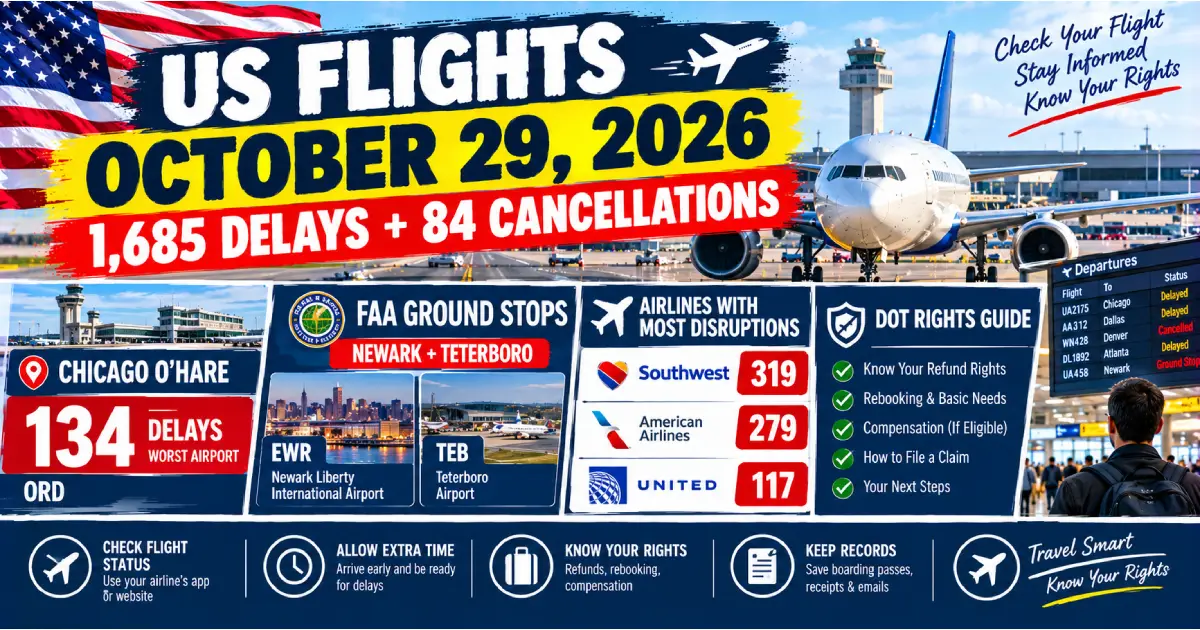
A fresh wave of flight disruptions is sweeping the United States on Thursday October 29, 2026, with 1,685 delays and 84 cancellations recorded across US airports as of this morning — driven by weather systems sweeping the Southwest and Pacific Northwest simultaneously and compounded by ongoing FAA staffing shortages at Northeast facilities. Chicago O’Hare International Airport leads today’s national disruption table with 134 delays, followed by Los Angeles International with 100 delays and Phoenix Sky Harbor with 92 delays. Anchorage Ted Stevens International is recording 49 delays as a Pacific weather system pushes inland from the Gulf of Alaska. San Diego International — still absorbing residual pressure from the October nor’easter aftermath — records 47 delays. Tampa International adds 34 delays as the southeastern weather system extends its reach.
The Northeast adds a different dimension to today’s disruption picture. The FAA has issued ground stops at Newark Liberty International (EWR) and Teterboro Airport (TEB) due to staffing constraints — the ongoing ATC controller shortage at Philadelphia TRACON (currently at 64.9% of its staffing target) continuing to generate formal ground programs even in the absence of severe weather. Newark’s existing FAA schedule cap (36 arrivals and 36 departures per hour — extended through October 2027) means that any staffing-related ground stop at EWR produces an immediate cascade with almost no operational buffer to absorb it.
The airline scoreboard tells the other half of the story: Southwest Airlines is today’s most disrupted carrier with 319 delays — a figure that reflects its extensive Southwest and West Coast network exposure to the dual weather systems. American Airlines records 279 delays driven by its Chicago O’Hare hub and Phoenix connections. United Airlines records 117 delays, SkyWest records 96, and Alaska Airlines records 58. Today’s total of 1,769 combined delays and cancellations is significantly lower than the peak disruption days of September and early October — but it falls on a Thursday when Spain is simultaneously striking on rail (Renfe) and two days before Italy’s national general strike, making it the most globally disrupted aviation day of the week for UK and European travellers with transatlantic connections.
Published: October 29, 2026 — Thursday Data Timestamp: FlightAware data recorded approximately 5:20 PM ET October 28 (rolling into October 29 operations) National Total: 1,685 delays + 84 cancellations = 1,769 disruptions Worst Airports:
Chicago O’Hare International Airport leads the national disruption table with 134 delays today. The cause is the broader weather system sweeping across the Midwest — which is generating the convective activity and wind patterns that most frequently disrupt O’Hare operations. O’Hare’s four-runway configuration should give it more weather resilience than single-runway airports like Boston Logan, but the sheer volume of daily movements at one of the world’s busiest airports means that even a moderate weather-driven reduction in hourly movement rates produces significant absolute delay counts.
American Airlines and United Airlines — O’Hare’s two dominant carriers — are absorbing the majority of today’s ORD delays. American’s hub banks at O’Hare connect to the Southeast, the Gulf Coast, Mexico, the Caribbean, and transatlantic services. United’s O’Hare hub connects to its Star Alliance partners and its Pacific routes through San Francisco and Los Angeles. With 134 delays today at ORD alone, both airlines are managing aircraft rotations that are progressively falling further behind schedule as the morning hours extend.
For passengers connecting at O’Hare today: ✅ Minimum 2.5-hour connection recommended — standard 60–90 minute windows are inadequate today ✅ American Airlines: aa.com/travelalerts for any ORD waiver — check for any weather advisory ✅ United Airlines: united.com/travel-alerts ✅ Use airline apps for fastest rebooking — not the phone
Los Angeles International Airport is recording 100 delays driven by the weather system affecting the Southwest and Pacific coast. LA’s weather disruption today is primarily driven by unusual October atmospheric conditions — low-pressure systems pushing in from the Pacific are creating fog and low cloud ceilings that reduce visual approach capability and force instrument approach procedures that compress the arrival rate.
LAX is one of the few airports in the US where weather disruption in October can be as severe as in winter — the Santa Ana wind pattern and coastal fog inversions both produce aviation-impacting conditions during the autumn months. Today’s disruption is consistent with the seasonal pattern.
Delta, United, American, Alaska are the primary carriers at LAX and the most exposed to today’s 100 delays. Delta’s LA hub — feeding connections to its Pacific network (Japan, South Korea, Australia) — is particularly sensitive: a delayed LAX arrival means a late transatlantic or transpacific departure.
LAX passengers today: ✅ Check fly.faa.gov for current arrival programs at LAX before leaving home ✅ Delta: 1-800-221-1212 | United: 1-800-864-8331 | American: 1-800-433-7300
Phoenix Sky Harbor International Airport is recording 92 delays today. Phoenix is the western hub for American Airlines and a significant Southwest Airlines base — both carriers are heavily exposed to today’s Phoenix figure. The Southwest weather system generating Phoenix disruption today is a low-pressure trough moving across the desert Southwest, producing gusty surface winds and reduced visibility at PHX’s desert-climate-sensitive runways.
Phoenix also serves as a connecting hub for passengers routing from the Southeast to California and the Pacific Northwest — disruption at PHX cascades to connecting flights at LAX, SFO, SEA, and SAN.
Phoenix passengers today: ✅ American Airlines Phoenix: aa.com/travelalerts ✅ Southwest Phoenix: southwest.com/travel-disruptions
Anchorage recording 49 delays today reflects the Pacific weather system that has pushed inland from the Gulf of Alaska. While Anchorage is not a hub most UK, Australian, or Canadian travellers transit through for regular travel, it is significant as a cargo hub (FedEx, UPS, and international freighters use ANC extensively as a Pacific refuelling and sorting point) and as the primary gateway for Alaska’s aviation-dependent communities. Alaska Airlines is the dominant Anchorage carrier.
San Diego’s 47 delays today reflect residual pressure from the October nor’easter aftermath, the broader Southwest weather system, and San Diego’s structural constraints as one of the busiest single-runway airports in the US. The drone and balloon incident of September 4 and the subsequent volume programs have left San Diego operating with tighter scheduling margins than before — any additional weather or volume pressure compounds into elevated delay counts faster than at multi-runway airports.
Tampa’s 34 delays reflects the southeastern edge of today’s weather system pushing across Florida. Tampa is a significant Southwest Airlines and American Airlines base — both carriers’ Florida networks feed through Tampa connections.
| Airport | Code | Delays | Primary Cause |
|---|---|---|---|
| Chicago O’Hare | ORD | 134 | Midwest weather system |
| Los Angeles International | LAX | 100 | Pacific coastal weather + fog |
| Phoenix Sky Harbor | PHX | 92 | Southwest weather trough |
| Anchorage Ted Stevens | ANC | 49 | Pacific Alaska weather |
| San Diego International | SAN | 47 | Southwest system + single runway |
| Tampa International | TPA | 34 | Southeast weather extension |
| Newark Liberty | EWR | Elevated | FAA staffing ground stop + cap |
| Teterboro | TEB | Ground stop | FAA staffing constraint |
| All others | — | Elevated | Cascade from above |
| Carrier | Delays | Primary Hub Exposure | Notes |
|---|---|---|---|
| Southwest Airlines | 319 | ORD area + PHX + LAX + TPA | Point-to-point network — each delay cascades through multiple rotations |
| American Airlines | 279 | ORD (primary) + PHX + LAX | Two-hub exposure to both major weather zones |
| United Airlines | 117 | EWR (ground stop) + ORD + LAX | Newark staffing ground stop + Midwest/Pacific weather |
| SkyWest Airlines | 96 | ORD + LAX + PHX regional feeders | Regional feeder — delays cascade from hub disruptions |
| Alaska Airlines | 58 | ANC + SAN + LAX | Pacific weather exposure + Anchorage primary |
Southwest’s 319 delays — the highest of any carrier — reflects the structural vulnerability of Southwest’s point-to-point network model to multi-geography simultaneous weather disruption. When a hub-and-spoke carrier like American has delays at O’Hare and Phoenix, those delays are somewhat contained — the hub absorbs and redistributes. When Southwest has delays across Chicago, Los Angeles, Phoenix, and Tampa simultaneously, the cascades multiply across its entire point-to-point network as each aircraft’s next rotation runs late from its previous disrupted rotation.
Southwest’s Chicago Midway (MDW) operations — not O’Hare — are Southwest’s primary Chicago base, but the broader Midwest weather system affecting O’Hare is equally affecting Midway, creating the Southwest delay accumulation visible today.
Newark Liberty International Airport is today operating under a FAA ground stop caused by staffing constraints at Philadelphia TRACON — the same structural issue that has produced the FAA’s formal schedule cap (36 arrivals + 36 departures per hour, extended through October 30, 2027) and regular ground programs throughout September and October.
The Philadelphia TRACON staffing situation: currently at 74 controllers against a target of 114 — 64.9% of staffing target. The Newark-specific Area C sector within PHL TRACON sits at 28 controllers against a target of 46 — 60.8% of target. When a controller team is at 60% of target, any additional demand spike — such as a weather event pushing additional aircraft toward the Northeast — can trigger formal ground stops because there are simply not enough certified controllers to safely sequence the additional traffic.
Today’s Newark ground stop is a staffing-driven program, not a weather-driven program. The distinction matters for passengers because:
United Airlines — Newark’s dominant carrier at approximately 70% of daily movements — is the carrier most exposed to today’s EWR ground stop. United passengers with Newark connections should check their specific itinerary status now.
Teterboro Airport in New Jersey is a general aviation and business jet airport — not a commercial airline hub. It does not carry the passenger volumes of Newark or the New York trio. However, a FAA ground stop at Teterboro on a Thursday reflects the same staffing-driven airspace management being applied across the New York metro area. Business aviation passengers with Teterboro-originating or -arriving flights today should contact their FBO (Fixed Base Operator) or charter operator for current status.
Today’s disruption in the US does not stay in Chicago, LA, Phoenix, and Newark. By late afternoon:
| Origin Disruption | Downstream Impact | Via Which Carriers |
|---|---|---|
| O’Hare (ORD) 134 delays | New York, DC, Miami, Dallas, Atlanta, West Coast | American, United |
| LAX 100 delays | Chicago, New York, Atlanta, Dallas, international Pacific | Delta, United, American, Alaska |
| PHX 92 delays | Los Angeles, Dallas, Chicago, Southeast US | American, Southwest |
| EWR ground stop | Chicago, Houston, Denver, LA, transatlantic | United (dominant) |
| Southwest 319 delays | Every Southwest city nationwide | Southwest point-to-point |
By 3:00–5:00 PM Eastern Time today, the cascade will be visible at airports as geographically distant from today’s primary disruption points as Dallas, Atlanta, Charlotte, Miami, Seattle, and Denver — all of which receive aircraft from the disrupted airports.
Thursday October 29 sits between two major European transport disruptions:
For UK and European passengers flying transatlantic today and connecting onward to Europe, today’s US airport disruptions arrive at a moment when European onward connections are under simultaneous pressure. A transatlantic passenger delayed at O’Hare today, arriving late into London Heathrow or Amsterdam, may be trying to connect onward to Spain (where trains are disrupted) or Italy (where flights are cancelled tomorrow).
If you have a transatlantic US → Europe flight today with an onward European connection involving Spain or Italy: contact your airline now and verify the entire itinerary — not just today’s transatlantic leg.
For every cancelled flight today at any US airport, regardless of cause:
| Situation | Your Right |
|---|---|
| Flight cancelled — weather, staffing, any cause | Full cash refund to original payment — mandatory |
| Domestic delay 3+ hours — choose not to travel | Full cash refund right |
| International delay 6+ hours — choose not to travel | Full cash refund right |
The exact phrase: “Under the DOT’s April 2024 Automatic Refund Rule, I am requesting a full cash refund to my original payment method. I do not accept an eCredit or travel voucher.”
Both weather-driven and staffing-driven FAA ground stops are treated similarly to weather for compensation purposes under US DOT rules — they are not categorised as airline controllable events. This means:
❌ No additional cash compensation per passenger beyond the refund right for ground stop-caused delays ✅ Full cash refund for cancelled flights — unconditional ✅ Meal vouchers — all carriers provide for significant delays (ask at 2-hour mark) ✅ Hotel accommodation (controllable delays) — all carriers required; Southwest + JetBlue provide even for weather
With consolidations and aircraft repositioning likely today, overbooking situations are elevated:
| Delay to Destination | DOT-Mandated Cash |
|---|---|
| 1–2 hours domestic | $775 minimum |
| 2+ hours domestic | $1,550 minimum |
Cash — not a voucher. Airlines cannot pay involuntary bump compensation in travel credits without your consent.
| Carrier | Travel Alerts | Phone |
|---|---|---|
| Southwest | southwest.com/travel-disruptions | 1-800-435-9792 |
| American Airlines | aa.com/travelalerts | 1-800-433-7300 |
| United Airlines | united.com/travel-alerts | 1-800-864-8331 |
| Alaska Airlines | alaskaair.com | 1-800-252-7522 |
| Delta Air Lines | delta.com/travel-disruptions | 1-800-221-1212 |
Step 1 — Check fly.faa.gov before leaving for any US airport Live FAA ground stop + ground delay programs — Newark and Teterboro active. Check whether your specific departure airport has a program in effect and the current average delay.
Step 2 — Check your inbound aircraft on FlightAware flightaware.com → search your flight number → see where the aircraft is right now. If it is sitting in Chicago or LA in a ground hold, your departure today will be late regardless of what the departure board shows.
Step 3 — Use airline apps — not the phone Southwest, American, and United apps process rebooking in 3–5 minutes. Today’s phone queues are running 45–90 minutes minimum.
Step 4 — O’Hare today: 2.5-hour connection minimum With 134 delays at ORD, the standard 60–90 minute connection window has a high failure probability. If your ORD connection is tighter than 2.5 hours, call your airline now — before you board your inbound — to discuss alternatives.
Step 5 — Newark today: double-constrained — 2.5-hour connections minimum EWR is operating under both the 36/hr cap AND today’s staffing ground stop simultaneously. This is the most constrained operating environment of any major US hub today. United passengers with Newark connections: 2.5 hours minimum — call 1-800-864-8331 before boarding your inbound.
Step 6 — Southwest 319 delays: use the app, not the phone Southwest’s point-to-point network means 319 delays cascade across 90+ cities. Phone queues are 60+ minutes. The Southwest app processes same-day rebooking in under 5 minutes.
Step 7 — Cancelled flight: cash refund, not voucher “Under the DOT’s April 2024 Automatic Refund Rule, I am requesting a full cash refund to my original payment method. I do not accept an eCredit.”
Step 8 — Meal vouchers at the 2-hour mark At any airline desk: “My flight has been delayed more than two hours. I am requesting meal vouchers.” Keep every food receipt regardless.
| Resource | Contact / Link |
|---|---|
| FAA Ground Stop Status | fly.faa.gov |
| FlightAware Live Tracking | flightaware.com |
| Southwest Travel Disruptions | southwest.com/travel-disruptions |
| American Airlines Travel Alerts | aa.com/travelalerts |
| United Airlines Travel Alerts | united.com/travel-alerts |
| Alaska Airlines | alaskaair.com |
| Delta Air Lines | delta.com/travel-disruptions |
| SkyWest Airlines | skywest.com |
| Chicago O’Hare Airport | flychicago.com |
| Los Angeles Airport | flylax.com |
| Phoenix Sky Harbor | skyharbor.com |
| Newark Liberty Airport | newarkairport.com |
| DOT Consumer Protection | airconsumer.dot.gov |
Thursday October 29, 2026 is a moderately disrupted day across the US aviation network — 1,685 delays and 84 cancellations nationally, driven by dual weather systems over the Southwest and Pacific Northwest and ongoing FAA staffing shortages in the Northeast. Chicago O’Hare leads with 134 delays, followed by Los Angeles at 100 and Phoenix at 92. FAA ground stops are active at Newark and Teterboro due to staffing constraints. Southwest leads all carriers with 319 delays across its point-to-point network. American records 279, United 117, SkyWest 96, Alaska 58.
Today’s figures are significantly lower than the peak disruption days of September and October — but the timing matters. Today is the same day as Spain’s national Renfe train strike and the day before Italy’s full national general strike. Transatlantic passengers with European connections involving Spain or Italy should verify their entire multi-leg itinerary today, not just tomorrow.
The eight things every affected US passenger must do:
For More Resources:
Related Articles:
Posted By : Vinay
This article is provided for general informational purposes only and is based on information available at the time of publication. Travel advisories, airline schedules, airport operations, visa requirements, government regulations, and other travel-related information are subject to change without prior notice. While Travel Tourister makes reasonable efforts to verify information using official announcements, government publications, airline and airport communications, and other reliable sources, we cannot guarantee that all information remains complete, accurate, or up to date at all times. Readers should independently verify any information that may affect their travel plans with the relevant airline, airport authority, government agency, embassy, or other official source before making travel, financial, or other decisions. Travel Tourister shall not be liable for any direct or indirect loss, inconvenience, or damages arising from the use of or reliance on the information contained in this article. Nothing in this publication constitutes legal, immigration, financial, or professional travel advice. If you believe any information in this article is inaccurate or outdated, please contact our editorial team. We review all credible correction requests promptly and update our content whenever appropriate.
Lastest News
2nd Floor, 39, Above Kirti Club, DLF Industrial Area, Kirti Nagar, New Delhi, Delhi 110015



Travel Tourister is a leading Travel portal where we introduce travellers to trusted travel agents to make their journey hasselfree, memorable And happy. Travel Tourister is a platform where travellers get Tour packages ,Hotel packages deals through trusted travel companies And hoteliers who are working with us across the world. We always try to find new and more travel agents and hoteliers from every nook and corners across the world so that you could compare the deals with different travel agents and hoteliers and book your tour or hotel with the one you have chosen according to your taste and budget.
Copyright © Travel Tourister, India. All Rights Reserved

 Call
 Enquiry