Published on : 09 Sep 2026
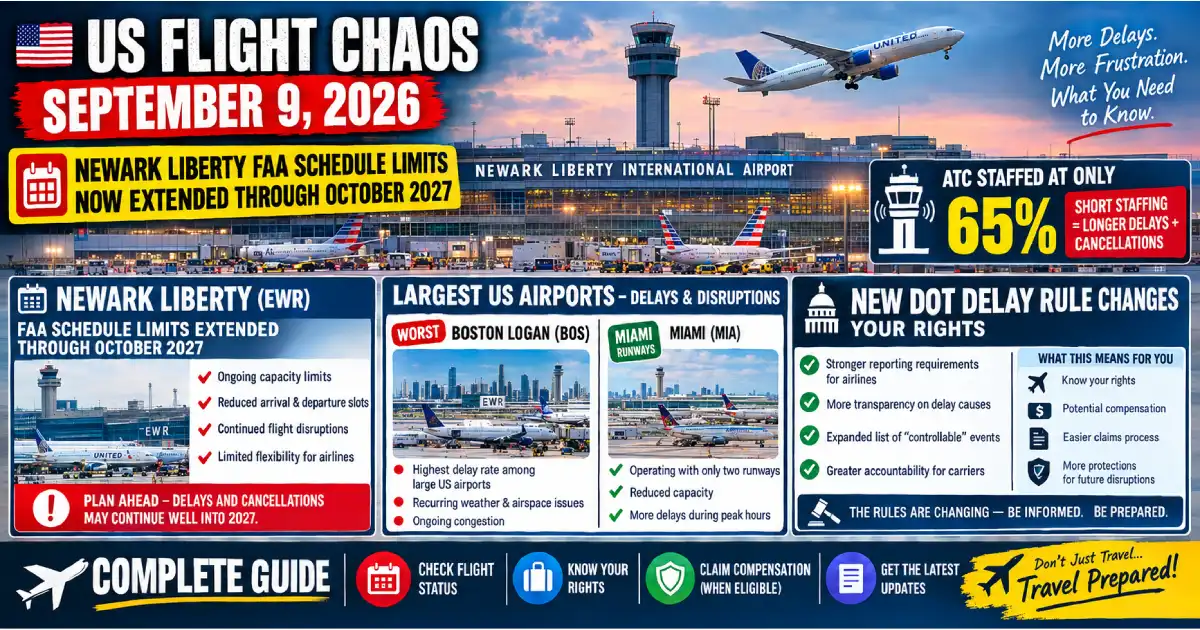
The United States aviation network is entering the post-Labor Day period of September 2026 with three structural problems that were not resolved by the end of the holiday weekend — and none of them are going away soon. Today, Wednesday September 9, the national picture is one of gradual post-Labor Day recovery interrupted by three confirmed ongoing systemic issues that will affect millions of US passengers through the autumn season and well into 2027.
First, the most significant aviation policy confirmation of the month: the Federal Aviation Administration has extended its order limiting scheduled operations at Newark Liberty International Airport through October 30, 2027 — more than a full year beyond the previous October 24, 2026 deadline. The Federal Register entry published June 23, 2026 confirms that the FAA has capped Newark arrivals and departures at 36 per hour in each direction — against a pre-crisis peak of 77 operations per hour. The driving reason is stark: Philadelphia TRACON, which controls Newark’s airspace, is staffed at only 64.9% of its target — 74 controllers against a target of 114. The Newark-specific Area C sector is even more severely understaffed, at 60.8% — 28 controllers against a target of 46. United Airlines, Newark’s dominant carrier, cannot grow at the airport until ATC staffing recovers. Every passenger flying to, from, or through Newark in the next 13 months is operating within these imposed constraints.
Second, Boston Logan International Airport remains the worst-performing large hub in the United States after a week of severe disruption caused by active runway construction for EMAS (Engineered Materials Arresting System) installation on runway 9-27. The construction began September 2 and runs through mid-November — flights will have average delays of 60 to 75 minutes, or more depending on weather. Boston logged 434 delays and 6 cancellations on September 4, 256 delays and 59 cancellations on September 6, and 208 delays and 9 cancellations on September 7. Today is Day 7 of construction and the afternoon peak delay accumulation pattern is confirmed as a daily feature through November.
Third, Miami International Airport is still operating on two of its four runways after Sunday’s fatal Amazon cargo plane crash. Airport officials confirmed that two of MIA’s four runways remain closed as the NTSB investigation continues. American Airlines has an active travel waiver for MIA passengers. Impacts for travelers are likely going to continue for the next day or two — or longer, depending on NTSB scene clearance.
Nationally, the post-Labor Day recovery from a weekend that saw 2,559 delays on September 7 alone is well underway — but today is not yet a clean day. Here is the complete picture.
Published: September 9, 2026 — Wednesday National Context: Post-Labor Day recovery — week of September 7–13 is first full work week of autumn 2026 Newark Liberty (EWR):
The most important aviation policy fact for any US passenger flying through Newark in the next 13 months is this: this action extends the order limiting the number of scheduled aircraft operations at Newark Liberty International Airport, which was most recently extended on September 29, 2025, by approximately one year, through October 30, 2027.
This is not a short-term emergency measure. It is not a temporary COVID-era restriction. It is a formal FAA regulatory action published in the Federal Register, extending structured limits on the number of aircraft that can arrive and depart from one of America’s three primary New York-area airports for 13 more months. The extension was published June 23, 2026 and has been in effect since then. It applies through the summer, autumn, and winter of 2027.
The cap is set at 36 arrivals and 36 departures per hour during normal operations. Prior to the crisis that triggered the original limits, Newark could handle as many as 77 arrivals and departures combined per hour during peak times. Today’s limit represents less than half the peak capacity. The airport cannot process the volume of flights that airlines would want to schedule into it — so the FAA is legally restricting how many slots are available.
The fundamental cause of Newark’s schedule limits is a severe shortage of certified air traffic controllers in the sector that manages Newark’s airspace.
In July 2024, FAA transferred air traffic control oversight for the Newark area, known as Area C, to the Philadelphia TRACON (PHL). PHL’s current targeted staffing number remains at 114 Certified Professional Controllers (CPCs); the current number of onboard controllers at PHL is 74, representing 64.9 percent of the staffing target. Within PHL, Area C’s targeted staffing number is 46 CPCs. Currently, Area C has 28 CPCs, representing 60.8 percent of the staffing target.
To translate these numbers into practical aviation terms: the team responsible for guiding every aircraft arriving and departing from Newark is running at approximately 60% of the human capacity needed to do that job safely and efficiently at full schedule volumes. A controller team at 60% of target is a team under constant pressure. It means supervisors are covering more positions simultaneously than is optimal. It means training pipelines are stretched. It means any additional stressor — a weather event, an equipment outage, a surge in departures during a holiday weekend — hits a system with almost no margin.
ATC controller training takes 2–5 years from hiring to full certification. The shortage cannot be resolved quickly. The FAA has extended the Newark limits to October 2027 precisely because it has no credible pathway to full ATC staffing before then.
United Airlines maintains its largest East Coast hub at Newark and is the dominant carrier at EWR, accounting for approximately 70% of daily operations. United cannot expand at Newark while the FAA caps are in place — and the caps now run through October 2027. The extension of caps through 2026 and into 2027 constrains United’s ability to grow in Newark and forces a recalibration of how aggressively it can scale operations under external limits.
United was optimistic earlier in 2026. The carrier touted more than six million punctual arrivals through Newark and announced plans to expand service to more than 160 destinations from the airport this fall and winter. The Federal Register extension — now confirmed to run through October 30, 2027 — has imposed a ceiling on that expansion. United must prioritize which routes and frequencies remain viable in Newark’s constrained environment.
Layered on top of the hourly caps, runway 4L-22R at Newark is closed on weekends from September 1 through December 31, 2026. Saturday and Sunday departures and arrivals at EWR are operating under both the hourly cap (36 each way) and reduced runway availability. Weekend Newark passengers face the most constrained operating environment of any regular weekday or weekend combination at any major New York-area airport.
| Metric | Value |
|---|---|
| FAA cap: arrivals per hour | 36 (vs 77 at pre-crisis peak) |
| FAA cap: departures per hour | 36 (vs 77 at pre-crisis peak) |
| Total hourly operations under cap | 72 (vs up to 154 previously) |
| Cap expiry date | October 30, 2027 |
| PHL TRACON staffing | 74 of 114 target — 64.9% |
| Area C (EWR sector) staffing | 28 of 46 target — 60.8% |
| Weekend runway closure | 4L-22R — Saturdays + Sundays through Dec 31, 2026 |
| Dominant carrier | United Airlines — ~70% of daily operations |
| United expansion status | Constrained — cannot grow while caps apply |
| Monday September 7 ground delay | 102 minutes average (Labor Day) |
Boston Logan is now on Day 7 of the EMAS runway construction that began September 2 on runway 9-27. The week-one disruption picture is precisely what Massport warned: “We do expect delays, particularly in the afternoons and evenings until mid-November.”
September 4 (Thursday — Day 2): 434 delays + 6 cancellations — FAA average gate hold 43 minutes September 6 (Saturday — Day 4): 256 delays + 59 cancellations — worst large US airport that day — 30% of arriving flights delayed September 7 (Monday — Day 5, Labor Day): 208 delays + 9 cancellations — FAA ground hold 44 minutes — 17% departing delay rate
Today — September 9 (Wednesday — Day 7) — is the first full midweek business day of the construction period. Wednesdays at Logan are typically dominated by business travel — United, American, and Delta corporate accounts — and the afternoon peak of departures from 3:00 PM to 7:00 PM local time will generate the most construction-related delay accumulation of the day. JetBlue, as Boston’s largest carrier by daily departures, faces the highest individual airline exposure.
Runways will undergo rework for 75 days, beginning September 2, to improve runways with EMAS — Engineered Materials Arresting System. The EMAS installation — a bed of soft concrete beyond the runway end that crushes under an overrunning aircraft to bring it safely to a stop — is a confirmed federal safety mandate. After Sunday’s fatal Amazon cargo crash at Miami International, which lacks EMAS on runway 30, the safety case for Logan’s installation has become even more visible.
But for the business traveller catching a Wednesday afternoon flight from Boston to Chicago, New York, Washington, or Dallas, the EMAS safety mandate translates into 60–75 minutes of average delay — or more depending on weather. The afternoon thunderstorm season in New England runs through October, compounding the construction delays on any afternoon when convective weather develops over Boston Harbor or the Charles River Basin.
JetBlue is facing a unique double squeeze at Boston in September 2026. JetBlue is facing 133 delays and 25 cancellations on September 6 — a single-carrier total that represents more than half of Boston’s entire disruption count that day. And the carrier is simultaneously preparing to launch transatlantic service from Boston to London Heathrow on September 20 — directly into the peak construction disruption window.
JetBlue’s inaugural Boston–London Heathrow service, launched after a series of Airbus delivery delays that pushed the original July 19 start date back twice, will begin operating on September 20 with the construction period still active. Passengers booked on early BOS–LHR JetBlue departures should understand that their transatlantic departure is originating from an airport running 60–75 minute average delays in the afternoon window — which is precisely when the London Heathrow service will depart.
Miami International Airport remains at half runway capacity today after Sunday’s fatal Amazon Prime Air crash. Two of MIA’s four runways remain closed as the NTSB investigation continues. Airport officials confirmed that two of the airport’s four runways are currently open. Impacts for travelers remain and are likely going to continue.
American Airlines has issued a travel waiver covering all itineraries to, from, and through Miami International. The waiver allows passengers to rebook without change fees or fare differences. Check aa.com/travelalerts for current waiver terms.
The MIA runway reopening timeline depends entirely on the NTSB’s clearance of the investigation scene. The NTSB cannot estimate how long that will take — it is determined by investigative requirements, not calendar preferences. Until two runways are fully cleared and their associated instrument landing systems are recertified, Miami continues to operate at significantly reduced capacity.
| Airport | Status | Active Issue | Est. Recovery |
|---|---|---|---|
| Newark Liberty (EWR) | Structurally constrained | FAA caps through Oct 2027 + ATC 65% staffed | October 2027 |
| Boston Logan (BOS) | Construction disruption | EMAS runway 9-27 closure | Mid-November 2026 |
| Miami International (MIA) | Half runway capacity | NTSB Amazon crash investigation | TBD — days to weeks |
| San Francisco (SFO) | Ongoing delays | Runway construction — delays through Oct | Early October 2026 |
| San Diego (SAN) | Post-drone recovery | Volume program — recovering | This week |
| Chicago O’Hare (ORD) | Recovering | Post-Labor Day storm cascade clearing | This week |
| New York JFK | Recovering | Post-Labor Day cascade | Clearing |
| Atlanta (ATL) | Elevated | Weather + Labor Day residual | Clearing |
| National network | Recovering | Post-2,559-delay Labor Day peak | This week |
The US Transportation Department has published a new rule redefining airline delays, curbing when passengers qualify for compensation while preserving automatic refunds for major disruptions.
This is the most important consumer rights development of September 2026 for US air passengers and deserves close attention. Here is exactly what changes and what does not:
The April 2024 DOT Automatic Refund Rule is fully preserved and applies to every passenger today:
| Situation | Your Right |
|---|---|
| Flight cancelled — any cause | Full cash refund to original payment — mandatory |
| Domestic delay 3+ hours — you choose not to travel | Full cash refund right |
| International delay 6+ hours — you choose not to travel | Full cash refund right |
Airlines cannot substitute a travel voucher for a cash refund on a cancelled flight. This right is unconditional and unchanged by the new rule.
The new rule redefines what qualifies as a “significant delay” for additional compensation purposes beyond the basic refund. The DOT has tightened the circumstances under which airlines must offer meals, hotels, and rebooking for delays that do not reach the cancellation threshold. The practical effect:
Fewer delay situations trigger mandatory airline accommodation. Shorter delays — previously in a grey zone where passengers could argue for compensation — are now more clearly defined as non-triggering. Airlines have more regulatory certainty about when they must provide duty of care and when they can decline.
What this means for Newark and Boston passengers specifically: Passengers experiencing 44–71 minute average ground holds at Newark or Boston should be aware that these delay durations — while frustrating — do not trigger mandatory duty of care or compensation under current DOT rules. The passenger’s right to compensation activates when:
The FAA caps at Newark do not directly give passengers any additional compensation rights. They are a regulatory tool for managing airspace, not a consumer protection measure. However, they have two practical passenger implications:
Implication 1 — Slot contraction: With only 36 arrivals and 36 departures per hour, Newark’s schedule is compressed. When a thunderstorm, ATC issue, or equipment failure reduces the airport’s effective hourly rate below 36, there is no buffer. Delays cascade faster at Newark than at uncapped airports because the cap has already reduced the slack in the system to near zero.
Implication 2 — Weekend Saturdays and Sundays are worst: With runway 4L-22R closed on weekends through December 31, 2026, Saturday and Sunday operations at Newark are running at both the hourly cap AND reduced runway capacity simultaneously. Weekend Newark passengers face double-constrained operations — plan accordingly.
Runway construction is treated as an extraordinary circumstance for compensation purposes — airlines are not required to pay additional cash compensation for construction-caused delays. However:
✅ Cancelled flight = full cash refund — unconditional under DOT April 2024 rule ✅ Meal vouchers — all major Boston carriers (JetBlue, American, Delta, United) provide upon request for significant delays ✅ Hotel (controllable overnight delays) — all carriers provide; weather-related overnight delays at JetBlue and Southwest are also covered ✅ Minimum 3-hour connections — build into any Logan itinerary through mid-November
American Airlines’ MIA waiver covering flights to, from, and through Miami is still active. Check aa.com/travelalerts for current waiver expiry date. Passengers rebooked under the waiver retain all compensation rights for the original cancelled or disrupted flight.
Newark: ✅ Check fly.faa.gov before heading to EWR — the hourly cap means any ATC hiccup produces immediate cascade ✅ If on United: use the standby feature in the United app to queue for up to three earlier flights ✅ Saturday and Sunday EWR connections: build minimum 3-hour buffer — reduced runway AND cap ✅ Transatlantic at EWR: United’s hub for international departures — allow 3+ hours minimum connections
Boston: ✅ Book morning flights — afternoons are worst daily through mid-November ✅ JetBlue passengers: your September transatlantic launch (September 20) is in the heart of construction — allow extra time ✅ Business travellers Wednesday evening: the 3–7 PM Logan departure bank has highest construction delay risk ✅ 3-hour minimum connection through Logan through November — no exceptions
Miami: ✅ Check flight status before going to MIA — two runways still closed ✅ Use American Airlines waiver if on AA — rebook via app before alternative seats are taken ✅ Fort Lauderdale (FLL) as alternative: 30 miles north, fully operational on all runways
| Resource | Contact / Link |
|---|---|
| FAA Newark Statements | faa.gov/newsroom/faa-statements-newark-liberty |
| Federal Register Newark Limits | federalregister.gov — search “Operating Limitations Newark” |
| FAA Ground Stop Status | fly.faa.gov |
| Newark Liberty Airport | newarkairport.com |
| Boston Logan Airport | massport.com/logan-airport |
| Miami International Airport | miami-airport.com |
| United Airlines (EWR dominant) | united.com |
| JetBlue (BOS dominant) | jetblue.com |
| American Airlines (MIA + PHL) | aa.com |
| American Airlines MIA Waiver | aa.com/travelalerts |
| FlightAware Live | flightaware.com |
| DOT Consumer Protection | airconsumer.dot.gov |
| NTSB Investigation Updates | ntsb.gov |
Wednesday September 9, 2026 opens the first full post-Labor Day week of US autumn travel with three structural problems confirmed and ongoing. Newark Liberty’s FAA schedule limits have been formally extended through October 30, 2027 by the Federal Register — the ATC staffing crisis that drives them (65% of target controllers) has no quick fix. Boston Logan’s EMAS runway construction runs through mid-November — average delays of 60–75 minutes daily in the afternoon peak. Miami International is still on half runway capacity after Sunday’s fatal Amazon cargo crash, with NTSB investigation timeline uncertain. The new DOT delay compensation rule has narrowed the circumstances where airlines must provide duty of care for delays — but the April 2024 automatic cash refund rule for cancelled flights is fully preserved and unconditional.
The six things every US passenger must know right now:
For More Resources:
Related Articles:
Posted By : Vinay
This article is provided for general informational purposes only and is based on information available at the time of publication. Travel advisories, airline schedules, airport operations, visa requirements, government regulations, and other travel-related information are subject to change without prior notice. While Travel Tourister makes reasonable efforts to verify information using official announcements, government publications, airline and airport communications, and other reliable sources, we cannot guarantee that all information remains complete, accurate, or up to date at all times. Readers should independently verify any information that may affect their travel plans with the relevant airline, airport authority, government agency, embassy, or other official source before making travel, financial, or other decisions. Travel Tourister shall not be liable for any direct or indirect loss, inconvenience, or damages arising from the use of or reliance on the information contained in this article. Nothing in this publication constitutes legal, immigration, financial, or professional travel advice. If you believe any information in this article is inaccurate or outdated, please contact our editorial team. We review all credible correction requests promptly and update our content whenever appropriate.
Lastest News
2nd Floor, 39, Above Kirti Club, DLF Industrial Area, Kirti Nagar, New Delhi, Delhi 110015



Travel Tourister is a leading Travel portal where we introduce travellers to trusted travel agents to make their journey hasselfree, memorable And happy. Travel Tourister is a platform where travellers get Tour packages ,Hotel packages deals through trusted travel companies And hoteliers who are working with us across the world. We always try to find new and more travel agents and hoteliers from every nook and corners across the world so that you could compare the deals with different travel agents and hoteliers and book your tour or hotel with the one you have chosen according to your taste and budget.
Copyright © Travel Tourister, India. All Rights Reserved

 Call
Call Enquiry