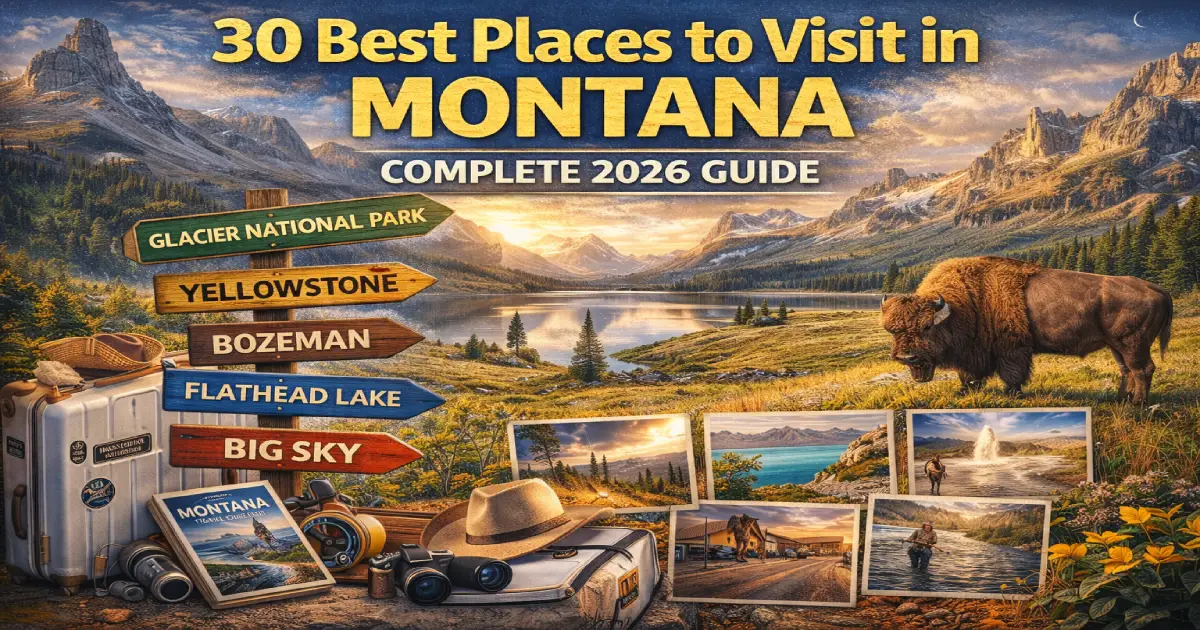
30 Best Places to Visit in Montana: Complete 2026 Guide
Published on : 03 Apr 2026
Places to Visit in Montana Overview: What to Expect in 2026
By Travel Tourister | Updated February 2026Quick Answer: Montana offers 30+ world-class destinations spanning two iconic national parks (Glacier, Yellowstone), mountain resort towns (Whitefish, Big Sky), university cities (Bozeman, Missoula), historic Western towns (Virginia City, Bannack ghost town), vast wilderness areas (Bob Marshall Complex 1.5 million acres), Montana’s largest lake (Flathead Lake—largest natural freshwater west of Mississippi), scenic byways (Going-to-the-Sun Road, Beartooth Highway), and authentic cowboy culture unchanged by tourism. Best places include: Glacier National Park (crown jewel, Going-to-the-Sun Road engineering marvel, alpine hiking), Yellowstone’s Montana section (Lamar Valley wildlife, North entrance year-round access), Whitefish (charming ski town, 25 miles from Glacier), Bozeman (outdoor recreation capital, Montana State University, booming), Flathead Lake (200 square miles, cherry orchards, water sports), Big Sky Resort (America’s largest ski resort by acreage), and preserved ghost towns revealing 1860s gold rush history. Montana’s nickname “Big Sky Country” reflects reality—147,000 square miles (4th-largest state) with only 1.1 million residents creates uncrowded outdoor paradise where distances are vast but rewards extraordinary.
After visiting Montana seven times across seasons—from summer Glacier National Park hikes where mountain goats approached within feet on Hidden Lake Trail to winter Big Sky powder days with zero lift lines, from Whitefish’s brewpub scene to Yellowstone’s Lamar Valley watching wolf packs through spotting scope at dawn, from Flathead Lake cherry picking in July to soaking natural hot springs under stars in Paradise Valley, from exploring Bannack ghost town’s preserved 1860s buildings to fly fishing the Madison River’s legendary waters—I’ve learned that Montana rewards strategic planning around vast geography and extreme seasonality. Most first-time visitors underestimate scale (Glacier to Yellowstone = 390 miles, 7+ hours driving) or visit wrong season for desired experiences (Going-to-the-Sun Road closed October-June, many attractions inaccessible winter), missing that Montana’s 147,000 square miles demand multi-day exploration with seasonal awareness dictating what’s accessible when.
Montana offers something extraordinary: genuine wilderness proximity to sophisticated Western towns—Bozeman’s craft beer scene and university culture exist 90 minutes from Yellowstone’s geysers, Whitefish’s mountain resort amenities sit minutes from Glacier’s backcountry, Missoula’s food scene neighbors million-acre wilderness complexes. This combination—comfortable bases providing excellent dining/lodging/culture, true wilderness requiring no permits or crowds (unlike overcrowded Colorado or California), and authentic cowboy heritage unchanged by tourism—creates American West experience rivaling any destination for outdoor adventure with civilized comfort.
But 2026 brings continued evolution to Montana’s landscape. Tourism growth accelerating (Glacier visitation increased 35% since 2010, Bozeman real estate surging), though Montana remains less crowded than comparable destinations. Glacier National Park now requires vehicle reservations peak summer (Going-to-the-Sun Road, North Fork—book months advance via recreation.gov). Climate change visible (glaciers receding 80%+ since 1850, Grinnell Glacier may disappear by 2030, earlier spring snowmelt affecting rafting seasons, wildfire season extending). Real estate prices transforming towns (Bozeman, Whitefish, Missoula becoming expensive, pricing out locals, tech workers/retirees arriving). Yet fundamentals persist: vast public lands (30% federally owned ensuring access), wildlife populations healthy (grizzly recovery succeeding, wolf reintroduction working), Western culture authentic (working ranches dominate landscape, rodeos serve locals not tourists), and 147,000 square miles ensure even popular areas feel spacious compared to crowded parks elsewhere.
This comprehensive guide identifies Montana’s 30 best places across regions, explains what makes each worth visiting, provides strategic logistics (seasonal access, distance realities, reservation requirements), and ensures you maximize Montana exploration whether spending long weekend or two weeks—because this state rewards those who plan around geography, embrace seasonality, and understand that Montana’s magic lies in space, authenticity, and wilderness defining America’s “Last Best Place.”
Why Montana Has America’s Best Wilderness Accessibility Combined With Authentic Western Culture
Montana doesn’t compete with densely populated states (Colorado’s 5.8 million residents create crowded trails), exclusive resort destinations (Jackson Hole, Aspen priced for wealthy), or remote inaccessible wilderness (Alaska requiring expensive flights). Instead, it perfected something uniquely American: genuine wilderness accessible from functional towns, authentic Western culture unchanged by tourism, world-class destinations remaining uncrowded, and scale providing freedom impossible in smaller states. Here’s why Montana offers unmatched American experience:
Two iconic national parks within one state—different ecosystems: Montana contains portions of both Glacier National Park (northwest Montana, glacially-carved alpine peaks, Going-to-the-Sun Road engineering marvel) and Yellowstone National Park (south Montana-Wyoming border, geothermal wonderland, world’s first national park 1872). No other state claims two nationally-recognized parks this caliber with such distinct characters. Wyoming shares Yellowstone but lacks Glacier. This enables visitors experiencing both volcanic geothermal (Yellowstone) and glacial alpine (Glacier) geology within single state trip, contrasting ecosystems requiring multiple states elsewhere.
Scale creates genuine wilderness unavailable in crowded states: Montana’s 147,000 square miles (4th-largest state, larger than Germany) with only 1.1 million residents (7.5 people per square mile, 48th in density) creates space defining experience. Bob Marshall Wilderness Complex alone (1.5 million acres—larger than Delaware) offers roadless backcountry, plus millions additional wilderness acres and 30% federal public lands mean hikers access genuine solitude. Compare Colorado (55 people/square mile density, trails crowded, permit systems restricting access) or California (253/square mile, reservations required). Montana’s emptiness isn’t marketing—it’s mathematical reality enabling wilderness experience vanished elsewhere Lower 48.
Authentic Western towns—not theme parks or billionaire playgrounds: Montana towns—Bozeman, Missoula, Whitefish, Kalispell—function as real communities (universities, agriculture, forestry) rather than pure tourism economies. Unlike Jackson Hole (median home $2.5 million, billionaires’ playground), Aspen (celebrity ski town, $5 million median), or Scottsdale (resort destination), Montana maintains working Western culture. Rodeos serve local ranching communities (not tourist spectacles), dude ranches operate as actual cattle operations (not just resorts), downtown businesses cater to residents year-round (not seasonal tourists only). This authenticity—cowboy culture functioning genuinely rather than performing—creates immersive Western experience absent from commercialized destinations.
Flathead Lake offers freshwater recreation unmatched: Flathead Lake (200 square miles, 370 feet deep, largest natural freshwater lake west of Mississippi) provides massive freshwater recreation—sailing, kayaking, swimming, fishing, lakeside cherry orchards—within scenic mountain setting. Unlike Great Lakes (too large, industrial), Tahoe (overcrowded, expensive), or smaller Montana lakes, Flathead combines scale with accessibility, clarity with warmth (swimmable summer), and recreation with cherry farming heritage creating unique destination. No comparable freshwater lake exists in Rockies with this combination.
Going-to-the-Sun Road democratizes alpine access: Glacier’s Going-to-the-Sun Road (50-mile National Historic Landmark, completed 1932) provides passenger car access to alpine environments typically requiring technical climbing elsewhere. Continental Divide crossing at Logan Pass (6,646 feet), dramatic 3,000-foot cliffs, glacial valleys, and high-country hiking trailheads accessible to families create democratic mountain experience. Compare Colorado fourteeners (requiring fitness/acclimatization), Cascades wilderness (backpacking to reach alpine), or Sierra Nevada (Tioga Pass comparable but less dramatic). Going-to-the-Sun Road delivers accessible grandeur unmatched in American mountain highways.
University towns provide culture unexpected in wilderness state: Bozeman (Montana State University 17,000 students), Missoula (University of Montana 10,000 students) offer cosmopolitan amenities—craft breweries (Montana has 90+ breweries, 8 per capita nationally), farm-to-table restaurants, indie bookstores, music venues—within wilderness proximity. This combination—morning hiking Hyalite Canyon, afternoon brewery hopping Bozeman, evening concert at Wilma Missoula—creates cultural depth rare in outdoor-focused destinations. Unlike pure resort towns (limited culture) or cities (distant from wilderness), Montana university towns balance sophistication with outdoor access.
Historic preservation maintains 1860s-1880s gold rush heritage: Montana’s ghost towns and preserved mining camps—Bannack State Park (1860s buildings intact, Montana’s first territorial capital), Virginia City/Nevada City (living history, preserved Victorian downtown), Garnet (remote ghost town, winter access snowshoe only)—maintain authentic Western history. Unlike commercialized tourist attractions or deteriorated ruins, Montana’s preservation balances access with authenticity. Walk plank sidewalks where gold rush prospectors walked, enter buildings unchanged since 1860s, experience Western history tangibly rather than through museums or theme parks.
The result: Montana offers America’s best combination of accessible wilderness (national parks, millions of acres public land), authentic Western culture (working ranches, real cowboy heritage, functional towns), sophisticated amenities (university culture, craft beer, excellent dining), uncrowded experiences despite world-class quality, and scale providing freedom impossible in smaller, denser states. You’re not choosing between “wild but remote” (Alaska) or “accessible but crowded” (Colorado)—Montana delivers both wilderness and comfort, authenticity and sophistication, within Lower 48 framework.
Yellowstone limited (only North entrance Gardiner open to vehicles)
Ski resorts peak (Big Sky, Whitefish)
Many mountain roads closed
Shoulder (April-May, September-October):
Unpredictable (snow can close roads unexpectedly)
Fewer crowds, excellent wildlife viewing
Some services closed, weather variable
Top 30 Places to Visit in Montana
GLACIER NATIONAL PARK & NORTHWEST (6 Places)
1. Glacier National Park – Crown of the Continent
What it is: 1 million acres, glacially-carved peaks, Going-to-the-Sun Road, alpine lakes, grizzly habitat, Montana’s signature destination
Why it’s essential:
Location: Northwest Montana (south of Glacier)
Best months: June-September (warm water, cherry season July)
Time needed: 1-3 days
Best for: Water sports, cherry picking, scenic beauty, family recreation, Glacier extension
4. Kalispell – Gateway City
What it is: Largest city near Glacier (24,000 population), regional airport, services, historic downtown
Why it’s useful base:
Glacier International Airport (FCA, direct flights from major cities)
Location: Northwest Montana
Population: ~24,000
Best for: Flying in/out, affordable Glacier base, services, functional town
5. Bob Marshall Wilderness Complex – Roadless Wilderness
What it is: 1.5 million contiguous roadless acres (Bob Marshall, Great Bear, Scapegoat Wilderness), backcountry paradise, grizzly habitat
Why serious adventurers prioritize:
Scale (1.5 million acres—larger than Delaware, true wilderness)
Roadless (no vehicles, access by foot or horseback only, genuine backcountry)
Location: Northwest Montana (south of Glacier)
Best months: July-September (snow-free, accessible)
Requirements: Backcountry experience, bear safety knowledge, self-sufficiency
Best for: Experienced backpackers, wilderness immersion, solitude, multi-day trips
6. Polebridge – Remote North Fork
What it is: Tiny community (15 residents), Glacier’s North Fork entrance, off-grid, famous bakery, dirt road access
Why adventurous visitors seek it:
Remoteness (40 miles dirt road from Columbia Falls, off-grid living)
Polebridge Mercantile (legendary bakery: huckleberry bear claws, cookies, famous throughout Montana)
North Fork Glacier access (less crowded than Going-to-the-Sun Road)
Authentic frontier (no electricity, no internet, genuine old Montana)
Bowman Lake, Kintla Lake (pristine Glacier lakes, remote access)
Important:
Dirt road only (rough, slow, 4WD recommended)
Very limited services (bring supplies, gas)
Summer only practical (winter road treacherous)
Location: Northwest Montana (Glacier North Fork)
Best months: June-September
Best for: Adventure, remoteness, bakery pilgrimage, off-beaten-path, photographers
YELLOWSTONE & SOUTHWEST MONTANA (5 Places)
7. Yellowstone National Park (Montana Section) – Geothermal Wonderland
What it is: World’s first national park (1872), geothermal features, wildlife sanctuary, mostly Wyoming but Montana contains key areas
Montana’s Yellowstone highlights:
Mammoth Hot Springs: Travertine terraces, steaming pools, elk grazing lawns, park headquarters
North entrance (Gardiner): Only year-round vehicle entrance, Roosevelt Arch (1903), Montana gateway
Boiling River: Free hot spring (where hot creek meets Gardiner River, swimsuit required)
Why Montana section matters:
Year-round access (North entrance never closes unlike others)
Wildlife central (Lamar Valley unmatched for viewing)
Less crowded (than Wyoming’s Old Faithful/Grand Prismatic areas)
Gardiner base (authentic Western town, not commercialized)
Location: Montana-Wyoming border (southwest Montana)
Entry: $35/vehicle (7 days, also valid Glacier)
Best Montana base: Gardiner (north entrance)
Time needed: 3-5 days Yellowstone, 1-2 days Montana section specifically
Best for: Wildlife, geothermal features, iconic national park, year-round access
8. Gardiner – Yellowstone North Entrance Town
What it is: Small town (900 residents), Yellowstone North entrance, only year-round vehicle access, authentic Western vibe
Why it’s special:
Year-round Yellowstone access (North entrance never closes)
Roosevelt Arch (1903, Teddy Roosevelt dedicated, iconic park entrance)
Authentic Western town (not commercialized like West Yellowstone, real community)
Yellowstone River rafting (Class II-III white water, half/full day trips)
Lamar Valley access (30 minutes to wildlife viewing paradise)
Boiling River (free hot spring, 2.5 miles into park)
Location: South-central Montana (Livingston to Gardiner, 53 miles)
Best for: Scenic drive, hot springs, ranching culture, Yellowstone approach, fly fishing
WESTERN MONTANA CITIES & CULTURE (4 Places)
12. Missoula – University Town & Cultural Hub
What it is: University of Montana city (10,000 students), Clark Fork River, vibrant downtown, outdoor recreation, progressive culture
Why it’s beloved:
University culture (UM creates educated population, young energy, events/arts)
Downtown (walkable, independent bookstores—Fact & Fiction, music venues—Wilma Theater, galleries)
Food scene (excellent restaurants, farm-to-table, diverse cuisine rivaling larger cities)
“A River Runs Through It” (Norman Maclean book/movie set here, fly fishing heritage)
Outdoor access (Clark Fork River through town, hiking Rattlesnake Wilderness, skiing 12 miles)
Activities:
Clark Fork River (kayaking, tubing, fishing through town)
Mount Sentinel “M” Trail (switchbacks to overlook, views over Missoula)
Farmers Market (summer Saturdays, local produce/crafts)
Live music (vibrant scene, touring acts stop through) Event Tickets Center KettleHouse Amphitheater in nearby Bonner
Location: Western Montana
Population: ~75,000
Best for: University culture, dining/nightlife, arts scene, outdoor recreation, fly fishing heritage, cultural depth
13. Helena – State Capital & Gold Rush History
What it is: Montana state capital (32,000 population), 1860s gold rush origins, historic architecture, Last Chance Gulch
Historical significance:
State capital since 1894 (Capitol building tours, legislative sessions)
Gilded Age wealth (50+ millionaires by 1888, ornate Victorian mansions survive)
St. Helena Cathedral (1908 Gothic Revival, 230-foot spires, stunning)
Attractions:
Montana State Capitol: Tours available, impressive dome, murals
Last Chance Gulch: Pedestrian mall, historic buildings, shops/restaurants
Original Governor’s Mansion: 1888 Victorian, tours
Reeder’s Alley: 1870s miners’ cabins, preserved, now shops/galleries
Mount Helena: City park, hiking trails, views over valley
Location: West-central Montana
Population: ~32,000
Best for: Montana history, architecture, capital city, gold rush heritage, small city charm
14. Great Falls – Missouri River & Lewis & Clark
What it is: Missouri River city (60,000 population), Lewis & Clark National Historic Trail, waterfalls, central Montana hub
Lewis & Clark significance:
Portage around Great Falls (1805, month-long portage, expedition’s greatest physical challenge)
Lewis & Clark National Historic Trail Interpretive Center (excellent museum, expedition history)
Giant Springs State Park (one of world’s largest freshwater springs, crystal-clear)
Attractions:
Five waterfalls: Missouri River drops 500+ feet through city (Black Eagle, Rainbow, Colter, Crooked, Ryan Falls)
100+ historic buildings (relocated from around Montana, concentrated here)
Music Hall (automated music machines collection, tours/demos)
Train rides (summer, narrow-gauge historic railroad between towns)
More museum-like (less active town, more preservation focus)
Vigilante history: 1860s road agents (bandits), vigilante justice (hangings), lawless era Montana history
Location: Southwest Montana (75 miles southeast of Butte)
Season: Late May through September (closed winter)
Best for: Gold rush history, living history, families, authentic Western preservation, vaudeville shows
18. Garnet Ghost Town – Remote Winter Snowshoe Access
What it is: 1890s gold mining town, partially preserved, remote location, winter snowshoe/ski access only
Why it’s unique:
Location: Southeast Montana (Crow Reservation, 15 miles south of Hardin)
Entry: $25/vehicle (7 days)
Time needed: 2-3 hours
Best for: American history, military history, Native American history, battlefield tours
UNIQUE MONTANA EXPERIENCES (5 Places)
20. Museum of the Rockies (Bozeman) – Dinosaur Research
What it is: Smithsonian-affiliated museum, world-class dinosaur collection, paleontology research center, Bozeman
Why it’s world-class:
Jack Horner (famous paleontologist, consulted Jurassic Park films, former curator)
T. Rex collection (largest in world, including MOR 555 complete skull)
Montana dinosaurs (Hell Creek Formation fossils, Triceratops, hadrosaurs)
Season: Late May to mid-October (snow closes rest of year)
Route: Red Lodge, Montana to Cooke City/Yellowstone (68 miles)
Time: 2.5 hours minimum (allow 4-5 hours with stops/photos)
Best for: Scenic driving, photography, alpine environment, Yellowstone northeast approach
23. Lewis and Clark Caverns State Park – Cave Tours
What it is: Limestone cave system, guided tours, stalactites/stalagmites, Montana’s first state park (1937)
Cave features:
Guided tours (2-hour, ranger-led, through developed passages)
Boardwalks/stairs (accessible, no crawling required main tour)
Wild cave tour (advanced, undeveloped sections, 3+ hours)
Above-ground:
Hiking trails (Jefferson River views, prairie/forest)
Visitor Center (exhibits, geology)
Campground (tent/RV, scenic)
Location: Southwest Montana (between Bozeman and Butte, 47 miles west of Bozeman)
Season: Cave tours May through September
Cost: $12 adults, $5 kids (classic tour)
Time: 2 hours for tour
Best for: Cave tours, geology, families, rainy day, unique Montana experience
24. Makoshika State Park – Badlands & Dinosaurs
What it is: 11,531-acre badlands, eastern Montana, dinosaur fossils, otherworldly landscape, Montana’s largest state park
Why it’s dramatic:
Badlands scenery (eroded cliffs, hoodoos, colorful layers, similar to South Dakota/North Dakota badlands)
Dinosaur fossils (Hell Creek Formation, Triceratops discovered here, ongoing research)
Location: South-central Montana
Population: ~8,000
Best for: Fly fishing, arts, historic town, Yellowstone approach via Paradise Valley, authentic Montana
27. West Yellowstone – Winter Snowmobile Capital
What it is: Tourist town (1,300 winter, 5,000 summer), Yellowstone West entrance, snowmobile hub winter, outdoor recreation summer
Summer (June-September):
Yellowstone gateway (West entrance, busy tourist town)
Yellowstone winter access (snowcoach/snowmobile into park, geothermal steaming)
Quiet season (fewer tourists than summer, winter magic)
Reality check: Tourist-commercial (not charming Western town like Whitefish/Red Lodge), functional Yellowstone base
Location: Southwest Montana (Idaho border, Yellowstone West entrance)
Population: ~1,300 (seasonal fluctuation)
Best for: Yellowstone West entrance, winter snowmobiling, cross-country skiing, convenient park access
28. Ennis – Madison River Fly Fishing
What it is: Small town (840 population), Madison River blue-ribbon fishing, Madison Valley ranching, Virginia City proximity
Fly fishing mecca:
Madison River (legendary blue-ribbon trout stream, runs through town)
Nearby: Virginia City (14 miles, ghost town day trip)
Location: Southwest Montana (Madison Valley)
Population: ~840
Best for: Fly fishing, Madison River, anglers, ranch country, authentic small town
29. Seeley Lake – Wilderness Gateway
What it is: Small community (1,700 population), chain of lakes, Bob Marshall Wilderness access, recreation base
Activities:
Seeley Lake (swimming, kayaking, fishing, scenic)
Chain of lakes (Seeley, Salmon, Placid, Alva—connected waters)
Bob Marshall Wilderness (eastern access, trailheads, backcountry)
Clearwater National Forest (hiking, camping, dispersed recreation)
Cross-country skiing (winter, groomed trails)
Snowmobiling (extensive trail network)
Character:
Small community (services limited, basic amenities)
Outdoor focus (recreation-oriented, not tourist town)
Scenic route (Highway 83, Missoula to Kalispell alternative to I-90)
Location: Northwest Montana (between Missoula and Kalispell)
Population: ~1,700
Best for: Bob Marshall access, lake recreation, wilderness gateway, cross-country skiing
30. Choteau – Rocky Mountain Front & Dinosaurs
What it is: Small town (1,700 population), Rocky Mountain Front (dramatic prairie-to-mountains transition), dinosaur sites
Rocky Mountain Front:
Dramatic geography (mountains rise abruptly from Great Plains, stunning transition)
Bob Marshall Wilderness (eastern access, Teton Pass trailheads)
Glacier NP + Whitefish, or Bozeman + Yellowstone North
Compact, maximize limited time
Two Weeks
Glacier region (5 days), Yellowstone (3 days), Bozeman/Big Sky, ghost towns, Flathead Lake
Comprehensive Montana experience
Frequently Asked Questions
What are the best places to visit in Montana?
Top Montana places: Glacier National Park (Going-to-the-Sun Road, alpine hiking, glaciers), Yellowstone’s Montana section (Lamar Valley wildlife, North entrance Gardiner), Whitefish (charming ski town, Glacier gateway), Bozeman (outdoor recreation capital, university culture, craft beer), Flathead Lake (largest freshwater west of Mississippi, cherry orchards), Big Sky Resort (America’s largest ski resort, uncrowded), and Bannack State Park (best-preserved ghost town). First-timers should prioritize Glacier + one Montana town (Whitefish or Bozeman) covering national park grandeur and authentic Western town culture within week.
How far apart are Glacier and Yellowstone?
Glacier to Yellowstone = 390 miles / 7+ hours driving (common planning mistake assuming they’re close). These are Montana’s two major parks but separated by vast distance. Best strategy: Choose one as focus (Glacier = alpine scenery, Yellowstone = geothermal/wildlife) or plan 10-14 day trip visiting both with time exploring between (Bozeman, Big Sky, Flathead Lake). Don’t attempt both on short trip—each deserves 3-5 days minimum, plus driving time between.
What is the best town to stay in Montana?
Depends on priorities: Whitefish (charming ski town, 25 miles from Glacier, walkable downtown, year-round appeal, excellent dining), Bozeman (university culture, outdoor recreation hub, craft beer scene, Yellowstone 90 miles, Montana State University energy), Missoula (University of Montana, cultural depth, river through town, artistic community), or Red Lodge (Beartooth Highway gateway, skiing, small-town authentic). Whitefish wins for Glacier access + charm. Bozeman for overall Montana experience + Yellowstone proximity. Missoula for culture/food. Choose based on which park you’re prioritizing.
When is Going-to-the-Sun Road open?
Typically mid-June to mid-September (varies by winter snowpack). Glacier’s signature road crosses Logan Pass (6,646 feet) requiring extensive plowing—can’t open until snow clears, usually completing clearing mid-June. Closes when fall snow makes it impassable (mid-September to October). Check Glacier National Park website for current year opening/closing. Vehicle reservations required peak summer (May-September entry, book months advance recreation.gov). Plan Montana trip June-September if Going-to-the-Sun Road is priority.
Is Montana expensive to visit?
Wide range enables budget control: Budget travelers camp ($15-30/night), cook meals ($20/day food), visit free/cheap places (national parks $35 for 7 days, ghost towns $3-10, hiking free) = $50-70/day. Mid-range stays motels ($100-150), eats restaurants ($50/day), does some paid activities = $150-200/day per person. Luxury dude ranches/resorts ($350-600/night), fine dining, private guides = $500-800+/day. Summer peak (June-August) most expensive. Shoulder seasons (May, September) better values. Rental car essential ($60-100/day split between travelers). Montana offers value compared to Colorado/California if strategic.
Yes—rental car essentially mandatory. Montana’s 147,000 square miles and 7.5 people/square mile density means no practical public transportation between towns/attractions. Distances vast (Glacier to Yellowstone 390 miles, Bozeman to Glacier 280 miles), places spread out, and Montana’s essence requires driving freedom exploring. Exception: If staying Whitefish only and doing Glacier tours without driving park yourself. Otherwise, rent car for Montana trip. Gas stations can be 50+ miles apart rural areas—fill up regularly.
What should I know about Montana weather?
Extreme seasonal variation and elevation-dependent: Summer (June-August) warm days (70-85°F valleys, cooler mountains), cool nights (40-50°F), afternoon thunderstorms common mountains, wildfire smoke possible August. Winter (November-March) very cold (0-30°F common, -20°F possible), heavy snow mountains (Big Sky/Whitefish 400+ inches), many roads closed (Going-to-the-Sun Road, Beartooth Highway). Spring/Fall unpredictable (snow possible any month mountains, weather variable). Layer always, prepare rapid weather changes, check road conditions winter/shoulder seasons. Montana saying: “If you don’t like the weather, wait 15 minutes.”
Are there grizzly bears in Montana and are they dangerous?
Yes—Montana has thriving grizzly populations (2,000+ statewide in two recovery zones: Greater Yellowstone 1,000+, Northern Continental Divide 1,000+). Dangerous if surprised or defending cubs/food, but attacks rare with proper precautions. Bear safety: Carry bear spray (required Glacier/Yellowstone backcountry, works better than guns), hike groups 3+ people (makes noise, “Hey bear!” periodically), never approach bears (100+ yard distance), store food properly (bear canisters backcountry, bear-proof containers provided campgrounds). Grizzlies are magnificent, seeing one wild is privilege—respect distance, stay safe, don’t let fear prevent enjoying Montana’s wilderness.
Can I visit Montana in winter?
Yes but very different experience: Skiing excellent (Big Sky, Whitefish, Red Lodge—powder, uncrowded, December-April), Yellowstone winter magical (snowmobiling/snow coach tours from West Yellowstone, geothermal features steaming dramatically), Bozeman/Missoula function year-round (universities, culture, winter activities). However: Glacier essentially closed (Going-to-the-Sun Road impassable, limited access), many mountain roads closed, very cold (-20°F possible), shorter days, some towns/services close seasonally. Winter Montana rewards those seeking skiing, solitude, and winter beauty—not those wanting full-access national park touring.
Final Tips for Visiting Montana
Do:
Plan around distances (Glacier-Yellowstone 390 miles, allow travel days, don’t overpack itinerary)
Expect crowds like Colorado (Montana less crowded but popular areas busy summer—go early morning)
Montana rewards strategic planning around geography and seasonality. The same state offering Glacier’s alpine grandeur accessible via Going-to-the-Sun Road also provides Yellowstone’s geothermal wonders, vast Bob Marshall Wilderness where hikers disappear for weeks, charming Western towns balancing outdoor access with craft beer culture, and preserved 1860s ghost towns where gold rush history remains tangible rather than museumified.
This isn’t a destination you “complete” staying one town. First-timers hit Glacier (Going-to-the-Sun Road essential), base in Whitefish (charming gateway), maybe add Flathead Lake. Return visitors discover Yellowstone’s Montana section (Lamar Valley wolves, Gardiner’s year-round access), explore Bozeman’s outdoor culture, ski Big Sky’s uncrowded powder. Devoted Montana explorers time visits for shoulder seasons avoiding crowds, venture Bob Marshall backcountry, understand the state offers geographic diversity (alpine peaks, prairie badlands, vast wilderness) and cultural depth (university towns, ranching heritage, mining history) rivaling destinations ten times its population.
Plan strategically using this guide, but remember: Montana’s magic emerges from embracing scale and seasons. Accept distances. Check seasonal access before booking trips. Carry bear spray. Talk to locals (Montanans friendly, love sharing favorite spots). And recognize that Montana—despite tourism growth, real estate inflation, and climate change pressures—still delivers genuine American West experience where wilderness proximity to civilization, authentic cowboy culture unchanged by commercialization, and space providing freedom impossible elsewhere create Last Best Place deserving its reputation.
Welcome to Montana—where Glacier’s Going-to-the-Sun Road crosses Continental Divide making alpine scenery accessible, where Yellowstone’s Lamar Valley concentrates wildlife rivaling Africa, where Big Sky Resort’s 5,850 acres ski uncrowded despite quality rivaling famous resorts, where university towns Bozeman and Missoula balance sophistication with outdoor access, where 1860s ghost towns preserve gold rush heritage, and where 147,000 square miles with only 1.1 million residents creates uncrowded outdoor paradise combining wilderness and Western authenticity within framework accessible to travelers willing to embrace Big Sky Country’s scale, seasons, and genuine character.
— AboutTravel TouristerTravel Tourister’s Montana specialists have explored the state seven times across seasons, experiencing everything from summer Glacier National Park hikes where mountain goats approached within feet to winter Big Sky powder days with zero lift lines, from Yellowstone’s Lamar Valley wolf viewing at dawn to Flathead Lake cherry picking in July, from exploring Bannack’s preserved 1860s buildings to soaking natural hot springs under stars. We provide honest guidance acknowledging scale realities (Glacier-Yellowstone 390 miles apart requiring multi-day trips, not day-trippable), seasonal access requirements (Going-to-the-Sun Road closed October-June, vehicle reservations required summer), and steering adventurous travelers toward Bob Marshall Wilderness, remote Polebridge, and understanding Montana rewards those who embrace distances, plan around weather, and venture beyond obvious Glacier/Yellowstone corridor discovering Western towns, ghost towns, and vast wilderness creating America’s Last Best Place.Ready to explore Montana strategically? Our specialists help you plan realistic itineraries around distances and seasonal access (Glacier summer only vs. Yellowstone year-round North entrance), secure advance Glacier vehicle reservations (essential peak summer, recreation.gov), decide between Glacier-focused trip (Whitefish base) or Yellowstone-focused (Bozeman/Gardiner), and build comprehensive 10-14 day trips combining both parks with Montana towns, ghost towns, and wilderness rather than rushing between destinations missing the state’s diversity entirely.
Posted By : Vinay
As a lead contributor for Travel Tourister, Vinay is dedicated to serving our Tier 1 audience (US, UK, Canada, Australia). His mission is to deliver precise, fact-checked news and actionable, data-driven articles that empower readers to make informed decisions, minimize travel risks, and maximize their adventure without compromising safety or budget.
Travel Tourister is a leading Travel portal where we introduce travellers to trusted travel agents to make their journey hasselfree, memorable And happy. Travel Tourister is a platform where travellers get Tour packages ,Hotel packages deals through trusted travel companies And hoteliers who are working with us across the world. We always try to find new and more travel agents and hoteliers from every nook and corners across the world so that you could compare the deals with different travel agents and hoteliers and book your tour or hotel with the one you have chosen according to your taste and budget.




 Call
Call Enquiry