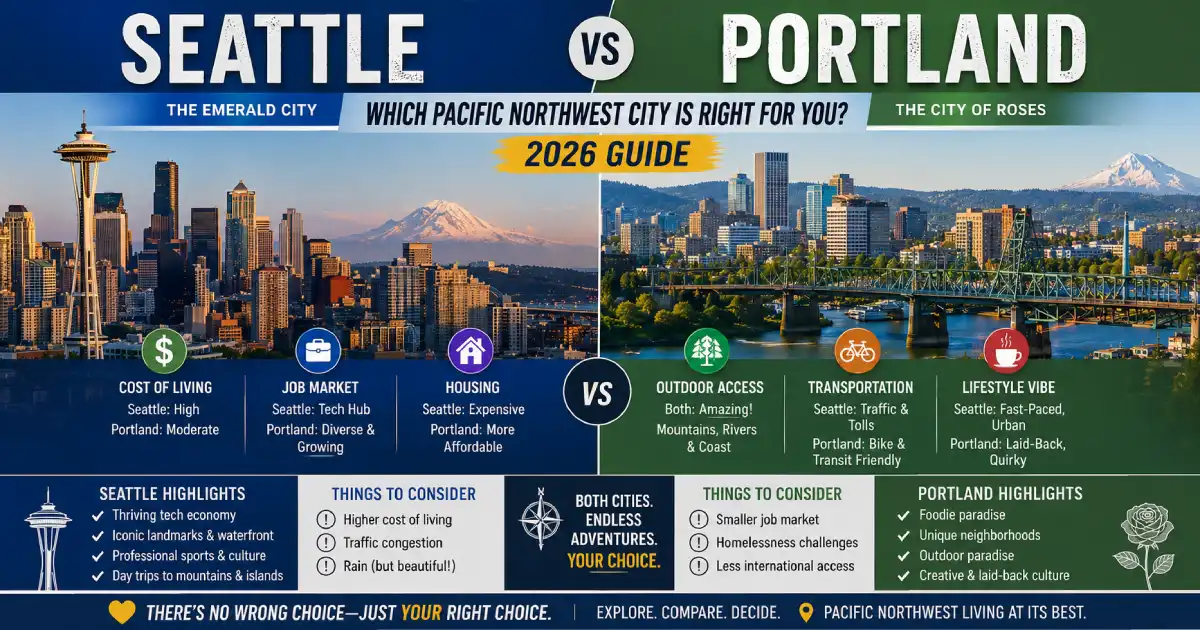
Seattle vs Portland: Which Pacific Northwest City Is Right for You? (2026 Guide)
Published on : 13 May 2026
Seattle vs Portland — The Pacific Northwest’s Two Greatest Cities, Honestly Compared
By Travel Tourister | Updated May 2026
Seattle and Portland are the two most specifically Pacific Northwest and the two most specifically rain-embracing major American cities — separated by 174 miles on I-5, 2.5 hours of driving through the most green and the most volcanic landscape accessible between any two major American cities (Mount Rainier visible on the right going south, Mount St. Helens visible to the east, the Cascades extending in both directions in the most specifically PNW mountain-and-forest panorama available from any US interstate), and the most productive single regional city comparison available on the American West Coast. Seattle is the most economically ambitious and the most globally connected Pacific Northwest city — the home of Amazon, Microsoft, Boeing, Starbucks, and Nirvana, with the most technologically forward and the most internationally sophisticated economy of any American city between Los Angeles and Vancouver BC, a waterfront position on Puget Sound that produces the most ferry-connected and the most island-accessible urban geography in the continental US, and a food scene (Pike Place Market’s direct-from-boat salmon, the Tom Douglas restaurant empire, the Canlis special occasion dining on the Lake Union hillside) that has been James Beard-adjacent for long enough that it has stopped needing to prove itself. Portland is the most specifically weird, the most fiercely independent, and the most specifically food-cart-culture-pioneering American city — the city that invented the American food cart pod (the Cartopia pod on SE Division was operating in 2009 before any other American city had organized food carts into permanent community dining spaces), the city with the most Powell’s Books (the largest independent bookstore in the world at 68,000 square feet of books across multiple floors of a former warehouse, the most specifically Portland institution accessible at any price), the most craft brewery density of any American city, and the most specifically Oregon and the most specifically Keep-Portland-Weird character that has been the subject of six seasons of Portlandia and that is genuinely, specifically, authentically Portland in the way that only a city whose residents consider weirdness a civic responsibility can be.
Choosing between them for a Pacific Northwest trip is the most specifically rewarding PNW planning decision available — because both cities are genuinely excellent and genuinely different in scale, ambition, food culture, music history, outdoor access, and the specific experience of walking their streets in the specific Pacific Northwest drizzle that both cities process differently and both cities consider a feature rather than a bug.
For more US city comparisons, see our Chicago vs New York and Miami vs New York guides.
The Most Important Facts First
Key Fact
☕ Seattle
🍩 Portland
Population (City)
750,000 (metro 4 million)
650,000 (metro 2.5 million)
Known For
Amazon, Boeing, Microsoft, Starbucks, Nirvana, Pike Place Market, grunge
Seattle-Tacoma Int’l (SEA) — 14 miles from downtown
Portland Int’l (PDX) — 12 miles from downtown
Average Rainfall (annual)
38 inches (less than NYC — the myth is bigger than the rain)
43 inches (slightly rainier than Seattle)
Craft Breweries
100+ — excellent scene
70+ in city limits — most per capita of any US city
Coffee Culture
Birthplace of Starbucks; most specialty coffee shops per capita
Stumptown Coffee (founded here); strong third-wave scene
Outdoor Access
Puget Sound ferry network, Mount Rainier NP, Olympic NP, Cascades
Columbia River Gorge (30 min), Mount Hood (1 hr), Oregon Coast (1.5 hrs)
Transit
Link Light Rail; $3.25/ride; car useful for day trips
MAX Light Rail; $2.50/ride; free in downtown fare zone
Sales Tax
10.25% (Washington state)
0% — Oregon has NO sales tax
Quick Verdict: Seattle vs Portland
Category
☕ Seattle Wins
🍩 Portland Wins
Winner
Skyline & Urban Scale
Space Needle, dramatic Puget Sound waterfront, more imposing skyline
Smaller, more human-scale — Mount Hood backdrop on clear days
☕ Seattle
Hotel Cost
$175–$310/night
$130–$240/night
🍩 Portland
No Sales Tax
10.25% sales tax applies
0% — Oregon has no sales tax
🍩 Portland
Coffee
Birthplace of Starbucks; most specialty cafés per capita in US
Stumptown HQ; excellent third-wave scene
☕ Seattle
Food Carts
Good street food; no organized pod culture
Invented the food cart pod — 500+ food carts, most per capita in US
🍩 Portland
Pike Place Market
Most beloved public market in the US — fish throwing, first Starbucks
Saturday Market good but smaller
☕ Seattle
Bookstore
Elliott Bay Book Co. — excellent indie
Powell’s Books — largest independent bookstore in the world (68,000 sq ft!)
🍩 Portland
Music History
Nirvana, Pearl Jam, Soundgarden, Jimi Hendrix birthplace — grunge capital
Elliott Smith, The Decemberists — strong indie scene
☕ Seattle
Craft Beer
100+ breweries; strong Ballard brewery district
Most breweries per capita in US; Hair of the Dog, Deschutes, 10 Barrel
🍩 Portland
Waterfront & Ferry
Puget Sound ferry network — Bainbridge, Vashon, Bremerton; most dramatic urban water access
Willamette River — no ferry culture; Tom McCall Waterfront Park
☕ Seattle
Columbia River Gorge
3 hours from Seattle
30 minutes from Portland — most accessible extraordinary day trip
🍩 Portland
Rose Garden
No equivalent
International Rose Test Garden — most rose varieties in a public garden in the US (free)
🍩 Portland
Overall City Vibe
More cosmopolitan, tech-driven, ambitious
More relaxed, weird, independently-minded, walkable
🤝 Tie (depends on your vibe)
Seattle: The Tech Capital of the Pacific Northwest
Pike Place Market: The Most Beloved Public Market in America
Pike Place Market — the 1907 public market complex at the Pike Place Market hillside overlooking Elliott Bay in downtown Seattle, with 9 acres of fish mongers, flower stalls, produce vendors, artisan craftspeople, restaurants, and specialty shops in the most organically evolved and the most specifically Seattle public market accessible in the United States — is the most visited single attraction in Seattle and the most emotionally specific public market in America. The specific Pike Place experiences:
The fish throwers (Pike Place Fish Market): The most specifically Pike Place and the most photographed single moment in the market — the fishmongers who throw whole salmon across the stall when an order is placed, the most theatrical and the most specifically Seattle seafood market tradition accessible at any price. The best viewing time: 9–11 AM weekdays before the tourist crowds arrive and the throwers are most enthusiastically performing. Watch for 30 seconds. Photograph for 60. Move on before the crowd reaches 3 people deep.
The original Starbucks (1912 Pike Place): The most visited coffee shop in the world — the 1971 original Starbucks location with the original round logo (the mermaid without the sanitized cropping of the modern logo), the most pilgrimaged-to single coffee address in the Pacific Northwest, and the most specifically historically significant coffee shop accessible in the United States. Expect a 20–45 minute line on weekends; the Pike Place Starbucks Reserve Roastery on Capitol Hill is the more ambitious and the less crowded alternative. The original Pike Place Starbucks: $6–$8 for the specific bragging right that accompanies it.
Beecher’s Handmade Cheese: The most specifically excellent and the most productively viewable cheesemaking operation accessible at any US public market — the open-kitchen format allows visitors to watch the cheesemaking process through the front window while ordering the house macaroni and cheese (the most acclaimed single market food item in Pike Place, served in a cup for $5–$7, made with the Flagship and Just Jack cheese blend that is the most specifically Beecher’s and the most commonly cited “best mac and cheese” in Seattle by any food publication that has published a Seattle food ranking in the last decade).
The Space Needle and Seattle Center
The Space Needle — the 605-foot 1962 World’s Fair observation tower at Seattle Center, with the most specifically Seattle and the most mid-century-futurist silhouette of any American landmark — is Seattle’s most globally recognized single building and the most specifically photographed element of the most recognizable Pacific Northwest urban skyline. The 520-foot observation deck ($42/adult online) delivers the most panoramic Seattle view accessible without a private aircraft: Elliott Bay and Puget Sound to the west, the Olympic Mountains beyond the Sound, Mount Rainier to the southeast (the most dramatically visible Cascades volcano from any Seattle viewpoint on a clear day — 14,411 feet at 60 miles distance, the most physically overwhelming mountain visible from any major American city skyline), and the Olympic Sculpture Park to the north. The most productive Space Needle timing: clear mornings (before noon, when marine layer occasionally reduces visibility) or clear evenings (the sunset over the Olympics, 7:30–9 PM in summer, is the most specifically extraordinary Space Needle view available at any hour).
Seattle’s Music History: Grunge Capital of the World
Seattle’s music legacy is the most specifically consequential and the most globally distributed American regional music movement of the last 50 years — grunge (the specific guitar-heavy, angst-saturated Pacific Northwest music form that Nirvana, Pearl Jam, Soundgarden, and Alice in Chains brought to global awareness in 1991–1992) was born in Seattle’s Capitol Hill and Central District club scene and exported to every American city and every English-speaking country simultaneously with Nevermind’s release in September 1991. The specific Seattle music experiences:
MoPOP (Museum of Pop Culture, Seattle Center): The most architecturally specific and the most culturally comprehensive pop culture museum in the United States — Frank Gehry’s crumpled-metal building at the base of the Space Needle houses the most complete Jimi Hendrix archive (Hendrix was born in Seattle’s Central District — the most specifically Seattle birthplace of the most influential electric guitarist in American music history), the Nirvana exhibit (the most emotionally specific grunge documentation accessible at any US museum), and the Science Fiction and Fantasy Hall of Fame. $33/adult; the most essential Seattle cultural institution after Pike Place Market.
Kurt Cobain’s childhood home (Aberdeen, 2 hours south): The most specifically pilgrimage-specific Nirvana destination accessible from Seattle — the 1001 East 1st Street house in Aberdeen where Cobain grew up, now a city-maintained landmark, accessible for exterior viewing.
Jimi Hendrix Grave (Greenwood Memorial Park, Renton): 12 miles south of downtown Seattle — the most specifically pilgrimage-specific single grave accessible within day-trip distance of any major American music city.
The Puget Sound Ferry Network: Seattle’s Most Distinctive Geographic Feature
Seattle’s position on Puget Sound — the saltwater inlet that separates Seattle from the Olympic Peninsula, the Kitsap Peninsula, and the various islands (Bainbridge, Vashon, Whidbey) that make the Seattle metro the most ferry-dependent major American city — produces the most accessible and the most dramatically scenic urban ferry network in the United States. The Washington State Ferry system (the most heavily trafficked ferry network in the United States by passenger volume) operates from the Seattle waterfront on multiple routes:
Seattle–Bainbridge Island ferry ($9.75 roundtrip walk-on): The most scenic 35-minute commuter ferry in America — the return view from the Bainbridge ferry approaching Seattle (downtown skyline + Space Needle + Mount Rainier in the background on clear days) is the most specifically extraordinary single urban approach view accessible by ferry in the continental US. Bainbridge Island’s Winslow town (the most walkable and the most specifically Pacific Northwest small town accessible within 35 minutes of any major American city center) and the Olympic Peninsula’s Hurricane Ridge (2 hours from the Bainbridge ferry landing) make this the most rewarding single Seattle day trip accessible without a car.
Seattle–Vashon Island ferry: The most specifically rural and the most specifically agricultural island accessible from Seattle within 30 minutes — the working farms, the local art studios, and the specific Vashon Island character (the island that most consistently and most specifically opts out of mainland Pacific Northwest development culture) make it the most genuinely local day trip accessible from the Seattle ferry terminal.
Seattle Coffee: The Birthplace of American Specialty Coffee Culture
Seattle is the most specifically consequential American city in the history of specialty coffee — not merely because Starbucks was founded here in 1971 (an origin story that the specialty coffee community processes with complicated feelings) but because the specific Pacific Northwest coffee culture that preceded and followed Starbucks (Vivace Espresso’s 1988 development of the rosetta latte art pattern, the most specifically Seattle contribution to global espresso culture; the emergence of Caffe Vita, Lighthouse Coffee, and Stumptown’s Portland sibling operations as the most technically accomplished espresso operations in America before the Third Wave reached the East Coast) produced the most coherent and the most technically sophisticated regional coffee culture accessible in any American city before the national specialty coffee explosion of the 2010s. The specific Seattle coffee institutions: Caffe Vita (Capitol Hill, the most consistently excellent espresso in Seattle proper), Lighthouse Coffee Roasters (the most technically precise single-origin filter coffee accessible in the Capitol Hill corridor), and the Starbucks Reserve Roastery (the most architecturally spectacular and the most premium-tier Starbucks experience accessible in the world, at 15th and E. Pike in Capitol Hill, free to enter and worth the visit regardless of your feelings about Starbucks as a corporation).
Portland: Keep It Weird and Keep It Excellent
Powell’s Books: The Largest Independent Bookstore in the World
Powell’s City of Books at 1005 W. Burnside Street in the Pearl District — 68,000 square feet of new, used, and rare books across multiple color-coded rooms in a former warehouse, the most specifically Portland institution and the most specifically book-culture-forward single retail establishment accessible in the United States — is the most compelling single attraction in Portland for any visitor who has ever used the word “bibliophile” to describe themselves and the most specifically irreplaceable Portland experience at any price (free to browse). The Powell’s specific access strategy: obtain the store map (available at the information desk in the main entrance atrium), navigate by room color (the Blue Room is rare books; the Gold Room is science and technology; the Pearl Room is the most comprehensive literature section in any US independent bookstore), and allocate a minimum of 2 hours before accepting that the store is larger than 2 hours can adequately explore. The used book selection at Powell’s — the most comprehensively curated and the most specifically value-priced used book inventory accessible in any American bookstore — is the most productive book-purchasing activity accessible in Portland at any budget level.
Portland’s Food Cart Pods: The Most Specifically Portland Dining Culture
Portland invented the American food cart pod — the organized collection of permanent food cart vendors sharing a communal eating area, a concept that Portland’s Cartopia pod (SE 12th and Division) pioneered in 2009 before any other American city had organized food carts into permanent community dining spaces at the same scale or with the same community-integration ambition. The specific Portland food cart landscape:
Cartopia (SE 12th and Division, open until 3 AM): The most specifically Portland and the most historically significant food cart pod in the United States — the late-night operation (open until 3 AM Thursday–Sunday) produces the most specifically Portland 2 AM dining experience, with Pyro Pizza’s wood-fired pizza ($13–$18), the grilled cheese at Potato Champion, and the rotating international carts that make Cartopia the most consistently creative late-night food destination in any Pacific Northwest city
Portland Saturday Market (Tom McCall Waterfront Park): The most attended and the most crafts-specific outdoor market in Portland — the Saturday (and Sunday) market running March through December along the Willamette River waterfront is the most consistently excellent and the most specifically Portland artisan market accessible in the city, with the most food cart variety of any Portland weekend market
Voodoo Doughnut (22 SW 3rd Avenue): The most specifically Portland and the most globally recognized single doughnut shop in the United States — the bacon maple bar (raised yeast doughnut with maple glaze and two strips of bacon on top, the most frequently photographed single Voodoo item), the Voodoo Doll (raised doughnut shaped like a voodoo doll with pretzel stake through the chest and raspberry jam filling, the most specifically theatrical), and the Old Dirty Bastard (chocolate frosting, Oreo crumbles, and peanut butter, named for the Wu-Tang Clan member in the most specifically Portland ODB honor) make Voodoo Doughnut the most specifically food-item-as-cultural-statement doughnut shop accessible at any US address. $2–$4 per doughnut; 24 hours daily; the line at 11 PM on a Friday is 20 minutes long and entirely composed of people who are genuinely excited about $3 doughnuts at 11 PM, which is the most specifically Portland thing accessible at any price.
Portland Craft Beer: Most Breweries Per Capita in the US
Portland has the most craft brewery density per capita of any major American city — more than 70 breweries within Portland city limits, producing the most specifically hop-forward and the most specifically Pacific Northwest craft beer culture accessible in any American city. The specific Portland brewing institutions:
Hair of the Dog Brewing: The most critically acclaimed and the most specifically Portland-character-forward brewery in the city — the Adam (smoked barleywine, the most technically ambitious and the most nationally recognized single Hair of the Dog beer) and the Fred (the most complex and the most age-worthy Portland craft beer) are the most specifically Portland beer-culture-establishing productions accessible at the Burnside taproom
Deschutes Brewery Portland Public House: The most nationally distributed Oregon craft brewing brand’s Portland brewpub — the Black Butte Porter (the most-sold craft porter in the United States) and the Mirror Pond Pale Ale are the most accessible Deschutes beers at the most social and the most casual Portland taproom setting
Belmont Station: The most beer-selection-complete bottle shop and taproom in Portland — 1,300 beers in the bottle shop and 20 rotating taps in the adjacent taproom produce the most comprehensive single-location craft beer selection accessible in any Portland address
The Mississippi Avenue brewery corridor: The most walkable brewery neighborhood in Portland — Alberta Street, Mississippi Avenue, and the North Portland corridor’s brewery cluster (Ecliptic Brewing, Occidental Brewing, Ex Novo Brewing) produce the most specifically neighborhood-integrated and the most socially accessible Portland brewing district
Portland’s Day Trips: The Most Accessible Outdoor Wonders in America
Portland’s most significant single competitive advantage over Seattle for the nature-focused visitor is the geographic accident that has placed the most dramatic and the most diverse outdoor experiences in the continental United States within 30–90 minutes of the city center:
Columbia River Gorge (30 minutes east on I-84): The most dramatic gorge in the continental United States — a 292,500-acre National Scenic Area where the Columbia River cuts through the Cascade Mountains in a 4,000-foot-deep canyon, producing the most waterfall-dense landscape accessible within an hour of any major American city: Multnomah Falls (620 feet, the most visited natural attraction in Oregon, accessible via the Historic Columbia River Highway scenic drive — free to visit, $2 timed parking reservation required at recreation.gov on busy days), Latourell Falls, Wahkeena Falls, and 77 additional named waterfalls within the Oregon side of the Gorge. The Historic Columbia River Highway is the most specifically beautiful paved road in the Pacific Northwest, engineered in 1915 as the most scenic route between Portland and the Gorge with stone bridges and vista points that are the most specifically Arts and Crafts-era road infrastructure accessible in any US state.
Mount Hood (1 hour east on US-26): The most dramatically visible volcanic peak in Oregon — the 11,250-foot stratovolcano visible from Portland’s downtown on clear days (the most specifically Portland “good weather” indicator — when Mount Hood is visible from the Pearl District, it is a genuinely beautiful Pacific Northwest day) is accessible for skiing (Timberline Lodge, the most historically and the most architecturally significant ski lodge in the Pacific Northwest, built by FDR’s WPA in 1937 and used as the exterior of the Overlook Hotel in The Shining), hiking (the Timberline Trail, the most complete Mount Hood circumnavigation accessible in a single multi-day backpacking route), and the most specifically clear-day viewpoint driving (the Timberline Lodge’s snowfield views in summer are the most accessible glacial landscape accessible within 1 hour of any Pacific Northwest city).
Oregon Coast (1.5 hours west on US-26): The most specifically wild and the most publicly accessible Pacific coastline in the continental United States — every beach in Oregon is publicly accessible by state law (the Oregon Beach Bill of 1967, the most consequential single Oregon environmental legislation, guarantees permanent public access to the entire Oregon coast). Cannon Beach (the most photogenic Oregon coast town — Haystack Rock, the most photographed coastal rock formation in Oregon, visible from the town’s main beach), the Tillamook Creamery (the most visited dairy facility in the United States, free tours, the best cheese curds accessible within 1.5 hours of any Pacific Northwest city), and the Ecola State Park viewpoints (the most dramatically positioned Pacific Ocean view accessible from any Oregon coast state park within 1.5 hours of Portland) collectively produce the most rewarding Oregon Coast day trip accessible from Portland.
Portland’s Neighborhoods: The Most Walkable City in the Pacific Northwest
The Pearl District: The most specifically Portland-gentrification-story neighborhood — the former rail yards and warehouse district that became Portland’s most gallery-dense and the most restaurant-complete urban neighborhood in the 1990s, home to Powell’s Books, the most gallery-per-block density in Portland, and the Jamison Square fountain (the most specifically child-friendly public art installation in Portland, where the water feature produces a wading area that is used by the Pearl District’s children from April through October)
Division Street (SE Division): The most nationally food-publication-celebrated restaurant corridor in Portland — the James Beard Award nominations have been concentrated here more specifically than on any other Portland street, with Pok Pok (the most nationally recognized Thai restaurant outside of New York, James Beard Award winner), Ava Gene’s (the most vegetable-forward fine dining accessible in Portland), and the Whiskey Soda Lounge (the most specifically Thai-street-food-adjacent casual experience on the Division corridor) producing the most concentrated fine-casual dining block in Portland
Mississippi Avenue (North Portland): The most community-embedded and the most specifically North Portland-character neighborhood — the Mississippi Studios (the most intimate and the most acoustically specific live music venue in Portland, with the most consistently excellent independent music booking in the city), the Mississippi Records shop (the most specifically record-collector-oriented and the most curated independent record store in Portland), and the restaurant corridor’s combination of Ethiopian (Aster Ethiopian, the most consistently excellent injera in Portland), Mexican, and American casual produce the most specifically neighborhood-character and the most locally authentic Portland dining accessible in any North Portland address
Alberta Arts District: The most specifically arts-community and the most mural-dense Portland neighborhood — the Last Thursday art walk (the most attended monthly outdoor art event in Portland, free, held on the last Thursday of each month from May through August) produces the most specifically Portland street-level art engagement accessible at any neighborhood event in the city
Seattle vs Portland: The No Sales Tax Advantage
Oregon has no sales tax — the most specifically financially consequential single Oregon state fact for the visiting international or domestic traveler who plans to purchase anything in Portland. Washington State’s 10.25% sales tax (Seattle’s combined state and local rate, the most specific and the most consequential single cost differential between the two cities for shopping-oriented visitors) means that a $100 purchase costs $110.25 in Seattle and $100.00 in Portland. For the visitor planning significant retail purchases (outdoor gear at REI or Columbia Sportswear’s Portland headquarters, books at Powell’s, or any electronics or clothing purchase), Portland’s 0% sales tax produces the most specifically financially rewarding shopping environment accessible at any major Pacific Northwest city.
The practical implication: if your Pacific Northwest trip includes significant shopping (and both cities’ outdoor gear retail is the most comprehensive accessible in the US), plan the shopping day in Portland rather than Seattle and save 10.25% on every purchase. Columbia Sportswear’s flagship store in Portland (the Portland-headquartered outerwear brand’s most complete retail experience), Nike’s employee store (accessible to the public with a pass obtained at Nike’s Beaverton HQ visitor center, the most Nike-specific retail experience accessible in the Pacific Northwest), and Powell’s Books collectively produce the most financially rewarding retail day accessible in any Pacific Northwest city without a sales tax.
Seattle vs Portland: Cost Comparison
Cost Category
☕ Seattle
🍩 Portland
Cheaper?
Midrange Hotel (per night)
$175–$310
$130–$240
🍩 Portland
Budget Hotel (per night)
$110–$165
$85–$140
🍩 Portland
Sales Tax
10.25% on all purchases
0% — saves $10.25 per $100 spent
🍩 Portland
Craft Beer (pint)
$7–$10
$6–$9
🍩 Portland
Food Cart Meal
Street food $10–$16
Food cart pod $8–$14
🍩 Portland
Transit
Link Light Rail $3.25/ride; $6 day pass
MAX $2.50/ride; FREE in downtown fare zone
🍩 Portland
Bainbridge Ferry / Gorge Trip
Ferry $9.75 round trip walk-on
Gorge drive free (parking $2 at Multnomah Falls)
🍩 Portland (Gorge free)
Space Needle / Voodoo Doughnut
Space Needle $42/adult
Voodoo Doughnut $3; Powell’s Books free to browse
🍩 Portland
7-Day Total (per person, midrange)
~$2,000–$3,200
~$1,500–$2,400
🍩 Portland (20–25% cheaper)
Cost verdict: Portland is 20–25% cheaper than Seattle — the hotel differential ($45–$70/night less than comparable Seattle downtown properties), the 0% Oregon sales tax advantage, the free downtown MAX transit zone, and the lower craft beer and food cart pricing collectively make Portland the most financially rewarding Pacific Northwest city visit for the budget-conscious traveler. The Columbia River Gorge day trip (essentially free) vs the Bainbridge Island ferry ($9.75) and the Mount Rainier National Park entry ($35/vehicle) additionally favor Portland for budget-conscious nature-day planning.
Seattle vs Portland: The Rain Reality
Both cities have a reputation for rain that is the most specifically exaggerated of any major American city weather stereotype — and the honest comparison between the two is more nuanced than “both are rainy.”
Seattle rainfall reality: Seattle averages 38 inches of annual rainfall — less than New York (46 inches), less than Miami (62 inches), and significantly less than Atlanta (52 inches). What Seattle has instead of heavy rainfall is drizzle frequency — light, persistent, Pacific maritime drizzle that occurs on more days per year than any of the rainier cities listed above but produces less total precipitation per drizzle event. The Seattle drizzle is more atmospheric than wet — the kind of light mist that requires a hood rather than an umbrella and that produces the specific grey-green Pacific Northwest light that has been the subject of more Instagram photographs and more Sleepless in Seattle cinematography than any other regional weather phenomenon in American film.
Portland rainfall reality: Portland averages 43 inches annually — slightly more than Seattle, with the same drizzle-forward precipitation character and the same grey-green Pacific maritime light. The honest comparison: Portland is marginally rainier than Seattle by total annual precipitation; both cities are significantly drier than their reputations suggest; and both cities’ residents display the most specifically PNW-attitude relationship with rain — genuine indifference, umbrella-optional, the most specifically regionalist pride in weather-tolerant character accessible at any major American city.
Best visiting months (both cities): July through September — the Pacific Northwest’s genuinely spectacular summer season, with Seattle averaging 72°F in July (the most specifically beautiful and the most dramatically mountain-visible season of any Pacific Northwest month), Portland averaging 78°F, and both cities producing the most specifically clear and the most mountain-visible days of the annual calendar. The summer PNW is the most rewarding weather season in the United States for outdoor activity that requires mountain visibility — Mount Rainier, Mount Hood, and Mount St. Helens are all most reliably visible in July and August.
Who Should Visit Seattle?
Choose Seattle if you:
Want Pike Place Market — the most beloved public market in America, with the fish throwers, the original Starbucks, and the most complete fresh Pacific seafood retail available at any US public market
Want the most dramatic urban waterfront in the Pacific Northwest — Puget Sound’s ferry network, the Seattle waterfront renovation (the most recently completed major US waterfront infrastructure project), and the Bainbridge Island ferry’s 35-minute crossing with the return skyline view that includes Mount Rainier behind the downtown towers
Want the Space Needle and the most recognizable Pacific Northwest skyline — the most specifically Seattle and the most globally recognized Pacific Northwest urban image accessible at any viewpoint
Want MoPOP and the grunge music history — the most comprehensive Jimi Hendrix archive and the most specifically emotional Nirvana documentation accessible at any US museum
Want the most cosmopolitan and the most tech-driven Pacific Northwest city character — Amazon, Microsoft, and Boeing collectively produce the most economically ambitious and the most internationally connected Pacific Northwest urban economy accessible in any US city between Los Angeles and Vancouver BC
Want day trips to Mount Rainier National Park (2 hours) and Olympic National Park (2.5 hours via Bainbridge ferry) — the most dramatically volcanic and the most ecologically complete national parks accessible within 3 hours of any major Pacific Northwest city
Want the most specialty coffee per capita in the United States — the Caffe Vita espresso and the Starbucks Reserve Roastery experience are the most specifically Seattle and the most nationally coffee-historically significant coffee experiences accessible in any Pacific Northwest address
Who Should Visit Portland?
Choose Portland if you:
Want Powell’s Books — the largest independent bookstore in the world (68,000 square feet, multiple color-coded rooms, the most comprehensive used book inventory in the United States); Powell’s alone justifies a Portland visit for any bookstore-culture-appreciating traveler
Want the Columbia River Gorge 30 minutes from downtown — the most dramatically waterfall-dense landscape accessible within 30 minutes of any major American city, with Multnomah Falls (620 feet) and 77 additional named waterfalls on the Oregon side
Are on a tighter budget — Portland is 20–25% cheaper than Seattle across all categories, including the 0% Oregon sales tax that saves 10.25% on every retail purchase
Want the most craft brewery density per capita in the United States — Portland’s 70+ breweries in a city of 650,000 produce the most specifically hop-forward and the most specifically Pacific Northwest craft beer culture accessible in any American city
Want Voodoo Doughnut at 2 AM — the most specifically Portland institution at the most specifically Portland hour, a $3 bacon maple bar in a pink box that is the most photographed single doughnut in the United States
Want the most walkable and the most neighborhood-specific Pacific Northwest city character — Division Street’s James Beard-nominated restaurant corridor, Mississippi Avenue’s breweries and record shops, the Alberta Arts District’s mural-walk, and the Pearl District’s Powell’s and gallery concentration are all accessible within a 2-mile radius of the city center
Want Oregon Coast access (1.5 hours) and Mount Hood skiing and hiking (1 hour) — the most diverse single-day outdoor activity range accessible from any Pacific Northwest city base
Can You Visit Both Seattle and Portland?
Yes — and the 174-mile I-5 corridor between them (or the Amtrak Cascades train) is the most specifically scenic and the most efficiently combined Pacific Northwest city pairing accessible in the United States. The routing:
7-day PNW trip: Fly into Seattle (SEA) → Seattle 3–4 days (Pike Place, Space Needle, MoPOP, Bainbridge ferry, Mount Rainier day trip if clear) → Amtrak Cascades train or drive to Portland (3.5 hours train; 2.5–3 hours drive) → Portland 3 days (Columbia River Gorge day trip, Powell’s Books, Division Street dinner, craft beer, Voodoo Doughnut, Oregon Coast half-day if time allows) → fly home from PDX
Amtrak Cascades recommendation: The Amtrak Cascades train between Seattle King Street Station and Portland Union Station ($29–$65 each way, 3.5 hours) is the most scenic and the most stress-free Seattle–Portland connection, running along Puget Sound and through the Chehalis River valley in the most specifically Pacific Northwest landscape visible from any US Amtrak route. The Mount Rainier is sometimes visible from the train’s right side going south. No traffic concern. No parking challenge at the Portland end. The most relaxed Pacific Northwest city transfer accessible without a car.
Seattle vs Portland: Practical Tips
Topic
☕ Seattle
🍩 Portland
Best Time to Visit
July–September (most days clear, Mount Rainier visible, warmest); May–June (tulip fields, fewer crowds)
July–September (most clear days, Columbia Gorge waterfalls most accessible); Rose Festival June (most festive Portland annual event)
Worst Time
November–March (most grey days, fewest clear mountain views; though perfectly fine for indoor Seattle activities)
November–March (rainiest months; Gorge waterfalls spectacular in winter rain but cold); perfectly functional for Powell’s and craft beer indoor culture
Best Area to Stay
Downtown/Pike Place area (most walkable to market and waterfront, $175–$250/night); Capitol Hill (most neighborhood character, most music/coffee, $155–$220/night)
Pearl District (most walkable to Powell’s and galleries, $140–$220/night); Division Street area (most restaurant-dense, most local, $110–$185/night)
Don’t Miss
Pike Place Market before 9 AM (most fish throwers, least crowds); Bainbridge ferry return view at golden hour; Caffe Vita espresso Capitol Hill ($4 — best espresso in Seattle)
Powell’s Books (minimum 2 hours; get the map); Multnomah Falls at 8 AM before crowds ($2 parking reservation); Division Street dinner Thursday evening (most local, least wait)
Free Highlights
Pike Place Market browse (free), Seattle waterfront walk (free), Olympic Sculpture Park (free always), Fremont Troll sculpture (free), Gas Works Park lake view (free)
Powell’s Books browse (free), International Rose Test Garden (free), Tom McCall Waterfront Park (free), Alberta Arts Last Thursday walk (free May–Aug), Saturday Market browse (free entry)
Rain Packing
Bring a waterproof shell jacket (the most essential single Seattle packing item) and waterproof shoes; skip the umbrella (locals don’t use them; the drizzle is light enough that a hood suffices 90% of the time)
Same waterproof shell recommendation; the Columbia River Gorge trail surfaces are the most slippery when wet — bring waterproof hiking shoes for any Gorge waterfall trail visit, November through April specifically
Shopping Tip
10.25% sales tax applies to all retail purchases — factor this into any outdoor gear or electronics budget
0% sales tax — the most financially strategic shopping city in the Pacific Northwest; buy your REI gear, Columbia Sportswear, and Powell’s Books in Portland, not Seattle
Frequently Asked Questions: Seattle vs Portland
Is Seattle or Portland better for a first-time Pacific Northwest visit?
Seattle is the better first Pacific Northwest city visit for most international travelers — the Space Needle (the most globally recognized Pacific Northwest urban landmark), Pike Place Market (the most beloved public market in the United States), the Puget Sound waterfront, and the Bainbridge Island ferry collectively deliver the most immediately recognizable and the most dramatically scenic Pacific Northwest urban experience. Seattle is also the more internationally connected airport hub (SEA has more direct international flights than PDX from UK, Canada, and Australia), making it the more logistically convenient Pacific Northwest entry point. Portland is the ideal second Pacific Northwest city — once the Seattle foundation is established, Portland’s Powell’s Books, the Columbia River Gorge, the food cart culture, and the more locally-character-forward neighborhoods produce the most specifically Pacific Northwest-authentic and the most complementary second-city experience available in the region.
Which is cheaper — Seattle or Portland?
Portland is consistently 20–25% cheaper than Seattle across hotels, restaurants, and entertainment. The most consequential single cost difference is Oregon’s 0% sales tax vs Washington’s 10.25% — a $1,000 outdoor gear purchase costs $1,000 in Portland and $1,102.50 in Seattle. Hotel rates run $45–$70/night less in Portland’s downtown for comparable quality. The free downtown Portland MAX light rail zone reduces daily transit costs to $0 for visitors staying in the Pearl District or downtown. Portland food carts ($8–$14/meal) are generally less expensive than Seattle street food ($10–$16). The 7-day trip total difference: approximately $500–$800 less per person in Portland for a comparable quality midrange trip.
Is the Columbia River Gorge worth visiting from Portland?
Yes — unconditionally. The Columbia River Gorge is the most dramatic single day trip accessible within 30 minutes of any major American city and requires no more planning than driving east on I-84 from Portland and stopping at the Historic Columbia River Highway pullouts. Multnomah Falls ($2 timed parking reservation at recreation.gov on busy days May–September; free parking at Vista House on the Historic Highway) is the most visited natural attraction in Oregon and genuinely deserves the most visited designation — the 620-foot waterfall visible from the bridge crossing at the falls’ base is the most specifically dramatic single waterfall accessible at any Oregon day-trip destination. The most efficient Gorge day: depart Portland by 7:30 AM (before Multnomah Falls parking fills), take the Historic Columbia River Highway east from Troutdale (the most scenic Gorge drive, with 5 waterfall viewpoints in the first 15 miles), continue to Vista House (the most panoramic Gorge overlook accessible by car), have lunch at the Gorge White House winery (the most specifically Oregon wine country experience accessible within the Gorge), and return to Portland by 4 PM. Total fuel and parking cost: approximately $15–$25. Total experience: the most specifically extraordinary Pacific Northwest single-day outdoor experience accessible from any major city in the region.
Is Powell’s Books worth visiting if I’m not a book lover?
Yes — Powell’s City of Books is worth visiting even for the visitor who has not purchased a physical book in the digital era, because Powell’s is not merely a bookstore but the most specifically Portland institution accessible in the city and the most comprehensive demonstration of what an independent bookstore committed to the physical book can become when an entire city community decides to sustain it across 50+ years of existence. The building itself — a former warehouse transformed into a color-coded multi-room library-scale retail environment with 68,000 square feet of inventory — is the most specifically awe-inducing retail space accessible in any Pacific Northwest city regardless of the visitor’s relationship to the products inside it. Browse for 45 minutes. Leave with something you didn’t plan to buy. This is the most specifically Portland thing that Powell’s produces.
Final Verdict: Seattle vs Portland
Seattle and Portland are the Pacific Northwest’s two greatest and most specifically complementary cities — genuinely different in scale, ambition, cost, and character, and both genuinely rewarding for the visitor who engages with what each city actually is rather than what the city’s reputation suggests. The most honest single-sentence verdict:
Choose Seattle if you want the most dramatically positioned, the most globally connected, and the most specifically iconic Pacific Northwest city — Pike Place Market’s fish throwers and Beecher’s mac and cheese before 9 AM, the Bainbridge ferry’s return view with Mount Rainier behind the Seattle skyline in the specific late-afternoon Puget Sound light that belongs to no other approach to any other city in America, the MoPOP’s Jimi Hendrix archive and Nirvana exhibit in Frank Gehry’s crumpled-metal building at the Space Needle’s base, the Caffe Vita espresso on Capitol Hill that is the most technically accomplished single espresso shot accessible in any Pacific Northwest address, and the specific Seattle ambition — Amazon’s floating spheres visible from the Westlake Center, the Boeing plant tours in Everett, the Microsoft campus in Redmond — that makes Seattle the most economically consequential and the most globally connected Pacific Northwest city accessible from any major airport between Los Angeles and Vancouver BC. Seattle is the Pacific Northwest’s most ambitious city. It is the most dramatically waterfront-positioned. It is the most specifically grunge-historically significant. And the return ferry view from Bainbridge Island at golden hour, with Mount Rainier behind the downtown towers and the Sound’s surface catching the last light, is the most specifically and the most irreplaceably extraordinary urban approach available at any ferry terminal in the continental United States.
Choose Portland if you want the most specifically weird, the most financially generous, and the most specifically Pacific Northwest-local city — Powell’s Books’ 68,000 square feet of organized bibliophilic ambition free to browse for as long as you can sustain the attention that the inventory demands, the Columbia River Gorge’s 77 waterfalls 30 minutes east on I-84 accessible for the cost of a $2 parking reservation, the Voodoo Doughnut bacon maple bar at 11 PM in a 20-minute line composed entirely of people who are genuinely more excited about a $3 doughnut than any rational analysis of a $3 doughnut justifies, the Division Street restaurant corridor’s James Beard nominations in a neighborhood that still feels like a neighborhood rather than a restaurant district, the Deschutes Black Butte Porter at the Burnside brewpub for $7 without sales tax, and the Mount Hood silhouette visible from the Pearl District on any clear day that reminds you that Portland is still, despite everything the food carts and the record shops and the bookstore have built around it, a city at the base of a volcano in one of the most specifically dramatic geological landscapes accessible in the continental United States. Portland is 20–25% cheaper than Seattle. It has the world’s largest independent bookstore. It has the most breweries per capita in the US. It has the Columbia River Gorge 30 minutes from downtown. And it has the most specifically Pacific Northwest weird that any American city has ever committed to as a civic identity, and it delivers that weird with the most genuine and the most specifically unself-conscious conviction available at any price in any American city that has ever put “Keep It Weird” on a bumper sticker and meant it as a municipal promise.
Both cities are genuinely extraordinary. Seattle is the more dramatic and the more ambitious. Portland is the more affordable and the more specifically local. The best Pacific Northwest trip includes both — and the Amtrak Cascades between them ($29–$65, 3.5 hours, Puget Sound visible on the right going south, the Pacific Northwest forests moving past the windows in the most specifically green and the most specifically rain-washed landscape accessible from any US passenger train window east of the Canadian border) is the most specifically Pacific Northwest single transportation experience available at any price.
—
For the most current visitor information, road conditions, national park access, and travel planning resources for Seattle and Portland, consult these official government sources:
Visit Seattle — Official Seattle Tourism (Visit Seattle Organization) — Official Seattle destination marketing organization covering Pike Place Market visitor information, Space Needle hours, Washington State Ferry schedules, Link Light Rail maps, Seattle neighborhood guides, and all current Seattle visitor resources.
Travel Portland — Official Portland Tourism (Travel Portland Organization) — Official Portland destination marketing organization covering Powell’s Books, Columbia River Gorge day trip information, Portland MAX light rail maps, food cart pod locations, craft brewery guides, and all current Portland visitor resources.
Columbia River Gorge National Scenic Area — US Forest Service (Official Federal Government) — Official US federal government resource for Columbia River Gorge National Scenic Area visitor information, Multnomah Falls timed entry reservations at recreation.gov, Historic Columbia River Highway road conditions, waterfall trail closures, and all official access information for the most dramatic Pacific Northwest day trip accessible from Portland.
—
About Travel TouristerTravel Tourister’s Pacific Northwest specialists have extensively explored both Seattle and Portland — from Pike Place Market fish throwers at 8 AM and the Bainbridge Island ferry return view with Mount Rainier to Powell’s Books’ Gold Room and Multnomah Falls at sunrise — to provide the most honest and most specific comparison available for Tier 1 travelers choosing between the Pacific Northwest’s two greatest and most genuinely different cities.Need help planning your Pacific Northwest trip? Our specialists can help you build the optimal Seattle or Portland itinerary, plan the Columbia River Gorge day trip timing, book the Bainbridge ferry walk-on, time the Mount Rainier clear-day visit, and build the most efficient Seattle–Portland Amtrak Cascades combination for any trip length or travel style.
Posted By : Vinay
As a lead contributor for Travel Tourister, Vinay is dedicated to serving our Tier 1 audience (US, UK, Canada, Australia). His mission is to deliver precise, fact-checked news and actionable, data-driven articles that empower readers to make informed decisions, minimize travel risks, and maximize their adventure without compromising safety or budget.
Travel Tourister is a leading Travel portal where we introduce travellers to trusted travel agents to make their journey hasselfree, memorable And happy. Travel Tourister is a platform where travellers get Tour packages ,Hotel packages deals through trusted travel companies And hoteliers who are working with us across the world. We always try to find new and more travel agents and hoteliers from every nook and corners across the world so that you could compare the deals with different travel agents and hoteliers and book your tour or hotel with the one you have chosen according to your taste and budget.




 Call
Call Enquiry