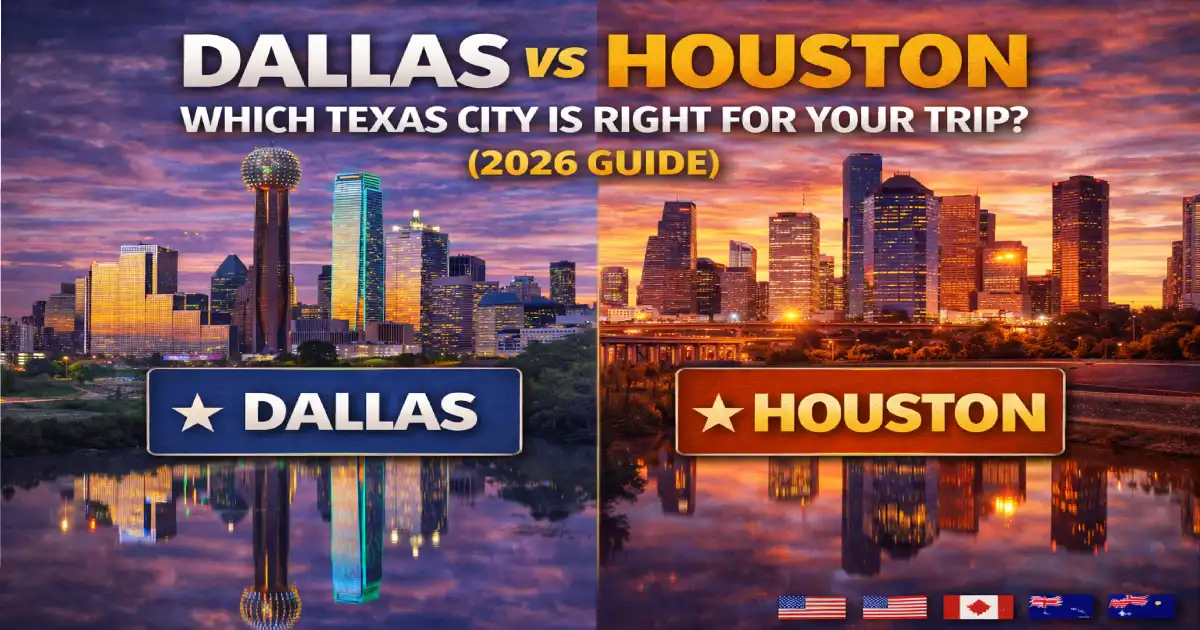
Dallas vs Houston: Which Texas City Is Right for Your Trip? (2026 Guide)
Published on : 16 Apr 2026
Dallas vs Houston — Texas’s Two Largest Cities, Two Entirely Different Experiences
By Travel Tourister | Updated March 2026
Dallas and Houston are the two largest cities in Texas and the fourth and fifth largest in the United States — separated by 239 miles on I-45, roughly 3.5 hours of driving through the flat East Texas pine belt, and approximately everything that makes one major American city distinct from another. Dallas is the most architecturally ambitious and the most fashion-conscious major Texas city: a world-class arts district built in 68 acres downtown, a restaurant scene producing James Beard nominations at an accelerating rate, neighborhoods (Bishop Arts, Deep Ellum, Knox-Henderson) that are genuinely walkable and genuinely independent, and a skyline that is the most conventionally dramatic in the state. Houston is the most internationally diverse and the most culturally complex: the most ethnically diverse major city in the United States (more than 145 languages spoken, the most diverse immigrant restaurant communities in any American city south of New York), the Johnson Space Center, the finest medical center on earth (the Texas Medical Center, the world’s largest), the Museum District with 19 museums in a single walkable corridor, and a Tex-Mex and Vietnamese and Cajun and Ethiopian and West African food scene that makes Houston the most genuinely cosmopolitan dining city in Texas by any honest measure.
Both cities are vast, car-dependent, and genuinely hot in summer. Both have been growing faster than almost any American city for two decades. Both have been quietly producing world-class food and cultural experiences that national media has consistently underestimated. The difference is character — and choosing between them requires honest self-assessment of what you came to Texas for.
For complete city guides, see our Things to Do in Dallas and Things to Do in Houston guides.
Quick Verdict: Dallas vs Houston at a Glance
Category
🏙️ Dallas Wins
🚀 Houston Wins
Winner
Arts & Museums
68-acre Arts District, DMA (free), Nasher, Sixth Floor Museum
19-museum Museum District, Menil Collection (free), Space Center
🤝 Tie (different strengths)
International Food Diversity
Good — Mot Hai Ba, Jeng Chi, Laili
Best in Texas — Viet-Cajun, Nigerian, Salvadoran, Indian, Korean
🚀 Houston
Fine Dining
Lucia, Knife, Stampede 66, Bullion
Brennan’s, Underbelly, Xochi, March
🤝 Tie
BBQ
Pecan Lodge, Lockhart Smokehouse
Feges BBQ, Killen’s, CorkScrew
🤝 Tie
Tex-Mex
Good — El Fenix, Meso Maya
Best in Texas — Original Ninfa’s (birthplace of fajita 1973!), El Real
🚀 Houston
History & Landmarks
Sixth Floor Museum / JFK, Victorian East End, Arts District
Space Center Houston, San Jacinto Battleground, Buffalo Bayou
🏙️ Dallas (JFK alone wins it)
Sports
Cowboys, Mavericks, Rangers, Stars
Astros, Texans, Rockets
🤝 Tie
Outdoor Activities
Katy Trail, White Rock Lake, Arboretum
Buffalo Bayou Park, Hermann Park, Galveston (50 mi)
🚀 Houston (Galveston access)
Walkability
Bishop Arts, Uptown (select areas)
Museum District, Montrose, Heights
🤝 Tie (both car-dependent)
Nightlife
Deep Ellum, Uptown, Greenville Ave
Midtown, Montrose, Washington Ave, East End
🤝 Tie
Family Activities
Perot Museum, Dallas Zoo, Arboretum
Space Center Houston, Houston Zoo, Children’s Museum
🚀 Houston (Space Center wins)
Hotel Cost
$130–$220/night midrange
$120–$210/night midrange
🚀 Houston (slightly cheaper)
Beach Access
No beach access
Galveston (50 miles, 55-min drive)
🚀 Houston
Dallas vs Houston: City Personality
Dallas: Ambition, Architecture, and the Most Polished Texas
Dallas is the most image-conscious major Texas city — a place that has been investing in its own appearance and ambition with a conviction and a capital commitment that has produced the most architecturally significant urban arts district in the United States (buildings by Renzo Piano, Zaha Hadid, I.M. Pei, and Norman Foster in a 68-acre walkable corridor), the most aspirational restaurant scene in the state (quietly accumulating James Beard nominations for a decade while the food media focused on Austin), and the most fashion-forward street culture in Texas. Dallas knows what it wants to look like and works harder than any other Texas city to look that way.
The result is a city that is genuinely excellent for the visitor who engages with it seriously — the Sixth Floor Museum’s emotional weight, the Nasher Sculpture Center’s Renzo Piano garden, the Bishop Arts District’s walkable Victorian grid of independent restaurants, and the Fort Worth Stockyards day trip (30 miles west, free twice-daily cattle drive) combine to produce a genuinely rewarding major American city experience that Dallas’s reputation has historically undersold.
Dallas visitors tend to be: Culture and history travelers, sports fans (4 major pro teams), business travelers, families seeking museums and the State Fair, and visitors who want the most conventionally “major American city” Texas experience.
Houston: The World’s Most Diverse City in Texas Form
Houston is the most genuinely cosmopolitan major city in the American South — a sprawling, car-dependent, architecturally chaotic city of 7 million metropolitan residents whose greatest achievement is not the skyline (which is functional rather than beautiful) but the diversity of the human community living under it. The Bellaire Vietnamese corridor (the finest Vietnamese food outside Vietnam accessible in the American South), the Mahatma Gandhi District’s Indian restaurants, the Gulfton neighborhood’s Central American pupuserias, the Kashmere Gardens community’s soul food, and the Midtown Ethiopian restaurants make Houston the city that most specifically rewards the food-curious visitor with the most diverse and the most genuinely international dining landscape accessible in any Texas city.
Houston also has Johnson Space Center — the most genuinely inspiring single attraction in Texas, where Apollo Mission Control has been preserved in its 1969 configuration and the visitor can stand in the room where Neil Armstrong’s first moon steps were directed from Earth. The Museum District’s Menil Collection (the finest private art collection in Texas, free always) and the 19 institutions within the walkable Museum District corridor add a cultural depth that rivals Dallas’s Arts District in scale if not in architectural ambition.
Houston visitors tend to be: Food explorers, international travelers, families with NASA-obsessed children, arts and museum visitors, and anyone who values the most genuinely diverse urban cultural experience in Texas.
Dallas vs Houston: Arts & Museums
Dallas Arts & Museums — The Most Architecturally Ambitious
The Dallas Arts District is the most architecturally significant museum corridor in Texas — 68 acres in downtown Dallas containing the Dallas Museum of Art (free general admission always — the most generous major museum in Texas), the Nasher Sculpture Center ($10, Renzo Piano building and garden, one of the finest sculpture collections in the world), the Crow Museum of Asian Art (free always), the AT&T Performing Arts Center (Zaha Hadid’s Winspear Opera House with among the finest opera acoustics in North America), and the Morton H. Meyerson Symphony Center (I.M. Pei’s 1989 masterwork). The Sixth Floor Museum at Dealey Plaza ($18) — the Kennedy assassination museum in the preserved Texas School Book Depository — is the most emotionally and historically specific museum experience in any American city.
Dallas’s free museum day delivers: DMA (permanent collection free), Crow Museum (free), Holocaust and Human Rights Museum (free), African American Museum at Fair Park (free) — the most generous free museum portfolio in Texas.
Houston Arts & Museums — The Most Numerous and Most Diverse
Houston’s Museum District contains 19 museums within a walkable corridor in the Hermann Park neighborhood — the most museum-dense walkable area in Texas. The anchor institutions: the Museum of Fine Arts Houston (the largest art museum in the American South, with the finest Impressionist collection in Texas and a permanent collection spanning 6,000 years), the Menil Collection (the de Menils’ private collection of Surrealist, tribal, and Byzantine art — free always, the most intellectually specific and the most emotionally affecting private art collection accessible in Texas), the Houston Museum of Natural Science (the most family-attended science museum in Texas, with the finest gem and mineral hall), and the Contemporary Arts Museum Houston (free always, the most adventurously programmed contemporary art institution in Texas).
Space Center Houston at Johnson Space Center (25 miles from downtown) is the most genuinely inspiring single attraction in Texas — Apollo Mission Control preserved in its 1969 configuration, the Saturn V rocket hall (the most physically overwhelming single aerospace exhibit accessible in the United States), and the tour of the active International Space Station Mission Control. For families with children, Space Center Houston is the single most compelling reason to choose Houston over Dallas.
Arts verdict: Tie, with different characters. Dallas wins on architectural ambition and the JFK historical weight. Houston wins on museum quantity, the Menil Collection’s specific brilliance, and Space Center Houston’s unique national significance.
Dallas vs Houston: Food Scene
Dallas Food — Rising James Beard Ambition
Dallas’s restaurant scene is the most rapidly improving in Texas — Lucia in Bishop Arts (James Beard-nominated Italian, finest pasta in DFW), Knife in Highland Park (240-day dry-aged beef, most technically ambitious steakhouse in Dallas), Stampede 66 in the Arts District (Stephan Pyles, James Beard Award winner), and Uchi Dallas (James Beard Award-winning Japanese) collectively represent the most nationally recognized fine dining available in Dallas. The international range is also expanding — Mot Hai Ba’s Vietnamese bún bò Huế, Laili’s Afghan mantoo dumplings, and Jeng Chi’s DFW-finest dim sum in Richardson fill out a genuinely diverse dining landscape.
Dallas BBQ at Pecan Lodge (Texas Monthly Top 50, the beef rib that is the most photographed single BBQ plate in Dallas) and Lockhart Smokehouse in Bishop Arts (Kreuz Market lineage, the most authentic Central Texas BBQ tradition in the city) are both genuinely excellent. Dallas is a legitimately good BBQ city — it is simply not Austin.
Houston Food — The Most Diverse Dining City in Texas
Houston is the most internationally diverse food city in Texas and one of the most diverse in the United States — a function of the city’s immigration history (the most internationally diverse metropolitan population in the American South) producing the most genuinely cosmopolitan food landscape accessible in any Texas city. The specific Houston food culture achievements:
Viet-Cajun crawfish: The most specifically Houston culinary invention — the Bellaire Vietnamese community’s adaptation of the Louisiana crawfish boil tradition, producing Viet-Cajun crawfish (garlic butter, lemongrass, and Vietnamese spice blends applied to whole boiled crawfish) that is unavailable in this specific form in any other American city. The best: Crawfish & Noodles, the most celebrated Viet-Cajun operation in the country ($20–$30/lb in season)
Original Ninfa’s: The birthplace of the fajita — Mama Ninfa Laurenzo introduced the fajita at her Houston Tex-Mex restaurant in 1973; the dish that defines Texas-Mexican cuisine was invented in Houston, and eating the original fajita at the original location is the most historically specific Tex-Mex dining accessible in Texas ($22–$32)
Brennan’s of Houston: The most celebrated special-occasion restaurant in Houston — the New Orleans Creole tradition transplanted to Texas (the Sunday jazz brunch with Bananas Foster tableside is the most specifically indulgent Houston restaurant experience accessible at any price)
Underbelly Hospitality: Chris Shepherd’s Houston restaurant group (James Beard Award winner) — the most celebrated Houston culinary name and the most specifically Houston culinary identity, built around the city’s immigrant food communities
Food verdict: Houston wins on diversity and international range; tie on fine dining quality; Dallas wins on walkable neighborhood restaurant concentration (Bishop Arts, Knox-Henderson). If food is the primary reason for the Texas trip, Houston is the most rewarding food city in the state by any honest measure of culinary diversity.
Dallas vs Houston: Sports
Dallas Sports — Four Major Professional Teams
Dallas is the most sports-saturated Texas city — the Cowboys (NFL, AT&T Stadium in Arlington, the largest and most technologically spectacular NFL venue in the United States), the Mavericks (NBA, American Airlines Center, recent deep playoff runs), the Rangers (MLB, Globe Life Field, 2023 World Series champions — the most recent championship of any Dallas team), and the Stars (NHL) provide the most year-round major professional sports schedule in Texas. AT&T Stadium is the most physically overwhelming sports venue in the United States — the 160-foot center-hung HD screen, the 5,850-seat suite level, and the retractable roof make it the most spectacular single sports building in the country regardless of the team’s record.
The Cowboys game is the most specific and the most globally recognized Dallas sports experience — the NFL’s most valuable franchise in the most technologically ambitious stadium produces the most specific American football spectacle accessible anywhere, at ticket prices ranging from $85 (upper deck, non-division game) to $400+ (lower level, division rivalry). Book 4–6 weeks ahead for the best availability.
Houston Sports — Championship Pedigree and Minute Maid Park
Houston’s sports scene is built around the most recent championship pedigree of any Texas major sports city — the Astros’ back-to-back World Series appearances (2017 champions, 2019 and 2021 runners-up, 2022 champions) have produced the most celebrated baseball team in the American South, and Minute Maid Park (the retractable-roof downtown ballpark with the most specifically atmospheric downtown location — Union Station’s 1911 facade incorporated into the outfield wall, the hill in centerfield, and Tal’s Hill, now removed) is the most historically interesting ballpark in Texas. The Texans (NFL) and the Rockets (NBA) complete Houston’s major professional sports portfolio, though neither has produced the sustained competitiveness of the Astros’ recent dynasty.
Sports verdict: Tie — Dallas wins on team quantity and the AT&T Stadium spectacle; Houston wins on recent Astros championship culture and Minute Maid Park’s downtown accessibility and character.
Dallas vs Houston: Outdoor Activities & Nature
Dallas Outdoors — The Finest Urban Parks in Texas
Dallas’s outdoor recreation is concentrated in the finest urban park infrastructure in Texas — Klyde Warren Park (the 5-acre deck park over the Woodall Rodgers Freeway, the most successful urban park project in Dallas’s history, free always), the Katy Trail (3.5 miles of urban cycling converted from a former railroad right-of-way through Uptown), White Rock Lake (9.3-mile loop trail around a 1,015-acre reservoir in East Dallas, the finest urban cycling in the city), and the Dallas Arboretum (66 acres with 500,000 spring tulips and 90,000 fall pumpkins). Dallas’s outdoor offering is the finest urban park system in Texas — it does not include a beach or a natural swimming hole or any wilderness.
Houston Outdoors — Bayou Parks and Gulf Beach Access
Houston’s outdoor landscape is defined by the bayou system — Buffalo Bayou Park (a 160-acre park along the bayou running through the urban core, with the most extensive multi-use trail system accessible in Houston proper, the most photogenic downtown Houston view from the pedestrian bridges, and the most family-used riverside park in the city), Hermann Park (545 acres adjacent to the Museum District with a Japanese garden, a reflection pond, and the Houston Zoo), and the Memorial Park (a 1,500-acre forested park in the urban Galleria area that is the most extensive natural forest accessible within a major Texas city). Houston also has the Armand Bayou Nature Center — the most intact coastal prairie ecosystem accessible within a major US metro area, with alligators, roseate spoonbills, and migratory shorebirds.
Houston’s most significant outdoor advantage over Dallas: Galveston Island (50 miles south, 55 minutes on I-45) — the Texas Gulf Coast’s most historically specific island city, with the Strand Victorian Historic District, the Pleasure Pier, Stewart Beach, and the free Bolivar Ferry crossing the Ship Channel. No equivalent beach destination is accessible from Dallas within a day trip.
Outdoors verdict: Houston wins — the bayou park system rivals Dallas’s urban parks, and the Galveston day-trip access is an advantage Dallas cannot match.
Dallas vs Houston: Neighborhoods & Walkability
Dallas’s Best Neighborhoods
Bishop Arts District (Oak Cliff): The most walkable and the most culinarily independent neighborhood in Dallas — Lucia (finest Italian in DFW), Emporium Pies (finest dessert in Dallas), and 60+ independent retailers in a 1920s commercial Victorian grid; accessible free via the DART Streetcar from Union Station
Deep Ellum: The most creatively energetic neighborhood — mural corridors, live music venues, Pecan Lodge BBQ, and the specific warehouse district energy that is the most raw and the most urban Dallas neighborhood experience
Uptown: The most restaurant-dense and the most outdoor-dining-active — McKinney Avenue’s restaurant row, the free McKinney Avenue Trolley (vintage 1920s streetcars), and the Katy Trail connection to Knox-Henderson
Knox-Henderson: The most rapidly evolving — Trompo (finest taco al pastor in Dallas), Boulevardier (finest natural wine bar), and the most food-forward independent restaurant corridor in the city
Houston’s Best Neighborhoods
Montrose: The most creative and the most culturally diverse Houston neighborhood — the Menil Collection anchors a walkable arts corridor surrounded by independent restaurants, galleries, LGBTQ+ bars, and the most bohemian residential streetscape accessible in the city
The Heights: The most historically preserved and the most walkable residential neighborhood in Houston — 19th Street’s independent boutiques, the best coffee shops in the city, and the most specifically neighborhood-feeling dining accessible in Houston (the Coltivare restaurant’s garden patio is the finest single restaurant setting in the neighborhood)
Midtown: The most nightlife-concentrated and the most young-professional-facing Houston neighborhood — the bar density on Gray Street and the surrounding blocks produces the most sustained Friday and Saturday evening energy in Houston
Museum District / Hermann Park: The most walkable and the most culturally concentrated — 19 museums, Hermann Park, and the most pedestrian-complete neighborhood in Houston proper
EaDo (East Downtown): The most rapidly developing — Houston’s most creative and most culinarily evolving neighborhood, with the most interesting new restaurant openings in the city and the Dynamo Stadium as the neighborhood’s sports anchor
Neighborhood verdict: Tie — both cities have excellent neighborhood characters; Dallas’s Bishop Arts is more specifically photogenic and culinarily concentrated; Houston’s Montrose and Heights are more walkably residential and culturally layered.
Dallas vs Houston: Cost of Visiting
Cost Category
🏙️ Dallas
🚀 Houston
Cheaper?
Midrange Hotel (per night)
$130–$220
$120–$210
🚀 Houston (slightly)
Budget Hotel (per night)
$85–$130
$80–$125
🚀 Houston
Casual Dinner (per person)
$25–$45
$20–$40
🚀 Houston
Fine Dining (per person)
$65–$120
$65–$125
🤝 Tie
Museum Access
DMA free, Nasher $10, Crow free
Menil free, CAMH free, MFAH $19, Space Center $35
🤝 Tie
Cowboys / Astros Game
Cowboys from $85; Rangers from $18
Astros from $20; Texans from $50
🚀 Houston (baseball cheaper)
Space Center Houston
Not available
$35/adult
🚀 Houston (has it)
Beach Day (Galveston)
Not accessible as day trip
$5 parking + gas, 55-min drive
🚀 Houston (has it)
Event-Week Premiums
State Fair Oct (+50%), Cowboys games
Houston Livestock Show Feb (+40%), Super Bowl years
🤝 Tie (comparable spikes)
Cost verdict: Houston is modestly cheaper overall — hotel rates are slightly lower, casual dining is more affordable (the international food corridor’s ethnic restaurants are the most value-for-dollar food in Texas), and baseball tickets at Minute Maid Park are the most accessible professional sports in Texas ($20 for upper deck Astros game versus $85 minimum for a Cowboys ticket). Dallas’s State Fair week (October) and Cowboys home game weekends produce the most significant hotel price spikes. Houston’s largest spike is the Houston Livestock Show and Rodeo (February–March, the world’s largest livestock show, 20 days).
Dallas vs Houston: Weather & Best Time to Visit
Both cities are hot in summer and mild in winter — but with meaningful differences in humidity that significantly affect the visitor experience.
Dallas summer (June–August): 95–103°F average highs, low humidity (the dry heat of the North Texas prairie). Genuinely hot but more tolerable than Houston’s equivalent temperatures because the dry air allows sweat to evaporate. Outdoor activities limited to morning (before 10 AM) and evening (after 7 PM).
Houston summer (June–August): 90–98°F average highs, high humidity (60–80% average relative humidity, the Gulf of Mexico moisture influence). Houston’s summer is the most oppressively humid of any major Texas city — the combination of 95°F and 75% humidity produces the most physically challenging outdoor conditions in Texas. Indoor activities (Space Center, Museum District, Galleria) are the most practical summer Houston itinerary.
Best time for Dallas: April (perfect weather, Arboretum blooming) or late September–early October (State Fair, excellent fall temperatures).
Best time for Houston: October–April (dry season, best temperatures). The Houston Livestock Show and Rodeo (February–March, world’s largest, 20 days at NRG Stadium) is the most specifically Houston event worth timing a visit around. Avoid June–September unless the itinerary is almost entirely indoors.
Dallas vs Houston: Getting There & Getting Around
Dallas Airports
Dallas/Fort Worth International (DFW): The most connected airport in Texas — a major American Airlines hub with the most direct international connections of any Texas airport; 30 minutes from downtown Dallas
Dallas Love Field (DAL): Southwest Airlines’ primary Texas hub, 15 minutes from downtown; domestic routes only but often cheaper for US domestic travelers
Houston Airports
George Bush Intercontinental (IAH): United Airlines’ primary hub — the most connected international airport in Texas, with the most direct international routes including the most Latin American connections of any US airport; 30 minutes from downtown Houston
William P. Hobby (HOU): Southwest Airlines’ Houston hub, 20 minutes from downtown; domestic routes and select Mexico/Caribbean destinations
Getting around: Both cities are car-dependent for most activities. Dallas has a more functional light rail system (DART) reaching Deep Ellum, Fair Park, the Zoo, and Victory Park; the free McKinney Avenue Trolley and free Bishop Arts Streetcar are genuinely useful. Houston’s METRORail is less extensive but reaches the Museum District from downtown. Budget $15–$25 per Uber/Lyft ride between neighborhoods in both cities.
Who Should Visit Dallas?
Choose Dallas if you:
Want the most architecturally significant arts district in the United States — the DMA (free), Nasher ($10), Crow Museum (free), AT&T Performing Arts Center, and the Meyerson Symphony Center in a single walkable 68-acre corridor
Are a history traveler who specifically wants the Sixth Floor Museum and Dealey Plaza — the most emotionally and historically specific single museum experience in any American city
Want to attend an NFL Cowboys game at AT&T Stadium — the most physically spectacular sports venue in the United States
Are visiting during October for the State Fair of Texas — the largest state fair in the United States, the most specifically Texas annual event
Want a day trip to Fort Worth (30 miles west) — the Kimbell Art Museum (free, world-class) and the Stockyards cattle drive (free, twice daily) are the two finest free experiences in the American South accessible by day trip from any Texas city
Want the most neighborhood-feeling and most culinarily walkable Texas city experience — Bishop Arts District is the finest walkable independent restaurant neighborhood in Texas
Want the most internationally diverse food experience in Texas — the Viet-Cajun crawfish, the Original Ninfa’s fajita birthplace, the Underbelly Houston dining philosophy, and the world’s most diverse immigrant restaurant community make Houston the most rewarding food city in the state
Are visiting with children who are interested in space — Space Center Houston at Johnson Space Center, with Apollo Mission Control preserved in its 1969 configuration and the Saturn V rocket hall, is the single most compelling family attraction in Texas
Want the Menil Collection — the most intellectually specific and emotionally affecting free art museum in Texas; the de Menil family’s Surrealist, tribal, and Byzantine collection in Renzo Piano’s 1987 building is the finest single private art collection accessible in the American South
Want a Gulf Coast beach day — Galveston is 50 miles south of Houston (55-minute drive) and offers the most historically specific Gulf Coast island experience in Texas
Are attending the Houston Livestock Show and Rodeo (world’s largest, February–March, 20 days) — the most specifically Texas and the most internationally attended rodeo accessible in the United States
Want the most authentic Tex-Mex roots — the Original Ninfa’s (birthplace of the fajita, 1973, still serving the original preparation at the original Navigation Boulevard location) is the most historically specific Tex-Mex dining accessible in Texas
Want the most genuinely cosmopolitan and the most globally diverse major Texas city experience
Can You Visit Both Dallas and Houston?
Yes — and if you have 6+ days in Texas, combining both cities produces the most complete major Texas urban experience accessible in a single trip. Dallas and Houston are 239 miles apart (3.5 hours on I-45) — close enough for a road trip, far enough to require a planned overnight rather than a day trip. The most efficient routing:
6-day trip: Dallas 3 days (Arts District, Sixth Floor Museum, Bishop Arts dinner, Fort Worth day trip) → Houston 3 days (Space Center, Menil Collection, Viet-Cajun crawfish, Museum District, Galveston half-day)
8-day trip: Dallas 3 days → Austin 2 days (add Franklin BBQ and Barton Springs) → Houston 3 days — the Dallas–Austin–Houston triangle is the most complete single-trip Texas experience accessible by rental car
One-way road trip: Fly into Dallas Love Field, drive the Dallas–Austin–San Antonio–Houston loop (the full Texas circuit, 4–5 cities, 7–10 days), fly out of Houston Hobby — the most efficient multi-city Texas itinerary for the visitor with limited time
Dallas vs Houston: Practical Tips
Topic
🏙️ Dallas
🚀 Houston
Best Time to Visit
April (Arboretum bloom, perfect weather) or late September–October (State Fair)
October–April; February–March for Livestock Show & Rodeo
Worst Time
August (100°F+ dry heat; avoid midday outdoors)
June–September (humid heat; the most oppressive weather in any Texas city)
Best Area to Stay
Uptown (walkable to Arts District, Klyde Warren, Katy Trail) or Downtown
Museum District / Midtown (walkable to Menil, Hermann Park, restaurants) or Downtown
Don’t Miss
Sixth Floor Museum + Dealey Plaza; Bishop Arts free DART Streetcar; Fort Worth day trip
Space Center Johnson Space Center; Menil Collection (free); Viet-Cajun crawfish in Bellaire
Avoid
West End tourist restaurant corridor; driving without GPS in the Design District
Driving on I-610 or I-10 during rush hours (worst traffic in Texas); outdoor activities in July–August midday
Best Day Trips
Fort Worth (30 min — Kimbell + Stockyards); Waco/Magnolia (90 min)
Galveston (55 min — Strand + beach + Bolivar Ferry); Space Center (25 min)
Free Highlights
DMA, Crow Museum, Holocaust Museum, Klyde Warren Park, McKinney Trolley, Bishop Arts DART Streetcar, Dealey Plaza
Menil Collection, CAMH, Buffalo Bayou Park, Hermann Park, Houston Zoo (free first Tuesdays)
Frequently Asked Questions: Dallas vs Houston
Is Dallas or Houston better overall?
Neither city is objectively better — they are genuinely different cities that reward different traveler priorities. Dallas is better for the visitor who wants the most architecturally ambitious arts district in the United States (free DMA, $10 Nasher), the most emotionally specific historical experience in any American city (the Sixth Floor Museum), and the most conventionally “major American city” Texas experience. Houston is better for the visitor who wants the most internationally diverse food city in Texas (Viet-Cajun crawfish, Original Ninfa’s fajita birthplace, the world’s most diverse immigrant restaurant community), the most inspiring family attraction in the state (Space Center Houston), and the most genuinely cosmopolitan urban experience south of Chicago. The most honest comparison: Dallas is the more photogenic and the more culinarily walkable city. Houston is the more diverse and the more genuinely cosmopolitan.
Is Houston more dangerous than Dallas?
Both cities have areas with elevated crime rates, and both cities have large safe tourist-facing neighborhoods. The standard urban safety advice applies to both: stay in the well-trafficked tourist and hotel areas, use rideshare at night rather than walking unfamiliar areas, and apply the same situational awareness you would in any large American city. Neither city is uniquely dangerous for tourists who follow standard travel safety practices. The Museum District, Montrose, and Heights in Houston and the Arts District, Uptown, and Bishop Arts in Dallas are all safe and well-trafficked for visitors.
Which city has better BBQ — Dallas or Houston?
This is genuinely a tie, with the important caveat that neither city beats the Austin-Lockhart-Luling corridor for Central Texas-style brisket. Within the cities themselves: Dallas’s Pecan Lodge (Texas Monthly Top 50, the most celebrated beef rib accessible within Dallas city limits) and Lockhart Smokehouse (Kreuz Market lineage, no sauce policy) are both excellent examples of the Central Texas tradition. Houston’s Feges BBQ (James Beard-nominated, the most technically ambitious Houston BBQ), Killen’s BBQ in Pearland (the most nationally recognized Houston-area BBQ), and CorkScrew BBQ in Spring (Texas Monthly’s highest-rated Houston-area operation) collectively produce a BBQ scene that is the equal of Dallas’s in quality if not in media recognition. If BBQ is the primary Texas food priority, make the day trip to Franklin Barbecue in Austin (7 AM arrival) or drive the I-35 corridor to Lockhart’s original Kreuz Market or Smitty’s Market.
Which city is easier to get to from outside Texas?
Dallas/Fort Worth International (DFW) has more international direct flights than Houston Intercontinental (IAH) for Tier 1 markets (UK, Canada, Australia) — American Airlines’ DFW hub produces the most direct connections from European and Pacific destinations to Texas. Houston IAH is the better hub for Latin America and South America connections. For domestic US visitors, both cities are equally accessible with multiple major carrier options. Love Field (Dallas) and Hobby (Houston) serve Southwest Airlines’ domestic network from both cities. For the visitor flying from London, Toronto, or Sydney specifically: check both DFW and IAH for direct routes — the availability varies significantly by departure city and season.
Which has better weather — Dallas or Houston?
Dallas has better summer weather for outdoor activities — the North Texas dry heat (95–103°F, 20–35% humidity) is significantly more tolerable for sustained outdoor activity than Houston’s Gulf Coast humidity (90–98°F, 60–80% humidity). The specific comparison: 95°F in Dallas feels like a hot but manageable afternoon. 90°F in Houston in July at 80% humidity feels like breathing warm wet cloth and makes sustained outdoor activity genuinely unpleasant. Both cities are excellent October through April. For the summer visitor who intends to spend time outdoors: Dallas is the more comfortable choice. For the summer visitor whose itinerary is primarily indoors (museums, restaurants, Space Center): Houston’s weather disadvantage is largely irrelevant.
Final Verdict: Dallas vs Houston
Dallas and Houston are the two largest and the two most genuinely different major Texas cities — and the visitor who chooses between them based on honest self-assessment of their priorities will not be disappointed by either. The most honest single-sentence summary:
Choose Dallas if you want the most architecturally ambitious arts and cultural district in Texas (DMA free, Nasher $10, Sixth Floor Museum $18, Winspear Opera House, and a Fort Worth day trip that delivers the Kimbell and the Stockyards cattle drive), the most walkable and the most culinarily independent neighborhood experience in a major Texas city (Bishop Arts District via the free DART Streetcar), and the most spectacular single sports venue in the United States (AT&T Stadium). Dallas is the Texas city that most rewards the visitor who arrives expecting less and finds more — more culture, more art, more neighborhood life, and more historical weight than the Cowboys-and-skyline reputation prepares any visitor to expect.
Choose Houston if you want the most internationally diverse food city in the American South (the Viet-Cajun crawfish in Bellaire, the fajita birthplace at Original Ninfa’s, the Underbelly dining philosophy, and a restaurant community that is the most genuinely cosmopolitan in Texas), the most inspiring family attraction in the state (Space Center Houston, Apollo Mission Control, Saturn V rocket hall), the finest free art collection in Texas (the Menil Collection, free always), and a Gulf Coast beach day at Galveston (55-minute drive). Houston is the Texas city that most rewards the visitor who arrives expecting chaos and finds depth — more food diversity, more cultural complexity, more genuine cosmopolitanism, and more specific food memories than any other Texas city produces.
Both cities are genuinely extraordinary. Dallas is the more photogenic and the more artistically curated. Houston is the more diverse and the more specifically surprising. The best Texas trip includes both — and the 239 miles of I-45 between them is the most productively instructive single drive in Texas for understanding what the state’s two largest cities are, and why they are so magnificently and so specifically different from each other.
For more detail, see our complete guides: 50 Things to Do in Dallas, Best Restaurants in Dallas, 50 Things to Do in Houston, and Best Restaurants in Houston.
—
—Official Government & Tourism ResourcesFor the most current visitor information, entry requirements, road conditions, and travel advisories for Dallas and Houston, consult these official government sources:
—About Travel TouristerTravel Tourister’s Texas specialists have extensively explored both Dallas and Houston — from the Sixth Floor Museum and Bishop Arts District to the Menil Collection and Viet-Cajun crawfish in Bellaire — to provide the most honest and most specific comparison available for Tier 1 travelers choosing between Texas’s two largest and most genuinely different major cities.Need help planning your Texas trip? Our specialists can help you build the optimal Dallas–Houston itinerary, choose the right neighborhood to stay in each city, time your visit around the State Fair or Houston Livestock Show, and identify the best food experiences in both cities for any visit length or travel style.
Posted By : Vinay
As a lead contributor for Travel Tourister, Vinay is dedicated to serving our Tier 1 audience (US, UK, Canada, Australia). His mission is to deliver precise, fact-checked news and actionable, data-driven articles that empower readers to make informed decisions, minimize travel risks, and maximize their adventure without compromising safety or budget.
Travel Tourister is a leading Travel portal where we introduce travellers to trusted travel agents to make their journey hasselfree, memorable And happy. Travel Tourister is a platform where travellers get Tour packages ,Hotel packages deals through trusted travel companies And hoteliers who are working with us across the world. We always try to find new and more travel agents and hoteliers from every nook and corners across the world so that you could compare the deals with different travel agents and hoteliers and book your tour or hotel with the one you have chosen according to your taste and budget.




 Call
Call Enquiry