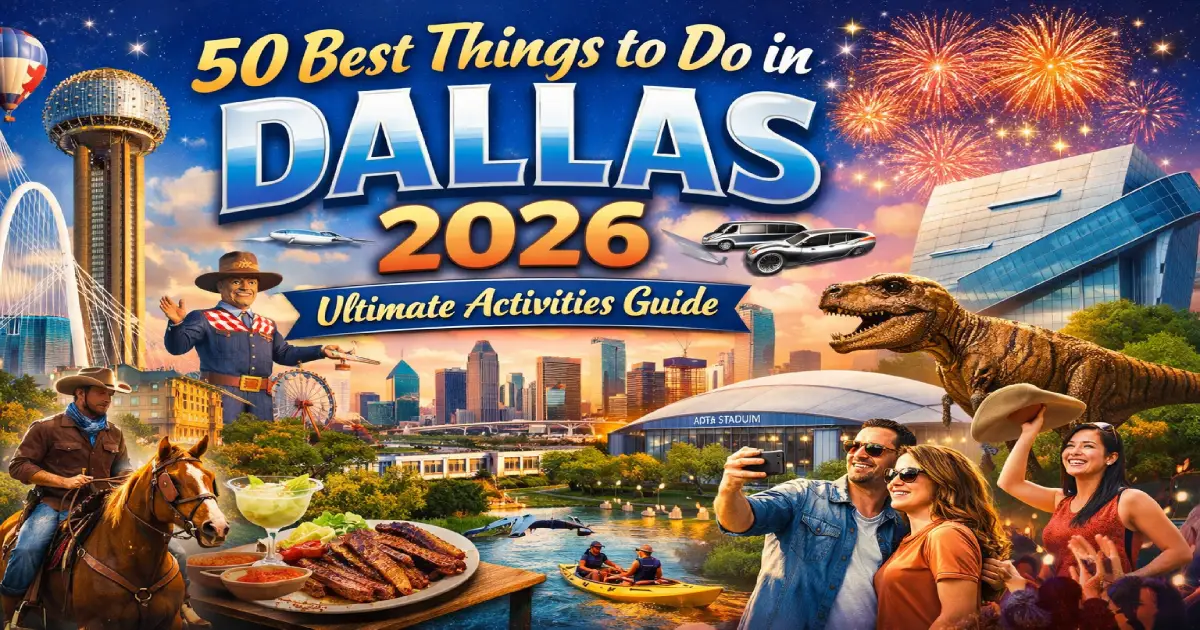
50 Best Things to Do in Dallas 2026: Ultimate Activities Guide
Published on : 30 Mar 2026
Things to Do in Dallas — America’s Most Underrated Major City, Activity by Activity
By Travel Tourister | Updated March 2026
Dallas is the most underestimated major city in America — a place that most Americans associate with the Cowboys, JFK, and Big D swagger, but that actually contains the largest contiguous urban arts district in the United States (68 acres with more performance venues per block than any other American city outside New York), one of the finest collections of free museum admission policies in any American city (the Dallas Museum of Art and the Crow Museum of Asian Art are free always; the Kimbell Art Museum’s permanent collection is free always), a live music and mural art culture in Deep Ellum that rivals Austin’s more celebrated scene for raw energy and genre diversity, a farmers market movement anchored by the Dallas Farmers Market (open daily since 1941) that is the finest food market in North Texas, and the Bishop Arts District — a 60-block walkable neighborhood of independent restaurants, boutiques, and galleries that demonstrates more clearly than any other Dallas neighborhood that the city has a genuinely excellent life beyond its football stadium and its signature cowboy image.
I’ve explored Dallas across multiple visits and every neighborhood — the Sixth Floor Museum on a November morning when the light from the Dealey Plaza windows falls on Elm Street at the same low angle it did on November 22, 1963, the Nasher Sculpture Center’s outdoor garden in October when the sculpture is at its most beautiful in the autumn light filtering through the skylight, the Deep Ellum walk on a Friday night when the murals are lit from below and the music from competing venues overlaps in the street, the Klyde Warren Park’s Thursday food truck gathering when the downtown office workers fill the deck park above the Woodall Rodgers Freeway for lunch, and the Bishop Arts District on a Sunday morning when the coffee shops open early and the neighborhood is entirely at ease with itself. Each visit expanded the map and confirmed the same truth: Dallas rewards the visitor who arrives with curiosity rather than assumptions, who walks the Bishop Arts District rather than staying in the hotel corridor, and who understands that the finest Dallas experiences require getting in the car and driving 30 minutes west to Fort Worth, where the Stockyards’ cattle drive and the Kimbell Art Museum are the two finest free activities within a day’s round trip of any Dallas hotel.
This comprehensive 2026 guide breaks down Dallas’s 50 best activities using verified information from Visit Dallas, years of on-the-ground expertise, and honest assessments of what delivers genuinely memorable experiences. We organize activities by category — iconic Dallas, arts and culture, outdoor and parks, food and drink, sports and entertainment, neighborhoods, day trips, and unique Dallas — with realistic costs, timing, and strategic advice for experiencing one of America’s most surprising and most continuously underrated major cities.
Dallas Activities by Category
Category
Top Activities
Best Location
Cost Range
Iconic Dallas
Sixth Floor Museum, Dallas Arts District, Reunion Tower
Downtown, Uptown
Free–$18
Arts & Culture
DMA, Nasher Sculpture Center, Perot Museum
Arts District
Free–$25
Outdoor & Parks
Klyde Warren Park, White Rock Lake, Arboretum
Citywide
Free–$15
Neighborhoods
Bishop Arts, Deep Ellum, Uptown, Design District
Citywide
Free to explore
Sports & Entertainment
Cowboys, Mavericks, Rangers, Stars
Arlington, Downtown, Fair Park
$35–$400
Day Trips
Fort Worth Stockyards, Kimbell Art Museum, Waco
30–90 min from Dallas
Free–$35
Iconic Dallas Experiences
1. Visit the Sixth Floor Museum at Dealey Plaza — MUST DO
Why It’s the Most Important Place in Dallas: The Sixth Floor Museum in the former Texas School Book Depository — where Lee Harvey Oswald allegedly fired the shots that killed President John F. Kennedy on November 22, 1963 — is the most carefully presented and most emotionally affecting history museum in Dallas. The museum documents the assassination, the investigation, and the global cultural impact of Kennedy’s death with primary source audio, video, photographic, and physical artifacts (the sniper’s perch window preserved behind glass exactly as it appeared in 1963 photographs, the original Zapruder film footage, the Warren Commission documentation) in a presentation that is simultaneously forensically honest and emotionally intelligent. Standing at the sixth floor windows and looking down to the assassination site on Elm Street, at the same oblique angle that produced the sniper’s sight line, is one of the most specific and most sobering historical experiences available in any American city.
What to Experience:
The sniper’s perch window (southeast corner, sixth floor): Preserved behind glass in its 1963 configuration — the stacked boxes, the arranged shooting position, and the view down to the Elm Street Z-turn where the motorcade passed. The most specific and most controversial single display in the museum.
The Zapruder film: The 26-second home movie that is the most analyzed 486 frames of film in American history — screened continuously in the museum’s film viewing area
The audio guide (included): The most essential audio guide in any Dallas museum — providing forensic, historical, and cultural context that transforms the physical space from a building into a historiographical argument
Dealey Plaza (free): The X mark in the Elm Street pavement marking the assassination site, the grassy knoll, the triple underpass — free to walk from the street at any hour
Reservations: Timed entry tickets at jfk.org recommended for weekend visits; walk-in available weekdays
Cost: $18/adult; jfk.org; 411 Elm Street, Downtown Dallas; open daily 10 AM–6 PM
2. Explore the Dallas Arts District
Why It’s Dallas’s Greatest Cultural Achievement: The Dallas Arts District — 68 acres of downtown Dallas containing the Dallas Museum of Art, the Nasher Sculpture Center, the Crow Museum of Asian Art, the AT&T Performing Arts Center (Winspear Opera House, Wyly Theatre), the Meyerson Symphony Center, the Booker T. Washington High School for the Performing and Visual Arts, and the Trammell Crow Center’s public sculpture garden — is the largest contiguous urban arts district in the United States and the most concentrated cultural zone in Texas. The public art (over 40 permanent works), the free museum admission policies, and the architectural ambitions (buildings by Rem Koolhaas, Renzo Piano, Zaha Hadid, and Norman Foster) make the Arts District the finest half-day free cultural itinerary in Dallas.
Dallas Museum of Art (free general admission): The finest art museum in Dallas — free admission to the permanent collection always, with particular strength in ancient art, Impressionism, and contemporary American; the 68 galleries and the sculpture garden are the most generous free museum offering in Texas
Nasher Sculpture Center ($10/adult): Renzo Piano’s building and garden housing one of the finest private sculpture collections in the world — the garden’s combination of Piano’s skylight system and the mature live oak trees creates the finest outdoor sculpture space in Texas
Crow Museum of Asian Art (free): The finest collection of Asian art in Dallas — free always, the most undervisited museum in the Arts District, with extraordinary Chinese, Japanese, and South Asian objects
Winspear Opera House (Zaha Hadid, 2009): The most architecturally distinctive building in the Arts District — the red glass disk canopy covering the outdoor plaza is the most photographed contemporary architecture in Dallas
Cost: DMA free; Nasher $10; Crow free; Arts District, downtown Dallas; most facilities open Tuesday–Sunday
3. Walk Dealey Plaza
The grassy plaza at the western edge of downtown Dallas — where the motorcade turned from Main Street onto Houston Street and then onto Elm Street on November 22, 1963 — is freely accessible at any hour, with the X mark in the Elm Street pavement (repainted periodically by the city), the triple underpass at the plaza’s western edge, the grassy knoll with its wooden picket fence on the north side, and the Book Depository building clearly visible from the assassination site
The perspective: Standing on the Elm Street assassination X and looking up to the sixth floor southeast corner window of the Depository — the most widely analyzed sight line in American history, immediately comprehensible from the street level in a way that decades of photographs do not convey
The conspiracy theories: The grassy knoll area has hosted independent researchers, conspiracy documentarians, and the occasional person with a handmade sign on any given weekday — part of the Dealey Plaza experience that no management of the site has successfully eliminated
The 470-foot observation sphere at Reunion Tower — the most recognizable element of the Dallas skyline (the geodesic sphere atop the concrete shaft is visible from most highway approaches to downtown) and the finest elevated view of Dallas accessible to the general public. The 360-degree outdoor wraparound observation deck delivers the full Dallas skyline, the Trinity River corridor, and on clear days the Fort Worth skyline 30 miles west.
The GeO-Deck: Interactive digital telescopes allowing zoomed views of specific Dallas landmarks from the observation level — the most technologically enhanced observation deck experience in Texas
Wolfgang Puck’s Five Sixty restaurant: The rotating restaurant at the top of the tower — the most dramatically positioned restaurant in Dallas, completing a full rotation every 55 minutes
Why It’s Dallas’s Most Beloved Public Space: Klyde Warren Park — the 5.2-acre deck park built over the Woodall Rodgers Freeway between the Arts District and Uptown, opened 2012 — is the most successful urban park project in Dallas’s history and the city’s finest daily gathering space: a park suspended over a highway that connects two neighborhoods that the highway had divided for 50 years, with food trucks (Thursday–Sunday), free fitness classes, a children’s playground, a dog park, a reading room, outdoor concerts, and a bocce ball court that are used by the full cross-section of Dallas’s population simultaneously. The park is the finest expression of Dallas’s civic self-improvement that exists, and it is free always.
Food trucks (Thursday–Sunday): The finest food truck lineup in Dallas — rotating operators with permanent spots, the most diverse and the most consistently excellent food truck selection in North Texas
Free activities: Yoga (mornings), bocce ball, board games, the reading room, the children’s splash area, the dog park — all free, all daily
Friday evening concerts: Free outdoor performances in the park’s performance area — the most accessible free outdoor music in downtown Dallas
The connectivity: Klyde Warren Park connects the Arts District (Nasher, DMA, Crow Museum) directly to the Uptown neighborhood’s restaurants and hotels — the most useful pedestrian connection in Dallas’s geography
Cost: FREE always; klydewarrenpark.org; 2012 Woodall Rodgers Freeway, between Downtown and Uptown; open daily
Arts & Culture Activities
6. Visit the Dallas Museum of Art
The finest art museum in Dallas — 68 galleries spanning 5,000 years of art history, with the most significant ancient Americas collection at any Texas museum (Olmec, Maya, and Aztec works of extraordinary quality), an excellent Impressionist collection, and the most free-admission-permanent-collection policy of any major Texas art museum. The building (Edward Larrabee Barnes, 1984) is one of the finest museum buildings in Texas for the quality of its natural light management.
Ancient Americas (Pre-Columbian) collection: The most significant collection of pre-Columbian art at any Texas museum — Olmec jade, Maya polychrome ceramics, and Aztec stone sculpture of extraordinary quality
Free Late Nights (third Friday of each month): The museum stays open until midnight on the third Friday — free admission, live music in the atrium, the most festive museum evening in Dallas
Cost: FREE general admission; special exhibitions $16–$22; dma.org; 1717 N. Harwood, Arts District
7. Visit the Nasher Sculpture Center
Why Essential: Renzo Piano’s 2003 building in the Arts District houses one of the finest private sculpture collections in the world — assembled by Dallas developer Raymond Nasher and his wife Patsy over 40 years, including works by Picasso, Matisse, Brancusi, Giacometti, Serra, Calder, and de Kooning in a building whose travertine and glass architecture and whose outdoor garden (one acre of mature live oaks and Piano’s signature skylight system managing the natural light) constitute the finest sculpture museum building in Texas. The outdoor garden is the single finest place in the Dallas Arts District on a clear October afternoon.
The outdoor garden: One acre of sculpture in a designed landscape — the most beautiful outdoor museum space in Dallas, with Piano’s skylight system filtering the North Texas sun to museum-quality illumination even in the outdoor garden
The indoor galleries: The most climatically controlled and most architecturally refined gallery space in the Arts District — the Serra, the Brancusi, and the Giacometti in Piano’s light
Nasher Sculpture Center Day (free, once annually): The one day per year when the Nasher is free to all visitors — check nashersculpturecenter.org for the annual date
Cost: $10/adult; nashersculpturecenter.org; 2001 Flora Street, Arts District; closed Monday
8. See a Performance at the AT&T Performing Arts Center
The most architecturally and acoustically accomplished performing arts complex in Dallas — the Winspear Opera House (Zaha Hadid), the Wyly Theatre (Rem Koolhaas), the Strauss Square (outdoor performance space), and the Annette Strauss Artist Square form the performance heart of the Arts District. The Dallas Opera, the Dallas Theater Center, and the Dallas Black Dance Theatre all perform at the AT&T complex in the most ambitious performing arts facility built in any American city this century.
The Winspear Opera House: Hadid’s most successful public building in the US — the acoustic design (one of the finest opera house acoustics in North America) and the visual drama of the building’s red disc canopy make a Winspear performance the most complete cultural event accessible in Dallas
Rush tickets: Available at the Winspear box office for same-day performances — $25–$45 for seats that sell at $85–$150 in advance
Cost: $35–$150/ticket; attpac.org; 2403 Flora Street, Arts District
9. Explore the Perot Museum of Nature and Science
Thom Mayne’s 2012 building in the Victory Park neighborhood adjacent to the Arts District — the most architecturally dramatic science museum in Dallas, with a 170,000-square-foot interior across 11 permanent halls (including the T. Boone Pickens Life Then and Now Hall with the finest Texas fossil collection at any Dallas museum and the Rees-Jones Foundation Dynamic Earth Hall with the most engaging earthquake simulator in the region)
The Energy Hall: The most Dallas-specific museum exhibit — the geology, geophysics, and economics of the Texas petroleum industry presented through interactive displays that are simultaneously educational and historically honest
The building exterior: Mayne’s concrete and glass cube suspended above the street on a diagonal — the most photographically interesting building in the Victory Park area
Cost: $25/adult, $17/child; perotmuseum.org; 2201 N. Field Street, Victory Park; open daily
10. Walk the George W. Bush Presidential Library and Museum (SMU)
The SMU-campus presidential library and museum — the Decision Points Theater (a simulation of four major Bush administration decisions: Iraq, Hurricane Katrina, the 2008 financial crisis, and 9/11) is the most engaging interactive presidential library experience in Texas. The September 11 exhibit’s primary source documentation, the Oval Office recreation, and the Freedom Hall’s 43rd President display make this the most intellectually substantive presidential library accessible from Dallas.
The Decision Points Theater: The most specifically engaging element — visitors vote on the same decisions the President faced, then compare their choices to what actually happened and why; the most intellectually honest interactive exhibit at any Texas presidential library
The 3.5-mile urban hike-and-bike trail converted from the former Missouri-Kansas-Texas Railway right-of-way through Dallas’s most affluent neighborhoods — Katy Trail runs from American Airlines Center in Victory Park through Uptown and the Knox-Henderson neighborhood to the edge of Highland Park, connecting Dallas’s most walkable residential neighborhood with its most active sports and entertainment zone in a continuous trail that is the finest urban cycling accessible from downtown Dallas hotels.
The social trail: Katy Trail is Dallas’s most socially active outdoor space — the runner culture, the dog walkers, and the morning exercise crowd make this the most reliably busy trail in the city at any hour before 10 AM
Katy Trail Ice House: The food and drink destination adjacent to the trail’s Knox-Henderson terminus — the finest outdoor bar directly accessible from any major Dallas cycling trail
Cost: FREE; katytraildallas.org; trailhead at American Airlines Center, Victory Park; open daily
12. Walk White Rock Lake
The 9.3-mile loop trail around White Rock Lake in East Dallas — a 1,015-acre reservoir and park with the finest urban cycling and running loop in Dallas, the Dallas Arboretum and Botanical Garden on the lake’s south shore (the finest botanical garden in North Texas), and the most complete wildlife habitat (great blue herons, egrets, pelicans, and migrating ducks) accessible within Dallas city limits
Dallas Arboretum and Botanical Garden: 66 acres on the White Rock Lake shore — the most impressive botanical garden in North Texas, with the finest spring tulip display (March–April) and the most elaborate fall pumpkin village (October) of any Texas botanical institution ($20/adult)
The lake loop: 9.3 miles of paved trail around the lake — the finest extended outdoor recreation in East Dallas, accessible from multiple parking areas
Cost: FREE trail; Arboretum $20/adult; dallasarboretum.org; East Dallas via Garland Road
13. Explore the Dallas Arboretum’s Seasonal Gardens
The finest botanical garden in North Texas — the Dallas Arboretum’s 66 acres on White Rock Lake’s south shore produces the most spectacular spring tulip display in Texas (March–April: 500,000 tulips in synchronized bloom), the most elaborate pumpkin and fall display in the South (October: the Pumpkin Village covering 3+ acres), and the most reliably beautiful garden experience in any Dallas season. The DeGolyer Estate historic mansion provides the architectural anchor for the garden’s most formal section.
Spring Blooms (March–April): The most visited Dallas spring event — 500,000 tulips, daffodils, and spring perennials in synchronized bloom
Pumpkin Village (October): 90,000 pumpkins, gourds, and squash covering the garden’s main lawn — the most photographed Dallas fall event
Cost: $20/adult, $15/child; dallasarboretum.org; 8525 Garland Road, East Dallas
14. Visit the Dallas Farmers Market
The 68-year-old Dallas institution — the Dallas Farmers Market in the Shed (a renovated 1941 commercial market building in the Farmers Market neighborhood adjacent to downtown) sells fresh produce, artisan food, and regional crafts daily, with the Saturday and Sunday outdoor market (the original open-air shed format with North Texas farmers selling direct) providing the most authentic Texas farmers market experience accessible from downtown Dallas hotels.
The Shed Market: The renovated indoor market with permanent food stalls, coffee, and the Dallas Farmers Market’s most curated food vendor selection
The Saturday outdoor market: The most traditional version — North Texas farmers, honey producers, and specialty food vendors in the original open-air format
Cost: FREE entry; dallasfarmersmarket.org; 920 S. Harwood Street, Farmers Market neighborhood; open daily
15. Walk the Trinity Strand Trail
The newest and most ambitious trails project in Dallas — the Trinity Strand Trail, connecting the Design District to the Trinity River Corridor through a series of elevated and at-grade trail sections, is the most infrastructure-ambitious outdoor project in Dallas’s recent park development program. The completed sections deliver the finest views of the downtown Dallas skyline from the Trinity River floodplain.
Cost: FREE; multiple access points in the Design District and West Dallas; open daily
Food & Drink Activities
16. Eat Dallas BBQ at Pecan Lodge
Justin and Diane Fourton’s Deep Ellum BBQ institution — ranked in the Texas Monthly Top 50 and producing the most celebrated brisket available within Dallas city limits, with the beef rib (approximately 2 lbs per rib, post-oak smoked) that is the most visually impressive single plate available at any Dallas BBQ restaurant. The converted Deep Ellum warehouse space and the live music from the adjacent venues create the most characteristically Dallas BBQ dining experience.
Beef rib: The house showpiece — approximately 2 lbs, post-oak smoked, the most dramatic BBQ plate in Deep Ellum ($28–$35)
Arrive before noon: Pecan Lodge sells out of the most popular cuts (beef rib and the fattier brisket sections) by 1–2 PM on most days
Cost: $20–$35/person; pecanlodge.com; 2702 Main Street, Deep Ellum; walk-in
17. Explore the Bishop Arts District Food Scene
Why the Bishop Arts District Is Dallas’s Finest Dining Neighborhood: The Bishop Arts District in Oak Cliff — 60+ independent restaurants, bars, boutiques, and galleries in a walkable grid of 1920s commercial buildings — is the finest neighborhood dining experience in Dallas, with Lucia (James Beard-nominated Italian, finest pasta in DFW), Lucia Wine Bar, Hattie’s (neighborhood brunch institution), Bolsa (farm-to-table), Emporium Pies (the finest slice of pie in Dallas), and the street-level café culture that makes a Bishop Arts District afternoon the most enjoyable sustained outdoor dining experience in the city.
Lucia: The James Beard-nominated Italian restaurant with the finest charcuterie and pasta in DFW — the most essential Bishop Arts dinner reservation ($65–$100/person)
Emporium Pies: Handmade pies (the Drunken Nut pecan pie is the house signature) in the most beloved Bishop Arts dessert counter ($6–$8/slice)
Sunday brunch at Hattie’s: The neighborhood brunch that draws the Bishop Arts community every Sunday morning — chicken and waffles and the best Bloody Mary in Oak Cliff
Cost: Free to walk; dining $25–$100/person; Bishop Arts District, Oak Cliff; DART Oak Cliff Streetcar from Union Station
18. Do the Dallas Food Tour
Dallas food tour operators lead guided walks through the Farmers Market neighborhood, the Bishop Arts District, and the Knox-Henderson corridor — producing the most efficient and most educational introduction to Dallas’s diverse food geography. Dallas Food Tours offers the most consistently reviewed operator for the Bishop Arts and Design District walking tours ($65–$85/person).
Cost: $65–$85/person; book at dallasfoodtours.com; 3-hour guided walking tours
19. Visit the Craft Beer Scene (Deep Ellum Brewing and Beyond)
Dallas’s craft beer scene — anchored by Deep Ellum Brewing Company (the most celebrated Dallas craft brewery, producing the Neanderthal Imperial Stout and the Dallas Blonde), Lakewood Brewing Company (the largest Texas-owned craft brewery in DFW), and the rotation of new brewery taprooms in the Cedars and the Design District — is the most rapidly growing craft beverage culture in North Texas.
Deep Ellum Brewing Company: The most celebrated Dallas craft brewery — the taproom on Elm Street in Deep Ellum is the most atmospherically appropriate location for a craft beer in the neighborhood ($6–$9/pint)
Cost: $6–$9/pint; Deep Ellum Brewing: 2823 St. Louis Street, Deep Ellum
20. Attend the Dallas Farmers Market Saturday
The Saturday morning open-air market — the most social and the most locally sourced version of the Dallas Farmers Market’s weekly schedule, with North Texas produce farmers, honey producers, local cheesemakers, and specialty food vendors in the original outdoor shed format that has anchored the Farmers Market neighborhood since 1941. The prepared food stalls, the weekend coffee vendors, and the neighborhood energy make Saturday the finest single morning in the Farmers Market district.
Cost: FREE entry; 920 S. Harwood Street; Saturday and Sunday 8 AM–2 PM for outdoor market
Sports & Entertainment Activities
21. See a Dallas Cowboys Game (AT&T Stadium, Arlington)
Why It’s the Most Spectacular NFL Experience: AT&T Stadium in Arlington — the most visually overwhelming sports venue in the United States, with a seating capacity of 80,000 (expandable to 100,000), the world’s largest high-definition video display (a 160-foot-wide, 72-foot-tall center-hung display), and a retractable roof that makes it simultaneously an indoor and outdoor stadium — is the “Jerry World” experience that produces the specific combination of architectural excess, sports spectacle, and Texas sports culture that defines Cowboys football. Even if the Cowboys are having a mediocre season, the stadium itself justifies the ticket price.
The video board: The 160-foot center-hung HD display — the most technically impressive single piece of sports venue technology in the United States; the replay clarity from any seat in the building is genuinely remarkable
Stadium tours (non-game days): The AT&T Stadium Art Tour ($30/adult) — a guided tour of the stadium’s 13,000+ permanent and rotating artworks (including works by Olafur Eliasson, Lawrence Weiner, and Trenton Doyle Hancock), the most unexpected cultural activity available at any NFL stadium
Game tickets: $85–$400+ depending on seat and opponent; Cowboys games against NFC East division rivals (Eagles, Giants, Commanders) produce the most intense atmosphere
Cost: $85–$400/game; art tour $30; dallascowboys.com; 1 AT&T Way, Arlington; 20-mile drive from downtown Dallas
22. Attend a Dallas Mavericks Game (American Airlines Center)
The Dallas Mavericks at American Airlines Center — the NBA’s most recent Dallas champions (2011 championship, multiple deep playoff runs) in a downtown Victory Park arena that is the most conveniently located major sports venue in Dallas for visitors staying in downtown or Uptown hotels. The Mavericks’ recent rebuild around Luka Dončić and subsequent trades has produced one of the most watched teams in the NBA.
American Airlines Center: The most accessible major sports venue from downtown Dallas hotels — adjacent to Klyde Warren Park, with the Victory Park entertainment district surrounding the arena providing the finest pre-game dining options of any Dallas sports venue
Cost: $45–$350/ticket; mavs.com; 2500 Victory Avenue, Victory Park; DART Green and Orange Lines to Victory Station
23. See the Dallas Stars (American Airlines Center)
The Dallas Stars’ NHL home at American Airlines Center — a franchise with a Stanley Cup championship (1999) and multiple recent deep playoff runs, producing the most passionate hockey fan base in the American South. Stars playoff games in April–June are the most atmospherically electric events at the American Airlines Center.
Cost: $55–$250/ticket; stars.nhl.com; American Airlines Center, Victory Park
24. See the Texas Rangers (Globe Life Field, Arlington)
The Texas Rangers’ most recent World Series championship (2023, the franchise’s first) and the new Globe Life Field — a retractable-roof stadium that ended the era of playing baseball in 100°F Arlington heat — have produced the most energized Rangers fan base in the franchise’s history. Globe Life Field is the finest baseball venue in Texas (Fenway remains the finest in America) and the best stadium in the DFW area for a summer evening game.
The retractable roof: Eliminates the weather anxiety that made Globe Life Park’s predecessor the most uncomfortable summer sports experience in Texas — games proceed in perfect climate-controlled conditions regardless of August heat
Cost: $18–$200/ticket; mlb.com/rangers; 734 Stadium Drive, Arlington; 20 miles from downtown Dallas
25. Attend the State Fair of Texas (Fair Park, September–October)
The largest state fair in the United States — 24 days at Fair Park in Dallas (a 277-acre National Historic Landmark built for the 1936 Texas Centennial), with Big Tex (the 55-foot talking cowboy mascot), the most creative fried food competition in America (fried butter, fried beer, the annual new fried food contest winner), the Cotton Bowl football game (Texas vs. Oklahoma — the Red River Rivalry, one of the most attended rivalry games in college football), rides, livestock exhibitions, and concerts that collectively draw 2+ million visitors annually.
The Red River Rivalry (Texas vs. Oklahoma, second Saturday of October): The most attended single-day event at any Texas state fair — 92,000 spectators in the Cotton Bowl, split evenly between burnt orange and crimson
Big Tex: The 55-foot talking cowboy at the fair’s entrance — the most photographed State Fair mascot in America
Cost: $18/adult admission; bigTex.com; Fair Park, Dallas; late September–mid-October annually
Neighborhood Activities
26. Explore Deep Ellum
Why It’s Dallas’s Most Vibrant Neighborhood: Deep Ellum — the East Dallas entertainment district east of downtown, historically the center of Dallas’s African American music culture where Blind Lemon Jefferson and Leadbelly performed in the 1920s and 1930s — is the most actively creative neighborhood in Dallas in 2026: independent music venues (Trees, The Bomb Factory, Ruins, Club Dada), an extraordinary concentrated mural art program covering nearly every exterior wall, the finest independent restaurant and bar density in Dallas, and a street energy on Friday and Saturday evenings that is the most authentically urban Dallas experience accessible without leaving the city limits.
The mural corridor: Deep Ellum’s large-scale exterior murals — dozens of works by local and international artists covering the warehouse walls of Commerce, Main, and Elm Streets; self-guided mural walk maps available at the Deep Ellum Business Improvement District website ($0)
Club Dada (2720 Elm Street): The most historic live music venue in Deep Ellum — the intimate listening room that has hosted the full arc of Deep Ellum’s musical history from Edie Brickell to local touring acts
The Bomb Factory (2713 Canton Street): The most versatile mid-size venue in Dallas — a converted 1940s industrial building producing the finest mid-size shows in North Texas
Pecan Lodge BBQ (2702 Main Street): The Deep Ellum BBQ anchor — the walk-up ordering and the beef ribs available until sold out
Cost: Free to walk; cover charges $10–$20 at music venues; DART Green Line to Deep Ellum Station
27. Walk the Bishop Arts District
The Oak Cliff neighborhood’s 60-block walkable grid of 1920s commercial buildings — the finest neighborhood character in Dallas, with Lucia (finest Italian in DFW), Emporium Pies, Bishop Cider Company, and 60+ independent retailers in the most pedestrian-friendly commercial district in the city. The Bishop Arts District is the neighborhood that most convincingly argues that Dallas has a genuine walkable neighborhood life beyond its freeway-oriented suburban sprawl.
Lucia: The James Beard-nominated Italian restaurant at 408 W. 8th Street — the finest pasta and charcuterie in Dallas
Emporium Pies: Handmade pies at 314 N. Bishop — the most beloved dessert counter in Oak Cliff
Bishop Cider Company: The finest craft cider taproom in Dallas — local apple cider produced on-site
Cost: Free to walk; dining $25–$100/person; Oak Cliff, 3 miles from downtown; DART Streetcar from Union Station
28. Explore Uptown Dallas
The dining and entertainment neighborhood immediately north of downtown — the McKinney Avenue Trolley (the most charming free transit experience in Dallas, running vintage 1920s streetcars from downtown through Uptown to Knox-Henderson) connects the most active outdoor dining corridor in Dallas (McKinney Avenue’s restaurant patios) to the Katy Trail’s running and cycling community and the Knox-Henderson neighborhood’s boutiques and bars.
McKinney Avenue Trolley (free): Vintage 1920s and 1940s streetcars running continuously along McKinney Avenue from the Arts District to Knox-Henderson — the most atmospheric and the most charming free transit experience in Dallas
McKinney Avenue restaurant row: The most concentrated outdoor dining in Dallas — restaurant patios from the Arts District boundary to Knox-Henderson in the finest outdoor dining weather season (March–May and September–November)
Cost: Free to walk and trolley; dining $30–$80/person; McKinney Avenue, Uptown
29. Discover the Knox-Henderson Neighborhood
The Highland Park-adjacent neighborhood of independent restaurants and boutiques — Knox-Henderson’s Henderson Avenue corridor is Dallas’s most rapidly evolving mid-range neighborhood, with Trompo (the finest taco al pastor in Dallas, with an actual trompo spit in the open kitchen), Boulevardier (the finest wine bar in North Texas), and the Knox Street Shopping District (the most walkable boutique retail corridor accessible from the Katy Trail).
Trompo Taqueria (3622 McKinney Avenue): The taco al pastor from a visible spinning trompo spit — the most specifically correct Dallas taco experience and the most Instagram-photographed Dallas taco preparation ($3–$4 each)
Cost: Free to walk; dining $20–$60/person; Henderson Avenue, Knox-Henderson
30. Explore the Design District
The Dallas Design District — the warehouse district northwest of downtown anchored by the Trinity Groves restaurant and bar development on the west bank of the Trinity River — is the most rapidly changing Dallas neighborhood: furniture showrooms, art galleries, experimental restaurants, and the most interesting new architecture in the city clustered in a former industrial district that is the best example of urban Dallas’s ongoing reinvention
Trinity Groves: The collection of restaurant concepts on the west bank of the Trinity River — the most experimental dining destination in Dallas, with rotating concepts testing new food ideas in a food-incubator model that produces more interesting food per dollar than most established Dallas restaurant corridors
Cost: Free to walk; dining $25–$60/person; Design District, northwest of downtown; accessible via Trinity Strand Trail
Day Trip Activities from Dallas
31. Fort Worth Stockyards and Kimbell Art Museum (30 Minutes West)
Why Fort Worth Is Dallas’s Essential Day Trip: The 30-mile drive west on I-30 from Dallas to Fort Worth delivers two of the finest free experiences in the DFW Metroplex: the Fort Worth Stockyards’ twice-daily longhorn cattle drive (10 AM and 4 PM, free, the most specifically Texas activity in North Texas) and the Kimbell Art Museum’s free permanent collection (Louis Kahn’s 1972 building, the most beautiful museum architecture in Texas, with the Caravaggio, the Fra Angelico, and the finest pre-Columbian collection in the South). The Stockyards at 4 PM followed by dinner at Joe T. Garcia’s (the 1935 Tex-Mex institution with no menu at dinner) and the Kimbell the following morning is the finest Fort Worth-Dallas two-day itinerary.
Fort Worth Stockyards cattle drive: 10 AM and 4 PM daily — free, the most specifically Western heritage activity accessible from Dallas
Kimbell Art Museum: Free permanent collection — Louis Kahn’s masterwork building and the finest art collection in Fort Worth
Modern Art Museum of Fort Worth: Tadao Ando’s 2002 building — the finest contemporary art museum in the DFW area ($16/adult)
Cost: Stockyards free; Kimbell free; Modern $16; Fort Worth, 30 miles from Dallas on I-30
32. Waco and Magnolia Market (90 Minutes South)
The Silos — Chip and Joanna Gaines’s Magnolia Market complex in downtown Waco — is the most visited commercial destination in Central Texas outside Austin, with a bakery (the Magnolia Table banana bread is the signature), a garden, food trucks, and retail. The Baylor University campus and the Dr Pepper Museum (Waco is where Dr Pepper was invented in 1885) provide historical context.
Magnolia Table Restaurant: Joanna Gaines’s adjacent restaurant — the most visited single restaurant in the Central Texas corridor between Dallas and Austin; arrive before 8 AM for shortest waits
Cost: Free grounds; restaurant $15–$30; magnolia.com; Waco, 90 miles from Dallas on I-35
33. Arlington Entertainment District
The entertainment complex 20 miles west of Dallas — AT&T Stadium (Cowboys), Globe Life Field (Rangers), the AT&T Stadium Art Tour, and the Six Flags Over Texas and Hurricane Harbor water park form the largest entertainment complex accessible from Dallas. The Six Flags Over Texas (the original Six Flags park, opened 1961) and the Globe Life Field combine for the most complete family entertainment day trip from downtown Dallas.
Six Flags Over Texas: The original Six Flags theme park — the New Texas Giant (hybrid wood-steel coaster) and the Titan (the largest steel coaster in Texas) are the most celebrated rides
Cost: Six Flags $60–$80/adult (online); sixflags.com; 2201 Road to Six Flags, Arlington
Unique Dallas Activities
34. Take the McKinney Avenue Trolley
The free vintage streetcar service running vintage 1920s and 1940s streetcars along McKinney Avenue from the West End Historic District through Uptown to Knox-Henderson — the most charming and most specifically Dallas transit experience, producing a neighborhood perspective on Uptown’s restaurant corridor and the transition from downtown’s historic buildings to Uptown’s contemporary mixed-use development that no car trip replicates
Cost: FREE; matd.org; McKinney Avenue from downtown to Knox-Henderson; operates daily
35. Visit Dealey Plaza at Sunset
The most atmospheric version of Dallas’s most emotionally charged public space — Dealey Plaza at sunset, when the tourist day-trippers have gone and the light falls on Elm Street at the low angle that makes the assassination site’s geography most comprehensible. The sixth floor windows of the Depository, the triple underpass, and the grassy knoll in the horizontal evening light are the most specific and most freely accessible historical experience available after business hours in Dallas.
Cost: FREE; Dealey Plaza, Downtown; open 24 hours
36. Explore the Crow Museum of Asian Art
The most undervisited museum in the Dallas Arts District — the Crow Museum (founded by Dallas developer Trammell Crow) houses the finest collection of Asian art in Dallas, with extraordinary Chinese jade, Japanese netsuke and screens, Indian temple sculpture, and Southeast Asian bronzes in a compact, beautifully lit building that is perpetually less crowded than the DMA and the Nasher despite housing comparable quality objects. Free always.
Cost: FREE; crowmuseum.org; 2010 Flora Street, Arts District; closed Monday
37. See a Show at the Majestic Theatre
The 1921 Spanish Baroque theater in downtown Dallas — one of the finest surviving movie palace/vaudeville theater buildings in the American South, now hosting Broadway touring shows, comedy, and live music in the most historically atmospheric performance space in Dallas. The Majestic’s interior (the ornate plasterwork ceiling, the balcony boxes, and the elaborate stage proscenium) is the finest piece of early 20th-century theatrical architecture accessible in Texas.
Cost: $35–$125/ticket; majestic.com; 1925 Elm Street, Downtown Dallas
38. Walk the Arts District Sculpture Trail
The Dallas Arts District’s public art program — 40+ permanent sculptures, murals, and installations accessible at street level throughout the Arts District, from the Trammell Crow Center’s Rodin bronzes (free, always accessible at the sculpture garden on Ross Avenue) to the temporary installations at the AT&T Performing Arts Center’s outdoor spaces. The finest free public art walk in Dallas, covering the full Arts District in 45–60 minutes.
The Rodin bronzes at the Trammell Crow Center: The most significant public sculpture collection in downtown Dallas — Rodin’s monumental bronzes in a street-level garden ($0, always accessible)
Cost: FREE; Arts District, Downtown Dallas; self-guided at any hour
39. Visit the African American Museum (Fair Park)
The most important African American history museum in Texas — housed in the 1936 Texas Centennial Exposition building at Fair Park, with the largest collection of African American folk art in the United States, the finest documentation of African American Texas history at any state institution, and the most architecturally significant museum building in the Fair Park complex
Cost: FREE; aamdallas.org; 3536 Grand Avenue, Fair Park; closed Monday
40. Explore the Dallas World Aquarium
The most innovative urban aquarium in Dallas — the Dallas World Aquarium in the West End Historic District combines a traditional aquarium with a tropical rainforest (the 85-foot tropical forest atrium contains free-flying birds, monkeys, and the largest collection of free-roaming animals in any Dallas zoo or aquarium facility) in a 1920s warehouse building that is the most surprising natural history environment in downtown Dallas
Cost: $25/adult; dwazoo.com; 1801 N. Griffin Street, West End; open daily
Family Activities in Dallas
41. Dallas Zoo
The oldest zoo in Texas (1888) and the largest in the state — 106 acres in Marsalis Park in Oak Cliff, with the Giants of the Savanna habitat (the most naturalistic African elephant and giraffe habitat in Texas), the Children’s Zoo, and the Wilds of Africa section producing the most complete zoo day trip accessible from Dallas hotels. The DART Red Line to Zoo Station eliminates parking complexity.
Cost: $22/adult, $17/child; dallaszoo.com; 650 S. R.L. Thornton Freeway; DART Red Line to Zoo Station
42. Perot Museum of Nature and Science
Already described in the Arts and Culture section — worth its specific family emphasis: the Moody Family Children’s Museum (age 0–5) and the Engineering and Innovation Hall (the most hands-on STEM exhibit in North Texas) make the Perot the finest family science destination in Dallas regardless of children’s ages.
Cost: $25/adult, $17/child; perotmuseum.org; Victory Park
43. Reunion Tower Observation Deck
Already described — the digital telescopes and the GeO-Deck’s interactive features make Reunion Tower the most specifically family-oriented observation deck experience in Dallas, with activities that engage younger visitors more effectively than a standard observation level.
44. Medieval Times Dinner and Tournament (Lawton, 25 minutes south)
The most theatrical family dinner in the Dallas area — live jousting, swordplay, and horsemanship in a castle-themed arena with a 4-course meal eaten without utensils. The most reliably entertaining and most consistently sold-out family dinner experience in the DFW area.
Cost: $65–$85/adult; medievaltimes.com; 2021 N. Stemmons Freeway, near downtown Dallas
Dallas Activities: Practical Tips
Topic
What to Know
Getting Around
Dallas is a car city — most activities outside the Arts District/Klyde Warren/Uptown walkable core require a car or rideshare. DART (Dallas Area Rapid Transit) is useful for specific routes: DART Red Line from downtown to Deep Ellum (Deep Ellum Station), the Zoo (Zoo Station), and Fair Park; DART Green and Orange Lines to the Victory Park arena complex; the DART Silver Line to DFW Airport. The McKinney Avenue Trolley (free) runs between the Arts District and Knox-Henderson. The Dallas Streetcar (free) connects Union Station to the Bishop Arts District in Oak Cliff. Budget $20–$35 per Uber/Lyft trip between major Dallas neighborhood clusters.
Free Activities
Dallas Museum of Art (permanent collection), Crow Museum of Asian Art (always), Klyde Warren Park (always, including food trucks and programming), Dealey Plaza and the grassy knoll walk, Dallas Farmers Market (entry free), the Arts District sculpture trail (Rodin bronzes at Trammell Crow Center), the McKinney Avenue Trolley, the Katy Trail, White Rock Lake trail, the Deep Ellum mural walk, the African American Museum (always), the Bishop Arts District walk, the Dallas Streetcar to Bishop Arts (free), and the Fort Worth Stockyards cattle drive (free, 30 miles west). Dallas’s free activity portfolio is the most generous of any Texas city.
Best Seasons
Spring (March–May): Dallas Arboretum spring blooms (March–April), comfortable temperatures for outdoor walks, the Katy Trail and White Rock Lake at their most active, and the wildflower season on the DFW outskirts. Fall (September–November): State Fair of Texas (late September–mid-October — the largest state fair in the US), Dallas Arboretum Pumpkin Village (October), comfortable outdoor temperatures returning after summer. Summer (June–August): Indoor activities (DMA, Nasher, Perot Museum) essential for midday; pool culture, the Mavericks/Stars offseason, and the Rangers’ peak baseball season. Winter (December–February): Dallas Zoo Lights (December), the Arts District performing arts season at its most programming-intensive, and the most comfortable hotel pricing of the year.
Dallas vs. Fort Worth
Dallas and Fort Worth are 30 miles apart — close enough for a day trip but distinct enough in character that visitors should understand the difference. Dallas: Arts District, Klyde Warren Park, Deep Ellum, Bishop Arts, the DMA, corporate culture, skyline. Fort Worth: Stockyards cattle drive and Western heritage, Kimbell Art Museum (free, world-class), Billy Bob’s Texas, Joe T. Garcia’s, Sundance Square. The most common visitor error: choosing one city and ignoring the other. The most rewarding DFW itinerary combines a Dallas Arts District day with a Fort Worth Stockyards afternoon, with the Kimbell the following morning.
Tipping
20% standard at Dallas sit-down restaurants. 22–25% at fine dining (Lucia, Knife, Stampede 66). Pecan Lodge and counter-service BBQ: $3–$5/person tip jar; the pit crew works from early morning. Bishop Arts District restaurants: 20% standard; the independent operators in Oak Cliff are the most tipping-dependent restaurant community in Dallas. State Fair food stalls: No tip expected; cash accepted, card preferred at most 2026 State Fair vendors. Dallas Mavericks/Cowboys/Rangers game staff: $1–$2/drink at the concession stands is customary.
Activity Clustering
Optimize driving by grouping activities geographically: Downtown cluster (Sixth Floor Museum, Dealey Plaza, Klyde Warren Park, Arts District DMA + Nasher + Crow, Reunion Tower — full day walkable). Deep Ellum cluster (Deep Ellum mural walk, Pecan Lodge, evening live music — half day + evening). Bishop Arts cluster (Bishop Arts District walk, Lucia dinner, Emporium Pies — afternoon + evening, accessible via free streetcar from Union Station). Fort Worth day trip (Kimbell + Modern in the morning, Stockyards cattle drive at 4 PM, Billy Bob’s or Joe T. Garcia’s evening). Katy Trail + Knox-Henderson (morning cycle + brunch + afternoon shopping — half day).
More Essential Dallas Activities
45. Attend a Dallas Opera or Symphony Performance
The Dallas Opera at the Winspear Opera House (one of North America’s finest opera companies, with a commitment to world premieres that rivals the Houston Grand Opera) and the Dallas Symphony Orchestra at the Morton H. Meyerson Symphony Center (I.M. Pei’s 1989 masterwork, with the finest acoustics of any Texas concert hall) represent the most ambitious performing arts available in North Texas. Rush tickets for the DSO ($25–$35) are the finest performing arts value in Dallas.
Cost: $35–$175; dallasopera.org / dso.org; Arts District venues
46. Visit the Holocaust and Human Rights Museum of Dallas
One of the finest Holocaust museums in the American South — a comprehensive documentation of the Holocaust with primary source survivor testimony, physical artifacts, and the most emotionally engaging exhibition design of any Dallas museum after the Sixth Floor. Free to visit, the most morally important cultural institution in Dallas outside the African American Museum.
Dallas’s built environment — the 1978 Hyatt Regency with John Portman’s atrium lobby (the most dramatic hotel interior in Dallas), the 1984 Trammell Crow Center with its Rodin sculpture garden, the 1989 Meyerson Symphony Center (I.M. Pei), the 2003 Nasher (Renzo Piano), the 2009 Winspear (Zaha Hadid), and the 2012 Perot Museum (Thom Mayne) — constitutes the most concentrated collection of significant contemporary architecture in Texas. A self-guided downtown architecture walk covers 40 years of major American architectural achievement in a 20-block radius.
Cost: FREE self-guided; Dallas Architecture Forum (dallasarchitecture.com) offers guided tours
48. Visit the Frontiers of Flight Museum
The most comprehensive aviation history museum in Texas — the Frontiers of Flight Museum at Love Field Airport documents aviation history from the Wright Brothers through current space exploration, with a full-scale Apollo 7 Command Module, a Mercury space capsule, and the only surviving Braniff International Airlines jet in its original paintwork among the 100+ aircraft in the collection.
Cost: $12/adult; flightmuseum.com; 6911 Lemmon Avenue, Love Field; open daily
49. Explore Greenville Avenue
The Lower Greenville Avenue corridor — the most socially active bar and restaurant street in East Dallas, with Truck Yard (the outdoor bar and food truck park in a former used car lot that is the finest outdoor bar in Dallas), Eno’s Pizza Tavern, and the Goodfriend Beer Garden and Burger House constituting the most walk-friendly after-dark corridor in East Dallas. Lower Greenville’s residential integration (apartment dwellers walking to dinner rather than driving from a suburb) makes it the most neighborhood-feeling entertainment district in Dallas.
Cost: Free to walk; dining and drinks $20–$50/person; Lower Greenville Avenue, East Dallas
50. Sunset from the Katy Trail at the Knox-Henderson Bridge
The most freely available beautiful view in Dallas — the Knox-Henderson section of the Katy Trail, where the trail passes over the Knox Street intersection at elevation and the downtown Dallas skyline is visible to the southwest in the horizontal evening light. The specific combination of the trail’s greenery, the urban skyline, and the golden hour light makes this the finest free photograph in Dallas available to anyone willing to walk 30 minutes from the American Airlines Center trailhead.
Cost: FREE; Katy Trail at Knox Street bridge, Knox-Henderson; best 30–60 minutes before sunset
Dallas Activities: Practical Tips
Frequently Asked Questions: Things to Do in Dallas
What is the #1 thing to do in Dallas?
The Sixth Floor Museum at Dealey Plaza is the single most important Dallas activity — the primary source documentation of the Kennedy assassination in the physical space where it was planned, combined with the free walk through Dealey Plaza and the view down to the assassination site on Elm Street, delivers the most historically specific and most emotionally affecting experience available in Dallas. For cultural activities, the Dallas Museum of Art (free) and the Nasher Sculpture Center ($10) together constitute the finest 4-hour cultural afternoon in the city. For neighborhood experiences, the Bishop Arts District walk on a Sunday afternoon — independent boutiques, Emporium Pies, Lucia’s patio, and the DART Streetcar from Union Station — provides the most convincing argument for Dallas’s genuine neighborhood character. And the Fort Worth Stockyards cattle drive (30 miles west, free) is the single most distinctly Texas experience accessible from any Dallas hotel within a 45-minute drive. All four are genuinely #1 for different visitor priorities.
What can you do in Dallas for free?
An impressive amount: The Dallas Museum of Art (permanent collection always free), the Crow Museum of Asian Art (always free), Klyde Warren Park (always free, with food trucks and programming), Dealey Plaza walk (24 hours, free), the Arts District sculpture trail (Rodin bronzes at Trammell Crow Center, free), the McKinney Avenue Trolley (always free), the Dallas Streetcar to Bishop Arts (always free), the Katy Trail, White Rock Lake trail, the Deep Ellum mural walk, the Dallas Farmers Market (free entry), the African American Museum at Fair Park (always free), the Holocaust and Human Rights Museum (always free), and the Fort Worth Stockyards cattle drive (30 miles west, free twice daily). Dallas’s free activity portfolio — anchored by two world-class museum free admissions (DMA and Crow) — is the most generous of any Texas city and more generous than most comparable American cities outside New York.
How many days do you need in Dallas?
Three to four days covers Dallas’s essential experiences: Day 1 — Downtown (Sixth Floor Museum, Dealey Plaza walk, Arts District: DMA + Nasher + Crow, Klyde Warren Park food trucks); Day 2 — Deep Ellum (afternoon mural walk, Pecan Lodge BBQ, evening live music) + Bishop Arts District (DART Streetcar, Lucia dinner, Emporium Pies); Day 3 — Fort Worth day trip (Kimbell Art Museum morning, Stockyards cattle drive at 4 PM, Billy Bob’s Texas or Joe T. Garcia’s evening); Day 4 — White Rock Lake and Dallas Arboretum OR a Mavericks/Cowboys/Rangers game OR the State Fair (seasonal). Five to six days adds Waco/Magnolia Market (90 minutes south), a deeper Deep Ellum music evening, and the Knox-Henderson neighborhood’s restaurants.
Is Dallas good for walking?
Selectively yes — Dallas has a reputation as an entirely car-dependent city that is both accurate and misleading. The Arts District → Klyde Warren Park → Uptown corridor is genuinely walkable (30 minutes on foot from the DMA to McKinney Avenue); the Bishop Arts District is fully walkable once you arrive (via the free DART Streetcar from Union Station); Deep Ellum’s entertainment corridor is walkable on an evening; and the Katy Trail’s 3.5-mile Uptown segment is the finest urban walking in Dallas. The limitation: moving between these walkable clusters requires a car or rideshare (10–15 minutes, $10–$20 per trip). The most walkable Dallas day: stay near the Arts District, walk to Klyde Warren Park for food trucks, walk the Nasher garden, walk the DMA, walk up McKinney Avenue for dinner. Everything else in Dallas requires accepting the car-dependent reality.
What is the best Dallas neighborhood to explore?
Bishop Arts District is the most consistently excellent neighborhood for a sustained afternoon-to-evening exploration — the 60-block walkable grid has the finest restaurant density (Lucia, Emporium Pies, Bishop Cider, Bolsa, Hattie’s), the finest boutique retail (The Wild Detectives independent bookshop, the Oak Cliff Artisan Market), and the most specifically neighborhood-feeling commercial character in Dallas. It’s accessible via the free DART Streetcar from Union Station, eliminating parking. Deep Ellum is the most energetic Friday and Saturday evening neighborhood — the mural corridor, the live music venues, and the street energy from 8 PM to 2 AM produce the most raw and the most specifically Dallas urban neighborhood experience. The answer depends on timing: Bishop Arts for daytime and Sunday brunch; Deep Ellum for Friday and Saturday evenings.
What should I skip in Dallas?
Several Dallas activities consistently disappoint or represent poor value: (1) Tourist-facing restaurants in the West End Historic District adjacent to the Sixth Floor Museum — the West End has been dominated by tourist-facing chain restaurants for two decades; skip them entirely in favor of Deep Ellum, Bishop Arts, or Knox-Henderson; (2) The Uptown bar strip on a college football Saturday — the McKinney Avenue bars are standing-room only and cover-charge intensive during UT or SMU games; (3) Attempting to walk between the Arts District and Bishop Arts without the DART Streetcar — the route is not pedestrian-friendly; (4) Reunion Tower’s restaurant for dinner as a primary dining destination — Wolfgang Puck’s Five Sixty has the finest view in Dallas but the food-to-price ratio is not the city’s best; the GeO-Deck observation level is excellent without the restaurant; (5) AT&T Stadium without a game or the Art Tour — the stadium without activity is a large empty parking structure; the Art Tour is the most accessible non-game reason to visit, and it is genuinely excellent.
Final Thoughts: Dallas Rewards the Curious Visitor
After multiple Dallas visits building a complete map — the Sixth Floor Museum’s specific historical weight, the Nasher’s garden in October light, the Deep Ellum murals in Friday evening illumination, the Bishop Arts District on a Sunday morning, the Fort Worth Stockyards at 4 PM — three principles emerge for experiencing America’s most underrated major city:
1. Dallas’s finest free activities are in the Arts District and at Dealey Plaza, and the visitor who spends a full day in the Arts District — DMA in the morning, Nasher garden at noon, Klyde Warren Park for lunch, Crow Museum in the afternoon — will have experienced the finest free cultural half-day available in any Texas city without spending more than the $10 Nasher admission. The Dallas Museum of Art’s free general admission (including one of the finest pre-Columbian and ancient Americas collections at any museum in the American South) and the Crow Museum’s free Asian art collection (the most undervisited excellent free museum in Texas) together constitute a cultural generosity that the city’s reputation does not adequately advertise. Add the Nasher Sculpture Center ($10) and the Klyde Warren Park food truck lunch (free to enter), and the full Arts District day costs under $25 per person and delivers world-class experiences at every stop. Dallas’s cultural infrastructure is extraordinary. Its civic communication about that infrastructure is not.
2. The Bishop Arts District is the most important single Dallas neighborhood for the visitor who arrived expecting to find no genuinely walkable neighborhood life in a car-dependent Texas city — and the Sunday morning there, with the coffee shops open and Emporium Pies preparing the day’s pies and Lucia’s charcuterie board available for brunch, is the most convincing argument that Dallas’s conventional reputation as a city of freeways and suburban sprawl misses the genuinely excellent neighborhood character that has been building in Oak Cliff for 15 years. The Wild Detectives independent bookshop, the Bishop Cider Company taproom, the Emporium Pies slice of the Drunken Nut pecan pie, and the Lucia dinner that follows constitute the most complete and the most convincingly Dallas neighborhood afternoon and evening available. The DART Streetcar from Union Station eliminates the car. The neighborhood eliminates the assumption. Go on a Sunday. Go slowly. Return for dinner.
3. The Fort Worth Stockyards cattle drive at 4 PM is the single most specifically Texas free activity accessible from any Dallas hotel, and the 30-mile drive is the single best investment of time and distance in any Dallas itinerary — because the cattle drive, the White Elephant Saloon, and the Kimbell Art Museum are each genuinely world-class experiences that Dallas’s concentration on its own skyline and sports teams consistently undersells. The twice-daily longhorn cattle drive on Exchange Avenue — the working cowboys, the real cattle, the brick-paved street, the crowd parting for 6-foot horn spans — is not a simulation or a performance. It is a genuine continuation of the cattle tradition that made Fort Worth’s economy for a century, available free twice daily on a schedule that hasn’t changed in 30 years. Drive west. Watch the cattle drive. Walk to the Kimbell. This is what the DFW Metroplex is at its most genuinely extraordinary. Dallas is 30 miles east. Fort Worth is the reason the drive is worth making.
Dallas is a city in the process of becoming fully aware of its own best qualities — the Arts District’s world-class museums that have been free for decades, the Bishop Arts District’s neighborhood character that has been building for 15 years, and the Deep Ellum creative energy that has been running since the 1920s. The visitor who arrives with curiosity rather than assumptions, who walks the Arts District and takes the streetcar to Bishop Arts and drives to Fort Worth for the cattle drive, will find a genuinely excellent major American city that has been consistently underestimated and that rewards the attention with experiences that no reputation has adequately prepared any visitor to expect.
For current event listings, attraction hours, and Dallas visitor information, consult Visit Dallas, DART for current transit routes and schedules, and Dallas Museum of Art for current exhibition and Late Night programming schedules.
—
—
About Travel TouristerTravel Tourister’s Dallas specialists provide honest activity recommendations based on extensive exploration across every neighborhood, museum, sports venue, park, and day-trip destination the city and surrounding DFW Metroplex offer — from the Sixth Floor Museum’s historical weight to the Bishop Arts District’s Sunday morning character, from the Nasher’s October garden to the Fort Worth Stockyards’ 4 PM cattle drive. We understand Dallas rewards visitors who arrive with curiosity and leave the hotel corridor.Need help planning your Dallas activities itinerary? Contact our specialists who can recommend optimal neighborhood clustering, Arts District free activity sequencing, Deep Ellum music venue selection, Fort Worth day trip planning, Bishop Arts restaurant reservations, and Dallas sports ticket strategies for any visit length or travel style. We help travelers find the Dallas that most visitors miss — and it starts with the free streetcar to Bishop Arts.
Posted By : Vinay
As a lead contributor for Travel Tourister, Vinay is dedicated to serving our Tier 1 audience (US, UK, Canada, Australia). His mission is to deliver precise, fact-checked news and actionable, data-driven articles that empower readers to make informed decisions, minimize travel risks, and maximize their adventure without compromising safety or budget.
Travel Tourister is a leading Travel portal where we introduce travellers to trusted travel agents to make their journey hasselfree, memorable And happy. Travel Tourister is a platform where travellers get Tour packages ,Hotel packages deals through trusted travel companies And hoteliers who are working with us across the world. We always try to find new and more travel agents and hoteliers from every nook and corners across the world so that you could compare the deals with different travel agents and hoteliers and book your tour or hotel with the one you have chosen according to your taste and budget.




 Call
Call Enquiry