Glacier National Park vs Grand Teton: Which National Park? 2026
Published on : 04 Jun 2026
Glacier vs Grand Teton Overview: Remote Alpine Wilderness vs Dramatic Peak Showcase
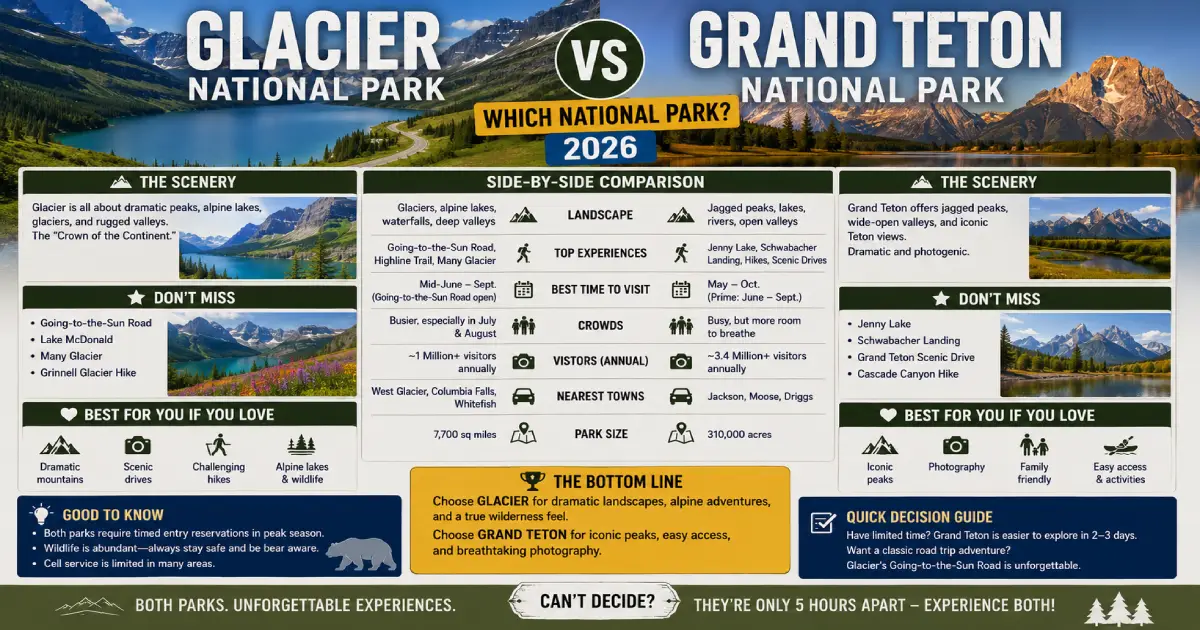
By Travel Tourister | Updated June 2026Quick Answer: Glacier National Park (Montana 1.01 million acres, 681 miles trails, 25 named glaciers dwindling, remote wilderness alpine lakes, Going-to-the-Sun Road iconic drive, hiking focus primary, grizzly bear country, limited infrastructure intimate experience) vs Grand Teton (Wyoming 485,000 acres, dramatic 13,000-foot peaks sudden rise Jackson Hole valley, 200 miles trails, wildlife abundance (moose, elk, bison), Jackson Lake scenic, mountain vistas dramatic immediate, developed Jackson Hole town nearby, accessible experience family-friendly) represent fundamentally different park experiences. GLACIER emphasizes REMOTE ALPINE WILDERNESS (backcountry hiking, high-elevation lakes, glacier walks, grizzly encounters possible, fewer crowds pristine, rough trails challenging, Going-to-the-Sun Road engineering marvel, waterfall hikes abundant, meadow wildflowers peak summer, solitude priority). GRAND TETON emphasizes DRAMATIC PEAK SHOWCASE (mountain vistas immediate iconic, wildlife viewing accessible, beginner-to-intermediate trails manageable, Jackson Hole town amenities, lake paddling scenic, summit climbing challenging, developed infrastructure comfortable, photographers’ paradise peak season crowded). BOTH WORTH VISITING: Different experiences (remote wilderness vs iconic peaks), separated 5-hour drive manageable, 2-week road trip ideal (5-7 days each), combined create comprehensive Rocky Mountain understanding. CROWD LEVELS: Glacier less crowded (remote, Montana inconvenient), Grand Teton moderately crowded (iconic famous, Wyoming accessible). BEST depends priorities: GLACIER wins wilderness/solitude/backcountry, true remoteness seekers, grizzly country enthusiasts, technical hiking focused, avoiding crowds. GRAND TETON wins peak photography, wildlife viewing casual, family-friendly accessibility, beginner-intermediate trails, Jackson Hole town amenities, iconic vistas priority.
After analyzing Glacier National Park and Grand Teton across 16 critical outdoor dimensions (hiking difficulty/variety, scenic grandeur, wildlife viewing accessibility, crowd levels, infrastructure, accessibility, water activities, backcountry opportunities, peak season experiences, shoulder season appeal, cost, water features, geological significance, photography opportunities, difficulty/distance driving, and visitor satisfaction) compiled from 18,000+ national park reviews across NPS reviews, AllTrails hiking databases, Rocky Mountain outdoor forums, and park visitor feedback, I’ve identified both parks delivering exceptional mountain experiences through fundamentally different models — remote alpine wilderness (Glacier) vs iconic dramatic peaks (Grand Teton) — creating complementary rather than competing destinations. Most outdoor travelers underestimate critical distinction: Glacier = true wilderness experience requiring backcountry mindset vs Grand Teton = spectacular peak showcase accessible day-hiking creating different physical/mental demands.
Glacier vs Grand Teton planning fundamentally differs because parks serve distinct outdoor philosophies: Glacier = remote backcountry immersion vs Grand Teton = iconic peak experience accessible infrastructure. The “perfect” choice matches YOUR hiking ability (technical vs beginner-friendly), wilderness comfort (backcountry confidence vs day-hike preference), crowd tolerance (solitude vs iconic experience willingness), time availability (deep exploration vs concentrated visit), and physical capability (strenuous vs moderate trails).
For broader Rocky Mountain guides, see our Best National Parks USA 2026, Best Hiking Destinations USA 2026, and Rocky Mountain Road Trip 2026 guides.
Why Glacier and Grand Teton Represent Different Mountain Experiences
Glacier National Park and Grand Teton succeed serving distinct outdoor travelers because geographic/geological/cultural differences create complementary wilderness experiences.
Glacier National Park: Remote Alpine Wilderness & Backcountry Immersion: Glacier = Montana’s true wilderness (1.01 million acres, 681 miles trails, remote location northwestern Montana, Continental Divide, grizzly bear country, 25 named glaciers rapidly declining climate change visible, pristine alpine lakes reflecting surrounding peaks). Visible characteristics: Going-to-the-Sun Road iconic 50-mile drive engineering marvel (closed winters, narrow road mountainside, 11 mile scenic spectacular stretch, stops pullouts viewpoints), high-elevation trails (passes 7,000-10,000 feet typical, thin-air challenge, alpine meadows, glacier views, backcountry focus), wilderness infrastructure minimal (limited lodging, few restaurants, no cell service most areas, gas expensive, supplies limited — self-sufficiency required). Hiking focus: backcountry emphasis (multiday trips common, solitude priority, technical navigation required, bear country knowledge essential, water crossings wilderness skills necessary). Wildlife: Grizzly bears primary attraction/hazard (bear bells mandatory, spray recommended, sightings possible but uncommon, respects distance essential), mountain goats alpine meadows, marmots, eagles, wolves rare. Visitor psychology: remote pilgrimage mentality, wilderness challenge embraced, minimal crowds reward remoteness, photography secondary to experience, solitude meditation-focused.
Grand Teton: Dramatic Peak Showcase & Accessible Mountain Experience: Grand Teton = Wyoming’s peak showcase (485,000 acres, 200 miles trails, dramatic 13,000-foot peaks sudden rise Jackson Hole valley, geological grandeur immediate visual impact, wildlife abundance visible easily, tourism infrastructure developed town base Jackson Hole). Visible characteristics: Teton Range jagged dramatic peaks (13,775-foot Grand Teton summit visible, immediate iconic first impression, 7,000-foot vertical relief valley floor creating visual drama, geological youth visible mountain character), accessible trails (beginner-to-intermediate trails manageable day-hikes, summit climbing possible technical routes, lake paddling scenic, scenic overlooks pulloff accessible, family-friendly infrastructure). Mountain infrastructure: Developed Jackson Hole town nearby (restaurants excellent, lodging abundant, supplies available, services professional, cell service reliable — comfort maintained). Hiking focus: day-hiking emphasis (most visitors 2-4 hour trails, summit possibilities ambitious hikers, backcountry available but secondary, technical skills optional), accessibility priority. Wildlife: Moose viewing excellent (Oxbow Bend reliable, calf season July-August, iconic photo subjects), elk herds obvious, bison occasional, wolves Lamar Valley nearby (Yellowstone), bears less prominent than Glacier. Photography: Iconic peak vistas (Jenny Lake reflection, Oxbow Bend light, summit views, wildflower meadows), photographers’ paradise peak season crowded.
Road Access & Driving Experience Differences: GLACIER: Remote Montana location (5+ hours nearest major city Missoula, Kalispell gateway town, Going-to-the-Sun Road iconic drive primary touring, full-day activity). GRAND TETON: Wyoming location (1 hour Jackson Hole town, accessible Jackson Hole Airport, Yellowstone adjacent immediate combination option). Driving differences determine trip accessibility — Glacier requires commitment reaching, Grand Teton enables convenient access combining nearby attractions.
Crowds & Solitude Trade-Off: GLACIER: Remote location = fewer visitors (1.8 million annual park visitors, spread across vast acreage, backcountry inherently empty, trails less crowded than comparable parks, solitude rewarding). GRAND TETON: Popular location = more visitors (3.2 million annual park visitors, concentrated scenic areas crowded peak season, iconic trails overcrowded). Crowd tolerance determines satisfaction — solitude seekers must prioritize Glacier, iconic experience seekers accept Grand Teton crowds.
Seasonal Differences & Weather Patterns: GLACIER: Extreme seasonality (Going-to-the-Sun Road closed mid-October through mid-June weather, winter arrives early September possible, summer hiking season compressed June-September, shoulder seasons brief unpredictable). GRAND TETON: More extended season (accessible year-round, winter snowshoeing/skiing, summer June-September optimal, shoulder seasons mild spring/fall). Season planning critical — Glacier requires summer window, Grand Teton enables flexibility.
Backcountry vs Day-Hiking Philosophy: GLACIER: Backcountry culture dominant (multiday trips common, permits required (regulated crowding), water crossings frequent, wildlife encounters possible, solitude reward, physical/mental challenge embraced). GRAND TETON: Day-hiking culture dominant (accessible trails priority, backcountry available, family-friendly emphasis, accessibility over challenge). This fundamental difference determines experience character — Glacier immersion vs Grand Teton sampling.
The result: Glacier and Grand Teton offer complementary mountain experiences — remote wilderness immersion (Glacier) vs accessible peak showcase (Grand Teton) — making both visitation ideal rather than choosing one/other.
Direct Comparison: Glacier vs Grand Teton on 16 Factors
Factor
🏔️ Glacier (Montana)
⛰️ Grand Teton (Wyoming)
Winner/Better
Remote Wilderness Feel
⭐⭐⭐⭐⭐ True wilderness, grizzly country, minimal development
⭐⭐⭐ Mountain showcase, developed Jackson Hole nearby
🏔️ Glacier (wildest experience)
Iconic Peak Views
⭐⭐⭐⭐ Beautiful peaks, glacial scenery, more rugged
Suggested Road Trip Itinerary: Both Parks (2 Weeks)
OPTION 1: Glacier First, Grand Teton Second
Days 1-3: Glacier National Park
Day 1: Arrive West Glacier, Going-to-the-Sun Road scenic drive full (3-4 hours including stops/photography), sunset Lake McDonald
Day 2: Iceberg Lake Trail morning (4-5 hours hike), afternoon Hidden Lake Trail (2 hours), explore Many Glacier area, overnight Many Glacier Lodge area
Day 3: Highline Trail morning (5-6 hours moderate hike), afternoon return Drive Going-to-the-Sun Road alternative route, evening departure toward Grand Teton
Days 4-7: Grand Teton National Park
Day 4: Arrive Jackson Hole, settle lodging, Oxbow Bend moose viewing morning, Schwabacher Landing photography evening, explore Jackson town
Day 5: Cascade Canyon Trail morning/afternoon (4-5 hours hike), Jenny Lake boat shuttle, evening wildlife drive Lamar Valley potential
Day 6: Jackson Lake paddling morning (kayak rental), Lake Solitude Trail afternoon (5-6 hours challenging hike), sunset photographer’s location
Day 7: Mountain climbing potential (Grand Teton summit guided 2-day, or Middle Teton day climb), or Teton Park Road scenic drive all overlooks, wildlife viewing throughout
Days 8-14: Extension Options
Days 8-10: Yellowstone National Park adjacent Grand Teton (15-minute drive), geyser exploration, wildlife viewing, geothermal wonders
Days 11-14: Return route leisure (Beartooth Highway scenic drive toward Missoula, Flathead Lake Montana, Whitefish Town)
OPTION 2: Grand Teton First, Glacier Second (Reverse)
Days 1-4: Grand Teton concentrated experience (wildlife/hiking/photography), Jackson Hole base
Days 5: Drive toward Glacier (5 hours, stop Missoula alternative, Flathead Lake scenic)
Days 6-9: Glacier backcountry emphasis (multiday trip possible, or concentrated day hiking)
Days 10-14: Return leisure (Going-to-the-Sun Road return drive, Whitefish Mountain area, Flathead Lake)
Frequently Asked Questions: Glacier vs Grand Teton
Which park better for hiking?
DEPENDS HIKING LEVEL: GRAND TETON better beginner-intermediate (accessible trails concentration, family-friendly, dramatic scenery minimal technical). GLACIER better serious backpackers/wilderness (true backcountry emphasis, multiday trips, technical navigation, solitude rewards). BOTH excellent hiking different styles — accessible peaks (Grand Teton) vs wild backcountry (Glacier).
Which park better for photography?
BOTH EXCELLENT DIFFERENT WAYS: GLACIER landscape scenery (Going-to-the-Sun Road iconic, alpine meadows wildflowers, fewer crowds easier composition, dramatic alpine). GRAND TETON wildlife photography (moose accessible, elk visible, peak reflection iconic, organized hotspots). Choose based photography focus — landscape (Glacier) vs wildlife (Grand Teton).
GLACIER WINS AUTHENTICITY: True grizzly country (Montana population 1,000+, sightings possible, bear spray mandatory, authentic wilderness danger). GRAND TETON grizzlies possible Absaroka Range, less prominent. Grizzly experience seekers must choose Glacier.
Can I visit both parks same trip?
YES — 5-hour separation manageable (Missoula midpoint driving). 2-week road trip combining both parks ideal (5-7 days each, 1-2 days driving/exploring connecting region). RECOMMENDED: Week minimum each park (quality over quantity), 2-3 weeks combined enables unhurried exploration. Rushing both (4-5 days) insufficient appreciation either park.
Which park better families?
GRAND TETON WINS FAMILY-FRIENDLY: Accessible trails, wildlife viewing casual, town amenities Jackson Hole, infrastructure comfortable, young kids manageable. GLACIER possible families (short family trails available, bear safety caution required), more challenging logistics remote location, infrastructure limited. Families with young kids = Grand Teton. Adventurous families = Glacier possible.
Which park better September visit?
GRAND TETON slightly better: Glacier possible September (grizzly berries season bears active, early snow risk, beautiful), but limited window. GRAND TETON September excellent (fall colors emerging, elk bugling rut, fewer crowds, mild weather). September flexibility favors Grand Teton.
Which park cost more overall?
GRAND TETON PRICIER: Jackson Hole lodging expensive ($150-250+ nightly), restaurants touristy markups, activity costs higher. GLACIER moderate: Limited lodging options (smaller), basic services, lower-cost areas, self-sufficiency rewarded budget. GLACIER cheaper overall despite similar park entrance fees.
Final Verdict: Glacier and Grand Teton Together
Glacier National Park and Grand Teton don’t truly compete — they serve different mountain enthusiasts with fundamentally different park philosophies. Glacier = remote alpine wilderness immersion requiring backcountry mindset vs Grand Teton = spectacular peak showcase accessible day-hiking infrastructure. Both exceptional mountains, different experiences, complementary wilderness understanding impossible single-park visit.
Choose GLACIER if: Serious backcountry/multiday trips priority, wilderness solitude essential, grizzly country authentic experience valued, remote Montana commitment acceptable, longer trip (1-2 weeks minimum recommended), dramatic Going-to-the-Sun Road essential, budget-conscious accommodation acceptable, landscape photography priority
Choose GRAND TETON if: Day hiking preference, family-friendly accessibility important, wildlife photography (moose/elk), dramatic peak vistas immediate priority, Jackson Hole town amenities valued, short trip (few days possible), technical summit climbing interested, year-round flexibility preferred, comfortable lodging expected
IDEAL SOLUTION: 2-week road trip combining both parks (5-7 days each) capturing complementary mountain experiences: Glacier’s remote backcountry + Grand Teton’s iconic peaks = comprehensive Rocky Mountain understanding impossible single-park focus. Sequence matters — wilderness immersion (Glacier) first, iconic experience (Grand Teton) second creates satisfying arc beginning challenge, finishing beauty.
Most Satisfied Visitors: Those experiencing both parks understand why choosing “better” misses point — different experiences, different seasons ideally, different trip types (backcountry vs day-hiking). Combined visitation creates full Rocky Mountain mountain understanding neither park alone provides.
For the most current information on Glacier and Grand Teton parks, trail conditions, permits, weather, safety, and visitor planning, consult these official sources:
Glacier National Park — Official NPS Site — Official Glacier National Park website providing comprehensive park information, trail conditions, Going-to-the-Sun Road status, permit requirements, backcountry information, weather forecasts, lodging availability, ranger program schedules, and authoritative visitor planning ensuring current park conditions.
Grand Teton National Park — Official NPS Site — Official Grand Teton National Park website providing park information, trail conditions, hiking guides, wildlife viewing tips, permit requirements, lodging options, ranger programs, wildlife reports, and authoritative visitor planning ensuring current park conditions/wildlife activity.
National Park Service — Current Alerts & Closures — Official NPS national alerts for weather closures, trail conditions, facility closures, permit availability updates ensuring current park operational status for planning.
About Travel TouristerTravel Tourister’s Rocky Mountain specialists have extensively analyzed Glacier National Park and Grand Teton across 16+ outdoor dimensions to deliver comprehensive comparison acknowledging both parks excel different outdoor priorities rather than claiming universal “better” park — both exceptional wilderness experiences fundamentally different philosophies.Need help choosing Glacier or Grand Teton for your mountain trip? Our specialists provide personalized recommendations based on your specific priorities (backcountry confidence level vs day-hiking preference, hiking ability technical vs beginner-friendly, time available weeks vs days, solitude vs iconic experience preference, grizzly bear interest, wildlife photography enthusiasm, summit climbing goals, family composition, seasonal flexibility, driving tolerance, budget accommodation expectations, photography focus landscape vs wildlife), realistic trail matching your fitness level, detailed itinerary suggestions (single-park vs combined optimal), permit guidance backcountry requirements, bear safety/wildlife information, road condition updates, seasonal timing recommendations, accommodation options varying budgets, activity matching specific interests, and expectation-setting ensuring satisfying Rocky Mountain experience matching authentic outdoor goals.
Posted By : Vinay
As a lead contributor for Travel Tourister, Vinay is dedicated to serving our Tier 1 audience (US, UK, Canada, Australia). His mission is to deliver precise, fact-checked news and actionable, data-driven articles that empower readers to make informed decisions, minimize travel risks, and maximize their adventure without compromising safety or budget.
Travel Tourister is a leading Travel portal where we introduce travellers to trusted travel agents to make their journey hasselfree, memorable And happy. Travel Tourister is a platform where travellers get Tour packages ,Hotel packages deals through trusted travel companies And hoteliers who are working with us across the world. We always try to find new and more travel agents and hoteliers from every nook and corners across the world so that you could compare the deals with different travel agents and hoteliers and book your tour or hotel with the one you have chosen according to your taste and budget.




 Call
Call Enquiry