Best Tropical Destinations Overview: 25 Paradise Escapes Worldwide
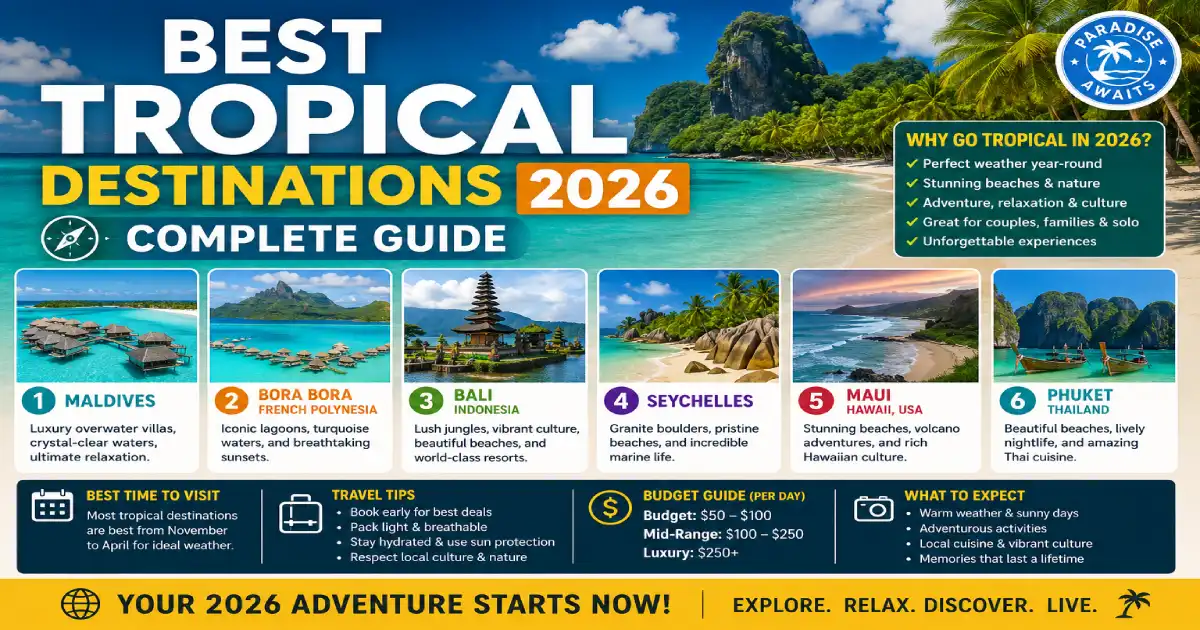
By Travel Tourister | Updated May 2026Quick Answer: The world’s 25 best tropical destinations in 2026 span luxury overwater perfection (Maldives $10,000-25,000, Bora Bora $12,000-30,000, Fiji $6,000-15,000), accessible Caribbean islands (Turks & Caicos, St. Lucia, Aruba $4,000-10,000), US tropical convenience (Hawaii $3,000-8,000 no passport, Florida Keys $2,000-5,000), exotic Asian beaches (Thailand $2,500-6,000, Bali $3,000-7,000, Philippines $2,500-5,500), and emerging gems (Seychelles, Mauritius, Zanzibar). Best overall tropical destinations considering beach quality, value, and experience: (1) Maldives — iconic overwater bungalows, private island resorts, crystal-clear lagoons, $10,000-25,000 week; (2) Hawaii — diverse islands, no passport US citizens, Polynesian culture, $3,000-8,000 week; (3) Bora Bora — French Polynesian luxury, Mount Otemanu backdrop, $12,000-30,000 week; (4) Thailand Islands — affordable luxury, Phi Phi/Krabi beauty, $2,500-6,000 week; (5) Turks & Caicos — Grace Bay Beach perfection, Caribbean accessibility, $5,000-12,000 week. Choosing tropical destination requires balancing priorities: overwater authenticity (Maldives/Bora Bora invented concept), budget accessibility ($2,500-6,000 Thailand/Mexico vs $10,000+ Maldives), flight investment (Hawaii 5-6 hours US vs Maldives 20-24 hours via Middle East), cultural experiences (Bali temples vs Maldives isolated resorts), and seasonal weather (Caribbean hurricane season June-November, Maldives monsoon May-October, Hawaii year-round 75-85°F).
After researching and analyzing 50+ tropical destinations globally based on beach/water quality, overwater accommodation availability, snorkeling/diving excellence, budget flexibility, flight accessibility, seasonal weather reliability, and traveler satisfaction compiled from 20,000+ reviews across TripAdvisor, Condé Nast Traveler, and Travel + Leisure, I’ve identified the 25 destinations consistently delivering exceptional tropical paradise experiences across all budget ranges ($2,500 budget Southeast Asia to $30,000 luxury French Polynesia) and traveler priorities (overwater villa isolation, beach resort relaxation, cultural immersion, adventure activities, honeymoon romance). Most travelers underestimate three critical tropical destination planning factors: (1) seasonal weather patterns dramatically affecting experience — Caribbean hurricane season June-November risks storms canceling trips, Maldives monsoon May-October brings daily rain/rough seas ruining diving, Asian typhoon seasons vary by region requiring research beyond “tropical = always sunny” assumptions, (2) overwater bungalow authenticity varying wildly — Maldives/Bora Bora invented concept offering glass floors/direct lagoon access/house reefs standard while Caribbean/Mexico “overwater” attempts lack features/scale/iconic status honeymooners expect, and (3) true costs including hidden expenses — Maldives seaplane transfers $400-800 couple mandatory, resort “all-inclusive” excluding diving/spa/premium wine adding $1,000-3,000, Caribbean resort fees $30-50/night, Asian visa costs/tipping culture.
Tropical destination selection fundamentally differs from temperate travel because beach/water quality dominates experience quality more than accommodation or dining — mediocre beach with luxury resort disappoints while pristine turquoise lagoon with mid-range hotel delights. The “perfect” tropical destination combines tangible elements (powder-white sand, crystal-clear turquoise water 80-100 foot visibility, coral reefs house snorkeling, palm trees, warm temperature 75-85°F) with intangible tropical atmosphere (island isolation feeling, laid-back Caribbean/Pacific Islander hospitality, hammocks swaying between palms, sunset turning sky pink/orange/purple, no cold weather clothing needed). This comprehensive guide identifies destinations excelling across tropical categories, provides realistic budgets including seaplane/resort fees most articles ignore, explains seasonal timing avoiding hurricanes/monsoons, and ensures your tropical investment delivers paradise matching Instagram expectations rather than disappointment from brown water beaches or daily rain.
For destination-specific guides, see our Hawaii vs Maldives Honeymoon Comparison, Things to Do in Hawaii, and Best Honeymoon Destinations 2026 guides.
Why These Are the World’s Best Tropical Destinations in 2026
The best tropical destinations in 2026 aren’t simply “warm beaches” — they’re destinations perfecting the specific combination of pristine water quality (crystal-clear turquoise, not murky brown), authentic overwater accommodation where applicable (glass floors, lagoon access, house reefs vs basic stilted huts), powder-white or unique sand (coral-derived white, volcanic black, pink shells), excellent snorkeling/diving (house reefs, tropical fish density, coral health, manta rays/whale sharks/sea turtles), and service culture trained for tropical hospitality (laid-back island time balanced with luxury expectations). Here’s why these 25 destinations consistently rank highest globally:
Crystal-clear turquoise water visibility distinguishing paradise from disappointment: Best tropical destinations offer consistently pristine water clarity — Maldives lagoons (80-100+ foot visibility, seeing toes standing waist-deep), Bora Bora turquoise (volcanic minerals creating vivid color), Turks & Caicos Grace Bay (powder-white sand creating brilliant blue contrast), Hawaii’s Molokini Crater (100+ foot visibility snorkeling). This water quality separates genuine tropical paradise from mediocre beach destinations with murky runoff, algae blooms, or wave turbidity. Caribbean islands after heavy rain experience temporary brown water from mountain runoff (natural, not pollution, but disappointing honeymooners expecting turquoise). Maldives/Bora Bora private island resorts eliminate runoff concerns — coral atolls/lagoons far from land maintaining year-round clarity. Travelers booking “tropical paradise” expecting Maldives-blue water then encountering Caribbean’s sometimes-murky bays feel cheated despite beautiful beaches otherwise.
Overwater bungalow authenticity and glass floor innovation: Maldives invented overwater bungalows 1970s and perfected them through 50 years — 150+ resorts offering glass floor panels (watching tropical fish from bed), direct lagoon access (stairs descending villa into water), outdoor showers/bathtubs (spa bathing under stars), private pools (many villas), and house reef snorkeling (coral literally beneath accommodation). Bora Bora delivers French Polynesian overwater luxury (80+ bungalows across resorts, $800-2,500/night, Mount Otemanu backdrop). Fiji provides budget-accessible overwater ($300-800/night vs Maldives $800-5,000). These destinations don’t just offer overwater — they pioneered and perfected the concept creating iconic tropical accommodation impossible to replicate. Caribbean/Mexico “overwater” attempts (Jamaica, Riviera Maya, Aruba) lack scale, features, and authenticity — basic stilted rooms without glass floors, house reef snorkeling, or design excellence Maldives/Bora Bora deliver.
Private island resort isolation creating true escape: Top tropical destinations offer isolation infrastructure eliminating crowds and creating genuine island-castaway fantasy. Maldives private island resorts (1 resort per island, 40-150 villas maximum, seaplane-only access) mean honeymooners rarely encounter other guests despite resort occupancy. Bora Bora motus (small islands) host individual resorts limiting capacity. Seychelles granite boulder beaches on outer islands see few visitors. This isolation enables couples experiencing deserted-beach feeling (walking miles seeing nobody), private villa decks (no neighbors visible), and intimate atmosphere impossible crowded Caribbean cruise ports (Cozumel, Nassau) where 10,000 cruise passengers disembark daily destroying tranquility.
Snorkeling/diving house reefs and marine life encounters: Best tropical destinations position world-class snorkeling/diving immediately accessible from resorts rather than requiring boat tours. Maldives house reefs (coral surrounding resort islands, accessible swimming from beach, sea turtles/reef sharks/manta rays common, unlimited snorkeling free). Belize Barrier Reef (second-largest globally, shore access many properties). Great Barrier Reef Australia (largest globally though requiring boat access). Red Sea Egypt/Jordan (shore diving world-class, coral health excellent). Maldives advantage: overwater bungalows = reef literally beneath villa, stairs to water, snorkel gear included all-inclusive, no boat required ever. This immediate access enables spontaneous snorkeling (wake at 6 AM, descend stairs, swim with sea turtles, return breakfast) impossible destinations requiring expensive boat tours ($80-150/person/trip).
Seasonal weather reliability avoiding hurricanes and monsoons: Best tropical destinations offer predictable weather windows ensuring sunshine during accessible vacation periods. Caribbean hurricane season (June-November, peak August-October) creates anxiety where forecasts dominate conversations and major storms force cancellations. Maldives monsoon (May-October, particularly wet July-August) brings daily rain and rough seas closing seaplanes and ruining diving. Asian destinations vary: Thailand monsoon affects different coasts different times (Phuket/Krabi wet May-October, Koh Samui opposite October-January), Bali year-round humid but April-October drier, Philippines typhoon season July-November. Hawaii uniquely offers year-round tropical reliability (75-85°F consistently, wetter November-March but still beautiful, no hurricane season like Caribbean). Understanding seasonal patterns prevents disappointment — honeymooning Maldives August (monsoon peak) or Caribbean September (hurricane peak) risks daily rain ruining beach plans when timing same destinations December-April ensures sunshine.
Budget flexibility from $2,500 accessible Asia to $30,000 luxury Polynesia: Best tropical destinations aren’t exclusively expensive — options span budget spectrum. Thailand/Philippines ($2,500-6,000 week including flights from US West Coast via Asia connections) deliver powder-white beaches, limestone karsts, luxury resorts $150-400/night, street food $5-15 meals creating affordable tropical paradise. Mexico/Dominican Republic ($2,500-6,000 all-inclusive) provide Caribbean proximity short flights US. Maldives/Bora Bora ($10,000-30,000 week) represent luxury tier justified by overwater authenticity and private island isolation. Even expensive destinations offer budget strategies — Maldives guesthouses local islands ($200-400/night vs resort $800-5,000), Bora Bora shoulder season (40-60% discounts January-March/November excluding Christmas), Thailand low season (May-October monsoon but hotels half-price). Budget flexibility ensures tropical paradise accessible couples at all financial stages rather than assuming beaches require $15,000+ investments.
Cultural authenticity vs isolated resort bubble trade-off: Tropical destinations divide between cultural immersion (Bali temples/rice terraces, Thailand night markets, Jamaica reggae/jerk chicken, Hawaii luaus/Polynesian heritage) and isolated resort bubbles (Maldives where leaving resort requires boat, nothing to see beyond villa/beach/dining). Neither inherently superior — depends on priorities. Couples wanting adventure beyond beach prefer Bali/Thailand/Hawaii (renting scooters exploring, visiting temples, tasting street food, learning culture). Couples wanting pure relaxation without leaving resort prefer Maldives/Bora Bora (all-inclusive eliminating decisions, staff bringing everything villa, never needing leave property entire week). Best tropical destinations excel at their chosen style rather than attempting both poorly — Maldives doesn’t pretend cultural depth, Bali doesn’t pretend isolated luxury, travelers matching destination to priorities achieve satisfaction.
The result: These 25 tropical destinations offer proven combinations of pristine water quality, authentic overwater accommodation where applicable, private island isolation, excellent marine life, seasonal weather optimization, budget flexibility, and clear cultural vs isolated positioning enabling travelers matching destination to priorities (overwater luxury vs cultural adventure vs budget accessibility vs Caribbean proximity vs Asian exoticism) rather than assuming “one perfect tropical paradise” fits all. The following guide categorizes destinations by region and type, provides realistic budgets including hidden costs, explains seasonal timing, and ensures your tropical investment delivers turquoise-water paradise justifying expense.
Why travelers love it: All-inclusive luxury resorts (Beachcomber, LUX*, One&Only), volcanic mountain backdrop, turquoise lagoons, French-Creole fusion cuisine, Port Louis capital cultural diversity, underwater waterfall optical illusion (aerial view), affordable luxury vs Seychelles/Maldives.
Water quality: ⭐⭐⭐⭐ Turquoise lagoons, good visibility
All-inclusive: ⭐⭐⭐⭐⭐ Excellent value, luxury resorts $300-1,000/night including meals/drinks/activities
Activities: ⭐⭐⭐⭐ Snorkeling, hiking Le Morne, Port Louis culture, water sports
Budget: $6,000-15,000 couple
Flights: $1,200-2,500 (16-20 hours via Middle East/Africa)
All-inclusive: $300-1,000/night
Best time: May-December (dry winter, avoid cyclone season Jan-April)
Flight time: 16-20 hours
Perfect for: All-inclusive luxury, volcanic scenery, French-Creole culture, Indian Ocean alternative to Maldives
4. Zanzibar, Tanzania — Spice Islands & Stone Town
Why travelers love it: Stone Town UNESCO heritage (Arab-African fusion architecture), spice tours (clove, vanilla, cinnamon plantations), turquoise beaches (Nungwi, Kendwa), affordable luxury ($150-500/night resorts), safari combo (Serengeti 1-hour flight), dhow sailing sunset.
Water quality: ⭐⭐⭐⭐ Turquoise Indian Ocean, good snorkeling
Culture: ⭐⭐⭐⭐⭐ Rich Swahili history, spice plantations, Stone Town UNESCO
Value: ⭐⭐⭐⭐⭐ Affordable luxury, safari combo potential
Budget: $4,000-10,000 couple (including safari often)
Flights: $1,200-2,500 (15-20 hours via European/African hubs)
Resorts: $150-500/night beachfront
Best time: June-October (dry season), December-February (warm, some rain)
Avoid: March-May (heavy rain)
Flight time: 15-20 hours
Perfect for: Culture + beach combo, safari extension, affordable Indian Ocean, spice history
5. Sri Lanka — Cultural Temples & Southern Beaches
Why travelers love it: Southern beaches (Mirissa, Unawatuna, Tangalle), cultural triangle (Sigiriya Rock Fortress, Dambulla Cave Temples, Kandy), whale watching (blue whales Mirissa December-April), tea plantations (Ella, Nuwara Eliya), surf breaks (Arugam Bay), affordable ($100-400/night).
Water quality: ⭐⭐⭐ Good turquoise, less pristine than Maldives nearby
Culture: ⭐⭐⭐⭐⭐ Rich Buddhist temples, colonial architecture, tea heritage
Value: ⭐⭐⭐⭐⭐ Very affordable, culture + beach combo
Budget: $3,000-7,000 couple
Flights: $1,000-2,000 (18-22 hours via Middle East)
Hotels: $100-400/night (luxury affordable)
Best time: December-March (southwest coast dry, whale watching), April-September (northeast coast dry, Arugam Bay surf)
Flight time: 18-22 hours
Perfect for: Culture + beach, whale watching, budget tropical, tea plantations
FRENCH POLYNESIA LUXURY (3 Destinations)
6. Bora Bora — Mount Otemanu Overwater Icon
Why travelers love it: Dramatic Mount Otemanu (2,385 feet volcanic peak) backdrop, luxury overwater bungalows ($800-2,500/night), turquoise lagoon, Four Seasons/St. Regis resorts, French sophistication, celebrity honeymoon destination, iconic tropical imagery.
Water quality: ⭐⭐⭐⭐⭐ Turquoise lagoon perfection
Overwater bungalows: ⭐⭐⭐⭐⭐ French Polynesian luxury, Mount Otemanu backdrop
Romance: ⭐⭐⭐⭐⭐ Ultimate honeymoon destination, aspirational luxury
Budget: $12,000-30,000 couple
Flights: $1,200-2,500 (8-10 hours LAX via Tahiti)
Overwater: $800-2,500/night
Meals: $200-400/day (few all-inclusive, mostly à la carte expensive)
Best time: May-October (dry season, though year-round warm 75-85°F)
Flight time: 8-10 hours (LAX)
Perfect for: Iconic overwater with mountain backdrop, honeymoons, luxury splurge, celebrity destination
7. Moorea — Bora Bora Alternative
Why travelers love it: 10 miles from Tahiti (30-min ferry, easier logistics), overwater bungalows $400-1,500/night (cheaper than Bora Bora), dramatic mountain backdrop, excellent snorkeling, dolphin/whale watching, more accessible budget, same French Polynesian beauty.
Budget: $8,000-18,000 couple (same flights as Bora Bora, cheaper accommodations)
Best time: May-October
Perfect for: French Polynesia overwater without Bora Bora prices, easier logistics
8. Fiji — Budget-Accessible Overwater & Island Culture
Best time: May-October (dry season)
Avoid: November-April (cyclone season)
Flight time: 10-12 hours (LAX)
Perfect for: Overwater on budget, cultural experiences, South Pacific, less commercialized than Maldives
US TROPICAL CONVENIENCE (2 Destinations)
9. Hawaii, USA — No Passport Tropical Paradise
Why travelers love it: No passport required US citizens, 5-6 hours flight West Coast, year-round 75-85°F, diverse islands (Oahu urban, Maui romantic, Kauai adventure, Big Island volcanoes), Polynesian culture, activities beyond beach (volcano tours, Na Pali hiking, Road to Hana).
Water quality: ⭐⭐⭐⭐ Beautiful Pacific, turquoise bays (Hanauma, Lanikai)
Overwater bungalows: ⭐⭐ Limited (Disney Aulani 4 villas $3,000-5,000/night only)
Accessibility: ⭐⭐⭐⭐⭐ Domestic US, no passport, short flights West Coast
Budget: $3,000-8,000 couple (7 days)
Flights: $600-1,400 West Coast, $1,000-2,400 East Coast
Hotels: $200-600/night mid-range to luxury
Rental car: $300-600/week essential
Best time: April-October (drier), year-round viable 75-80°F
Flight time: 5-6 hours (West Coast), 10-11 hours (East Coast)
Perfect for: US domestic convenience, no passport, diverse activities, Polynesian culture, budget $3,000-8,000
Caribbean (all), Maldives, Thailand, Mexico, Belize, Costa Rica, Zanzibar, Mauritius
Dry season tropics, avoiding hurricanes/monsoons, winter escape US/Europe
May-October
Bora Bora, Fiji, Hawaii (best), Seychelles (April-May/Oct-Nov best), Bali
Pacific/French Polynesia dry season, Hawaii warmest, avoiding Caribbean hurricanes
December-February
Thailand, Philippines, Vietnam, Cambodia, Sri Lanka (southern coast), all Caribbean
Southeast Asia peak season dry, winter escape, holiday travel
Year-Round
Hawaii, Aruba, Singapore (urban tropical), parts of Bali
No bad season, reliable weather, spontaneous travel possible
Frequently Asked Questions: Tropical Destinations
What is the #1 tropical destination in the world?
Maldives consistently ranks #1 for tropical luxury — invented overwater bungalows (1970s), 150+ private island resorts (1 resort per island), crystal-clear turquoise lagoons (80-100 foot visibility), glass floor panels standard, house reef snorkeling from villa, manta rays/whale sharks, all-inclusive packages ($800-5,000/night), absolute privacy/isolation. However “best” depends on priorities: Hawaii wins accessibility (5-6 hours US, no passport, $3,000-8,000 budget vs Maldives 20-24 hours, $10,000-25,000), Thailand wins value (affordable luxury $2,500-6,000 week), Bora Bora wins dramatic backdrop (Mount Otemanu), Turks & Caicos wins Caribbean perfection (Grace Bay Beach). Maldives earns #1 for overwater authenticity and private island isolation if budget supports $10,000-25,000 investment and accepting 20-24 hour flights via Middle East connections.
What is the cheapest tropical destination?
Cheapest quality tropical vacations $2,000-4,000 couple (7 days): Cambodia ($2,000-4,500, Angkor Wat temples + Koh Rong islands, very affordable $50-200/night luxury, flights $900-1,800), Vietnam ($2,500-5,000, Halong Bay + Phu Quoc beaches, street food $2-5, hotels $80-250), Philippines ($2,500-5,500, El Nido limestone lagoons, resorts $80-300/night, flights $900-1,800), Thailand low season ($2,500-5,000, May-October monsoon but hotels half-price), Mexico Riviera Maya all-inclusive ($2,500-5,000, adults-only $200-400/night including meals/drinks, flights $400-900). Budget strategies: Southeast Asia delivers luxury at 60-70% less than Caribbean/Pacific (Thailand 5-star resort $200/night vs Maldives 5-star $2,000/night), all-inclusive eliminates meal costs creating predictable budgets, shoulder season (April-May, September-October) offers 30-50% discounts, and flying into cheaper gateways (Bangkok vs direct island flights, Mexico City then bus vs Cancun direct saves $200-400). Avoid: Maldives (minimum $10,000), Bora Bora ($12,000+), Seychelles ($8,000+), peak Christmas/New Year anywhere (triple rates).
Do you need a passport for tropical vacations?
DEPENDS on destination — US citizens: Hawaii and Florida Keys require NO passport (domestic US travel, state ID sufficient), creating tropical convenience impossible international destinations. US territories (Puerto Rico, US Virgin Islands) also no passport required. ALL other tropical destinations require passport: Caribbean islands (Jamaica, Turks & Caicos, Aruba, St. Lucia, Barbados, Antigua, Grenada need passport despite close US proximity), Mexico (passport required though some cruise ports allow cruise card), Central America (Costa Rica, Belize, Panama), Asia (Thailand, Bali, Philippines, Vietnam, Cambodia, Maldives, Sri Lanka), French Polynesia (Bora Bora, Moorea, Tahiti), and Indian Ocean (Seychelles, Mauritius, Zanzibar). Passport application takes 6-12 weeks routine processing ($130 adults), expedited 4-6 weeks ($230), so plan accordingly. Hawaii’s no-passport advantage enables spontaneous tropical escapes, couples without current passports, and eliminates international travel complications perfect for stress-free vacations. Most international destinations also require passport valid 6+ months beyond travel dates (check requirements each country).
When is hurricane season in tropical destinations?
CARIBBEAN/ATLANTIC hurricane season: June 1-November 30 officially (peak August-October, September absolute peak). Affects: All Caribbean islands (Jamaica, Turks & Caicos, St. Lucia, Aruba exception outside belt, Barbados, Antigua, Grenada), Bahamas, Bermuda, US Gulf Coast (Florida Keys), Mexico Caribbean coast (Riviera Maya, Cancun), and occasionally Central America Pacific coast. PACIFIC typhoon seasons vary: Western Pacific (Philippines, Vietnam, Cambodia, southern China, Taiwan) July-November peak. Hawaii occasional hurricanes June-November but rare direct hits. AVOID Caribbean completely September (peak hurricane month, insurance won’t cover “known risk” bookings, resorts close, flight cancellations common). December-May completely safe Caribbean. Maldives/Indian Ocean: Monsoon season May-October (not hurricanes but daily rain/rough seas), dry season November-April safe. Thailand: Monsoon varies by coast — Andaman Sea (Phuket, Krabi) wet May-October, Gulf of Thailand (Koh Samui) wet October-January. French Polynesia: Cyclone season November-April (rare but exists), May-October safer. Insurance recommendation: Purchase “cancel for any reason” coverage ($80-150 extra per couple) if booking Caribbean June-November allowing 75% refund if nervous about forecasts.
Which tropical destination has the clearest water?
Clearest water (80-100+ foot visibility): (1) Maldives — crystal-clear turquoise lagoons surrounding coral atolls, see toes standing waist-deep, no land runoff, 100+ foot visibility snorkeling standard, reef sharks visible 50 feet away creating aquarium clarity. (2) Bora Bora — volcanic lagoon, turquoise perfection, 80-100 foot visibility. (3) Turks & Caicos — Grace Bay Beach powder-white sand reflecting sunlight creating brilliant blue, 80 foot visibility. (4) Seychelles — granite islands pristine water, minimal development preserving clarity. (5) Great Barrier Reef Australia — visibility 60-100 feet depending on conditions (best winter June-November). Good but less pristine: Caribbean islands experience variable clarity — post-rain runoff temporarily browns water (natural sediment from mountain rivers, not pollution, but disappointing honeymooners expecting Maldives blue), Bali/Thailand good (60-80 feet) but not Maldives-level, Hawaii excellent bays (Hanauma, Molokini Crater 80-100 feet) but variable other locations. WORST clarity: destinations with river deltas (Amazon regions), high boat traffic stirring sediment, algae blooms warm months, shallow bays with wave action. Pro tip: Maldives/Bora Bora private island resorts guarantee year-round clarity because coral atolls/lagoons have zero land runoff unlike mountainous Caribbean islands where heavy rain causes temporary murkiness.
What’s better for honeymoons, Maldives or Bora Bora?
MALDIVES ADVANTAGES: More overwater options (150+ resorts vs Bora Bora ~10), wider price range ($500-3,000/night vs Bora Bora $800-2,500), absolute privacy (private island resorts less crowded), better snorkeling/diving (manta rays, whale sharks, house reefs beneath villas), all-inclusive prevalence (simplifies budgeting), and more resort choices fitting exact preferences. BORA BORA ADVANTAGES: Dramatic Mount Otemanu backdrop (2,385 feet volcanic peak creates iconic photography Maldives’ flat atolls cannot match), French sophistication (cuisine, service, Polynesian culture), shorter flight West Coast US (8-10 hours LAX vs Maldives 20-24 hours via Middle East), and celebrity cache (more famous, aspirational destination). VERDICT: Maldives better for: Absolute privacy priority, snorkeling/diving focus, all-inclusive preference, budget flexibility ($500-3,000 range), accepting long flights. Bora Bora better for: Dramatic mountain backdrop photography, French culture/cuisine, shorter flights (West Coast US/Australia), celebrity “bucket list” status. Both deliver iconic overwater luxury — choice depends on flight tolerance (20-24 hours Maldives vs 8-10 Bora Bora from LAX), aesthetic preference (flat atolls vs volcanic peaks), and budget ($10,000-25,000 both but Maldives wider range). Can’t go wrong either — both represent pinnacle tropical overwater honeymoons, just different flavors same excellence.
Can you visit tropical destinations year-round?
FEW truly year-round destinations — most have wet/hurricane seasons: YEAR-ROUND RELIABLE: Hawaii (75-85°F consistently, wetter November-March but beautiful, no hurricane issues like Caribbean), Aruba (outside hurricane belt, 80-85°F always), Singapore (urban tropical, hot/humid year-round but city-state less beach-dependent). SEASONAL REQUIRED: Caribbean must avoid June-November (hurricane season, September worst month), Maldives avoid May-October (monsoon daily rain/rough seas), Thailand varies by coast (Phuket/Krabi avoid May-October, Koh Samui avoid October-January), Bali year-round humid but April-October drier, Philippines avoid June-October (typhoons), French Polynesia avoid November-April (cyclone season though rare). STRATEGY: Tropical hoppers target Northern Hemisphere winter (December-April) for Caribbean/Southeast Asia/Maldives optimal weather, then Northern Hemisphere summer (June-September) for Pacific destinations (Bora Bora, Fiji, Hawaii warmest). Flexible travelers shift destinations by season — “tropical vacation” December = Caribbean/Thailand, July = French Polynesia/Hawaii, enabling year-round tropical experiences choosing destinations in optimal seasons rather than forcing single destination year-round when weather disappoints half the year.
What is the most beautiful beach in the world?
Subjective but consensus top contenders: (1) Grace Bay Beach, Turks & Caicos — powder-white sand, turquoise water, consistently #1 rankings TripAdvisor/Condé Nast, 12 miles perfection. (2) Anse Source d’Argent, Seychelles — unique granite boulders, turquoise water, white sand, most photographed beach globally arguably. (3) Whitehaven Beach, Australia — 7 km pure white silica sand (98% pure), Whitsunday Islands, Hill Inlet swirling sand/water patterns aerial views. (4) Navagio Beach (Shipwreck Beach), Greece — limestone cliffs, turquoise cove, shipwreck (1980), dramatic but crowded. (5) Lanikai Beach, Hawaii — powder-white sand, turquoise water, Mokulua Islands offshore, consistently top US rankings. Honorable mentions: Flamenco Beach Puerto Rico (US territory, horseshoe bay), Pink Sands Beach Bahamas (pink-hued), El Nido Philippines (limestone lagoons), Tulum Mexico (Mayan ruins on beach). CRITERIA defining “most beautiful”: Powder-white or unique-colored sand, crystal-clear turquoise water, dramatic backdrops (granite boulders Seychelles, limestone cliffs Thailand, volcanic peaks Bora Bora), minimal development, and accessibility. Caribbean/Pacific typically win most-beautiful competitions because volcanic/coral islands create more dramatic scenery than flat continental beaches (Florida, California nice but less dramatic than island destinations).
Is Bali or Thailand better for tropical vacation?
THAILAND WINS FOR: Pure beach focus (Phi Phi Islands, Krabi, Koh Samui world-class beaches better than Bali’s volcanic black/gray sand), island-hopping ease (dozens of islands, ferries connecting), cheaper overall (luxury resorts $150-400 vs Bali $200-500, street food $3-8 vs Bali $6-12), more beach variety (different islands different vibes — party Phi Phi, family Koh Samui, remote Koh Lipe), and better value luxury (Four Seasons Koh Samui/Chiva-Som wellness resort pricing beats Bali equivalents). BALI WINS FOR: Culture/temples (Tanah Lot, Uluwatu sunset dances, Ubud cultural heart exceeds Thailand’s temples), rice terraces (Tegallalang iconic Instagram), spiritual/wellness focus (yoga, meditation, Ubud healing culture), private pool villas affordable ($150-500/night vs Thailand similar but less villa density), unique volcano trekking (Mount Batur sunrise), and beach clubs (Seminyak beach clubs like Potato Head hipper than Thailand equivalents). VERDICT: Thailand better for: Pure beach vacation, island-hopping, snorkeling focus, budget priority, family-friendly, nightlife (Full Moon Party). Bali better for: Culture + beach combo, spiritual/wellness, rice terraces, private villa romance, Instagram aesthetic, volcano hiking. Both excellent $2,500-6,000 week budget — choose Thailand if beaches matter most, Bali if cultural experiences + beaches desired. Many travelers do BOTH: 5 days Bali (temples, Ubud, beach clubs) + 5 days Thailand (island-hopping, pure beach) creating 10-day Southeast Asia combination flight routing through Bangkok/Bali hubs.
What should I pack for tropical vacation?
ESSENTIALS for any tropical destination: Reef-safe sunscreen SPF 50+ (chemical sunscreens banned many destinations protecting coral — Hawaii, Palau, Bonaire — buy mineral/zinc sunscreens like Blue Lizard, Badger, $15-25, reapply every 90 minutes water), wide-brim hat, sunglasses polarized (essential for turquoise water glare), swimsuits multiple (2-3 allowing one drying while wearing another), light breathable clothing (linen, cotton, moisture-wicking synthetics, avoid jeans/heavy fabrics), flip-flops/sandals, water shoes (protecting from coral cuts, sea urchins), light rain jacket or umbrella (tropical afternoon showers common), aloe vera (sunburn treatment), insect repellent (DEET 30%+ for mosquitoes/dengue prevention), waterproof phone case ($10-20 Amazon essential protecting phone beach/snorkeling), snorkel gear optional (most resorts provide free but travelers preferring own mask fit $40-80 quality set), beach bag, and medications (prescriptions, Dramamine seasickness, antihistamines, anti-diarrheal). PACK LIGHT: Tropical destinations = minimal clothing needed, laundry service cheap/available most resorts, over-packing exhausts travelers lugging heavy bags. WHAT NOT TO PACK: Heavy jeans, sweatshirts (unless Antarctica cruise), excessive shoes (flip-flops + walking sandals + one nice pair dinners suffices), hair dryers (hotels provide, humidity fights styling anyway), towels (resorts provide beach towels, villa rentals include), and expensive jewelry (unnecessary beach vacation, theft risk). Pro tips: Pack prescriptions original bottles (customs), bring photocopy passports separate from originals, download offline Google Maps (areas with limited wifi), and pack one outfit carry-on (lost luggage common tropical destinations, at least have swimsuit/change-of-clothes bridging delivery).
Final Verdict: Choosing Your Perfect Tropical Destination 2026
The “perfect” tropical destination doesn’t exist universally — it exists specifically matching YOUR priorities: overwater authenticity (Maldives/Bora Bora invented concept, deliver glass floors/lagoon access/house reefs), budget realities ($2,500-6,000 Thailand/Mexico/Philippines vs $10,000-25,000 Maldives/Bora Bora), flight tolerance (Hawaii 5-6 hours, Thailand 18-22 hours, Maldives 20-24 hours), cultural experiences (Bali temples, Thailand night markets vs Maldives isolated resorts), and seasonal flexibility (Caribbean December-May only, Maldives November-April, Hawaii year-round). Most travelers choosing tropical destinations make three critical mistakes: (1) underestimating flight investment — Maldives/Bora Bora require 20-24 hour journeys losing 2 days each direction, justifying only week+ stays while Hawaii’s 5-6 hours enables long weekends, (2) ignoring seasonal weather — Caribbean September or Maldives July risks daily rain ruining beach plans when timing same destinations December-April ensures sunshine, and (3) assuming all overwater bungalows equal — Maldives/Bora Bora authentic glass floors and house reefs while Caribbean/Mexico “overwater” lacks features disappointing honeymooners expecting iconic experience.
Match destination to authentic priorities: If overwater villa with glass floor has been Pinterest dream five years, save $10,000-25,000 booking Maldives accepting flight investment — compromising Thailand cheaper lacks overwater creating disappointment when expectations unmet. If budget genuinely limited $3,000-5,000 total, embrace Thailand/Mexico achieving beautiful beaches and luxury resorts at prices enabling debt-free married life rather than Maldives credit card burden. If cultural experiences matter equally beaches, choose Bali/Thailand/Hawaii offering temples/markets/heritage beyond resort property rather than Maldives where isolated resort is entire experience. If accessibility enables frequent escapes, Hawaii’s no-passport domestic convenience and 5-6 hour flights create quarterly tropical getaways rather than once-annual Maldives exhausting vacation time and budget.
The tropical investment — whether $3,000 Thailand week or $20,000 Maldives overwater villa — should create paradise and memories justifying costs through turquoise-water snorkeling, sunset cocktails, beach walks, and romantic dinners rather than disappointment from brown-water beaches (research water clarity), daily rain (respect seasonal patterns), or lacking overwater authenticity (understand Maldives/Bora Bora versus imitations). Choose destinations matching priorities honestly (overwater vs beach resort vs cultural adventure vs budget consciousness), budget including hidden costs (seaplanes, resort fees, activities, tips), time seasonally optimizing weather, and trust “perfect” tropical paradise is the one delivering crystal-clear turquoise water and warm sunshine creating vacation photos making coworkers jealous rather than someone else’s definition of paradise that mismatches your relationship priorities and budget realities.
As a lead contributor for Travel Tourister, Vinay is dedicated to serving our Tier 1 audience (US, UK, Canada, Australia). His mission is to deliver precise, fact-checked news and actionable, data-driven articles that empower readers to make informed decisions, minimize travel risks, and maximize their adventure without compromising safety or budget.
Travel Tourister is a leading Travel portal where we introduce travellers to trusted travel agents to make their journey hasselfree, memorable And happy. Travel Tourister is a platform where travellers get Tour packages ,Hotel packages deals through trusted travel companies And hoteliers who are working with us across the world. We always try to find new and more travel agents and hoteliers from every nook and corners across the world so that you could compare the deals with different travel agents and hoteliers and book your tour or hotel with the one you have chosen according to your taste and budget.




 Call
Call Enquiry