Published on : 10 Jun 2026
By Travel Tourister | Updated June 2026
New York City is the world’s most iconic urban destination — 8.3 million residents across five boroughs (Manhattan, Brooklyn, Queens, The Bronx, Staten Island), 66 million annual visitors making it the most-visited city in the United States, and 800+ languages spoken creating the most culturally diverse metropolis on Earth. The best places to visit in New York City span every possible travel interest: world-class art museums (The Met, MoMA, Guggenheim) housing 2 million+ combined artworks, iconic landmarks (Statue of Liberty, Empire State Building, Central Park) recognized globally before arrival, Broadway theatre district producing 40+ shows nightly ranging $50–350/ticket, neighborhoods so distinct they feel like separate cities (Times Square neon chaos vs Brooklyn’s tree-lined brownstones vs Chinatown’s dim sum rush), and food representing every cuisine on Earth within walking distance regardless of which borough you’re standing in.
What separates New York City from every other American destination is the sheer compression of world-class experiences — Central Park’s 843 acres of green space bordered by Museum Mile on the east and luxury apartments on the west sits entirely within Manhattan island smaller than many American suburbs, the Financial District’s Wall Street and 9/11 Memorial occupy the same blocks where Dutch colonists founded New Amsterdam in 1626, and the Brooklyn Bridge pedestrian walkway covers 1.1 miles connecting two boroughs while delivering the most famous skyline view in North American photography. Unlike Los Angeles (car-dependent), Chicago (seasonal weather extremes), or Miami (beach-focused), New York City functions fully by subway ($2.90/ride, 24-hour service, 472 stations) enabling visitors to cover Manhattan to Brooklyn to Queens without rental cars — a $0 transportation model covering more attractions than most US cities contain total.
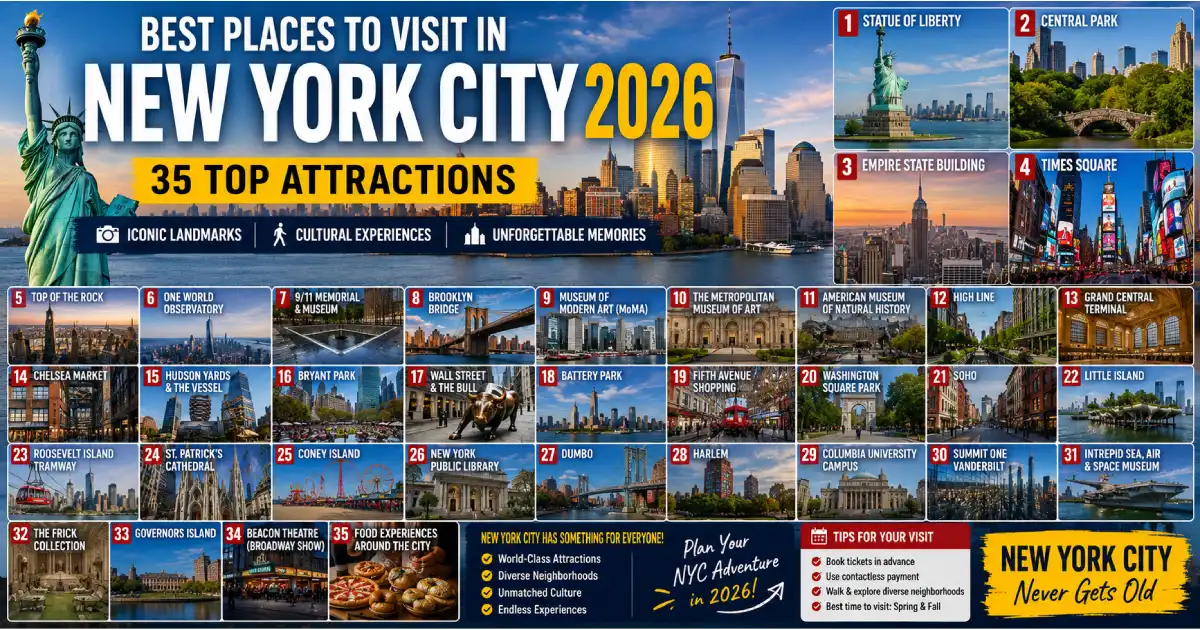
The best places to visit in New York City divide naturally across neighborhoods: Midtown Manhattan concentrates the most famous landmarks (Times Square, Empire State Building, Rockefeller Center, Bryant Park) within 20-minute walking radius; Lower Manhattan preserves American history (Statue of Liberty, Wall Street, Brooklyn Bridge, 9/11 Memorial) in the city’s oldest neighborhoods; Upper Manhattan houses Museum Mile and Central Park’s northern reaches; Brooklyn offers the Brooklyn Bridge, DUMBO waterfront, Prospect Park, and Williamsburg’s arts scene; and the outer boroughs (Queens’ Flushing Meadows, The Bronx’s Yankee Stadium and Bronx Zoo) extend NYC experiences beyond Manhattan’s 23 square miles. This guide covers 35 best places to visit in New York City with practical details — entry costs, subway directions, best visiting times, and insider tips — for first-time and return visitors planning 2026 trips.
For complete guides, see our Things to Do in New York City 2026, Best Restaurants in New York City, and New York City Trip Cost 2026 guides.
| Place | Borough | Entry Cost | Best For | Time Needed |
|---|---|---|---|---|
| Central Park | Manhattan | Free | Nature, walks, iconic views | 2–4 hours |
| Statue of Liberty & Ellis Island | Harbor | $24–$30 | History, iconic landmark | Half day |
| Empire State Building | Manhattan | $44–$79 | Skyline views | 1–2 hours |
| Times Square | Manhattan | Free | Energy, lights, Broadway | 1–2 hours |
| The Metropolitan Museum of Art | Manhattan | $30 (suggested) | Art, culture | 3–5 hours |
| Brooklyn Bridge | Brooklyn/Manhattan | Free | Architecture, skyline views | 1 hour |
| 9/11 Memorial & Museum | Manhattan | Free/$33 | History, reflection | 2–3 hours |
| High Line | Manhattan | Free | Urban park, art, views | 1–2 hours |
| MoMA | Manhattan | $30 | Modern art | 2–3 hours |
| Rockefeller Center & Top of the Rock | Manhattan | $40–$50 | Views, architecture | 1–2 hours |
| Brooklyn Bridge Park | Brooklyn | Free | Skyline views, waterfront | 1–2 hours |
| One World Observatory | Manhattan | $46 | Highest views NYC | 1–2 hours |
| Grand Central Terminal | Manhattan | Free | Architecture | 30–60 min |
| The Guggenheim Museum | Manhattan | $30 | Art, architecture | 2–3 hours |
| Prospect Park | Brooklyn | Free | Nature, local life | 2–3 hours |
| Coney Island | Brooklyn | Free–$20 | Beach, amusement rides | Half day |
| Chelsea Market | Manhattan | Free | Food, shopping | 1–2 hours |
| DUMBO | Brooklyn | Free | Views, arts, food | 2–3 hours |
| The High Line Art | Manhattan | Free | Street art, urban design | 1–2 hours |
| Whitney Museum | Manhattan | $28 | American art | 2–3 hours |
| Flushing Meadows Corona Park | Queens | Free | Space, history | 2–3 hours |
| Bronx Zoo | The Bronx | $39–$44 | Wildlife, families | Half–full day |
| New York Botanical Garden | The Bronx | $28–$35 | Nature, gardens | 2–4 hours |
| Governors Island | Harbor | Free (ferry $4) | Historic forts, views | Half day |
| Bryant Park | Manhattan | Free | Seasonal events, reading | 30–60 min |
| Little Island | Manhattan | Free | Architecture, gardens | 1 hour |
| The Vessel | Manhattan | Free (timed pass) | Architecture | 30 min |
| Flatiron Building | Manhattan | Free | Architecture | 15–30 min |
| Washington Square Park | Manhattan | Free | Local life, chess | 30–60 min |
| NYCFC / Yankee Stadium | The Bronx | $15–$200+ | Sports | 3–4 hours |
| Intrepid Sea, Air & Space Museum | Manhattan | $36–$46 | History, aircraft | 2–3 hours |
| New York Public Library | Manhattan | Free | Architecture, history | 30–60 min |
| Harlem | Manhattan | Free (tours vary) | Music, culture, food | 2–3 hours |
| Queens Night Market | Queens | Free (food $2–$5) | Food, culture | 2–3 hours |
| Staten Island Ferry | Staten Island | Free | Statue of Liberty views | 1 hour round trip |
Entry: Free | Subway: A/C/B/D to 59th St–Columbus Circle or 4/5/6 to 86th St | Best Time: Morning weekdays
Central Park is the most visited urban park in the United States — 42 million annual visitors, 843 acres stretching from 59th Street to 110th Street in the heart of Manhattan, and 58 miles of pedestrian paths creating green escape impossible to replicate in any other American city. Designed by Frederick Law Olmsted and Calvert Vaux (1858), Central Park predates most Manhattan landmarks and remains the city’s primary outdoor gathering space through all four seasons.
The park divides into distinct zones serving different interests: The Mall and Literary Walk (65th–72nd Street) lines American elm trees over a promenade leading to Bethesda Fountain and Bethesda Terrace, the most photographed location in Central Park ($0 entry, open 6 AM–1 AM). Strawberry Fields (72nd Street West Drive) memorializes John Lennon with the “Imagine” mosaic 300 feet from the Dakota apartment building where he lived and was murdered in 1980 — a pilgrimage site for music lovers visiting year-round. The Loeb Boathouse (74th Street, East Drive) rents rowboats ($20/hour, April–November) on The Lake, creating the classic Manhattan skyline background visible in countless films. Belvedere Castle (79th Street) sits atop Vista Rock, providing the highest point in Central Park with panoramic views including The Great Lawn (baseball fields, summer concerts), Delacorte Theater (Shakespeare in the Park, free tickets distributed mornings June–August), and the Central Park Zoo (64th Street, $14–$20 adults, penguins and snow leopards).
Insider tips: Enter at 72nd Street (West Drive) for Strawberry Fields → Bethesda Fountain loop requiring 45 minutes covering most photographed spots. Rent Citi Bikes ($4.49/30 min, stations at park perimeters) for full park circumference efficiently. Visit weekday mornings (before 9 AM) for nearly empty paths regardless of season — weekend afternoons become extremely crowded April–October.
Entry: $24–$30 adults (ferry + grounds) | Crown access: $24 additional, book months in advance | Ferry: Battery Park (Whitehall St–South Ferry subway) | Best Time: First morning ferry (9 AM)
The Statue of Liberty is the most globally recognized American landmark — a 305-foot copper statue (including pedestal) gifted by France in 1886, greeting 3.5 million annual visitors on Liberty Island in New York Harbor, and representing freedom and immigration to the United States for over 130 years. Visiting requires Statue of Liberty–Ellis Island Ferry (operated by Statue Cruises, departing Battery Park Manhattan, $24 adults includes round-trip ferry + access to both islands).
Liberty Island offers three access tiers: Grounds access ($24, ferry only, walk around base, view statue from outside, access museum in pedestal base), Pedestal access ($24 + pedestal reservation, climb to top of pedestal = 146 feet elevation, excellent harbor views), and Crown access ($24 + $3 crown reservation, 354 steps, highly limited capacity, book 3–6 months advance — sells out immediately). Most visitors (grounds/pedestal) spend 45–90 minutes Liberty Island before continuing to Ellis Island.
Ellis Island Immigration Museum is equally essential — 12 million immigrants processed 1892–1954 through the Great Hall (now museum), passenger ship manifests, and interactive exhibits recreating the immigration experience. Free with ferry ticket, plan 1.5–2 hours. The American Family Immigration History Center database ($8/year access) allows searching immigrant ancestor records — meaningful for families tracing roots through Ellis Island.
Insider tips: Book crown tickets 3–6 months advance at StatueCruises.com (only official seller; third-party “tours” add markup without better access). First ferry (9 AM) avoids queues — later ferries wait 30–60 minutes boarding. Free alternative for iconic views: Staten Island Ferry (free, see #35 below) passes Liberty and Ellis Islands closely without landing — excellent photography especially sunset.
Entry: $44 (Main Deck, 86th floor) | $79 (Top Deck, 102nd floor) | Subway: B/D/F/M/N/Q/R to 34th St–Herald Square | Best Time: Sunset (1 hour before) or night
The Empire State Building is Manhattan’s most famous skyscraper — 1,454 feet tall (including antenna), 102 floors, completed 1931 in 410 days during the Great Depression, and holding the title of world’s tallest building for 40 years until 1970. The Main Observation Deck (86th floor, 1,050 feet) offers 360-degree open-air views of all five boroughs, New Jersey, and on clear days Connecticut — the most classic NYC skyline viewpoint, open daily 10 AM–midnight.
The 86th floor deck is open-air (outdoor wraparound platform) making it weather-dependent — wind and cold significant October–March, but sunsets from this height justify layers. The 102nd floor (Top Deck, enclosed glass, $79 upgrade) sits 250 feet higher with clearer glass panels and fewer crowds than 86th floor. Skip-the-line tickets ($44 main, $79 top) purchased online save 30–60 minute queues. NYC CityPASS and Explorer Pass include Empire State Building discounted.
The building’s LED spire lights change colors for events/holidays — schedule published on ESB website. Lobby Art Deco murals (free to view, ground floor) are architectural masterpiece worth 10 minutes even without observatory visit.
Insider tips: Visit 30–45 minutes before sunset for daytime city views transitioning into golden hour into lights-on sequence — the most dramatic lighting sequence in NYC observations. Night views (after 9 PM, when crowds thin) show city lights most dramatically, but sunrise (first entry 10 AM unfortunately) isn’t an option here — use Top of the Rock (opens 9 AM) for sunrise alternatives.
Entry: Free | Subway: 1/2/3/7/N/Q/R/W/S to Times Square–42nd St | Best Time: After dark (9 PM–midnight for full neon effect)
Times Square is the most energy-dense intersection in America — 50 million annual visitors, 26 miles of neon and LED lighting creating the “Crossroads of the World,” Broadway theatre marquees along 44th–52nd Streets, and the New Year’s Eve ball drop watched by 1 billion television viewers globally making it the world’s most-watched countdown location. Bounded by Broadway and 7th Avenue between 42nd and 47th Streets, Times Square is simultaneously NYC’s most touristy and most iconic neighborhood.
The pedestrian plazas (created 2009 by closing Broadway to vehicles) provide tables/chairs where visitors sit watching the spectacle free indefinitely. TKTS Discount Booth (47th Street red stairs) sells same-day Broadway tickets 20–50% off starting 3 PM (matinee tickets from 10 AM) — the most legitimate way to see Broadway cheaply. Madame Tussauds, Ripley’s Believe It Or Not, and other Times Square attractions charge $25–$40 and offer limited value compared to the free street spectacle.
The surrounding blocks contain essential NYC experiences: 42nd Street entertainment corridor (AMC Theatre, Dave & Buster’s), Duffy Square (bleacher seating facing dual TKTS boards), and Broadway’s Shubert Alley (private alley between Shubert and Booth Theatres, historic theatre district landmark).
Insider tips: Times Square at midnight on a Tuesday beats New Year’s Eve for manageable crowds with identical neon effect. The northern end (47th Street) is less crowded than the southern (42nd Street) entrance. Avoid “costumed characters” (Spider-Man, Elmo) — aggressive tipping demands follow photos. Best photography: stand in the pedestrian plaza facing south at night for the classic Times Square neon canyon shot.
Entry: $30 adults (suggested, NYC residents/students pay what you wish) | Subway: 4/5/6 to 86th St, walk west | Best Time: Friday/Saturday evenings (open until 9 PM, less crowded after 5 PM)
The Metropolitan Museum of Art (“The Met”) is the largest art museum in the Western Hemisphere — 2 million+ artworks spanning 5,000 years of human creativity, 17 curatorial departments from Egyptian antiquities to contemporary art, and a Fifth Avenue facade spanning 1,000 feet along Museum Mile. Founded 1870, The Met draws 7 million annual visitors across its main Fifth Avenue building and The Met Cloisters (medieval art, Fort Tryon Park, upper Manhattan).
Essential collections within The Met: The Egyptian Wing (Temple of Dendur, actual 2,000-year-old Egyptian temple reconstructed inside glass-walled gallery — most photographed museum installation in NYC), Arms and Armor (medieval European and Asian weaponry, $0 extra, visually spectacular), American Wing (glass-enclosed courtyard with Tiffany stained glass, period rooms), European Paintings (Vermeer, Rembrandt, El Greco, comprehensive Old Masters collection), and the Roof Garden (open May–October, contemporary sculpture, Manhattan skyline views included with admission).
The suggested $30 admission includes same-day access to all three Met locations (main Fifth Avenue, Breuer building, Cloisters) — extraordinary value given collection depth. Plan minimum 3 hours for highlights; serious art visitors allocate full day.
Insider tips: Download The Met’s free app for audio guides to specific galleries without paying $10 rental. The Egyptian Wing (ground floor, north end) and Arms & Armor (ground floor, south end) require the least art background to appreciate — excellent starting points before diving into paintings. Friday/Saturday evenings (5–9 PM) offer wine bar, live music, and crowds half the weekend afternoon size.
Entry: Free | Subway: 4/5/6 to Brooklyn Bridge–City Hall (Manhattan side) or A/C to High St (Brooklyn side) | Best Time: Sunrise (6–8 AM) or sunset
The Brooklyn Bridge is the most photographed bridge in the United States — 1.1 miles spanning the East River connecting Manhattan’s City Hall district to Brooklyn’s DUMBO neighborhood, completed 1883 as the world’s first steel-wire suspension bridge, and delivering the definitive New York City skyline panorama from its wooden pedestrian walkway. The walk (20–30 minutes Manhattan to Brooklyn one way) is among the most dramatic urban walks in America — twin neo-Gothic granite towers rising 276 feet, steel cables forming the iconic harp-like silhouette visible from miles away, and Lower Manhattan’s Financial District skyline perfectly framing the scene behind walkers heading toward Brooklyn.
Start Manhattan side (City Hall Park, Chambers Street) for downhill experience into Brooklyn, finish at DUMBO (see #18) where Main Street frames the bridge perfectly for the classic shot. Alternatively start Brooklyn side for uphill Manhattan skyline views walking toward you. The walkway sits above vehicle lanes — no traffic noise at rail height, wind noticeable but not problematic except winter.
Bridge photography: Manhattan Bridge visible from Brooklyn Bridge creates layered bridge composition. DUMBO’s Main Street and Washington Street intersection frames Brooklyn Bridge between buildings — Instagram’s most-tagged NYC location.
Insider tips: Walk sunrise weekdays for near-empty bridge — weekend midday gets crowded with cyclists and tourists making pedestrian navigation slow. Cyclists share the walkway (designated lanes) but speeds often high — stay in pedestrian section (right side). Round-trip walk feasible in 45 minutes; most visitors walk one direction and subway back.
Entry: Memorial Plaza: Free | Museum: $33 adults | Subway: E to World Trade Center or 2/3 to Park Place | Best Time: Weekday mornings (9–11 AM)
The 9/11 Memorial & Museum occupies the footprints of the original Twin Towers — two massive reflecting pools (each nearly an acre, 30-foot waterfalls cascading inward, bronze panels bearing 2,983 names of victims) set in a plaza of white oak trees at the World Trade Center site. The Memorial Plaza is free, open daily sunrise to sunset, and represents the most somber and most powerful public space in New York City — visitors arrive from every country to stand at the waterfall edges reading names of lost individuals.
The 9/11 Memorial Museum ($33, underground below plaza, 110,000+ square-foot permanent exhibition) houses actual artifacts — twisted steel beams, personal effects, first responder equipment, fire trucks — surrounding the preserved slurry wall (foundation wall keeping Hudson River out of Manhattan, September 11 survivors called the “Bathtub”). Audio guide ($8 additional) contextualizes 23-year-old exhibits for visitors too young to remember September 2001. Allow 2.5–3 hours minimum for museum; emotionally intense, not suitable for young children.
The surrounding World Trade Center complex (One WTC / Freedom Tower, Westfield Mall Oculus) creates the rebuilt financial district — Oculus transportation hub (designed by Santiago Calatrava, spine-like white structure) is architectural landmark worth 20 minutes regardless of museum visit.
Insider tips: Museum tickets sell out summer weekends — book online 1–2 weeks advance. Timed-entry tickets allow re-entry same day. The Memorial Plaza is powerful independently (free) for visitors finding museum admission too expensive or emotionally taxing. Nearby: St. Paul’s Chapel (1766, oldest public building in continuous use in NYC, served as first responder rest station September 2001, free, 5-minute walk).
Entry: Free | Subway: A/C/E to 14th St or C/E to 23rd St | Best Time: Morning weekdays, spring bloom (April–May)
The High Line is the most innovative urban park in America — 1.45 miles of abandoned 1930s elevated freight railway converted into linear public park (2009–2014), running from Gansevoort Street (Meatpacking District) through Chelsea to 34th Street (Hudson Yards), and demonstrating urban revitalization globally replicated from Atlanta to Chicago to Seoul. Free, open 7 AM–10 PM daily, the High Line combines landscaped native plantings, contemporary public art commissions, food vendors, seating areas, and aerial views of Chelsea’s gallery district, Hudson River, and surrounding streets.
The park’s three sections each offer distinct character: Southern section (Gansevoort to 20th Street) passes through Meatpacking District’s renovated warehouses and Chelsea Market (see #16) with the most dense food vendor concentration. Middle section (20th to 30th Street) contains the 10th Avenue Square amphitheater (seating facing street-level traffic below in glass-floored window — free), Chelsea Market Passage, and the most gallery district views. Northern section (30th to 34th Street) terminates at Hudson Yards, passing the controversial Vessel (see #28) and connecting to The Shed cultural center.
Insider tips: Download the High Line’s free app for self-guided audio tours identifying specific plant species, public artworks, and historical elements. Spring (April–May) offers bloom peak — wildflower meadows and prairie grasses at maximum visual impact. Enter at 14th Street Gansevoort (southern entrance, busiest but best) or 23rd Street (mid-park, less crowded) to avoid elevator queues at northern Hudson Yards entrance.
Entry: $30 adults (free Fridays 5:30–9 PM, first-come queues form early) | Subway: E/M to 5th Ave–53rd St | Best Time: Friday evenings (free entry, unexpectedly manageable)
The Museum of Modern Art is the world’s most influential modern art museum — Picasso’s “Les Demoiselles d’Avignon,” Van Gogh’s “The Starry Night,” Warhol’s “Campbell’s Soup Cans,” Dalí’s “The Persistence of Memory,” and 200,000+ works spanning painting, sculpture, film, design, and architecture defining 20th century creativity. Founded 1929, MoMA established the vocabulary of modern art curation globally — every museum exhibiting “contemporary art” worldwide follows MoMA’s exhibition model developed over nine decades.
The permanent collection spans six floors: Architecture and Design (iconic chairs, posters, typography), Drawing and Prints, Media and Performance, Film (MoMA’s cinema program screens essential films daily, separate $15 ticket), Painting and Sculpture I (Post-Impressionism through 1940s), and Painting and Sculpture II (Abstract Expressionism through contemporary). The Starry Night (5th floor) draws the longest queue — arrive before it on a direct path from entry to avoid 20–30 minute viewing waits.
The 2019 expansion added 47,000 square feet integrating former neighbor spaces — improved flow, new galleries, and ground-floor free public space (accessible without admission for gift shop, café, sculpture garden views).
Insider tips: Free Friday evenings (5:30–9 PM) require joining queue by 4:45 PM to avoid 45–60 minute waits forming from 5 PM. MoMA’s audio guide ($8 rental, or free app download) covers Starry Night, Warhol, Picasso comprehensively — worth using for non-art specialists gaining context for masterworks. The Sculpture Garden (ground floor, accessible through museum) is NYC’s best urban sculpture setting — visible from street on 54th Street, can be viewed from exterior free.
Entry: Center tour free | Top of the Rock observation: $40–$50 | Subway: B/D/F/M to 47–50 Sts–Rockefeller Center | Best Time: Sunset or evening
Rockefeller Center is the most celebrated Art Deco complex in America — 19 commercial buildings spanning three blocks of Midtown Manhattan (48th–51st Streets, 5th–7th Avenues), completed 1930–1939, home to NBC Studios (Saturday Night Live, Today Show studio visible from street), Radio City Music Hall (1932, 6,000-seat entertainment venue, Rockettes), and the Top of the Rock observation deck delivering the one view Empire State Building can’t — the Empire State Building itself in the foreground of the Manhattan skyline.
Top of the Rock (70th floor, 850 feet) offers the definitive NYC skyline photograph: Empire State Building centered in frame, One World Trade visible south, Central Park stretching north, Hudson and East Rivers flanking Manhattan island. Three outdoor observation decks (67th, 69th, 70th floors) with glass-enclosed and open-air options, open 9 AM–midnight. Sunset tickets (time-entry available) create golden hour Empire State Building photography.
The sunken plaza below (1221 Avenue of the Americas) hosts the famous Christmas tree (November–January, 70–100 feet tall, 50,000 lights) and the Rockefeller Center Ice Rink (October–April, $12–$29 skate rental, $13 admission, iconic but crowded and small). NBC Studio Tour ($44 adults, 70 minutes) accesses SNL sets, Today Show studio, and broadcast history exhibits.
Insider tips: Top of the Rock vs Empire State Building: Top of the Rock wins for Empire State Building views and slightly less crowded observation; Empire State Building wins for being on the iconic landmark itself with more dramatic height (1,050 vs 850 feet). Book timed-entry sunset tickets ($3–5 premium above standard) for optimized photography light. Lower Plaza’s free Christmas tree viewing (November–January) draws millions — arrive before 9 AM or after 9 PM to avoid street-level crowds.
Entry: Free | Subway: A/C to High St or F to York St | Best Time: Sunset facing Manhattan
Brooklyn Bridge Park is Manhattan’s best view from outside Manhattan — 85 acres of reclaimed waterfront along Brooklyn’s East River shoreline (John Street to Atlantic Avenue, Piers 1–6), opened 2010–2012, offering the most photogenic Lower Manhattan skyline perspectives including Brooklyn Bridge, Manhattan Bridge, and the entire Financial District glass tower cluster reflected in East River water.
Pier 1 (northernmost, closest Brooklyn Bridge) delivers the primary view: Brooklyn Bridge above, Manhattan skyline behind, and both bridges creating layered composition impossible from Manhattan itself. Pier 6 (southernmost, Atlantic Avenue) hosts summer events including outdoor concerts and a seasonal beach with volleyball. Jane’s Carousel (restored 1922 carousel, $2/ride, April–October inside glass pavilion designed by Jean Nouvel) sits at the park’s north end as architectural landmark worth visiting independently.
The park’s inland connection to DUMBO neighborhood (see #18) creates a natural walking circuit: Brooklyn Bridge walk → DUMBO exploration → Brooklyn Bridge Park waterfront → Jane’s Carousel → return via High Street subway.
Insider tips: Sunset from Pier 1 (facing west/northwest) lights the Manhattan skyline in gold — arrive 30 minutes before sunset for prime positioning on the waterfront lawn. The park gets crowded on summer weekends but has enough length (1-mile waterfront) to find uncrowded sections walking north from Pier 6. Bring food from DUMBO’s Time Out Market or Grimaldi’s Pizza (under Brooklyn Bridge, famously coal-fired) for waterfront picnic.
Entry: $46 adults | Subway: E to World Trade Center or 2/3 to Fulton St | Best Time: Clear days, late afternoon
One World Observatory (floors 100–102, 1,250 feet) sits atop One World Trade Center — the Western Hemisphere’s tallest building (1,776 feet including antenna, symbolic reference to 1776 Declaration of Independence) at the rebuilt World Trade Center site. The observatory offers the highest publicly accessible views in NYC, surpassing Top of the Rock (850 feet) and Empire State Building (1,050 feet) by significant margin.
The Sky Portal (floor 102, 14-foot circular screen in the floor) creates the sensation of standing on the building’s roof — digital camera beneath the building’s base projects real-time street-level view below your feet, extraordinary and slightly vertigo-inducing. Floor 101 houses See Forever Theater (cinematic 7-minute NYC history film as elevator ascends) and the main 360-degree observation area. Floor 100 (Dining and Events) operates as restaurant/bar with reservation.
View quality compared to competitors: One World Observatory provides the clearest Lower Manhattan perspective (Financial District, Harbor, Statue of Liberty, Brooklyn, New Jersey) but less comprehensive Midtown views than Top of the Rock. For Midtown Manhattan (Times Square, Empire State Building, Central Park), Top of the Rock remains superior. For complete cityscape including all five boroughs, One World’s height wins.
Insider tips: Clear days offer views 50+ miles to Atlantic Ocean and New Jersey hills — check weather before booking. Book timed-entry online (saves $5 vs walk-up), arrive 15 minutes early for security screening. Combination tickets with 9/11 Memorial Museum available ($60 bundle, saves $19 vs separate purchase) — logical pairing given same WTC campus location.
Entry: Free | Subway: 4/5/6/7/S to Grand Central–42nd St | Best Time: Weekday 8–9 AM (morning commuter rush) or after 7 PM (quiet)
Grand Central Terminal is the most architecturally magnificent public space in New York City — the world’s largest train station by number of platforms (44 platforms, 67 tracks), Beaux-Arts masterpiece completed 1913, and the celestial ceiling of the Main Concourse (turquoise zodiac constellation mural, 125-foot vaulted ceiling, golden light through arched south windows) creating one of the most photographed interior spaces in American architecture. 750,000 daily visitors pass through Grand Central — more than any transit hub in the Western Hemisphere.
The Main Concourse (free public access, open 5:30 AM–2 AM) functions as civic space: vast marble floors, the iconic four-faced brass opal clock above the information booth ($100 million appraisal estimate), and the famous “whisper gallery” at the lower-level Oyster Bar (arched tile corridor where whispers carry around the room’s curved ceiling). The Dining Concourse (lower level) concentrates NYC food stalls: Pescatore (seafood), Magnolia Bakery (banana pudding), Campbell Bar (ornate former railroad president’s office, historic cocktail bar).
Free architecture tours (Municipal Art Society, Wednesdays 12:30 PM, $25 suggested donation) cover Vanderbilt family history, astronomical ceiling restoration, and saved-from-demolition story (preservation landmark case won 1978 Supreme Court decision).
Insider tips: The “whisper gallery” requires two people: stand in diagonally opposite corners of the lower-level arched corridor outside Oyster Bar Restaurant and whisper facing the wall — voices carry clearly despite 40-foot distance between speakers. Morning rush (8–9 AM weekdays) is paradoxically more photogenic than quiet periods — moving commuter streams beneath celestial ceiling create dynamic long-exposure photography opportunities.
Entry: $30 adults (Pay What You Wish Saturdays 5–8 PM) | Subway: 4/5/6 to 86th St | Best Time: Saturday evenings (Pay What You Wish)
The Solomon R. Guggenheim Museum is simultaneously the most architecturally significant museum building in the United States and a world-class collection of modern and contemporary art — Frank Lloyd Wright’s only major New York City building (1959), a spiral rotunda of continuous ramp rising six stories housing Kandinsky, Picasso, Brancusi, Calder, and Pollock alongside rotating temporary exhibitions. The building itself is the primary art experience: stand at ground level looking up the 92-foot central atrium as visitors ascend the 1,416-foot continuous ramp, creating a sculptural interior space no photograph prepares you for.
The permanent collection (rotated due to space) includes Thannhauser Collection (Impressionist and Post-Impressionist works including Renoir, Manet, Cézanne, Picasso), Guggenheim’s original non-objective collection (Kandinsky’s “Several Circles,” Delaunay, Mondrian), and contemporary additions. Temporary exhibitions frequently outshine permanent collection — check programming before visiting.
Museum Mile location connects Guggenheim logically with The Met (10 blocks south) and Museum of the City of New York (104th Street, north) for full Museum Mile walking day (3–4 museums, 3–4 miles total, manageable by determined visitors).
Insider tips: Saturday evening Pay What You Wish (5–8 PM) fills the rotunda with New Yorkers making it more social/lively than standard museum hours — worth the slight crowds for significant savings ($30 → whatever feels right). The building exterior (Fifth Avenue facade) deserves 15 minutes photography from across the street — Wright’s cantilevered rings photographed with Met visible behind creates the definitive Museum Mile composition.
Entry: Free | Subway: B/Q to Prospect Park or F/G to 15th St–Prospect Park | Best Time: Weekend mornings, fall foliage (October–November)
Prospect Park is Central Park’s Brooklyn counterpart — 585 acres designed by the same team (Olmsted and Vaux, 1867), considered by the designers their superior achievement to Central Park, and serving as Brooklyn’s primary green space with significantly fewer tourists than Manhattan’s equivalent. The park combines Long Meadow (the longest uninterrupted meadow in an American urban park, 1-mile, prime weekend picnic destination), Prospect Lake (boating April–October, pedalboats $20/30 min), the Audubon Center at the Boathouse (Victorian boathouse, bird watching, kayaking), and Litchfield Villa (1857 Italianate mansion visible from East Drive).
Surrounding Prospect Park: Park Slope neighborhood (west entrance, brownstone-lined 7th Avenue with excellent coffee shops and restaurants), Prospect Park Zoo (Flatbush Avenue entrance, $10–$14, smaller than Bronx Zoo but excellent for families), and the Prospect Park Bandshell (east side, summer free concerts including Celebrate Brooklyn festival drawing 100,000+ annual attendees).
Insider tips: Enter at Grand Army Plaza (intersection of Flatbush and Eastern Parkway) for the magnificent Soldier’s and Sailors’ Arch (1892 triumphal arch modeled on Arc de Triomphe) framing the park’s main entrance. Fall foliage (mid-October to mid-November) rivals anything Central Park offers but with 80% fewer visitors. Combine with neighboring Brooklyn Museum (200 Eastern Parkway, $20 adults, Brooklyn Botanic Garden ($18) for full Prospect Park cultural day.
Entry: Free | Subway: A/C/E/L to 14th St–8th Ave | Best Time: Weekdays 11 AM–2 PM
Chelsea Market occupies the former Nabisco factory where the Oreo cookie was invented in 1912 — a 1.2 million square-foot converted industrial complex on 9th Avenue between 15th and 16th Streets, housing 35+ food vendors, retailers, and the Google NYC campus on upper floors. The ground-floor market passage (accessible between 9th and 10th Avenues) represents the best concentration of quality food vendors in a single NYC building: Los Tacos No. 1 (consistently ranked NYC’s best tacos, $4–$6, always queued), The Lobster Place (seafood market with sushi bar, lobster rolls, $22–$28), Creamline (burgers, milkshakes, brunch), Anthropologie, and dozens more vendors alongside specialty food purveyors.
The industrial architecture (raw exposed brick, rusted pipes, overhead water features, original Nabisco machinery) creates NYC’s most atmospheric food hall environment — warmer than nearby High Line in winter, good rainy-day alternative. The market connects to High Line access on 10th Avenue and sits one block from Google NYC offices (the campus occupies upper floors but isn’t accessible to visitors).
Insider tips: Lunch rush (12–2 PM weekdays) creates 15–20 minute queues at Los Tacos No. 1 — arrive before noon or after 2 PM. The Lobster Place’s retail section sells some of NYC’s freshest seafood at reasonable prices for cooking, alongside sit-down prepared options. Weekend mornings (9–11 AM) offer quietest browsing before crowds arrive.
Entry: Free | Subway: A/C to High St or F to York St | Best Time: Any day, weekday mornings for famous shot
DUMBO (Down Under the Manhattan Bridge Overpass) is Brooklyn’s most photographed neighborhood — cobblestone streets, converted 19th-century brick warehouses, and the intersection of Washington Street and Front Street where the Manhattan Bridge frames perfectly between buildings with the Brooklyn Bridge visible behind, creating NYC’s most shared Instagram composition and one of the most recognizable urban views in global photography.
The neighborhood has evolved from artists’ lofts (1970s–1990s) to tech startup hub to luxury residential while retaining industrial architecture character — Empire Stores (1880s Civil War-era tobacco warehouse, now boutiques, West Elm, Time Out Market food hall), St. Ann’s Warehouse (Brooklyn’s most important off-Broadway theatre), and Dumbo Arts District galleries. The waterfront park (Brooklyn Bridge Park extension, see #11) provides the Manhattan skyline views while the inland streets provide the signature bridge-framing photography.
Time Out Market DUMBO (Empire Stores, 2019) brings together 21 NYC food concepts under one roof — Roberta’s Pizza (renowned Bushwick pizzeria’s DUMBO outpost), Khe-Yo (Laotian, $16–$22), and rooftop bar with Manhattan views. Good rainy-day food option and evening gathering spot.
Insider tips: Washington Street and Front Street intersection: arrive before 9 AM weekdays for the famous Manhattan Bridge shot without tourists blocking the view — weekends create crowds from 9 AM onward. The cobblestones are genuinely difficult on wheeled luggage and heels. Combine DUMBO with Brooklyn Bridge walk and Brooklyn Bridge Park waterfront for a complete half-day Brooklyn itinerary (subway to High Street → bridge walk → DUMBO → waterfront → Jane’s Carousel → return subway from York Street).
Entry: $28 adults (Pay What You Wish Fridays 7–10 PM) | Subway: A/C/E/L to 14th St–8th Ave | Best Time: Friday evenings
The Whitney Museum focuses exclusively on 20th and 21st century American art — 25,000+ works by 3,500 American artists in Renzo Piano’s striking 2015 building at the southern entrance to the High Line (Gansevoort Street, Meatpacking District). The museum’s permanent collection emphasizes Edward Hopper (largest collection globally, including “Early Sunday Morning”), Georgia O’Keeffe, Alexander Calder, Jasper Johns, and contemporary digital media — the most comprehensive American art collection in a single institution.
The building’s outdoor terraces (floors 5, 7, 8) provide Hudson River views and High Line perspectives — free with admission, among NYC’s best free-with-entry skyline viewpoints. Whitney Biennial (even-numbered years, spring) is the most prestigious survey of contemporary American art, drawing international attention and extended weekend queues.
Insider tips: Friday Pay What You Wish evenings (7–10 PM) combine with nearby Meatpacking District dinner for an affordable culture-and-dining evening. The building’s exterior (asymmetric concrete/steel, varied window patterns) deserves 10 minutes examination — Piano designed it to engage with the neighborhood’s industrial past while establishing contemporary presence. Combine with High Line access (north entrance directly adjacent) for efficient afternoon.
Entry: Free | Subway: 7 to Mets–Willets Point | Best Time: Spring–fall weekends
Flushing Meadows Corona Park is Queens’ largest public space — 1,255 acres hosting the 1939 and 1964 World’s Fairs, the Unisphere (largest global structure on Earth, 12-story stainless steel globe, 1964 World’s Fair centerpiece, free), the USTA Billie Jean King National Tennis Center (US Open venue, August–September), Citi Field (NY Mets baseball stadium), Queens Museum (detailed panoramic model of all NYC buildings, $12 suggested), and New York Hall of Science (hands-on science museum, $20 adults, excellent for families).
The 1964 World’s Fair pavilions (many still standing) create the park’s science-fiction atmosphere — Flying Saucer Building (now Queens Theatre), New York State Pavilion Towers (crumbling but preserved, visible from 7 train), and the Unisphere reflecting pool recreate the optimistic Space Age aesthetic of mid-century American futurism.
Insider tips: The 7 train elevated approach to Mets-Willets Point station provides aerial views of both the Unisphere and Citi Field simultaneously — stand at the train’s front window for the approach. If visiting during US Open (late August–September), book tickets well in advance ($65–$200+) or attend qualifying rounds (free to watch on outside courts). The Queens International Night Market (nearby, Saturdays April–October) offers 75+ international food vendors for $2–$6 dishes.
Entry: $39–$44 adults (General admission includes most exhibits) | Subway: 2/5 to E 180th St, then Bx12 bus, or Metro-North to Fordham | Best Time: Weekday mornings
The Bronx Zoo is the largest metropolitan zoo in the United States — 265 acres, 6,000+ animals, 700+ species, and the most naturalistic animal habitats in any American urban zoo including the Congo Gorilla Forest (6.5-acre naturalistic African rainforest, 300 animals, 20 gorillas), Tiger Mountain (Siberian tigers with visitor-level glass panels), and African Plains (giraffes, zebras, wildebeest visible from Monorail, $6 additional).
The zoo’s conservation credentials differentiate it from entertainment-focused competitors — Bronx Zoo is operated by Wildlife Conservation Society (founded 1895), with conservation programs in 60+ countries. Exhibits emphasize behavioral enrichment and natural habitat reproduction rather than performance. Sea Bird Colony, World of Reptiles, and Children’s Zoo (additional $5) round out full-day programming.
Insider tips: Wednesday is “suggested admission” day (pay what you wish for general admission, premium exhibits still charge separately) — busier but significant savings for budget visitors. Download the Bronx Zoo app for real-time animal location tracking (animals move between habitats; app shows current positions). The Metro-North approach (Grand Central → Fordham, 20 minutes, $8) is faster and more comfortable than subway for visitors from Midtown.
Entry: Free (ferry $4 round-trip adults) | Ferry: Battery Maritime Building (10 South St, Whitehall St–South Ferry subway) | Best Time: May–October (island closed November–April)
Governors Island is Manhattan’s secret — 172-acre island in Upper New York Harbor, 800 meters south of Manhattan’s tip, hosting two 19th-century military forts (Fort Jay, 1794 star fort; Castle Williams, 1811 circular stone fort, both National Monument), Nolan Park Victorian officers’ housing, 43 acres of new public park, art installations, and the most unobstructed 360-degree views of the New York Harbor including Statue of Liberty, Manhattan skyline, and Brooklyn waterfront accessible in the city.
The Hills (2016 landscape intervention) created four artificial hills rising 25–70 feet above island elevation — previously flat, now offering the clearest Statue of Liberty views in New York Harbor from viewpoint accessible for free (ferry fare only). Summer programming includes hammock grove, outdoor art installations, food vendors (Roebling Tea Room, Steve’s Authentic Key Lime Pie), and seasonal vendors. No cars permitted on island — rent bikes ($7–$11/hour, available at ferry landing) to cover 2.2-mile perimeter efficiently.
Insider tips: First ferry (10 AM weekends, noon weekdays) arrives before crowds — island gets crowded by 1 PM summer weekends but remains spacious given 172 acres. Bring picnic food from lower Manhattan (Brookfield Place, Whole Foods on Vesey Street) — island food is fine but expensive. Last ferry 6:30 PM weekdays, 7 PM weekends — easy to miss if exploring hills.
Entry: $28–$35 adults (includes most gardens and Conservatory) | Subway/Train: Metro-North to Botanical Garden (20 minutes Grand Central, $8) | Best Time: May (Lilac Collection, Azalea Garden) or December (Holiday Train Show)
The New York Botanical Garden covers 250 acres in the northern Bronx — 50 gardens and plant collections, the Enid A. Haupt Conservatory (11-room Victorian glasshouse, 1902, housing rainforest, desert, and seasonal floral shows), the Thain Family Forest (50-acre old-growth New York forest, never logged, extraordinary inside NYC), and collections representing every plant ecosystem on Earth. Annual highlights: Orchid Show (February–April, most popular, tickets $30–$35), Holiday Train Show (November–January, G-gauge trains circling botanical garden reproductions of NYC landmarks made from plant materials), and cherry blossoms (April, Japanese collection).
The adjacent Bronx Zoo creates a logical full-day Bronx cultural itinerary (Metro-North Fordham → zoo → taxi/bus to botanical garden → Metro-North Botanical Garden back to Grand Central) covering both attractions without subway complexity.
Insider tips: Metro-North “Botanical Garden” stop deposits visitors at the garden’s main gate — fastest, most comfortable access from Midtown, comparable cost to subway. Holiday Train Show tickets ($35) sell out December weekends — book 2–4 weeks advance. NYBG membership ($90/individual, $125/family) pays for itself in 3 visits and includes unlimited entry plus 10% restaurant/shop discounts.
Entry: Beach free | Luna Park rides $6–$12 each or $42/unlimited | Subway: D/F/N/Q to Coney Island–Stillwell Ave | Best Time: June–August (summer season)
Coney Island is Brooklyn’s historic seaside escape — 3.5-mile Atlantic Ocean beach, Luna Park amusement rides (cyclone wooden roller coaster 1927, Wonder Wheel 1920 ferris wheel), the boardwalk stretching to Brighton Beach, Nathan’s Famous (1916, original hot dog stand, annual Fourth of July hot dog eating contest), and New York Aquarium ($26 adults, seahorses, jellyfish, ocean creatures). Coney Island operates as a genuine working-class NYC beach (packed summer weekends with families from every borough), a nostalgia-soaked amusement area, and an atmospheric Brooklyn neighborhood — not a sanitized theme park but a complex urban beach experience.
The neighborhood extends: Brighton Beach (“Little Odessa,” Russian-Ukrainian immigrant community east of Coney Island) offers excellent Eastern European restaurants (MarinaRestaurant, Tatiana, extraordinary borscht and blintzes for $8–$15) as Coney Island cultural extension. MCU Park (minor league stadium, Brooklyn Cyclones NY Mets affiliate, $12–$20 tickets, ocean breeze, spectacular July 4 fireworks visible from open-air seats) provides summer evening entertainment.
Insider tips: Summer weekends (July–August) bring 1 million visitors to Coney Island beach — arrive before noon for manageable density or visit weekday afternoons. The Cyclone roller coaster ($10) is one of America’s oldest operating wooden coasters — simultaneously historically significant and genuinely terrifying. Combine with Brighton Beach boardwalk walk (30 minutes east) for Russian food and different neighborhood atmosphere in same trip.
Entry: Free | Tours: Harlem Heritage Tours ($30–$55) | Subway: 2/3 to 125th St or A/B/C/D to 125th St | Best Time: Sunday mornings (gospel, 10 AM–noon)
Harlem is the most historically significant African American neighborhood in the United States — birthplace of the Harlem Renaissance (1920s, when Black writers, artists, musicians including Langston Hughes, Zora Neale Hurston, Duke Ellington created the defining cultural movement in American art history), home of the Apollo Theater (253 West 125th Street, Amateur Night since 1934, $10–$75 depending on show), and a neighborhood maintaining cultural identity through ongoing gentrification pressures.
Essential Harlem experiences: Apollo Theater tours ($12 guided, Monday–Saturday, even without shows), Sunday Gospel Brunch at Sylvia’s (Lenox Avenue, $42/person, live choir, fried chicken, collard greens, the most authentic introduction to Harlem food culture for first-time visitors), Studio Museum in Harlem (free, 144 West 125th Street, dedicated to artists of African descent), Marcus Garvey Park (Mount Morris Park, Victorian fire watch tower 1856, free), and Hamilton Grange National Memorial (Alexander Hamilton’s home, Convent Avenue, free NPS site).
Insider tips: Sunday morning gospel services at Canaan Baptist Church (132 West 116th Street) or Abyssinian Baptist Church (132 West 138th Street) welcome respectful visitors — arrive before 11 AM, dress modestly, do not photograph during service. Harlem Heritage Tours ($30–$55, 2–3 hours) provide essential historical context that self-guided walking misses. 125th Street food corridor offers NYC’s best Southern/soul food: Sylvia’s, Amy Ruth’s, Red Rooster (Marcus Samuelsson’s renowned restaurant, $25–$45 entrées).
Entry: Free | Subway: B/D/F/M to 42nd St–Bryant Park or 7 to 5th Ave | Best Time: Summer (reading room) or Winter Village (November–January)
Bryant Park is Midtown Manhattan’s best free public space — 9.6-acre park behind the New York Public Library (42nd Street, between 5th and 6th Avenues) transformed from drug-infested neglect (1970s–1980s) to the most programmed urban park in America through a 1992 renovation model studied by parks worldwide. Summer programming (May–October): free outdoor movies (HBO Bryant Park Summer Film Festival, Mondays, 5,000+ attendees on blanket-covered Great Lawn), reading room (free book loans, table seating), ping pong, pétanque, and rotating food kiosks.
Winter Village (November–January): free ice skating rink (no admission fee, just skate rental $17), holiday market (185 vendors, European Christmas market aesthetic), and the most atmospheric Midtown gathering space during the holiday season. The park’s central fountain (reopened 2022 after restoration), European plane trees (1930s plantings), and marble terrace create consistent aesthetic regardless of programming season.
Insider tips: The Monday Film Festival (June–August) requires arriving by 5 PM for blanket real estate before the 8 PM (dusk) screening — bring food from nearby Urbanspace food hall (230 Park Avenue). Winter ice skating (free admission, just skate rental) creates the most egalitarian NYC winter experience — locals and tourists skating identically in the shadow of Midtown skyscrapers.
Posted By : Vinay
Latest Article
2nd Floor, 39, Above Kirti Club, DLF Industrial Area, Kirti Nagar, New Delhi, Delhi 110015



Travel Tourister is a leading Travel portal where we introduce travellers to trusted travel agents to make their journey hasselfree, memorable And happy. Travel Tourister is a platform where travellers get Tour packages ,Hotel packages deals through trusted travel companies And hoteliers who are working with us across the world. We always try to find new and more travel agents and hoteliers from every nook and corners across the world so that you could compare the deals with different travel agents and hoteliers and book your tour or hotel with the one you have chosen according to your taste and budget.
Copyright © Travel Tourister, India. All Rights Reserved

 Call
Call Enquiry