Published on : 10 Jun 2026
By Travel Tourister | Updated June 2026
New York City is the world’s most activity-dense destination — 66 million annual visitors, 800+ languages spoken across five boroughs, and a concentration of world-class experiences so extreme that visitors returning for the tenth time still encounter something new. The best things to do in New York City range from completely free (walking the Brooklyn Bridge, exploring Central Park, watching sunset from the Staten Island Ferry, attending a free Shakespeare in the Park performance) to world-class splurges (Broadway front-row tickets $250–$350, helicopter tours $250–$400, Michelin three-star dinners $350+/person) — and unlike most US cities where budget travelers feel excluded from premium experiences, New York City’s free tier is genuinely extraordinary. The Metropolitan Museum of Art’s $30 suggested admission is voluntary for New York State residents; the High Line park is free; the Staten Island Ferry delivering Statue of Liberty views costs $0; and Central Park’s 843 acres of designed landscape rivals any paid attraction in the country.
What makes New York City’s activity list genuinely different from every other American destination is the five-borough diversity — Manhattan concentrates the most famous experiences (Times Square, Broadway, Midtown landmarks, Museum Mile) but Brooklyn delivers the best skyline views (DUMBO’s bridge photography, Brooklyn Bridge Park waterfront), Queens offers the most authentic international food experiences (Flushing’s Chinese restaurants, Jackson Heights’ South Asian corridor, Astoria’s Greek neighborhood), The Bronx claims America’s largest metropolitan zoo and oldest surviving forest within a major city, and Staten Island provides the most underrated harbor views and free ferry experience in the American Northeast. The subway ($2.90/ride, 472 stations, 24-hour service) connects all five boroughs without rental cars, enabling a visitor to eat dim sum in Flushing at noon, walk the Brooklyn Bridge at 3 PM, catch a Broadway show at 8 PM, and eat a late-night slice on the Lower East Side at midnight — all for under $15 in transportation.
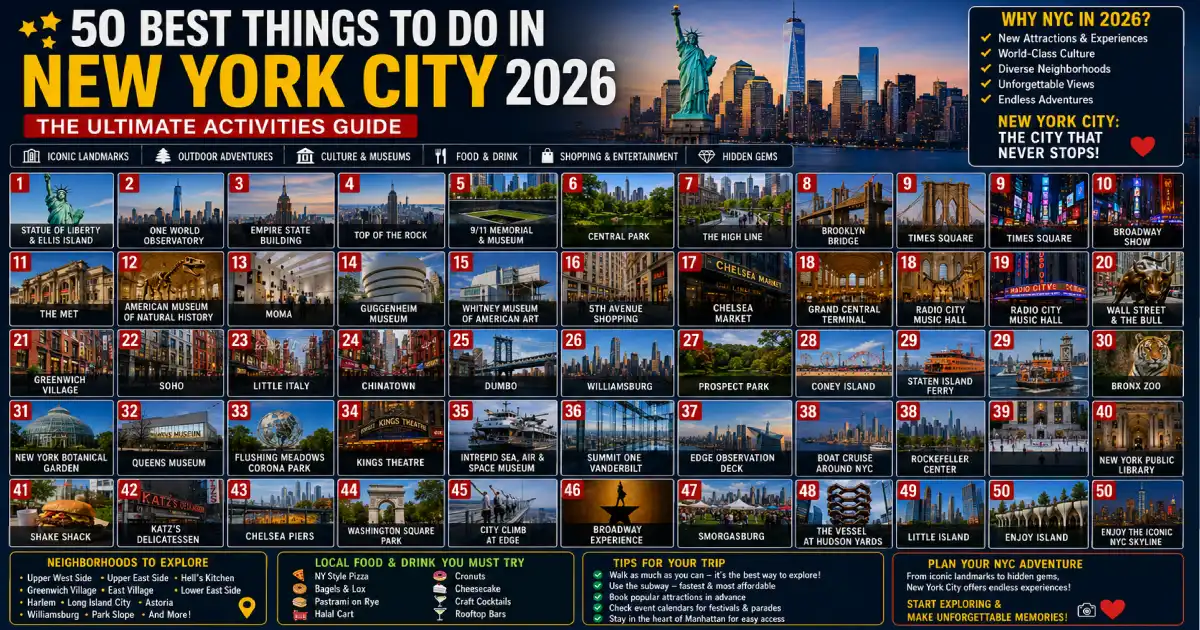
This guide covers the 50 best things to do in New York City organized by category — iconic landmarks, museums and culture, outdoor activities, food and drink experiences, neighborhoods, live entertainment, and day trips — with practical details covering costs, subway directions, booking requirements, and insider timing advice for 2026 visitors planning trips of any length from a long weekend to two weeks.
For complete guides, see our Best Places to Visit in New York City 2026, Best Restaurants in New York City, and New York City Trip Cost 2026 guides.
| # | Activity | Category | Cost | Time Needed | Book Ahead? |
|---|---|---|---|---|---|
| 1 | Walk the Brooklyn Bridge | Iconic | Free | 45–60 min | No |
| 2 | See a Broadway Show | Entertainment | $50–$350 | 2.5–3 hrs | Yes (weeks ahead) |
| 3 | Explore Central Park | Outdoors | Free | 2–4 hrs | No |
| 4 | Visit the 9/11 Memorial & Museum | History | Free/$33 | 2–3 hrs | Yes (museum) |
| 5 | Ride the Staten Island Ferry | Iconic | Free | 1 hr round trip | No |
| 6 | Tour the Metropolitan Museum of Art | Museum | $30 | 3–5 hrs | No |
| 7 | Watch sunset from Top of the Rock | Views | $40–$50 | 1–2 hrs | Yes (sunset slots) |
| 8 | Visit Times Square at Night | Iconic | Free | 1–2 hrs | No |
| 9 | Tour the Statue of Liberty | Landmark | $24–$30 | Half day | Yes (crown: months) |
| 10 | Walk the High Line | Outdoors | Free | 1–2 hrs | No |
| 11 | Eat a NYC Pizza Slice | Food | $3–$5 | 15 min | No |
| 12 | Visit MoMA | Museum | $30 | 2–3 hrs | No |
| 13 | Kayak on the Hudson River | Outdoors | Free–$20 | 1–2 hrs | No |
| 14 | Explore DUMBO & Brooklyn Waterfront | Neighborhood | Free | 2–3 hrs | No |
| 15 | Take a Cooking Class | Food | $85–$150 | 2–3 hrs | Yes |
| 16 | Visit the Guggenheim Museum | Museum | $30 | 2–3 hrs | No |
| 17 | Watch a Yankees or Mets Game | Sports | $15–$200+ | 3–4 hrs | Yes (popular games) |
| 18 | Eat Your Way Through Chelsea Market | Food | Free–$25 | 1–2 hrs | No |
| 19 | See One World Observatory | Views | $46 | 1–2 hrs | Yes |
| 20 | Explore the Lower East Side | Neighborhood | Free | 2–3 hrs | No |
| 21 | Take a Helicopter Tour | Views | $250–$400 | 15–20 min | Yes |
| 22 | Visit the Brooklyn Museum | Museum | $20 | 2–3 hrs | No |
| 23 | Attend Shakespeare in the Park | Entertainment | Free | 2.5–3 hrs | Yes (ticket lottery) |
| 24 | Explore Harlem | Neighborhood | Free | 2–3 hrs | No |
| 25 | Visit the American Museum of Natural History | Museum | $28 | 2–4 hrs | No |
| 26 | Bike Around Governors Island | Outdoors | $4 ferry + $11 bike | Half day | No |
| 27 | Eat at a Michelin-Starred Restaurant | Food | $100–$350+/person | 2–3 hrs | Yes (months ahead) |
| 28 | Explore the Flea Markets | Shopping | Free entry | 2–3 hrs | No |
| 29 | Visit the New York Public Library | Architecture | Free | 30–60 min | No |
| 30 | Take the Roosevelt Island Tram | Unique | $2.90 | 30 min round trip | No |
| 31 | Explore Chinatown & Little Italy | Neighborhood | Free | 2–3 hrs | No |
| 32 | Visit the Whitney Museum | Museum | $28 | 2–3 hrs | No |
| 33 | Watch Live Jazz in the West Village | Music | $15–$30 cover | 2–3 hrs | No |
| 34 | Take a Food Tour | Food | $65–$110 | 2–3 hrs | Yes |
| 35 | Explore Coney Island | Outdoors | Free–$42 | Half day | No |
| 36 | Visit the Intrepid Museum | History | $36–$46 | 2–3 hrs | No |
| 37 | Explore the Bronx Zoo | Outdoors | $39–$44 | Half–full day | No |
| 38 | Visit the Brooklyn Botanic Garden | Outdoors | $18 | 2–3 hrs | No |
| 39 | Attend a Comedy Show | Entertainment | $20–$40 | 1.5–2 hrs | Yes |
| 40 | Explore the East Village Food Scene | Food | $10–$30 | 2–3 hrs | No |
| 41 | Visit the Tenement Museum | History | $30 | 1.5–2 hrs | Yes |
| 42 | Explore Williamsburg | Neighborhood | Free | 2–3 hrs | No |
| 43 | Watch a NYC Marathon (November) | Event | Free | 2–4 hrs viewing | No |
| 44 | Take a Boat Tour of Manhattan | Views | $30–$50 | 1–2 hrs | No |
| 45 | Explore the West Village | Neighborhood | Free | 2–3 hrs | No |
| 46 | Visit the Frick Collection | Museum | $22 | 1–2 hrs | No |
| 47 | Eat at a NYC Deli (Katz’s) | Food | $20–$30 | 30–60 min | No |
| 48 | Explore Astoria, Queens | Neighborhood | Free | 2–3 hrs | No |
| 49 | Visit the New York Botanical Garden | Outdoors | $28–$35 | 2–4 hrs | No |
| 50 | Take a Sunset Sail on the Hudson | Outdoors | $40–$55 | 2 hrs | Yes |
Cost: Free | Subway: 4/5/6 to Brooklyn Bridge–City Hall | Best Time: Sunrise weekdays (6–8 AM)
Walking the Brooklyn Bridge is the single most essential free activity in New York City — 1.1 miles across the East River on the wooden pedestrian walkway, twin neo-Gothic granite towers rising 276 feet overhead, and the definitive Lower Manhattan skyline view unfolding as you cross. The bridge completed in 1883 was the world’s first steel-wire suspension bridge, an engineering feat so extraordinary it drew 150,300 pedestrians on opening day, and it remains New York City’s most democratic landmark — equally accessible to a budget backpacker and a luxury hotel guest.
Start at the Manhattan entrance (City Hall Park, accessible from Brooklyn Bridge–City Hall subway) for the downhill walk toward Brooklyn, arriving in DUMBO where the bridge’s twin stone towers frame against a backdrop of the Manhattan Bridge. The entire crossing takes 20–30 minutes at a leisurely pace; plan 45–60 minutes including photography stops. The walkway sits 20 feet above vehicle lanes, providing aerial views of East River traffic, Brooklyn Bridge Park waterfront below, and on clear days, the Verrazano-Narrows Bridge in the distance.
Photography: Stand mid-bridge facing Manhattan (looking northwest) for the classic Lower Manhattan financial district shot with Freedom Tower visible. Looking back toward Brooklyn from mid-span frames DUMBO’s brick warehouses below the bridge’s cables. Sunrise creates golden light on the cables and Manhattan buildings simultaneously — the most dramatic lighting available without helicopter access.
Insider tips: Weekday sunrise (6–7 AM) means near-empty bridge regardless of season — weekend midday creates a slow-moving crowd of tourists and aggressive cyclists. Return via the Manhattan Bridge pedestrian walkway (15-minute walk from DUMBO, free) for a different perspective and better Manhattan skyline views than the Brooklyn Bridge itself provides — fewer people know the Manhattan Bridge walkway exists.
Cost: $50–$350 (TKTS discount $30–$180) | Theatre District: 44th–52nd Streets, 7th–8th Avenues | Subway: 1/2/3/7/N/Q/R/W to Times Square–42nd St | Book: Weeks to months ahead for popular shows
Broadway is the world’s most prestigious commercial theatre district — 41 active Broadway theatres (500+ seats each), 40+ shows running simultaneously in any given season, Tony Award productions that define global popular culture (Hamilton, The Lion King, Chicago, Phantom of the Opera) and introduce new cultural phenomena annually. Attending a Broadway show is the most culturally distinctive thing to do in New York City — an experience impossible to replicate in any other American city at this scale, quality, or variety.
The full-price Broadway experience ($100–$350/ticket) delivers premium seating at shows that have often been running for years with understudies and replacements, while rush tickets ($30–$40, released morning of show, in-person or digital lottery) and TKTS discount booth (47th Street red stairs, 20–50% off same-day tickets, 3 PM for evening shows, 10 AM for matinees) provide significant savings. Broadway.com lottery and official show websites run $30–$35 digital lotteries for most productions — entering the Hamilton lottery from anywhere in the world and winning $10 tickets remains a genuine possibility.
Current long-running productions offering reliable quality regardless of specific cast: The Lion King (1997, New Amsterdam Theatre, recommended for all ages), Chicago (1996 revival, Ambassador Theatre, classic Fosse choreography), Aladdin (New Amsterdam Theatre alternate weeks), and Hamilton (Richard Rodgers Theatre, book 2–3 months minimum). New productions (Tony season peaks April–June) offer freshest casts but shorter booking windows.
Insider tips: The TKTS app (free download) shows same-day available shows and prices before physically queuing — allows strategic selection. Standing Room Only (SRO) tickets ($27–$35) released day-of when shows sell out provide full show experience from rear orchestra — uncomfortable for 2.5 hours but legitimate option for sold-out premium shows. Wednesday matinees and Tuesday/Thursday evenings typically offer best TKTS availability as opposed to Friday/Saturday when tourists fill houses at full price.
Cost: Free | Subway: Multiple entrances (A/C/B/D to 59th St or 4/5/6 to 86th St) | Best Time: Weekday mornings; fall foliage October–November
Central Park offers entirely different experiences depending on how you approach it — the tourist circuit (Bethesda Fountain → Strawberry Fields → Bow Bridge) versus the local experience (morning run on the reservoir track, Shakespeare in the Park tickets, winter ice skating, summer rowboating). The 843-acre park contains 58 miles of paths, 36 bridges and arches (each unique architectural design), 21,000 trees, and eight bodies of water — a designed landscape so comprehensive that the original architects (Olmsted and Vaux, 1858) intentionally created varied terrain preventing any single viewpoint from seeing the park’s full extent.
Essential Central Park activities beyond the standard loop: Rent a rowboat from the Loeb Boathouse ($20/hour, April–November, cash only, maximum 4 people) for paddling on The Lake with Manhattan skyline visible above the treeline — the most romantic activity in the park. Watch chess players at the Chess & Checkers House (65th Street, mid-park, free boards available) on weekend afternoons. Attend a free SummerStage concert (Rumsey Playfield, June–September, 100+ free events annually, first-come seating). Run the reservoir (1.58-mile cinder track, east and west 86th–96th Streets, popular morning gathering point since Jackie Kennedy Onassis ran here regularly).
Winter activities: Wollman Rink (southeast corner, October–April, $13 admission + $10 skate rental) and Lasker Rink (north park, 106th Street, cheaper and less crowded alternative). Summer: The Great Lawn (81st Street) hosts Metropolitan Opera and New York Philharmonic free concerts drawing 50,000+ attendees — arrive 3 hours early for blanket space.
Insider tips: The Ravine (North Woods area, 102nd–106th Streets) is Central Park’s best-kept secret — a designed wilderness with waterfall and stream that feels genuinely remote despite being surrounded by Manhattan. Almost no tourists visit; locals bring dogs and children to the same area weekend mornings. Belvedere Castle (79th Street) provides free Central Park maps and ranger programs — better orientation resource than any commercial tour.
Cost: Free (runs 24 hours, every 15–30 minutes) | Ferry Terminal: Whitehall Street–South Ferry (1/R subway) | Best Time: Sunset (30 minutes before) heading Staten Island
The Staten Island Ferry is New York City’s most extraordinary free experience — a working commuter ferry carrying 70,000 daily passengers across Upper New York Harbor, passing within 600 feet of the Statue of Liberty and Ellis Island, delivering the best harbor skyline views in the city without admission fees, queues, or reservations. The 25-minute crossing each direction provides exterior deck standing space for photography, interior climate-controlled seating, and the experience of traveling as a New Yorker rather than a tourist.
The sunset crossing (leaving Whitehall Terminal 30–40 minutes before sunset) faces westward toward New Jersey with Manhattan’s Financial District skyline behind you — turn around and photograph Lower Manhattan’s towers reflecting sunset gold while Statue of Liberty stands in the middle distance. Return crossing (Staten Island back to Manhattan) faces east into the skyline directly, creating the classic harbor approach shot of Manhattan that cruise ship passengers pay thousands to experience from their stateroom balconies.
The round trip takes 50 minutes total — board at Whitehall, ride to Staten Island (no reason to disembark unless exploring St. George neighborhood), immediately board return ferry, arrive back Manhattan having paid nothing and photographed everything. The ferry has a snack bar ($3–$5 drinks/food) and outdoor decks on both levels — upper deck provides clearest Statue of Liberty sightlines.
Insider tips: Late afternoon weekday crossings (3–5 PM) are significantly less crowded than evening rush (5–7 PM) and weekend midday. Stand on the right side (starboard) of the ferry departing Manhattan for Statue of Liberty views — the statue appears on the right as the ferry leaves Whitehall Terminal. Bring a wide-angle lens or use panorama mode — the harbor is too broad for standard phone framing to capture both skyline and statue simultaneously.
Cost: $44 (86th floor) | $79 (102nd floor) | Subway: B/D/F/M/N/Q/R to 34th St | Best Time: 9–11 PM (crowds thinner, city lights maximum)
The Empire State Building at night is a fundamentally different experience from daytime visits — the city transforms from grey stone and glass canyons into a luminous grid of light extending to every horizon, the Hudson and East Rivers become black ribbons separating illuminated grids of Manhattan from Brooklyn and New Jersey, and the LED spire color changes (following an events schedule published at esbnyc.com) add a kinetic element that makes each visit unique. The 86th floor open-air deck at night is among the most viscerally dramatic observation experiences available anywhere — wind, city sounds rising from 1,000 feet below, and 360-degree light panorama with no glass barrier between viewer and skyline.
The building’s Art Deco lobby (free to enter, 34th Street entrance) contains original 1930s murals depicting Radio City Music Hall, Rockefeller Center, and a stylized world map celebrating the building’s completion during the Great Depression — worth 10 minutes regardless of observatory visit. The lobby’s stainless steel and aluminum details represent the era’s optimism in material form.
Skip-the-line tickets purchased online ($44 main, $79 top) eliminate 30–60 minute entry queues. NYC CityPASS includes Empire State Building main deck — worth calculating if visiting 4+ other included attractions.
Insider tips: The “lightning rod” effect: during summer thunderstorms, the Empire State Building is struck by lightning approximately 100 times annually — witnessing a strike from the 86th floor (safely enclosed observation level during storms) is genuinely spectacular and something guides quietly mention when weather threatens. Visit Tuesday/Wednesday evenings when crowds drop to half weekend levels for identical views.
Cost: $30 adults (suggested, NYC residents pay what you wish) | Subway: 4/5/6 to 86th St | Best Time: Friday/Saturday 5–9 PM
The Met’s 2 million+ artworks and 17 curatorial departments create a single-day impossibility — strategic visitors choose 2–3 departments and explore them properly rather than sprinting through the full building. The Temple of Dendur (Egyptian Wing, Gallery 131) is the most spectacular single installation: an actual 2,000-year-old Egyptian temple dismantled and reconstructed inside a purpose-built glass-walled gallery, surrounded by a reflecting pool with sand-colored stone glowing in natural north light. The temple was gifted to the United States in 1965 after American engineers helped save Nubian monuments from flooding during Aswan Dam construction.
The Arms and Armor collection (ground floor, south end, Gallery 371) requires zero art background to appreciate — Japanese samurai armor, European medieval plate armor, Renaissance parade shields, and Ottoman horse armor create visually extraordinary displays accessible to any age or art knowledge level. European Paintings (second floor) contains the most concentrated Old Masters collection in North America: Vermeer’s “Young Woman with a Water Pitcher,” Rembrandt self-portraits, El Greco’s “View of Toledo,” and hundreds of canonical works students encounter in textbooks appearing here full-scale and unmediated by glass.
The Roof Garden (open May–October, included with admission) hosts rotating contemporary sculpture commissions against a backdrop of Central Park and Manhattan skyline visible in every direction — the most underused Met space given its extraordinary outdoor environment.
Insider tips: The Met’s free audio guide app (iOS and Android) covers 500+ artworks across all departments — download before visiting for offline access. Friday and Saturday evenings (5–9 PM) include The Met’s Balcony Bar (cocktails $18–$22, live music, roof access) creating a museum-and-drinks evening without additional admission. Members gain free unlimited entry plus guest passes — worth calculating for 2+ visits annually ($120 individual membership).
Cost: Free | Venue: Delacorte Theater, Central Park (81st Street) | Season: June–August | Tickets: Morning lottery (app) or in-person queue
Shakespeare in the Park is New York City’s most beloved summer cultural institution — free outdoor performances of Shakespeare (and occasional other productions) at the 1,800-seat Delacorte Theater in Central Park since 1962, produced by The Public Theater, featuring A-list Broadway and film actors drawn to the prestige production regardless of the $0 salary. Past performers include Meryl Streep, Al Pacino, Kevin Kline, Anne Hathaway, and Lupita Nyong’o — the caliber of casting makes these free productions competitive with the finest Broadway nights at any price.
Two ticketing methods: The TodayTix lottery app (opens 11 AM day of show, results announced 1 PM, $5 processing fee per pair) is the easiest approach — winners receive 2 tickets and pick up at Delacorte will-call. In-person: line at Delacorte Theater from 9 AM (earlier for premieres), tickets distributed starting noon for evening show. Both methods are genuinely competitive during July/August peak — popular productions (Henry V, A Midsummer Night’s Dream) require multiple lottery attempts. Less popular productions (Twelfth Night weeknights) often have same-day availability.
The Delacorte’s open-air setting adds irreplaceable atmosphere — performances surrounded by trees, occasional hawk sightings overhead, Central Park darkness creating natural intimacy impossible in indoor theaters.
Insider tips: Bring layers even in July — park temperatures drop 10–15°F after sunset, and 2.5-hour performances end after 10 PM when it can be surprisingly cold. Picnic in the park (Great Lawn behind theater) before evening performances with food from nearby Shake Shack (southeast Central Park, original location) or Café Sabarsky (89th Street, Austrian pastries). The show goes on in light rain (umbrellas welcome) but cancels in thunder/lightning — cancelled performances receive makeup announcements via The Public Theater social media.
Cost: Free (Fridays 5:30–9 PM, arrive by 4:45 PM) | Subway: E/M to 5th Ave–53rd St | Best Time: Fridays 5:30–9 PM
MoMA’s free Friday evenings democratize access to the world’s most important modern art collection — Van Gogh’s “The Starry Night,” Picasso’s “Les Demoiselles d’Avignon,” Warhol’s “Campbell’s Soup Cans,” and Dalí’s “Persistence of Memory” accessible without $30 admission in an atmosphere that feels more like an urbane evening out than a museum visit. The Friday evening crowd skews younger and more local than weekday visitors — conversations happen between strangers, the café operates as a wine bar, and the sculpture garden transforms into a social space.
The Starry Night (5th floor, Gallery 505) draws the longest queue regardless of day — approach it directly from the elevator before browsing other galleries to view it before crowds build. Van Gogh painted it in June 1889 from his Saint-Paul-de-Mausole asylum room in Saint-Rémy-de-Provence — the swirling night sky above a village represents both hallucinatory vision and deeply controlled painterly technique, a tension visible in person that reproductions fail to communicate.
Insider tips: The Abby Aldrich Rockefeller Sculpture Garden (ground floor, visible from 54th Street through glass walls) is MoMA’s most atmospheric space — accessible with admission (including free Fridays) as an outdoor room with Maillol bronzes, Rodin, and a Serra steel sculpture among others. The garden is NYC’s best urban sculpture space after Governors Island, and considerably more accessible.
Cost: $35–$45 cover (includes 1 drink minimum) | Address: 178 7th Avenue South, West Village | Subway: 1/2/3 to 14th St | Shows: Nightly 8 PM and 10:30 PM
The Village Vanguard is the world’s most celebrated jazz club — a wedge-shaped basement space at 7th Avenue South in Greenwich Village, open continuously since 1935, where Miles Davis, John Coltrane, Bill Evans, Thelonious Monk, and Sonny Rollins recorded their most important live albums. The club holds 123 people, maintains a Monday night residency by the Vanguard Jazz Orchestra (the world’s longest-running large ensemble residency, since 1966), and books touring artists and resident players who represent living jazz tradition at its highest level.
The experience is irreducibly physical — low ceiling, close tables, musicians 10–20 feet from any seat in the house, and sound quality produced by decades of acoustic refinement in the specific room where the recordings you already know were made. Seeing live jazz at the Village Vanguard is what New York City offers that no streaming service, concert hall, or television substitute approaches.
Other premier jazz venues: Blue Note (131 West 3rd Street, Greenwich Village, $30–$45 cover, more tourist-oriented but top-tier booking), Smalls Jazz Club (183 West 10th Street, $25 cover, late-night jam sessions to 4 AM, most authentic after-midnight atmosphere), Jazz at Lincoln Center (Columbus Circle, 60th Street, $30–$100+, formal concert setting vs club intimacy).
Insider tips: Village Vanguard’s Monday Vanguard Jazz Orchestra ($35 cover) offers the most reliable extraordinary experience for first-time visitors — the ensemble has performed every Monday since 1966 and maintains extraordinary musicianship. Book online through the Vanguard’s website (tables sell out Thursday–Saturday); walk-ins possible for bar seating weeknights. Dress code: smart casual — the club is neither formal nor casual but something specifically New York in between.
Cost: $20–$40 (2-drink minimum at many clubs) | Best Clubs: Comedy Cellar, Gotham Comedy Club, Stand Up NY | Best Time: Friday/Saturday late shows (10:30 PM/midnight)
New York City is the global capital of stand-up comedy — the city where Jerry Seinfeld, Chris Rock, Dave Chappelle, Amy Schumer, and Louis C.K. developed their craft in clubs that still operate with famous alumni dropping in unannounced for “work-in-progress” sets. The Comedy Cellar (117 MacDougal Street, Greenwich Village) is the most famous — a low-ceilinged basement club where unannounced celebrity drop-ins are genuinely common, the lineup is never published more than a day in advance, and the $20–$25 cover ($10 food/drink minimum) delivers a genuinely unpredictable evening.
The Cellar’s format: 6–7 comedians per show, 10–15 minutes each, hosted by a club regular. Shows run nightly starting 7 PM (weeknights) through 12:30 AM (Friday/Saturday), with the late shows (10:30 PM/midnight weekends) drawing the most famous drop-ins. Tables are assigned by arrival order — arrive 30 minutes before showtime for better positioning.
Gotham Comedy Club (208 West 23rd Street, Chelsea, $20–$30) books higher-profile national touring acts in a cleaner, larger room. Stand Up NY (236 West 78th Street, Upper West Side) offers neighborhood atmosphere and consistent booking. UCB (Upright Citizens Brigade, multiple locations) focuses on improv and sketch comedy ($5–$10 shows, some free).
Insider tips: The Comedy Cellar’s reservation system (online or phone) is strongly recommended for weekends — walk-ins are possible but tables are assigned, and arriving without reservation risks bad positioning. Cell phones strictly prohibited during shows at The Cellar (phones confiscated in lockboxes at some clubs) — this is enforced seriously and contributes to the room’s electricity.
Cost: Free (Downtown Boathouse, Manhattan Community Boathouse, LIC Community Boathouse) | Season: June–October | Best Time: Weekdays, late morning
Free kayaking on the Hudson River is one of NYC’s least-known extraordinary free activities — three community boathouses offer complimentary sit-on-top kayak rentals on a walk-up basis (no reservation, first-come, no experience required) during summer months. The Downtown Boathouse (Pier 26, Hudson River Park, Tribeca) is the most accessible, offering free kayaking Tuesday/Thursday evenings and Saturday/Sunday mornings (mid-June through September, 9 AM–5 PM, 20-minute sessions). Manhattan Community Boathouse (Pier 96, 56th Street) operates similar hours. LIC Community Boathouse (Hunter’s Point South Park, Queens, Newtown Creek) covers the East River with Manhattan skyline views from the water.
The experience: paddle 20 minutes in protected cove area adjacent to piers (not open Hudson River), instructors assist beginners, life jackets provided, no prior kayaking experience necessary. Limited to 20-minute sessions on free boats, though many participants rotate back for multiple sessions. Longer private kayak rentals ($25–$40/hour) available through Hudson River Community Sailing and other operators.
Insider tips: Arrive 15–20 minutes before boathouse opening on summer weekends — queues form quickly for the most popular sessions (10 AM–noon Saturdays). Wear clothes you don’t mind getting wet (spray common, minor swamping occasionally) and bring sunscreen — Hudson River sun exposure is intense. The Downtown Boathouse location (Pier 26) is within easy walking distance of the High Line (10-minute walk north) for efficient activity combination.
Cost: Citi Bike $4.49/30 min or $18/day | Route: Battery Park to George Washington Bridge (13 miles) | Best Time: Weekday mornings
The Hudson River Greenway is the most-used cycling path in the United States — a continuous 13-mile car-free bikeway along Manhattan’s entire west side from Battery Park (southern tip) to Inwood Hill Park (northern tip), passing Hudson River Park’s 550 acres of waterfront green space, Chelsea Piers, the Intrepid Museum, and views of the New Jersey Palisades across the river throughout. Citi Bike stations exist every 3–5 blocks along the route, enabling pay-per-use cycling without carrying a personal bike.
The southern 8 miles (Battery Park to 79th Street) are flat, consistent, and pass the most points of interest. The northern section (79th Street to George Washington Bridge) becomes hillier but less crowded. Most recreational cyclists do Battery Park to Chelsea Piers (4 miles, 25 minutes), lock Citi Bike, explore Chelsea Market or the High Line, and return. Full Manhattan Greenway round trip (26 miles) takes 2.5–3 hours for moderate cyclists.
Insider tips: The 72nd Street pier (Pier I) along Hudson River Park has excellent coffee from the Boat Basin Café (seasonal, May–October) for mid-ride rest. The George Washington Bridge’s pedestrian walkway (south sidewalk, opens 6 AM) allows cycling across to the New Jersey Palisades and Fort Lee Historic Park — extending the route into New Jersey for those wanting a longer adventure. Avoid midday summer weekends when the greenway becomes congested.
Cost: $4 round-trip ferry | Ferry: Battery Maritime Building (10 South St, Whitehall-South Ferry subway) | Season: May–October | Best Time: Weekday mornings
Governors Island offers 172 acres of car-free harbor space with extraordinary views unavailable anywhere else in New York City — the Statue of Liberty appears larger from The Hills viewpoint than from any Manhattan location, the lower Manhattan skyline spreads left across the horizon, and the working harbor’s ship traffic creates constant visual interest. The island combines 19th-century military architecture (Fort Jay 1794, Castle Williams 1811), Victorian officers’ housing in Nolan Park, 43 acres of new public park, and seasonal art installations in a setting that makes Manhattan’s density feel genuinely distant despite being 800 meters away.
Summer programming includes the Figment art festival (June, participatory outdoor art), Jazz Age Lawn Party (period dress encouraged, two weekends July/August, ticketed), hammock grove, outdoor cinema, and food vendors. The Bronx Brewery operates a seasonal tap room on the island from June–September ($8–$12 beers, outdoor seating with Statue of Liberty view — exceptional combination).
Bike rental ($7–$11/hour, available at ferry landing, unlimited time included in daily rental) covers the 2.2-mile perimeter efficiently. The island’s relative flatness makes cycling accessible to all fitness levels.
Insider tips: Pack a picnic from Lower Manhattan before boarding — island food is good but expensive. Whole Foods (270 Greenwich Street, Tribeca, 5-minute walk from Whitehall Terminal) or Brookfield Place food hall provide quality provisions. Last ferry departs island 6:30 PM weekdays, 7 PM weekends — easy to miss in summer when long daylight makes time less noticeable.
Cost: Free | Distance: 1.58 miles (perimeter track) | Location: 86th Street, mid-park | Best Time: Any morning
The Jacqueline Kennedy Onassis Reservoir (named 1994) is a 106-acre body of water in the center of Central Park, surrounded by a cinder running track used by tens of thousands of New Yorkers weekly — the most democratic fitness space in Manhattan, where hedge fund managers, students, tourists, and retirees run the same 1.58-mile loop in shared silence. Jackie Kennedy ran here regularly in the 1970s–1980s; the track has been a fixture of Manhattan morning life since the reservoir’s completion in 1862.
The track’s soft cinder surface is gentler on joints than pavement — bring running shoes rather than general sneakers. The east side of the reservoir (facing toward the Upper East Side) offers morning light on the water with Museum Mile buildings visible beyond the treeline. The west side faces the Upper West Side’s pre-war apartments and the Dakota building (John Lennon’s home, visible from certain angles). Full-loop time: 15–18 minutes at comfortable jogging pace.
Insider tips: The reservoir track has a strict one-direction running rule (counterclockwise) enforced by social convention — runners going the wrong direction are corrected immediately by other runners. Arrive before 8 AM on weekdays for maximum solitude; weekend mornings (8–10 AM) draw the largest crowds but create the most communal atmosphere. The track is gravel/cinder — unsuitable for road cycling or rollerblades (Central Park Drive loop provides alternatives for both).
Cost: $3–$5/slice | Best Locations: Joe’s Pizza (Greenwich Village), Di Fara (Brooklyn), L&B Spumoni Gardens (Brooklyn) | Best Time: Late night (11 PM–2 AM)
New York City pizza is a distinct food category — coal or gas-fired ovens, thin hand-tossed crust with specific chew, San Marzano tomato sauce, and fior di latte mozzarella creating a combination defined more by technique and ingredients than by toppings. A proper NYC slice requires: fold in half along the long axis (the “New York fold”), hold from the crust end, angle slightly downward to prevent cheese sliding, eat while walking. This is not metaphorical — it is a mechanical requirement for street pizza consumption and a genuine skill acquired after one slice.
Essential pizza experiences spanning the spectrum: Joe’s Pizza (7 Carmine Street, Greenwich Village, $3.50/plain slice, open until 4–5 AM weekends, universally regarded as the standard NYC slice) for reliable everyday excellence. Di Fara (1424 Avenue J, Midwood Brooklyn, $5–$6/slice, Dom DeMarco’s 50-year-old recipes, cash only, long waits accepted universally) for the most celebrated traditional New York pizza experience. Roberta’s (261 Moore Street, Bushwick Brooklyn, $22–$26/pie, Neapolitan-influenced, wood-fired, outdoor garden, deservedly famous) for the artisanal end of the spectrum.
Insider tips: The $1 pizza slice shops in Midtown (multiple locations on 8th Avenue between 34th–42nd Streets) provide functional fuel at reasonable price but are not the authentic NYC pizza experience — seek Greenwich Village or Brooklyn for quality. Pizza at 2 AM after a Broadway show or concert is not a compromise; it is a genuine New York City ritual embraced by food critics and Michelin-starred chefs alike.
Cost: $20–$30/person | Address: 205 East Houston Street, Lower East Side | Subway: F to 2nd Ave | Hours: Daily 8 AM–10:45 PM (Fri/Sat until 2:45 AM)
Katz’s Delicatessen is the most historically significant food establishment in New York City — open since 1888, serving pastrami and corned beef sandwiches hand-carved from whole briskets slow-smoked and steamed in the same tradition for 136 years, in a cavernous room of fluorescent lights, Formica tables, and laminated menus where the classic scene from “When Harry Met Sally” (1989) was filmed at table 11 (marked with a sign). The pastrami sandwich ($27, enormous, requiring two hands and producing shame-free meat sweats) is the most famous single dish in New York City’s food culture — ordered by every president, celebrity, and food journalist visiting New York since the Eisenhower administration.
The ordering system: receive a paper ticket at the door, bring it to the counter, order from the carver (tip $2–$3 for sample slice of freshly cut meat before committing), take food to any available table, pay on the way out when cashier punches your ticket. Losing the ticket incurs a $50 fee — guard it seriously.
Insider tips: The pastrami is the order (not corned beef, not hot dogs, though both are good — pastrami is the reason 136 years of customers return). Ask the carver for the “fatty end” — more marbling, richer flavor. Arrive before noon on weekends to avoid the 30–45 minute wait typical from noon to 3 PM. Take-away available for picnicking in Tompkins Square Park (3 blocks north) if the crowds inside feel overwhelming.
Cost: $5–$20 per person | Subway: 7 to Flushing–Main St | Best Time: Weekend lunch (11 AM–2 PM)
Flushing’s Main Street in Queens is the largest Chinese-speaking community in the Western Hemisphere — a dense commercial corridor extending from the 7 train terminus through multiple food courts, street vendors, bubble tea shops, and restaurants representing every region of Chinese cuisine in a concentration that Manhattan’s tourist-oriented Chinatown cannot approach. The Golden Shopping Mall (133-35 Roosevelt Avenue, basement level), the New World Mall (40-21 Main Street, food court), and Flushing’s outdoor market stalls represent Chinese regional food culture — Sichuan, Cantonese, Fujianese, Shanghai — at prices that make Midtown restaurants embarrassing by comparison.
The experience of Flushing at weekend lunch: five different dumplings for $6 total from Golden Mall vendors (lamb, pork and chive, soup dumplings, pan-fried), beef noodle soup ($9) from Hong Kong-style café, scallion pancakes ($2) from street cart, ending with taro bubble tea ($5) from one of dozens of competing shops. The entire meal costs $15–$20 and represents food culture unavailable at any price in most American cities.
Insider tips: The 7 train (the “International Express” through Queens) passes through Jackson Heights (South Asian food: roti, curry, mango lassi), Woodside (Irish pubs, Filipino food), Elmhurst (Thai, Mexican), and Flushing (Chinese) — a $2.90 subway ride through the most food-diverse corridor in American urban geography. Combine Flushing with a Mets game at Citi Field (adjacent to Flushing Meadows Corona Park, see #19 below) for a complete Queens afternoon.
Cost: $65–$110 per person | Best Tours: Sidewalk Food Tours (various neighborhoods), Foods of NY Tours, Scott’s Pizza Tours | Duration: 2.5–3.5 hours
Guided food tours are the most efficient way to understand a NYC neighborhood’s culinary culture quickly — combining 6–10 tastings from vendors and restaurants selected for quality and history, walking between stops with narration covering immigration patterns, ingredient sourcing, and culinary technique that self-guided exploration misses entirely. The best NYC food tours go beyond tourist-circuit stops into family-run shops, wholesale markets, and off-menu specials unavailable to walk-in customers.
Top food tour categories: Greenwich Village and West Village (pizza, gelato, Italian-American food history, pasta, cheese tastings — 3 hours, covers culinary history from Italian immigration to today, $85–$95/person). Chelsea and High Line (Chelsea Market vendors, artisanal food producers, multicultural food stops, $75–$85). Brooklyn (Williamsburg or DUMBO focused, craft food culture, $80–$95). Scott’s Pizza Tours ($35, Columbia Street area and various Brooklyn locations, 100% pizza focus — legendary among food tourists).
Insider tips: Book food tours Thursday/Friday for better guide availability and smaller group sizes versus weekend tours that sell out to maximum capacity (12–16 people). Arrive slightly hungry but not starving — 6–8 tastings add up to a full meal across a tour. The best food tours go to places without English menus or tourist accommodation — this is the point, not an obstacle.
Cost: $100–$350+/person (tasting menu + wine pairing) | Booking: 1–3 months advance via Resy, OpenTable | Best Experience: Multi-course tasting menu
New York City has the highest concentration of Michelin-starred restaurants in the United States — 76 starred restaurants in the 2025 Michelin Guide (including 7 three-star, the highest rating), covering cuisine from Japanese ($350 omakase) to French ($280 tasting menu) to Korean ($95 prix fixe) to Indian ($85 tasting). Michelin stars in New York represent genuine global culinary achievement — the starred restaurants here compete with Tokyo and Paris as the world’s most critically scrutinized dining environments.
Approachable Michelin-starred options: Blanca (Brooklyn, tasting menu $195/person, seasonal Italian-influenced), Dovetail (Upper West Side, Sunday brunch prix fixe $95, accessible version of starred cuisine), Semma (Greenwich Village, South Indian tasting menu $95, regional Indian cuisine at Michelin standard, most culturally surprising dining experience in NYC). More formal: Le Bernardin (Midtown, three-star, seafood tasting $225+, the definitive French-influenced fine dining in America), Chef’s Table at Brooklyn Fare (Brooklyn, three-star, the most elusive reservation in NYC — 18 seats, $485 tasting menu, book 3 months minimum).
Insider tips: Resy app (iOS/Android) releases reservation windows for most NYC starred restaurants and offers cancellation notifications — enable alerts for hard-to-book restaurants and act immediately when slots appear. Lunch at starred restaurants often costs 40–60% of dinner prices with similar food quality — Le Bernardin’s lunch ($98 prix fixe vs $225 dinner tasting) represents NYC’s best fine dining value. Dress code: most NYC starred restaurants require “smart casual” rather than formal — jacket not required but sneakers/athletic wear refused at traditional French establishments.
Cost: Free to explore | Subway: A/C/E/B/D/F/M to West 4th St | Best Time: Weekend afternoon, evening
The West Village is Manhattan’s most beautifully preserved 19th-century neighborhood — irregular street grid (predating Manhattan’s 1811 Commissioner’s Plan that imposed the rectangular grid), Federal and Greek Revival townhouses from the 1820s–1840s, and a concentration of independent restaurants, wine bars, bookshops, and specialty food stores that survived where comparable neighborhoods lost character to chains and development. The streets named (rather than numbered) — Bleecker, Carmine, Bedford, Commerce, Grove — reflect the neighborhood’s pre-grid origins and create a genuinely European-feeling urban environment unique in Manhattan.
Essential West Village stops: Magnolia Bakery (401 Bleecker Street, original location 1996, banana pudding $5, cupcakes $4, the bakery that inspired a generation of NYC cupcake culture — see it in its original form before or after the city’s dozens of followers opened), Cluny (284 West 12th Street, French bistro wine bar, outstanding by-glass selection), Murray’s Cheese (254 Bleecker Street, New York’s finest cheese shop since 1940, free tastings at counter, classes available), and Jefferson Market Garden (tucked behind Jefferson Market Library, volunteer-maintained community garden, open weekday afternoons, unexpected green space in dense urban fabric).
Insider tips: Bedford Street (between Christopher and Grove) contains several historically significant buildings: 75½ Bedford Street (narrowest house in Manhattan, 9.5 feet wide, 1873), and Chumley’s (86 Bedford Street, 1922 speakeasy with no exterior sign still — ring the bell, the unmarked door policy survives Prohibition by a century). The West Village functions as a film location constantly — early mornings on Cornelia Street or Commerce Street often find small film crews requiring brief pedestrian detours.
Cost: Free | Subway: F/J/M/Z to Delancey–Essex St | Best Time: Friday afternoon and evening
The Lower East Side is New York City’s most layered neighborhood — sequential waves of immigration (German Jewish 1840s–1880s, Eastern European Jewish 1880s–1940s, Puerto Rican 1950s–1970s, Chinese expansion from adjacent Chinatown 1980s–present, gentrification with bar and restaurant culture 2000s–present) visible simultaneously in architecture, business names, food options, and demographics. The neighborhood contains the highest concentration of New York City history per square block of any area in Manhattan — Tenement Museum (103 Orchard Street, $30, the single best historical interpretation of immigrant urban life in America), Essex Market (new building, original Essex Street Market relocated 1940), and the remaining Judaica and appetizing shops on Hester and Orchard Streets.
The contemporary LES offers excellent nightlife (Rivington Street bars, Mercury Lounge live music venue, Arlene’s Grocery), Russ & Daughters (179 East Houston Street, smoked fish and caviar since 1914, appetizing counter culture, $18–$30 bagels with full accompaniments), and some of New York City’s most creative restaurants (Mission Chinese Food influenced the national conversation about American Chinese cuisine from its LES origin).
Insider tips: Tenement Museum tours ($30, 75 minutes, timed-entry, book in advance) provide the most historically contextualized neighborhood experience available anywhere in NYC — the building at 97 Orchard Street housed 7,000 immigrants from 20 countries between 1863–1935. Various apartments are restored to specific periods and family histories. The museum’s guides are extraordinarily well-researched; the experience is genuinely moving rather than museum-dry.
Cost: Free | Subway: L to Bedford Ave | Best Time: Weekend afternoon
Williamsburg is Brooklyn’s most culturally generative neighborhood of the past 25 years — the epicenter of the early 2000s Brooklyn indie arts scene that influenced global culture before gentrification transformed it into NYC’s most expensive Brooklyn neighborhood. The Bedford Avenue corridor (between North 7th and Metropolitan Avenue) concentrates vintage shops, record stores, specialty coffee (Toby’s Estate, Variety Coffee), restaurants ranging from $12 pizza to $95 tasting menu, and the visual culture of the most Instagram-saturated urban neighborhood in America.
Essential Williamsburg stops: Artists & Fleas Market (70 North 7th Street, weekends 10 AM–6 PM, local makers and vintage sellers, free entry), Brooklyn Brewery (79 North 11th Street, tours Friday–Sunday, $12, brewery producing 100,000+ barrels annually and originating Brooklyn’s craft beer identity), Marlow & Sons (81 Broadway, farm-to-table oyster bar and restaurant, exemplary New American cuisine), and the Williamsburg waterfront (East River State Park, free, Manhattan skyline views competing with DUMBO for the best across-river perspective).
Insider tips: The L train provides direct Manhattan–Williamsburg access (14th Street–8th Ave to Bedford Ave, 10 minutes, $2.90) making Williamsburg Manhattan’s most logistically accessible outer-borough neighborhood. Sunday mornings (9–11 AM) offer the most atmospheric Williamsburg experience — quiet streets, strong coffee, neighborhood farmers’ market in McCarren Park (April–November, Saturday/Sunday mornings, excellent locally grown produce and prepared food).
Cost: $28 adults (suggested, pay what you wish NY residents) | Subway: B/C to 81st St–Museum of Natural History | Best Time: Weekday mornings
The American Museum of Natural History (AMNH) is the world’s largest natural history museum — 45 permanent exhibition halls, 33 million specimens and artifacts, the Rose Center for Earth and Space (glass sphere housing Hayden Planetarium, $18 additional), and the most famous dinosaur fossil collection in any public museum globally. The fourth floor dinosaur halls (Saurischia and Ornithischia) display Tyrannosaurus rex (one of the most complete specimens known), Apatosaurus, Triceratops, and dozens of additional specimens in contextual layouts showing evolutionary relationships rather than simple chronological display.
The Hall of Ocean Life (first floor, blue whale model 94 feet suspended from ceiling) remains the most arresting single room in any NYC museum — the life-size blue whale sculpture installed 1969 creates an immediate visceral sense of scale and biodiversity. The Northwest Coast Hall (ground floor, totem poles from Pacific Northwest indigenous cultures) and the Margaret Mead Hall of Pacific Peoples represent anthropological collections assembled across 150 years of museum expeditions.
Insider tips: The free “pay what you wish” principle applies to NY State residents — out-of-state visitors pay the suggested $28 (discounted for students and seniors). Planetarium shows ($18 additional, Dark Universe and Journey to the Stars run continuously) require timed-entry tickets purchased at the Rose Center box office — sell out on weekends. The museum’s suggested route through major halls requires 3–4 hours; dinosaur-focused visit covers the essential fourth floor halls in 90 minutes.
Cost: $30 adults | Address: 103 Orchard Street, Lower East Side | Subway: B/D to Grand St or F/J/M/Z to Delancey–Essex St | Book: 1–2 weeks ahead
The Tenement Museum is the most historically powerful and most underappreciated attraction in New York City — two preserved tenement buildings at 97 and 103 Orchard Street (built 1863 and 1888, inhabited by immigrants 1863–1935 and 1940s–1980s respectively) interpreted through specific family histories with apartments restored to period accuracy. Unlike conventional history museums displaying artifacts behind glass, the Tenement Museum places visitors inside furnished apartments where identified historical families — the Gumpertz family (German Jewish, 1870s), the Levine family (Eastern European Jewish garment workers, 1890s), the Baldizzi family (Sicilian immigrants, 1930s) — lived in conditions simultaneously shocking and deeply human.
Tours run 60–90 minutes in groups of maximum 15 people, led by guides with specific family research backgrounds who answer questions about the actual people who inhabited each apartment. Different tour themes (immigrant life, garment industry, 20th century families, shop-owners) allow return visits covering different historical periods and families.
Insider tips: Book specific tours rather than general admission — the “Hard Times” tour (Levine and Baldizzi apartments) is the most complete and emotionally resonant single tour experience. The museum shop carries outstanding books on Lower East Side immigrant history for continued reading. Combining Tenement Museum with Russ & Daughters and the LES food landscape creates the best half-day historical + food immersion available in NYC.
Cost: $36–$46 adults | Address: Pier 86, West 46th Street and 12th Avenue | Subway: A/C/E to 42nd St, then M42 bus west | Best Time: Weekday mornings
The Intrepid is a WWII-era Essex-class aircraft carrier permanently docked on the Hudson River — flight deck covering 4 acres, hull 872 feet long, and collections including a British Airways Concorde (one of 6 surviving), NASA Space Shuttle Enterprise (the prototype, indoor pavilion), SR-71 Blackbird reconnaissance aircraft (capable of Mach 3.3), and approximately 30 aircraft covering military aviation from WWI biplanes through modern fighters. The carrier itself served in WWII Pacific theater, five Apollo missions (recovering splashed-down capsules), and Cold War deployments before decommissioning in 1974.
The museum’s most significant artifact — Space Shuttle Enterprise (OV-101, built 1974, used for atmospheric flight tests approaching Kennedy Space Center) — occupies its own climate-controlled pavilion built specifically to preserve it. Enterprise never flew in space but represents the testing program that validated shuttle design for the orbital vehicles that followed. Audio guide narrated by actual astronauts accompanies the pavilion.
Insider tips: The Concorde ($10 additional guided access) flies visitors inside the actual aircraft — seats 0.75 aircraft-length from nose to tail, the narrow fuselage accommodating only 100 passengers at up to Mach 2.04 (1,354 mph) becomes tangible in person. General admission + Concorde access + Space Shuttle pavilion together represent the museum’s full experience ($46–$56, still cheaper than many NYC attractions with similar time investment).
Cost: Free | Subway: A/C/E to 14th St, C/E to 23rd St, or 7 to 34th St–Hudson Yards | Hours: 7 AM–10 PM daily
The High Line’s personality changes completely across seasons — spring (April–May) brings wildflower blooms and the park’s native plantings at maximum color intensity, summer (June–September) activates food vendors, water features, and the most diverse street-art and performance programming, fall (October–November) transitions native grasses to amber and copper while Hudson River sunsets align perfectly with the west-facing park’s sightlines, and winter (December–March) reduces crowds by 70% while revealing the industrial steel structure most clearly and providing the clearest views to the surrounding buildings.
The three sections (Gansevoort to 20th Street, 20th to 30th Street, 30th to 34th Street Hudson Yards) take 45–60 minutes walking continuously, 90–120 minutes stopping to engage with art installations, seating areas, and views. The park commissions approximately 30 public artworks annually — temporary installations change seasonally, and the permanent collection (Rachel Whiteread, Spencer Finch, and others) rewards repeat visits.
Insider tips: The 10th Avenue Square (17th Street) is the park’s most cinematic moment — bleacher seating arranged as a “window” to 10th Avenue below, with a glass floor section revealing the original rail tracks. Arrive around 8:30 PM on summer evenings when the park transitions to atmospheric evening lighting and the Hudson sunset color is visible at the far western end of cross-streets. The High Line’s free app provides audio walking tours narrated by architects, artists, and historians who designed the park.
Cost: $2.90 (standard MetroCard fare) | Tram Station: 59th Street and 2nd Avenue | Subway: 4/5/6/N/Q/R to 59th St–Lexington Ave, walk east | Hours: 6 AM–2 AM
The Roosevelt Island Tramway is North America’s only urban commuter aerial tramway — gondola cabins carrying 125 passengers suspended 250 feet above the East River on cables running between Manhattan and Roosevelt Island, a 989-foot sliver of land in the middle of the East River between Manhattan and Queens. The tram opened 1976, operates on standard MetroCard fare (same $2.90 as subway), and provides an aerial crossing of the East River with views encompassing the Queensboro Bridge, the UN building, the Queens and Manhattan skylines, and river traffic below — a genuine cable car experience for the price of a subway token.
Roosevelt Island itself (10 minutes by tram) offers unusual NYC experiences: Southpoint Park (tip of island, ruins of Renwick Smallpox Hospital 1856, one of NYC’s most atmospheric abandoned buildings), the Franklin D. Roosevelt Four Freedoms State Park (LM Pei’s final architectural work, 2012, serene waterfront monument), and residential streets housing 14,000 islanders in a neighborhood that feels more like a European new town than any other NYC neighborhood.
Insider tips: The tram operates on the same MetroCard swipe as the subway — no additional purchase required. The cabins hold 125 passengers but feel intimate at off-peak hours (mornings, early afternoons weekdays). Best photography: face Manhattan-side during the eastbound crossing (approaching Roosevelt Island) for the Queensboro Bridge and Midtown skyline framing.
About Travel Tourister Travel Tourister’s destination specialists have explored New York City across all seasons and all five boroughs — from 5 AM Brooklyn Bridge photography walks and Shakespeare in the Park lottery queues to Village Vanguard late-night jazz sessions and Flushing dim sum Sunday mornings — to deliver the most practical and honest guide to the best things to do in New York City for every type of 2026 visitor.
Posted By : Vinay
Latest Article
2nd Floor, 39, Above Kirti Club, DLF Industrial Area, Kirti Nagar, New Delhi, Delhi 110015



Travel Tourister is a leading Travel portal where we introduce travellers to trusted travel agents to make their journey hasselfree, memorable And happy. Travel Tourister is a platform where travellers get Tour packages ,Hotel packages deals through trusted travel companies And hoteliers who are working with us across the world. We always try to find new and more travel agents and hoteliers from every nook and corners across the world so that you could compare the deals with different travel agents and hoteliers and book your tour or hotel with the one you have chosen according to your taste and budget.
Copyright © Travel Tourister, India. All Rights Reserved

 Call
Call Enquiry