Published on : 11 Jun 2026
By Travel Tourister | Updated June 2026
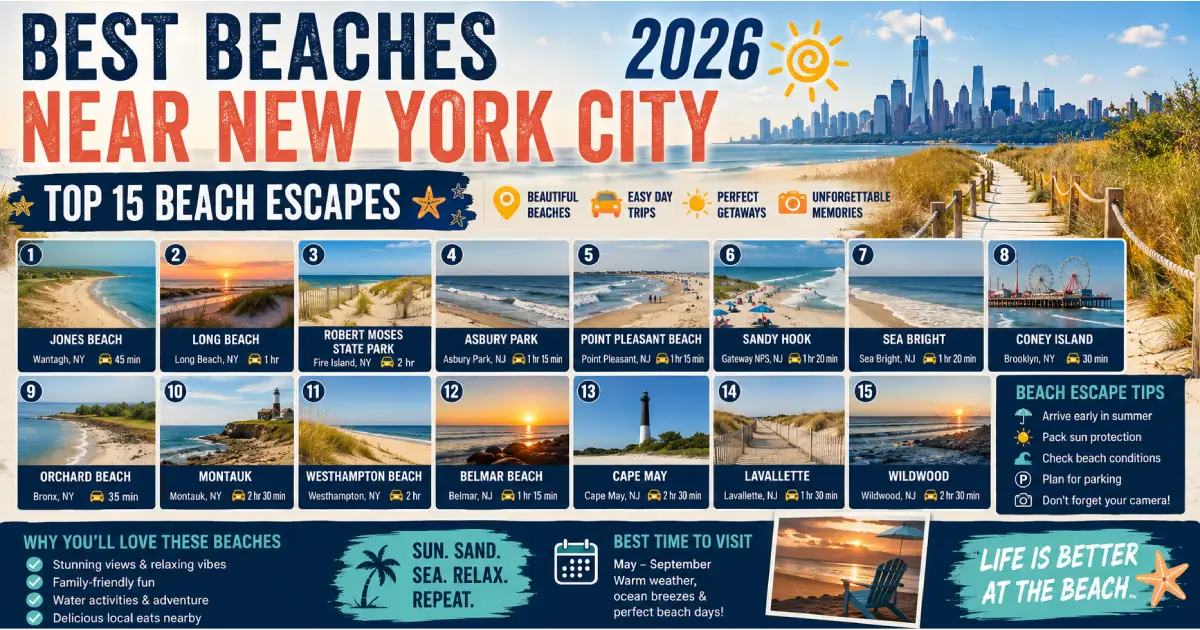
New York City’s reputation as a concrete metropolis obscures a genuinely surprising fact — the city itself contains 14 miles of public beaches across three boroughs (Brooklyn, Queens, and Staten Island), all reachable by subway for the cost of a single MetroCard swipe ($2.90), while the surrounding region (Long Island, New Jersey Shore, Connecticut coastline) offers some of the most celebrated beach destinations on the East Coast within 1–2.5 hours of Manhattan by Long Island Rail Road, NJ Transit, or ferry. The best beaches near New York City range from Coney Island’s historic boardwalk and amusement park atmosphere (subway-accessible, $0 to swim, iconic Americana) to the Hamptons’ exclusive sand and celebrity-spotting culture (1.5–3 hours by train, significant cost) to the Rockaways’ surf culture and food truck scene (subway-accessible, genuinely good waves for an urban beach).
What makes the NYC beach landscape genuinely unique is this accessibility gradient — a visitor staying in Manhattan can reach Coney Island or Rockaway Beach by subway in under an hour for free, spend the day swimming in the Atlantic, eating boardwalk food, and return to Manhattan by evening, all without renting a car or booking transportation in advance. For those willing to use Long Island Rail Road ($15–$30 round trip depending on destination and peak/off-peak timing) or the Hampton Jitney/ferry services, beaches further from the city (Long Beach, Jones Beach, Fire Island, the Hamptons) offer progressively less crowded, more “beach vacation” experiences while remaining feasible as day trips or short overnight excursions from New York City bases.
This guide covers the 15 best beaches near New York City — organized by accessibility (NYC subway-accessible beaches, Long Island Rail Road day-trip beaches, and further excursions requiring more planning) — with practical details on travel time, cost, crowd levels, and what makes each beach distinctive for 2026 summer visitors.
For complete guides, see our Best Places to Visit in New York City 2026, Things to Do in New York City 2026, and Best Time to Visit New York City guides.
| Beach | Location | Travel Time from Manhattan | Cost | Best For |
|---|---|---|---|---|
| Coney Island Beach | Brooklyn | 45–60 min (subway) | Free | Iconic boardwalk, amusement rides, families |
| Rockaway Beach | Queens | 60–75 min (subway) | Free | Surfing, food trucks, local vibe |
| Brighton Beach | Brooklyn | 50–60 min (subway) | Free | Russian food, quieter than Coney Island |
| South Beach (Staten Island) | Staten Island | 60–75 min (ferry + bus) | Free + ferry | Verrazzano Bridge views, boardwalk |
| Long Beach | Long Island | 1–1.5 hrs (LIRR) | $15–$25 (LIRR + beach fee) | Surf town atmosphere, day trip |
| Jones Beach | Long Island | 1.5 hrs (LIRR + bus) | $15–$30 (LIRR + parking/entry) | Massive beach, concerts, boardwalk |
| Robert Moses State Park | Long Island | 1.5–2 hrs | $20–$35 (LIRR + parking) | Less crowded, dunes, nature |
| Fire Island | Long Island | 2–2.5 hrs (LIRR + ferry) | $40–$60 | Car-free islands, LGBTQ+ communities, dunes |
| Sandy Hook | New Jersey | 1–1.5 hrs (ferry/NJ Transit) | $20–$45 | NYC skyline views, clothing-optional section |
| Asbury Park | New Jersey | 1.5–2 hrs (NJ Transit) | $20–$30 | Boardwalk culture, music venues, arts scene |
| The Hamptons (Main Beach, East Hampton) | Long Island | 2–3 hrs (LIRR/Jitney) | $50–$100+ | Luxury beach culture, celebrity-spotting |
| Montauk | Long Island | 3–3.5 hrs (LIRR) | $50–$100+ | Surfing, lighthouse, less formal than Hamptons |
| Orchard Beach | The Bronx | 60–75 min (subway + bus) | Free | “The Bronx Riviera,” large beach, Latin culture |
| Riis Beach (Jacob Riis Park) | Queens | 75–90 min (subway + bus) | Free | LGBTQ+ friendly, art deco bathhouse, quieter |
| Greenwich, CT (Tod’s Point) | Connecticut | 1–1.5 hrs (Metro-North) | $10 (non-resident parking varies) | Quiet Connecticut beach, day trip |
Location: Brooklyn | Travel Time: 45–60 minutes by subway (D/F/N/Q to Coney Island–Stillwell Ave) | Cost: Free | Best Time: Weekday mornings, June–early September
Coney Island is the original American beach resort — 2.7 miles of Atlantic Ocean beachfront with a 2.5-mile boardwalk (the Riegelmann Boardwalk, built 1923), Luna Park amusement rides (including the Cyclone, a 1927 wooden roller coaster designated a National Historic Landmark), and Nathan’s Famous original hot dog stand (1916, host of the annual Fourth of July Hot Dog Eating Contest broadcast nationally). The beach itself is wide, sandy, and free to access, with lifeguards on duty during summer months (typically late May through early September) and a genuinely festive atmosphere that combines beach culture with carnival energy.
Coney Island functions as New York City’s most democratic beach — on a hot summer weekend, the beach fills with families from every borough, every demographic, and every income level, creating a snapshot of New York’s diversity that few other single locations capture as completely. The amusement park (Luna Park, individual ride tickets $6–$12 or unlimited wristband $42) operates alongside the free beach, meaning visitors can swim, sunbathe, ride roller coasters, and eat boardwalk food (corn dogs, fried clams, frozen custard) all within the same afternoon.
The New York Aquarium ($26 adults, adjacent to the boardwalk) provides an air-conditioned alternative if beach conditions become too hot, while MCU Park (home of the Brooklyn Cyclones, NY Mets minor-league affiliate, $12–$20 tickets) hosts evening baseball games with ocean breeze and fireworks on select nights.
Insider tips: Summer weekends bring crowds exceeding 1 million visitors to Coney Island — arrive before 11 AM for reasonable beach space, or visit on weekday afternoons for a dramatically less crowded experience. The Cyclone roller coaster ($10) remains genuinely thrilling despite (or because of) its 1927 wooden construction — not recommended immediately after eating boardwalk food. Combine with Brighton Beach (15-minute walk east along the boardwalk) for a different neighborhood atmosphere and excellent Russian food.
Location: Queens | Travel Time: 60–75 minutes by subway (A train to Rockaway Park or Beach 90th St, or ferry from Wall Street/East 34th Street) | Cost: Free (ferry $4.50 each way) | Best Time: Weekday mornings, summer
Rockaway Beach is New York City’s surfing destination — 11 miles of beachfront along the Rockaway Peninsula, with designated surfing beaches (Beach 67th-69th, Beach 87th-92nd) where city-permitted surf schools operate alongside experienced local surfers, creating a genuine surf-town atmosphere unexpected within NYC limits. The beach itself is wider and less developed than Coney Island, with a boardwalk lined with food vendors that gained particular acclaim post-Hurricane Sandy rebuilding (2012-2015) — Rockaway Beach Surf Club, Rippers, and various taco and seafood vendors created a food scene that drew comparisons to trendier beach towns.
The NYC Ferry (Rockaway route, $4.50 each way, approximately 50 minutes from Wall Street/Pier 11 or East 34th Street) offers a scenic alternative to the subway, providing harbor and coastline views during the journey — particularly popular on summer weekends despite the additional cost compared to subway access.
Surfing here is genuinely viable — board rentals ($20-30/day) and lesson packages ($75-100 for group lessons) are available from several operators, and the Rockaways host actual surf competitions during summer months. Water quality has improved significantly since Hurricane Sandy infrastructure investments, though swimmers should check current advisories during/after heavy rain (combined sewer overflow can affect water quality temporarily).
Insider tips: Beach 96th-97th Street area has the best concentration of food vendors (Rippers, Rockaway Beach Bakery) for a beach-day meal without leaving the boardwalk. The A train to Rockaway Park takes considerably longer than the ferry but costs standard subway fare ($2.90) — worth the tradeoff for budget travelers, while the ferry suits those prioritizing experience and willing to pay the premium. Surf conditions are best in fall (September-October) when summer crowds diminish but water remains swimmable with wetsuits.
Location: Brooklyn | Travel Time: 50–60 minutes by subway (B/Q to Brighton Beach) | Cost: Free | Best Time: Weekday afternoons
Brighton Beach, immediately east of Coney Island along the same boardwalk, offers a beach experience embedded within “Little Odessa” — Brooklyn’s Russian and Ukrainian immigrant community, where Brighton Beach Avenue (running parallel to the boardwalk, beneath the elevated B/Q train tracks) hosts Russian grocery stores, restaurants, and bakeries that create one of NYC’s most distinctive ethnic-enclave-meets-beach combinations. The beach itself is contiguous with Coney Island’s sand but typically less crowded, particularly on the eastern end away from Coney Island’s amusement park draw.
The combination of beach access and immediately adjacent Russian/Ukrainian restaurants (Tatiana, Volna, and others along the boardwalk itself, offering outdoor seating with ocean views and menus featuring borscht, blini, and Black Sea-style grilled meats) creates a genuinely unusual beach-day option — swim, then eat a full Russian restaurant meal with ocean views, all without leaving the boardwalk.
Insider tips: The boardwalk restaurants (Tatiana being the most established, with DJ and dancing on summer evenings) offer a beach-club-like experience with bottle service and full meal options — a different vibe from typical NYC beach concessions. Brighton Beach Avenue’s Russian shops (M&I International Foods being the largest) offer excellent picnic provisions (smoked fish, pierogi, baked goods) at lower prices than boardwalk restaurants for those preferring a beach picnic.
Location: Staten Island | Travel Time: 60–75 minutes (Staten Island Ferry, free, plus local bus or 20-minute walk) | Cost: Free | Best Time: Weekday afternoons
South Beach offers a genuinely underrated NYC beach experience — a 2.5-mile boardwalk (the FDR Boardwalk, one of the longest in the world) with direct views of the Verrazzano-Narrows Bridge (the longest suspension bridge in the Americas at the time of its 1964 completion), significantly fewer crowds than Coney Island or Rockaway even on summer weekends, and a beach that benefits from the free Staten Island Ferry’s harbor crossing as part of the journey itself. The ferry ride alone (25 minutes, passing the Statue of Liberty) provides scenic value before even reaching the beach.
The boardwalk includes a skate park, basketball courts, and a fishing pier, creating a more “local recreation area” atmosphere than the tourist-oriented Coney Island — South Beach functions primarily as a Staten Island residents’ beach, meaning visitors experience a genuinely different (quieter, more neighborhood-oriented) side of NYC beach culture.
Insider tips: Combine South Beach with the Staten Island Ferry’s harbor views (Statue of Liberty visible during crossing, free) for a beach day that includes one of NYC’s best free scenic experiences as a bonus. The walk from the ferry terminal to South Beach (approximately 20-25 minutes) passes through residential Staten Island neighborhoods, offering a glimpse of the borough’s more suburban character compared to Manhattan/Brooklyn density.
Location: The Bronx (Pelham Bay Park) | Travel Time: 60–75 minutes (subway to Pelham Bay Park, then Bx12 or Bx29 bus) | Cost: Free | Best Time: Weekday mornings, summer
Orchard Beach, nicknamed “The Bronx Riviera” since its 1930s Robert Moses-era construction, offers a 1.1-mile crescent-shaped artificial beach within Pelham Bay Park — the largest park in New York City (three times the size of Central Park), providing a beach experience surrounded by significantly more greenery and natural setting than Coney Island or Rockaway. The beach attracts a predominantly local Bronx and Latin American community, with the pavilion area (Art Deco-influenced 1930s architecture) hosting salsa and merengue music on summer weekends, creating one of NYC’s most vibrant cultural beach atmospheres.
The surrounding Pelham Bay Park offers additional activities beyond the beach itself — hiking trails, Hunter Island’s nature trails (a former island now connected to the mainland, offering rocky coastline distinct from the sandy beach), and Split Rock Golf Course for those seeking non-beach activities during a Pelham Bay Park visit.
Insider tips: The bus connection from Pelham Bay Park subway station (the last stop on the 6 train) adds time compared to direct-subway beaches, but the relative remoteness means significantly smaller crowds than Coney Island even during peak summer weekends. Hunter Island’s nature trails (accessible from the northern end of Orchard Beach) offer a genuinely different NYC experience — rocky New England-style coastline and forest trails within city limits.
Location: Queens (Rockaway Peninsula, west end) | Travel Time: 75–90 minutes (subway to Flatbush Ave-Brooklyn College then Q35 bus, or Rockaway ferry plus local transport) | Cost: Free | Best Time: Weekday afternoons
Jacob Riis Park, part of the Gateway National Recreation Area (meaning it’s federally managed, distinct from NYC Parks-managed beaches), offers a 1930s Art Deco bathhouse building (currently being restored, originally one of the most architecturally significant beach pavilions on the East Coast) and a stretch of beach (particularly the eastern “Bay” section, sometimes called “People’s Beach”) that has been an established LGBTQ+ gathering spot since at least the 1940s, maintaining that character today as a welcoming, community-oriented beach atmosphere distinct from more family-oriented sections.
The beach itself offers wide sand, generally calmer waters than the open-ocean Rockaway sections further east, and a less commercialized atmosphere (fewer food vendors, more “bring your own” beach culture) than Coney Island. The federal management means certain regulations differ slightly from city beaches (alcohol policies, for instance), so checking current National Park Service guidelines before visiting is worthwhile.
Insider tips: The “People’s Beach” (eastern section, near Jacob Riis Park’s eastern parking lot) maintains its historic LGBTQ+ community character — visitors should be aware of and respectful toward this established community space. The bathhouse building, even mid-restoration, remains a notable piece of 1930s public architecture worth viewing even for those not specifically beach-bound.
Location: Long Island, Nassau County | Travel Time: 1–1.5 hours (LIRR from Penn Station, Long Beach branch, direct) | Cost: ~$15-22 round trip LIRR (off-peak/peak varies) + beach fee ($12-15 weekdays, more weekends) | Best Time: Weekdays, June–September
Long Beach represents the closest genuine “beach town” experience to Manhattan — a 2.5-mile barrier island beach with a 2.2-mile boardwalk, year-round residential community (meaning actual beach-town infrastructure: surf shops, beach bars, restaurants that operate beyond tourist season), and direct LIRR service that makes it the most logistically simple “real beach” day trip from NYC. The boardwalk (rebuilt after Hurricane Sandy with reinforced, elevated construction) supports a thriving surf culture, with Long Beach hosting regular surf competitions and maintaining one of the East Coast’s most consistent urban-adjacent surf breaks.
The town itself (separate from the beach) offers a walkable downtown with restaurants and shops, making Long Beach viable as either a pure beach day or a combination beach-and-town exploration. Beach access requires a daily fee (non-residents pay $12-20 depending on day/season) collected at beach entrances during summer season.
Insider tips: The LIRR Long Beach branch runs direct from Penn Station (no transfers required) — check schedules for the fastest off-peak trains, as some services involve a transfer at Lynbrook depending on time of day. Surfboard and wetsuit rentals are available near the boardwalk for those wanting to try surfing without equipment investment — Long Beach’s breaks are generally more beginner-friendly than Rockaway’s more challenging sections.
Location: Long Island, Nassau County | Travel Time: 1.5 hours (LIRR to Freeport or Wantagh, then bus; or direct bus from Manhattan in summer) | Cost: ~$15-25 LIRR + $10 parking (if driving) or bus fare | Best Time: Weekdays, or for evening concerts
Jones Beach State Park, opened in 1929 as Robert Moses’s signature public works project, remains one of the largest and most architecturally distinctive public beaches in the United States — 6.5 miles of beachfront, a 2-mile boardwalk, the iconic Jones Beach Water Tower (a 231-foot Art Deco landmark visible from miles away, modeled loosely on the campanile in Venice’s St. Mark’s Square), and the Northwell Health at Jones Beach Theater (an outdoor amphitheater hosting major concert tours throughout summer, with ocean views from many seats).
The sheer scale of Jones Beach (six distinct numbered fields, each essentially its own beach area with parking) means crowds distribute across a much larger area than smaller beaches — even on busy summer weekends, walking 10-15 minutes from main entrance areas typically finds significantly more space. The beach includes a 2-mile boardwalk with food concessions, mini-golf, and a large outdoor pool (separate admission) for those preferring chlorinated swimming to ocean conditions.
Insider tips: Concerts at the Jones Beach Theater (summer season, major touring acts) combine beach-day logistics with evening entertainment — many concertgoers arrive early afternoon for beach time before evening shows. Field 6 (West End) tends to have a more local, less crowded character than the more heavily-trafficked central fields near the water tower and boardwalk.
Location: Long Island (Fire Island, western end) | Travel Time: 1.5–2 hours (LIRR to Babylon, then bus or taxi to park) | Cost: ~$20-30 LIRR + $10 parking | Best Time: Weekdays, less crowded than Jones Beach
Robert Moses State Park occupies the western tip of Fire Island (accessible by causeway/bridge, unlike most of Fire Island which requires ferry access) — offering a beach experience with significantly more natural dune landscape and less development than Jones Beach, while remaining accessible by car/bus without requiring the ferry crossing that defines most Fire Island access. The park’s location at Fire Island’s western tip places it near the Fire Island Lighthouse (a National Historic Landmark, climbable for park visitors, offering views extending to the NYC skyline on clear days).
The relative remoteness (longer LIRR journey, requiring bus/taxi connection from Babylon station) keeps crowds noticeably lower than closer-in beaches, while the dune-backed beach landscape provides a more “wild Atlantic coastline” feel than the boardwalk-heavy beaches closer to the city.
Insider tips: The Fire Island Lighthouse climb (additional small fee, separate from beach access) provides one of the only elevated views of NYC’s skyline from a genuinely “beach vacation” setting — on clear days, Manhattan’s skyscrapers are visible across the bay. Field 2 and Field 5 (the park’s main developed areas) have facilities; the areas between fields offer more secluded, less-visited beach sections for those willing to walk.
Location: Long Island (barrier island) | Travel Time: 2–2.5 hours (LIRR to Bay Shore/Sayville/Patchogue, then ferry, 30-45 min crossing) | Cost: ~$40-60 (LIRR + ferry round trip) | Best Time: Weekdays, full-day commitment
Fire Island represents one of the most distinctive beach experiences within reach of New York City — a 32-mile barrier island where most communities prohibit cars entirely (transportation is by foot, bicycle, or small wagon), creating an atmosphere unlike anywhere else in the New York metropolitan area. The island contains numerous distinct hamlets, each with its own character: Cherry Grove and the Pines are internationally renowned LGBTQ+ vacation communities with a decades-long history as safe havens and vibrant social scenes; Ocean Beach offers a more family-oriented village atmosphere with shops and restaurants; and Sailors Haven/Sunken Forest preserves a rare maritime holly forest accessible via boardwalk trails.
The ferry journey itself (from Bay Shore, Sayville, or Patchogue depending on destination community) adds to the “getting away” feeling — Fire Island genuinely feels removed from New York City despite being within day-trip range, with beaches that are consistently less crowded than mainland Long Island beaches due to the additional access friction (LIRR plus ferry) that limits casual visitation.
Insider tips: Different ferry terminals serve different Fire Island communities — research which community matches your interests (Cherry Grove/Pines for LGBTQ+ nightlife and beach culture, Ocean Beach for family-friendly village atmosphere, Sailors Haven for nature trails) before booking LIRR tickets, as terminals aren’t interchangeable without significant additional travel. The Sunken Forest boardwalk trail (Sailors Haven) offers a genuinely unique ecosystem — one of the few remaining maritime holly forests on the East Coast, accessible via an easy 1.5-mile boardwalk loop.
Location: New Jersey (Gateway National Recreation Area) | Travel Time: 1–1.5 hours (NYC Ferry from Wall Street/Pier 11, seasonal; or NJ Transit + local bus) | Cost: ~$20-45 (ferry) or $20-30 (NJ Transit + bus) + $20 parking if driving | Best Time: Weekdays, ferry for scenic value
Sandy Hook offers a genuinely unusual perspective — a New Jersey beach (part of the federally-managed Gateway National Recreation Area, the same designation as Jacob Riis Park) where the Manhattan skyline remains visible across Lower New York Bay, creating beach photographs that combine sand, ocean, and the iconic NYC skyline in a single frame unavailable from any NYC beach itself (which face away from Manhattan toward open ocean). The peninsula includes multiple beach areas, the historic Sandy Hook Lighthouse (1764, one of the oldest operating lighthouses in the United States), and Gunnison Beach — a clothing-optional beach that’s one of the largest and most established nude beaches on the East Coast.
The seasonal NYC Ferry service (Sandy Hook route, operating roughly May through September) provides the most scenic access — a journey across New York Harbor with extended skyline and Statue of Liberty views, landing directly at Sandy Hook’s Horseshoe Cove. NJ Transit combined with local bus service offers a land-based alternative for off-season visits or those preferring not to use ferry transport.
Insider tips: Gunnison Beach (clothing-optional) is clearly designated and separated from family beach areas — visitors should be aware of which beach area they’re entering. The ferry crossing itself, particularly in late afternoon with the sun beginning to lower behind Manhattan’s skyline, provides photography opportunities that rival many paid “skyline tour” boat experiences at a fraction of the cost.
Location: New Jersey Shore | Travel Time: 1.5–2 hours (NJ Transit from Penn Station, North Jersey Coast Line, direct) | Cost: ~$20-30 round trip NJ Transit + beach badge ($5-10) | Best Time: Weekends for music venues, weekdays for beach
Asbury Park combines beach access with significant American music history — the Stone Pony (the legendary venue where Bruce Springsteen and Jon Bon Jovi developed early careers, still operating as a live music venue) anchors a boardwalk that has undergone substantial revitalization over the past two decades, transforming from a declined mid-century resort town into one of the New Jersey Shore’s most culturally vibrant destinations. The beach itself requires a “beach badge” (daily fee, $5-10 depending on season) typical of New Jersey Shore towns, with the boardwalk offering restaurants, bars, and the historic (currently being redeveloped) Asbury Park Convention Hall.
The town beyond the boardwalk has developed a notable arts and LGBTQ+-friendly scene, with restaurants and shops reflecting Asbury Park’s identity as a New Jersey Shore alternative to more traditional family-resort towns — appealing to visitors seeking beach access combined with nightlife and cultural programming beyond typical shore-town offerings.
Insider tips: The direct NJ Transit North Jersey Coast Line service from Penn Station (no transfers) makes Asbury Park one of the more straightforward NJ Shore day trips despite the longer overall travel time compared to Long Island beaches. Evening shows at the Stone Pony (check schedule in advance) can transform a beach day into a beach-day-plus-concert experience for those willing to extend into evening hours.
Location: Long Island, Suffolk County (East Hampton) | Travel Time: 2–3 hours (LIRR to East Hampton, or Hampton Jitney bus from Manhattan) | Cost: $50-100+ (LIRR/Jitney round trip + beach parking $30-50 for non-residents on weekends) | Best Time: Weekdays, off-peak season (June or September)
The Hamptons represent New York’s most internationally recognized luxury beach destination — Main Beach in East Hampton consistently rates among the most beautiful beaches in the United States (white sand, dunes, relatively clean water), while the surrounding villages (East Hampton, Southampton, Sag Harbor) offer high-end shopping, dining, and the celebrity-spotting culture that has defined “the Hamptons” in popular media for decades. Summer weekends bring the Hamptons’ most intense crowds and pricing — beach parking restricted to residents/permit-holders on weekends at many beaches, restaurant reservations extremely competitive, and overall costs significantly elevated compared to weekday visits.
For day-trippers without cars, beach access without local parking permits can be genuinely challenging on summer weekends — Main Beach and other popular East Hampton beaches restrict non-resident parking, meaning visitors without permits may need to walk significant distances from available parking or rely on limited public transport options within the Hamptons themselves (which, unlike NYC, has minimal public transit infrastructure).
Insider tips: Weekday visits (particularly Tuesday-Thursday) dramatically reduce both costs and crowding compared to the renowned weekend intensity — Hamptons weekday beaches can feel almost empty compared to the same locations on Saturday. The Hampton Jitney (luxury bus service, $40-50 round trip from Manhattan) drops passengers in town centers, but reaching specific beaches typically requires additional transport (taxi, bike rental, or walking) given limited public transit within the Hamptons themselves — research specific beach access logistics before committing to a Hamptons day trip without a car.
Location: Long Island, Suffolk County (eastern tip) | Travel Time: 3–3.5 hours (LIRR direct to Montauk, longest LIRR route) | Cost: $50-80 round trip LIRR + beach access (often free or low-cost compared to Hamptons) | Best Time: Weekdays, shoulder season (late spring/early fall for surfing)
Montauk, at Long Island’s easternmost point, offers a more casual, surf-oriented beach culture than the formal Hamptons villages closer to the city — Ditch Plains Beach is one of the East Coast’s most renowned surf breaks, drawing experienced surfers for consistent waves, while the Montauk Point Lighthouse (1796, one of the oldest lighthouses in the United States, commissioned by George Washington) anchors the area’s most dramatic coastal scenery at the easternmost tip of Long Island.
The town itself maintains a working fishing-village character alongside its beach-tourism economy — Montauk’s harbor remains an active commercial fishing port, and the overall atmosphere (despite increasing trendiness and rising prices in recent years) retains more “beach town” informality than the manicured Hamptons villages, with surf shops, casual seafood restaurants, and a younger demographic drawn by surfing culture.
Insider tips: The direct LIRR route to Montauk (no transfers, though the longest single LIRR journey from Manhattan at 3+ hours) makes it logistically simple despite the distance — many visitors choose to make Montauk an overnight trip given the travel time investment, though dedicated day-trippers can manage a (long) single-day visit by taking early morning trains. Ditch Plains Beach is specifically the surfing destination — other Montauk beaches (Montauk Downs State Park beach areas) offer calmer swimming for non-surfers.
Location: Greenwich, Connecticut | Travel Time: 1–1.5 hours (Metro-North New Haven Line from Grand Central to Greenwich, then taxi/bus to park) | Cost: ~$20-30 round trip Metro-North + non-resident parking/entry fee (varies, check current rates) | Best Time: Weekdays
Tod’s Point, officially Greenwich Point Park, represents the most accessible Connecticut beach option from Manhattan via Metro-North’s New Haven Line (Grand Central Terminal departure, roughly 45-50 minutes to Greenwich station). The park offers a peninsula with beach areas on both Long Island Sound sides, walking/biking paths around the perimeter, and a noticeably different character from NYC-area Atlantic beaches — Long Island Sound’s calmer waters (compared to open Atlantic) create a more lake-like swimming experience, while the affluent Greenwich setting provides a quieter, more residential beach-town atmosphere.
Non-resident access policies have varied over the years (Greenwich has at times restricted non-resident access or charged premium fees) — checking current Greenwich Parks Department policies before planning a visit is essential, as policies can change seasonally or annually.
Insider tips: The Metro-North journey itself (Grand Central to Greenwich) passes through Connecticut’s Gold Coast communities, offering scenic value distinct from Long Island Rail Road’s more suburban Long Island scenery. Given the variable non-resident access policies, calling ahead or checking the Greenwich Parks Department website immediately before a planned visit is recommended to confirm current entry requirements and costs.
Coney Island, Rockaway Beach, Brighton Beach, Orchard Beach — all reachable via standard $2.90 subway fare with free beach access, representing genuine ocean swimming within NYC limits.
Rockaway Beach (subway-accessible, established surf schools) or Long Beach (LIRR, beginner-friendly breaks) for closer options; Montauk’s Ditch Plains for serious surfers willing to commit to the longer trip.
Sandy Hook, New Jersey — the only beach option where the Manhattan skyline remains visible across the water, particularly dramatic via the seasonal NYC Ferry route.
Long Beach — direct LIRR access, year-round residential beach town infrastructure, significantly more affordable than the Hamptons while offering genuine boardwalk/surf-town atmosphere.
Jacob Riis Park (Riis Beach) for subway-accessible options, or Fire Island’s Cherry Grove and the Pines for an immersive car-free island community experience.
The Hamptons (Main Beach, East Hampton) — though weekday visits are strongly recommended given weekend parking restrictions and crowd intensity.
About Travel Tourister Travel Tourister’s destination specialists have explored beaches across the New York metropolitan area — from subway rides to Coney Island and Rockaway surf sessions to Hamptons weekday escapes and Fire Island’s car-free communities — to deliver the most practical and honest guide to the best beaches near New York City for 2026 visitors of every budget.
Posted By : Vinay
Latest Article
2nd Floor, 39, Above Kirti Club, DLF Industrial Area, Kirti Nagar, New Delhi, Delhi 110015



Travel Tourister is a leading Travel portal where we introduce travellers to trusted travel agents to make their journey hasselfree, memorable And happy. Travel Tourister is a platform where travellers get Tour packages ,Hotel packages deals through trusted travel companies And hoteliers who are working with us across the world. We always try to find new and more travel agents and hoteliers from every nook and corners across the world so that you could compare the deals with different travel agents and hoteliers and book your tour or hotel with the one you have chosen according to your taste and budget.
Copyright © Travel Tourister, India. All Rights Reserved

 Call
Call Enquiry