Published on : 12 Jun 2026
By Travel Tourister | Updated June 2026
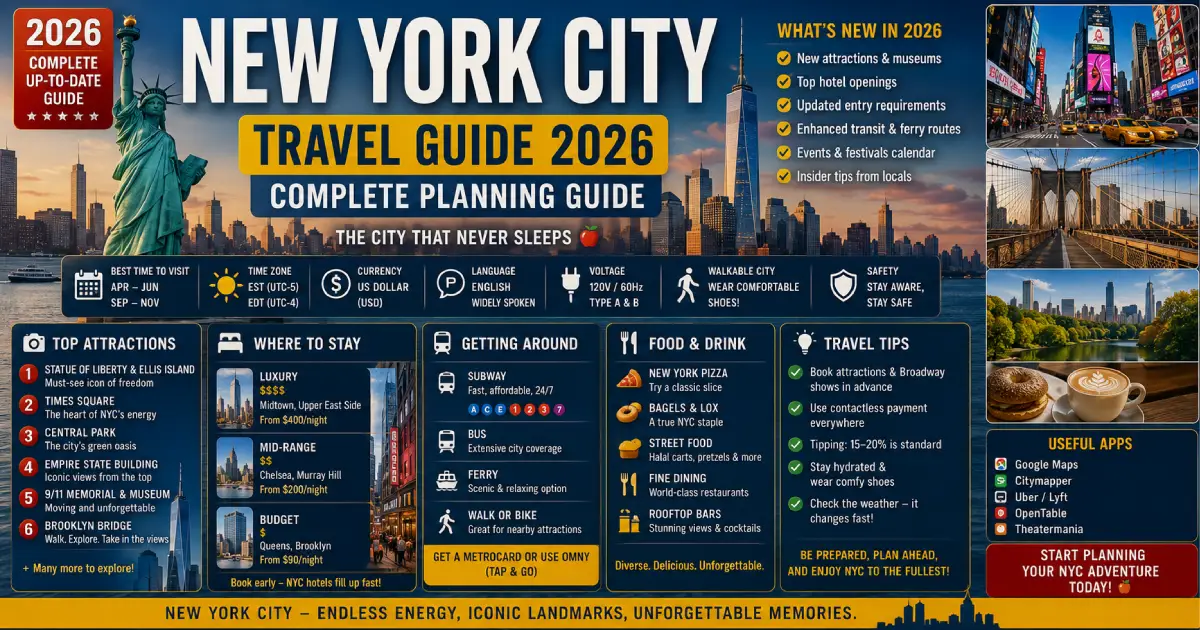
New York City overwhelms first-time visitors more than almost any other destination on Earth — 8.3 million residents across five boroughs, 472 subway stations, 800+ languages spoken, and a density of world-class attractions so extreme that even visitors who’ve researched extensively often arrive without a clear sense of how the city actually fits together geographically and logistically. This New York City travel guide exists to solve that problem — providing the foundational orientation (how the boroughs relate to each other, how the subway actually works, where to base yourself, how much to budget) that makes every other NYC guide (places to visit, things to do, restaurants, beaches) immediately more useful because you understand the city’s underlying structure.
Unlike destinations where a few days of research covers the essentials, New York City rewards genuine pre-trip orientation — understanding that “Midtown” and “Downtown” aren’t just directions but distinct experiences with different paces, that the subway’s express/local distinction can save or cost you 20 minutes depending on whether you know which platform to stand on, and that neighborhoods within walking distance of each other (SoHo and the Lower East Side, for instance) can feel like entirely different cities in character. This guide covers everything needed to plan a 2026 New York City trip — from choosing where to stay and understanding the subway system to budgeting realistically and avoiding the mistakes that turn a NYC trip from exhilarating into exhausting.
For specific recommendations, see our companion guides: Best Places to Visit in New York City 2026, Things to Do in New York City 2026, Best Restaurants in New York City 2026, Best Time to Visit New York City, and Best Beaches Near New York City.
| Category | Details |
|---|---|
| Population | 8.3 million (NYC), 20 million+ (metro area) |
| Boroughs | Manhattan, Brooklyn, Queens, The Bronx, Staten Island |
| Main Airports | JFK, LaGuardia (LGA), Newark (EWR) |
| Currency | US Dollar (USD) |
| Languages | English primary; 800+ languages spoken citywide |
| Time Zone | Eastern Time (ET) |
| Subway Fare | $2.90 per ride (unlimited transfers within 2 hours) |
| Tipping Norm | 18–20% at restaurants, $1–2/bag for hotel staff |
| Best First-Time Stay Area | Midtown or Lower Manhattan (central, walkable to major sights) |
| Average Daily Budget (Mid-Range) | $250–$400/person (hotel, food, attractions, transport) |
New York City consists of five boroughs, each technically also a county of New York State — a structure that surprises many visitors who assume “New York City” refers only to Manhattan. Understanding what each borough offers (and how they connect) is the foundation of effective trip planning.
Manhattan is the borough most visitors mean when picturing “New York City” — the dense island containing Times Square, Central Park, the Empire State Building, Wall Street, and Museum Mile. Manhattan itself divides into informal zones: Downtown/Lower Manhattan (Financial District, Tribeca, SoHo, Greenwich Village, East Village, Lower East Side — historic, walkable, irregular streets south of 14th Street), Midtown (14th Street to 59th Street — Times Square, Empire State Building, Broadway, most business hotels, the most “iconic NYC” visual experience), and Upper Manhattan (59th Street north — Central Park, Museum Mile, Upper East Side, Upper West Side, Harlem).
Brooklyn is NYC’s most populous borough and, for many visitors, contains the experiences that feel most “authentically New York” in 2026 — DUMBO’s bridge views, Williamsburg’s restaurant scene, Park Slope’s brownstones, Coney Island’s beach, and Prospect Park’s green space. Brooklyn connects to Manhattan via numerous subway lines plus the iconic Brooklyn Bridge, Manhattan Bridge, and Williamsburg Bridge (all walkable).
Queens is NYC’s largest borough by area and most ethnically diverse — Flushing’s Chinatown (larger than Manhattan’s), Astoria’s Greek community, Long Island City’s waterfront skyline views, and both major airports (JFK and LaGuardia) are located here. The 7 train through Queens is often called the “International Express” for the food diversity along its route.
The Bronx is home to the Bronx Zoo (America’s largest metropolitan zoo), Yankee Stadium, the New York Botanical Garden, and Orchard Beach — generally visited for specific destinations rather than general exploration, with Metro-North providing faster access than subway for several Bronx attractions.
Staten Island is the most suburban-feeling borough, primarily visited via the free Staten Island Ferry (which itself, with its Statue of Liberty views, is one of NYC’s best free activities) — most visitors experience Staten Island as a round-trip ferry ride rather than an extended destination, though South Beach and the Staten Island September 11 Memorial offer reasons for longer visits.
JFK is NYC’s primary international gateway, located in Queens approximately 16 miles from Midtown Manhattan. The AirTrain JFK ($8.50, connects to subway via Jamaica Station for an additional $2.90, or to Howard Beach for the A train) provides the most economical connection to Manhattan, typically taking 60-75 minutes total to Midtown depending on subway conditions. Taxis from JFK to Manhattan operate on a flat rate (approximately $70 plus tolls and tip as of 2025-2026 rates, verify current rate), taking 45-60 minutes depending on traffic. Ride-share (Uber/Lyft) typically costs $55-85 depending on demand and destination, with similar travel times to taxis.
LaGuardia, primarily serving domestic flights, sits closer to Manhattan (approximately 8 miles) but has historically lacked direct subway/AirTrain connections — the Q70 Select Bus (free, connects to the 7 train at 74th St-Broadway and E/M/R trains at Jackson Heights-Roosevelt Ave) combined with subway provides the budget option (total approximately $2.90, 45-60 minutes to Midtown). Taxis/ride-share to Manhattan typically run $35-55 plus tolls, taking 30-45 minutes depending on traffic (LaGuardia traffic can be notoriously unpredictable).
Newark, despite being in New Jersey, serves as a major NYC gateway, located approximately 16 miles from Midtown. The AirTrain Newark ($8.50) connects to NJ Transit or Amtrak trains to Penn Station Manhattan (total approximately $13-16, 30-45 minutes) — generally the fastest and most reliable transit option among the three airports given dedicated rail infrastructure. Taxis/ride-share to Manhattan run $70-100 plus tolls, with significant traffic variability (45-75 minutes).
Insider tip: For visitors prioritizing cost and willing to navigate transit with luggage, all three airports offer sub-$20 connections to Manhattan via AirTrain/bus plus subway/rail combinations — but factor in 60-90 minutes total transit time plus the logistics of navigating subway turnstiles and stairs with luggage (NYC subway accessibility varies significantly by station, with many stations lacking elevators).
Midtown (roughly 34th to 59th Streets) offers the highest concentration of hotels at every price point, walking distance to Times Square, Broadway theaters, Empire State Building, and Rockefeller Center, plus excellent subway connectivity (multiple lines converge at major Midtown stations). The tradeoff is Midtown’s intensity — constant crowds, higher noise levels, and a more purely “tourist zone” character than neighborhoods further downtown or in Brooklyn. Hotel prices here are among NYC’s highest, particularly near Times Square itself.
Best for: First-time visitors prioritizing proximity to iconic landmarks and Broadway, those with mobility considerations (excellent subway access reduces walking distances to attractions), business travelers.
Lower Manhattan offers a different NYC experience — narrower, irregular streets (pre-dating the 1811 grid plan), proximity to 9/11 Memorial, Statue of Liberty ferries, Brooklyn Bridge, and increasingly residential character (particularly Tribeca and Financial District, both having converted significant office space to residential/hotel use in recent decades) that creates a quieter evening atmosphere than Midtown. SoHo and Tribeca offer some of NYC’s best shopping and dining, generally at premium prices reflecting the neighborhoods’ upscale character.
Best for: Visitors prioritizing 9/11 Memorial, Statue of Liberty, Brooklyn Bridge access, and downtown dining/shopping; those preferring quieter evenings outside Midtown’s intensity.
The Upper West Side (roughly 59th to 110th Streets, west of Central Park) offers a more residential, “real New York neighborhood” atmosphere while remaining close to Central Park, the American Museum of Natural History, and Lincoln Center. Generally calmer than Midtown with excellent (though slightly less central) subway access, and often offering better value for larger rooms/apartment-style accommodations compared to equivalent Midtown pricing.
Best for: Families (proximity to Central Park, AMNH, generally calmer evening atmosphere), longer stays prioritizing residential neighborhood feel, museum-focused visitors.
Staying in Brooklyn — particularly Williamsburg (trendy restaurants/nightlife, L train access to Manhattan), DUMBO (waterfront views, Brooklyn Bridge proximity), or Brooklyn Heights (historic brownstones, promenade with Manhattan skyline views) — offers a genuinely different experience: often better hotel value than equivalent Manhattan options, a “lived-in” neighborhood atmosphere, and direct access to Brooklyn’s restaurant/nightlife scene, while remaining 15-25 minutes by subway from Manhattan’s major attractions.
Best for: Repeat visitors or those prioritizing Brooklyn’s food/nightlife scene, value-conscious travelers, those wanting a quieter “residential” evening base with easy Manhattan access.
The New York City subway is the single most important tool for navigating the city efficiently — 472 stations, 24-hour service (a rarity among major world subway systems), and a network covering all boroughs except limited direct Staten Island connection (served by the separate Staten Island Railway plus the free ferry to Manhattan).
As of 2025-2026, the subway fare is $2.90 per ride with unlimited transfers between subway and bus within a 2-hour window. Payment is via OMNY (tap-to-pay using contactless credit/debit cards or smartphone payment apps — Apple Pay, Google Pay) at turnstiles, which has largely replaced the physical MetroCard system, though MetroCard vending machines remain available for those preferring physical cards or lacking contactless payment methods. OMNY also offers fare capping — after a certain number of rides within a 7-day period (12 rides), subsequent rides that week become free, automatically creating an “unlimited weekly” benefit without needing to purchase a separate unlimited pass.
A critical subway concept for efficient navigation: many subway lines run both express (skipping stations, faster for longer distances) and local (stopping at every station) services, often on the same platform with different trains. Express trains are indicated by a different colored circle/letter designation and skip multiple stations — taking a local train when an express was available (or vice versa, when you needed a local stop that the express skips) is one of the most common navigation errors for visitors. Google Maps and the MTA’s official app (MYmta) both provide real-time, accurate routing that accounts for express/local distinctions — using one of these apps rather than relying on memorized routes is strongly recommended.
The NYC subway operates 24/7 and is generally safe for tourists exercising normal urban awareness — keep belongings secure (particularly in crowded cars), be aware of surroundings on platforms (standing away from the platform edge, particularly late at night), and note that while the subway is extensively used by visitors, certain late-night hours on certain lines see reduced service frequency and different rider demographics than daytime — standard urban travel awareness applies without requiring excessive caution.
Insider tip: Download the MYmta app (official MTA app) before arrival — it provides real-time train arrival information, service alerts (planned and unplanned changes are common, particularly on weekends when maintenance work frequently reroutes services), and station maps that are more reliable than older printed subway maps which can become outdated as service patterns change.
New York City spans an enormous price range — the same day could theoretically include a free museum visit (many offer “pay what you wish” hours), a $3.50 pizza slice lunch, and a $200 Broadway ticket for the evening. Understanding realistic budgets across traveler types helps with both planning and expectation-setting.
Hostel or budget hotel ($60-100/night for a private room, $40-60 for hostel dorm beds), subway-based transportation ($2.90/ride or weekly cap around $34), meals from food carts, pizza slices, and casual ethnic restaurants ($10-20/meal), free or low-cost activities (Staten Island Ferry, free museum hours, walking tours of neighborhoods, Central Park, Brooklyn Bridge). This budget level requires choosing free/discounted activities deliberately and avoiding sit-down restaurant meals for most dining.
Mid-range hotel ($200-350/night for a standard Manhattan hotel room, varying significantly by neighborhood and season), subway plus occasional taxis/rideshare, mix of casual and sit-down restaurant meals ($30-60/meal at mid-range restaurants), paid attractions (museums at standard admission, observation decks, etc., $30-50 each), and potentially one Broadway show during the trip ($100-200/ticket with some advance planning or discount strategies).
High-end hotels ($500-1000+/night for 4-5 star properties in prime locations), private transportation/car services, fine dining including potential Michelin-starred experiences ($150-350+/person for tasting menus), premium Broadway seating ($200-350/ticket for prime orchestra seats), and private tours/experiences.
Insider tip: The largest variable cost is accommodation — NYC hotel prices fluctuate dramatically by season (December holiday weeks and major events can double “normal” rates) and by exact neighborhood (a hotel two blocks from Times Square can cost 30-40% more than an equivalent property in a less iconic but still convenient location). Booking accommodations 2-3 months ahead for summer/December travel, and being flexible about exact neighborhood within “convenient” zones, provides the most meaningful budget control.
NYC CityPASS and similar bundled-ticket products (combining several major attractions — Empire State Building, museums, observation decks — at a discount versus individual tickets) can provide genuine savings if your itinerary naturally includes 3+ of the included attractions. Calculate individual ticket costs for your specific planned attractions before purchasing bundles — bundles save money only when your actual plans align with included attractions, and committing to a bundle can create pressure to visit attractions primarily because they’re “included” rather than because they fit your interests.
Several major museums offer free or “pay what you wish” admission during specific hours — MoMA (free Fridays 5:30-9 PM, arrive by 4:45 PM to avoid extended queues), the Whitney (Friday evenings, pay what you wish), and the Guggenheim (Saturday evenings 5-8 PM, pay what you wish). The Met’s “suggested” $30 admission is technically pay-what-you-wish for all visitors (not just NY residents as commonly misunderstood) though the museum’s framing makes this less obvious than at other institutions — visitors on tight budgets can pay less than the suggested amount.
Beyond full-price tickets ($100-350+), several discount channels exist: TKTS (47th Street booth, same-day tickets 20-50% off, best for flexible visitors), digital lotteries (TodayTix and individual show apps, $25-40 tickets via daily lottery, requires entering by specific deadlines and accepting uncertainty), and rush tickets (released morning-of for specific shows, $25-40, often requiring early-morning queuing or digital rush at specific times). Combining flexibility (not committing to a specific show until close to the date) with willingness to use lottery/rush systems can reduce Broadway costs by 50-70% compared to advance full-price booking.
The Staten Island Ferry (free, Statue of Liberty views), walking the Brooklyn Bridge (free, iconic skyline views), the High Line (free, elevated park), Central Park (free, 843 acres), and free kayaking on the Hudson River (summer, community boathouses) represent experiences that genuinely compete with paid attractions in quality — building these into itineraries reduces both costs and the sense that “everything in NYC costs money.”
NYC’s grid (in Midtown/Uptown areas) creates a deceptive sense of proximity — “just a few blocks” can represent 15-20 minutes of walking, particularly crossing avenues (which are typically longer than the north-south blocks). Subway transfers, particularly at large stations (Times Square, Union Square, Atlantic Avenue-Barclays Center), can themselves require 5-10 minutes of walking underground between platforms — factor this into time estimates, particularly when connecting to time-sensitive activities (Broadway curtain times, restaurant reservations).
The density of NYC attractions creates pressure to “fit everything in” — but the combination of subway transit time, walking distances, and the genuine time required to properly experience major attractions (the Met alone rewards 3+ hours; Central Park can absorb an entire day) means that scheduling 5-6 “major” activities in a single day typically results in rushed, unsatisfying versions of each rather than meaningful experiences of 2-3. Building in buffer time, and accepting that “seeing everything” isn’t realistic even across a week-long visit, improves overall trip satisfaction significantly.
Restaurants immediately adjacent to major attractions (Times Square, near major museums) frequently offer lower quality at higher prices than restaurants just a few blocks away in less tourist-saturated areas — a short subway ride or 10-minute walk to an adjacent neighborhood often yields significantly better dining options at comparable or lower prices. Researching specific restaurant recommendations (rather than simply choosing whatever is nearest to your current location) meaningfully improves NYC dining experiences.
NYC sightseeing involves substantial walking on hard surfaces (sidewalks, subway stairs, museum floors) — footwear prioritizing fashion over comfort frequently results in foot pain that genuinely impairs multi-day visits. This applies across seasons: summer sandals that lack support, winter boots that aren’t actually warm enough for extended outdoor waiting (for Broadway rush tickets, TKTS lines, or simply walking between subway stations in cold weather), and any footwear not broken-in before extensive use.
Tipping in NYC (and the US generally) is expected and forms a significant portion of service workers’ income: restaurants 18-20% of the pre-tax bill is standard (many receipts now include suggested tip calculations at 18%, 20%, and 25%), taxis/rideshare 15-20%, hotel staff $1-2 per bag for bellhops, $2-5/night for housekeeping (left in the room, not handed directly), and bars $1-2 per drink or 15-20% on a tab. Tipping is not optional in the sense that service workers’ base wages assume tip income — visitors from countries where tipping is unusual or smaller should budget for this as an essential cost component, not an optional bonus.
New York City’s overall crime rates have declined substantially from historical (1970s-1990s) levels, and the areas visitors typically frequent (Manhattan tourist zones, Brooklyn neighborhoods covered in typical guides) are generally safe with standard urban precautions — being aware of surroundings, particularly late at night; keeping valuables secure (front pockets, bags worn in front in crowded areas like subway cars or tourist-dense sidewalks); and using licensed taxis/established rideshare apps rather than unmarked vehicles offering rides. Pickpocketing in extremely crowded tourist areas (Times Square specifically) represents the most common visitor-targeted crime — not violent crime, but opportunistic theft in distraction-heavy environments.
New Yorkers’ reputation for directness/brusqueness reflects genuine cultural norms — efficient, brief interactions (particularly with service workers managing high volumes — subway booth attendants, food cart vendors, busy restaurant staff during peak hours) aren’t rudeness but reflect a faster-paced communication style than many visitors are accustomed to. Adapting to slightly more direct, efficient interactions (having your order/question ready before reaching the counter, for instance) tends to result in smoother interactions than approaches that work well in more leisurely-paced destinations.
Morning: Top of the Rock or Empire State Building (early entry avoids crowds) → Walk through Bryant Park to the New York Public Library → Times Square (daytime, then return at night for the full neon experience). Afternoon: Grand Central Terminal → walk to St. Patrick’s Cathedral → Rockefeller Center. Evening: Broadway show (book in advance or use TKTS for same-day).
Morning: 9/11 Memorial & Museum → walk through Financial District (Wall Street, Charging Bull) → Staten Island Ferry round trip (free, Statue of Liberty views). Afternoon: Walk the Brooklyn Bridge to DUMBO → Brooklyn Bridge Park waterfront views → explore DUMBO/Brooklyn Heights. Evening: Dinner in Brooklyn (Williamsburg or DUMBO).
Morning: Central Park exploration (Strawberry Fields, Bethesda Fountain, rowboating if season permits) → walk to The Met (allow 3+ hours). Afternoon: Continue Museum Mile if interested (Guggenheim) or explore Upper West Side (American Museum of Natural History). Evening: Dinner on Upper West Side or return downtown for Greenwich Village/West Village exploration.
Morning: Choose based on interests — Chelsea Market and High Line walk, or Lower East Side (Tenement Museum, Katz’s Delicatessen), or Harlem (depending on Sunday timing, gospel brunch). Afternoon: Flexible — return to any missed priority attractions, additional neighborhood exploration, or shopping. Evening: Final dinner — consider a “splurge” restaurant if budget allows, or return to a favorite discovery from earlier days.
Insider tip: This framework assumes typical walking/subway pace — visitors with mobility considerations, traveling with young children, or simply preferring a more relaxed pace should consider extending to 5-6 days covering the same general framework, allowing more time at each location rather than compressing the schedule.
About Travel Tourister Travel Tourister’s destination specialists have navigated New York City extensively across all five boroughs — from first subway rides and Midtown hotel comparisons to Brooklyn neighborhood stays and budget-stretching strategies — to deliver the most practical and honest planning guide for first-time and returning 2026 visitors to New York City.
Posted By : Vinay
Latest Article
2nd Floor, 39, Above Kirti Club, DLF Industrial Area, Kirti Nagar, New Delhi, Delhi 110015



Travel Tourister is a leading Travel portal where we introduce travellers to trusted travel agents to make their journey hasselfree, memorable And happy. Travel Tourister is a platform where travellers get Tour packages ,Hotel packages deals through trusted travel companies And hoteliers who are working with us across the world. We always try to find new and more travel agents and hoteliers from every nook and corners across the world so that you could compare the deals with different travel agents and hoteliers and book your tour or hotel with the one you have chosen according to your taste and budget.
Copyright © Travel Tourister, India. All Rights Reserved

 Call
Call Enquiry