Published on : 03 Aug 2026
By Travel Tourister | Updated Aug 2026
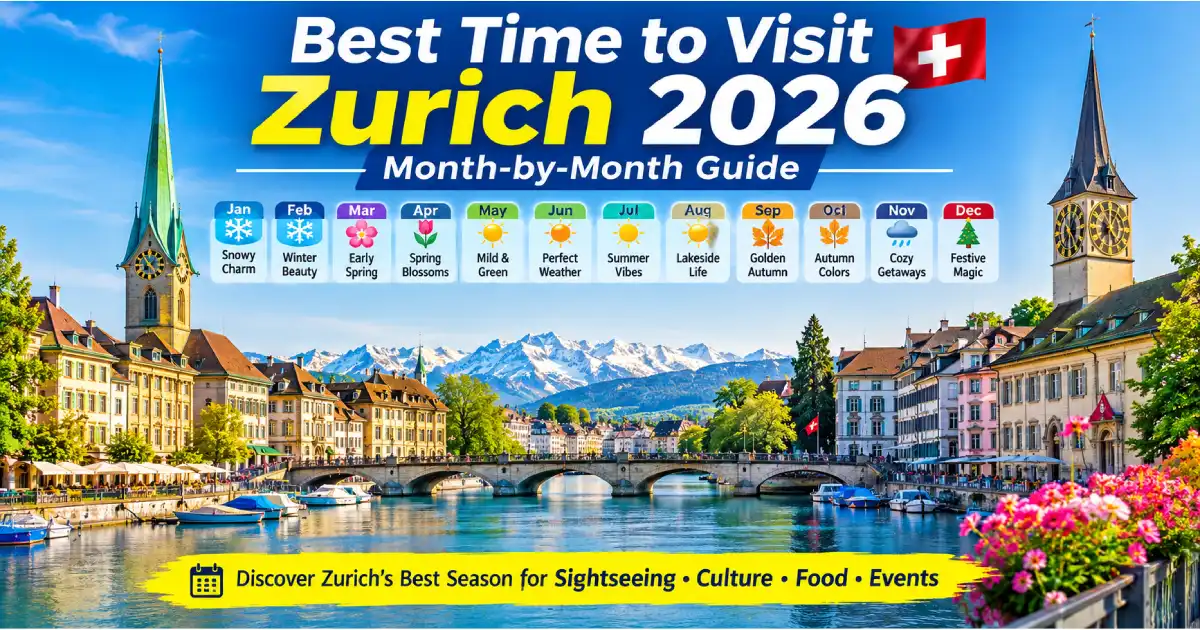
Zurich operates as a genuinely year-round destination — unlike Alpine resort towns whose entire identity shifts between ski and hiking seasons, Switzerland’s largest city maintains its full cultural infrastructure (museums, opera, restaurants, the Old Town, the lake) regardless of season, with weather and specific events determining which experiences are optimal rather than which are available at all. The best time to visit Zurich depends primarily on what you want to do: the lake swimming and long evening daylight of June through August create a specifically summery version of the city that no other season replicates, the December Christmas markets transform the Hauptbahnhof and city center into one of Europe’s most atmospheric seasonal environments, the September Street Parade draws close to a million people to the lakefront for the world’s largest techno music event, and the spring shoulder season of April and May provides comfortable weather, blooming parks, and hotel prices noticeably below summer’s peak without sacrificing any of Zurich’s core cultural attractions.
What makes Zurich’s seasonal variation genuinely interesting for planning purposes is the specific combination of city-level and regional factors — Zurich itself experiences Central European seasonal weather patterns (warm, occasionally humid summers; cold winters with occasional snow but generally milder than the Alpine regions; spring and autumn transitional months with variable conditions) while also functioning as the primary rail gateway to the Swiss Alps. A visitor timing a Zurich trip to align with ideal hiking conditions in the Bernese Oberland (June through September) or skiing conditions in Zermatt or Verbier (January through March) will experience different versions of Zurich as a base city depending on those seasonal alignments — Zurich in January (quiet, cold, culturally rich, cheapest hotel rates of the year) differs substantially from Zurich in July (warm, lake-swimming-ready, maximum crowds from global tourism coinciding with European summer holidays).
This guide breaks down Zurich’s climate, crowd patterns, hotel pricing, and event calendar month-by-month — identifying the optimal windows for specific traveler priorities and providing practical packing and planning advice for visitors booking 2026 Zurich trips from any international source market.
For complete guides, see our Best Places to Visit in Zurich 2026, Things to Do in Zurich 2026, Best Restaurants in Zurich 2026, and Switzerland Travel Guide 2026 guides.
| Month | Avg High/Low (°C) | Avg High/Low (°F) | Crowd Level | Hotel Prices | Best For |
|---|---|---|---|---|---|
| January | 3°C / -2°C | 37°F / 28°F | Low | $ (lowest) | Budget travel, museums, cozy city breaks |
| February | 5°C / -1°C | 41°F / 30°F | Low | $ | Budget travel, fewer tourists, fondue season |
| March | 10°C / 3°C | 50°F / 37°F | Low–Medium | $$ | Spring beginnings, quieter Old Town walks |
| April | 15°C / 7°C | 59°F / 45°F | Medium | $$ | Spring blooms, comfortable walking, Easter |
| May | 19°C / 11°C | 66°F / 52°F | Medium | $$$ | Best shoulder-season weather, lake walks begin |
| June | 23°C / 14°C | 73°F / 57°F | Medium–High | $$$ | Lake swimming begins, long days, al-fresco dining |
| July | 25°C / 16°C | 77°F / 61°F | High | $$$$ | Peak swimming, Zürichsee heat, maximum daylight |
| August | 24°C / 16°C | 75°F / 61°F | High | $$$$ | Lake swimming, Street Parade (early Sept) warm-up |
| September | 20°C / 12°C | 68°F / 54°F | High (Street Parade week) | $$$ | Street Parade, warm days, fewer peak tourists |
| October | 14°C / 7°C | 57°F / 45°F | Medium | $$ | Autumn colour, shoulder pricing, cozy restaurants |
| November | 7°C / 2°C | 45°F / 36°F | Low | $ | Quietest month, budget travel, Christmas prep |
| December | 3°C / -1°C | 37°F / 30°F | Medium–High | Christmas markets, festive atmosphere |
Avg Temp: 10°C / 50°F | Rainfall: Moderate | Crowds: Low–Medium | Hotel Prices: $$
March in Zurich occupies the classic shoulder-season position — genuinely transitional, with early March still feeling like winter (temperatures regularly below 5°C, grey skies, rain possible any day) while late March brings the first reliable warmer days and the visible early signs of spring in the city’s parks and lakefront gardens. The Zürichsee (Lake Zurich) begins its seasonal transformation as birds return to the waterfront and the lakeside promenade becomes increasingly attractive for afternoon walks, though the lake remains far too cold for swimming (typically around 7–9°C in March) and the Badis (outdoor swimming facilities) remain closed until May.
March’s hotel prices remain at or near winter’s low levels — a meaningful saving compared to June through September’s peak pricing, particularly for central Old Town and lakefront properties where the premium in summer can be substantial. The city’s museums (Kunsthaus, Swiss National Museum, Rietberg) operate without meaningful crowd competition — visiting the Kunsthaus on a March weekday typically means navigating the Giacometti rooms in near-solitude, a contrast to the weekend crowds of July and August.
The Zurich Film Festival (ZFF) has occasionally scheduled events in March, and various gallery openings and cultural events mark the city’s spring cultural restart — checking the Zurich Tourism events calendar (zuerich.com) before booking a March visit identifies any specific events worth timing around.
What to do: March rewards indoor cultural programming — the Kunsthaus Zürich’s extended collection exploration, the Swiss National Museum, the Foundation Beyeler as a day trip to Basel (one of the finest art museums in Europe, consistently less crowded in March than in summer despite equal quality). Old Town walks in late March (when the first blossoms appear on the trees lining Niederdorf and the lakefront) begin transitioning from winter’s bare-tree character toward spring’s more photogenic conditions.
Insider tip: The late-March “Sechseläuten” preview period (the actual Sechseläuten festival occurs in April, but the spring mood it heralds begins building in late March with changing city programs and the lengthening afternoon light) is one of Zurich’s most appealing transitional moments — the city collectively anticipating spring in ways that are palpable in the café atmosphere and the first outdoor seating appearing at Old Town restaurants.
Avg Temp: 15°C / 59°F | Rainfall: Moderate | Crowds: Medium | Hotel Prices: $$
April delivers Zurich’s most appreciated seasonal transition — the Zürichsee lakefront parks (particularly the Zürichhorn and the Enge lakeside) reach their ornamental cherry and magnolia blossom peak in mid-to-late April (timing varies year to year by 1–2 weeks based on temperature patterns), the city’s many private garden walls along Old Town lanes produce wisteria and roses, and the Botanical Garden on the Zürichberg transitions from its winter-greenhouse identity to a fully active outdoor display. Temperatures become consistently comfortable for extended outdoor exploration (daytime highs regularly 14–18°C) without the humidity that July and August can bring.
The most distinctive April event is the Sechseläuten (typically third Monday of April) — Zurich’s spring festival, one of Switzerland’s most historically specific civic celebrations. The festival involves the guilds of Zurich (historically powerful trade organizations that retain ceremonial significance in the city’s civic calendar) parading through the streets in traditional guild costumes, culminating in the burning of the “Böögg” (a snowman figure stuffed with firecrackers, placed atop a pyre in the Sechseläutenplatz at the lake) — the time the Böögg’s head takes to explode (when the firecracker-loaded snowman is burned at 6 PM precisely) is traditionally interpreted as a weather forecast for the coming summer (faster explosion = better summer). The parade and Böögg burning are free to watch and draw large local crowds — one of Zurich’s most authentic public celebrations.
What to do: Lakefront blooms photography (the Cherry Esplanade in Kilchberg, accessible by S-Bahn, is a specific destination for April cherry blossom photography), the Sechseläuten parade and Böögg burning if timing aligns (check the specific 2026 date at sechselaeuten.ch), and the general pleasure of walking the Old Town in comfortable spring conditions with the city’s collective mood brightened by the season’s arrival.
Insider tip: The Sechseläuten weekend (the Monday of the festival plus the surrounding days) brings Zurich’s own residents out in significant numbers, making the Old Town and lakefront more lively than at any other April period — combining a Sechseläuten visit with an additional day for quieter museum and café exploration provides the best of both the festive and the contemplative versions of April Zurich.
Avg Temp: 19°C / 66°F | Rainfall: Moderate | Crowds: Medium | Hotel Prices: $$$
May represents Zurich’s most balanced visiting month — temperatures consistently warm enough for genuine outdoor enjoyment (17–22°C most days), the lake’s parks and promenades at their most colourful (tulips, roses, and early-summer plantings in full display across the Zürichhorn and Rieter Park gardens), and hotel prices that remain below the July–August ceiling while the city’s full complement of activities is operational. The Badis (outdoor swimming facilities) typically open their seasonal service in May — the Seebad Utoquai and Flussbad Oberer Letten opening to swimmers as lake temperatures gradually climb toward comfortable levels (the lake typically reaches 16–18°C by late May, refreshing if not yet warm).
The May Day celebrations (May 1, International Workers’ Day, a public holiday in most Swiss cantons including Zurich) generate the year’s most significant left-wing political demonstration and street celebration in Zurich — the Langstrasse-based May Day march and the associated Rote Fabrik cultural events create a specific one-day energy distinct from any other Zurich public event.
Late May’s long evenings (sunset approaching 9 PM by month’s end) allow outdoor dining and lakefront walks in daylight hours that winter and early spring cannot match, while the crowds remain meaningfully below the July–August peak — one of the most tangible quality-of-experience distinctions between May and high summer Zurich.
What to do: The full Zurich outdoor program opens in May — Seebad Utoquai (as the lake warms), lakefront cycling (PubliBike available citywide, the lakeside path from Bürkliplatz south through the Zürichhorn and beyond), the ZSG lake steamer service (operating year-round but specifically rewarding on sunny May days when the Alps are clearly visible at the southern lake horizon), and the Botanical Garden at its spring peak before summer heat arrives.
Insider tip: Booking May accommodation 4–6 weeks ahead (rather than the 3–6 months required for July–August in popular Zurich properties) provides access to first-choice hotels at prices 20–35% below summer peak — the combination of near-equivalent outdoor conditions (minus only the lake’s warmest swimming temperatures) with meaningfully better hotel availability and pricing makes May the informed visitor’s preferred month.
Avg Temp: 23°C / 73°F | Rainfall: Moderate (afternoon thunderstorms begin) | Crowds: Medium–High | Hotel Prices: $$$
June brings Zurich’s summer into full operation — lake temperatures climb toward 20°C making swimming genuinely pleasant rather than merely refreshing, the Badis operate at full season capacity, restaurant terraces are fully open and operational throughout the city, and the maximum daylight (sunset approaching 9:20 PM at the June solstice) creates evenings of extraordinary length that transform the city’s outdoor social culture into something approaching Mediterranean in its use of public space. The Zurich lakefront (from Bürkliplatz south through the Zürichhorn) and the Limmat riverbanks become genuinely crowded on warm June evenings, but the diversity and quality of what’s happening in that crowded space (river swimming at Letten, café terraces on Niederdorf’s lanes, boat trips on the lake, outdoor concerts in various parks) makes the crowds feel energizing rather than overwhelming.
June’s hotel prices represent the beginning of the summer premium — noticeably above May’s levels but not yet at the July–August absolute peak. The absence of school holidays (most European school summer breaks begin in July) keeps crowd levels more manageable than the following two months, making June arguably the most complete single-month version of Zurich’s summer identity.
What to do: Flussbad Oberer Letten (the Limmat river swimming — free, at its most social in June’s warm afternoons and evenings), Seebad Utoquai lake swimming, the ZSG lake steamer evening cruises, and the outdoor restaurants and bar gardens of Frau Gerolds Garten and various Zurich West outdoor spaces. The Zürichsee’s first swimming races and open water events begin in June, creating specific events worth watching (or participating in) alongside general lake recreation.
Insider tip: June represents the optimal month for combining Zurich with a Jungfraujoch or Bernese Oberland day trip — the mountain railway infrastructure operates at full season capacity from June, weather windows for clear summit visits are statistically strong, and Zurich accommodation can still be secured with 4–6 weeks advance booking before the peak-season booking crunch that July generates.
Avg Temp: 25°C / 77°F | Rainfall: Moderate (afternoon thunderstorms common) | Crowds: Very High | Hotel Prices: $$$$
July is Zurich at its peak — the lake at its warmest (22–24°C in July, genuinely comfortable for extended swimming), the longest days of the year still creating evening light until 9+ PM, the full global tourism season coinciding with European school holidays to create the year’s highest hotel demand, and the city’s outdoor infrastructure (Badis, restaurant terraces, lake boats, outdoor concerts) operating at maximum capacity simultaneously. The specific pleasure of July Zurich — sitting on the Seebad Utoquai’s wooden platform as the sun sets over the lake and the Grossmünster catches the last golden light — is genuinely extraordinary and specific to the season, representing a version of the city unavailable at any other time of year.
The practical tradeoff is straightforward: hotels at their most expensive (central Zurich properties regularly CHF 250–500+/night for standard rooms in July), major attractions slightly more crowded than any other month, and the afternoon thunderstorm pattern (convective storms developing over the Alps in afternoon heat, reaching Zurich by late afternoon with occasional lightning that temporarily closes the outdoor swimming facilities) creating weather variability that morning plans occasionally need to accommodate.
What to do: Lake swimming and lakefront culture are July’s defining activities — building itineraries around the morning swimming/café routine (Seebad Utoquai or Flussbad Oberer Letten early, breakfast at the facility café, Old Town exploration through the cooler morning hours before midday heat) and the evening lake culture (sunset drinks at a lakeside café, evening boat trip, restaurant terrace dinner extending until darkness approaches 10 PM) makes the most of July’s specific conditions while working with rather than against the heat pattern.
Insider tip: Booking July Zurich accommodation 3–5 months ahead is genuinely necessary for preferred central properties — July’s combination of peak global tourism demand and European school holiday domestic travel creates the year’s most competitive hotel market. Last-minute July bookings in central Zurich routinely find limited availability at elevated prices; advance planning is the only reliable strategy.
Avg Temp: 24°C / 75°F | Rainfall: Moderate | Crowds: High | Hotel Prices: $$$$
August maintains July’s summer conditions while adding the approaching energy of the Zurich Street Parade (held on the first or second Saturday of September, technically just outside August, but whose preparations and cultural buildup are visible throughout August’s final weeks). The lake remains warm (typically 20–22°C throughout August), the outdoor swimming culture continues at full intensity, and the slight shortening of days (sunset by late August around 8:30 PM rather than 9:15 PM at the July peak) creates an imperceptible but real sense of summer beginning to turn — a psychological shift that some visitors find adds rather than subtracts from the experience.
Swiss National Day (August 1) — Switzerland’s national holiday — generates the Zürichsee’s most spectacular public fireworks display of the year, launched from barges on the lake at nightfall (approximately 10 PM) and visible from the entire western lakefront. The display is free, accessible from any lakefront position, and represents the year’s most concentrated single-evening public event on Lake Zurich — arriving at Bürkliplatz or the Zürichhorn by 9 PM provides good viewing positions for the fireworks and the collective atmosphere of 100,000+ residents celebrating from the lakefront.
What to do: August 1 fireworks (free, lakefront — arrive well before nightfall for position), continued lake swimming, and the Zurich theater and opera season’s summer programming before the main autumn season opens in September.
Insider tip: The last two weeks of August (after the peak of European school holidays begins to subside as Germany and France’s holidays conclude) see a slight but perceptible reduction in crowd density compared to July and early August — the same hotel properties sometimes offer marginally better availability, and the city’s restaurants are slightly more bookable. For visitors flexible between late July and late August, the latter provides an almost equivalent summer experience with marginally improved logistics.
Avg Temp: 20°C / 68°F | Rainfall: Moderate | Crowds: High (Street Parade weekend), Medium otherwise | Hotel Prices: $$$
September is the month that experienced Zurich visitors often identify as their favorite — the summer warmth persists (average highs still 18–22°C through most of the month), the lake remains swimmable (temperatures hovering around 18–20°C in early September before cooling through the month), the afternoon light takes on a specifically golden autumn quality, and the tourist crowd pressure begins easing as European school holidays conclude and summer travelers return home. The city’s cultural season restarts with renewed energy — the Zurich Opera opens its new season in September, major galleries launch autumn exhibitions, and the overall sense of the city’s intellectual and cultural life resuming after summer provides a different kind of engagement from July’s purely sensory lake-and-sun experience.
The Zurich Street Parade (first or second Saturday of September, check specific 2026 date at streetparade.com) creates the year’s most dramatically concentrated single-day crowd event — approximately 900,000 people on the lakefront for the world’s largest techno music event. Hotels in central Zurich during Street Parade weekend book out months in advance at elevated prices; the event itself is free, spectacular, and represents a genuinely unique Zurich experience. Visitors either specifically seeking or specifically avoiding the Street Parade should identify the 2026 date early in their planning process.
The Zurich Film Festival (ZFF, late September to early October, 11 days) runs concurrently with or immediately following September’s tail end — bringing international cinema, filmmakers, and industry figures to Zurich in a festival that has grown significantly in European film festival importance since its 2005 founding.
What to do: The September combination — residual summer warmth for outdoor activities, gold-light photography in the Old Town and lakefront parks, new cultural season energy, and reduced peak-tourist crowds — makes it one of the most complete Zurich visiting experiences of the year. The Zürichhorn park (the lakeside park south of the city center, site of the Le Corbusier Heidi Weber Museum) reaches its most atmospheric in September’s light.
Insider tip: Street Parade weekend is genuinely not the ideal first-visit Zurich experience for visitors primarily interested in the Old Town, museums, and lake culture — the event transforms the lakefront into a 900,000-person music festival that makes normal Zurich navigation difficult. However, for visitors specifically interested in electronic music culture and genuinely large-scale outdoor events, it represents exactly what makes Zurich culturally distinctive. Knowing which category you fall into before booking is the essential September planning decision.
Avg Temp: 14°C / 57°F | Rainfall: Moderate–High | Crowds: Medium | Hotel Prices: $$
October transforms Zurich into its most visually autumnal character — the lime trees lining Bahnhofstrasse, the plane trees of the Old Town lanes, and the mixed forest of the Zürichberg and Üetliberg all transition through yellows and golds that peak in mid-to-late October, providing distinctly seasonal photography that Zurich’s summer-focused tourism often overlooks. The lake closes its outdoor swimming facilities (the Badis typically shutting for the season in late September or early October as water temperatures drop below 15°C) and the city’s focus shifts decisively indoors — museums, fondue restaurants (fondue season traditionally runs September through April, October representing its comfortable autumn peak), and the warm interior atmospheres of Old Town cafés all come into their own as outdoor culture transitions.
Hotel prices drop meaningfully from September’s peak while the city’s full cultural infrastructure (Kunsthaus, Opera, Tonhalle, Swiss National Museum, restaurants across all categories) operates at normal autumn intensity — providing a combination of quality and value that neither summer (quality excellent, prices maximum) nor winter (prices minimum, some outdoor limitations) perfectly replicates.
What to do: The Zürichberg forest walking (the autumn foliage on the Zürichberg reaches its most photogenic peak in mid-October, with the forest trails through beech and oak providing color displays without the crowds that similar European forest experiences in more famous fall-foliage destinations attract), the first fondue evenings of the season (specifically September–October represents the transition to fondue culture that Zurich restaurants celebrate), and museum visits that benefit from reduced tourist competition for gallery space.
Insider tip: The Zurich Wine Fair (Zürcher Weinfest, typically late October, check specific 2026 dates) presents Swiss wines from across the country’s four wine regions in a lakefront setting — one of the best single events for visitors specifically interested in Swiss wine, which remains largely unknown internationally despite genuinely high quality particularly from the Graubünden, Valais, and Geneva cantons.
Avg Temp: 7°C / 45°F | Rainfall: High | Crowds: Low | Hotel Prices: $ (lowest of year)
November in Zurich is the city at its most local and least tourist-facing — the lake swimming and outdoor terrace culture of summer have fully concluded, Christmas market infrastructure hasn’t yet opened (markets typically begin in the third or fourth week of November), and the in-between quality of mid-November Zurich (cold, frequently grey, the bare-tree urban landscape between autumn’s colour and winter’s occasional snow) deters the casual visitor in a way that rewards those who specifically seek the city’s excellent indoor cultural life without competition. Hotel prices reach their annual nadir in early-to-mid November — the combination of truly off-season tourism demand and the gap between autumn’s reduced visitor numbers and December’s Christmas-tourism resurgence creates Zurich’s single most affordable accommodation window.
The Berner Weissweinprobe (the Bernese white wine tasting, a regional wine event) and various gallery openings in the Löwenbräu Areal and Zurich West mark the month’s cultural calendar without producing the crowd events that summer and December generate. The Kunsthaus Zürich and Swiss National Museum operate at their least-crowded conditions — visiting the Giacometti collection in November’s quiet means genuinely private encounters with major works that summer’s visitor volumes preclude.
What to do: November rewards the visitor whose primary interest is cultural depth rather than outdoor recreation — three days of unhurried museum visits (Kunsthaus, Swiss National Museum, Rietberg, Museum of Design), fondue evenings at Kronenhalle or Wirtschaft zum Wiesengrund, exploration of the Löwenbräu Areal contemporary art complex, and the Old Town cafés’ cozy interiors provide the most specifically urban Swiss experience available at the year’s lowest cost.
Insider tip: The transition from mid-November’s quiet to the Christkindlimärkt opening (typically the third week of November) represents Zurich’s most dramatic single-week atmosphere shift — the Hauptbahnhof’s market opening day transforms the main station from a functional transit hub into an illuminated festival space. Specifically timing a November visit to arrive just as the Christmas market opens captures both the pre-market quiet and the festive opening without requiring a separate December visit.
Avg Temp: 3°C / 37°F | Rainfall: Moderate (possible snow) | Crowds: Medium–High | Hotel Prices:
–$$December Zurich offers the city’s most specifically seasonal visitor experience — the Christkindlimärkt inside the Hauptbahnhof (one of Europe’s largest indoor Christmas markets, operating under the historic station ceiling below the Niki de Saint Phalle sculpture, from late November through December 24), the Werdmühleplatz outdoor market (traditional outdoor format, a 10-minute walk from the station), and the entire city’s seasonal decoration (the Bahnhofstrasse “Lucy” lights installation — suspended illuminated elements above the shopping street, redesigned every few years, one of Europe’s most admired seasonal street lighting displays) create a specifically winter-festive version of Zurich that draws visitors specifically for this seasonal identity.
December hotel prices reflect two distinct periods: the weeks of December 1–20 (moderate premiums above November’s low rates, increasingly popular as visitors discover that early December provides the full Christmas market atmosphere without the Christmas-week peak pricing and crowds) and the Christmas–New Year period (December 20–January 2, when prices spike significantly as Swiss families travel, ski resort visitors transit through, and New Year celebrations attract international visitors to Zurich’s lakefront midnight fireworks).
What to do: The Zurich Christmas market circuit (Hauptbahnhof indoor market + Werdmühleplatz outdoor market + the seasonal ice rink at Werdmühleplatz), the Bahnhofstrasse “Lucy” lights after dark (best photographed in the hour after sunset when artificial light and residual sky color balance effectively), the Zurich Opera’s December programming (typically including seasonal performances alongside the regular season), and fondue at Kronenhalle or another Old Town institution.
Insider tip: Early December (December 1–15) provides the most cost-effective access to Zurich’s Christmas atmosphere — the markets are fully operational, the Bahnhofstrasse lights are illuminated, and hotel prices remain 30–40% below the Christmas-week peaks. Visiting specifically in this window rather than the Christmas–New Year period provides the festive experience at meaningfully lower total cost.
Avg Temp: 3°C / 37°F | Rainfall: Moderate (snow possible) | Crowds: Very Low | Hotel Prices: $ (annual low)
January brings Zurich’s lowest hotel prices and lowest visitor volumes simultaneously — the post-holiday lull that drops both demand and pricing to their annual minimum while the city’s full cultural infrastructure continues operating normally. The Kunsthaus, Swiss National Museum, Rietberg, and Zurich Opera all operate their regular programs, restaurants operate without reservation competition, and the Old Town lanes (empty of the crowds that summer and December bring) provide the most unobstructed architectural photography of any month.
The occasional snowfall (Zurich averages 20–25 snow days per year, most falling November through February) transforms the city briefly — the Grossmünster and Fraumünster in snow, the Old Town cobblestones covered, the Zürichsee frozen at its northern end in cold winters (a genuinely rare event in recent warmer winters, but still possible) — creating photographic conditions unavailable in any warmer month.
What to do: January favors the cultural visitor — Kunsthaus deep dives (spending 4–5 hours in the collection across two separate visits is entirely feasible at January’s visitor levels), fondue evenings at the city’s best traditional restaurants without reservation competition, the Old Town’s cozy café culture at its most intimate (the Niederdorf cafés drawing mainly local regulars in January rather than international tourists), and the ZSG lake steamer (operating year-round, even in January, for the genuinely hardy visitor who finds the winter lake atmospheric rather than merely cold).
Insider tip: January combines Zurich’s lowest prices with the highest accessibility for accommodation bookings — central properties that require 3–6 months advance booking in July can typically be booked 1–2 weeks ahead in January with full choice of property. For visitors prioritizing cultural depth over seasonal outdoor activities, January is genuinely one of Zurich’s best visiting months.
Avg Temp: 5°C / 41°F | Rainfall: Moderate | Crowds: Low | Hotel Prices: $
February maintains January’s favorable pricing and crowd conditions while adding the approaching energy of spring — late February occasionally produces Zurich’s first warm days (10–12°C, genuinely felt as a seasonal transition after the cold of January and early February), and the Fasnacht carnival (not as dramatically observed in Zurich as in Basel, but with neighborhood events particularly in the Langstrasse area) adds cultural programming. Valentine’s Day restaurant demand creates the month’s single notable booking competition — fine dining and romantic restaurant reservations specifically on February 14 book out 2–3 weeks ahead even in Zurich’s low-season quiet.
The Basel Fasnacht (three days beginning the Monday after Ash Wednesday, typically February — check specific 2026 date at fasnacht.ch) is accessible as a day trip from Zurich (approximately 55 minutes by train) and represents one of Europe’s most extraordinary public cultural events — the 4 AM Morgestraich (city lights-out, thousands of illuminated lanterns, fife-and-drum bands appearing from the darkness simultaneously) requiring an overnight stay in Basel or a very early Zurich departure to experience properly.
What to do: The Basel Fasnacht day trip (or overnight stay) is February’s single most distinctive available activity from a Zurich base — the standard Zurich indoor cultural program continues, and late February’s lengthening days begin to suggest the approaching spring that makes March and April progressively more appealing.
Insider tip: The February–March transition represents Zurich’s most favorable booking window for visitors flexible on exact travel dates — prices remain at or near winter lows while the first genuine spring light begins appearing in the final days of February, providing better photography conditions than the flat grey light of December and January.
Best months: May, June, September
First-time visitors benefit from the full Zurich experience — outdoor activities (lake, Old Town, parks) accessible and comfortable, the city’s cultural infrastructure fully operational, and hotel prices that, while not bargain level, are below the July–August absolute peak. May and June provide the lake’s beginning-of-summer energy without the peak crowds; September provides summer’s tail end with autumn’s added photographic quality.
Best months: January, February, November
Winter pricing (January and November particularly) reduces central Zurich hotel costs by 35–50% relative to July peak while the Kunsthaus, Swiss National Museum, and restaurant scene operate normally. The practical tradeoff is cold weather (3–7°C typically) and the absence of lake swimming — for visitors whose priorities are cultural rather than outdoor, these months represent Zurich’s strongest value proposition.
Best months: July, August, early September
The Zürichsee swimming, the Badis at full operation, long evenings, and the lakefront’s maximum social energy all peak in July and August — the months that prioritize outdoor culture accept higher hotel prices and greater competition for popular facilities in exchange for the specific pleasures that no other season replicates.
| Event | Month | Notes |
|---|---|---|
| Sechseläuten (spring guild festival) | April (3rd Monday) | Check specific 2026 date |
| Zurich Street Parade | September (1st or 2nd Saturday) | Check specific 2026 date |
| Zurich Film Festival (ZFF) | Late September–early October | Check specific 2026 dates |
| Swiss National Day Fireworks | August 1 | Free, lakefront |
| Basel Fasnacht (day trip) | February (after Ash Wednesday) | Check specific 2026 dates |
| Zurich Christmas Market | Late November–December 24 | Hauptbahnhof + Werdmühleplatz |
| Zurich Opera Season | September–June | Booking required |
| Tonhalle Concert Season | September–June | Booking required |
Best months: April (blossoms), June (lake reflections, long light), October (autumn colour), December (Christmas lights, possible snow)
Each season provides distinct photographic conditions — April’s blossoms against the Old Town architecture, June’s golden evening light on the lake, October’s forest colour on the Zürichberg, and December’s Christmas market atmosphere and “Lucy” lights on Bahnhofstrasse each create uniquely seasonal images unavailable in other months.
Best months: January, February, October, November
The low-season winter months and the autumn shoulder season provide the Kunsthaus, Rietberg, and other Zurich museums at their least crowded — the Giacometti collection in January, the temporary exhibitions at the Museum of Design in November, and the full Kunsthaus across both buildings in October deliver genuinely private encounters with major works that summer’s visitor volumes cannot match.
Layers essential — temperatures vary 10–15°C between morning and afternoon, particularly in March. Waterproof jacket for April showers (genuine in Zurich). Comfortable walking shoes for Old Town cobblestones. Light layer for indoor museums (Swiss museums maintain consistent temperatures regardless of outdoor conditions).
Light clothing for warm to hot conditions. Swimwear for Badis and lake swimming (essential for the full summer experience). Sunscreen for lake and outdoor time. Light layer for museum air conditioning (noticeably cool compared to summer outdoor temperatures). Compact umbrella or rain jacket for afternoon thunderstorm possibility.
Medium layers — September still warm enough for lighter clothing, October requiring genuine jacket. Rain jacket for increased October precipitation. Comfortable shoes for Old Town and forest walking (Zürichberg foliage trails involve some uneven terrain).
Genuine winter clothing — a proper coat, hat, gloves, and warm layers for sustained outdoor exposure. Waterproof shoes or boots for potential rain, sleet, or occasional snow on cobblestone Old Town streets. Indoor-focused wardrobe can be lighter given the season’s emphasis on museum visits and restaurant evenings rather than extended outdoor exploration.
About Travel Tourister Travel Tourister’s destination specialists have visited Zurich across all twelve months — from January’s empty Kunsthaus galleries and December’s Hauptbahnhof Christmas market magic to July’s Seebad Utoquai lake evenings and September’s Street Parade lakefront energy — to deliver the most practical and honest month-by-month guide for planning your 2026 Zurich trip.
Posted By : Vinay
Latest Article
2nd Floor, 39, Above Kirti Club, DLF Industrial Area, Kirti Nagar, New Delhi, Delhi 110015



Travel Tourister is a leading Travel portal where we introduce travellers to trusted travel agents to make their journey hasselfree, memorable And happy. Travel Tourister is a platform where travellers get Tour packages ,Hotel packages deals through trusted travel companies And hoteliers who are working with us across the world. We always try to find new and more travel agents and hoteliers from every nook and corners across the world so that you could compare the deals with different travel agents and hoteliers and book your tour or hotel with the one you have chosen according to your taste and budget.
Copyright © Travel Tourister, India. All Rights Reserved

 Call
Call Enquiry