Published on : 29 Jun 2026
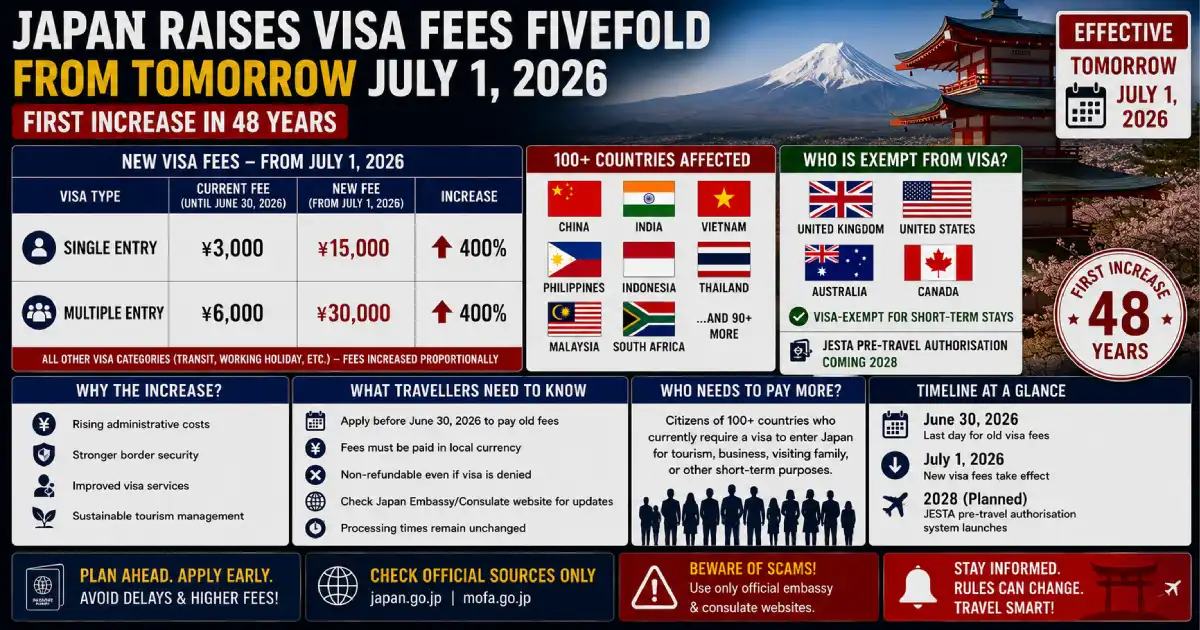
Published: June 29, 2026 — Monday (URGENT: New fees apply from TOMORROW July 1, 2026 · Cabinet decision: June 19, 2026 · First revision since 1978 · 48 years unchanged)
This is your last day to apply for a Japanese visa at the old price.
From tomorrow, Tuesday July 1, 2026, Japan raises its visa fees to five times their current level — the first revision to the country’s visa fee structure in 48 years, since 1978. A single-entry visa to Japan, which costs ¥3,000 today (approximately £18 / AUD 29 / USD 18 / CAD 25), will cost ¥15,000 from tomorrow (approximately £93 / AUD 145 / USD 93 / CAD 128). A multiple-entry visa rises from ¥6,000 to ¥30,000. The increase affects travellers from more than 100 countries that currently require a visa to enter Japan — including China, India, Vietnam, the Philippines, Bangladesh, Pakistan, Egypt, Saudi Arabia, Indonesia, and Thailand.
Critically, for UK, US, Australian, Canadian, and most European passport holders: you do not pay these fees. You are currently visa-exempt for Japan. Today’s fee rise does not affect you directly. You can enter Japan for up to 90 days with just your passport, as before.
However — and this is the article your audience needs to read today — that free visa-exempt entry to Japan will not last forever. Japan’s new JESTA system (Japan Electronic System for Travel Authorization), modelled directly on the US ESTA, UK ETA and EU ETIAS, is confirmed for launch in fiscal year 2028 and will require every visa-exempt traveller — including UK, US, Australian and Canadian passport holders — to obtain digital pre-travel authorisation before flying to Japan. The age of just turning up at the airport with a passport and buying a ticket to Tokyo is coming to an end.
Here is everything confirmed: who the visa fee rise affects, what it now costs in your currency, who is exempt, what JESTA means for your future Japan trips, and what the broader picture of Japan’s tightening entry landscape looks like for 2026 and beyond.
Published: June 29, 2026 URGENT: New Japan visa fees apply from TOMORROW — July 1, 2026 Cabinet decision: June 19, 2026 — Japanese Cabinet Announcement: Foreign Minister Toshimitsu Motegi — June 20, 2026 First revision since: 1978 — 48 years unchanged Countries affected (visa fee rise): 100+ countries requiring a Japan visa — including China, India, Vietnam, Philippines, Indonesia, Bangladesh, Pakistan, Egypt, Saudi Arabia, Thailand, and more Countries NOT affected (visa fee rise): UK ✅ | USA ✅ | Australia ✅ | Canada ✅ | New Zealand ✅ | EU member states ✅ | Japan visa-exempt countries (~71–74 nations total)
NEW FEES FROM JULY 1, 2026:
In your currency (approx. June 2026 rates):
Old fees (if applying before July 1 today only):
Why the increase: Fees unchanged since 1978 — inflation, yen depreciation, rising screening costs — fees now broadly align with G7 comparable nations Revenue target: ¥116.1 billion (~USD 800 million) additional fiscal year 2026 revenue Part of PM Takaichi policy: Broader tightening of foreign national entry and residency rules — permanent residence fee to rise from ¥10,000 to ¥200,000 (proposed October 2026) Japan visitor data: Record 42.6 million arrivals in 2025 — May 2026 arrivals DOWN 3.6% year-on-year before fee announcement Chinese tourist impact: Largest single market decline — Japan-China relations deterioration + new fee = compounded pressure Japan govt position: Does not expect fee rise to significantly reduce inbound tourism demand
JESTA — Japan Electronic System for Travel Authorization (COMING 2028):
When Japan set its visa fee schedule in 1978, a return flight from London to Tokyo cost more than a year’s average British salary, Star Wars had just been released in cinemas, and the Sony Walkman had not yet been invented. The fee for a single-entry Japanese visa — ¥3,000 — was set during the Carter administration in the United States and has not moved by a single yen in the 48 years since.
That changes tomorrow.
The Japanese Cabinet approved the fee revision on June 19, 2026, under Prime Minister Sanae Takaichi’s government. Foreign Minister Toshimitsu Motegi announced the details on June 20, citing inflation and exchange rate changes over nearly five decades as the primary drivers. “Visa fees had remained unchanged since 1978,” Motegi stated, “and the increase reflects inflation and changes in exchange rates over the years.” The new fee schedule aligns Japan’s visa costs broadly with those of comparable G7 nations — the UK charges £115 for a standard visitor visa, the US charges USD 185 for a B1/B2 visa, and the EU charges €80 for a Schengen short-stay visa.
The financial impact on Japan’s government is significant. The revised fees are expected to generate an additional ¥116.1 billion (approximately USD 800 million) in fiscal year 2026 revenue compared to the previous year. Part of this revenue will be redirected to reduce Japanese citizens’ passport fees — nationals are expected to pay approximately USD 43 less under the new arrangement.
The fee revision is explicitly part of Prime Minister Takaichi’s broader policy shift toward tightening controls on foreign nationals entering and residing in Japan. Separately from the tourist visa increase, Japan’s Cabinet has proposed raising permanent residence application fees from ¥10,000 to ¥200,000 — a 1,900% increase — with implementation anticipated as early as October 2026. The Tokyo and Osaka bar associations have both filed criticism of that proposal as an excessive burden on foreign nationals, but the direction of travel under the Takaichi government is unambiguous: Japan is recalibrating its approach to international mobility.
Countries that MUST pay the new fees (visa required for Japan):
The fee increase affects nationals of more than 100 countries and territories that are currently required to apply for a visa before entering Japan. These include:
Countries NOT affected (visa-exempt — current entry unchanged):
The following nationalities can continue to enter Japan for short stays (up to 90 days) without a visa and without paying any fee — until JESTA launches in 2028:
🇬🇧 United Kingdom · 🇺🇸 United States · 🇦🇺 Australia · 🇨🇦 Canada · 🇳🇿 New Zealand · 🇩🇪 Germany · 🇫🇷 France · 🇮🇹 Italy · 🇪🇸 Spain · 🇳🇱 Netherlands · 🇧🇪 Belgium · 🇸🇬 Singapore · 🇰🇷 South Korea · 🇭🇰 Hong Kong · 🇲🇾 Malaysia · 🇹🇭 Thailand · 🇶🇦 Qatar · 🇦🇪 UAE · 🇸🇪 Sweden · 🇩🇰 Denmark · 🇳🇴 Norway · 🇫🇮 Finland · 🇦🇹 Austria · 🇵🇹 Portugal · 🇬🇷 Greece · 🇮🇪 Ireland · 🇨🇭 Switzerland · 🇧🇷 Brazil · 🇦🇷 Argentina · 🇲🇽 Mexico · 🇮🇱 Israel — and approximately 40–50 further countries
For the complete current visa-exempt list, check: mofa.go.jp/j_info/visit/visa
China is the country where the visa fee rise has the most immediate, acute, and politically charged impact.
Chinese tourists are already pulling back from Japan amid deteriorating relations between Beijing and Tokyo. Japan’s cabinet formally approved raising visa fees to five times their current levels on June 19 — the single-entry fee rising to 15,000 yen (about 630 yuan or USD 93) and multiple-entry fees to 30,000 yen (about 1,260 yuan).
This is not a neutral context. Japan-China diplomatic relations have been under sustained strain throughout 2025–2026, with bilateral tensions over the South China Sea, the Taiwan Strait, and historical grievances all contributing to an already cooling tourism market. In May 2026, visitor numbers to Japan fell 3.6% compared to the same month the previous year, with Chinese tourists accounting for the largest single-country decline — before the fee announcement was even made.
The structure of Japan’s China visa system compounds the practical impact. Unlike other countries where Chinese nationals can apply individually to a Japanese embassy or consulate, China operates under a special arrangement requiring applicants to go through designated travel agencies or authorised agents. The practical effect is that a Chinese tourist booking an independent Japan trip faces not only a 400% fee increase but also a mandatory intermediary agent process — making the total cost and complexity of a Japan visa application from China significantly higher than from almost any other country.
An industry insider in Beijing quoted in the South China Morning Post noted that the cost surge would primarily affect single-entry applicants, while those already holding multiple-entry status face a different calculation. Several Japan visa agencies in China have already raised their fees in anticipation, and applicants who submitted complete materials by June 25 could still apply under the current fee schedule — but that window has now closed.
Japan’s Ministry of Foreign Affairs sets fees in yen, with individual embassies and consulates converting to local currency. The figures below use June 2026 exchange rates as a guide — your local embassy may apply a slightly different conversion.
| Currency | Old single-entry | New single-entry (July 1) | Old multiple-entry | New multiple-entry (July 1) |
|---|---|---|---|---|
| Japanese Yen (JPY) | ¥3,000 | ¥15,000 | ¥6,000 | ¥30,000 |
| US Dollar (USD) | ~$18 | ~$93 | ~$37 | ~$186 |
| British Pound (GBP) | ~£18 | ~£93 | ~£37 | ~£186 |
| Australian Dollar (AUD) | ~A$29 | ~A$145 | ~A$58 | ~A$290 |
| Canadian Dollar (CAD) | ~C$25 | ~C$128 | ~C$50 | ~C$257 |
| Euro (EUR) | ~€17 | ~€86 | ~€34 | ~€172 |
| Chinese Yuan (CNY) | ~CN¥130 | ~CN¥630 | ~CN¥260 | ~CN¥1,260 |
| Indian Rupee (INR) | ~₹1,500 | ~₹7,500 | ~₹3,000 | ~₹15,000 |
Approximate figures — verify with your local Japanese embassy or consulate for the exact local-currency fee applicable to your specific application
Context: At USD 93 for a single-entry visa, Japan’s new fee is still lower than a US B1/B2 visa (USD 185) and the UK Standard Visitor Visa (£115 / ~USD 148), and broadly comparable to a Schengen visa (€80 / ~USD 87). The government’s case that fees were simply overdue for a catch-up with comparable nations is not without merit — but a 400% overnight increase is still a significant shock, particularly for markets like India and Southeast Asia where visa fees represent a meaningful proportion of total travel costs.
If you hold a UK, Australian, Canadian, New Zealand, or US passport — here is the complete picture.
TODAY and through 2027: Nothing changes for you. You enter Japan visa-free for up to 90 days per visit with a valid passport. No fee. No application. No JESTA yet. Japan is open to you on the same terms as always.
From fiscal year 2028 (April 2028 – March 2029): JESTA becomes mandatory.
JESTA — the Japan Electronic System for Travel Authorization — is Japan’s version of the US ESTA, UK ETA, and EU ETIAS. It will require every visa-exempt traveller, including all UK, US, Australian, Canadian, and New Zealand passport holders, to obtain digital pre-travel authorisation before boarding a flight to Japan.
JESTA is scheduled for rollout by the end of Japan’s fiscal year 2028 — slightly ahead of a previously suggested 2030 launch — and will affect travelers from over 70 countries and regions that currently enjoy visa exemptions, including the United States, Canada, the United Kingdom, Germany, France, Italy, Spain, Australia, New Zealand, South Korea, Singapore, Taiwan, and Hong Kong.
What JESTA will require:
The development contractor for JESTA was selected by April 2026, and the system is being built now — with the official portal, exact fee and final validity period expected to be published closer to launch, likely in late 2027 or early 2028.
What JESTA does NOT do:
The broader pattern:
JESTA follows a global trend toward “authorised visa-free travel” — where digital pre-approval becomes a standard step even for passport holders who do not require a traditional visa. The US has operated ESTA since 2009. Australia’s ETA has existed since 1996. Canada’s eTA launched in 2016. The EU’s ETIAS launched in late 2026. Japan is now joining that system by 2028. The age of simply landing at Narita or Haneda with a British, Australian or Canadian passport and no prior digital registration is coming to an end — but not yet.
The visa fee rise and JESTA do not exist in isolation. Japan under Prime Minister Takaichi has been systematically reviewing and tightening its foreign national entry and residence framework. Here is the full picture for travellers planning Japan visits in 2026 and beyond.
Tourism tax and entry tax:
Japan’s exit tax — a departure tax applied when leaving the country — has been in place since 2019. In 2025 and 2026, the government reviewed further entry-related charges. The possibility of a mandatory travel insurance requirement for foreign visitors has also been discussed at cabinet level — similar to requirements in China and Bhutan — though no implementation date has been confirmed.
Permanent residence fee increase (proposed October 2026):
Japan’s Cabinet proposed in March 2026 raising the permanent residence application fee from ¥10,000 to ¥200,000 — a 1,900% increase. This does not affect tourists but is highly relevant for the significant UK, Australian, and international resident communities in Japan. Both the Tokyo and Osaka bar associations have publicly criticised the proposal as an excessive burden.
Visit Japan Web (existing system — continue to use):
Japan’s Visit Japan Web system — the existing online entry declaration tool — remains in place and is separate from JESTA. It allows travellers to pre-register customs and immigration declarations before arrival, reducing time spent at the immigration desk. JESTA, when it launches, will sit alongside Visit Japan Web rather than replacing it, though the two systems may eventually be integrated. Current travellers should continue to use Visit Japan Web at web.visit-japan.jp.
Tourist overtourism measures:
Several popular destinations within Japan — including Kyoto, Mount Fuji, and Hakone — have implemented or are planning visitor caps, entry fees, or access restrictions at peak times. These are local-level measures, separate from the national visa and JESTA framework, but form part of the same broader policy direction toward managed, higher-value tourism.
Japan’s visitor trend in context:
Japan recorded a record 42.6 million international visitors in 2025 — its highest-ever annual total. But arrivals showed signs of cooling before the fee announcement, falling 3.6% in May 2026 compared to May 2025. The government’s position that it does not expect the fee rise to significantly affect inbound tourism is based on Japan’s fundamental appeal as a destination — its cuisine, cultural heritage, natural landscapes, and the still-favourable exchange rate for many Western visitors — rather than any evidence that the specific fee level has been tested.
If you or someone you know needs a Japan visa (applies to China, India, Vietnam, Philippines and 97+ other nationalities):
Today — June 29 — is the last day to submit an application under the old fee structure at most Japanese embassies and consulates globally. Check the specific cut-off time at your local Japanese diplomatic mission. In China, the cut-off for old-rate applications passed on June 25 — applications submitted after that date are subject to new rates. In other countries, July 1 is the universal trigger date.
If you have an upcoming Japan trip and have not yet applied, apply today if you physically can reach your consulate. If you cannot, the new fee applies from tomorrow.
If you hold a UK, Australian, Canadian, or US passport:
No action required for any Japan travel in 2026 or 2027. Continue to book and travel as before — visa-free, no JESTA yet, passport only. Monitor the Japanese Ministry of Foreign Affairs and Immigration Services Agency websites from late 2027 for JESTA application details.
For travel businesses, tour operators, and travel advisors:
Update all Japan product information to reflect the new visa cost for clients from visa-required countries. A USD 93 single-entry visa is now a line item in the total trip cost that clients from China, India, Vietnam, and the Philippines need to factor in at the booking stage. This is particularly relevant for Australia-based travel advisors with significant Chinese, Indian, and Southeast Asian client bases.
| Your Passport | Visa needed for Japan? | Affected by fee rise? | JESTA needed (from 2028)? | Action needed TODAY |
|---|---|---|---|---|
| 🇬🇧 UK | ❌ No | ❌ No | ✅ Yes (from FY2028) | None — travel as normal |
| 🇺🇸 USA | ❌ No | ❌ No | ✅ Yes (from FY2028) | None — travel as normal |
| 🇦🇺 Australia | ❌ No | ❌ No | ✅ Yes (from FY2028) | None — travel as normal |
| 🇨🇦 Canada | ❌ No | ❌ No | ✅ Yes (from FY2028) | None — travel as normal |
| 🇳🇿 New Zealand | ❌ No | ❌ No | ✅ Yes (from FY2028) | None — travel as normal |
| 🇪🇺 EU nationals | ❌ No | ❌ No | ✅ Yes (from FY2028) | None — travel as normal |
| 🇨🇳 China | ✅ Yes | ✅ YES — ¥15,000 single | ❌ N/A (needs visa, not JESTA) | Apply NOW for old rate (today only) |
| 🇮🇳 India | ✅ Yes | ✅ YES — ¥15,000 single | ❌ N/A (needs visa, not JESTA) | Apply NOW for old rate (today only) |
| 🇻🇳 Vietnam | ✅ Yes | ✅ YES — ¥15,000 single | ❌ N/A (needs visa, not JESTA) | Apply NOW for old rate (today only) |
| 🇵🇭 Philippines | ✅ Yes | ✅ YES — ¥15,000 single | ❌ N/A (needs visa, not JESTA) | Apply NOW for old rate (today only) |
| Resource | Website | What For |
|---|---|---|
| Japan MOFA — visa exemptions | mofa.go.jp/j_info/visit/visa | Check if your country is visa-exempt |
| Japan MOFA — visa fees | mofa.go.jp/j_info/visit/visa/procedure | Official new fee schedule |
| Visit Japan Web | web.visit-japan.jp | Pre-register customs + immigration (all travellers) |
| Japan Immigration Services Agency | moj.go.jp/isa | JESTA updates (monitor from 2027) |
| Japanese Embassy — UK | uk.emb-japan.go.jp | UK-based visa enquiries |
| Japanese Embassy — Australia | au.emb-japan.go.jp | Australia-based visa enquiries |
| Japanese Embassy — Canada | ca.emb-japan.go.jp | Canada-based visa enquiries |
| Japan National Tourism Org (JNTO) | jnto.go.jp | Japan travel planning |
Related Articles:
Posted By : Vinay
This article is provided for general informational purposes only and is based on information available at the time of publication. Travel advisories, airline schedules, airport operations, visa requirements, government regulations, and other travel-related information are subject to change without prior notice. While Travel Tourister makes reasonable efforts to verify information using official announcements, government publications, airline and airport communications, and other reliable sources, we cannot guarantee that all information remains complete, accurate, or up to date at all times. Readers should independently verify any information that may affect their travel plans with the relevant airline, airport authority, government agency, embassy, or other official source before making travel, financial, or other decisions. Travel Tourister shall not be liable for any direct or indirect loss, inconvenience, or damages arising from the use of or reliance on the information contained in this article. Nothing in this publication constitutes legal, immigration, financial, or professional travel advice. If you believe any information in this article is inaccurate or outdated, please contact our editorial team. We review all credible correction requests promptly and update our content whenever appropriate.
Lastest News
2nd Floor, 39, Above Kirti Club, DLF Industrial Area, Kirti Nagar, New Delhi, Delhi 110015



Travel Tourister is a leading Travel portal where we introduce travellers to trusted travel agents to make their journey hasselfree, memorable And happy. Travel Tourister is a platform where travellers get Tour packages ,Hotel packages deals through trusted travel companies And hoteliers who are working with us across the world. We always try to find new and more travel agents and hoteliers from every nook and corners across the world so that you could compare the deals with different travel agents and hoteliers and book your tour or hotel with the one you have chosen according to your taste and budget.
Copyright © Travel Tourister, India. All Rights Reserved

 Call
Call Enquiry