Published on : 18 Jul 2026
By Travel Tourister | Updated July 2026
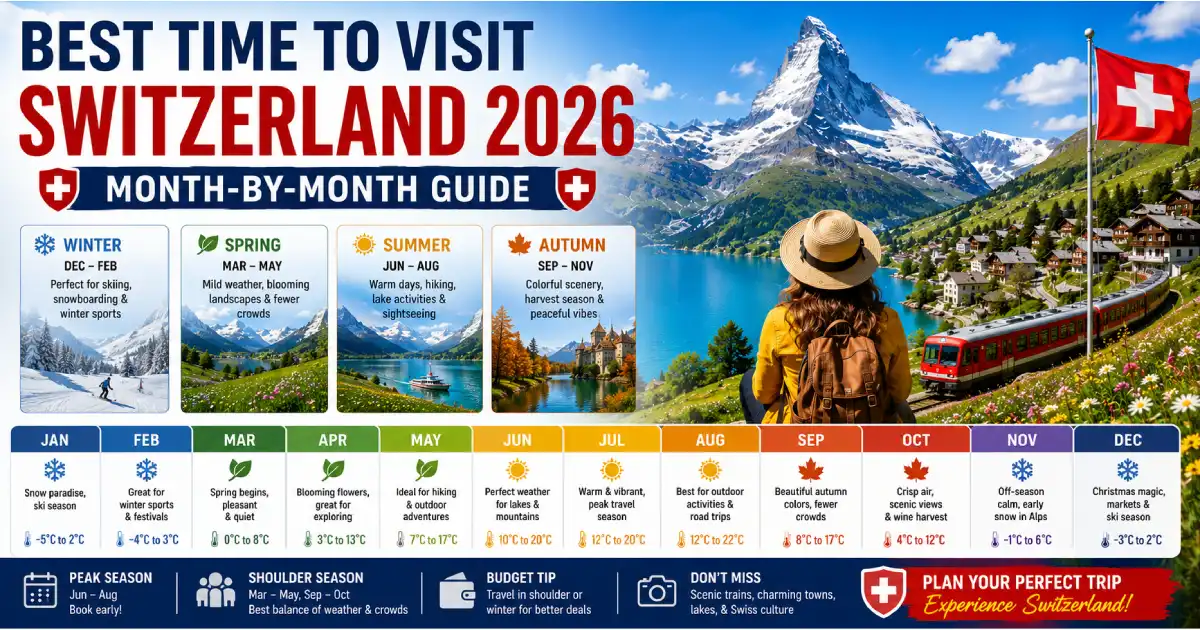
Switzerland’s geography creates one of the most dramatically varied seasonal travel environments in the world — a country the size of the Netherlands that simultaneously contains the highest permanently inhabited villages in Europe, four distinct linguistic cultures, and climatic zones ranging from the Mediterranean palm-tree warmth of Lugano’s lakeside (where camellias bloom in February) to the Arctic-like conditions at the Jungfraujoch’s 3,454-meter peak (where snowfall is possible in every month of the year). The best time to visit Switzerland depends more on what you’re planning to do than on any universal “best season” recommendation — summer (June–August) delivers the most reliable mountain hiking conditions, maximum daylight hours, and lake swimming in crystal-clear water, but also brings the highest prices and largest crowds at the country’s most iconic destinations; winter (December–March) transforms Switzerland into the world’s premier ski destination but closes some mountain railways and reduces access to certain hiking trails; and the shoulder seasons of spring (April–May) and autumn (September–October) offer the most balanced combination of manageable weather, reasonable pricing, and reduced crowds that make them the optimal choice for most first-time visitors.
What makes Switzerland’s seasonal planning genuinely more complex than most European destinations is the altitude factor — within the country itself, the seasons operate on completely different timescales at different elevations. While Geneva’s lakeside may be experiencing comfortable 20°C spring weather in late April, the Bernese Oberland’s high Alpine trails remain snow-covered until June, and the Jungfraujoch is accessible year-round but may be completely obscured by cloud and snowstorm on any given day regardless of month. The Swiss Travel Pass (the unlimited public transport pass covering trains, buses, boats, and mountain railways) provides the logistical flexibility to shift between altitude levels rapidly in response to weather — moving from a snowed-in high Alpine pass to a lakeside city for the day when conditions deteriorate — making flexible planning paired with the Swiss Transport system one of the most effective approaches to navigating Switzerland’s complex seasonal variability.
This guide breaks down Switzerland’s climate, crowd patterns, and pricing month-by-month — identifying optimal windows for specific traveler priorities (skiers, hikers, city visitors, budget travelers, photography enthusiasts, and festival seekers) — and providing practical packing and planning advice for visitors booking 2026 Switzerland trips from any of the world’s major source markets.
For complete guides, see our Best Places to Visit in Switzerland 2026, Switzerland Travel Guide 2026, and Things to Do in Switzerland 2026 guides.
| Month | Avg Temp Zurich (°C/°F) | Alpine Conditions | Crowd Level | Hotel Prices | Best For |
|---|---|---|---|---|---|
| January | 0°C / 32°F | Peak ski season | High (ski resorts) | $$$$ (resorts) / $$ (cities) | Skiing, city breaks, Wengen lauberhorn |
| February | 2°C / 36°F | Peak ski season | Very High (ski + carnival) | $$$$ (resorts) | Skiing, Fasnacht carnival (Basel, Lucerne) |
| March | 6°C / 43°F | Good skiing, spring beginning | Medium | $$$ | Skiing (early), spring city visits |
| April | 11°C / 52°F | Snow in high Alps, spring in cities | Low–Medium | $$ | Easter, spring flowers, city exploration |
| May | 15°C / 59°F | Trails opening, wildflowers | Medium | $$ | Hiking begins, wildflowers, waterfalls at peak |
| June | 19°C / 66°F | Full hiking season | Medium–High | $$$ | Hiking, lake swimming begins, long days |
| July | 22°C / 72°F | Peak hiking, peak crowds | Very High | $$$$ | Hiking, lake swimming, Montreux Jazz |
| August | 21°C / 70°F | Peak hiking, National Day | Very High | $$$$ | Hiking, National Day (Aug 1), lake swimming |
| September | 17°C / 63°F | Hiking excellent, harvest season | Medium | $$$ | Hiking, wine harvest, Lavaux, reduced crowds |
| October | 12°C / 54°F | High trails closing, fall color | Low–Medium | $$ | Fall foliage, city breaks, shoulder pricing |
| November | 5°C / 41°F | Ski resorts opening | Low | $ | Budget city travel, Christmas markets begin |
| December | 2°C / 36°F | Ski season opens, Christmas | Medium–High | $$ | Christmas markets, skiing begins, New Year |
Avg Temp Zurich: 11°C / 52°F | Rainfall: Moderate | Crowds: Low–Medium | Hotel Prices: $$
April brings Switzerland’s most dramatic seasonal transformation — lake cities (Geneva, Lausanne, Lugano) transition into full spring by mid-April, with magnolias, cherry blossoms, and camellias at peak bloom in lakeside parks while the alpine regions above 1,500 meters remain snow-covered and many high-altitude trails are still inaccessible. This altitude-based seasonal split creates April’s defining characteristic: extraordinary spring scenery in the lower elevations while mountain railways like the Jungfraujoch operate year-round access to snowy, potentially cloud-obscured high-Alpine environments that photograph dramatically if weather cooperates.
The Easter holiday period (date varies, typically falling in April) brings a noticeable but manageable uptick in domestic Swiss and European tourism — hotels in major cities see moderate price increases over Easter weekend specifically, while the broader April calendar remains relatively affordable compared to summer peak. The Bern Onion Market (Zibelemärit, traditionally November) and other spring markets begin activating local town centers, while the Appenzell Landsgemeinde (the open-air cantonal parliament, typically last Sunday of April) provides one of Switzerland’s most distinctive civic events for visitors specifically timing a Graubünden/eastern Switzerland visit.
Spring wildflowers at lower elevations (Lugano’s lakeside parks, Geneva’s Jardin Anglais, Bern’s rose garden) reach their first peak in late April — the Lugano area’s particularly mild microclimate produces camellias, azaleas, and rhododendrons in quantities and colors that genuinely surprise visitors expecting a more restrained Swiss spring.
What to do: City-focused itineraries (Zurich, Bern, Lucerne, Geneva, Lausanne, Lugano) work exceptionally well in April — the spring light flatters urban architecture photography, crowds at major city attractions are manageable, and the combination of flowering city parks with the lingering snow on surrounding mountains creates a specifically Alpine-spring visual character. Day trips to Rhine Falls (Schaffhausen) are excellent in April as snowmelt begins — the falls reach their first volume increase from winter-low conditions in April, with peak volume still building toward the May–June maximum.
Insider tips: The high mountain railways (Jungfraujoch, Matterhorn Glacier Paradise, Schilthorn) operate year-round but April weather at altitude is highly variable — building flexibility for weather cancellations into high-mountain excursion plans is more important in April than in summer’s more stable conditions. The Camellia Festival in Locarno and Ascona (Ticino, typically mid-March through April) makes the Italian-speaking south of Switzerland particularly worth visiting in early-to-mid spring, when the lakeside gardens of Lago Maggiore reach their ornamental flower peak.
Avg Temp Zurich: 15°C / 59°F | Rainfall: Moderate | Crowds: Medium | Hotel Prices: $$
May is Switzerland’s most underrated visiting month — temperatures have moderated to genuinely comfortable levels for both city exploration and the first serious hiking of the season (trails below approximately 1,800 meters typically clear of snow by mid-May, with higher trails opening progressively through the month), waterfalls reach their annual peak volume as Alpine snowmelt accelerates (the Staubbachfall in Lauterbrunnen Valley, the Rhine Falls, and dozens of smaller cascades across the Bernese Oberland reach their most dramatic flow levels in May–June), and the combination of excellent conditions with pre-summer-peak pricing and crowd levels makes May one of the best value months in Switzerland’s annual calendar.
The alpine wildflower season (beginning in earnest in late May at lower elevations, continuing upward through June–July as the snow retreats from progressively higher terrain) represents Switzerland’s most spectacular seasonal natural display — fields of alpine roses (alpenrosen, the rhododendron species that carpets Swiss hillsides), gentians, edelweiss, and dozens of other species creating color displays across meadows that are entirely inaccessible under winter snow cover. The late May wildflower peak at 1,200–1,800 meter elevations (Männlichen, Kleine Scheidegg, various Bernese Oberland walking routes) provides photography conditions that European landscape photographers specifically time trips around.
What to do: The first real hiking season of the year opens in May — trails around Grindelwald, the Schynige Platte above Interlaken (a specific alpine botanical garden accessible by rack railway, opening in late May for the season), and the lower Mürren and Wengen hiking circuits become fully accessible and provide spectacular conditions with wildflowers, residual snow on higher peaks, and waterfalls at their most dramatic. Lake Geneva’s Lavaux vineyards (the flowering vine period in late May, when the white Chasselas vines are in blossom) create a specific photographic window that wine-interested visitors specifically seek.
Insider tips: May accommodation pricing (before the June summer premium fully kicks in) combined with hiking conditions that are often equivalent to or better than mid-summer (lower snowlines mean specific photographic combinations of flowering meadows against snow-covered peaks) make it genuinely one of Switzerland’s best value months for outdoor-focused visitors. Book accommodation for late May at Swiss mountain resorts (Grindelwald, Wengen, Mürren, Zermatt) 4–6 weeks ahead rather than months in advance — availability remains reasonable without the desperate-early-booking culture that July–August generates.
Avg Temp Zurich: 19°C / 66°F | Rainfall: Moderate (afternoon thunderstorms developing) | Crowds: Medium–High | Hotel Prices: $$$
June marks the beginning of Switzerland’s primary tourist season — the high Alpine trails (above 2,000 meters, previously snow-covered) open progressively through the month, the Jungfraujoch and other summit experiences offer their best visibility statistics, lake swimming begins in earnest as lake temperatures reach comfortable levels (Lake Zurich typically reaching 18–20°C, Lake Geneva slightly warmer at lower elevations), and the longest days of the year (June 21 sunset in Zurich around 9:15 PM) provide maximum usable daylight for outdoor activities.
June represents an excellent balance point between the fully-open summer Alpine season and the extreme July–August crowd and pricing levels — major attractions are operating in full season mode, hiking trails are open across all elevations, and the mountain panoramas benefit from the clear, pre-haze air quality that July’s heat can compromise at lower viewpoints. The Montreux Jazz Festival (early July, straddling the June–July border, check specific 2026 dates) begins with pre-festival programming and offers some of the best ticket availability of the festival period in its opening days.
The afternoon thunderstorm pattern (convective storms developing over the Alps in the afternoon heat, producing lightning that can make ridge hiking genuinely dangerous between approximately 2 PM and 5 PM) establishes itself in June and continues through August — the standard Swiss hiking practice of starting early and descending before early afternoon mitigates this risk effectively, but visitors planning Swiss Alpine hiking should understand this pattern and plan accordingly.
What to do: The complete Swiss summer activity calendar opens in June — Jungfraujoch railway at full season capacity, Five Lakes Walk in Zermatt with reliable snow-free conditions, the Schynige Platte Botanical Garden’s alpine flower peak in late June, Glacier Express at full service, and the Rhine Falls approaching (or already at) peak water volume from June snowmelt. Lake swimming at Zurich’s lakeside Badis (traditional swimming facilities) and along Geneva’s Promenade de la Plage becomes reliable and popular.
Insider tips: Booking accommodation in mountain resorts for June (Grindelwald, Zermatt, Wengen) 2–3 months ahead provides reasonable availability at prices noticeably below July–August peak — June represents summer season pricing without summer’s most extreme premiums. For the Jungfraujoch specifically, June’s clear mornings (before afternoon cloud-building) provide statistically better summit visibility than any winter month, while not yet experiencing the maximum July–August visitor numbers.
Avg Temp Zurich: 22°C / 72°F | Rainfall: Moderate (afternoon storms) | Crowds: Very High | Hotel Prices: $$$$
July is Switzerland’s peak tourist month — every major attraction operating at maximum capacity, hotel prices at their annual ceiling, and the specific combination of reliable warm weather, long daylight, and fully-open Alpine terrain drawing visitors from across Europe and globally who target Switzerland for summer holidays. The July school holiday period across Germany, France, Italy, and the Netherlands (Switzerland’s primary tourism source markets) simultaneously creates the year’s highest demand at Swiss resorts — Zermatt, Grindelwald, Interlaken, and Lucerne specifically experience their most crowded conditions in July.
Despite the crowds, July’s hiking conditions are genuinely extraordinary — the high Alpine trails (including the demanding routes above 2,500 meters that require technical ability and equipment outside the brief summer window) are in optimal condition, the Bernese Oberland’s mountain railways operate frequent service, and the combination of maximum wildflower peak at high elevations (the alpenrosen typically bloom at 1,800–2,200 meters in July, creating the Alpine rose fields that define summer mountain imagery in Switzerland) with long evening light (sunset not until 9:15 PM) creates an environment where the mountains feel genuinely alive in a way that no other season replicates.
The Montreux Jazz Festival (early-to-mid July, check specific 2026 dates) transforms the Lake Geneva town into one of Europe’s most concentrated jazz and music events — two weeks of programming ranging from the main ticketed concerts (international headliners) to free outdoor concerts on the lakeside stages that attract tens of thousands of daily visitors without requiring festival tickets.
What to do: July is the month for Switzerland’s most ambitious hiking — the Haute Route (a multi-day high-Alpine traverse from Chamonix to Zermatt, typically 14 days, requiring significant mountaineering experience and equipment), the Eiger Trail (a spectacular but exposed route below the Eiger’s north face, accessible from Grindelwald), and the numerous via ferrata routes across Switzerland that require fixed-rope protection. Non-hikers benefit equally from the reliable weather for mountain railway excursions — the Jungfraujoch’s clear-morning statistics peak in July.
Insider tips: For July visits, booking everything (accommodation, mountain railway excursions, restaurant reservations at in-demand Bernese Oberland locations) 3–6 months in advance is genuinely necessary rather than precautionary. The most popular Zermatt and Grindelwald hotels sell out their July availability within weeks of the 6-month booking window opening. The “Good Morning Ticket” for the Jungfraujoch (first train of the day, arriving at the summit before tour groups, significantly discounted) is worth the early wake-up in July when visitor numbers are at maximum — arriving at the summit at 8 AM vs. 11 AM produces a meaningfully different experience in terms of crowds.
Avg Temp Zurich: 21°C / 70°F | Rainfall: Moderate | Crowds: Very High | Hotel Prices: $$$$
August maintains July’s peak conditions while adding Switzerland’s National Day (August 1st, Swiss National Day celebrating the 1291 Federal Charter — a public holiday featuring fireworks displays over every significant Swiss lake, beacon fires lit on mountain summits, and nationwide celebrations ranging from small village fête to Zurich’s lakefront fireworks visible from the entire western shore). The August 1st fireworks over Lake Geneva (Geneva), Lake Lucerne (Lucerne), and the Zurichsee (Zurich) are among the most spectacular public fireworks displays in Europe — all free, all accessible from public lakefront areas without ticketing.
Late August brings the first subtle seasonal transition — evening temperatures begin dropping from July’s levels, the first tinge of autumn color appears on lower elevation deciduous trees, and the “post-summer” mood begins settling over resort towns as European school holidays conclude and the heavy domestic tourist wave subsides. This late-August transition makes the final week of August sometimes the best August visiting window — summer conditions still fully in effect, but the most extreme crowds beginning to thin as families return to school and work schedules.
What to do: August 1st National Day celebrations across Switzerland — positioning in a lakeside city (Zurich, Lucerne, Geneva, Montreux) for the evening fireworks is the primary August 1st activity, with free lakefront access to the best viewing positions. The Locarno Film Festival (early August, check specific 2026 dates — Switzerland’s most prestigious film event, with outdoor screenings in Piazza Grande) provides a specific cultural event that distinguishes early August in the Italian-speaking Ticino from the pure nature/outdoor focus of the German-speaking Alpine resorts.
Insider tips: The August 1st National Day is a public holiday in Switzerland — many shops and some restaurants close entirely (particularly in smaller towns), and public transport runs on holiday schedules. Planning a National Day visit to a lakeside city (rather than a hiking-focused mountain resort) provides the best access to the fireworks displays and celebrations that define the day, while avoiding the mountain railway reduced schedules that some operations run on the public holiday.
Avg Temp Zurich: 17°C / 63°F | Rainfall: Moderate | Crowds: Medium | Hotel Prices: $$$
September is Switzerland’s best-kept seasonal secret — the summer crowds have thinned significantly (European school holidays concluded, the domestic summer holiday wave subsiding), hiking conditions remain excellent through the month on most trails (the first high-Alpine snowfall typically arrives in late September or October at elevations above 2,500 meters, leaving mid-mountain trails fully open and often in their best conditions of the year), and the harvest season transforms the Lavaux vineyard terraces and other Swiss wine regions into their most visually and gastronomically interesting period.
The Lavaux harvest (mid-September to mid-October, timing varies year to year based on ripening conditions — the Chasselas vines along Lake Geneva’s northern shore are picked by hand in the steep terraced vineyards, with harvest teams visible working the impossible-angle terrain throughout the picking period) represents Switzerland’s most distinctive food-culture seasonal event — cellar doors open, wine villages (Cully, Rivaz, Epesses, Chexbres) come alive with harvest workers and the specific atmosphere of agricultural production, and tastings of the just-pressed juice (available at many domaines during harvest week) provide a Swiss wine experience unavailable during any other month.
The Zurich Street Parade (typically first or second Saturday of September, one of the world’s largest techno music parades, drawing 700,000+ participants along the Zurich lakeside) creates the year’s most intense single-day crowd event in Zurich specifically — visitors either specifically targeting this event or specifically avoiding it should check the 2026 date when planning.
What to do: September hiking in Switzerland combines all of summer’s access with significantly reduced trails crowding — the Zermatt Five Lakes Walk, the Schynige Platte circuit, the Bernese Oberland valley trails, and high-Alpine routes still below first-snowfall elevations are all operating in ideal conditions with far fewer other walkers than July–August. The Appenzell cattle descents (Alpabfahrt — the annual movement of cattle from high summer Alpine pastures back to valley farms, often accompanied by traditional decorations on the lead cattle and gatherings of local communities in specific villages in late September) provide a specific glimpse of living Swiss Alpine agricultural tradition that the tourist season doesn’t otherwise surface prominently.
Insider tips: The September combination of good hiking conditions, reduced crowds, and pricing that hasn’t yet fully dropped to October’s lower levels makes the first three weeks of September particularly attractive for mountain-focused visitors — Zermatt and Grindelwald accommodation in mid-September can be 20–30% below July peak pricing while offering virtually equivalent hiking conditions. The Lavaux harvest timing (check the Lavaux website for current-year harvest dates, announced 4–6 weeks ahead based on grape maturity assessments) makes the Lake Geneva region specifically worth timing a September or early October visit around.
Avg Temp Zurich: 12°C / 54°F | Rainfall: Moderate–High | Crowds: Low–Medium | Hotel Prices: $$
October brings Switzerland’s most dramatic autumn transformation — deciduous forests (beech, maple, and larch at various elevations) transition through yellows, oranges, and golds in a progression that moves from higher elevations downward through the month, while the larch forests of the Engadine (the Graubünden valley of St. Moritz and Pontresina) produce one of Europe’s most extraordinary single autumn color displays when the European larch (the only deciduous conifer in the Alps, producing needles that turn brilliant gold before falling) peaks in early-to-mid October at approximately 1,800–2,000 meters elevation.
The high Alpine trails begin closing in October — first snowfalls above 2,500 meters (sometimes as early as late September, sometimes not until November depending on the year) progressively reduce accessible hiking terrain, and some mountain cable cars and railways adjust to reduced autumn schedules before the ski season infrastructure begins opening in late November. However, mid-mountain and valley trails remain accessible and provide the season’s best autumn color photography — the combination of golden larch forests, first snow dusting on higher peaks, and the specific October light quality (lower sun angle than summer, warmer color tones in golden-hour light) creates Switzerland’s most photographically distinctive season.
The Zurich Film Festival (late September to early October, check specific 2026 dates) and Art Basel’s fall programming add cultural events to October’s calendar in German-speaking Switzerland, while the wine harvest reaches its completion across the Swiss wine regions during October’s first weeks.
What to do: The Pontresina and St. Moritz area larch forest color (accessible via various walking routes above Pontresina in the Roseg Valley and on the slopes above St. Moritz) represents Switzerland’s single best autumn foliage destination — the specific golden color of larch needles against the dark-green stone pine backdrop, with the Engadine lake chain visible below and snow-covered peaks behind, creates a combination available nowhere else in the Alps. Timing an October Engadine visit for the week of peak larch color (typically October 10–20, varying by year and altitude) is the primary October planning priority for foliage-focused visitors.
Insider tips: Check the larch color reports on Swiss hiking websites (SchweizMobil and local tourism board reports from the Engadine) in early October for current-year peak timing — the larch color window is relatively brief (10–14 days of peak color before the needles begin falling) and varies by several weeks between early-season cold autumns and late-season warm ones. Booking Engadine accommodation (Pontresina specifically, which sits at better elevation for larch viewing than St. Moritz town) for mid-October 4–6 weeks ahead provides reasonable availability without the last-minute scramble that the brief peak window creates.
Avg Temp Zurich: 5°C / 41°F | Rainfall: High | Crowds: Low | Hotel Prices: $ (lowest of year)
November is Switzerland’s quietest and most affordable visiting month — the hiking season has largely concluded, the ski season hasn’t fully opened (only the highest-elevation resorts like Zermatt’s glacier skiing and Saas-Fee operate in November), and the late-autumn conditions (grey skies, bare deciduous trees, frequent rain at lower elevations and fresh snow at higher) create the least visually appealing conditions for outdoor photography of any month. Hotel prices in both cities and mountain resorts drop to their annual lows, museums are uncrowded, and the cities (Zurich, Geneva, Basel, Bern, Lucerne) provide excellent conditions for urban cultural tourism without the competition for restaurant reservations and gallery attention that other seasons generate.
The saving grace of November is its Christmas market transition — Switzerland’s most beloved seasonal tradition (the Christkindlimärkt, held in every Swiss city from late November onward) begins opening in the third week of November, with the Zurich Christkindlimärkt (inside the main train station, one of the largest indoor Christmas markets in Europe) and the Basel Weihnachtsmarkt (on Marktplatz, one of Switzerland’s oldest and most atmospheric outdoor markets) among the first to open.
What to do: Museum visits in Zurich (Kunsthaus, Landesmuseum), Bern (Kunstmuseum, Historical Museum), and Basel (Kunstmuseum, Foundation Beyeler) provide exceptional conditions — uncrowded galleries, no advance booking required for entry, and the full winter programs that major Swiss cultural institutions present. The Bern Onion Market (Zibelemärit, fourth Monday of November) is one of Switzerland’s most distinctive seasonal markets — a centuries-old tradition where onion sellers from the surrounding Fribourg region fill Bern’s city center with decorative onion braids and market stalls from 4 AM onward.
Insider tips: The Foundation Beyeler in Riehen (near Basel, CHF 30, one of Europe’s finest private art museums housing major Monet, Picasso, Bacon, and Klee works in a Renzo Piano-designed building) is one of Switzerland’s most rewarding museum experiences and is consistently under-visited relative to its quality — a November visit, when the museum’s winter exhibition programming begins and crowds are minimal, provides an ideal opportunity for a contemplative visit that summer’s visitor numbers make less achievable.
Avg Temp Zurich: 2°C / 36°F | Rainfall: Moderate (snow at altitude, rain/sleet in cities) | Crowds: Medium–High | Hotel Prices: $$–$$$$ (varies enormously between Christmas week and early December)
December Switzerland divides into two very different periods: early December (1st–20th), when Christmas markets are in full operation, ski season is launching at most resorts (typically mid-December opening for major destinations), hotel prices remain moderate outside school holiday dates, and the festive atmosphere of the Advent season creates one of Switzerland’s most genuinely distinctive visitor experiences; and the Christmas–New Year period (December 20th to January 2nd), when school holidays drive prices in mountain resorts to their annual peaks (matching or exceeding July summer rates), trains require advance booking, and the combination of families, ski enthusiasts, and luxury travelers creates the year’s most competitive accommodation environment.
Switzerland’s Christmas markets (Basler Weihnachtsmarkt, Zürcher Christkindlimärkt, Berner Weihnachtsmarkt, Luzerner Weihnachtsmarkt) operate from approximately late November to December 24th — a genuine cultural institution that’s firmly embedded in Swiss seasonal life rather than purely tourist infrastructure. The markets sell mulled wine (Glühwein), raclette, roasted chestnuts, local handicrafts, and traditional Swiss Christmas items (wooden decorations, advent calendars) in settings that vary from the Zurich main station’s vast indoor hall to Basel’s open-air Marktplatz to Montreux’s lakeside market (one of the most visually spectacular, extending along the Lake Geneva promenade with the Alps and Chillon Castle visible behind the market stalls).
What to do: Early December (first three weeks) is ideal for combining Christmas market visits with the opening of the ski season — Zermatt’s glacier skiing operates year-round, the lower resort ski areas (Verbier, Grindelwald, Davos, Arosa) typically open by mid-December with the season officially launching on the third or fourth weekend. Late December is exclusively for either the Christmas-in-the-Alps experience (budget permitting at peak prices) or avoiding Switzerland entirely in favor of January’s equivalent skiing at lower cost.
Insider tips: The Montreux Christmas Market (Noël du Lac, running from late November to December 24th along the Lake Geneva promenade) is Switzerland’s most photographed Christmas market for its specific setting — the mountains and lake visible behind the market stalls create a composition that’s been reproduced on countless Switzerland winter travel images. Weekday visits (Tuesday–Thursday) offer the most comfortable browsing experience compared to weekend crowds that make movement between stalls difficult on peak December Saturdays.
Avg Temp Zurich: 0–2°C / 32–36°F | Snowfall: Heavy at altitude, rain/sleet at lower elevations | Crowds: Very High (ski resorts), Low (cities) | Hotel Prices: $$$$ (ski resorts) / $ (cities)
January and February represent Switzerland’s ski season peak — full-depth snowpack at established resorts (Zermatt, Verbier, St. Moritz, Davos, Grindelwald, Engelberg), the Lauberhorn World Cup downhill race (Wengen, typically third weekend of January — the world’s longest and most prestigious downhill ski race, a 4,270-meter course descending from the Lauberhorn through Wengen to the Grindelwald valley, drawing 30,000+ spectators to the course and worldwide television audiences), and the Hahnenkamm at Kitzbühel (Austria, accessible by train for serious ski-race fans wanting both the Swiss and Austrian race weeks). St. Moritz hosts the White Turf horse races on the frozen Lake St. Moritz (February, thoroughbred racing on the frozen lake surface, a specifically St. Moritz tradition since 1907) and the Engadin Skimarathon (second Sunday in March, 42-kilometer cross-country ski race from Maloja to S-chanf, one of the world’s largest cross-country ski events).
February’s most distinctive non-skiing attraction is the Fasnacht carnival — Switzerland’s uniquely Swiss equivalent of carnival, celebrated most intensely in Basel (three days beginning the Monday after Ash Wednesday, with the 4 AM Monday “Morgestraich” — a total city lights-out with thousands of illuminated lanterns and costumed parade groups moving through the darkened streets in silence except for fife-and-drum music — one of the most extraordinary street events in Europe) and Lucerne (a week-long carnival with parades, costumes, and mask-wearing traditions quite different from Basel’s more solemn and artistically ambitious Fasnacht character).
What to do: Skiing is the primary January–February activity — Switzerland’s resort infrastructure (Verbier’s 4 Vallées, Zermatt–Cervinia cross-border skiing, Davos-Klosters, the Bernese Oberland trio of Grindelwald, Wengen, and Mürren combining as the Jungfrau ski region) provides some of the world’s finest resort skiing with the logistical reliability that Switzerland’s infrastructure generally delivers. Non-skiers base in cities (Zurich, Geneva, Bern, Basel) for January’s lowest hotel prices, museum visits, and access to the day-long skiing destinations as a spectator or non-skiing companion.
Insider tips: The Lauberhorn World Cup weekend (Wengen, January) requires booking accommodation in Wengen, Grindelwald, or Interlaken 6–12 months in advance — the race’s enormous domestic Swiss following creates accommodation competition across the entire Bernese Oberland region rather than just within walking distance of the course. The Basel Fasnacht (February, three specific days beginning at 4 AM Monday morning after Ash Wednesday — check the 2026 specific date on fasnacht.ch) is Switzerland’s most extraordinary single cultural event for visitors — the Monday morning Morgestraich (4 AM, city goes dark, thousands of lit lanterns appear, fife-and-drum bands begin simultaneously throughout the Old Town) requires being in Basel at 3:30 AM to secure a position but creates an experience unlike anything else in Europe.
Avg Temp Zurich: 6°C / 43°F | Snowfall: Declining at lower elevations, still active at altitude | Crowds: Medium | Hotel Prices: $$$
March provides some of Swiss skiing’s best conditions — deep-established snowpack from January and February’s accumulation, longer days (spring equinox March 20th), warmer temperatures that make lift queues more comfortable without compromising snow quality at altitude, and a specific Carême (spring sunshine) quality of Alpine light that photographers specifically time trips around. The term “spring skiing” in Switzerland (neige de printemps — spring snow, with its specific corn-snow texture that develops from daily freeze-thaw cycles) defines March and April skiing conditions that experienced Alpine skiers often prefer to mid-winter powder for controlled piste skiing.
The Engadin Skimarathon (second Sunday of March, Maloja to S-chanf, 42 kilometers, 13,000+ participants) and various other spring ski events conclude the formal competitive ski-racing season, while the gradual lengthening of days provides a palpable transition toward the approaching hiking season that begins activating in earnest by mid-April.
What to do: Spring skiing at Zermatt, Verbier, or Saas-Fee — resorts at higher elevations maintain the best conditions deepest into March while lower-altitude resorts may be transitioning to patchy snow coverage. Cities (Geneva’s Salon de l’Auto — the Geneva International Motor Show, typically early March, one of the world’s most significant car shows) provide event-specific programming alongside the standard urban winter cultural calendar.
Insider tips: March accommodation in ski resorts drops 15–25% from February’s peak pricing while snow conditions often equal or exceed February’s — the post-school-holiday lull in demand creates genuine value, particularly in the second half of March when European spring breaks haven’t yet driven another demand spike.
Best months: July and August for complete Alpine access, maximum trail availability, and highest summit visibility statistics. Late June and September provide nearly equivalent conditions with meaningfully reduced crowds and slightly lower pricing. May offers the first serious hiking with dramatic waterfalls and wildflowers at the cost of some high-trail inaccessibility.
Best months: January and February for peak snowpack and full resort operations. Mid-December for a quieter, less expensive early-season experience with good snow at major high-altitude resorts. March for spring skiing conditions, reduced prices, and longer days.
Best months: November (absolute minimum crowds and prices, cities-focused), early December (before Christmas week pricing), April (good shoulder pricing with spring city conditions), and October (post-summer discounts with excellent autumn color).
Switzerland’s cities are genuinely year-round — Zurich, Bern, Lucerne, Geneva, Basel, and Lausanne all reward visits in any month, with December’s Christmas markets and February’s Fasnacht (Basel) providing specific seasonal events worth timing visits around. November and April offer the best urban visiting conditions in terms of crowd management and pricing.
Late June (wildflower peak at mid-elevations, alpenrosen beginning), October (Engadine larch color, dramatic autumn light), December (Christmas market atmosphere, first snows on surrounding peaks), and May (maximum waterfall volume, first spring flowers against residual snow on peaks) each offer distinctive photographic conditions that no other season replicates.
| Event | Month | Location |
|---|---|---|
| Lauberhorn World Cup Ski Race | January (3rd weekend) | Wengen |
| Basel Fasnacht Carnival | February (after Ash Wednesday) | Basel |
| Lucerne Fasnacht | February | Lucerne |
| Geneva International Motor Show | March | Geneva |
| Appenzell Landsgemeinde | April (last Sunday) | Appenzell |
| Montreux Jazz Festival | July (early-mid) | Montreux |
| Zurich Street Parade | September (1st or 2nd Saturday) | Zurich |
| Switzerland National Day Fireworks | August 1st | All lakeside cities |
| Locarno Film Festival | August (early) | Locarno |
| Engadin Skimarathon | March (2nd Sunday) | St. Moritz/Engadine |
| Lavaux Harvest | September–October | Lake Geneva |
| Basel Christmas Market | Late November–December 24th | Basel |
| Zurich Christkindlimärkt | Late November–December 24th | Zurich |
Waterproof jacket essential (April rain is frequent and Swiss springs are genuinely wet). Layers — temperatures vary 10–15°C between morning and afternoon, particularly in April. Hiking boots if planning trail walking (even low-elevation trails in April can have muddy sections from snowmelt). Sunglasses and sunscreen if planning any time above 1,500 meters (UV exposure increases dramatically with altitude).
Light clothing for cities and lake areas (temperatures regularly 25–30°C in valleys and lakeside cities). Warm mid-layer and waterproof for mountain excursions (temperature drops 6–7°C per 1,000 meters of elevation — summit destinations like Jungfraujoch require genuine winter clothing even in July). Sturdy hiking footwear for trails. Afternoon thunderstorm protection (quick-dry clothing, compact rain jacket).
Medium-weight layers — September still warm in cities, October requiring genuine jacket. Rain jacket for October’s increased precipitation. Warm hiking clothing for high-trail excursions before first snowfall. Early October larch viewing in the Engadine may require light winter layers at 1,800+ meters elevation.
Genuine winter clothing for all activities — cities are cold (0–5°C), mountain areas are frigid (-10 to -20°C at resort altitude). Ski equipment (rent at resorts rather than traveling with) if skiing. Waterproof winter boots for city walking on potentially icy sidewalks. Multiple thermal layers for outdoor activities.
About Travel Tourister Travel Tourister’s destination specialists have visited Switzerland across all four seasons — from January’s Lauberhorn race weekend in Wengen and February’s Basel Fasnacht Morgestraich to July’s Jungfraujoch hiking days and October’s Engadine larch color peak — to deliver the most practical and honest month-by-month guide for planning your 2026 Switzerland trip.
Posted By : Vinay
Latest Article
2nd Floor, 39, Above Kirti Club, DLF Industrial Area, Kirti Nagar, New Delhi, Delhi 110015



Travel Tourister is a leading Travel portal where we introduce travellers to trusted travel agents to make their journey hasselfree, memorable And happy. Travel Tourister is a platform where travellers get Tour packages ,Hotel packages deals through trusted travel companies And hoteliers who are working with us across the world. We always try to find new and more travel agents and hoteliers from every nook and corners across the world so that you could compare the deals with different travel agents and hoteliers and book your tour or hotel with the one you have chosen according to your taste and budget.
Copyright © Travel Tourister, India. All Rights Reserved
 Call
Call Enquiry