Published on : 03 Aug 2026
By Travel Tourister | Updated Aug 2026
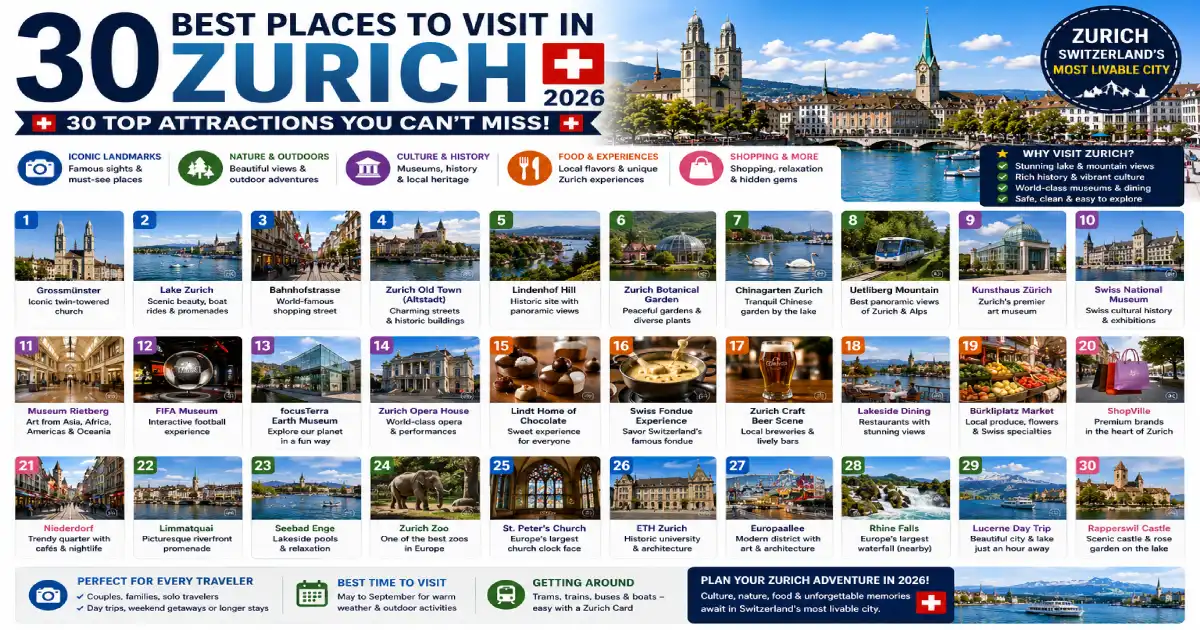
Zurich consistently ranks among the world’s most livable cities — and for visitors, that liveability translates into a travel experience of unusual density and quality. Switzerland’s largest city (440,000 residents in the city proper, 1.4 million in the metropolitan area) combines a preserved medieval Old Town (Altstadt) whose cobblestone lanes and guild halls have survived largely intact since the 12th and 13th centuries with one of Europe’s most sophisticated contemporary arts and dining scenes, the crystalline swimming waters of the Zürichsee (Lake Zurich) extending 40 kilometers south of the city center, and a public transportation system so precise and comprehensive that visitors can reach virtually every attraction in this guide without ever needing a taxi. The best places to visit in Zurich span the Grossmünster cathedral where Ulrich Zwingli launched the Protestant Reformation in 1519, the Kunsthaus Zürich whose recent expansion created Switzerland’s largest art museum housing one of the world’s most important Giacometti collections, the historic Bahnhofstrasse shopping street, and the lakeside Badis (traditional swimming establishments) where Zurich residents swim in the lake from wooden platforms in summer — all within a city compact enough that most major attractions are walkable from the main train station.
What makes Zurich genuinely rewarding for visitors is the combination of cultural depth and physical beauty — the Old Town’s two rivers (the Limmat flowing from the lake through the historic center, and the Sihl joining it near the main station) create a waterfront urban environment that few European cities of comparable size can match, while the surrounding hills (the Zürichberg and Üetliberg) provide forested walking terrain within the city limits that delivers panoramic lake and mountain views without leaving the urban area. Zurich’s reputation as a financial center and luxury shopping destination (Bahnhofstrasse is consistently listed among the world’s most expensive retail streets) coexists with a genuinely accessible visitor experience — most of the city’s best museums charge modest admission or offer free days, the lake swimming is free or nearly free, and the Old Town’s lanes reward unhurried exploration at no cost whatsoever.
This guide covers the 30 best places to visit in Zurich with practical details — admission costs, transport connections, best visiting times, and insider tips — for 2026 visitors planning their first or return trip to Switzerland’s cosmopolitan capital.
For complete guides, see our Things to Do in Zurich 2026, Best Restaurants in Zurich 2026, Best Places to Visit in Switzerland 2026, and Switzerland Travel Guide 2026 guides.
| Place | Area | Entry Cost | Best For | Time Needed |
|---|---|---|---|---|
| Zurich Old Town (Altstadt) | City Center | Free | Medieval lanes, historic buildings | 2–4 hrs |
| Kunsthaus Zürich | City Center | CHF 26 | Switzerland’s largest art museum | 2–4 hrs |
| Grossmünster Cathedral | Old Town | Free (tower CHF 5) | Reformation history, twin towers | 30–60 min |
| Fraumünster Church | Old Town | Free | Chagall stained glass windows | 20–30 min |
| Bahnhofstrasse | City Center | Free | Luxury shopping, atmosphere | 1–2 hrs |
| Lake Zurich (Zürichsee) | Lakefront | Free | Swimming, boat trips, views | 2–4 hrs |
| Swiss National Museum | Hauptbahnhof | CHF 10 | Swiss cultural history | 1.5–2 hrs |
| Lindenhügel (Lindenhügel Hill) | Old Town | Free | Best Old Town panoramic view | 15–20 min |
| Zurich Hauptbahnhof | City Center | Free | Architecture, Christmas market | 20–30 min |
| Zürich Zoo | Zürichberg | CHF 29 | Family visit, diverse wildlife | 3–4 hrs |
| Seebad Utoquai | Lakefront | CHF 8 | Historic lake swimming facility | 2–4 hrs |
| Rietberg Museum | Rieter Park | CHF 18 | Non-European art, park setting | 1.5–2 hrs |
| Üetliberg | Southwest | CHF 14 (train) | City’s local mountain, panorama | 3–4 hrs |
| Langstrasse | City Center | Free | Nightlife, multicultural, street food | Evening |
| Predigerkirche | Old Town | Free | Gothic church, concerts | 20 min |
| Zurich Botanical Garden | Zürichberg | Free | 9,000 plant species, greenhouse | 1–2 hrs |
| Polybahn / ETH Zurich | City Center | CHF 1.60 (funicular) | Funicular, ETH terrace views | 45–60 min |
| Zürichhorn Park | Lakefront | Free | Public lakefront park, Heidi Weber | 1–2 hrs |
| Flussbad Oberer Letten | Limmat River | Free | Urban river swimming | 2–3 hrs |
| Niederdorf | Old Town | Free | Lively Old Town neighborhood, cafes | 1–2 hrs |
| Kunsthalle Zürich | West Zurich | CHF 12 | Contemporary art exhibitions | 1 hr |
| Cabaret Voltaire | Old Town | CHF 10 | Dada birthplace, art museum | 45 min |
| Museum Rietberg | Rieter Park | CHF 18 | Asian, African, non-Western art | 1.5 hrs |
| Zurich Film Museum | Zurich (Löwenbräu-Areal) | CHF 15 | Film history, screenings | 1–2 hrs |
| Thermalbad & Spa Zürich | City Center | CHF 39–55 | Rooftop thermal pools | 2–3 hrs |
| Heidi Weber Museum (Le Corbusier) | Zürichhorn | CHF 12 | Le Corbusier architecture | 1 hr |
| St. Peter Church | Old Town | Free | Europe’s largest church clock face | 10–15 min |
| Great Hall of Zurich University | Zürichberg | Free (exterior) | Neo-Baroque architecture | 15–20 min |
| Zurich West (Industriequartier) | West Zurich | Free | Converted industrial, street art | 2–3 hrs |
| Bellevue Square and Quaibücke | Lakefront | Free | Lake gateway, tram hub, views | 20–30 min |
Entry: Free | Transport: Tram to Paradeplatz, Central, or Rudolf-Brun-Brücke | Best Time: Morning or late afternoon for light and fewer crowds
Zurich’s Altstadt (Old Town) divides naturally across both banks of the Limmat River — the western bank (Lindenhügel, Münstergasse, and the area around Fraumünster and St. Peter Church) historically the residential and ecclesiastical quarter, the eastern bank (Niederdorf, the Grossmünster area, and the lanes running east toward the Zürichberg slope) the commercial and craft quarter — together forming a medieval urban fabric whose street pattern, guild house facades, and building massing have survived relatively intact despite Zurich’s transformation into one of Europe’s wealthiest cities. The contrast between the medieval narrow lanes of the Altstadt and the modern financial district immediately adjacent (Bahnhofstrasse running north-south just west of the Old Town’s western edge) creates a specific Zurich experience of past and present compressed into walking distance.
The western bank’s most significant street, Münstergasse (running north-south from the Rathaus area toward Fraumünster and St. Peter), provides the most concentrated sequence of historic guild house facades, independent bookshops, and artisan businesses in the city — a slower-paced alternative to Niederdorf’s more tourist-oriented character on the opposite bank. The small lanes radiating east from Münstergasse (Strehlgasse, Wühre, and various named alleys descending toward the Limmat) contain some of Zurich’s most atmospheric passages — narrow enough that upper-floor windows of opposite buildings nearly touch, floored with original cobblestones, and largely unchanged in character since the 18th century.
Insider tips: The Altstadt’s most rewarding exploration happens at the pace of genuine walking rather than attraction-ticking — entering lanes without specific destination, noting the painted facades, fountain details (Zurich maintains 1,200 public fountains, many medieval, all providing drinkable water), and the occasional glimpse into courtyards through arched entryways rewards the visitor who treats the Old Town as an environment to inhabit rather than a checklist to complete. Early morning (before 9 AM) provides near-empty lanes with the best light for photography — the Old Town’s east-west oriented lanes catch morning light from the east particularly well in spring and autumn.
Entry: CHF 26 (permanent collection); CHF 35+ (with major temporary exhibitions) | Transport: Tram to Kunsthaus | Best Time: Weekday afternoons; free first Wednesday evening of each month | Address: Heimplatz 1
The Kunsthaus Zürich expanded dramatically in 2021 with a new building (designed by David Chipperfield Architects, connected to the original 1910 Moser building by an underground passage beneath the Heimplatz) that created Switzerland’s largest art museum and one of Europe’s most significant — the combined collection spans medieval Swiss paintings through Old Masters (an exceptional Rubens collection, significant Rembrandt works, and the most comprehensive Swiss Golden Age collection in any public institution) through 19th-century masterworks (Monet’s water lily series, significant van Gogh, Munch’s most important Swiss public works) and into the 20th and 21st centuries (the world’s largest Alberto Giacometti collection outside the Giacometti Foundation in Paris, assembled primarily through the artist’s personal relationship with Zurich, alongside major holdings in German Expressionism, Abstract Expressionism, and contemporary Swiss and international art).
The Chipperfield building’s specific addition — the Giacometti collection, Andy Warhol’s “Shadows” series (a monumental room-filling installation), the Merzbacher Collection of German Expressionism (Kirchner, Heckel, Schmidt-Rottluff at museum quality), and rotating contemporary exhibitions — makes the new building as essential as the historic Moser building for any serious museum visit. The underground connection between buildings (a designed circulation space with its own art installations) functions as a curatorial statement connecting the collection across time.
Insider tips: The first Wednesday evening of each month (free admission, approximately 5–8 PM) is the most democratic way to experience the Kunsthaus — genuinely free, relatively uncrowded compared to weekend afternoons, and providing access to both buildings. The Giacometti wing (new building, dedicated gallery space) represents the most concentrated single collection experience in the museum — the elongated bronze figures arranged in the gallery space create a specific spatial and sculptural environment that photographs cannot prepare visitors for. Allow a minimum of 3 hours for both buildings; serious museum visitors should plan a full day.
Entry: Church free; tower climb CHF 5 | Transport: Tram to Rathaus or walk from Old Town | Best Time: Morning for interior, any time for tower | Address: Grossmünsterplatz
The Grossmünster (Great Minster) — Zurich’s largest and most historically significant church, its twin Romanesque towers defining the Old Town’s skyline for nearly nine centuries — is where Ulrich Zwingli began preaching the Protestant Reformation in 1519, making it one of the most historically important Reformation sites in Europe (comparable in Reformation significance to Wittenberg’s Castle Church where Luther posted his theses two years earlier). The building’s origins date to the Carolingian period (8th century, with the church supposedly founded over the graves of Zurich’s patron saints Felix and Regula), though the current structure reflects primarily 11th–12th century Romanesque construction with various Gothic and later modifications.
The interior is deliberately austere — Zwingli’s Reformation rejected Catholic imagery and ornamentation, resulting in whitewashed walls and minimal decoration that creates a specific meditative atmosphere distinct from the heavily decorated Catholic and even Lutheran churches of neighboring regions. The exceptions to this austerity are the modern stained glass windows (designed by Augusto Giacometti, the sculptor’s cousin, in 1933 — vivid and technically remarkable despite predating the abstract movement that would make Alberto Giacometti internationally famous) and the bronze doors by sculptor Otto Münch (1935–1950, depicting Old and New Testament scenes in a style combining Expressionist influence with traditional iconographic programs).
The Karlsturm (the southern tower, climbable for CHF 5) provides one of Zurich’s most rewarding elevated viewpoints — the narrow staircase (not appropriate for those with claustrophobia) opening onto a small platform with views across the Limmat river, Fraumünster’s green spire across the water, and the lake beyond the Old Town roofline.
Insider tips: The crypt (below the main church floor, accessible from the nave) houses an 11th-century Carolingian remnant and a seated statue of Charlemagne (Karl der Große) — the original medieval sculpture, not a reproduction — displayed in the atmospheric stone space that provides the strongest sense of the building’s actual age. Most visitors walking through the main church miss the crypt entirely.
Entry: Free (voluntary donation) | Transport: Tram to Paradeplatz or walk from Old Town | Best Time: Morning (best light through the windows) | Address: Münsterhof 2
Fraumünster (Women’s Minster), the church across the Limmat River from the Grossmünster, provides Zurich’s most extraordinary single interior artistic experience — five stained glass windows designed by Marc Chagall (1970, each approximately 9 meters tall, the five windows covering the entire choir end of the church in Chagall’s distinctive cobalt blues, reds, and greens depicting Old Testament scenes alongside New Testament imagery and Chagall’s signature figurative dream imagery), alongside a sixth rose window in the transept designed by Augusto Giacometti (1945, predating the Chagall windows by 25 years, creating a deliberate two-artist conversation across the church’s architectural space).
The Chagall windows are among the most significant public works by the artist in any single location — Chagall was 83 when he completed the commission, working at the peak of his mastery of the stained glass medium that he had developed across four decades of religious commissions in France, Israel, and the United States. The windows’ morning illumination (when direct light passes through the south-facing windows, the color saturation intensifies dramatically) is the optimal viewing condition — afternoon light, while adequate, produces less vibrant color rendering than the morning’s direct illumination.
Insider tips: The cloister (accessed through a door in the church nave) is frequently overlooked — a medieval courtyard with Romanesque arches and frescoes depicting the legendary founding of the Fraumünster by Louis the German’s daughter in 853 CE, providing a specific historical and architectural depth that the main nave’s Chagall focus doesn’t communicate. Admission to the cloister is included in the free church entry; the space is typically uncrowded even when the main church is busy with visitors specifically for the Chagall windows.
Entry: Free | Transport: Tram to Bahnhofstrasse/HB or any Bahnhofstrasse stop | Best Time: Weekday mornings; December for Christmas lights | Length: 1.4 kilometers from Hauptbahnhof to Lake Zurich
Bahnhofstrasse — Zurich’s primary commercial artery running 1.4 kilometers from the Hauptbahnhof (main railway station) south to Bürkliplatz on the lake — is consistently listed among the world’s most expensive retail streets (alongside Fifth Avenue, Via Montenapoleone, and the Champs-Élysées), hosting the global flagship stores of Swiss watchmaking brands (Rolex, Patek Philippe, IWC, Audemars Piguet, Omega, each occupying architectural statements at prime Bahnhofstrasse addresses), luxury fashion houses (Chanel, Louis Vuitton, Hermès), and department stores (Jelmoli at the northern end, Switzerland’s oldest department store, Globus at the midpoint). The street’s character — broad, pedestrianized since 1931 (trams running through the central lanes, pedestrians on the generous sidewalks), lined with mature plane trees and presided over by the banking headquarters of UBS and Credit Suisse’s successors — communicates Zurich’s specific combination of financial power and commercial elegance without the aggressive luxury-brand visual competition of equivalent streets in Paris or Milan.
For non-shopping visitors, Bahnhofstrasse functions as a people-watching environment, a architectural tour (the 19th and early 20th-century commercial buildings lining both sides represent a continuous catalogue of Historicist and early Modernist commercial architecture), and the most efficient north-south pedestrian corridor through central Zurich — walking its full length from station to lake provides a complete cross-section of the city’s commercial identity.
Insider tips: The December Christmas lights along Bahnhofstrasse (“Lucy” — the name given to the specific light installation that has decorated the street since 1970, designed by a different artist every few years and always incorporating suspended illuminated elements above the street) transform the shopping street into one of Europe’s most photographed seasonal light displays, typically switching on in late November and running through the first week of January. The Lindt & Sprüngli shop at Bahnhofstrasse 79 (a Zurich institution rather than a generic global brand retail location) sells fresh truffle chocolates and the specific assortments not available internationally — a genuinely worthwhile chocolate purchase for visitors passing on the street.
Entry: Free (lakefront); CHF 5–8 (swimming facilities) | Transport: Tram to Bürkliplatz or various lake stop trams | Best Time: June–September for swimming; year-round for promenade
Lake Zurich (Zürichsee) extends 40 kilometers south of the city — a finger lake of exceptional water clarity (the city’s drinking water comes from the lake, treated to drinking standard from the same source where residents swim, creating the specific connection between swimming and municipal water supply that characterizes Zurich’s relationship with its lake) flanked by hills of vineyards and forest that gradually approach the pre-Alpine foothills visible at the lake’s southern end on clear days. The northern 10 kilometers of the lake (from Bürkliplatz at the foot of Bahnhofstrasse south through the lakeside parks and swimming areas) constitute Zurich’s finest public outdoor space — a continuous promenade connecting the city center to the lakeside villages south of the urban boundary.
The Zürichsee Schifffahrtsgesellschaft (ZSG) lake steamer service (included in the Swiss Travel Pass and Zurich public transport passes) operates year-round passenger boats connecting Zurich’s Bürkliplatz with lakeside communities south toward Rapperswil (a medieval town at the lake’s eastern elbow, 40 kilometers by boat, 1.5 hours) — the full lake crossing to Rapperswil provides one of the region’s finest scenic boat journeys, passing vineyards, manor houses, and the gradually narrowing lake as the pre-Alps come into view.
Insider tips: The Zürichsee’s “Badis” (traditional public swimming facilities, described separately below at #12) are the most authentic Zurich summer experience — swimmming in the lake at the Seebad Utoquai or the Flussbad Oberer Letten provides access to water quality that equals or exceeds dedicated swimming pools in most European cities, at a fraction of standard pool admission costs. The morning lake view from Bürkliplatz (the public square at the lake’s northern tip, where the ZSG boats depart, where the General flower market operates on Tuesday and Friday mornings, and where the Alpenquai promenade begins) provides Zurich’s most immediately striking single view — the lake, the hillside villages on both banks, and (on clear days) the snow-capped Alps at the southern horizon.
Entry: CHF 10 | Transport: Hauptbahnhof (adjacent to the main station) | Best Time: Weekdays, year-round | Address: Museumstrasse 2
The Swiss National Museum (Schweizerisches Nationalmuseum), housed in a purpose-built neo-Gothic castle-like building adjacent to Zurich’s main railway station (completed 1898, deliberately evoking a medieval Swiss castle in its turreted and gabled roofline while providing extensive interior gallery space), holds Switzerland’s most comprehensive collection of cultural history — furniture, textiles, silverware, arms and armor, religious art, folk objects, and applied arts from the medieval period through the 20th century, organized to create a narrative of Swiss cultural identity across the country’s four linguistic and cultural regions. A significant 2016 expansion (a new building connecting to the historic structure through an interior passage) added modern gallery space for the museum’s archaeological collections (Swiss prehistoric and Roman-period material) and temporary exhibitions.
The medieval section (rooms furnished with period furniture and religious art from Swiss church and aristocratic collections) and the Reformation rooms (objects related to Zwingli and the specific Swiss Protestant Reformation centered on Zurich) are the museum’s historically richest content for visitors interested specifically in Swiss history. The applied arts collection (guild silverware, clock mechanisms from the watchmaking cantons, embroidery from Appenzell, and painted furniture from various Swiss regional traditions) provides the most visually engaging overview of the specific decorative traditions that make Swiss material culture distinctive.
Insider tips: The museum’s location literally adjacent to the Hauptbahnhof (accessible through the station’s underpass without going outside) makes it the most logistically convenient major museum in Zurich — ideal for rainy days, for early arrivals before other attractions open, or for filling gaps between train connections. The museum’s restaurant (within the historic building, with courtyard seating in summer) provides one of central Zurich’s most atmospheric lunch settings at reasonable prices compared to Bahnhofstrasse-area alternatives.
Entry: Free | Transport: Walk from Old Town (5–10 minutes from Fraumünster) | Best Time: Golden hour for photography
The Lindenhügel (Linden Hill), a small elevated area on the western bank of the Old Town accessible via the Schipfe (the historic lower quay area below the Old Town’s western cliff), provides Zurich’s most immediately striking Old Town viewpoint — the view east across the Limmat River toward the Grossmünster’s twin towers, the Fraumünster’s green copper spire, the university building’s dome above, and the water towers and guild houses along the Limmat’s eastern bank creates the quintessential Zurich skyline composition that appears in tourism materials, postcards, and travel photography from every era since photography reached the city in the mid-19th century.
The Lindenhügel’s linden trees (after which the hill is named) shade a small public terrace — benches, a fountain, and the specific quiet of a non-touristy Old Town corner that is nevertheless within 10 minutes’ walk of the most-visited tourist areas — creating an environment where locals bring coffee from the nearby cafés and read, while visitors discover that the best view of the Old Town requires neither admission fee nor elevated transport.
Insider tips: The Schipfe area below the Lindenhügel (a narrow lane running along the Limmat at the base of the Old Town’s western cliff, historically a boatmen’s and craftsmen’s quarter and now home to independent shops and one of Zurich’s most charming café settings) provides a different perspective on the Old Town — at water level rather than elevated, with the cliff face and overhanging buildings creating a dramatic enclosed streetscape quite different from the more commonly photographed elevated views.
Entry: Free | Transport: All trams and trains terminate here | Best Time: Morning rush (atmospheric) or December (Christmas market)
Zurich’s Hauptbahnhof (HB) — the busiest railway station in Switzerland (490,000 daily passengers, more than Zurich Airport and Geneva Airport combined) and one of the busiest in Europe — merits a visit in its own right beyond its obvious transportation function. The main hall (a 19th-century barrel-vaulted space, completed 1871, with the original architectural character largely preserved despite modernization) is hung with “Hängeei” (a suspended sculptural mobile by Niki de Saint Phalle — colorful, large-scale figures hanging from the station ceiling, installed 2000 and now one of Zurich’s most recognized single public artworks). The underground levels (ShopVille retail concourse, tram and S-Bahn connections descending multiple levels below the main hall) extend the station into a subterranean city with its own geography.
The December Christkindlimärkt (Christmas Market) within the Hauptbahnhof creates one of Europe’s largest indoor Christmas markets — the main hall transformed from November through late December with market stalls selling Swiss handicrafts, food, glühwein, and seasonal goods under the station’s vaulted roof and the Niki de Saint Phalle mobile, creating a specifically Swiss indoor Christmas atmosphere that the outdoor markets of Basel and Bern complement rather than duplicate.
Insider tips: The station’s Zurich Card distribution point (Tourist Information, ground level main hall) issues the Zurich Card (24-hour CHF 29, 72-hour CHF 59 — covering all public transport, free museum entry to 43 Zurich museums, and various discounts) for visitors not using the Swiss Travel Pass. The station’s track 3 and 4 area (above ground, the historic platforms for long-distance departures) provides an unexpectedly quiet space with views over the Limmat river and the Sihl confluence — worth knowing as a brief respite from the main hall’s constant movement.
Entry: CHF 29 adults | Transport: Tram 6 to Zoo | Best Time: Weekday mornings; spring and autumn for comfortable temperatures | Address: Zürichbergstrasse 221
Zurich Zoo, located on the wooded slope of the Zürichberg hill northeast of the city center, is consistently ranked among Europe’s most progressive urban zoos — notable for the Masoala Rainforest (a 11,000 square meter heated glass hall housing a complete Madagascar rainforest ecosystem with free-flying lemurs, chameleons, and birds in an environment where the “zoo” boundary between visitor and animal habitat is deliberately blurred), the Kaeng Krachan Elephant Park (a 6,800 square meter habitat for Asian elephants, designed to allow natural herd behavior rather than traditional zoo containment), and a conservation philosophy that has produced successful breeding programs for endangered species including snow leopards, Amur tigers, and various primate species.
The zoo’s hillside setting (requiring some uphill walking between exhibits — comfortable footwear essential) and the Zürichberg forest surrounding the zoo grounds create an experience that feels less institutionally urban than flat-site zoos — the sensation of walking through a forest that happens to contain animal enclosures rather than walking between enclosures in a park setting.
Insider tips: The Masoala Rainforest hall (the Madagascar ecosystem, covered under general admission) is the zoo’s single most remarkable exhibit — a genuinely immersive tropical environment that operates as both zoo exhibit and functioning educational research site. The lemurs (moving freely through the rainforest canopy above visitor pathways) and the colorful Malagasy chameleons (visible with patience in the undergrowth) provide the zoo’s most memorable animal encounters for visitors who take time to move slowly and look carefully rather than walking quickly through to the next area.
Entry: CHF 8 | Transport: Tram 2/4 to Feldeggstrasse, then 5-minute walk | Season: May–September | Best Time: Early morning or early evening (avoid midday heat and crowds)
Seebad Utoquai, a Victorian-era lake bathing establishment (original structure 1890s, repeatedly renovated while maintaining historical character) extending over Lake Zurich’s surface on wooden pontoons and jetties, represents Zurich’s most historically resonant swimming experience — a mixed-gender facility where Zurich residents have been swimming in the Zürichsee from the same wooden platforms for over 130 years. The structure’s combination of changing rooms (historic wooden cubicles), a diving platform, a café (serving Zurich’s characteristic combination of coffee and a pretzel at reasonable prices), and the lake itself creates an experience of genuinely inhabiting Zurich rather than observing it — swimming in a lake of drinking-water quality within sight of the Grossmünster towers.
The Seebad’s café (operating on the floating platform with lake views in every direction) provides one of Zurich’s most atmospheric breakfast settings during morning swimming hours — swimmers, regulars with newspapers, and the occasional tourist who has discovered that this experience represents genuinely local Zurich life in a way that restaurant or museum visits don’t.
Insider tips: The Frauenbadi (women’s bathing establishment, nearby, separate admission) and Männerbadi (men’s, on the Schanzengraben canal connecting to the lake) are alternative historic bathing institutions with their own specific characters — the Frauenbadi’s mixed evening hours (typically after 7 PM in summer) have developed into one of Zurich’s most popular social gatherings, while the Männerbadi’s canal setting (rather than the open lake of the Seebad Utoquai) provides a different physical environment within the same historic bathing tradition.
Entry: Free | Transport: Tram to Escher-Wyss-Platz or walk from Hauptbahnhof (15 min) | Season: May–September | Best Time: Warm summer afternoons
Flussbad Oberer Letten, an outdoor swimming facility on the Limmat River (approximately 15 minutes’ walk northwest of the Hauptbahnhof), provides the most democratic and most genuinely local Zurich swimming experience — free to enter, historically associated with Zurich’s industrial working-class Industrie Quartier, and offering the specific pleasure of swimming in a fast-flowing river (the Limmat’s current carries swimmers downstream at walking pace) in an urban setting surrounded by the post-industrial Zurich West area that has been repurposed into a creative and nightlife district. The facility includes a beach volleyball court, a kiosk selling food and drinks, and a large outdoor area that becomes one of Zurich’s most populated social spaces on hot summer afternoons.
Insider tips: The river’s current means swimmers enter upstream and are carried downstream — there’s no lap swimming in the traditional sense; instead, the experience is of current-assisted drifting in a wide outdoor river corridor. The water temperature (the Limmat runs from Lake Zurich, which itself draws from Alpine tributaries, making it significantly colder than many rivers — 18–22°C at peak summer) rewards gradual entry rather than immediate immersion for visitors accustomed to warmer pool temperatures.
Entry: CHF 10 | Transport: Tram to Rathaus, then walk | Address: Spiegelgasse 1, Niederdorf | Best Time: Any time; check event calendar for special programming
Cabaret Voltaire, the bar and performance space at Spiegelgasse 1 in the Niederdorf district where Hugo Ball, Emmy Hennings, Jean Arp, Tristan Tzara, and other artists founded the Dada art movement in February 1916, operates today as a combination museum, art space, bar, and cultural institution dedicated to the legacy and continuing relevance of Dada’s anti-rational, anti-bourgeois cultural provocation. The physical space (a narrow building in a narrow Old Town lane, its dimensions unchanged from the 1916 original) houses rotating exhibitions exploring Dada’s connections to contemporary art and politics alongside a permanent collection of Dada documentation — manifestos, performance photographs, original publications — that makes it the primary institutional memory of the movement’s Zurich origins.
The specific location (Spiegelgasse 1) places Cabaret Voltaire at the center of a historically dense block — number 14 Spiegelgasse, a few doors down, was where Lenin lived during his 1916–1917 Zurich exile immediately before returning to Russia for the October Revolution, creating the remarkable historical coincidence of Dada and Bolshevism gestating simultaneously within the same 200-meter street.
Insider tips: The combination of the museum’s permanent Dada documentation with its rotating contemporary exhibition programming (the space actively commissions new work responding to Dada’s legacy rather than simply preserving historical material) makes Cabaret Voltaire worth checking for specific current programming before visiting — the experience varies significantly depending on what is currently installed in the gallery spaces. The bar (operating standard café/bar hours independent of museum programming) provides access to the historical space without museum admission for visitors wanting to drink coffee in the room where Dada was invented.
Entry: Free | Transport: Tram to Helvetiaplatz or Langstrasse | Best Time: Evening for nightlife; daytime for food markets and local character
Langstrasse (Long Street) runs north-south through the Aussersihl district west of the main railway station — Zurich’s most densely multicultural commercial street, historically the city’s working-class immigrant quarter and red-light district (the latter largely relocated by urban policy but still present in reduced form), now operating simultaneously as a nightlife center, a concentrated street food corridor (Turkish döner, Vietnamese pho, Ethiopian injera, Spanish tapas, and dozens of other cuisines represented within walking distance), and the home base of Zurich’s creative and alternative communities. The Langstrasse’s specific energy — genuinely diverse in ways that Zurich’s affluent residential neighborhoods are not, active from early morning (bakeries, fruit vendors, coffee shops) through late night (clubs operating until 6–7 AM on weekends) — represents the version of Zurich least visible from standard tourist itineraries.
Insider tips: The Helvetiaplatz (a large public square at the northern end of the Langstrasse commercial strip) operates as the neighborhood’s social center — markets, political demonstrations, and informal gatherings all occur here, making it the best single vantage point for understanding the Langstrasse as a living urban space rather than simply a nightlife corridor. The Rote Fabrik (Red Factory — a converted factory on the lake south of the city center, 15 minutes’ walk or tram from Langstrasse) hosts performances, concerts, and art events connected to the alternative culture that the Langstrasse represents within Zurich’s broader social landscape.
Entry: CHF 14 return (S-Bahn train from Hauptbahnhof, S10 line) | Transport: S10 train from Hauptbahnhof to Üetliberg terminus (25 min) | Best Time: Clear days for panoramic views; year-round | Altitude: 871 meters
Üetliberg, the forested ridge rising immediately southwest of Zurich to 871 meters altitude, provides the city’s most accessible panoramic viewpoint — a 25-minute S-Bahn train journey from the Hauptbahnhof deposits visitors at the mountain terminus, from which a short uphill walk reaches the Uto Kulm hotel and the observation tower (an additional 30 meters of elevation, free to climb, with 360-degree views encompassing Lake Zurich below, the city spreading north, and the snow-capped Alps forming the southern horizon on clear days). The Üetliberg ridge trail (the “Planetenweg” — Planet Path, a 6-kilometer walking route descending along the ridge that uses scale models of the solar system placed at proportional distances as an educational element) connects Üetliberg to the Felsenegg cable car descent toward the lake village of Adliswil.
Insider tips: The Üetliberg “Planetenweg” loop (ascending by S-Bahn, descending along the ridge trail to Felsenegg, then cable car to Adliswil and S-Bahn return to Zurich) creates one of Zurich’s finest half-day excursions — approximately 6 kilometers of walking with significant views throughout, using public transport for both the ascent and the descent, completing a circuit that covers the full character of the Üetliberg ridge without retracing steps. The cable car to Felsenegg is included in the Swiss Travel Pass and the Zurich Card.
Entry: CHF 18 | Transport: Tram to Museum Rietberg | Best Time: Weekday afternoons | Address: Gablerstrasse 15 (Villa Park Rieter)
The Rietberg Museum, housed in two historic villas (Villa Wesendonck — where Wagner completed Tristan und Isolde in the 1850s and where his relationship with Mathilde Wesendonck inspired the “Wesendonck Lieder” — and Villa Rieter) alongside a modern underground expansion in the surrounding Park Rieter, holds Switzerland’s most important collection of non-European art — Asian art (India, China, Japan, Southeast Asia, and Central Asia represented with works of significant museum quality), African art, ancient American art, and Oceanic art, organized into an encyclopedic overview of artistic traditions outside the European canon. The modern underground extension (integrated into the park landscape with a glass ceiling allowing natural light) connects the villas without disturbing the park’s historic character.
The park itself (Park Rieter, a 19th-century landscape park with lake views from its upper terraces, free to access independent of the museum) provides one of Zurich’s finest urban green spaces — the combination of historic villa architecture, mature exotic tree species planted by the 19th-century villa owners, and lake views through the lower terraces creates an environment worth visiting independently of the museum.
Insider tips: The Wagner connection (the Villa Wesendonck’s music room, where Wagner worked during his Zurich years) is documented in the museum’s collection — visitors specifically interested in Wagner’s biography will find the Wesendonck connection contextualizes the Tristan und Isolde period more specifically than any concert hall or opera house visit can provide. The Rietberg is consistently less crowded than the Kunsthaus despite comparable museum quality — a combination of location (slightly further from the Old Town center) and subject matter (non-European art remains less immediately familiar to general visitors) that rewards those who seek it out.
Entry: Polybahn CHF 1.60 (MetroCard fare); ETH Zurich free | Transport: Polybahn departure from Central square | Best Time: Clear days for ETH terrace views
The ETH Zurich (Eidgenössische Technische Hochschule — Federal Institute of Technology) consistently ranks among the world’s top 10 universities (Albert Einstein studied here 1896–1900 and returned as a faculty member, along with 21 other Nobel Laureates associated with the institution) — its main building, designed by Gottfried Semper (the architect also responsible for Dresden’s Semper Opera and Vienna’s Kunsthistorisches Museum), sits on the Hochschulquartier hill above the Old Town, accessible by the historic Polybahn funicular (a two-car cable funicular running between the Central square and the Polybahn top station, CHF 1.60 one way, one of the last working urban funiculars in Switzerland).
The ETH Zurich’s terrace (accessible free from the main building’s upper floor, overlooking the Old Town, Grossmünster, and the lake beyond — one of Zurich’s finest elevated views from a publicly accessible non-commercial space) and the ETH collection of geological, mineralogical, and scientific specimens (various scientific museums within the ETH campus, partially free) extend the visit beyond architecture into educational content.
Insider tips: The Polybahn funicular (one of only four remaining urban funiculars in Switzerland, operating since 1889) is worth riding specifically as a historic transport experience independent of any destination objective — the two-car system (one car descends as the other ascends, counterbalanced on a single cable) operates exactly as it did when first installed, providing a specifically Victorian mechanical transport experience in the center of one of the world’s most modern cities.
Entry: Free | Transport: Tram to Schiffbau or Escher-Wyss-Platz | Best Time: Evenings for nightlife; daytime for street art and food halls
Zurich West (the Industriequartier — Industrial District) occupies Zurich’s former heavy industrial zone west of the Limmat River — warehouses, factory buildings, gasworks, and industrial infrastructure that became economically obsolete in the late 20th century and were progressively repurposed from the 1990s onward into one of Europe’s most significant examples of post-industrial urban cultural transformation. The Schiffbau (a 1905 ship-building hall converted into a performing arts complex housing the Schauspielhaus Zurich’s main stage, a jazz club, and a restaurant), the Frau Gerolds Garten (a converted industrial yard operating as an outdoor bar, restaurant, and creative market space), the Löwenbräu Areal (a former brewery converted into a contemporary art gallery and museum complex housing Kunsthalle Zürich, the Migros Museum für Gegenwartskunst, and multiple commercial galleries), and the Prime Tower (Zurich’s tallest building, 126 meters, housing offices and a restaurant with city views from the upper floors) together create a neighborhood whose cultural density rivals the Old Town despite its entirely different historical character.
Insider tips: The Löwenbräu Areal art complex (Kunsthalle Zürich + Migros Museum + commercial galleries) represents some of Zurich’s most adventurous contemporary exhibition programming — visiting during a major opening (which typically include free public access to multiple gallery spaces simultaneously in an event format) provides the best combination of art access and Zurich creative-community atmosphere. Check the Kunsthalle and Migros Museum websites for current exhibition and opening schedules before visiting Zurich West specifically for the art.
Entry: CHF 39–55 depending on session | Transport: Tram to Helvetiaplatz | Book: Advance reservation recommended | Address: Thermalbad & Spa Zürich, Stauffacherstrasse 65
Thermalbad & Spa Zürich, housed in a converted 1960s municipal swimming facility (the Stadtbad Zürich West, whose original modernist architecture has been partially preserved within the spa conversion), offers Zurich’s most distinctive thermal bathing experience — rooftop thermal pools with 360-degree views of the Zurich West skyline, indoor thermal pools, steam rooms, and a “thermal journey” circuit that has become one of the city’s most popular wellness experiences for both residents and visitors. The rooftop pool (open air, year-round heated to approximately 36°C) provides the most striking experiential contrast — soaking in thermal water on a Zurich winter evening while snowflakes fall and the city lights illuminate the surrounding industrial-to-creative transition zone of Zurich West.
Insider tips: The thermal pool visit works best as an evening experience (the contrast between winter cold and warm pool water is most dramatic after dark, and the rooftop lighting creates an atmospheric quality that daylight visits don’t provide) — booking specifically for a post-dinner evening session (the spa typically operates until 10 or 11 PM depending on day) creates a complete Zurich West evening: dinner at Frau Gerolds Garten or a neighborhood restaurant, followed by the thermal bath experience.
Entry: Free | Transport: Tram to Rudolf-Brun-Brücke or Rathaus | Best Time: Anytime; evenings for restaurant and bar culture
Niederdorf (literally “lower village”) is the eastern bank Old Town’s most active neighborhood — the streets running north from the Grossmünster toward the Zähringerplatz and Niederdorfstrasse (the main commercial street of the area, pedestrianized, lined with restaurants, bars, independent shops, and the specific density of sidewalk cafés that gives Niederdorf its reputation as Zurich’s most sociable neighborhood) define the area’s character as a gathering place rather than a primarily tourist-facing attraction zone. The difference between Niederdorf and the western bank Old Town is one of energy — Niederdorf is busier, louder, and more commercially active than the quieter residential and ecclesiastical western bank, making it the better choice for visitors specifically seeking restaurant options and street-level atmosphere rather than architectural contemplation.
Insider tips: The Augustinergasse (a tiny lane on the western edge of Niederdorf, between the Grossmünster and the Rathaus) is Zurich’s single most photographed Old Town lane — the combination of medieval building facades, overhanging upper floors, and the way the lane curves to reveal the Grossmünster towers creates a composition of concentrated Old Town character in 50 meters of street that photographers from across the world specifically seek out. The lane is genuinely this beautiful and requires no admission, no planning, and no particular time of day — though morning light from the east illuminates the western-facing facades most flatteringly.
Entry: Free | Transport: Walk from Old Town western bank | Address: St. Peterhofstatt | Best Time: Any time; the clock is the attraction
St. Peter Church, the oldest parish church in Zurich (origins in the 9th century, though the current structure reflects primarily 13th–18th century construction), holds a specific distinction that makes it worth visiting for visitors interested in the specific and unusual — the church tower clock face (installed 1534) is the largest medieval clock face in Europe, at 8.7 meters in diameter, with minute hands each 3.6 meters long. The clock’s scale is genuinely difficult to appreciate in photographs — standing at the Petersgasse below the tower provides the most comprehensible perspective on a timepiece whose medieval engineering ambition exceeds anything visible at comparable distance in any European clock tower.
Insider tips: St. Peter Church serves an active congregation and functions as a parish church rather than purely a tourist attraction — respecting services in progress and the building’s religious function rather than treating it as a clock exhibition creates a more considerate visitor experience while providing equal access to the architecture and clock.
Entry: Free | Transport: Tram to Zürichbergstrasse | Best Time: Spring (April–May, peak bloom); year-round for greenhouses | Address: Zollikerstrasse 107
The Zurich Botanical Garden (Botanischer Garten der Universität Zürich), operated by the University of Zurich on the Zürichberg slope northeast of the city center, maintains 9,000 plant species across outdoor beds and three distinct greenhouse complexes (a rainforest tropical greenhouse, a succulent/cactus greenhouse, and a Mediterranean climate greenhouse) — free to visit year-round, making it one of Zurich’s best free attractions for visitors with any interest in horticulture, ecology, or simply green outdoor space. The garden’s hillside setting provides views back toward the lake from the upper terraces, while the greenhouse environments (maintaining tropical temperatures year-round, genuinely warm and humid on even the coldest Zurich winter days) provide a specific escape from winter conditions.
Insider tips: The succulents greenhouse (housing the garden’s substantial cactus and succulent collection alongside various carnivorous plants, air plants, and desert-adapted species) is the most visually striking of the three greenhouse environments for non-specialist visitors — the scale and variety of the cactus collection in particular (multi-decade-old specimens of notable size arranged in a purpose-built desert-climate space) rewards a visit independent of any specific botanical interest.
Entry: CHF 12 | Transport: Tram to Höschgasse | Address: Höschgasse 8, Zürichhorn | Best Time: May–October (outdoor surroundings)
The Heidi Weber Museum (officially the Centre Le Corbusier) — a building designed by Le Corbusier and completed posthumously in 1967, the year after his death, making it his final completed work — stands in the Zürichhorn park south of the city center as one of Switzerland’s most significant works of 20th-century architecture. The building (a steel-framed, prefabricated structure sheltered beneath a large independent concrete umbrella roof, both the building and the roof designed as demonstration of Le Corbusier’s late-period interest in modular prefabricated construction systems) houses a permanent collection of Le Corbusier’s paintings, sculptures, tapestries, and furniture designs alongside rotating architectural exhibitions, in a setting that itself constitutes the primary exhibit.
Insider tips: The building’s lakeside Zürichhorn park location makes it naturally combinable with a broader lakeside walk connecting south from Bürkliplatz — the path along the Zürichsee’s western shore through the Zürichhorn park provides access to the Le Corbusier building as part of a lakeside walking route rather than requiring a specific tram journey for this single attraction alone.
Already described above at #17. See ETH Zurich entry.
Entry: Free | Transport: Hauptbahnhof | Season: Late November through December 24 | Best Time: Weekday evenings
The Zurich Christkindlimärkt (Christmas Market inside the Hauptbahnhof), one of Europe’s largest indoor Christmas markets, transforms the main station’s grand hall into a festive space from late November through Christmas Eve — market stalls selling Swiss handicrafts, decorations, chocolate, mulled wine (Glühwein), and seasonal food arranged beneath the Niki de Saint Phalle sculpture and the historic station ceiling. A second, outdoor Zurich Christmas market operates simultaneously at Werdmühleplatz (a 10-minute walk from the station), with a different, more traditionally outdoor character.
Insider tips: The combination of the indoor Hauptbahnhof market (largest, most spectacular, busiest) and the outdoor Werdmühleplatz market (smaller, more intimate, somewhat less crowded) creates a complete Zurich Christmas market evening — visiting both in sequence, connecting via the short walk through the Old Town area between them, provides the most comprehensive overview of Zurich’s Christmas market tradition within a single evening.
About Travel Tourister Travel Tourister’s destination specialists have explored Zurich across all seasons and all neighborhoods — from early-morning Altstadt walks and Seebad Utoquai lake swims to Kunsthaus Giacometti galleries and Üetliberg sunset panoramas — to deliver the most practical and honest guide to the best places to visit in Zurich for every type of 2026 visitor.
Posted By : Vinay
Latest Article
2nd Floor, 39, Above Kirti Club, DLF Industrial Area, Kirti Nagar, New Delhi, Delhi 110015



Travel Tourister is a leading Travel portal where we introduce travellers to trusted travel agents to make their journey hasselfree, memorable And happy. Travel Tourister is a platform where travellers get Tour packages ,Hotel packages deals through trusted travel companies And hoteliers who are working with us across the world. We always try to find new and more travel agents and hoteliers from every nook and corners across the world so that you could compare the deals with different travel agents and hoteliers and book your tour or hotel with the one you have chosen according to your taste and budget.
Copyright © Travel Tourister, India. All Rights Reserved

 Call
Call Enquiry