Published on : 05 Aug 2026
By Travel Tourister | Updated Aug 2026
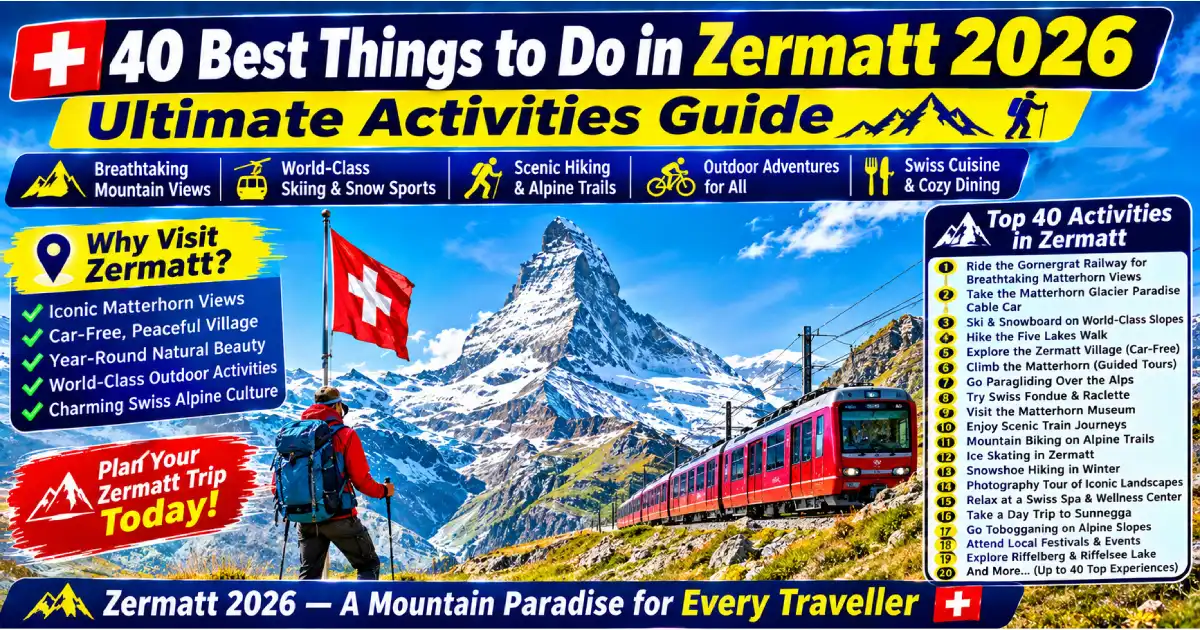
Zermatt delivers more genuinely world-class activities per square kilometer than virtually any other Alpine resort in Europe — a car-free village beneath the world’s most recognizable mountain, surrounded by 38 peaks exceeding 4,000 meters, served by one of the most sophisticated lift systems in the Alps (360 kilometers of marked ski runs in winter, 400 kilometers of marked hiking trails in summer), and supported by a village infrastructure (restaurants, museums, spas, and shops) that reflects 170 years of developing one of the world’s most visited mountain destinations. The best things to do in Zermatt span completely free experiences (watching the Matterhorn’s alpenglow from the village streets at sunrise, walking the historic Hinterdorf quarter, visiting the Mountaineers’ Cemetery) through moderate investments (the Five Lakes Walk above Sunnegga, the Matterhorn Museum, fondue dinner at Chez Vrony) to significant Alpine splurges (the Matterhorn Glacier Paradise cable car, the Glacier Express departure toward St. Moritz, a guided high-alpine scramble on the Hörnli Ridge approach) — all within a car-free village whose electric taxis and horse-drawn carriages maintain an Alpine authenticity that car-accessible resorts permanently sacrifice.
What makes Zermatt’s activity landscape genuinely distinctive is the year-round operational quality — unlike many Alpine destinations where summer and winter represent entirely different visitor experiences of variable quality, Zermatt operates at consistent excellence across both seasons. The ski season (December through April, extending to year-round glacier skiing above 3,500 meters) and the hiking/climbing season (June through October) each provide a complete and extraordinary activity program, with the specific advantages of each season (skiing the longest ski runs in Switzerland in February, watching alpine wildflowers carpet the Five Lakes Walk in July, photographing larch forests in golden October) making the destination rewarding regardless of when a 2026 visit falls.
This guide covers the 40 best things to do in Zermatt organized by category — hiking and mountain activities, skiing and winter sports, cable car and railway experiences, food and cultural activities, and day trips — with practical details on costs, seasonal availability, booking requirements, and insider timing for 2026 visitors planning any length of stay in this extraordinary Alpine village.
For complete guides, see our Best Places to Visit in Zermatt 2026, Best Restaurants in Zermatt 2026, Best Time to Visit Zermatt, Best Places to Visit in Switzerland 2026, and Switzerland Travel Guide 2026 guides.
| # | Activity | Category | Cost | Season | Book Ahead? |
|---|---|---|---|---|---|
| 1 | Watch Matterhorn Alpenglow at Sunrise | Photography/Nature | Free | Year-round | No |
| 2 | Hike the Five Lakes Walk | Hiking | CHF 36–42 (gondola) | June–Oct | No |
| 3 | Ride the Gornergrat Railway to Summit | Railway/Views | CHF 55–95 | Year-round | No |
| 4 | Ski the Matterhorn Ski Paradise | Skiing | CHF 79–92/day | Dec–Apr (+ glacier year-round) | Yes (accommodation) |
| 5 | Take the Matterhorn Glacier Paradise Cable Car | Cable Car | CHF 95–115 | Year-round | No |
| 6 | Hike to the Stellisee Reflection | Hiking/Photography | CHF 36–42 (gondola) | June–Oct | No |
| 7 | Eat Fondue at Chez Vrony | Food/Dining | CHF 50–100/person | June–Oct | Yes |
| 8 | Visit the Matterhorn Museum (Zermatlantis) | Museum | CHF 10 | Year-round | No |
| 9 | Walk the Hinterdorf Historic Quarter | Culture | Free | Year-round | No |
| 10 | Visit the Mountaineers’ Cemetery | History | Free | Year-round | No |
| 11 | Ski to Cervinia, Italy (Cross-Border) | Skiing | CHF 20–30 (supplement) | Dec–Apr | No |
| 12 | Hike the Schwarzsee Glacier Trail | Hiking | CHF 50–65 (cable cars) | June–Oct | No |
| 13 | Photograph the Riffelsee Matterhorn Reflection | Photography | CHF 55–95 (Gornergrat) | June–Oct | No |
| 14 | Walk the Zmutt Valley | Hiking | Free | June–Oct | No |
| 15 | Snowshoe Above the Village | Winter | CHF 30–50 (snowshoe rental + guide) | Dec–Mar | Recommended |
| 16 | Take the Glacier Express to St. Moritz | Railway | CHF 175+ (or Swiss Travel Pass + reservation) | Year-round | Yes |
| 17 | Dine at Findlerhof Mountain Restaurant | Food/Dining | CHF 40–85/person | June–Oct | Yes |
| 18 | Night Skiing on Zermatt Illuminated Runs | Skiing | CHF 40–55 (night pass) | Jan–Mar (select nights) | No |
| 19 | Take a Guided Matterhorn Hörnli Ridge Walk | Hiking/Mountaineering | CHF 200–400 (guide) | July–Sep | Yes (essential) |
| 20 | Paraglide over Zermatt | Adventure | CHF 180–220 | June–Oct | Yes |
| 21 | Visit the Alpine Museum | Museum | CHF 10 | Year-round | No |
| 22 | Horse-Drawn Carriage Ride | Experience | CHF 25–50 | Year-round | No |
| 23 | Hike to Ried Village Viewpoint | Hiking | Free | June–Oct | No |
| 24 | Try Swiss Raclette at a Local Restaurant | Food | CHF 25–45/person | Year-round | Recommended |
| 25 | Ski the Klein Matterhorn Long Descent | Skiing | Included in lift pass | Dec–Apr | No |
| 26 | Walk Bahnhofstrasse at Dusk | Sightseeing | Free | Year-round | No |
| 27 | Take a Winter Sleigh Ride | Experience | CHF 40–80 | Dec–Mar | Yes |
| 28 | Hike the Matterhorn Trail (Lower Sections) | Hiking | CHF 25–30 (cable car) | June–Oct | No |
| 29 | Visit the Winkelmatten Chapel | Culture/Photography | Free | Year-round | No |
| 30 | Stargazing from the Village | Astronomy | Free | Year-round | No |
| 31 | Spa and Wellness at Zermatt Hotels | Wellness | CHF 40–100+ | Year-round | Yes |
| 32 | Shop for Swiss Watches and Chocolate | Shopping | Free to browse | Year-round | No |
| 33 | Hike the Rothorn Paradise Ridge | Hiking | CHF 60–75 (cable car) | June–Oct | No |
| 34 | Attend the Zermatt Unplugged Festival | Music | CHF 50–150+ (tickets) | April | Yes (months ahead) |
| 35 | Ski the Theodul Glacier (Summer Skiing) | Skiing | CHF 55–79/day | Year-round (glacier) | No |
| 36 | Day Trip to Saas-Fee | Day Trip | CHF 20–30 (bus/taxi) | Year-round | No |
| 37 | Ice Climbing Course | Adventure | CHF 180–350 (guided) | Dec–Mar | Yes |
| 38 | Rock Climbing on the Riffelhorn | Climbing | CHF 200–400 (guided) | June–Sep | Yes |
| 39 | Take Ski Lessons at Zermatt Ski School | Skiing | CHF 90–130/day (group) | Dec–Apr | Yes |
| 40 | Watch the Sunrise from Gornergrat Summit | Photography | CHF 55–95 (train) | Year-round | No (first train timing) |
Cost: Free | Location: Ried area (10–15 min walk north of village), or any open viewpoint | Best Time: 20–30 minutes before sunrise | Season: Year-round
The Matterhorn’s alpenglow (Alpenglühen in German) — the pre-sunrise reddening of the peak’s summit before direct sunlight reaches the valley — is the single most extraordinary free experience in Zermatt and arguably the most memorable single natural event in the Swiss Alps. For a 10–15 minute window beginning approximately 20–30 minutes before official sunrise, the Matterhorn’s 4,478-meter summit catches the first reddish wavelengths of sunlight while the valley and lower slopes remain in complete darkness — the pyramid’s peak appearing to glow internally with a deep red-orange that transitions rapidly through orange to the normal white-grey of daytime before the sun clears the eastern ridgeline.
The best alpenglow viewing position is the Ried area — a small traditional residential neighborhood on the valley’s eastern slope, approximately 10–15 minutes’ walk north of the main train station, from which the Matterhorn faces nearly directly (northeast face) without intervening valley walls blocking the low-angle pre-sunrise light. Arriving at Ried 30–40 minutes before sunrise (check the specific sunrise time for your visit date via any weather app or the Zermatt Tourism website) provides position-finding time before the brief light window opens.
The experience requires nothing beyond the will to set an alarm — no cable car tickets, no reservations, no special equipment beyond appropriate warm layers (Zermatt’s 1,608-meter altitude makes pre-dawn temperatures genuinely cold even in summer, and quite cold to very cold October through May). The emotional impact of standing in pre-dawn darkness watching the world’s most recognizable mountain turn red above you is something that photographs partially convey but cannot fully replicate.
Insider tips: The alpenglow is most dramatically visible under completely clear skies — a cloud layer at the summit (even a thin one) eliminates the color effect entirely. Checking the weather forecast specifically for clear summit conditions the night before (the Zermatt Tourism website and the Gornergrat Observatory webcam both provide summit condition information) allows anticipating whether alpenglow is likely the following morning. Multiple consecutive mornings in Zermatt significantly increase the probability of at least one clear-sky alpenglow event compared to a single-night visit.
Cost: CHF 55–95 (Gornergrat Railway return) | Access: Alight at Rotenboden station (not Riffelberg, not Gornergrat — specifically Rotenboden) | Best Time: First morning train (before 9 AM, before wind disturbs the lake surface) | Season: June–October (lake frozen in winter)
The Riffelsee reflection — the Matterhorn’s pyramidal form reflected in the small high-altitude lake at Rotenboden station on the Gornergrat Railway — is the most famous single landscape photography composition in Switzerland, reproduced in more travel publications, tourism materials, and photography competitions than any other single Swiss image. Standing at the lake’s edge on a calm morning with the actual reflection visible (the inverted Matterhorn in the still water creating the perfect symmetrical double-image composition) produces the specific satisfaction of encountering a globally famous image in its actual physical context — and then discovering that the reality, at altitude, with the mountain’s three-dimensional presence above and the glacier visible beyond, exceeds the photograph.
The lake’s reflection requires calm surface conditions — morning wind (typically beginning after 10 AM in summer) consistently disturbs the mirror surface, making the morning’s first Gornergrat Railway train (check current timetable — departing Zermatt approximately 7 AM in summer season) the most reliable timing for calm-water reflection photography. Alighting specifically at Rotenboden station (the second stop from Zermatt, before Riffelberg and well before the Gornergrat summit) is essential — the Riffelsee is not visible from other stations, and many visitors miss it entirely by remaining on the train through to the summit.
Insider tips: The 15-minute walk from Rotenboden station to the Riffelsee’s primary photography position (clearly marked trail, relatively flat) passes through an area of mature larch and stone pine forest before opening to the lake — the trail’s direction toward the lake becomes apparent from the station platform, but following the specific “Riffelsee” signs (rather than the Riffelberg or Gornergrat direction signs) is the practical navigation aid. After photographing the Riffelsee, the Rotenboden-to-Riffelberg-to-Gornergrat hiking trail (approximately 1.5–2 hours to the summit, passing through open Alpine terrain with progressively expanding panoramas) allows continuing upward on foot rather than reboarding the train — a worthwhile option in clear conditions.
Cost: Free | Best Time: 1–2 hours before and after sunset | Season: Year-round
Zermatt’s village character reveals itself most completely in the hour before and after sunset — the day-visitor crowds have retreated to their hotels, the lift systems have closed, and the village’s permanent resident character reasserts itself in the quiet pedestrian streets where electric taxis glide silently and the Matterhorn catches the last western light at the end of Bahnhofstrasse. Walking from the main station southward along Bahnhofstrasse, then east into the Hinterdorf historic quarter’s traditional timber buildings, then west through Winkelmatten to the chapel (with its Matterhorn backdrop) and back constitutes a complete 45-minute evening circuit of the village’s most characterful areas.
Insider tips: The Matterhorn’s evening color sequence (it becomes gradually warmer in color as sunset approaches, then briefly catches the last direct orange light on its upper ridges as the valley falls into shadow) creates a dynamic photographic subject across the 30-minute window surrounding sunset — walking Bahnhofstrasse southward during this window delivers the mountain’s progressive illumination changes in real time, with the changing light creating different photographs every few minutes from the same viewing position.
Cost: CHF 36–42 (Sunnegga gondola return) | Distance: 9.6 km | Difficulty: Moderate | Duration: 4–5 hours | Season: June–October | Start: Sunnegga (2,288 m)
Switzerland’s most celebrated day hike — connecting five high-altitude lakes (Leisee, Grindjisee, Grünsee, Moosjisee, and Stellisee) each reflecting the Matterhorn at a different angle — provides the most photogenically rewarding walking experience in the Alps. The trail’s 9.6-kilometer circuit (returning to Sunnegga, or extending to the Rothorn cable car descent for a different return) combines accessible moderate terrain with extraordinary reward at every lake — the Stellisee (the highest and most celebrated, at 2,537 meters) providing the most mirror-still Matterhorn reflection available on foot, while the Grünsee’s distinctive emerald water and the Leisee’s immediately-accessible position below Sunnegga create varied photographic content across the full circuit.
Morning departures (first Sunnegga gondola, approximately 8:30 AM) optimize both reflection conditions (lake surfaces calm before 10 AM) and overall hiking experience (completing the circuit before midday crowds concentrate at the most popular viewpoints). The trail is well-marked and requires no navigation skill — a standard Zermatt hiking map (available from the tourist office) or the Zermatt.ch app provides route confirmation.
Insider tips: The Sunnegga-to-Stellisee direction (hiking the circuit counterclockwise, visiting the lakes in the order listed above) provides a more gradual approach to the most dramatic photography at Stellisee — saving the best for the circuit’s midpoint rather than the opening. The alternative counterclockwise-from-Rothorn approach (taking the cable car to Rothorn first, hiking down to Stellisee, then continuing to the smaller lakes and finishing at Sunnegga) provides the most dramatic opening (descending from 3,103 meters with the full panorama visible) but requires the Rothorn cable car addition to the Sunnegga gondola cost.
Cost: Free | Distance: 3.5 km to Zmutt hamlet one-way (7 km return) | Difficulty: Easy | Duration: 1.5 hrs to hamlet, 3 hrs return | Season: June–October
The Zmutt Valley walk — departing from the western edge of Zermatt village and following the Zmutt stream through larch forest toward the traditional hamlet at 1,936 meters — provides the most authentic and least-visited hiking experience accessible from Zermatt without cable car assistance. The valley’s western orientation means the Matterhorn’s rarely-seen west face appears above the path — a completely different mountain profile from the village’s northeast-face view that most Zermatt visitors spend their entire stay looking at. The hamlet of Zmutt (traditional Valais stone and timber buildings, virtually no modern development, the simple Gästehaus Zmutt providing drinks and simple meals) at the valley’s head rewards the walk with the sense of arriving somewhere genuinely away from resort infrastructure rather than simply at a slightly higher point on the same resort landscape.
Insider tips: Combining the Zmutt Valley outward journey with the return via the Schönbiel area above (ascending from the hamlet toward the Schönbielhütte direction for additional altitude and west-face Matterhorn views before returning to the valley floor) creates a more ambitious version of the same walk — approximately 4–5 hours for the extended circuit versus 3 hours for the simple hamlet return.
Cost: CHF 50–65 (Gondelbahn to Furi + cable car to Schwarzsee) | Distance: Variable (2–6 km depending on route) | Difficulty: Moderate | Season: June–October | Altitude: 2,583 m at Schwarzsee
The Schwarzsee (2,583 meters), reached by cable car from the Furi intermediate station of the Matterhorn Glacier Paradise system, sits at the base of the Matterhorn’s southeast face — the nearest accessible lake to the mountain’s actual base, where the ridgeline appears directly overhead in a scale relationship impossible from more distant viewpoints. The Maria zum See chapel (the small stone chapel at the lake’s edge, a traditional Alpine waymarker for climbers ascending the Hörnli Ridge) and the views upward toward the Matterhorn’s standard climbing route (the Hörnli Ridge, visible ascending the northeast skyline above the lake) create a specific mountaineering-adjacent atmosphere unavailable at the more tourist-facing Sunnegga or Gornergrat viewpoints.
The Glacier Trail (departing from the Schwarzsee toward the Furgg cable car station, passing close to the retreating margins of the Matterhorn glacier system) provides close-range encounter with actual glacial terrain — lateral moraine, ice remnants, and the dramatically scarred landscape of a glacier in retreat that provides both geological education and a visceral climate-change encounter in a form that information alone cannot match.
Insider tips: The Schwarzsee to Trockener Steg hiking route (approximately 1.5 hours, descending from the Schwarzsee toward the Matterhorn Glacier Paradise cable car system’s intermediate station at Trockener Steg) provides an alternative descent that covers additional glacial terrain and provides access to the continuing ascent toward Klein Matterhorn for visitors who want to extend the high-altitude experience after the Schwarzsee visit.
Cost: Free | Distance: 15 minutes walk from village center | Difficulty: Easy | Season: Year-round | Best Time: Sunrise (alpenglow)
Ried, the small traditional residential neighborhood on the valley’s eastern slope above Zermatt’s main village area, provides the finest close-range Matterhorn view accessible on foot from the village without any cable car or railway assistance. The specific positioning of Ried (elevated approximately 50–100 meters above the valley floor on the eastern slope, with the valley wall opening to the south) allows an unobstructed view of the Matterhorn’s northeast face in a configuration that village-floor viewpoints with intervening buildings and street infrastructure cannot replicate. Ried is also the optimal position for the morning alpenglow viewing described above — the combination of elevation, open southern exposure, and the neighborhood’s traditional residential character (away from the main tourist infrastructure of Bahnhofstrasse) creates the most specifically local Zermatt village experience available within a short walk.
Insider tips: The walk to Ried from the main station (northward along the valley floor for approximately 5 minutes, then uphill through the residential streets toward the eastern slope) can be extended further up the slope toward the forested Ried Trail (continuing toward Findeln above — the trail connects Ried to the Findeln hamlet area, allowing a circular route back to the village via Findeln for visitors wanting a longer morning walk combined with the viewpoint).
Cost: CHF 60–75 return (Sunnegga to Rothorn cable car sequence) | Altitude: 3,103 meters | Difficulty: Moderate–Strenuous (from Rothorn summit) | Season: June–October
The Rothorn Paradise summit area (3,103 meters) provides access to Zermatt’s most dramatic ridge-walking experiences without full mountaineering commitment — the marked trails along the Rothorn ridge system (the Stellibodenweg, connecting the Rothorn area toward the Mettelhorn and various other viewpoints along the ridge) offer genuine high-alpine walking in terrain where the surrounding landscape (the Matterhorn directly across, the Weisshorn and Zinalrothorn to the northwest, and the full Gorner Glacier basin visible below) is viewed from a ridge position rather than from a summit platform, creating a more sustained visual experience than any single viewpoint delivers.
Insider tips: The Rothorn area is among the most reliable locations for ibex sightings in the Zermatt region — the large wild goats (which lack the chamois’s skittishness and often allow close approach) frequently occupy the rocky areas immediately adjacent to the cable car station at Rothorn in summer, providing wildlife encounters that organized wildlife tours charge significantly more to guarantee.
Cost: CHF 200–400 (certified mountain guide, half or full day) | Season: July–September | Book: Essential — book weeks ahead through the Zermatt Mountain Guides office | Physical Level: Good fitness required
The Hörnli Ridge — the standard climbing route on the Matterhorn, followed by Whymper’s 1865 first-ascent party and by every subsequent Matterhorn climber taking the “normal route” — can be walked by non-climbers with a certified guide to approximately 3,260–3,500 meters, the level of the Hörnli Hut (the Swiss Alpine Club hut where climbing teams overnight before summit attempts). This guided excursion (available from the Zermatt Mountain Guides, the professional guide service operating from the village) provides the closest physically-engaged encounter with the Matterhorn’s actual terrain available without full technical climbing commitment — scrambling over the lower Hörnli Ridge rocks with a guide, experiencing the mountain’s scale and geology at close range, and potentially seeing actual climbing teams ascending above toward the summit.
Insider tips: The guide requirement for Hörnli Ridge walks is genuinely important rather than bureaucratic — the terrain above the Schwarzsee on the ridge approach involves actual rock scrambling on exposed terrain that independent hikers without Alpine experience should not attempt without supervision. The Zermatt Mountain Guides office (in the village center) provides booking, certification verification, and current route condition assessment — a far more reliable resource than independent route research for this specific terrain.
Cost: CHF 180–220 (tandem paraglide with certified instructor) | Duration: 20–40 minutes flight | Season: June–October | Book: 1–2 days ahead minimum
Tandem paragliding from the slopes above Zermatt (typically launching from the Sunnegga or Schwarzsee area with wind conditions permitting) provides the most complete aerial perspective on the Zermatt landscape — the Matterhorn visible at close range from the wing, the village appearing as a concentrated cluster of buildings at the valley’s northern end, the full glacier system visible above, and the specific sensation of soaring at altitude between the surrounding mountain walls that ground-level viewpoints and enclosed cable cars don’t replicate. The tandem format (certified instructor controlling the wing, passenger in front harness requiring no skill) makes this accessible to any visitor with basic fitness and without height phobia.
Insider tips: Wind conditions are the primary variable in paragliding availability — morning launches (when valley winds are typically calmer) generally provide more reliable conditions than afternoon launches, when thermal activity increases. Booking 1–2 days ahead (rather than morning of) provides flexibility if conditions are unsuitable — good operators will rebook without penalty for weather cancellations.
Cost: CHF 79–92/day (lift pass, varies by season and age) | Terrain: 360 km marked runs | Season: Full resort December–April; glacier year-round | Best Time: January–March for optimal snow conditions
The Matterhorn Ski Paradise — the combined Swiss-Italian ski area connecting Zermatt’s three ski areas (Rothorn, Sunnegga-Blauherd, and Kleine Matterhorn) with the Italian resort of Cervinia across the Theodul Pass — represents one of the most extensive lift-connected ski areas in the Alps, covering 360 kilometers of marked runs across three distinct mountain zones with the highest point accessible to recreational skiers in the Alps (3,883 meters at the Matterhorn Glacier Paradise) and the longest downhill run in Switzerland (22 kilometers from Klein Matterhorn to Zermatt village, 2,200 meters vertical descent).
The three Swiss ski areas offer distinct characters: Rothorn (the most varied terrain, including several of the area’s most challenging black runs and the most dramatic views of the Weisshorn and Zinalrothorn), Sunnegga-Blauherd (the most family-friendly area, with a concentration of blue and red runs, excellent on-mountain restaurant access, and the sunny southern exposure that earns this sector the most reliable soft-snow conditions in afternoon skiing), and Klein Matterhorn/Matterhorn Glacier Paradise (the highest terrain, including the glacier skiing that operates year-round and the most internationally recognizable runs beneath the Klein Matterhorn summit).
Insider tips: The cross-border ski to Cervinia (included in the Zermatt lift pass with a CHF 20–30 international supplement) represents one of Europe’s genuinely extraordinary skiing experiences — descending from the Theodul Glacier across the Swiss-Italian border, through terrain that transitions from Swiss glacier to Italian Alp while the Matterhorn’s profile shifts from the northeast face (visible from Zermatt) to the southern face (the “Italian” Matterhorn, broader and more massive in profile than the Zermatt view), arriving in the Italian resort for lunch before the return ascent. The international supplement is genuinely worth the addition for skiers specifically seeking this cross-border experience.
Cost: CHF 40–55 (night pass, specific illuminated runs) | Season: January–March (select evenings, typically Friday and Saturday nights) | Best Time: Clear nights for maximum atmosphere
Zermatt’s night skiing (specific runs on the Sunnegga-Blauherd area illuminated for evening operation on select winter nights) provides a specifically atmospheric skiing experience — the combination of the illuminated piste, the surrounding mountains and stars visible overhead in conditions of extraordinary clarity at altitude, and the Matterhorn’s summit catching moonlight above creates a skiing environment that daytime operations simply don’t replicate. Night skiing is available on select evenings rather than nightly — checking the current Zermatt night skiing schedule at zermatt.ch before planning a specific visit for this experience prevents scheduling disappointment.
Insider tips: The run back to Zermatt village after night skiing (on the illuminated slope or the separate lit path from the lift base) and the subsequent evening in the village (warm restaurants, the specific post-skiing atmosphere of a car-free Alpine village at 9 PM in winter) creates one of Zermatt’s most complete winter evenings — the skiing, the mountain atmosphere, and the village arrival form a continuous experience rather than disconnected activities.
Cost: Included in standard lift pass | Vertical Drop: 2,200 meters | Distance: 22 km | Difficulty: Intermediate–Advanced | Season: December–April (snow conditions allowing)
The full descent from Klein Matterhorn (3,883 meters) to Zermatt village (1,608 meters) — a 2,200-meter vertical drop over approximately 22 kilometers of skiing — is the longest ski descent in Switzerland and one of the most dramatic in the Alps. Beginning above the clouds on the Klein Matterhorn glacier, transitioning through the Trockener Steg and Furi areas as the run descends from glacial terrain to forested lower slopes, and arriving in the village center with the complete vertical of the surrounding mountains visible above, the full descent provides a summit-to-village skiing narrative available in very few places in the world at this elevation range.
Insider tips: The full descent’s snow conditions vary dramatically from the glacier (guaranteed snow year-round above 3,500 meters) to the lower village-approach runs (which may be groomed piste in ideal conditions or icy/patchy in adverse conditions) — confirming current lower-slope conditions before committing to the full descent prevents the disappointment of excellent glacier skiing transitioning into poor conditions on the final village approach. Morning departures from Klein Matterhorn (first cable car sequence) deliver skiers to the descent in the day’s best snow conditions before the surface is worked by afternoon traffic.
Cost: CHF 40–80 per ride (varies by distance and operator) | Season: December–March (snow conditions) | Departure: Village center (various operators near the main station) | Book: At the village departure points or through hotels
The horse-drawn sleigh rides operating through Zermatt’s snowy winter streets (the carriage drivers maintaining the horse-and-carriage transport tradition that predates the village’s motor vehicle ban by centuries — horses having been the primary transport mode in Alpine villages until well into the 20th century) provide the most evocative transportation experience in Zermatt and one of the most specifically Alpine winter experiences available in any Swiss resort. The gentle movement through the car-free village, with the Matterhorn visible above and the sound of horse hooves on snow rather than any motorized vehicle, creates a sensory experience of Alpine winter life that more efficiently-oriented activities don’t approach.
Insider tips: The longer sleigh routes (extending beyond the village center toward the Zmutt Valley entrance or the Winkelmatten area) provide more complete landscape exposure than the shorter circuit around the village core — asking drivers about extended-route options when booking at the departure point identifies the most scenic available circuits.
Cost: CHF 30–50 (snowshoe rental + guide for organized tours) | Season: December–March | Book: Recommended for guided tours | Level: Accessible to all fitness levels with appropriate rental equipment
Snowshoeing from Zermatt (either self-guided on marked winter hiking trails in the Sunnegga and Riffelberg areas, or on organized guided snowshoe tours departing from the village) provides winter alpine exploration at a fundamentally different pace and scale from skiing — the slower movement through snow-covered larch forests and open Alpine terrain, the sound absorption of fresh snow creating genuine silence (a specific sensory pleasure unavailable in the mechanized lift system), and the specific intimacy with winter landscape at ground level rather than from above. The snowshoe trails above the village (reaching the Riffelalp area and various mid-mountain forest sections) are marked and accessible with rental equipment available from multiple village sports shops.
Insider tips: The full-moon snowshoe evenings (organized tours specifically timed to full-moon nights, when the moonlight reflecting from the snow surface and illuminating the Matterhorn’s summit creates extraordinary atmospheric conditions) represent one of Zermatt’s most genuinely remarkable winter experiences — organized through local guide companies, these tours typically depart after dinner and return by late evening, providing the specific combination of physical activity and lunar Alpine atmosphere that day programs can’t replicate.
Cost: CHF 55–95 return | Journey Time: 33 minutes from village | Best Time: First morning train for minimum crowds and maximum visibility | Season: Year-round
The Gornergrat rack railway (GGB) ascends from Zermatt village through a sequence of increasingly dramatic Alpine terrain — the Riffelalp meadows, the Riffelberg plateau, the Rotenboden lake area, and the final exposed ridge approach to the summit — in a 33-minute rack-and-pinion ascent that provides the most comprehensive single introduction to the Zermatt mountain landscape available in any single vehicle journey. The open-air upper deck of the GGB trains (available in summer, weather permitting) delivers the ascent experience without window glass — wind, altitude air, and the Matterhorn growing progressively larger in the view as the train ascends creating a specifically outdoor mountain-railway experience rather than an enclosed cable car equivalent.
Insider tips: The journey down from Gornergrat (descending on the railway rather than hiking) provides different views from the ascent — the westward-facing descent reveals the Monte Rosa massif (which appears behind the train during ascent on the eastern approach) and the Gorner Glacier’s full expanse visible from below the train’s window line. Specifically choosing window seats on the left side (facing west) for the descent provides the best Monte Rosa and glacier views during the return.
Cost: CHF 175+ standard; Swiss Travel Pass + CHF 13–49 seat reservation | Duration: 7 hours 45 minutes (full route) | Book: Seat reservation required | Season: Year-round
Departing from Zermatt station — the western terminus of Switzerland’s most celebrated panoramic railway — the Glacier Express creates the most atmospheric Alpine railway departure available in Switzerland. The Matterhorn remains visible from the right side of the train (departing eastbound) for the first 10–15 minutes as the train moves down the Mattertal valley toward Visp and Brig, then transitions to the Rhône Valley, the Goms valley leading toward the Furka Pass area, the Andermatt junction, and the long eastern traverse through Graubünden to St. Moritz. For visitors who’ve based in Zermatt for multiple days, departing by Glacier Express (rather than retracing the standard Visp-Bern express route) provides a magnificent visual extension of the Zermatt visit into the broader Swiss Alpine experience.
Insider tips: The Swiss Travel Pass covers the Glacier Express route entirely (the railway tracks are standard SBB infrastructure operated by Matterhorn Gotthard Bahn in the western section and Rhaetian Railway in the eastern section) — the additional cost for Swiss Travel Pass holders is only the seat reservation (CHF 13–49 depending on the “panoramic” vs standard car designation). The panoramic reservation (CHF 49) provides specifically designated panoramic cars with slightly larger windows; the standard reservation (CHF 13) provides access to the same route with standard-size windows that are still substantial.
Cost: CHF 95–115 return from Zermatt | Journey Time: 45 minutes ascending (three cable car stages) | Altitude: 3,883 meters at summit | Season: Year-round | Best Time: Clear mornings
The three-stage cable car sequence from Zermatt to the Matterhorn Glacier Paradise — Gondelbahn Zermatt–Furi, Luftseilbahn Furi–Trockener Steg, and Luftseilbahn Trockener Steg–Matterhorn Glacier Paradise — provides the most sustained aerial ascent experience in the Alps, covering 2,275 meters of vertical in approximately 45 minutes through terrain that transitions from larch forest (lower stages) through exposed high-alpine rock and moraine (middle stage) to permanent glacier above the Trockener Steg. Each stage delivers different landscape perspectives — the Furi area’s mid-mountain position above the village, the dramatic high-alpine terrain of the Trockener Steg approach, and the final ascent to the summit’s 3,883-meter panorama.
Insider tips: The cable car queues at Zermatt’s base station can be significant during peak summer and winter periods (July–August and Christmas–February particularly) — arriving at the base station before 9 AM consistently provides the shortest queuing experience and the clearest summit conditions before afternoon haze develops over the glacier.
Cost: CHF 50–100/person | Access: Sunnegga gondola + 20-minute walk, or 45-minute walk from village | Reservation: Required | Season: June–October (summer) and December–April (winter)
Chez Vrony at the Findeln hamlet (1,996 meters) provides Zermatt’s most celebrated mountain restaurant experience — a sun terrace with the Matterhorn directly across the valley in a view that professional mountain photographers identify among the finest accessible Matterhorn vantage points in the Zermatt area, combined with genuinely good Valais cuisine (local cheese dishes, rösti, and the specific raclette and fondue preparations that represent the best of Swiss Alpine cooking in their most natural habitat). Eating the valley’s traditional food in view of the mountain that defines the valley while sitting on a sun-warmed terrace at altitude combines multiple dimensions of the Zermatt experience into a single event.
Insider tips: The reservation should specifically request sun terrace seating — interior seating, while comfortable, eliminates the mountain view that constitutes Chez Vrony’s primary identity. Lunch service (rather than dinner, which requires descending from altitude in darkness without the return gondola operating for walk-ins) is the primary visiting format for most guests, arriving after the morning’s hiking and returning to the village in the mid-afternoon gondola crowds.
Cost: CHF 25–45/person | Multiple Zermatt restaurants | Season: Year-round | Best Time: Evening, after a day on the mountain
Raclette du Valais — the semi-hard cow’s milk cheese produced specifically in the Valais canton (the same region as Zermatt), melted under a specialized grill and scraped directly onto the plate with boiled potatoes, gherkins, and silverskin onions in the traditional format — achieves its most authentic expression in the Valais itself. Eating Raclette du Valais AOP in Zermatt (where the cheese is produced in the surrounding valley farms and delivered to village restaurants with a specific regional freshness unavailable elsewhere) provides the most complete regional food experience in Zermatt’s culinary landscape — more specifically tied to place than fondue (which originates from the Fribourg and Gruyère regions rather than the Valais) and more distinctively flavored than the generic cheese preparations that appear on international restaurant menus.
Insider tips: The Raclette du Valais AOP designation (visible on menus at restaurants specifically sourcing the regional product) distinguishes genuinely local raclette from the broader raclette category available across Switzerland — asking specifically for “Raclette du Valais” when ordering confirms the regional product rather than a generic Swiss alternative.
Cost: CHF 10 each | Location: Both in village center, within walking distance of each other | Best Time: Rainy days; combine as 2-hour circuit | Season: Year-round
Zermatt’s two primary museums — the Matterhorn Museum (Zermatlantis, the underground museum covering village history and the 1865 first ascent) and the Alpine Museum (Alpines Museum, covering the history of Alpine mountaineering more broadly, with equipment displays, historical photographs, and accounts of significant ascents across the Swiss Alps) — provide complementary depth on the mountaineering history that defines Zermatt’s identity. Visiting both in sequence (typically 2 hours total) creates a comprehensive understanding of how the village evolved from isolated farming community to global mountaineering destination and how the specific history of the Matterhorn’s first ascent fits within the broader development of Alpine climbing culture in the 19th and 20th centuries.
Insider tips: The Matterhorn Museum’s underground descent format (visitors spiral downward through themed rooms covering different historical periods) and the specific artifact displays (the actual rope from the 1865 first-ascent descent, displayed in its own dedicated case) make it the more emotionally affecting of the two museums — visiting the Alpine Museum first (for broader context) and the Matterhorn Museum second (where the specific historical narrative lands with maximum impact) is the recommended sequence for visitors planning both.
Cost: CHF 50–150+ (day tickets); CHF 200–400 (multi-day passes) | Dates: April (typically mid-April, check specific 2026 dates at zermatt-unplugged.ch) | Season: Spring (still ski season, combination skiing and music festival) | Book: Months ahead for popular acts
Zermatt Unplugged, Switzerland’s most unique music festival, occupies the specific seasonal window when Zermatt’s ski season is in its final weeks (April, with spring skiing conditions — longer days, often warmer temperatures, spring snow) while the village hosts acoustic and stripped-down performances from international artists who present their music in the intimate village venues and specially constructed outdoor stages. The “unplugged” format (acoustic performances of artists otherwise known for full production shows) and the Alpine village setting create a music festival experience genuinely unlike any other in Europe — seeing international acts perform in a mountain village still covered in snow, with the Matterhorn as the permanent backdrop.
Insider tips: The combination of spring skiing (morning on the slopes) and festival attendance (afternoon/evening concerts) across multiple April festival days creates Zermatt’s most multi-dimensional visitor experience — requiring advance planning for both lift passes (spring ski passes at reduced rates below peak-season pricing) and festival tickets (purchased separately, some acts selling out months ahead).
Cost: Free | Best Time: Clear nights, new moon periods | Season: Year-round (winter’s longer nights and clearer air provide optimal conditions)
Zermatt’s position in a deep valley (surrounded by 4,000-meter peaks that block stray light from neighboring inhabited valleys) and its car-free, lighting-controlled village environment (outdoor lighting specifically regulated to minimize upward light pollution in recent years) create genuinely dark sky conditions extraordinary for a European resort with 5,800 permanent residents and 20,000+ visitor beds. The Milky Way is regularly visible from the village during new moon periods — a genuinely rare experience in any inhabited Swiss community — while the surrounding mountain silhouettes creating natural “walls” against the sky provide a framing for star observation unavailable in open-terrain dark-sky sites.
Insider tips: The Gornergrat Observatory (the scientific observatory at the Gornergrat summit, operating research programs in the specific clear-air and minimal-light-pollution conditions of 3,089 meters altitude) periodically offers public viewing evenings — checking the Zermatt Tourism website for organized stargazing events at the summit provides access to telescope observation with guide interpretation that independent village-level stargazing doesn’t provide.
Cost: CHF 40–100+ (day spa access for non-guests at various hotels) | Best Options: The Omnia, Zermatterhof, Backstage Hotel | Season: Year-round | Book: Required
Zermatt’s concentration of luxury hotels (the highest-priced resort accommodation in Switzerland consistently, reflecting both the destination’s prestige and the logistical premium of a car-free village supplied entirely by train and helicopter) includes several exceptional spa facilities accessible to non-guests at day-spa pricing — The Omnia’s clifftop spa (dramatic Matterhorn views from the infinity pool, CHF 50–80 day access), the Zermatterhof’s comprehensive wellness center, and various other hotel spa offerings provide recovery facilities appropriate to the physical demands of Alpine skiing or hiking in a way that the village’s outdoor environment doesn’t independently provide.
Insider tips: Post-skiing or post-hiking spa visits (arriving at the hotel spa directly from a mountain day, using the facility’s shower and relaxation amenities before dinner) create the most efficient use of the spa’s recovery function — timing the spa visit between the day’s mountain activity and the evening’s restaurant reservation provides the physical restoration that consecutive days of Alpine exertion genuinely benefit from.
Cost: CHF 20–30 (taxi or PostBus connection from Zermatt area) | Travel Time: 45–60 minutes | Best Time: Any season (both resorts operate year-round) | Note: Not directly connected by train — requires bus or taxi via Stalden or Visp
Saas-Fee, Zermatt’s neighboring car-free Alpine resort village in the adjacent Saas Valley, provides an interesting comparison and contrast to Zermatt — another car-free village beneath a dramatic mountain landscape (the Saas-Fee “Crown of the Alps,” with 13 peaks exceeding 4,000 meters surrounding the village’s glacier amphitheater), but with a smaller scale, lower international profile, and slightly more intimate village character than Zermatt’s globally-famous resort infrastructure. The Saas-Fee experience (its own cable car system reaching 3,500 meters, a glacier-level ski area operating year-round, and the Metro Alpin underground funicular — the world’s highest underground funicular — ascending to 3,500 meters inside the mountain) provides genuine comparison with Zermatt’s equivalent facilities in a visit that feels like discovering a less-famous version of the same Alpine world.
Insider tips: The day trip logistics require leaving Zermatt by private taxi (no direct bus connection) to Stalden or Visp, then PostBus to Saas-Fee — the total journey of approximately 45–60 minutes each way and the travel cost of CHF 20–30 each way make this a half-day rather than casual add-on, requiring specific planning rather than spontaneous decision. Visitors with rental cars (parked at Täsch) can drive directly to Saas-Fee (approximately 30 minutes from Täsch) more efficiently than by public transport.
About Travel Tourister Travel Tourister’s destination specialists have experienced Zermatt across all seasons — from Matterhorn alpenglow mornings at Ried and Five Lakes Walk photography hikes to Ski Paradise powder days, Chez Vrony sun terrace lunches, and Glacier Express departures toward St. Moritz — to deliver the most practical and honest guide to the best things to do in Zermatt for every type of 2026 visitor.
Posted By : Vinay
Latest Article
2nd Floor, 39, Above Kirti Club, DLF Industrial Area, Kirti Nagar, New Delhi, Delhi 110015



Travel Tourister is a leading Travel portal where we introduce travellers to trusted travel agents to make their journey hasselfree, memorable And happy. Travel Tourister is a platform where travellers get Tour packages ,Hotel packages deals through trusted travel companies And hoteliers who are working with us across the world. We always try to find new and more travel agents and hoteliers from every nook and corners across the world so that you could compare the deals with different travel agents and hoteliers and book your tour or hotel with the one you have chosen according to your taste and budget.
Copyright © Travel Tourister, India. All Rights Reserved

 Call
Call Enquiry