Published on : 08 Sep 2026
By Travel Tourister | Updated Sep 2026
Switzerland produces approximately 172,000 tonnes of chocolate annually — the world’s fourth-largest chocolate producer by volume despite being one of the smallest significant economies — and maintains the world’s highest per-capita chocolate consumption at approximately 10–11 kilograms per person per year. These statistics reflect both the extraordinary depth of Swiss chocolate culture (chocolate functions simultaneously as an everyday food, a luxury gift economy, an industrial export product, and a genuine artisanal craft tradition in Switzerland in a way that no other country except perhaps Belgium approaches) and the specific technical innovations (the conching process developed by Rodolphe Lindt in 1879 that transformed chocolate from a grainy, bitter substance into the smooth, meltable confection that defines modern eating chocolate; the milk chocolate formula developed by Daniel Peter and Henri Nestlé in the 1870s using condensed milk technology that Nestlé had developed; and the specific Swiss chocolate precision in tempering, moulding, and inclusion handling that has established the country’s quality reputation) that Switzerland contributed to the global development of chocolate as a product.
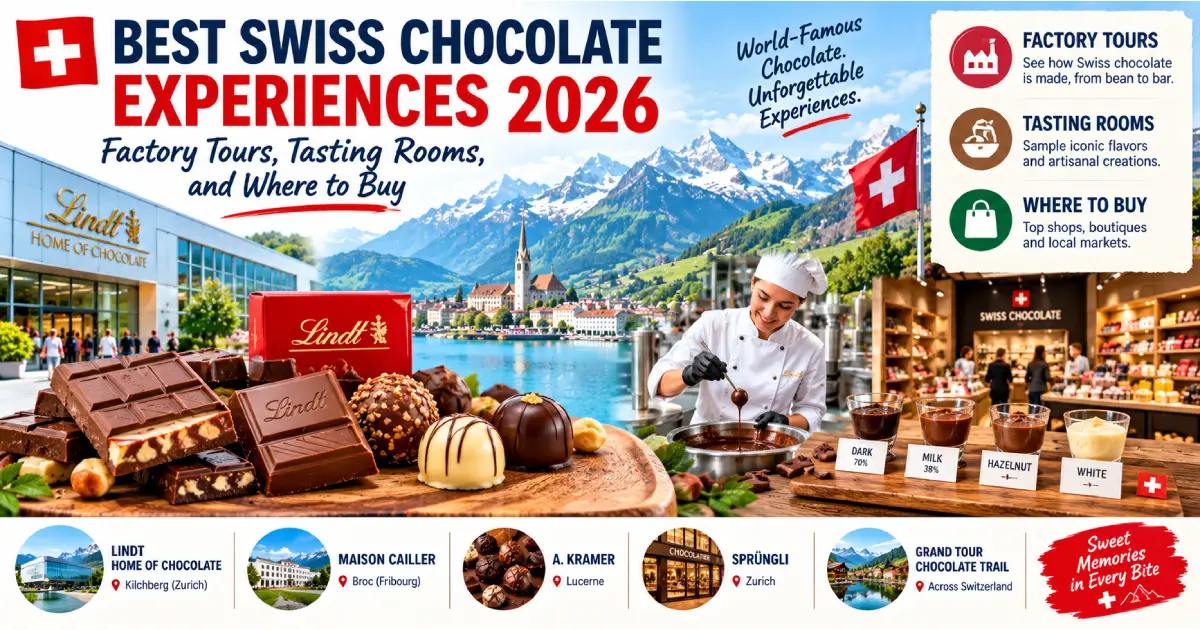
The best Swiss chocolate experiences in 2026 span the full spectrum from industrial to artisanal: the Maison Cailler factory tour in Broc (the most visited factory chocolate experience in Switzerland — a 1.5-hour immersive journey through Cailler’s chocolate history using Nestlé’s Heritage Collection), the Lindt Home of Chocolate in Kilchberg outside Zurich (the world’s largest chocolate museum, opened 2020, with the world’s tallest chocolate fountain at 9 meters), the artisan chocolatiers of Zurich and Geneva (the small-batch craft chocolate makers whose work represents a completely different tradition from the industrial brands), and the specific chocolate-purchase decisions that separate a genuinely Swiss chocolate experience (buying directly from a named Swiss producer at the site of production) from the generic airport chocolate shopping that Switzerland’s tourist infrastructure makes surprisingly easy to default into. This guide covers every dimension of Swiss chocolate experience for 2026 visitors.
For related guides, see our Switzerland Travel Guide 2026, Best Places to Visit in Switzerland 2026, Best Restaurants in Zurich 2026, and Best Restaurants in Geneva 2026.
| Experience | Location | Type | Cost | Duration | Book Ahead? |
|---|---|---|---|---|---|
| Lindt Home of Chocolate | Kilchberg (near Zurich) | Museum + Factory | CHF 15–20 | 1.5–2 hrs | Yes (online) |
| Maison Cailler Factory Tour | Broc, Fribourg | Factory tour | CHF 15–18 | 1.5 hrs | Yes (essential) |
| Sprüngli Confiserie | Zurich, Bahnhofstrasse | Historic confiserie | CHF 5–30/purchase | Open hours | No |
| Läderach Chocolatier Suisse | Multiple Swiss cities | Artisan purchase | CHF 8–50 | Open hours | No |
| Swiss Chocolate Train | Montreux to Broc | Scenic train + tour | CHF 39–52 | Full day | Yes |
| Favarger (Geneva) | Vernier, Geneva area | Factory visit | CHF 10–15 | 1 hr | Yes |
| Camille Bloch | Courtelary, Jura | Factory visit | CHF 10 | 1 hr | Yes |
| Villars Chocolatier | Fribourg | Factory visit | CHF 8–12 | 45 min | Yes |
| Aeschbach Chocolatier | Lucerne area | Artisan tasting | CHF 15–25 | 1 hr | Yes |
| Museum of Alimentarium | Vevey | Food museum | CHF 15 | 2 hrs | No |
| Zürich Confiserie Teuscher | Zurich Old Town | Artisan purchase | CHF 10–60 | Open hours | No |
| Max Chocolatier | Lucerne | Artisan workshop | CHF 20–40 | 1–2 hrs | Yes |
| Chocolaterie du Rhône | Geneva | Artisan tasting room | CHF 10–25 | 45 min | No |
| Nestlé Headquarters | Vevey | Public areas | Free | 30 min | No |
| Bernese Oberland Monastery Chocolate | Engelberg | Artisan monastic | CHF 8–25 | Open hours | No |
Location: Schokoladenplatz 1, Kilchberg (15 min by SBB from Zurich HB) | Cost: CHF 15 (adults), CHF 8 (children 6–16) | Hours: Daily 10 AM–6 PM (check lindt-home-of-chocolate.ch for current 2026 hours) | Duration: 1.5–2 hours | Book: Online advance booking recommended for weekends and school holidays
The Lindt Home of Chocolate (opened September 2020 in Kilchberg on Lake Zurich — the municipality where Rodolphe Lindt founded his chocolate factory in 1845 and where Lindt’s original Kilchberg factory still operates adjacent to the museum) is the world’s most comprehensive single chocolate museum: 1,500 square meters of permanent exhibition covering the full history of chocolate from the Olmec and Aztec origins through the Spanish colonial transfer to Europe, the 17th–18th century European aristocratic chocolate culture, the Industrial Revolution’s chocolate industrialization, and the specific Swiss contributions (Peter and Nestlé’s milk chocolate development, Lindt’s conching process, the Swiss chocolate brand-building of the late 19th and early 20th centuries) that shaped the global chocolate market.
The 9-meter chocolate fountain: The museum’s most immediately dramatic single element — the world’s tallest chocolate fountain (9 meters, a continuous flow of liquid Lindt chocolate circulating through the fountain’s glass structure) occupies the museum’s central atrium. The fountain’s specific visual impact (the chocolate’s viscosity creating a flowing curtain rather than a water fountain’s spray, the specific glossy surface of properly tempered liquid chocolate visible in close detail) and the associated smell (the warm chocolate aroma that the fountain generates creating the museum’s primary olfactory environment) create the museum’s most widely photographed single feature.
The tasting components: The exhibition includes multiple tasting stations (small chocolate samples at specific exhibition points — a milk chocolate bar section, a dark chocolate comparison, a conching-process demonstration tasting) and concludes with access to the Lindt chocolate shop (the museum’s retail component, stocking the full Lindt Swiss range alongside museum-exclusive products). The overall tasting exposure is modest rather than extensive — visitors specifically seeking maximum tasting should note that the museum’s value is primarily educational and experiential rather than primarily tasting-based.
Getting there: SBB from Zurich HB to Kilchberg (S8 line, 15 minutes, covered by Swiss Travel Pass) — the museum is a short walk from the Kilchberg station. The lakeside walking path from Kilchberg to Rüschlikon (both train stops on the same S-Bahn line) passes through the specific landscape of Lake Zurich’s western shore chocolate industry history.
Insider tips: The Lindt Home of Chocolate is most rewardingly visited on weekday mornings — the school group and tourist-family weekend crowds (the museum’s specific visitor demographic) create significant capacity at the tasting stations and in the shop during peak periods. The factory shop (adjacent to the museum but technically separate — the Lindt Outlet Shop at the same Kilchberg address) offers the most competitive Lindt chocolate pricing in Switzerland, typically 20–40% below retail, for visitors who want to stock up.
Location: Rue Jules-Bellet 7, Broc, Fribourg | Cost: CHF 15 (adults), CHF 8 (children) | Hours: Daily (check cailler.ch for current 2026 hours) | Duration: 1.5 hours | Book: Online advance booking strongly recommended | Access: Swiss Chocolate Train from Montreux (see below) or regional train to Bulle then bus to Broc
The Maison Cailler factory tour in Broc (Cailler being the oldest Swiss chocolate brand still operating, founded 1819 by François-Louis Cailler in Vevey before the factory moved to Broc in the Gruyères valley in 1898 — the same valley whose cheese tradition the region is simultaneously famous for, creating the specific Fribourg dual dairy-culture identity of cheese and chocolate) is Switzerland’s most specifically immersive factory chocolate experience. The 1.5-hour guided experience (proceeding through a chronological series of themed rooms covering Cailler’s history, the cacao origin story, the milk chocolate development using Gruyères valley milk, and the Broc factory’s specific production heritage) concludes in the free-tasting hall — a room where visitors can taste the full Cailler range without restriction, the most specifically generous tasting conclusion of any Swiss chocolate factory tour.
The tasting hall: The Maison Cailler tasting hall (the tour’s final 15–20 minutes, before the exit through the factory shop) provides access to the full Cailler range in tasting-size portions — the milk chocolate in multiple formulations (standard milk, Swiss milk with specific Gruyères valley milk, hazelnut variations), the dark chocolate range, and the Frilait (the specifically Swiss milk chocolate aerated tablet format). The absence of portion restriction and the self-service format create a tasting experience that rewards systematic tasting (trying each chocolate type in ascending cocoa percentage order, comparing milk sources in different formulations) rather than simply sampling.
The Gruyères valley context: The Maison Cailler’s specific setting (the Broc valley, immediately adjacent to the Gruyères area where the famous cheese is produced) creates a specific food-culture day trip combination: the Gruyères village and Maison du Gruyère cheese dairy in the morning (see our Swiss Cheese Guide) followed by the Maison Cailler tour in the afternoon. The specific Fribourg canton’s dual identity (cheese and chocolate both rooted in the same valley’s dairy tradition) makes this combination the most geographically coherent Swiss food-culture day available.
Insider tips: The Maison Cailler tour’s tasting hall is the key differentiator from any other Swiss chocolate factory experience — the no-restriction tasting format is genuinely remarkable for a commercial operation and should be specifically used rather than rushed through. Arriving hungry (skipping the chocolate snacks on offer during the tour itself and saving full appetite for the tasting hall) allows a more systematic and more specifically educational comparison of the range than casual sampling provides.
Route: Montreux → Gruyères → Broc (Maison Cailler) | Cost: CHF 39–52 (adult, includes MOB/GoldenPass train, Gruyères entry, and Maison Cailler tour) | Duration: Full day (approximately 7 hours) | Season: May–October (select days — check sbb.ch/en for current 2026 schedule) | Book: Required — through SBB or MOB
The Swiss Chocolate Train (a dedicated excursion product combining a scenic railway journey — the GoldenPass route from Montreux through the Vaud Prealps to Gruyères and then Broc on regional services — with the two most celebrated food-production tourism destinations in the Fribourg Prealps: the Gruyères medieval village and La Maison du Gruyère cheese dairy, followed by the Maison Cailler factory tour) provides the single most efficiently packaged Swiss food-culture day available from any Lake Geneva base.
The day structure:
What makes it worth the premium: The Swiss Chocolate Train package’s specific value is the combination ticket (individual component entry fees add up to similar costs without the train routing’s scenic value) and the logistical simplicity (the routing handled without requiring individual station navigation) rather than any exclusive access — the Gruyères and Cailler visits are both available independently. For visitors who want the day organized without transport logistics, the package is excellent value. For visitors comfortable with regional train navigation, the same day can be assembled at similar cost using individual tickets.
Swiss Travel Pass note: Swiss Travel Pass holders receive a discount on the Chocolate Train package — confirm the exact 2026 discount at sbb.ch, as the promotional terms vary by year.
Location: Rue de la Chocolatière 11, Courtelary, Bernese Jura | Cost: CHF 10 (adults) | Hours: Tuesday–Saturday mornings (check camille-bloch.com for current 2026 hours) | Duration: 1 hour | Book: Yes, online | Access: Regional train from Biel/Bienne to Courtelary (30 min, covered by Swiss Travel Pass)
Camille Bloch (the Bernese Jura chocolate company responsible for two specifically Swiss confectionery icons — Ragusa, the hazelnut chocolate bar that has been produced continuously since 1942 and that occupies a cultural position in Swiss confectionery uniquely its own; and Torino, the dark chocolate praline in the distinctive red packaging that Swiss adults of every generation describe as a childhood flavor memory) offers a factory visit experience at its Courtelary production site that provides the most specifically “Swiss confectionery history” focused visit available among the smaller producers.
The Ragusa story: The Ragusa bar (whole roasted Piedmont hazelnuts distributed through a smooth milk chocolate paste, the hazelnut density creating a textural experience quite different from hazelnut-praline alternatives) was developed by Adrien Bloch in 1942 during the wartime sugar and cocoa rationing period — the specific formula using the relatively available hazelnuts to extend the chocolate content while maintaining the confection’s commercial viability. The specific wartime origin, the bar’s unchanged formula across 80 years of production, and the specific Ragusa loyalty that Swiss consumers maintain across generations create one of Switzerland’s most compelling confectionery brand narratives.
Insider tips: Camille Bloch’s factory shop (available after the tour without the tour ticket — the shop is accessible separately) stocks factory-direct Ragusa and Torino at below-retail pricing, making the Courtelary side trip specifically worthwhile for buyers of large volumes. The discontinued and experimental variations (periodic Ragusa format experiments — white chocolate, dark chocolate, seasonal inclusions — that Camille Bloch produces in limited quantities) are most specifically available at the factory shop rather than through retail distribution.
Location: Route Suisse 29, Vernier (Geneva area) | Cost: CHF 10–15 | Hours: Weekday mornings (check favarger.com) | Duration: 1 hour | Book: Yes | Access: TPG bus from Geneva center (covered by Swiss Travel Pass)
Favarger (founded 1826, Geneva’s oldest continuously operating chocolatier — not the same scale as Lindt or Cailler but maintaining the specific artisanal-scale production and the Geneva confectionery tradition that the large brands’ industrial operations have largely replaced) offers factory visits at its Vernier production site that provide the most intimate encounter with Swiss chocolate production at artisanal scale: the small production rooms (visible during the guided tour), the specific handwork processes that the artisanal scale requires (hand-dipping, hand-decoration, hand-packaging for the most delicate products), and the factory shop (where Favarger’s specific range — particularly the Avelines, the whole roasted hazelnut pralines that are the company’s signature product — is available at production prices).
The Favarger Avelins: The defining Favarger product — whole roasted hazelnuts enrobed in hazelnut praline paste and coated in milk or dark chocolate, a confection of the purest possible form (no added stabilizers, no artificial flavors, the specific nuttiness of properly roasted Piedmont hazelnuts front-and-center in every bite). The Favarger Avelins are available in Geneva specialty shops and the Vernier factory shop — a specifically worthwhile purchase for visitors leaving Switzerland who want the most specifically Swiss artisanal confectionery available.
Location: Bahnhofstrasse 21, Zurich (main location); multiple Zurich branches | Price Range: CHF 5–50 (single truffles to gift boxes) | Hours: Daily, retail hours | Season: Year-round | Best Purchase: Luxemburgerli macarons, fresh truffles, seasonal confections
Sprüngli (Confiserie Sprüngli — the Zurich confiserie founded 1836 by Rudolf Sprüngli-Ammann, whose descendant split the company in 1892 to create what eventually became the Lindt & Sprüngli industrial enterprise while Sprüngli itself remained the independent Zurich confiserie that still operates today from the Paradeplatz flagship store) is Zurich’s most specifically emblematic single food business: a confiserie whose Paradeplatz location (the Paradeplatz being Zurich’s financial heart, the point from which UBS and Credit Suisse operations historically extended, and the specific social geography that makes Sprüngli simultaneously a democratic everyday purchase for Zurich commuters and a luxury confiserie for the city’s financial elite) and whose 188-year continuous operation represent the most specific single expression of Zurich’s specific relationship between everyday quality and aspirational luxury.
The Luxemburgerli: Sprüngli’s most specifically famous product — a macaron of specific Zurich identity (smaller than the Parisian macaron, airier in texture, available in approximately 20 flavors including the seasonal varieties that Sprüngli introduces quarterly, and sold exclusively at Sprüngli shops — not available through any other retail channel) whose specific character (the thin crispy shell, the slightly chewy interior, the cream filling that makes them genuinely perishable — 2–4 days maximum — creating the specific requirement for fresh purchase rather than advance buying) makes them simultaneously Zurich’s most sought-after edible souvenir and the most practically challenging souvenir to transport.
The truffle selection: Sprüngli’s fresh chocolate truffles (prepared daily, with a 3–5 day refrigerated shelf life — the freshness specifically marketed as the product’s most important quality differentiator) include specific varieties that the Zurich food culture closely associates with Sprüngli’s identity. The champagne truffle (ganache made with actual Champagne, the specific interaction of the wine’s acidity with the chocolate’s fat creating a lighter, slightly effervescent ganache character) is the most specifically sought-after individual Sprüngli confection.
Insider tips: The Sprüngli Paradeplatz café (upstairs from the retail floor — the formal sitting room with white tablecloths, the full hot chocolate service, and the pastry selection that the morning bakery produces fresh daily) provides the most complete Sprüngli experience: the café setting, the hot chocolate (made with Sprüngli’s own chocolate, a specific thick, intensely flavored preparation quite different from standard café hot chocolate), and the pastry selection consumed on-site rather than carried away. The queue for the café’s weekend morning service (Zurich residents specifically visiting for the Saturday morning ritual of Sprüngli coffee and Luxemburgerli) is the most specifically Zurich-domestic food experience available at any single address.
Locations: Multiple shops across Switzerland (Zurich, Bern, Basel, Geneva, Lucerne, and approximately 70 total Swiss locations) | Price Range: CHF 8–80 (100g chocolate to gift boxes) | Hours: Daily, retail hours | Best Purchase: FreshChocolates (fresh-made, shelf-life 3 weeks), Chili-Mango bark, hazelnut-caramel bark
Läderach (the family chocolatier founded in Glarus in 1962, now operated by the third generation of the Läderach family — Johannes Läderach having built the brand from a small confiserie supply operation to Switzerland’s most visible premium artisan chocolatier with approximately 70 Swiss retail locations) has achieved the specific position of being simultaneously genuinely artisanal in production approach (bean-to-bar sourcing for specific origin chocolates, the FreshChocolates made without preservatives or artificial stabilizers, produced fresh every 3 weeks and clearly date-stamped) and commercially scaled enough to be accessible at all major Swiss tourist destinations.
The FreshChocolates concept: Läderach’s primary marketing innovation — the production of chocolate confections (the ganache-filled pralines, the nut-and-chocolate bark tablets, and the moulded shapes that constitute the FreshChocolates range) without the artificial preservatives and shelf-life extension chemicals that most commercial chocolate uses, with the consequent 3-week maximum shelf life that distinguishes the product from shelf-stable alternatives. The FreshChocolates’ quality advantage (the ganache fillings maintaining genuine cream and butter character without the stabilizers that longer shelf-life products require) is detectable and significant — a specifically worthwhile purchase for the 3-week window.
The bark format: Läderach’s most specifically distinctive product — large irregularly-shaped tablets of high-quality chocolate with toppings (roasted nuts, dried fruit, crystallized ginger, caramel pieces, or various other inclusions) applied to the surface while the chocolate is still warm, the cooling creating the specific “bark” texture whose large surface-to-volume ratio delivers maximum topping encounter per bite. The specific Chili-Mango bark (dark chocolate with dried mango and chili flakes) and the Hazelnut-Caramel milk chocolate bark are the range’s most consistent quality representatives.
Location: Storchengasse 9, Zurich Old Town | Price Range: CHF 10–120 | Hours: Tuesday–Saturday | Best Purchase: Champagne truffles, seasonal specialties | Reservation: Not required
Teuscher (the Zurich Old Town confiserie founded in 1932, most internationally known for the champagne truffle — a specific ganache made with real Champagne that creates a lighter, effervescent ganache character through the interaction of the wine’s CO2 and acids with the chocolate fat emulsion) provides one of Zurich’s most specifically luxurious single confectionery experiences. The champagne truffle (domed ganache in white or dark chocolate shell, lightly dusted with powdered sugar, with the Champagne character most detectable when the truffle is consumed at room temperature rather than refrigerated) is the product for which Teuscher is most specifically known outside Switzerland.
The Old Town location: The Teuscher shop in the Storchengasse (one of Zurich Old Town’s most atmospheric medieval lanes, parallel to the Limmat River and within 5 minutes of the Grossmünster cathedral) occupies a specifically atmospheric space — the small shop front, the window display of seasonal confectionery, and the handcrafted appearance of the products (individually decorated, small-batch production visible through the preparation areas) distinguishing the experience from the more commercial retail environments of the larger brands.
Location: Schwanenplatz 4, Lucerne | Price Range: CHF 15–60 | Hours: Monday–Saturday | Workshop experiences: CHF 30–80 (chocolate-making classes, seasonal) | Book workshops: Yes, via maxchocolatier.ch
Max Chocolatier (the Lucerne artisan chocolatier whose workshop-and-retail space in the Schwanenplatz area provides direct access to the production process through both retail purchase and organized chocolate-making workshops) provides the most specifically hands-on chocolate experience available in Central Switzerland. The workshop format (2-hour sessions where participants produce their own chocolate selection under the chocolatier’s guidance — tempering demonstration, moulding, ganache preparation, and decoration) creates the most specifically educational chocolate encounter available in Switzerland outside the dedicated factory tour format.
The workshop experience: Participants receive a specific overview of the chocolate-making process (the tempering — the precise temperature cycling that creates the stable crystal structure that gives properly-tempered chocolate its snap, gloss, and mouthfeel; the ganache preparation — the emulsion of cream and chocolate that creates the truffle filling; and the decoration techniques — the specific skills of the chocolatier) before producing their own selection to take away. The workshop’s specific value: producing chocolate oneself provides a technical understanding of the process that observation-based factory tours don’t deliver.
Location: Rue de Rive 6, Geneva | Price Range: CHF 10–50 | Hours: Monday–Saturday | Tasting Room: Available during shop hours, no appointment required for basic tasting
The Chocolaterie du Rhône (a Geneva artisan chocolatier maintaining the specific Geneva confectionery tradition — more French in influence than the Zurich or Bern Swiss-German confiserie tradition, reflecting Geneva’s cultural position at the French-Swiss frontier) provides the most accessible artisan-scale chocolate tasting experience in Geneva without the advance-booking requirement that the formal tasting events require. The retail floor’s sampling (small pieces of the current production range offered with purchase, no formal tasting event required) and the in-store hot chocolate service (using the house chocolate) provide a Geneva artisan chocolate encounter appropriate for spontaneous visits.
Bean-to-bar: The highest quality designation — the chocolatier sources raw cacao beans (from specific origins, specific varieties) and processes them completely in-house from bean through roasting, grinding, conching, and tempering to the finished product. Very few Swiss chocolatiers work at this level (Felchlin in Schwyz, some smaller artisans) — the vast majority purchase finished couverture chocolate from Swiss manufacturers rather than processing beans themselves.
Couverture-based artisan chocolate: The most common artisan Swiss chocolate — the chocolatier purchases high-quality couverture chocolate (fluid-tempered chocolate of exceptional quality produced by Swiss manufacturers Felchlin, Cacao Barry Switzerland, or Valrhona) and uses it to produce confections (ganaches, pralines, moulded forms) using their own recipes and techniques. The quality at this level depends primarily on the chocolatier’s recipe knowledge, ganache technique, and ingredient sourcing for the non-chocolate components (the cream quality, the fruit purées, the nuts).
Industrial premium: The major Swiss brands (Lindt, Cailler, Toblerone, Läderach) operate at industrial scale with premium ingredient sourcing — consistently high quality relative to global chocolate standards, the specific Swiss manufacturing precision ensuring the baseline quality that Swiss chocolate’s reputation rests on.
Industrial standard: The major Swiss supermarket house brands (Migros M-Classic, Coop Prix Garantie) produce solid but undistinguished chocolate — appropriate for everyday consumption but not specifically representing the Swiss chocolate tradition at any level of distinction.
Swiss chocolate marketing (particularly for high-percentage dark chocolate) emphasizes cocoa percentage as a quality indicator — a relationship that is real but oversimplified. The factors that actually determine dark chocolate quality (independently of cocoa percentage):
Origin: The specific cacao origin (the country, region, and farm where the cacao was grown) contributes specific flavor compounds that the percentage cannot capture — Ecuadorian Nacional, Madagascan Criollo, and Venezuelan Porcelana varieties each producing specific flavor profiles (floral, red fruit, and classic “dark chocolate” respectively) that the same percentage from bulk-commodity sources doesn’t replicate.
Processing: The roasting profile, the grinding time, the conching duration, and the specific temperature management at each stage create the final chocolate’s texture and flavor from identical percentage-identical inputs — the Swiss chocolatiers’ specific processing expertise is the most direct determinant of quality at equivalent percentage levels.
Fat content: Swiss chocolate regulations require minimum fat content that creates the specific mouthfeel (“snap” when broken, clean melt on the tongue, absence of waxy coating sensation) that Swiss chocolate’s quality reputation primarily refers to — lower-fat alternatives (common in discount chocolate globally) produce the specific “waxy” sensation that Swiss chocolate specifically avoids.
Swiss Easter chocolate (the traditional Swiss Easter egg, rabbit, and bell moulded chocolate production that Swiss chocolatiers begin displaying from approximately 6 weeks before Easter) represents Swiss chocolate culture at its most specifically seasonal. The window displays of Swiss chocolate shops in the 6-week pre-Easter period (Sprüngli’s Paradeplatz window, Läderach’s multiple Zurich locations, and the artisan chocolatiers’ window compositions) create a specifically Swiss visual spectacle that the Christmas equivalent — while equally elaborate — doesn’t match in sheer chocolate engineering ambition (the moulded Easter eggs reaching 50cm+ height in the most ambitious individual chocolatier displays).
Practical Easter chocolate advice: The best individual Easter chocolate purchases (the artisan hollow eggs with hand-decoration, the specific animal mouldings of named chocolatiers — these are the Swiss Easter chocolate experience rather than the generic supermarket versions) sell out at the most sought-after shops in the final week before Easter — planning purchase from artisan chocolatiers (Sprüngli, Teuscher, Max Chocolatier) 2–3 weeks before Easter provides selection that the final-week rush eliminates.
Swiss Christmas chocolate (the calendar chocolates, the specialty seasonal flavors, the Christmas-specific moulded forms — the Chlaus figures that Swiss chocolate tradition specifically maintains in forms ranging from 20g to 2kg+) and the confiserie-season specialties (the specific autumn and winter flavors that Swiss chocolatiers introduce from October) create the most production-varied single period in the Swiss chocolate calendar.
The Lebkuchen-chocolate intersection: The Swiss Christmas market season (late November through late December, the Zurich Christkindlimarkt and the Basel Weihnachtsmarkt being the most visited) provides the most concentrated access to seasonal chocolate confections alongside the traditional Lebkuchen (spiced cookies) and Biber (the St. Gallen honey-and-almond pastry) that Swiss Christmas food culture also maintains.
The Swiss factory tour season (Maison Cailler, Lindt Home of Chocolate, and the smaller producers) peaks in July and August — the school holiday period bringing the largest visitor volumes and the longest booking lead times. Booking factory tours 3–4 weeks ahead for July–August visits and 1–2 weeks ahead for spring and autumn visits provides the planning window that avoids sold-out disappointment.
Direct purchase at named artisan chocolatiers (Sprüngli, Teuscher, Max Chocolatier, Läderach, Favarger, Camille Bloch factory shop) provides the freshest product, the most specific variety selection, and the most direct quality assurance. The freshness dimension is specifically important for ganache-filled confections (fresh ganache without preservatives — the Läderach FreshChocolates, the Sprüngli truffles, the Teuscher champagne truffles) whose quality deteriorates measurably within their specific shelf-life windows.
Migros and Coop both stock authentic Swiss-produced chocolate (Cailler/Nestlé, Lindt, Läderach, and various house-brand productions) at significantly lower prices than specialty shops — the specific Cailler range (produced by the same Nestlé/Cailler operation that the Broc factory tour visits) available in Swiss Migros at approximately 30–50% below the tourist-focused retail prices at airport shops and Old Town confiseries.
The supermarket quality reality: Migros Chocolate (the Migros house brand, manufactured by a dedicated Swiss operation to consistent quality standards) provides authentic Swiss chocolate quality at commodity pricing — a 100g bar for CHF 1.20–1.80 that is genuinely Swiss-produced and genuinely Swiss-quality for everyday consumption, regardless of the lesser marketing narrative surrounding it.
Airport duty-free shops (Zurich Airport in particular) stock the full range of Swiss chocolate brands at prices typically 20–40% above Swiss supermarket retail — the “duty-free” designation producing minimal actual saving for Swiss-resident shoppers and zero saving for international visitors (who pay the same prices as the Swiss resident premium). The specific airport chocolate advice: buy the same product at Migros or Coop in the city before the airport, saving the premium for genuinely exclusive products (artisan chocolatiers’ own ranges, exclusive packaging, fresh confections) unavailable at supermarkets.
About Travel Tourister Travel Tourister’s destination specialists have experienced Swiss chocolate from every angle — Lindt fountain museum mornings and Maison Cailler tasting hall conclusions through Sprüngli Luxemburgerli Saturday breakfasts and Teuscher champagne truffle Old Town visits to Camille Bloch Ragusa factory shop bulk purchases and Max Chocolatier Lucerne tempering workshops — to deliver the most practically honest guide to Switzerland’s best chocolate experiences for every type of 2026 visitor.
Posted By : Vinay
Latest Article
2nd Floor, 39, Above Kirti Club, DLF Industrial Area, Kirti Nagar, New Delhi, Delhi 110015



Travel Tourister is a leading Travel portal where we introduce travellers to trusted travel agents to make their journey hasselfree, memorable And happy. Travel Tourister is a platform where travellers get Tour packages ,Hotel packages deals through trusted travel companies And hoteliers who are working with us across the world. We always try to find new and more travel agents and hoteliers from every nook and corners across the world so that you could compare the deals with different travel agents and hoteliers and book your tour or hotel with the one you have chosen according to your taste and budget.
Copyright © Travel Tourister, India. All Rights Reserved

 Call
Call Enquiry