Published on : 04 Sep 2026
By Travel Tourister | Updated Sep 2026
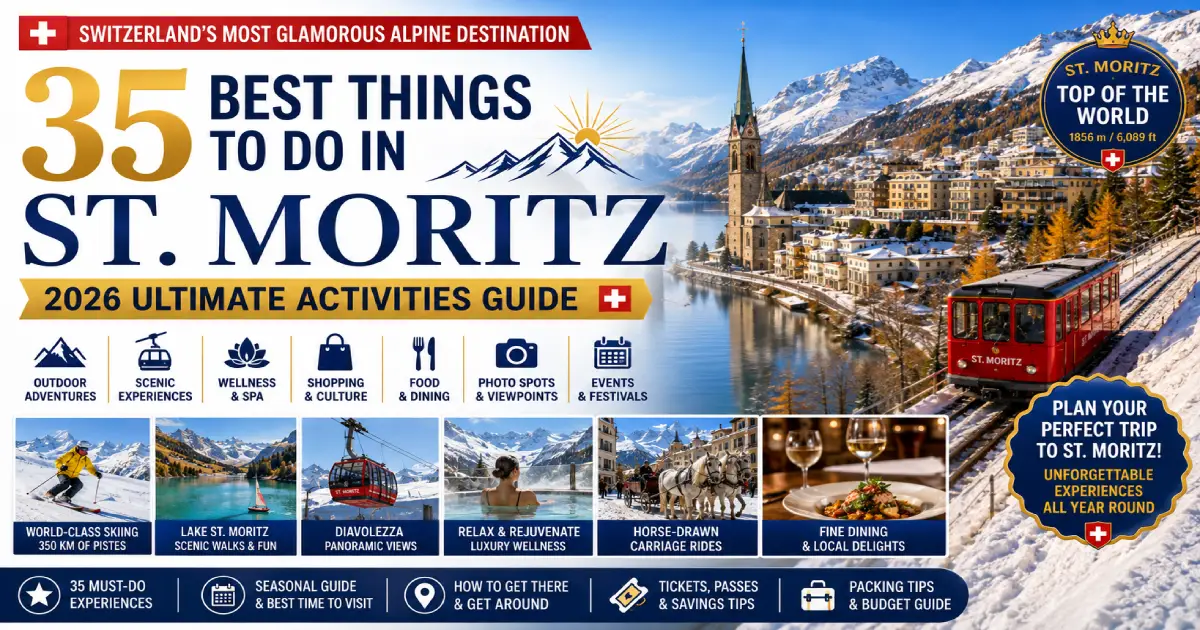
St. Moritz is Switzerland’s most famous Alpine resort and one of the world’s most consistently celebrated luxury destinations — a village of approximately 5,000 permanent residents at 1,856 meters altitude in the Upper Engadin valley of Graubünden, surrounded by a chain of glacial lakes (St. Moritz Lake, Silvaplana Lake, Champfèr Lake, and Sils Lake together creating the most distinctive high-altitude lake landscape in the Alps), with the Corviglia, Corvatsch, and Diavolezza ski areas providing over 350 kilometers of marked ski runs across the Engadin’s south-facing and glacier terrain. The resort has hosted the Winter Olympics twice (1928 and 1948), the Alpine Ski World Championships multiple times, and since 1928 the bobsled run (the Olympia Bob Run — the oldest natural ice bobsled run in the world, the only remaining track of its kind in the world, operational since 1904) that established St. Moritz’s specific identity as the birthplace of Alpine winter sports tourism.
The best things to do in St. Moritz in 2026 extend well beyond the skiing — a destination that operates with genuine excellence across both winter (December–April) and summer (June–September) seasons, with the specific summer pleasures of the Engadin (windsurfing on Silvaplana Lake in the guaranteed afternoon wind, the Via Engiadina hiking route through Switzerland’s most architecturally distinctive village landscapes, the Bernina Express departure for the Italy crossing, and the specific high-altitude light quality of the Upper Engadin’s 1,800-meter summer days) representing a genuinely different but equally extraordinary version of St. Moritz from the internationally celebrated ski season. This guide covers the 35 best things to do in St. Moritz organized by season and category — mountain activities, lake activities, cultural experiences, Engadin excursions, and the specific luxury pleasures (the Badrutt’s Palace afternoon tea, the Corviglia Club, the Cresta Run bobsled) that define St. Moritz’s specific global reputation.
For related guides, see our Glacier Express: Complete Guide 2026, Bernina Express: Complete Guide 2026, Switzerland Travel Guide 2026, and Best Places to Visit in Switzerland 2026 guides.
| # | Activity | Category | Cost | Season | Book Ahead? |
|---|---|---|---|---|---|
| 1 | Ski Corviglia — St. Moritz’s Home Mountain | Skiing | CHF 75–92/day | Dec–April | No |
| 2 | Ski Corvatsch — Glacier Terrain and Panoramic Runs | Skiing | CHF 75–92/day | Dec–April | No |
| 3 | Ski Diavolezza–Lagalb — Glacier and Bernina Views | Skiing | CHF 75–92/day | Dec–April | No |
| 4 | Take the Bernina Express to Tirano, Italy | Train | Swiss Travel Pass + CHF 14 | Year-round | Yes |
| 5 | Walk the Via Engiadina | Hiking | Free | June–October | No |
| 6 | Windsurf on Silvaplana Lake | Watersports | CHF 50–80 (rental) | June–September | No |
| 7 | Hike to Diavolezza for the Morteratsch Glacier View | Hiking | CHF 42 (cable car) | June–October | No |
| 8 | Attend Afternoon Tea at Badrutt’s Palace | Luxury | CHF 45–65/person | Year-round | Yes |
| 9 | Watch the White Turf Horse Races on the Lake | Event | CHF 20–50 | February | Yes (months) |
| 10 | Ride the Cresta Run (Skeleton Bobsled) | Adventure | CHF 120–200 (member cost) | December–February | Yes (SMTC membership) |
| 11 | Swim at Engadin Mineralbad und Spa | Wellness | CHF 28–45 | Year-round | No |
| 12 | Hike the Furtschellas Area | Hiking | CHF 35–42 (cable car) | June–October | No |
| 13 | Take the Glacier Express to Zermatt | Train | Swiss Travel Pass + CHF 13–49 | Year-round | Yes |
| 14 | Ski Hahnensee to St. Moritz (Long Descent) | Skiing | Included in lift pass | Dec–April | No |
| 15 | Visit the Engadin Museum | Museum | CHF 12 | Year-round | No |
| 16 | Walk Around the St. Moritz Lakes | Walking | Free | Year-round | No |
| 17 | Explore Sils Maria — Nietzsche’s Village | Culture | Free + CHF 5 (museum) | Year-round | No |
| 18 | Hike to the Muottas Muragl Sunrise | Hiking | CHF 30 return (funicular) | Year-round | No |
| 19 | Go Ice Skating on the Kulm Ice Rink | Winter | CHF 8–15 | December–March | No |
| 20 | Visit Pontresina — The Quieter Alternative | Day Trip | Swiss Travel Pass | Year-round | No |
| 21 | Horse Riding in the Engadin | Outdoors | CHF 60–100 | June–October | Yes |
| 22 | Attend the St. Moritz Polo World Cup on Snow | Event | CHF 30–80 | January–February | Yes |
| 23 | Mountain Bike on the Engadin Trails | Cycling | CHF 30–60 (rental) | June–October | No |
| 24 | Try the Olympic Bob Run | Adventure | CHF 200–300 (passenger run) | December–February | Yes (essential) |
| 25 | Hike to Piz Languard | Hiking | Free (trail) | July–September | No |
| 26 | Visit St. Moritz Dorf | Sightseeing | Free | Year-round | No |
| 27 | Explore Maloja and the Maloja Pass | Sightseeing | Swiss Travel Pass (bus) | Year-round | No |
| 28 | Attend the Snow Polo Tournament | Event | CHF 20–60 | January | Yes |
| 29 | Stand-Up Paddleboard on St. Moritz Lake | Watersports | CHF 30–45/hour | June–September | No |
| 30 | Visit Segantini Museum | Museum | CHF 15 | June–October | No |
| 31 | Snowshoe the Engadin | Winter | CHF 20–35 (rental) | December–March | No |
| 32 | Take the Bernina Diavolezza Cable Car | Mountain | CHF 42 return | Year-round | No |
| 33 | Ski the Corvatsch Night Skiing | Skiing | CHF 30–40 (night pass) | Select Jan–Feb evenings | No |
| 34 | Attend the FIS Alpine Ski World Cup | Sport Event | CHF 20–60 | December | Yes (months) |
| 35 | Hike the Silsersee Shore (Lake Sils Walk) | Hiking | Free | June–October | No |
Cost: CHF 75–92/day (Engadin St. Moritz lift pass, all three ski areas) | Access: Signalbahn gondola from St. Moritz Dorf (5 minutes walk from the center) or Chantarella cable car | Summit: 3,057 meters (Piz Nair) | Season: December–April | Character: St. Moritz’s original and most fashionable ski area
Corviglia (accessible directly above St. Moritz Dorf via the Signal gondola — a 5-minute walk from the Palace Hotel’s front steps to the gondola base creates the resort’s specific luxury-alpine compression, from luxury-hotel lobby to ski slope summit in 12 minutes) is St. Moritz’s home mountain, the ski area that established the resort’s winter identity when British guests first strapped boards to their feet on these slopes in the 1880s. The Corviglia summit at Piz Nair (3,057 meters) provides 360-degree Engadin panoramas — the chain of Upper Engadin lakes visible below, the Bernina massif to the south, and the broader Graubünden Alpine landscape in all directions.
The specific Corviglia character: wide, well-maintained runs on the south-facing Engadin slope (the consistent afternoon sunshine that the south aspect provides creates the specific spring-snow-while-luxury-lunching atmosphere that Corviglia’s mountain restaurants — particularly the Corviglia Club and the El Paradiso — are famous for), a concentration of intermediate red runs appropriate for the resort’s international leisure-skiing clientele, and the specific social character of a ski area where on-slope people-watching (the fur coats, the designer ski suits, and the consistent celebrity and aristocracy sighting possibilities that Corviglia specifically provides) is as much the activity as the skiing itself.
Key runs: The Marguns area (red runs of the most consistent quality, the Engadin lakes visible throughout), the Piz Nair descent (the longest Corviglia run, red classification, from the 3,057-meter summit through progressively varied terrain), and the specific Corviglia classic run (from the summit restaurant area to the signal gondola mid-station) that the resort’s regulars most frequently reference.
Insider tips: The Corviglia Club (the exclusive mountain restaurant at the Corviglia summit, membership-required for full service — non-members can access the public terrace section) represents St. Moritz’s most specifically elite single establishment — the Corviglia terrace at noon on a clear February day (the Engadin lakes visible below, the Bernina peaks above, and the international clientele assembled in the specific combination of ski boots, fur, and champagne that Corviglia specifically produces) is the single most compressed expression of St. Moritz’s identity available.
Cost: Included in Engadin St. Moritz lift pass (CHF 75–92/day) | Access: From Silvaplana (15-minute bus from St. Moritz) | Summit: 3,451 meters | Season: November–May (partial year-round on glacier)
Corvatsch (3,451 meters — the highest lift-accessible point in the Engadin ski region and one of the highest in Switzerland) provides St. Moritz skiing at its most seriously Alpine — the glacier terrain above 2,700 meters producing consistent snow conditions well into spring (the year-round glacier skiing on the upper Corvatsch section maintains summer skiing on specific limited terrain), the panoramic view from the summit (the Bernina massif directly across at eye level, the lakes below, and the specific 3,000+ meter Alpine visual field) exceeding any accessible from Corviglia, and the run variety (from the demanding blacks of the upper glacier to the wide open reds of the middle section and the long easy blues of the lower Silvaplana approach) providing the most complete single-area skiing in the Engadin.
The Corvatsch Panorama run: The descent from the Corvatsch summit (3,451 meters) to the Silvaplana valley (1,828 meters) — 1,623 meters of vertical across approximately 14 kilometers of ski terrain — constitutes one of Switzerland’s finest single ski descents for intermediate skiers seeking extended continuous skiing rather than repeated lift-and-run cycling.
Insider tips: The Corvatsch’s north-facing glacier sections (above 3,000 meters) provide the best powder snow retention in the Engadin — the first powder day of any significant snowfall produces untracked conditions on the upper glacier for considerably longer than the south-facing Corviglia runs, which are skied out by mid-morning. First-lift ascents to Corvatsch on powder days are specifically recommended for this powder preservation advantage.
Cost: Included in Engadin St. Moritz lift pass | Access: RhB train from St. Moritz to Bernina Diavolezza station (25 min, Swiss Travel Pass covered) + cable car | Summit: 2,978 meters | Season: October–May | Special: Morteratsch Glacier ski descent
The Diavolezza–Lagalb ski area (separate from the main Engadin resort areas, accessible by the Rhaetian Railway from St. Moritz toward the Bernina Pass — 25 minutes by train, included in Swiss Travel Pass) provides the Upper Engadin’s most specifically glacier-connected skiing — the Diavolezza summit (2,978 meters) providing a face-on view of the Morteratsch Glacier (one of Switzerland’s largest glaciers, descending from the Piz Bernina massif at 4,049 meters) and a guided glacier ski descent (the “Pers Glacier Run” — a guided off-piste descent across the Pers and Morteratsch glacier systems, available through the Ski School Pontresina with guide accompaniment required for the glacier-crossing sections) that constitutes the most dramatic skiing experience available in the Engadin region.
Insider tips: The Diavolezza sunrise tour (the Diavolezza cable car operates an early-morning sunrise ascent on specific weekends — check current 2026 schedule at diavolezza.ch — delivering visitors to the summit in pre-dawn darkness to watch the sunrise illuminate the Piz Bernina massif and the Morteratsch Glacier) is one of the Upper Engadin’s most extraordinary seasonal events, available to skiers (sunrise ski down) and non-skiing visitors (sunrise panorama and return by cable car) alike.
Cost: CHF 20–50 (grandstand areas); some areas free | Date: Three Sundays in February — check specific 2026 dates at whitturf.ch | Location: St. Moritz Lake (frozen solid in February, the track laid directly on the ice) | Book: Accommodation months ahead for race weekends
The White Turf (Weisser Turf) — horse racing on the frozen surface of St. Moritz Lake, held on three Sundays in February since 1907, the only major international horse race meeting held on a frozen lake in the world — is St. Moritz’s most specifically extraordinary annual spectacle. The racing itself (flat racing and skijöring — a Swiss winter sport in which riders are pulled across the snow on skis by horses rather than jockeys riding, a race format specific to St. Moritz) occurs directly on the frozen lake surface (the ice typically 70–90 centimeters thick in February, specifically tested before each race meeting), with the Engadin mountains visible above the track in all directions and the Palace Hotel’s distinctive tower forming the backdrop to the finishing line.
The event’s specific atmosphere — a combination of genuine international horse racing (prize money attracting professional European racing yards and international ownership) with the specific St. Moritz winter social calendar (the White Turf weekends are among the resort’s most concentrated celebrity and high-society attendance periods, with Badrutt’s Palace and the Kulm Hotel specifically at maximum capacity during race weekends) creates a spectator experience unavailable at any other horse racing venue in the world.
Insider tips: The free spectating areas (along the lake shore outside the grandstand cordons) provide an equally atmospheric — and financially accessible — version of the White Turf experience for visitors who don’t need grandstand positioning. The specific visual of horses racing across an Alpine lake with 3,000-meter peaks reflected in the snowfield is identical from the grandstand and the public viewing areas.
Cost: Membership required (St. Moritz Tobogganing Club membership approximately CHF 130/season for newcomers; ride costs approximately CHF 50–80/ride with membership) | Season: December–February | Book: Apply through SMTC (cresta-run.com) in advance | Note: Open to men only for descent from Top; women permitted from Junction
The Cresta Run — the natural ice skeleton run from St. Moritz to Celerina (1,222 meters, completed in 30–60 seconds by riders on a flat sled traveling face-down, reaching speeds up to 140 km/h — the original and defining skeleton racing track, which gave the sport its name when a rider in 1892 described the view of the track from the top as resembling a skeleton) has operated continuously since 1884, making it the oldest artificial-ice sports facility in the world still in original use. The specific requirements (membership in the St. Moritz Tobogganing Club — the oldest winter sports club in the world, founded 1887 — and the SMTC’s own safety training program for newcomers) make this an activity that requires specific planning rather than spontaneous participation, but one that provides a genuinely irreplaceable winter experience: riding a historical sporting facility, at speeds that are viscerally rather than abstractly thrilling, on a track that has hosted Olympic competition and that has remained essentially unchanged since the Victorian-era guests of Badrutt’s Palace began using it as entertainment.
Insider tips: The newcomer (Virgins’ Cup) program — the SMTC’s structured introduction for first-time riders, including specific training on the track’s technique (the specific head position, the raking technique for speed control, and the banking navigation that the Cresta’s distinctive curves require) — is the only responsible way to approach the Cresta for first-time riders. Arriving without prior contact with the SMTC and expecting walk-in access will be disappointed.
Cost: CHF 30–80 (varying grandstand and standing areas) | Date: Late January to early February — check current 2026 dates at polostmoritz.com | Location: St. Moritz Lake | Book: VIP areas months ahead; general areas closer to event
The Maserati Polo World Cup on Snow (snow polo, played on the frozen St. Moritz Lake, with teams sponsored by major international luxury brands competing on a white snow surface against the alpine backdrop) is the world’s most prestigious snow polo tournament — establishing snow polo as a distinct variant of the sport in St. Moritz before any other venue attempted it, and maintaining the event’s position as the reference point for luxury winter sports events globally. The combination of genuine international polo competition (professional players, top-ranked teams, prize money attracting the world’s highest-handicap players) with the St. Moritz winter social calendar creates the resort’s most concentrated single-week luxury event.
Insider tips: The lake viewing areas (outside the sponsor-reserved grandstands) provide equally good polo visibility — the lake’s open surface means the playing area is visible from three sides regardless of grandstand positioning. The polo’s specific adaptation for snow (the ball is orange for visibility against the white surface, the ponies wear special snow studs, and the goals are wider than standard polo goals to compensate for the slower ball movement in snow) creates a sport-watching experience specifically available only here.
Cost: CHF 42 return (cable car from Bernina Diavolezza station); Swiss Travel Pass covers the RhB train (25 min from St. Moritz) | Season: June–October (summer operation) | Best Time: Morning for maximum glacier clarity | Altitude: 2,978 meters
The Diavolezza cable car ascent (25 minutes by RhB train from St. Moritz, included Swiss Travel Pass, then cable car to 2,978 meters) provides the Upper Engadin’s finest single summer viewpoint — the Morteratsch Glacier visible at close range and from above in a face-on configuration that the ground-level Morteratsch station walk (equally worthwhile but providing a bottom-up glacier view) cannot replicate. From the Diavolezza terrace (2,978 meters), the full extent of the Morteratsch Glacier (3 kilometers wide at the upper accumulation zone, the glacier’s tongue descending toward the valley 2,500 meters below) and the Piz Bernina massif (4,049 meters — the easternmost four-thousander in the Alps) filling the western horizon create a panorama that is among the Graubünden’s most concentrated presentations of glacial Alpine scenery.
The Diavolezza-to-Morteratsch hike: A guided glacier crossing (from Diavolezza across the Pers Glacier to the Morteratsch, descending to the Morteratsch RhB station — approximately 3 hours with guide, required for the glacier sections) provides the most complete Diavolezza experience: the cable car ascent, the glacier panorama from the summit, a walking descent across actual glacier terrain (with the guide’s crevasse-avoidance route management), and the valley-level Morteratsch walk’s historical retreat markers. Book through the Pontresina mountain guides (pontresina.ch).
Insider tips: The Diavolezza restaurant (at the cable car summit station, 2,978 meters) serves one of the Engadin’s finest mountain lunches in terms of view — the south-facing terrace with the Morteratsch Glacier visible below and the Piz Bernina above creates a specifically satisfying altitude-dining context. Arriving for lunch (11:30 AM–1:30 PM) after the morning cable car crowds have thinned provides the most comfortable terrace conditions.
Cost: Free (trail) | Total distance: 90 km (full route); multiple day-section options | Best sections from St. Moritz: St. Moritz → Silvaplana → Maloja (30 km, two-day option) or individual lake-shore sections (2–3 hours each) | Season: June–October | Character: UNESCO Biosphere landscape, Engadin village architecture, lake chain
The Via Engiadina — a long-distance hiking trail running through the entire Upper Engadin from Maloja (at the southwestern end of Lake Sils) to Zernez (at the northeastern end of the Engadin valley, near the Swiss National Park) — provides the most complete engagement with the Upper Engadin’s landscape character: the chain of glacial lakes (Sils, Silvaplana, Champfèr, St. Moritz, and smaller lakes along the route), the specifically Engadin farmhouse architecture (the massive stone-and-sgraffito decorated residential buildings that distinguish the Engadin from every other Swiss regional architectural tradition), and the UNESCO Engadin Biosphere Reserve’s specific ecology (the highest-altitude Swiss agricultural landscape, the specific flora of the Engadin’s 1,800-meter base elevation, and the wildlife corridors connecting the Swiss National Park to the Bernina massif).
Day sections from St. Moritz:
Insider tips: The Via Engiadina’s lake-shore sections provide the most consistently photogenic hiking in Switzerland’s Graubünden — the specific morning light on the lake surfaces (the lakes’ combined surface area creating mirror-reflection conditions on calm mornings that the afternoon Maloja Wind eliminates), the sgraffito-decorated Engadin farmhouses visible in each village, and the Bernina massif’s changing profiles as the route traverses the valley create a hiking journey of sustained visual quality.
Cost: CHF 50–80 (board + sail rental); lessons CHF 80–120 | Location: Silvaplana Lake, particularly the Silvaplana lakefront windsurf center | Season: June–September | Best Time: Afternoon (2–5 PM when the Maloja Wind is at its consistent strength)
Silvaplana Lake (the second lake southwest of St. Moritz, connected to Lake Champfèr) is one of Europe’s most celebrated windsurfing destinations — the Maloja Wind (a specific thermal phenomenon generated by the valley’s geometry: warm air rising from the Italian Valtellina south of the Maloja Pass draws cooler Engadin air southward through the valley in the afternoon, creating a consistent northwest-to-southeast wind of 20–35 knots that the Silvaplana windsurfers specifically depend on) provides the most reliable afternoon wind of any high-altitude European lake, operating essentially daily from June through September during the thermal activity window (typically beginning at 1–2 PM and maintaining until 5–6 PM).
The specific Silvaplana windsurfing community (the windsurf center on the lake’s northern shore provides equipment rental, lessons, and the social atmosphere of a destination that has attracted serious windsurfers and kitesurfers for decades) and the lake’s visual setting (the Corvatsch massif above, the Piz de la Margna to the south, and the specific high-altitude lake light that the Engadin’s 1,800-meter base elevation creates) make Silvaplana one of Switzerland’s most unexpected sports destinations — a high-Alpine lake with consistent afternoon wind creating a watersports experience more associated with Mediterranean coasts than Swiss mountain valleys.
Insider tips: Kitesurfing has largely replaced windsurfing as the primary Silvaplana watersports activity among regulars — the Maloja Wind’s consistency and the lake’s open surface providing ideal kite conditions. Beginners are better served by the windsurf introduction (more immediately controllable at beginner level) before transitioning to kite if interest develops.
Cost: CHF 0 (trail) + optional Pontresina cable car to start point (CHF 18–22) | Distance: 6 km return from Pontresina cable car top station | Duration: 2.5 hours return from top station | Summit: 3,262 meters | Season: July–September | Difficulty: Strenuous (requires good fitness)
Piz Languard (3,262 meters, the highest point accessible by hiking trail without technical equipment in the immediate St. Moritz area — reachable by trail from Pontresina or with the help of the Pontresina cable car to the Alp Languard mid-station at 2,330 meters) provides the Upper Engadin’s finest summit accessible on foot — a 360-degree panorama encompassing the entire Engadin lake chain below (all five major lakes visible simultaneously), the Bernina massif directly across (the Piz Bernina at 4,049 meters at approximately eye level from the Piz Languard summit), and the broader Graubünden Alpine landscape extending to the Silvretta in the northeast and the Bernina peaks in the south.
The summit marker at 3,262 meters is the highest terrain visitors to St. Moritz typically access without the Diavolezza cable car — the physical achievement of reaching it on foot (the approximately 930-meter ascent from the Alp Languard cable car mid-station, requiring 2–2.5 hours of genuine mountain hiking) provides a specifically earned relationship with the Engadin’s scale that cable car ascents don’t replicate.
Insider tips: The Piz Languard summit hike is best in July and August when the trail is snow-free throughout — September can bring early-season snow to the upper sections that requires careful assessment before attempting. Carrying appropriate warm layers (summit temperatures 15–20°C below Pontresina valley conditions), sufficient water and food (no facilities above the Alp Languard cable car station), and starting before 10 AM (afternoon thunderstorm risk on exposed summit terrain from early afternoon in summer) provides the appropriate safety framework for this specific hike.
Cost: Free (village); Nietzsche Museum CHF 5 | Transport: PostBus from St. Moritz (20 min, included Swiss Travel Pass) | Season: Year-round | Character: Quietest, most architecturally complete Engadin village
Sils Maria (at the southwestern end of Lake Sils, the furthest lake from St. Moritz in the Upper Engadin chain — 20 minutes by PostBus from St. Moritz, covered by Swiss Travel Pass) provides the most complete single-village expression of the Engadin’s specific architectural and cultural identity: the massive stone farmhouses with their distinctive sgraffito-decorated facades (traditional Engadin exterior decoration created by scratching patterns through a colored plaster layer to reveal a contrasting color beneath), the specific village silence (Sils maintains a more deliberately quiet character than St. Moritz — no major resort infrastructure, the population primarily composed of Romansh-speaking residents in the traditional occupations), and the Nietzsche-Haus (the house where Friedrich Nietzsche spent six consecutive summers from 1881 to 1889 — the period of his most productive writing, during which “Also Sprach Zarathustra,” “Beyond Good and Evil,” and “The Genealogy of Morals” were composed while Nietzsche walked the Engadin landscape that he credited directly with enabling his philosophical vision).
The Nietzsche-Haus (open June–October, CHF 5 — the two rooms where Nietzsche lived and wrote, preserved approximately as he left them, with a small museum covering his Sils Maria period) provides one of Switzerland’s most specific literary-historical encounters — the philosopher’s actual writing desk, the view from his window toward the Silsersee that he described as providing his “most philosophical landscape,” and the surrounding village character that his letters describe create a biographical immersion available at very few European intellectual heritage sites.
Insider tips: The walk from Sils Maria to the Surlej peninsula (the land spit extending into the Silsersee, approximately 45 minutes from the village) passes the specific boulder where Nietzsche reported the vision of “eternal recurrence” (the philosophical concept that became the center of his mature work) struck him suddenly — the boulder is marked, the surrounding landscape essentially unchanged from his 1881 description, and the experience of sitting on this specific boulder above the Silsersee on a clear Engadin afternoon provides a specifically unusual intersection of philosophy and landscape.
Cost: Swiss Travel Pass covers the Swiss section; CHF 14 seat reservation | Duration: 2 hours 25 minutes (St. Moritz → Tirano) | Season: Year-round | See: Our complete Bernina Express guide
The Bernina Express’s departure from St. Moritz station — the most glamorous departure point of any Swiss scenic railway — creates the most dramatic possible contrast between origin and destination: the Palace Hotel visible through the station windows at departure, the Engadin’s high-altitude sophistication immediately replaced by the progressive descent through the Bernina Pass, the Morteratsch Glacier, Alp Grüm, the Brusio Circular Viaduct, and the Italian Tirano arrival where palm trees replace glaciers in 2 hours and 25 minutes.
Insider tips: Taking the Bernina Express from St. Moritz as a day trip to Tirano (departing St. Moritz at approximately 8:55 AM or 10:09 AM — check current 2026 timetable at rhb.ch for exact departures) and returning by the same route on the afternoon Bernina Express (departing Tirano approximately 3:08 PM or 4:38 PM — check current timetable) creates a complete Italy day from St. Moritz without overnight accommodation in Tirano. Lunch in Tirano (bresaola and pizzoccheri, the Valtellina’s specific culinary identity) and the Basilica della Madonna di Tirano visit fill the Tirano stop time productively.
Cost: CHF 45–65/person (traditional afternoon tea service) | Location: Badrutt’s Palace Hotel, Via Serlas 27 | Book: Yes, reservations recommended | Season: Year-round (peak winter season December–April)
Badrutt’s Palace (the Palace Hotel — the establishment that essentially created modern winter tourism by inviting British guests in 1864 and betting them that the Engadin winter was beautiful enough to justify a return visit, winning the bet and establishing the pattern for the global luxury ski resort industry that followed) provides afternoon tea in the most historically significant single building in the history of winter tourism. The specific Badrutt’s Palace afternoon tea (served in the Grand Hall or on the terrace in summer, with the Engadin lake and mountains visible through the hotel’s windows) combines the British afternoon tea format (brought to St. Moritz by the British visitors who established the resort’s winter culture in the 1860s) with Swiss confectionery tradition in a setting where 160 years of hosting European royalty, international celebrities, and global wealth has created an institutional self-confidence that newer luxury hotel openings cannot manufacture.
Insider tips: The terrace tea service (summer only, May–September, weather permitting) provides the most specifically atmospheric version — the lake and mountain view from the Palace Hotel’s elevated Dorf position adding the landscape dimension that the grand interior lacks. Reserving specifically a terrace table (“auf der Terrasse, bitte”) when booking provides this version of the Badrutt’s Palace experience.
Cost: CHF 15 | Location: Via Somplaz 30, St. Moritz | Hours: Tuesday–Sunday, June–October and December–April | Duration: 1 hour
The Segantini Museum (a purpose-built circular museum completed 1908, housing the work of Giovanni Segantini — the Italian-Swiss Alpine painter whose specific visual interpretation of the Upper Engadin’s light and landscape in the 1890s created both the definitive artistic representation of the Engadin environment and one of the most technically radical painting innovations of 19th-century European art) contains the artist’s three major “Triptych of Life” panels (Birth, Life, Nature — each an enormous canvas, the three paintings covering the entire curved wall of the museum’s central gallery) alongside smaller works, drawings, and the documentation of Segantini’s specific technique (the “divisionist” method of applying pure color strokes rather than blending — creating the specific luminous quality of his Alpine light that reproduces poorly but devastates in person).
The museum building itself (the round stone structure on the hill above St. Moritz, designed specifically to house the Triptych’s three enormous panels in the curved gallery that allows viewing from the correct distance) is one of Switzerland’s most elegantly conceived purpose-built art buildings — a structure that exists specifically to display three paintings in the specific way those paintings require to be experienced.
Insider tips: The Segantini Museum is closed in certain spring and autumn months — confirming the specific 2026 opening calendar at segantini-museum.ch before planning a visit avoids arriving at a closed museum. The donation of the museum collection by Segantini’s son Gottardo (who gave the complete collection to the city of St. Moritz rather than accepting the private sales offers that would have dispersed the Triptych internationally) makes this a specifically complete Segantini encounter impossible anywhere else in the world.
Cost: CHF 12 | Location: Via dal Bagn 39, St. Moritz | Hours: Year-round (varying winter/summer schedules — confirm at engadin-museum.ch) | Duration: 1 hour
The Engadin Museum (museum documenting the social and cultural history of the Upper Engadin from prehistoric settlements through the medieval period of Romansh cultural formation to the 19th-century tourist transformation) provides the historical context that makes St. Moritz’s current form comprehensible as the result of specific historical decisions rather than inevitable resort development. The collection’s Engadin farmhouse period room reconstructions (the specific interior arrangement of a traditional Engadin farmhouse — the combined people-and-livestock heating system, the massive tile stoves, the built-in furniture carved from Swiss stone pine — that the exterior sgraffito facades represent) and the Romansh language documentation (the museum maintains specific attention to the Romansh linguistic heritage of the Engadin, the most endangered of Switzerland’s four national languages) provide cultural depth that the resort’s luxury surface efficiently obscures.
Insider tips: The museum’s section on the 1864 bet that created modern St. Moritz (Johannes Badrutt’s wager with British summer guests that the Engadin winter was beautiful enough to warrant a return visit, with the condition that the guests would stay for free if they disagreed — the bet they demonstrably won and which launched the global luxury ski resort industry) provides the most specifically St. Moritz-relevant single historical narrative, condensing the origin of modern winter tourism into a personal wager between a Swiss hotelier and his British guests.
Cost: Free | Distance: Various circuits from 2–15 km | Season: Year-round | Best Time: Morning for reflections; late afternoon for alpenglow on the peaks
The St. Moritz lakefront (the walk around St. Moritz Lake — approximately 3 km, relatively flat, the lake visible throughout) and the extended circuit to Silvaplana (continuing along the lake shore from St. Moritz through Champfèr to Silvaplana — approximately 8 km one-way, the connected lakes each providing different reflective conditions and mountain profiles) constitute the Upper Engadin’s most accessible and most consistently rewarding free outdoor activity.
The specific lake circuit character: the Upper Engadin’s five connected lakes create a continuous waterway through the high-altitude valley (at 1,800 meters, these are among the highest large lakes in the Alps), and walking the lake shores provides the most complete Engadin landscape experience available without gondola or railway cost. The Bernina peaks visible above the southern shore, the Corvatsch and Piz Nair above the northern shore, and the specific Engadin light (the high altitude’s intense UV creating more vivid colors in both the sky and the water reflections than lowland lakes produce) create sustained visual quality across the full circuit length.
Insider tips: The lake circuit in winter (when the lakes are frozen solid, typically December–February) transforms the walk into the world’s largest natural ice skating surface — the lakes’ collective surface area allowing skating from St. Moritz to Silvaplana across open ice (with appropriate caution and local ice-quality confirmation). Skating on a mountain lake at 1,856 meters altitude with 3,000-meter peaks in all directions is one of the Swiss Alps’ most specifically extraordinary winter free activities.
Cost: CHF 28 (thermal pools only); CHF 45 (pools + spa access) | Location: Via Mezdi 17, St. Moritz Dorf | Hours: Daily | Season: Year-round | Character: Natural mineral water, historic wellness tradition
The Engadin Mineralbad und Spa (the St. Moritz mineral spring resort — the springs that gave St. Moritz its original reputation, before skiing, as a health destination when Victorian tourists arrived specifically for the mineral water’s therapeutic properties) provides the most directly connected-to-history St. Moritz experience: the same iron-rich carbonated mineral water that made the Engadin springs famous among the European upper class in the 17th and 18th centuries, piped into modern thermal pool facilities alongside a comprehensive spa. The specific mineral composition (the springs produce naturally carbonated water with significant iron and salt mineral content — the specific “Sauerbrunn” that Swiss Alpine spa culture was built on) creates a bathing experience physically different from standard spa pool water.
The outdoor thermal pool (open year-round, the pool maintained at 34°C regardless of outside temperature) in winter — soaking in 34°C mineral water while surrounded by snow-covered Alpine terrain at 1,856 meters altitude creates one of Switzerland’s most specifically satisfying contrast experiences.
Insider tips: The Mineralbad’s weekday late-afternoon timing (3–6 PM on weekdays) provides the most relaxed visitor conditions — the pool’s capacity creates genuine crowding on weekend mornings and during peak ski season when the après-ski flow feeds the wellness transition. The spa’s specific massage treatments (specifically the Engadin mineral bath-based treatments using the local water’s properties as an active component rather than purely as a medium) represent the most regionally authentic spa experience available in St. Moritz.
Cost: CHF 200–300 (passenger run, including guide and equipment) | Season: December–February (ice conditions permitting) | Book: Essential — through Olympia Bob Run (olympia-bobrun.ch) | Duration: Approximately 70 seconds for the run itself (1,722 meters, up to 130 km/h)
The Olympia Bob Run (operational since 1904, the oldest natural ice bobsled run in the world still in use, rebuilt and resurfaced annually from natural ice — unlike the artificial refrigerated runs at all other international bobsled venues) offers passenger runs in pilot-guided bobsleds — a 70-second descent of 1,722 meters at speeds reaching 130 km/h around 21 bends (including the legendary Horseshoe and Sunny Corners bends that professional racing commentary references) creates an experience that is simultaneously the most exclusive and most specifically St. Moritz of any activity in the resort.
The run’s specific character: the natural ice (no refrigeration — the run must be rebuilt from ice and snow each season, and closes immediately when temperatures rise above 0°C for extended periods) creates a different sliding surface from artificial tracks — faster in certain conditions, more variable in others, and requiring the specific technical knowledge of natural ice behavior that the Olympia Bob’s pilots (all St. Moritz residents with specific run knowledge) maintain across generations of family involvement.
Insider tips: Passenger runs are available as complete packages through the Olympia Bob Run organization (olympia-bobrun.ch) — the booking includes the specific safety briefing, equipment provision (helmet, overalls), and the pilot assignment that ensure the run meets Swiss safety standards. Attempting to arrange a passenger run without this booking structure is not possible — the run’s insurance and liability framework requires the formal booking process.
About Travel Tourister Travel Tourister’s destination specialists have experienced St. Moritz across summer and winter — from Corviglia first-lift powder mornings and Diavolezza glacier sunrises through White Turf frozen-lake race days and Bernina Express Italy crossings to Via Engiadina lake-shore walks, Segantini Museum Triptych encounters, and Mineralbad winter outdoor soaks — to deliver the most practical and honest guide to the best things to do in St. Moritz for every type of 2026 visitor.
Posted By : Vinay
Latest Article
2nd Floor, 39, Above Kirti Club, DLF Industrial Area, Kirti Nagar, New Delhi, Delhi 110015



Travel Tourister is a leading Travel portal where we introduce travellers to trusted travel agents to make their journey hasselfree, memorable And happy. Travel Tourister is a platform where travellers get Tour packages ,Hotel packages deals through trusted travel companies And hoteliers who are working with us across the world. We always try to find new and more travel agents and hoteliers from every nook and corners across the world so that you could compare the deals with different travel agents and hoteliers and book your tour or hotel with the one you have chosen according to your taste and budget.
Copyright © Travel Tourister, India. All Rights Reserved

 Call
Call Enquiry