Published on : 18 Sep 2026
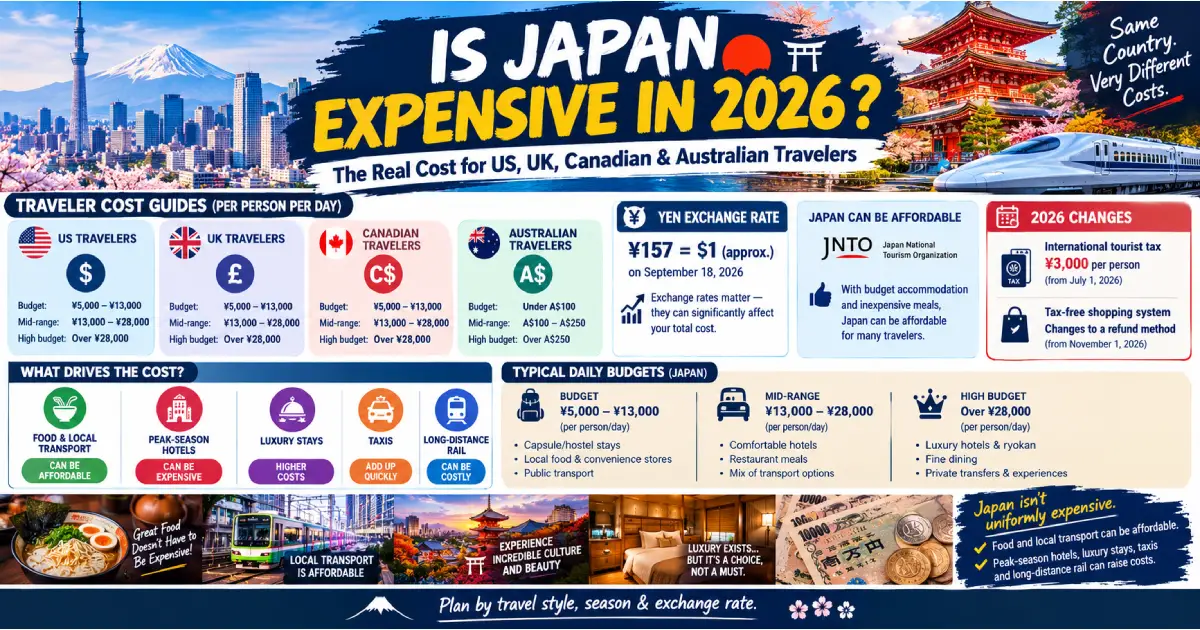
Japan carries a reputation among American, British, Canadian, and Australian travelers as a specifically expensive destination — a reputation formed largely in the 1980s and 1990s, when the yen was strong, Tokyo topped every “most expensive city in the world” ranking, and a bowl of coffee in Ginza genuinely could run the equivalent of $15–20 — and that reputation has simply not caught up to Japan’s actual 2026 pricing reality: the yen has spent much of the past several years at historically weak levels against the dollar, pound, Canadian dollar, and Australian dollar, meaning the exact same trip that felt punishingly expensive to a Western visitor in 1995 now frequently costs less per day than an equivalent trip to London, Sydney, Vancouver, or even many mid-sized American cities. The short, honest answer is that Japan in 2026 is a mid-range destination for tier-1 travelers — more expensive than Southeast Asia, comparable to or cheaper than most of Western Europe, and in several specific categories (public transport, casual dining, hotel quality per dollar) noticeably cheaper than what US, UK, Canadian, and Australian travelers pay at home.
The nuance that most surface-level “is Japan expensive” answers miss is that Japan’s cost structure is genuinely bimodal in a way few other countries are: it is entirely possible to eat an excellent, filling meal for the equivalent of $6–8 (a bowl of ramen, a conveyor belt sushi lunch, a convenience store meal that would embarrass most Western supermarkets) sitting two blocks from a sushi counter charging $400 per person, and both experiences are genuinely representative of Japan rather than one being a tourist trap and the other authentic. This guide breaks down exactly what a 2026 trip to Japan costs across every major category, compared directly against equivalent US, UK, Canadian, and Australian prices, so a first-time tier-1 visitor can budget accurately instead of relying on an outdated stereotype.
Japan is not more expensive than most tier-1 travelers’ home countries — it is frequently cheaper, specifically in: public transportation, casual and mid-range dining, hotel quality relative to price, and convenience-store food quality. Japan can get genuinely expensive in: peak-season flights, top-tier sushi and kaiseki dining, ski resort towns (Niseko, Hakuba) during winter season, and any experience explicitly marketed as luxury (five-star ryokan, private guided tours, first-class Shinkansen Green Car travel).
| Category | Japan (Tokyo/Kyoto) | US (mid-size city) | UK (London) | Verdict |
|---|---|---|---|---|
| Subway/metro single ride | ¥180–¥210 (~$1.20–$1.40) | $2.75–$3.00 (NYC) | £2.80 (~$3.60) | Japan cheaper |
| Mid-range dinner for one | ¥1,500–¥3,000 (~$10–$20) | $20–$35 | £18–£30 (~$23–$38) | Japan cheaper |
| 3-star hotel, double room | ¥10,000–¥18,000 (~$67–$120) | $130–$220 | £120–£200 (~$153–$255) | Japan meaningfully cheaper |
| Coffee (café, not convenience store) | ¥400–¥600 (~$2.70–$4.00) | $4.50–$6.50 | £3.50–£5 (~$4.50–$6.40) | Japan cheaper |
| Domestic train, 2-hour journey | ¥8,000–¥14,000 (~$53–$93, or included in JR Pass) | Amtrak: $40–$120 | UK rail: £40–£90 (~$51–$115) | Roughly comparable |
| Top sushi omakase | ¥40,000+ (~$267+) | NYC top omakase: $300–$500+ | London: £200–£400+ | Comparable to slightly cheaper |
The single biggest cost variable, and the one category where Japan genuinely can be more expensive than a tier-1 traveler expects, is the flight itself — not because Japan-specific pricing is high, but because long-haul flights simply cost more than short-haul ones regardless of destination.
| Origin | Economy round trip (2026 average) | Premium Economy | Business |
|---|---|---|---|
| US West Coast (LAX/SFO) | $750–$1,400 | $1,800–$2,800 | $4,500–$8,000+ |
| US East Coast (JFK/EWR) | $1,000–$1,800 | $2,200–$3,400 | $5,500–$9,500+ |
| UK (LHR) | £700–£1,300 (~$890–$1,650) | £1,900–£2,900 (~$2,400–$3,700) | £4,000–£7,500+ (~$5,100–$9,500+) |
| Canada (YVR/YYZ) | CAD $1,000–$1,900 (~$720–$1,370) | CAD $2,300–$3,600 | CAD $5,000–$9,000+ |
| Australia (SYD/MEL) | AUD $1,000–$1,900 (~$650–$1,240) | AUD $2,200–$3,400 | AUD $5,500–$9,500+ |
Money-saving note: Booking 3–5 months ahead for shoulder-season travel (May–June, or October, avoiding both cherry blossom and Golden Week peaks) routinely saves $300–$600 per ticket from US and Australian departure points specifically, where seasonal fare swings are the widest of any tier-1 origin market.
This is the category where the “Japan is expensive” stereotype breaks down most completely. A clean, well-located, immaculately maintained 3-star business hotel in central Tokyo or Kyoto — the kind of hotel a US or UK traveler would expect to pay $150–$250/night for at home — routinely runs $60–$120/night in Japan, and Japanese hotel standards (bathroom cleanliness, quietness, staff attentiveness) frequently exceed the Western equivalent at the same price point.
| Accommodation Type | Japan (Tokyo/Kyoto, per night) | Equivalent in US/UK |
|---|---|---|
| Capsule hotel | ¥3,000–¥5,000 (~$20–$33) | No real equivalent — hostel dorm bed: $35–$60 |
| Business hotel (3-star) | ¥8,000–¥15,000 (~$53–$100) | $130–$220 |
| Mid-range hotel (4-star) | ¥15,000–¥28,000 (~$100–$187) | $220–$380 |
| Traditional ryokan (with dinner, onsen) | ¥20,000–¥45,000/person (~$133–$300) | Boutique inn equivalent: $250–$500+ |
| Luxury hotel (5-star) | ¥45,000–¥120,000+ (~$300–$800+) | Comparable to NYC/London 5-star |
The specific reason Japanese hotels deliver more for less: extremely high domestic supply density (particularly business hotel chains like APA, Toyoko Inn, and Dormy Inn, built primarily for Japanese business travelers rather than international tourists), combined with a service culture where cleanliness and precision are baseline expectations rather than premium add-ons.
Japan’s food cost structure is genuinely bimodal, and the budget end is dramatically cheaper than most tier-1 visitors expect, while the top end can match or exceed anything in New York or London.
| Meal Type | Japan Cost | US/UK/Canada/Australia Equivalent |
|---|---|---|
| Convenience store meal (onigiri, bento, drink) | ¥500–¥900 (~$3.30–$6) | Gas station food, much lower quality: $6–$10 |
| Ramen or conveyor belt sushi | ¥800–¥1,500 (~$5.30–$10) | Fast-casual chain: $12–$18 |
| Izakaya dinner with drinks | ¥3,000–¥5,000 (~$20–$33) | Casual restaurant dinner with drinks: $40–$60 |
| Mid-range sit-down dinner | ¥4,000–¥8,000 (~$27–$53) | $50–$90 |
| Michelin-starred kaiseki/sushi | ¥25,000–¥50,000+ (~$167–$333+) | NYC/London tasting menu: $250–$500+ |
The Japanese konbini (convenience store) deserves specific mention: 7-Eleven, Lawson, and FamilyMart sell fresh, genuinely good prepared meals — from sandwiches to full bento boxes to seasonal desserts — at a quality-to-price ratio that has no real equivalent in US, UK, Canadian, or Australian convenience retail, and represents a legitimate, not merely acceptable, budget meal strategy throughout a Japan trip.
Japan’s public transportation is simultaneously the country’s most impressive infrastructure achievement and, for point-to-point pricing, cheaper than most tier-1 home-country equivalents — the specific exception being long-distance Shinkansen travel, which is fast and reliable but not cheap on a per-kilometer basis.
Within cities: A Tokyo subway ride (¥180–¥330 depending on distance) undercuts the New York subway ($2.90 flat), the London Underground (£2.80–£6.70 depending on zones), and most Australian and Canadian transit systems, while delivering meaningfully higher punctuality and cleanliness.
Between cities: The Shinkansen (bullet train) is where Japan’s transport costs rise — a one-way Tokyo–Kyoto Shinkansen ticket runs approximately ¥14,000 (~$93), comparable to a short-haul domestic flight in the US, but for a journey covering 513 km in 2 hours 15 minutes with none of the airport transfer time, security lines, or delay risk that domestic flying carries.
The JR Pass consideration: Since the JR Pass’s 2023 price increase (roughly 70% higher than its previous cost), it no longer delivers the automatic, obvious savings it once did — for a Tokyo-and-Kyoto-only trip, calculate the exact point-to-point cost before assuming the Pass saves money (see our Japan 7-Day Itinerary for a worked example).
To give an honest, non-one-sided answer, these are the specific categories where the old “Japan is expensive” reputation still holds true in 2026:
| Budget Level | Per Person, Per Day | What It Covers |
|---|---|---|
| Backpacker | ¥6,000–¥9,000 (~$40–$60) | Capsule hotel/hostel, convenience store and ramen meals, public transport, free/low-cost sights |
| Mid-range | ¥12,000–¥20,000 (~$80–$133) | 3-star business hotel, mix of casual and sit-down dining, occasional paid attraction |
| Comfortable | ¥22,000–¥35,000 (~$147–$233) | 4-star hotel, regular sit-down dining, mountain railway/cable car excursions, some shopping |
| Luxury | ¥50,000+ (~$333+) | 5-star hotels or ryokan with kaiseki dinner, top restaurants, private transport |
A realistic mid-range 7-day Japan trip for one person (excluding international flights) lands in the ¥84,000–¥140,000 range (~$560–$933) — genuinely comparable to, and frequently below, a mid-range week in Western Europe or a major US city.
About Travel Tourister Travel Tourister’s destination specialists track real, current pricing across Japan’s full spectrum — from ¥180 subway rides and ¥500 convenience store lunches to ¥40,000 sushi omakase counters — to give tier-1 travelers an honest, currency-adjusted answer to whether Japan actually fits their 2026 travel budget.
Posted By : Vinay
Latest Article
2nd Floor, 39, Above Kirti Club, DLF Industrial Area, Kirti Nagar, New Delhi, Delhi 110015



Travel Tourister is a leading Travel portal where we introduce travellers to trusted travel agents to make their journey hasselfree, memorable And happy. Travel Tourister is a platform where travellers get Tour packages ,Hotel packages deals through trusted travel companies And hoteliers who are working with us across the world. We always try to find new and more travel agents and hoteliers from every nook and corners across the world so that you could compare the deals with different travel agents and hoteliers and book your tour or hotel with the one you have chosen according to your taste and budget.
Copyright © Travel Tourister, India. All Rights Reserved

 Call
Call Enquiry