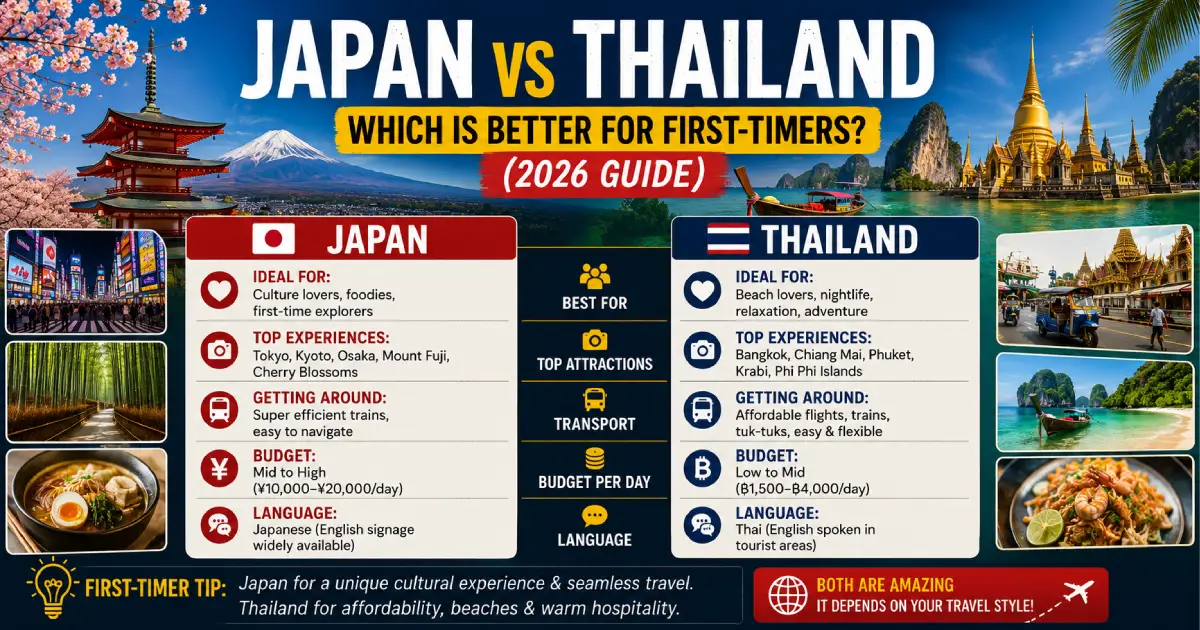
Japan vs Thailand: Which Is Better for First-Timers? (2026 Guide)
Published on : 02 Jun 2026
Japan vs Thailand — Asia’s Two Most Visited Countries by Western Travelers, Honestly Compared
By Travel Tourister | Updated March 2026
Japan and Thailand are the two most visited Asian countries by first-time Western travelers — the two destinations that appear most frequently on the “first trip to Asia” shortlist for Tier 1 travelers from the US, UK, Canada, and Australia — and the comparison between them is the most consequential single Asia trip planning decision available because the two countries are genuinely different in the most specific and the most practically important ways: cost (Thailand is among the world’s most affordable quality travel destinations; Japan is significantly more expensive than most Western travelers expect before pricing their first Japan itinerary), accessibility (Thailand’s signage, food, and tourism infrastructure are calibrated for the non-Japanese-speaking Western traveler in ways that Japan’s infrastructure — beautiful, precise, and occasionally impenetrable to the visitor who arrives without a working grasp of Japanese customs — is not always configured to provide), beach access (Thailand has the most specifically turquoise and the most specifically limestone-karst-framed beaches accessible in Southeast Asia; Japan has no tropical beach destination of comparable quality within the country’s islands), and cultural depth (Japan’s tea ceremony tradition, the Kyoto geisha district, the Fushimi Inari torii gate mountain walk, the Hiroshima Peace Memorial, and the Tsukiji Outer Market morning are among the most specifically profound and the most culture-historically specific experiences accessible anywhere on earth; Thailand’s Grand Palace, Chiang Mai’s 300 temples, the Chiang Rai White Temple, and the Damnoen Saduak floating market are the most Southeast Asian-culturally specific and the most visually irreplaceable single-country experiences accessible in the region).
This guide breaks down every meaningful category — cost, ease of travel, food, culture, beaches, transport, and what each country actually feels like to first-time visitors — and delivers the most honest and the most specific verdict on which Asian destination is right for which traveler in 2026.
For related international comparisons, see our Budget Honeymoon Destinations Under $5,000 and Best Overwater Bungalows in the World guides.
The Most Important Facts First
Key Fact
🇯🇵 Japan
🇹🇭 Thailand
Visa (Americans, UK, Canadians, Australians)
Visa-free up to 90 days (all Tier 1 markets)
Visa-free up to 60 days (2024 extension, confirm current status)
Currency
Japanese Yen (JPY); ~150 JPY per USD (2026)
Thai Baht (THB); ~36 THB per USD (2026)
Daily Budget (midrange)
$120–$200/person/day
$50–$100/person/day
Daily Budget (budget traveler)
$70–$120/person/day (hostel + convenience store meals)
$25–$50/person/day (guesthouse + street food)
Flight from New York (approx)
~14 hours direct to Tokyo (NRT/HND)
~18–20 hours (connection via Middle East or Asia) to Bangkok (BKK)
Flight from London (approx)
~12 hours direct to Tokyo (NRT)
~11.5 hours direct to Bangkok (BKK) on BA/Thai Airways
Language Barrier
Moderate — English signage in major cities; rural areas less so
Low in tourist areas — English widely spoken in Bangkok, Chiang Mai, beach resorts
Tap Water Safety
✅ Safe — Japan has the most reliably safe tap water in Asia
❌ Do NOT drink tap water; bottled water essential
Best Season
March–May (cherry blossom); Sept–Nov (fall foliage); avoid Aug heat
November–April (cool dry season); avoid May–October monsoon on coasts
Beach Access
Limited; Okinawa is tropical but requires additional flight from Tokyo
Bangkok’s Khao San Road, Koh Samui, Pattaya — most party-forward in Asia
🇹🇭 Thailand (volume and value)
Bucket List Factor
Mt. Fuji, cherry blossoms, Fushimi Inari, Hiroshima — most iconic in Asia
Phi Phi Islands, elephant sanctuary, White Temple — very strong
🇯🇵 Japan (Mt. Fuji is singular)
Japan: The World’s Most Precise and Most Culturally Extraordinary Country
Tokyo: The Most Stimulating City on Earth
Why Tokyo Is Extraordinary: Tokyo — the largest metropolitan area on earth at 37 million people, the city with the most Michelin-starred restaurants in the world (more than Paris and New York combined), the most specific and the most precisely operated urban transit system on the planet, and the most simultaneously ancient-and-future-facing cultural environment accessible in any major global city — is the most specifically overwhelming and the most specifically rewarding single city arrival accessible in Asia. The specific Tokyo experiences that no other Asian city replicates at any price:
Tsukiji Outer Market (tuna breakfast, $15–$25): The most specifically Japanese and the most precisely sourced seafood market breakfast accessible in any city — the maguro-don (tuna on rice) from the outer market stalls at 6:30 AM, surrounded by the most specific and the most knowledgeable Tokyo food culture accessible at any market address, is the most specifically Tokyo morning food experience at any price
Shibuya Crossing: The most simultaneously pedestrian-crossed and the most cinematically recognized single intersection on earth — the scramble crossing at peak hour (6–8 PM weekdays) fills with 3,000 simultaneous pedestrians from 8 directions in the most specifically and the most quantifiably organized human traffic event accessible at any city intersection
Senso-ji Temple, Asakusa (free): The most visited temple in the world (30+ million annual visitors), with the Nakamise-dori shopping street of the most specifically Japanese craft and confectionery vendors and the most specifically photogenic red lantern gate (Kaminarimon) accessible at any Tokyo heritage attraction
Ramen in Shinjuku or Shibuya ($10–$15/bowl): The most specifically Japan and the most specifically ramen-culture-embedded meal accessible in any city — the ramen shops of Tokyo’s most active neighborhoods produce the most nationally and internationally celebrated ramen accessible outside of Sapporo and Hakata at the most honest price per bowl accessible in any major Japanese city
TeamLab Planets or Borderless ($30–$40/adult): The most immersive and the most specifically digital-art-environment-pioneering museum installation accessible in Asia — the TeamLab digital art spaces in Tokyo are the most internationally exported and the most specifically contemporary-Japanese-art-forward experience accessible in the country
Kyoto: The Most Culturally Specific City in Japan
Why Kyoto Is the Most Essential Japan Experience: Kyoto — the former imperial capital (794–1868), with 17 UNESCO World Heritage Sites within city limits, the most intact geisha district (Gion) accessible in Japan, the most Zen Buddhist temple garden concentration of any Japanese city, and the most specifically Japanese-cultural-heritage-layered urban environment accessible in the country — is the most specifically Japan experience accessible in any Japanese city and the most cited “best Japan experience” by returning visitors across all nationality and budget categories.
Fushimi Inari Taisha (free, open 24 hours): The most photographed single Japan attraction — the 10,000 vermilion torii gates ascending Mount Inari in continuous tunnel formation for 4 km round trip. The most photogenically extraordinary and the most specifically Japan-identifying single walk accessible in any Japanese city. Arrive before 7 AM for the most crowd-free gate photographs — the path is shared with 10,000 daily visitors by midday. The summit (233m) and the upper trails are the least crowded and the most forest-atmospheric sections accessible to any visitor willing to walk beyond the lower gate tunnels that most tour groups photograph.
Arashiyama Bamboo Grove (free; best 6–7 AM): The most specifically Japanese and the most cinematically atmospheric bamboo forest walk accessible in Japan — the 300-meter path through the Sagano Bamboo Grove west of Kyoto produces the most specifically light-and-shadow and the most specifically acoustically unusual (the bamboo rustling in the breeze produces the most distinctive and the most specifically bamboo-atmospheric natural sound accessible at any Japan attraction) walk accessible without a garden admission fee. Arrive at dawn for the light quality and the crowd-free path — the bamboo grove is overrun by 9 AM on any non-rainy Kyoto day.
Gion District evening walk (free): The most specifically geisha-culture-embedded and the most historically preserved geisha district in Japan — the Hanamikoji Street in Gion (the most specifically maintained machiya townhouse streetscape in Kyoto) produces the most specifically Japan evening atmosphere accessible on foot, with the possibility of sighting a maiko (apprentice geisha) walking to or from an ochaya (teahouse) appointment between 5:30–7:30 PM on weekdays.
Nishiki Market (“Kyoto’s Kitchen”): The most specifically Kyoto-local and the most specifically food-culture-embedded covered market in Japan — the 390-meter five-block covered market in central Kyoto contains the most specifically Kyoto-character food vendors (tsukemono pickles, yuba tofu skin, matcha sweets, the most specific Kyoto-style obanzai prepared dishes) accessible at any single Japanese market address at the most honest prices accessible in central Kyoto
Kinkaku-ji (Golden Pavilion, $5/adult): The most globally recognized and the most specifically photograph-matching single Japan building — the 14th-century gold-leaf-covered Zen Buddhist pavilion reflected in the Kyoko-chi garden pond produces the most specifically Japan image accessible at any admission-fee attraction in the country
Mount Fuji and the Hakone Region
Why It’s the Most Iconic Japan Experience: Mount Fuji — at 12,388 feet the most specifically Japan-identified and the most internationally recognized single mountain in Asia — is visible from the Hakone National Park area (90 minutes from Tokyo by Romancecar train, the most specifically scenic and the most specifically ryokan-overnight-adjacent day trip accessible from Tokyo) on the most clear-weather days of the year (the most reliable Mt. Fuji views occur in October–February, when the least cloud cover and the most snow on the summit produce the most specifically photogenic and the most dramatic Mt. Fuji silhouette accessible from Hakone’s Lake Ashi or Chureito Pagoda viewpoint).
Hakone Open Air Museum ($18/adult): The most specifically outdoor-sculpture-and-Mt.-Fuji-backdrop museum accessible in Japan — the Hakone Open Air Museum’s collection of Moore, Picasso, and Rodin works in the most dramatically volcanic-landscape-positioned outdoor sculpture garden in the country
Mt. Fuji climbing season (July–September): The most specifically achievable and the most specifically crowded single mountain climb accessible in Japan — the Yoshida Trail (the most popular of the four Fuji climbing trails) is opened July 1 and closes September 10 annually; the most physically demanding 6–8 hour overnight ascent to the most specifically Japan summit accessible to any healthy adult with adequate preparation
Chureito Pagoda viewpoint (Fujiyoshida): The most specifically Japan photography composition accessible without climbing the mountain — the five-story pagoda with Mt. Fuji behind it and cherry blossoms in the foreground (the most reproduced single Japan image in any travel publication’s front cover selection process) is accessible by a 20-minute stair climb from the Fujiyoshida Sengen Shrine base
Japan’s Shinkansen and JR Pass
Why Japan’s Transport System Is the Most Specifically Extraordinary: The Japanese Shinkansen (bullet train) system — connecting Tokyo, Kyoto, Osaka, Hiroshima, and Fukuoka in the most precisely operated and the most specifically on-time rail network in the world — is the most transformative single infrastructure decision in any Japan itinerary. The JR Pass ($390–$550 for 14-day nationwide pass) provides unlimited travel on most JR Shinkansen lines, regional trains, and some ferries, making the Tokyo–Kyoto–Osaka–Hiroshima corridor accessible in the most time-efficient and the most specifically Japan-train-culture-embedded format accessible at any Japan ticket window.
Tokyo–Kyoto ($130 one-way without pass; 2h15m): The most impactful single Shinkansen journey for the first-time Japan visitor — the specific moment when Mt. Fuji appears through the right-side windows on a clear day between Shin-Fuji and Shizuoka stations is the most cited single Shinkansen travel moment by any returning Japan traveler
JR Pass value calculation: If your itinerary includes Tokyo + Kyoto/Osaka + Hiroshima + Nikko, the 14-day JR Pass ($390–$550) breaks even vs individual ticket prices. For Tokyo + Kyoto only: individual tickets ($260 roundtrip) may be cheaper than the full pass. Calculate before purchasing.
Japanese Food Culture: The World’s Most Michelin-Starred Nation
Japan has more Michelin-starred restaurants than any other country in the world — Tokyo alone has more Michelin stars than Paris, New York, and London combined. But the most specifically Japan and the most honest food culture assessment for the first-time visitor is not the $300 omakase sushi experience (extraordinary; accessible; the most worth-saving-for single meal in any Asia trip) but the daily convenience-store (conbini) culture:
7-Eleven, Lawson, FamilyMart (¥500–¥800/meal): The most specifically Japan and the most shocking-to-the-Western-visitor single retail food revelation — Japanese convenience stores serve the most genuinely excellent prepared food (onigiri rice triangles, katsu sandwiches, hot nikuman pork buns, fresh sushi packs, the most hygienic and the most freshly rotated prepared meals accessible at any convenience store chain in the world) at the most affordable price accessible in any Japanese city. The $4 conbini breakfast is not a budget compromise in Japan; it is the most specifically Japanese and the most honestly local morning food experience accessible at any Tokyo address.
Ichiran Ramen ($13–$18/bowl): The most specifically solitary and the most specifically ramen-culture-precise single dining experience in Japan — Ichiran’s individual booth system (sit alone in a partitioned wooden booth, customize the bowl intensity and firmness on a paper form, receive the bowl through a small bamboo curtain) is the most specific and the most Japan-character-revealing single restaurant experience accessible without a reservation
Depachika (department store basement food halls): The most specifically Japanese single retail food environment — the basement food floors of department stores like Isetan in Shinjuku, Takashimaya in Osaka, or Daimaru in Kyoto contain the most comprehensively curated and the most aesthetically presented prepared food and confectionery accessible in any single retail floor in the world; the most specific place to purchase the most specific Japanese food gifts accessible at any price point
The Onsen Experience — Japan’s Most Restorative Tradition
The Japanese onsen (geothermal hot spring bath) culture — accessible at traditional ryokan inns throughout the country but most concentrated in the volcanic regions of Hakone, Nikko, Noboribetsu (Hokkaido), and Kinosaki Onsen (Hyogo) — is the most specifically restorative and the most uniquely Japanese wellness experience accessible in the country: the specific ritual of entering the shared (or private) hot spring bath in the prescribed sequence (wash before entering, no swimwear in traditional onsens, specific gender-separated bath areas) produces the most specifically Japanese cultural-participation and the most specifically thermal-mineral-soaking relaxation accessible without a spa reservation at any Japan accommodation with onsen access.
Best onsen access for first-timers: Day-use onsen at Hakone’s Tenzan Tohji-kyo ($16/person, the most internationally accessible and the most private-option-complete day onsen near Tokyo), or staying one night at a Hakone ryokan with private onsen room ($200–$400/person including dinner and breakfast — the most culturally complete and the most specifically ryokan-experience-total Japan overnight accessible within 90 minutes of Tokyo).
Thailand: Asia’s Most Welcoming and Most Beach-Beautiful Country
Bangkok: The Most Energetically Sensory Asian Capital
Why Bangkok Is Extraordinary: Bangkok — Krung Thep in Thai, the most ceremonially named capital city in the world (the full ceremonial name is 168 characters long, the longest place name in any country) — is the most simultaneously chaotic and the most specifically rewarding Asian capital accessible for the first-time Asia visitor: the Grand Palace compound (the most elaborately gilded and the most specifically Buddhist-royal architecture accessible in Southeast Asia), the Chao Phraya River’s temple-lined banks, the Chatuchak Weekend Market (the most specifically enormous and the most specifically merchandise-overwhelming single weekend market accessible in Asia, with 15,000 stalls across 27 acres), and the street food scene (the most internationally celebrated and the most specifically UNESCO-heritage-cuisine-embedded street food accessible in any Southeast Asian capital) collectively produce the most densely programmed and the most specifically Bangkok-only urban experience accessible in the region.
Wat Phra Kaew and the Grand Palace ($20/adult): The most ornately decorated and the most specifically Thai-Buddhist-royal architecture complex accessible in Thailand — the Emerald Buddha (the most venerated single religious object in Thailand, a 66-cm jade-green seated Buddha wearing robes changed by the king three times annually at the seasonal equinoxes) and the surrounding compound’s gold-spired prangs and chedi are the most specifically Thailand-identifying single architectural ensemble accessible at any Bangkok attraction
Wat Pho ($5/adult): The most specifically Thai massage school-adjacent and the most historically significant temple in Bangkok — the 46-meter reclining Buddha (the most dramatically scaled and the most specifically gold-leaf covered single Buddha accessible in any Thailand temple) and the temple’s status as the birthplace of traditional Thai massage make Wat Pho the most culturally complete and the most historically layered single Bangkok temple visit
Chatuchak Weekend Market (Saturdays and Sundays, free entry): The most specifically overwhelming and the most specifically rewarding single weekend market experience in Asia — 15,000 stalls across 27 acres selling the most comprehensive range of Thai craft, antiques, plants, clothing, and food accessible at any single Southeast Asian market
Street food on Yaowarat Road (Bangkok Chinatown) at night: The most specifically Bangkok and the most specifically Chinese-Thai food culture evening accessible in the capital — the grilled seafood, the most specifically crab omelette-forward and the most specifically boat noodle-street-food-complete evening accessible in any Bangkok neighborhood at prices ($3–$8 per dish) that produce the most financially extraordinary food evening in any Asian capital
Chiang Mai: The Most Temple-Rich and the Most Elephant-Sanctuary-Adjacent Thailand City
Why Chiang Mai Is Essential: Chiang Mai — the capital of northern Thailand, 500 miles north of Bangkok (1.5-hour flight or 12-hour overnight train), with 300 temples within the old city moat and the most specifically elephant sanctuary, trekking, and hill tribe village access of any Thailand city — is the most culturally specific and the most Northern-Thailand-character-distinct single Thailand city experience accessible from any Bangkok flight connection.
Ethical elephant sanctuary experience ($75–$120/person): The most specifically transformative and the most ethically considered single Thailand wildlife experience — Elephant Nature Park (the most internationally recognized ethical elephant sanctuary in Thailand, founded by Lek Chailert and the most specifically welfare-focused elephant rescue and rehabilitation program in the country) and the Elephant Jungle Sanctuary (the most internationally accessible and the most day-visit-optimized ethical elephant encounter accessible from Chiang Mai) provide the most specifically responsible and the most emotionally engaging elephant bathing, feeding, and observation experience accessible at any Thailand wildlife venue. Avoid any elephant riding program — the most important single elephant welfare decision accessible to any Thailand visitor.
Doi Inthanon National Park (Thailand’s highest peak, $8 entry): The most dramatic and the most cloud-forest-complete nature experience accessible within 2 hours of Chiang Mai — the two royal pagodas (Naphamethinidon and Naphaphonphumisiri), the most specifically dramatic stepped-waterfall system (Wachirathan Falls), and the most specifically highland-bird-species observation accessible at any Thailand national park make Doi Inthanon the most nature-complete day trip from Chiang Mai
Doi Suthep Temple ($2 entry + minivan, or cable car): The most specifically Chiang Mai-skyline-view and the most dramatically mountain-forested temple accessible from any Thailand city — the 300-step Naga staircase ascending to the golden chedi and the panoramic Chiang Mai valley view from the temple terrace produce the most specifically Chiang Mai-character single attraction visit accessible at any city day-trip destination
Sunday Walking Street (Wualai Road, 4–10 PM): The most specifically Chiang Mai handicraft and the most locally Lanna-culture-embedded single weekly market — the most silver jewelry, the most lacquerware, and the most specifically northern-Thai-food vendor concentration of any Chiang Mai weekly market, accessible free of entry charge at the most affordable single cultural evening event in the city
Yi Peng Lantern Festival (November, Loi Krathong week): The most visually extraordinary and the most globally circulated single Thailand cultural event photograph — the mass release of sky lanterns (khom loi) over the moat and the Mae Ping River on the night of the full moon in November produces the most specifically magical and the most specifically Thailand-character sky visible at any Asian festival event. Chiang Mai’s Yi Peng is the most specifically Buddhist and the most community-embedded lantern festival in Thailand; the Maejo University mass release ($60–$120/ticket) is the most internationally ticketed and the most specifically large-scale lantern launch accessible at any November Chiang Mai event.
Thailand’s Beaches: The Most Beautiful in Southeast Asia
Why Thailand’s Beaches Are World-Class: Thailand’s Andaman Sea and Gulf of Thailand coastlines produce the most specifically limestone-karst-framed, the most turquoise, and the most globally photographed beach landscapes accessible in Southeast Asia — the vertical karst towers rising from the Phang Nga Bay, the emerald-green water of the Maya Bay on Koh Phi Phi, and the dramatically towering limestone cliffs framing the Railay Beach peninsula (accessible only by longtail boat, with no road connection to the mainland) produce the most specifically extraordinary and the most internationally reproduced single beach landscape accessible in any Southeast Asian country.
Railay Beach (Krabi): The most dramatically limestone-cliff-enclosed and the most specifically secluded beach destination accessible by longtail boat from Ao Nang (15 minutes, $3 each way) — Railay West Beach is the most calm-swimming and the most resort-adjacent; Railay East is the most mangrove-fringed and the most kayaking-appropriate; Phra Nang Cave Beach is the most dramatically sheer-cliff-backed and the most specifically photogenic of any Railay beach section
Koh Phi Phi (Phuket ferry, 1.5 hours, $12): The most globally recognizable Thailand beach island — the viewpoint above the isthmus connecting the twin peaks of Koh Phi Phi Don produces the most photographically reproduced Thailand island view accessible from any Southeast Asia hiking trail; Maya Bay (the beach from The Beach film, $20 NP fee, timed entry now managed to allow coral recovery) is the most specifically film-identified Thailand beach accessible by boat
Koh Lanta (2-hour ferry from Krabi): The most specifically long-stay and the most specifically yoga-retreat-and-beach-town atmosphere accessible in the Andaman Sea islands — the long-beach west coast of Koh Lanta (Klong Dao Beach and Long Beach) produces the most consistently sunset-facing and the most specifically relaxed beach culture accessible at a 5–7 day Thailand island base
Koh Samui (Gulf of Thailand): The most fully developed and the most resort-complete Thailand island — Chaweng Beach is the most specifically bar-and-resort-strip-adjacent and the most specifically nightlife-accessible; Maenam Beach on the north shore is the most specifically quiet and the most specifically local-Thailand-village-adjacent
Thailand Street Food: The World’s Most Celebrated
Why Thailand’s Food Culture Is the Most Extraordinary: Thai cuisine was declared an Intangible Cultural Heritage by UNESCO — the most globally replicated and the most internationally taught single Southeast Asian cuisine tradition, available at the most affordable price point of any comparable quality food culture in Asia. The specific Thailand street food experiences:
Pad Thai ($1.50–$3 from a street cart): The most internationally replicated and the most specifically Thailand-identified single dish — stir-fried rice noodles with egg, tofu or shrimp, bean sprouts, and the most specific combination of fish sauce, palm sugar, tamarind, and dried shrimp accessible at any Bangkok street vendor. The most authentic pad thai in Bangkok is served from a cart, not a restaurant, and costs less than any comparable noodle dish accessible in any other city’s street food culture.
Som Tum (green papaya salad, $1–$2): The most specifically Isan (northeastern Thai) and the most aggressively flavored single Thai dish — shredded green papaya pounded in a mortar with garlic, Thai chilies, lime juice, fish sauce, dried shrimp, and tomatoes produces the most specifically heat-and-sour-and-savory balance accessible at any Thai street food vendor in the most specifically Thai-food-culture-distinguishing preparation
Mango sticky rice ($2–$3, seasonal May–June): The most internationally beloved and the most specifically Thai dessert — the most specifically ripe mango with the most specifically coconut-milk-soaked and the most specifically pandan-fragranced sticky rice at the most specific warm-coconut-milk-drizzled presentation accessible at any Thai dessert street vendor
Khao San Road food crawl (Bangkok, evening): The most specifically backpacker-beloved and the most internationally famous single Thailand street food corridor — pad see ew, grilled corn, fried insects ($2–$4 for the bravest single Thailand food experience), and the most full-moon-party-adjacent and the most specifically budget-traveler-social-food-and-drink evening accessible in any Bangkok neighborhood
Thai Massage — The World’s Most Affordable Luxury
Thailand’s traditional Thai massage (Nuad Boran, listed on UNESCO’s Intangible Cultural Heritage register) — a 2,500-year-old therapeutic practice combining acupressure, stretching, and rhythmic compression into the most specifically joints-and-energy-pathways-targeted wellness tradition accessible at any Southeast Asian spa — is available at the most affordable price point of any comparable quality wellness experience in the world: $8–$15 for a 60-minute traditional Thai massage at any licensed massage parlor in Chiang Mai, Bangkok, or any Thailand beach resort. The $15 Thai massage on a Koh Lanta beach palapa is the most specifically value-extraordinary single Thailand luxury accessible at any price per minute of experienced manual therapy in any country.
Shinkansen Tokyo–Kyoto $130 one-way (or JR Pass $390–$550/14 days)
Overnight train Bangkok–Chiang Mai $15–$30; bus $8–$15; flight $30–$80
City Transport (per day)
$8–$15 (Tokyo Metro day pass $7)
$3–$8 (BTS Skytrain, tuk-tuk, songthaew)
Thai Massage / Onsen
Onsen day-use $12–$20; ryokan overnight with onsen $120–$400/person
Thai massage 1 hour $8–$15; spa treatment $20–$40
Key Attraction Entry
Fushimi Inari free; Kinkakuji $5; temples $5–$15
Grand Palace $20; Doi Inthanon $8; most temples free
14-Night Trip Total (per person)
~$2,500–$4,500 (midrange, includes JR Pass)
~$900–$2,000 (midrange, including beach resort)
Cost verdict: Thailand is 50–60% cheaper than Japan across every spending category. A 14-night Thailand trip at midrange costs $900–$2,000/person; a comparable Japan trip costs $2,500–$4,500/person. The most consequential single Japan cost factor for first-timers: the JR Pass ($390–$550 for 14 days) is the largest single non-flight Japan transport cost and must be calculated against your specific itinerary before purchase. Japan is the most expensive country in Asia for the midrange traveler; Thailand is among the most affordable globally for the quality of experience delivered.
Who Should Visit Japan First?
Choose Japan if you:
Want the most culturally overwhelming and the most specifically Japan-different single country experience accessible in Asia — the precision, the specific customs (shoes off, bowing, queuing etiquette, cash culture), the most polite and the most specifically helpful urban population accessible in any major Asian city, and the most simultaneously ancient-and-technologically-future-facing single country culture accessible on earth
Want cherry blossom season (late March–early April) — the most celebrated seasonal event in Asia; the most photographically specific and the most emotionally overwhelming natural flowering event accessible in any country’s annual calendar
Want to ride the Shinkansen — the most precisely operated and the most specifically train-culture-complete rail journey accessible in Asia; the Tokyo–Kyoto Shinkansen route is the most specifically Japan and the most travel-publication-cited single train journey in the country
Want the most Michelin-starred city in the world — Tokyo’s restaurant culture is the most nationally and internationally celebrated in Asia; the $13 ramen and the $300 sushi omakase are both available within the same city at different addresses and both justify the Japan trip independently
Have a moderate-to-generous travel budget — Japan rewards the visitor who is not counting every yen; the most specific and the most worth-the-investment Japan experiences (ryokan onsen overnight, sushi omakase dinner, JR Pass Shinkansen network) require a budget flexibility that Thailand does not
Want the most safety-assured and the most logistically predictable first Asia trip — Japan’s crime rate is the most specifically near-zero of any major Asian country; the transport runs on the most precisely published schedule of any rail system in the world; the most specifically low-anxiety and the most specifically organized Asia travel environment accessible
Who Should Visit Thailand First?
Choose Thailand if you:
Want the world’s best beach destination in Southeast Asia — Railay Beach, Koh Phi Phi, and Koh Lanta collectively produce the most specifically turquoise, the most dramatically limestone-karst-framed, and the most internationally celebrated beach landscape accessible in any Southeast Asian country
Are on a tighter travel budget — Thailand is the most affordable quality travel destination in Asia; the $15 beach bungalow, the $3 pad thai, and the $10 Thai massage collectively produce the most luxury-per-dollar experience accessible in any country within a 20-hour flight of the US East Coast
Want the most welcoming and the most English-accessible first Asia country — Thailand’s tourism infrastructure is the most developed and the most specifically English-speaker-forward of any Southeast Asian country; the most any first-time Asia visitor can realistically plan without learning any phrases in the local language and still have the most productive and the most comfortable country visit
Want an ethical elephant sanctuary experience — the most emotionally transformative and the most specifically Thailand-only wildlife encounter accessible in Southeast Asia; only accessible in Thailand (and Myanmar) at the scale available in Chiang Mai
Want the Yi Peng Lantern Festival (November) or Songkran Water Festival (April 13–15) — the two most globally circulated and the most specifically Thai-cultural single event photographs in any Asia travel publication’s annual calendar
Want a beach + city combination — Bangkok (most stimulating Southeast Asian capital) + Chiang Mai (most temple-rich northern Thailand city) + Koh Lanta or Railay (most beautiful Andaman Sea beach) in 14 days is the most comprehensively Thailand and the most geographically varied single-country Asia trip accessible at any budget
Japan vs Thailand: Practical Tips Side by Side
Topic
🇯🇵 Japan
🇹🇭 Thailand
Best Time to Visit
March–May (cherry blossom; most iconic season); Sept–Nov (autumn foliage; fewest typhoons); avoid Aug (most humid, most crowded, Golden Week)
Nov–Feb (cool dry season; best beach weather on both coasts; most comfortable temperatures everywhere); avoid May–Oct Andaman coast; April for Songkran
Recommended Itinerary (14 days)
Tokyo (5 days) → Hakone/Mt. Fuji (1 day) → Kyoto (4 days) → Osaka (2 days) → Hiroshima/Miyajima (2 days) → fly home from Osaka (KIX) — open jaw from Tokyo
Bangkok (3 days) → Chiang Mai (4 days: elephant sanctuary, Doi Suthep, cooking class) → fly to Phuket or Krabi (1 hour, $30–$50) → Railay/Koh Lanta (5 days beach) → fly home from Phuket or Krabi
Cash vs Card
Japan is the most cash-forward developed country in the world — many restaurants, vending machines, and smaller establishments accept cash only; withdraw yen at 7-Eleven or Japan Post ATMs (most reliable for foreign cards) on arrival
Cash is the most useful in Thailand markets and tuk-tuks; Kasikorn Bank ATMs (KBANK, green) are the most foreign-card-reliable; Bangkok’s major hotels and restaurants accept cards; beach resort areas increasingly card-friendly but always carry baht for markets and transport
SIM Card
IIJmio or Sakura Mobile SIM ($15–$30/14 days, buy online before departure or at airport convenience store); or pocket Wi-Fi device ($3–$5/day from airports)
AIS, DTAC, or True Move SIM at airport ($10–$20 for 15–30 days unlimited data); the most affordable and the most connectivity-complete SIM available at any Southeast Asian airport arrival hall
Cultural Etiquette
Remove shoes before entering homes and many ryokan; never tip (tipping is the most specifically rude gesture accessible in Japan dining culture — placing cash on the table after a meal insults the chef’s pride); speak quietly in public transport (the most noticed social violation for Western visitors on Tokyo trains); receive items with both hands
Remove shoes before entering temples and many guesthouses; dress modestly at temples (cover shoulders and knees — temple dress code violations are the most commonly cited tourist mistake in Chiang Mai); never touch anyone’s head (considered the most sacred body part in Thai culture); the wai (prayer hands greeting) is the most appropriate response to a local’s greeting; tip at restaurants (10% standard in tourist areas)
Scam Awareness
Japan has the least tourist scam culture of any major Asian country — virtually zero; the most safe and the most trustworthy country in Asia for the first-time visitor’s property and physical safety
The most common Thailand tourist scams: the tuk-tuk “gem store tour” (driver offers free tour with mandatory gem shop stops); the “Grand Palace is closed today” redirect scam (it is never closed for the reason the person on the street claims); metered taxi drivers refusing the meter (always insist on meter or agree price before entering). These are the most specifically Thai tourist-scam situations and the most avoidable with awareness.
Frequently Asked Questions: Japan vs Thailand
Is Japan or Thailand better for a first Asia trip?
Thailand is the more accessible and the more logistically manageable first Asia trip — the most English-speaker-friendly tourism infrastructure, the most affordable daily budget ($50–$100/person vs Japan’s $120–$200/person), the most available beach resort as a comfortable base, and the most specifically welcoming and the most tourist-forward single Southeast Asian country collectively make Thailand the most recommended first Asia trip for travelers who are budget-conscious or who want the most relaxed and the most beach-complete introduction to Asian travel. Japan is the more culturally overwhelming and the more specifically extraordinary first Asia trip for the traveler who has a more generous budget and who wants the most specifically Japan — the cherry blossoms, the Shinkansen, the Kyoto temples, and the Tokyo food culture collectively produce the most culturally distinctive single country experience in Asia. Both are genuinely extraordinary. Thailand is easier and cheaper. Japan is more profound and more expensive. Both are the correct answer for different specific travelers.
How much money do I need for 2 weeks in Japan vs Thailand?
Japan: $2,500–$4,500 per person for 14 nights at midrange (including flights from the US at $800–$1,400 roundtrip, JR Pass $390–$550, $130–$250/night hotels, $30–$60/day food). Thailand: $900–$2,000 per person for 14 nights at midrange (including flights at $700–$1,200 roundtrip, $40–$90/night Bangkok/Chiang Mai hotel, $60–$150/night beach resort, $30–$60/day food and transport). The most honest single budget comparison: 14 nights in Thailand costs approximately what 7 nights in Japan costs at the same accommodation quality tier.
Can you visit Japan and Thailand in the same trip?
Yes — and the Japan + Thailand combination is one of the most specifically rewarding and the most geographically logical Asia trip pairings accessible. Tokyo or Osaka to Bangkok flights are $100–$200 each way on AirAsia, Scoot, or Jetstar (the most affordable single Asian budget airline hop between the two countries). A 21-day Japan + Thailand combination: Tokyo (5 days) → Kyoto (3 days) → Osaka (2 days) → fly to Bangkok ($120) → Bangkok (2 days) → Chiang Mai (3 days) → Koh Lanta or Railay (5 days beach) → fly home from Phuket or Krabi is the most comprehensively rewarding single Asia trip accessible in 3 weeks and the most frequently cited “best first Asia trip” itinerary by returning Tier 1 travelers who have done both countries.
Is Japan safe for solo female travelers?
Japan is the safest country in Asia for solo female travelers — the near-zero street crime, the most police-responsive and the most community-watch-organized urban environment of any major Asian country, and the most specifically safe public transport system produce the most specifically solo-female-travel-comfortable destination accessible in Asia. Thailand is also very safe for solo female travelers in the most traveled tourist areas (Bangkok’s tourist zones, Chiang Mai, the established beach resorts) — the most specific precautions recommended in Thailand are the same precautions recommended in any international destination: avoid walking alone in unfamiliar areas after midnight, use reputable transport, and be aware of the most common tourist scams described above.
Final Verdict: Japan vs Thailand
Japan and Thailand are the two most globally celebrated and the two most genuinely rewarding single-country Asia trip destinations accessible to Tier 1 travelers — different enough that choosing between them as a first Asia destination is the most specifically self-revealing travel preference question available in Asia trip planning, and both extraordinary enough that every year of first-time Tier 1 travelers who visit either country returns understanding why the other country is also on the list. The most honest single-sentence verdict:
Choose Japan if you want the most culturally overwhelming, the most precision-engineered, and the most specifically Japan — the country where the 6 AM walk through the Fushimi Inari torii gates before the tourist crowds arrive produces the most specifically profound and the most specifically nowhere-else-on-earth walking experience accessible in Asia, where the $13 ramen in a Shinjuku standing-only counter costs more than a full Thailand street food dinner and is worth every yen, where the Shinkansen’s 300 km/h departure from Shin-Osaka on time to the second is the most specifically Japanese expression of national character accessible in 2 minutes of platform observation, and where the ryokan onsen soaking after Kyoto’s temple circuit is the most specifically restorative and the most culturally Japanese single evening accessible in any country at any price. Japan is more expensive than Thailand. It is the most technologically and the most culturally precise country on earth. And the cherry blossoms in Maruyama Park in Kyoto in the last week of March, when the most specifically Japan light illuminates the most specifically pink weeping sakura above the most specifically tatami-mat picnic blankets, are the most specifically beautiful and the most specifically irreplaceable single seasonal spectacle accessible in any country visited by any Tier 1 traveler in any year they choose to go.
Choose Thailand if you want the most affordable, the most beach-beautiful, the most street-food-extraordinary, and the most specifically Southeast Asian-welcoming country accessible in Asia — the $3 pad thai that is the most specifically Thailand and the most specifically UNESCO-heritage-cuisine-embedded street food dish in the world, the $10 Thai massage on the Railay Beach palapa that is the most specifically affordable luxury per minute accessible in any country’s wellness economy, the Koh Phi Phi viewpoint that produces the most specifically film-identified and the most specifically turquoise-and-limestone-karst beach panorama visible in any Southeast Asian archipelago, the Chiang Mai elephant sanctuary that is the most specifically ethical and the most emotionally transformative single wildlife encounter accessible in any Southeast Asian country, and the Yi Peng lantern release on a November full moon night in Chiang Mai when 10,000 rice paper lanterns rise simultaneously into the most specifically Thailand-dark sky and the most specifically full-moon-lit and the most specifically Buddhist-spiritually-contextualized mass lantern release visible at any public event in any country produces the most specifically magical single photograph accessible in any Asia trip of any duration at any price. Thailand is 50–60% cheaper than Japan. It has the most beautiful beaches in Southeast Asia. It has the most affordable street food in the world. It is the most welcoming first Asia destination. And the morning when the tuk-tuk driver drops you at Wat Pho before the temple opens and you walk through the reclining Buddha gallery in the first light of a Bangkok November morning with no one else in the building is the most specifically and the most irreplaceably Thailand single cultural moment accessible in Asia at any price.
Both countries are genuinely extraordinary. Japan is the more expensive and the more profound. Thailand is the more affordable and the more beach-complete. The best Asia life includes both — and the $120 AirAsia flight between Osaka and Bangkok that connects them is the most productively Asia-trip-completing single budget airline hop accessible in the most rewarding two-country Asia combination available to any Tier 1 first-time Asia traveler in 2026.
—
Japan National Tourism Organization (JNTO) — Official Japan Government Tourism — Official Japan government tourism authority covering current visa requirements for US, UK, Canadian, and Australian citizens, JR Pass purchasing information, seasonal event calendars (cherry blossom forecasts, autumn foliage schedules), regional travel guides, and all current Japan visitor resources and entry requirements.
Tourism Authority of Thailand (TAT) — Official Thailand Government Tourism — Official Thailand government tourism resource covering current visa on arrival and exemption policies for Tier 1 markets, beach island accessibility guides, ethical elephant sanctuary certification information, festival dates for Yi Peng and Songkran, and all current Thailand visitor resources and entry requirements.
CDC Travelers’ Health — Official US Government Health Guidance for Japan and Thailand — Official US Centers for Disease Control resource covering vaccination recommendations for Japan and Thailand travel, food and water safety guidance for Thailand, dengue fever risk by season, and the most authoritative health preparation information for any first-time Asia trip including both Japan and Thailand itineraries.
About Travel TouristerTravel Tourister’s Asia specialists have traveled extensively across Japan and Thailand — from the Fushimi Inari 6 AM torii walk and Kyoto ryokan onsen to Bangkok’s Yaowarat night food crawl, Chiang Mai’s ethical elephant sanctuary, and Railay Beach longtail boat arrival — to provide the most honest and most specific comparison available for Tier 1 travelers choosing between Asia’s two most visited and most genuinely different first-trip destinations in 2026.
Posted By : Vinay
As a lead contributor for Travel Tourister, Vinay is dedicated to serving our Tier 1 audience (US, UK, Canada, Australia). His mission is to deliver precise, fact-checked news and actionable, data-driven articles that empower readers to make informed decisions, minimize travel risks, and maximize their adventure without compromising safety or budget.
Travel Tourister is a leading Travel portal where we introduce travellers to trusted travel agents to make their journey hasselfree, memorable And happy. Travel Tourister is a platform where travellers get Tour packages ,Hotel packages deals through trusted travel companies And hoteliers who are working with us across the world. We always try to find new and more travel agents and hoteliers from every nook and corners across the world so that you could compare the deals with different travel agents and hoteliers and book your tour or hotel with the one you have chosen according to your taste and budget.




 Call
Call Enquiry