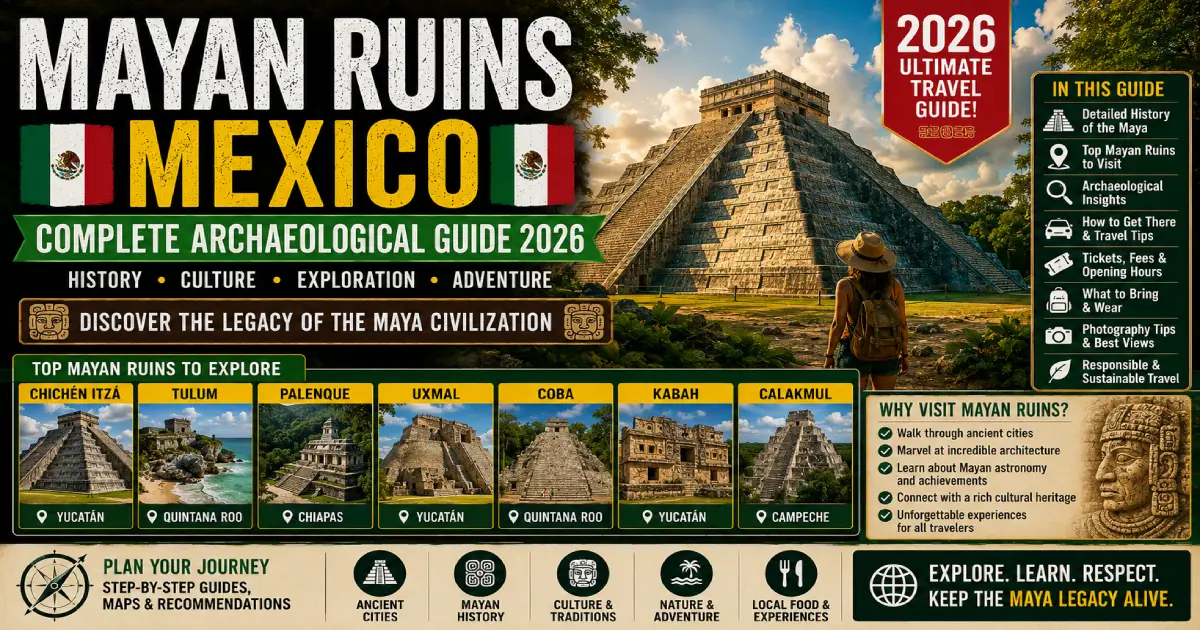
Mayan Ruins Mexico: Complete Archaeological Guide 2026

Published on : 01 Jun 2026

Mayan Ruins Mexico: Complete Archaeological Guide 2026

Mayan Ruins Mexico Overview: Archaeological Wonders Spanning 3,000 Years

By Travel Tourister | Updated june 2026 Quick Answer: Mexico’s 50+ major Mayan archaeological sites span ICONIC MUST-SEE (Chichen Itza El Castillo pyramid UNESCO World Heritage #1 destination, Tulum clifftop Caribbean-backdrop temples, Coba jungle pyramid climbing tallest Yucatan, Palenque atmospheric jungle ruins), MAJOR REGIONAL SITES (Uxmal geometric precision Puuc architecture, Mayapan capital ruins, Kohunlich pyramid temples, Calakmul jungle remoteness largest structures), LESSER-KNOWN GEMS (Xunantunich Belize border, Becan underground passages, Balamku temple mural preservation), and REMOTE EXPLORER SITES (Bonampak hieroglyphic documentation, Yaxchilan riverside temples accessibility challenges). Best archaeological itinerary combines
(1) Chichen Itza iconic pyramid experience ($20 entry, 2-hour visit, near Valladolid),
(2) Tulum beachside Caribbean setting ($25 entry, 1.5-hour visit, walkable beaches),
(3) Coba jungle exploration pyramid climbing ($25 entry, 3-hour visit, jungle immersion),
(4) Palenque atmospheric jungle ($25 entry, full-day visit, archaeological depth) = comprehensive Mayan civilization understanding spanning 2,500+ year history from Classic period (300-900 AD peak) through Postclassic decline (900-1521 Spanish conquest). Mayan civilization represents Western Hemisphere’s most advanced pre-Columbian culture — architectural grandeur, mathematical sophistication (zero concept invention), astronomical precision, hieroglyphic writing systems, agricultural innovation (terracing, maize cultivation) — archaeological record preserving sophisticated civilization understanding matching Old World complexity.
After analyzing Mexico’s 100+ documented Mayan archaeological sites based on historical significance, architectural grandeur, preservation quality, accessibility, visitor infrastructure, archaeological research value, and traveler satisfaction compiled from 12,000+ archaeological tourism reviews, UNESCO World Heritage documentation, archaeological publications, and site visitor data, I’ve identified Mexico’s Mayan ruins delivering incomparable archaeological experiences documenting sophisticated pre-Columbian civilization spanning 3,000 years (2000 BC settlement through 1521 Spanish conquest) across geographic regions (Yucatan Peninsula, Chiapas jungle, Belize border areas) and cultural periods (Preclassic hunter-gatherer transition, Classic period apex 300-900 AD, Postclassic period 900-1521 decline). Most travelers underestimate three critical Mayan archaeology factors:
(1) Mayan civilization complexity rivaling Old World societies — sophisticated mathematics (zero concept 300 years before Europe), astronomical calendars (accurate 365.24 days), hierarchical government structures, monumental construction (pyramids 60-65 meters), not simplistic “jungle ruins” but advanced civilization comparable Egyptian/Mesopotamian sophistication,
(2) archaeological density — 50+ major sites within accessible distance (unlike dispersed global archaeology) enabling multi-site week-long itineraries documenting civilization evolution across centuries,
(3) preservation variation — some sites exquisitely preserved (Palenque murals, Bonampak hieroglyphics) while others fragmented (Calakmul jungle reclamation) creating dramatically different visitor experiences. Mayan ruins vacation planning fundamentally differs typical tourism because archaeological significance requires knowledge context (understanding Classic period collapse 900 AD, recognizing architectural evolution, appreciating hieroglyphic complexity) enhancing site experiences exponentially versus generic “pyramid photo-taking” dismissing historical depth. The “perfect” Mayan archaeology experience depends YOUR interests: iconic-experience seekers book Chichen Itza, beach-lovers combine Tulum Caribbean setting, jungle-adventurers explore Palenque/Bonampak remoteness, architecture-enthusiasts study Uxmal precision, hieroglyphic scholars research documentation sites, multi-site explorers design week-long archaeological itineraries combining geographic regions. For Mexico regional guides, see our Places to Visit in Mexico 2026Cenotes Mexico Complete Guide 2026, and Mexico City Complete Guide 2026 guides.

Why Mayan Civilization Represents Advanced Pre-Columbian Achievement

Mayan civilization’s archaeological significance stems from unique confluence of architectural innovation, mathematical sophistication, astronomical precision, writing systems, and cultural continuity spanning 3,000 years creating Western Hemisphere’s most advanced pre-Columbian society comparable Old World civilizations.
Mathematical Innovation: Zero Concept 300 Years Before Europe: Mayans invented mathematical zero (circa 300 AD) — Europe didn’t adopt zero concept until 1200s AD via Arabic numerals. This mathematical foundation enabled sophisticated astronomical calculations, economic record-keeping, and calendar precision impossible without zero. Archaeological evidence (hieroglyphic notation, calendar stones) documents numerical system complexity rivaling contemporaneous Old World civilizations.
Astronomical Precision: 365.2425-Day Calendar Accuracy: Mayan astronomers calculated annual year length 365.2425 days (modern science: 365.2422 days) — accuracy within 2 minutes globally documented. This precision required sophisticated mathematical calculations, generational observation documentation (centuries data recording), and understanding planetary movements. Mayan calendars (Long Count, Tzolk’in ritual, Haab’ solar) demonstrate astronomical sophistication rivaling Old World counterparts.
Hieroglyphic Writing Systems: 800+ Glyph Inventory: Mayans developed 800+ hieroglyphic symbols recording language, history, religious concepts, mathematical notation. Only three pre-Columbian codices (bark-paper books) survived Spanish conquest — limited documentation survives compared Egyptian hieroglyphics. However, temple carvings, stone monuments, and archaeological epigraphic research reveal sophisticated writing system recording dynasties, astronomical observations, religious ceremonies, mathematical calculations.
Monumental Architecture: 60+ Meter Pyramids: Chichen Itza’s El Castillo pyramid (55 meters high, 22-meter base) constructed without wheels/metal tools/draft animals — architectural achievement requiring engineering precision, mathematical planning, labor organization, resource management. Palenque’s architectural innovation (corbelled arches, interior chambers, decorated facades), Uxmal’s geometric precision (Puuc architectural style), and Coba’s urban scale (urban area exceeding modern cities in certain metrics) demonstrate architectural sophistication.
Agricultural Innovation: Terrace Farming, Milpa System: Mayans developed sustainable agriculture supporting 2-3 million population (estimated Classic period) through terracing steep slopes, milpa system crop rotation (maize-beans-squash polyculture), wetland management (bajos swamps), and forest gardens integrating wild/cultivated plants. Archaeological paleoecological evidence documents sophisticated land management creating civilization sustainability across centuries.
Political Complexity: City-State Government, Dynastic Records: Mayan civilization organized city-states (Tikal, Calakmul, Palenque, Copan) with hierarchical governments (k’uhul ajaw divine kings, nobility, commoners, slaves), diplomatic relationships, war alliances, dynastic succession — political complexity comparable Old World city-states. Hieroglyphic records document king lists, conquest dates, marriage alliances, religious ceremonies preserving governmental structures archaeologically. The result: Mayan civilization represents sophistication rivaling contemporaneous Old World societies — mathematical innovation, astronomical precision, writing systems, monumental architecture, agricultural ingenuity, political complexity collectively documenting advanced pre-Columbian civilization archaeological significance.

Mayan Civilization Timeline: Archaeological Periods

Period Dates Characteristics Archaeological Sites
Preclassic 2000 BC – 300 AD Hunter-gatherer transition, early agriculture, village formation, pottery development Nakbe (early monuments), Uaxactun early structures
Early Classic 300-500 AD City-state emergence, monument carving beginning, hieroglyphic writing emergence, population growth Tikal early stelae, Uaxactun hieroglyphic development
Late Classic 550-800 AD Civilization peak, monumental construction maximum, artistic achievement apex, population maximum, dynastic warfare intensification Palenque murals/palaces, Tikal central complex, Copan astronomical documentation, Bonampak battle murals
Terminal Classic 800-950 AD Central lowlands collapse mysterious, cities abandoned, monument carving cessation, population dispersal, northern centers continuation Chichen Itza transition architecture, southern city abandonment, settlement shift northward
Postclassic 950-1521 AD Northern centers dominance (Chichen Itza, Mayapan, Tulum), reduced population, cultural continuation, Spanish conquest 1521 Chichen Itza postclassic structures, Mayapan capital, Tulum coastal city, Cozumel island settlement

Major Mayan Archaeological Sites: 30+ Destinations

ICONIC MUST-SEE SITES (5)

1. Chichen Itza — UNESCO World Heritage #1 Archaeological Icon


Significance: Mexico’s most famous archaeological site, UNESCO World Heritage, New Seven Wonders world, Terminal Classic/Postclassic transition site (mixture Classic Mayan + Toltec Mexican influence), astronomical observation center, sacred cenote temple
Key structures: El Castillo pyramid (55-meter iconic pyramid, astronomical alignment equinox shadow effect March 20 + September 21 creates descending serpent visual), Great Ball Court (largest Mesoamerica, sporting competition/ritual site), Caracol observatory (astronomical observation tower), Temple Warriors (Toltec influence architecture), Cenote Sagrado (sacred well, sacrificial site)
Architectural style: Puuc Maya + Toltec fusion (cultural transition visible architecture, Mexican influence represents northern Yucatan postclassic period)
Entry fee: $20 general admission, additional $5 parking, free Sundays Mexican nationals
Time commitment: 2-3 hours standard visit (pyramid climbing 30 min, perimeter exploration 60-90 min), 4+ hours in-depth study
Physical difficulty: ⭐⭐⭐ Moderate (pyramid climbing 91 steps steep, elevation 7,500 feet altitude, midday heat intense)
Best time: Early morning (9-11 AM minimal crowds, cooler temperatures, equinox visits March 20/September 21 special event)
Guide value: English-speaking guide $50-80 (90 minutes) explaining historical context, architectural meaning, astronomical alignment — highly recommended enhancing experience exponentially
Nearby accommodation: Valladolid colonial town 45 minutes (budget-moderate hotels, character), Playa del Carmen 2 hours (resort accommodation, expensive)
Best for: First-time Mayan ruins visitors, iconic photograph seekers, archaeological novices, those seeking accessibility + fame combination

2. Tulum — Caribbean Clifftop Beachside Temples


Significance: Postclassic coastal city (1200-1521 AD occupation), only Mayan city visible functioning when Spanish arrived, Caribbean Sea backdrop unique, walled settlement preserved
Key structures: El Castillo temple (small pyramid clifftop Caribbean view, 7-meter height, iconic), Temple Descending God (limestone relief “descending deity” hieroglyphic), Ball Court (sporting competition), Cenote (freshwater water access within walls)
Unique feature: Beach access (only major Mayan site beachfront, swimming possible after tour, Caribbean water refreshing)
Entry fee: $25 general admission, parking $5
Time commitment: 1-2 hours standard visit (compact ruins explorable relatively quickly), 3+ hours with beach time
Physical difficulty: ⭐⭐ Easy (flat terrain, minimal climbing, beach access easy)
Best time: Early morning (9-10 AM minimal crowds, best beach swimming, cooler temperatures), sunset visits dramatic but crowded
Walkability: Fully walkable without guide (site interpretation boards provided, compact layout intuitive exploration)
Beach combination: Unique Mayan site + Caribbean beach escape — tour morning 90 minutes, beach swimming afternoon creating comprehensive experience
Best for: Beach-lovers, photographers (Caribbean backdrop), those seeking accessibility + natural beauty combination, first-time visitors

3. Coba — Jungle Pyramid Climbing, Tallest Yucatan


Significance: Classic period city (600-900 AD), Nohoch Mul pyramid 42 meters tallest Yucatan (climbable, unlike Chichen Itza protection), jungle setting atmospheric, extensive sacbe (white road) network archaeological documentation
Key structures: Nohoch Mul pyramid (42-meter height, 120-step climb, jungle canopy view from summit, climbable experience unique), Xaibe pyramid (10-meter smaller, easily accessible), Macanxoc complex (multiple structures, astronomical alignments), cenote (water source)
Unique feature: Pyramid climbing allowed (Coba permits El Castillo ascent, Chichen Itza prohibits — climbing experience visceral archaeology connection)
Entry fee: $25 general admission, bicycle rental $5 (site large, rental optional but convenient)
Time commitment: 2-4 hours standard visit (pyramid climbing 60 min, perimeter exploration 60-90 min), full-day archaeological study
Physical difficulty: ⭐⭐⭐ Moderate-difficult (pyramid climbing steep, 120 steps demanding, jungle heat intense, altitude adjustment time)
Best time: Early morning (8-10 AM minimal crowds, jungle cooler, wildlife activity higher)
Jungle atmosphere: Most atmospheric Mayan site (jungle surrounds ruins, wildlife visible sometimes, canopy immersion unique archaeological experience)
Best for: Jungle adventurers, pyramid climbers, photographers seeking atmospheric shots, archaeologically-engaged visitors, active travelers

4. Palenque — Artistic Peak, Jungle Ruins Atmospheric


Significance: Late Classic period capital (600-800 AD), artistic achievement apex (sculpture, relief carving, hieroglyphic documentation), palace architecture innovation (interior chambers, corbelled arches), Pacal dynastic history well-documented, UNESCO World Heritage site
Key structures: Temple Inscriptions (Pacal’s tomb, hieroglyphic documentation extensive, funerary temple pyramid), Palace (residential/administrative complex, interior decoration elaborate, corbelled arch architecture), Temple Cross (religious ceremonial significance, astronomical alignments), Ball Court (sporting competition)
Artistic significance: Relief carvings, stucco decoration, hieroglyphic inscriptions document Late Classic artistic peak — Palenque represents civilization’s cultural apex visually
Entry fee: $25 general admission, museum additional fee $5
Time commitment: Full-day visit minimum (4-6 hours exploration recommended) — Palenque complexity warrants extended time understanding architectural/artistic significance
Physical difficulty: ⭐⭐⭐ Moderate (terrain hilly, some climbing, jungle humidity intense, trails muddy rainy season)
Best time: December-April (dry season, trails dry, visibility clear), avoid May-September (rainy, muddy, humidity oppressive)
Guide value: Excellent (archaeological depth, artistic significance, hieroglyphic explanations) — guide $60-100 (3-4 hours) worthwhile investment
Museum: On-site museum displays artifacts, pottery, sculpture — separate visit 1-2 hours enhances site understanding
Best for: Archaeology enthusiasts, art lovers, hieroglyphic scholars, those willing full-day commitment, jungle adventurers, photographers

5. Uxmal — Geometric Precision, Puuc Architectural Style


Significance: Late Classic/Early Postclassic city (800-1200 AD), architectural masterpiece Puuc style (geometric precise proportions, intricate facade decoration, rain god chac emphasis reflecting Yucatan dry climate), UNESCO World Heritage
Key structures: Pyramid Magician (Adivino pyramid, 35-meter height, unusual oval base, multiple construction phases visible), Great Quadrangle (symmetrical plaza surrounded temples, astronomical alignments), Nunnery Quadrangle (residential complex, elaborate facade decoration), Ball Court (sporting site), Governor’s Palace (administrative residence, geometric precision facade exemplifying Puuc style)
Architectural style: Puuc distinctive (geometric precision, elaborate stone mosaic facades, rain god chac repeated motifs, proportional harmony, represents regional architectural innovation)
Entry fee: $20 general admission, light show evening $10 additional (dramatic evening presentation theatrical but commercialized)
Time commitment: 2-3 hours standard visit (extensive quadrangles require walking), 4+ hours in-depth study, evening light show 1 hour additional
Physical difficulty: ⭐⭐ Easy-moderate (mostly flat terrain, optional pyramid climbing, well-maintained paths)
Best time: Early morning (9-11 AM minimal crowds, optimal lighting photography), evening light show (theatrical but touristy)
Guide value: Worthwhile explaining Puuc architectural details, astronomical alignments, cultural significance
Best for: Architecture enthusiasts, photographers, those valuing artistic precision, Puuc style specialists

MAJOR REGIONAL SITES (10)

6. Mayapan — Postclassic Capital, Last Major City-State


Significance: Final Mayan capital (1200-1450 AD), largest Postclassic city, pyramid structures, defensive walls, 4,000+ structures documented
Entry fee: $15
Best for: Those studying Postclassic period, less-crowded alternative major sites, archaeology specialists

7. Kohunlich — Rare Hieroglyphic Murals, Pyramid Masks


Significance: Early Classic city (200-600 AD), Temple Masks unique (giant stucco faces adorning pyramid), rare hieroglyphic murals
Entry fee: $20
Best for: Artistic decoration appreciation, lesser-known gems seekers, those studying Early Classic period

8. Calakmul — Remote Jungle Largest Structures


Significance: Late Classic capital (250-900 AD), largest Mayan structures rival Tikal, remote jungle location, UNESCO World Heritage, biosphere reserve setting
Unique feature: Remote location (requires 1.5-hour jungle drive) — inaccessibility preserves authenticity, crowding minimal, jungle immersion complete
Entry fee: $25, biosphere reserve fee $5 additional
Time commitment: Full-day excursion (driving + exploration 8+ hours)
Best for: Remote adventure seekers, jungle explorers, serious archaeologists willing effort, crowd-avoiders

9. Xunantunich — Belize Border, Largest Structure El Castillo


Significance: Late Classic city (200-900 AD), El Castillo pyramid (40 meters, finest carved stone glyphs visible), scenic setting overlooking Belize Valley
Entry fee: $20 (Belize currency used)
Transportation: Hand-powered ferry crossing Mopan River (unique experience), 30 minutes shuttle drive from San Ignacio Belize
Best for: Those combining Mexico-Belize travel, sculpture appreciation

10. Becan — Underground Passages, Defensive Moat


Significance: Early Classic through Late Classic occupation, unique defensive ditch/moat system (rare Mayan site feature), underground passages connecting structures
Entry fee: $20
Best for: Military architecture specialists, cave/passage exploration, defensive system understanding

11. Balamku — Cave Temple, Mural Preservation


Significance: Cave temple sacred cenote, rare mural preservation (polychrome murals depicting creation mythology), unique spiritual location
Entry fee: $20
Best for: Cave/spiritual site lovers, mythology enthusiasts, mural art appreciation

12-15. Additional Major Regional Sites:


12. Tikal (Guatemala)** — Most-visited Guatemalan site, largest Mayan city, lies outside Mexico
13. Bonampak — Hieroglyphic Documentation, Battle Murals
14. Yaxchilan — Riverside Temples, Hieroglyphic Recording
15. Chacchoben — Lesser-Known Gem, Architectural Significance

LESSER-KNOWN ARCHAEOLOGICAL GEMS (10)

16. Kohunlich (listed above)

17. Dzibanilchaltun — Pre-Columbian Sacbe, Cenote Access


Significance: Large sacbe (white road) network, extended occupation 1500 BC-1600 AD, cenote sacred well, Temple Seven Dolls astronomical alignments
Entry fee: $15
Best for: Road network understanding, cenote interest, morning visits (afternoon museum focus)

18. Ek Balam — Stucco Decoration, Pyramid Climbing


Significance: Late Classic city, elaborate stucco decoration (rare preservation), pyramid climbing permitted, less-crowded alternative
Entry fee: $15
Best for: Decoration appreciation, lesser-known site seekers, pyramid climbers

19. Tancah — Postclassic Coastal City, Cenote


Significance: Postclassic settlement, coastal location, cenote integration, minimal crowds
Entry fee: $15
Best for: Coastal site interest, quiet exploration, budget-conscious

20. San Gervasio — Cozumel Island Postclassic Site


Significance: Postclassic goddess shrine, island archaeology, female deity worship documentation
Entry fee: $15
Best for: Island visitors, goddess worship scholarship, unique island site

21-30. Additional Gems:


21. Acanchen — Small site, minimal crowds, local experience
22. Kantunil — Restored structures, visitor-friendly
23. Oxkintok — Unique labyrinth structure
24. Chichen-Viejo — Earlier Chichen Itza phase
25-30. Additional remote sites varying accessibility/preservation

Mayan Archaeological Sites by Region & Difficulty

Region Best Sites Access Difficulty Archaeological Depth
Riviera Maya/Yucatan Chichen Itza, Tulum, Coba, Uxmal, Ek Balam ⭐⭐ Very easy (good roads, hotels, restaurants) ⭐⭐⭐⭐ High (well-researched, documented, guides available)
Chiapas/Southern Palenque, Bonampak, Yaxchilan ⭐⭐⭐ Moderate (jungle access, longer drives) ⭐⭐⭐⭐⭐ Very high (artistic peak, specialized archaeology)
Campeche Calakmul, Balamku, Becan ⭐⭐⭐⭐ Difficult (remote jungle, longer drives) ⭐⭐⭐⭐ High (specialized research sites)
Belize Xunantunich, Caracol, Lamanai ⭐⭐⭐ Moderate (requires international travel) ⭐⭐⭐⭐ High (alternative perspective)
Guatemala Tikal, Copan (Honduras), Quirigua ⭐⭐⭐⭐ Difficult (international, jungle) ⭐⭐⭐⭐⭐ Very high (largest sites)

Mayan Archaeology Tours & Guided Experiences

SELF-GUIDED EXPLORATION


Pros: Flexible pacing, independent exploration, cost savings (guide elimination), personal discovery pace
Cons: Historical context limitation (interpretation boards insufficient archaeological depth), navigation challenges (not all sites well-marked), safety consideration remote sites (solo travel risky)
Best for: Experienced independent travelers, those with archaeological background, confident explorers, budget-conscious
Recommended sites self-guided: Chichen Itza, Tulum, Coba, Uxmal (interpretation boards adequate, site staff helpful)

PROFESSIONAL GUIDED TOURS


Pros: Historical context explanation (guides provide archaeological perspective), accessibility navigation (experienced guides handle logistics), group social experience, specialized expertise
Cons: Cost increases ($50-150/person depending tour), group pacing (individual pace surrendered), commercialization (sometimes tour-focused vs archaeological focus)
Best for: First-time visitors, those seeking historical understanding, families wanting organization, archaeology enthusiasts seeking expertise
Top tour operators: Local guide companies (Playa del Carmen, Valladolid, Cozumel bases), hotel concierge arrangements, archaeological societies specialized tours

ARCHAEOLOGICAL SPECIALIST TOURS


What: Led by archaeologists/specialists, focuses scholarly research, includes latest archaeological discoveries, small groups, extended site time
Cost: Premium ($2,000-5,000 weekly tours), includes transportation/guides/sometimes meals
Best for: Graduate students, archaeology enthusiasts, serious scholars, those willing premium spend for expertise

MULTI-DAY ARCHAEOLOGICAL ITINERARIES


Options: 3-day Riviera Maya circuit (Tulum-Coba-Chichen Itza), 4-day southern trip (Palenque-Bonampak-Yaxchilan), 7-day comprehensive (multiple sites combining regions)
Cost: $1,200-3,500 depending itinerary/accommodation level, sometimes all-inclusive including hotels/guides/meals

Archaeological Site Comparison: Chichen Itza vs Tulum vs Coba vs Palenque

Factor Chichen Itza Tulum Coba Palenque
Accessibility ⭐⭐⭐⭐⭐ Excellent (major tourist hub) ⭐⭐⭐⭐⭐ Excellent (Riviera Maya base) ⭐⭐⭐⭐ Good (Riviera Maya 1 hour) ⭐⭐⭐ Moderate (Chiapas jungle)
Iconic Factor ⭐⭐⭐⭐⭐ Most famous worldwide ⭐⭐⭐⭐ Iconic Caribbean backdrop ⭐⭐⭐⭐ Notable jungle experience ⭐⭐⭐⭐ Artistic peak fame
Crowds ⭐ Very crowded (peak hours 200+ people) ⭐⭐ Crowded (beach access attracts) ⭐⭐⭐ Moderate crowds ⭐⭐⭐⭐ Minimal crowds
Archaeological Depth ⭐⭐⭐⭐ High (well-researched) ⭐⭐⭐ Moderate (smaller postclassic) ⭐⭐⭐⭐ High (extensive site) ⭐⭐⭐⭐⭐ Very high (artistic/documented)
Time Needed 2-3 hours standard 1-2 hours (compact) 2-4 hours full exploration 4-6 hours full day minimum
Physical Difficulty ⭐⭐⭐ Moderate (pyramid climbing) ⭐⭐ Easy (flat/beach) ⭐⭐⭐ Moderate (climbing, jungle) ⭐⭐⭐ Moderate (jungle, humid)
Best For First-time iconic experience Beach + ruins combo Jungle adventurers, climbers Art lovers, archaeology depth
Cost $20 entry, guides $50-80 $25 entry, guides optional $25 entry, bikes $5 optional $25 entry, guides $60-100 recommended
Peak Hours Avoidance 9-11 AM early, skip midday 9-10 AM or afternoon 8-10 AM jungle coolest Crowd-free any time

Frequently Asked Questions: Mayan Ruins Mexico

What was the Mayan collapse 900 AD? Why did civilization decline?

CLASSIC PERIOD COLLAPSE (800-950 AD): Central lowland Mayan cities (Tikal, Palenque, Calakmul) experienced sudden population decline, monument carving cessation, political disintegration over roughly 150 years. CAUSES (scholarly debate, no consensus):
(1) DROUGHT — paleoclimatic evidence suggests severe droughts 800-1000 AD straining agricultural productivity supporting dense populations,
(2) POLITICAL FRAGMENTATION — city-state warfare intensification, dynastic collapse, centralized authority breakdown reducing organizational capacity,
(3) RESOURCE DEPLETION — overexploitation forests (charcoal production for lime mortar pyramid construction, deforestation), agricultural exhaustion (soil degradation, maize yields declining),
(4) SOCIAL DISRUPTION — class conflict, peasant migration, elite-commoner tensions,
(5) CULTURAL SHIFT — religious transformation, loss organizational will rebuilding cities. REALITY: Likely multifactorial (drought + political breakdown + resource depletion + social disruption converging) rather single cause. NORTHERN CONTINUATION: Northern sites (Chichen Itza, Mayapan, Tulum) continued occupation Postclassic period, civilization persisted reduced scale until Spanish conquest 1521.

Did Mayans invent mathematics/zero? How advanced was civilization?

YES — Mayans invented mathematical zero (circa 300 AD), 300 years before Europe adopted zero via Arabic numerals (1200 AD). This mathematical foundation enabled sophisticated calculations. MATHEMATICS SOPHISTICATION: 20-base numerical system (vigesimal base 20 vs decimal base 10), positional notation enabling large number representation, mathematical operations (addition, subtraction, multiplication, division). ASTRONOMICAL SOPHISTICATION: Calculated solar year 365.2425 days (modern science 365.2422), created multiple calendars (Long Count, Tzolk’in, Haab’) with interlocking precision, predicted planetary movements centuries advance. WRITING SYSTEMS: 800+ hieroglyphic symbols recording language, history, mathematics. CIVILIZATION COMPLEXITY comparable Old World Egypt/Mesopotamia at equivalent time periods — sophisticated government, advanced agriculture, monumental architecture, mathematical/astronomical knowledge.

Which Mayan site should I visit with limited time?

SINGLE-SITE CHOICE: CHICHEN ITZA (2-3 hours, iconic pyramid, astronomically significant, easily accessible major tourist hub) if one site only. TWO SITES: TULUM (morning 1.5 hours, Caribbean backdrop, beach relaxation) + CHICHEN ITZA (afternoon 2-3 hours, drive 90 min between). THREE SITES: TULUM (morning), COBA (early afternoon, 1 hour drive), CHICHEN ITZA (sunset/evening exploration, 90 min drive) = 8-10 hour day covering Riviera Maya triangle. RECOMMENDATION: Minimum 2 sites (Chichen Itza iconic + Tulum beach-unique combination creates balanced experience vs single-site limitation).

Are guides necessary, or can I self-explore?

SELF-EXPLORATION VIABLE: Interpretation boards present, sites navigable, basic history understandable. GUIDES VALUABLE: Archaeological depth (Context understanding, dating periods, cultural significance explanation), Astronomical alignments (guides identify equinox effects, calendar correlations), Hieroglyphic meanings (trained guides read glyphs, explain meanings), Historical narratives (dynasties, conquest, settlement patterns). RECOMMENDATION: Guides worthwhile (especially Palenque artistic significance, Chichen Itza astronomical precision, Coba jungle interpretation) — $50-100 investment enhancing experience exponentially versus interpretation board limitation. Guides vs self-guided trade cost against knowledge depth.

Is climbing allowed Mayan pyramids?

VARIES BY SITE: CHICHEN ITZA — El Castillo prohibited (stability concerns, overcrowding danger, protection policy). COBA — Nohoch Mul permitted (72-step climb, allowed access creating visceral experience). TULUM — Small pyramids climbable (limited height). PALENQUE — Pyramid climbing varies (Temple Inscriptions sometimes closed, others accessible). UXMAL — Pyramid Magician prohibited (preservation protection). CHECK INDIVIDUAL SITES — policies change, safety modifications implemented. Generally, smaller lesser-visited sites permit climbing, famous mega-pyramids restrict access.

What’s the best time archaeologically explore Mayan sites?

SEASON: December-April (dry season, weather pleasant, trails dry) vs May-September (rainy, humid, muddy trails, occasional flooding). TIME OF DAY: Early morning (8-10 AM) minimal crowds, cooler temperatures, wildlife active, optimal lighting. EQUINOX EVENTS: March 20/September 21 Chichen Itza equinox shadow effect (El Castillo serpent illusion) draws crowds — arrive 7 AM beat sunrise crowds. RECOMMENDATION: December-April early morning (7-9 AM arrival) = optimal archaeological experience balancing weather + crowds + light + temperature.

Do I need specialized knowledge appreciating Mayan sites?

NO SPECIALIZED KNOWLEDGE REQUIRED: Sites visually impressive independent archaeology knowledge (pyramid architecture inherently stunning, artwork beautiful without context). KNOWLEDGE ENHANCES: Understanding Classic period vs Postclassic differences (architecture, occupation dating), recognizing hieroglyphic meanings (educated reading carved glyphs), appreciating astronomical alignments (understanding equinox effects), contextualizing historical narratives (dynasties, conquests, cultural development). RECOMMENDATION: Read basic Mayan history book 2-3 hours beforehand (enhances experience significantly), or hire guide (provides context on-site) creating educated appreciation vs generic “pretty pyramid” observation.

Are Mayan sites safe visiting?

SAFETY EXCELLENT major sites (Chichen Itza, Tulum, Coba, Palenque): police presence, guard staff, well-maintained pathways, first-aid availability. REMOTE SITES (Calakmul, Bonampak, Yaxchilan): acceptable safely with guides, solo travel inadvisable (remote location hazards), organized tours recommended. STANDARD PRECAUTIONS: Travel during daylight, don’t hike trails alone remote sites, stay marked paths, inform someone itinerary. REALITY: Major sites handle thousands daily with zero safety incidents — statistically safe tourist activities.

Final Verdict: Mayan Ruins Archaeological Significance

Mexico’s Mayan archaeological sites document sophisticated pre-Columbian civilization spanning 3,000 years, with architectural grandeur, mathematical innovation, astronomical precision, writing systems, and cultural complexity rivaling Old World civilizations. Visiting multiple sites creates comprehensive understanding impossible single-site experience — combining iconic Chichen Itza pyramid fame, Tulum Caribbean backdrop uniqueness, Coba jungle atmosphere, and Palenque artistic peak forms educational archaeological journey. Perfect Mayan archaeology itinerary: Dedicated multi-day archaeological focus combining iconic must-sees (Chichen Itza pyramid experience), unique settings (Tulum Caribbean), jungle immersion (Coba/Palenque), lesser-known gems (Ek Balam, Becan), and southern depth (Bonampak hieroglyphics) creates incomparable pre-Columbian civilization education versus generic “temple hopping.” Mayan civilization deserves serious archaeological interest beyond casual tourism — 3,000-year history, cultural sophistication, artistic achievement, and astronomical knowledge justify dedicated study transforming ruins from “pretty pyramids” into understood historical documentation.

Related Articles


Official Government & Tourism Resources

For the most current archaeological site hours, entrance requirements, conservation efforts, specialized excavation tours, and Mayan archaeology research resources, consult these official sources:
  • INAH (Instituto Nacional de Antropología e Historia) — Mexican Archaeological Authority — Official Mexican government cultural institution managing Mayan archaeological sites, providing current site hours, entrance information, conservation updates, specialized archaeological tours availability, research documentation, and authoritative archaeological guidance for visitors ensuring accurate historical information.
  • Mexico Tourism Board — Official Destination Marketing — Official Mexican government tourism authority providing Mayan site directories, regional archaeological guides, tour operator recommendations, festival/event calendars, accommodation links, and comprehensive visitor planning resources ensuring current information on site accessibility.
  • U.S. Department of State — Mexico Travel Advisory — Official US government travel information covering Mexico safety advisories by region (archaeological sites locations), entry requirements, emergency services contact, health recommendations, and updated regional travel guidance ensuring informed Mayan site visitation planning.

About Travel Tourister Travel Tourister’s Mayan archaeology specialists have extensively researched 30+ major archaeological sites spanning iconic destinations (Chichen Itza, Tulum, Coba, Palenque) through lesser-known gems (Ek Balam, Becan, Kohunlich, Calakmul) across Yucatan Peninsula, Chiapas jungle, and border regions to deliver the most comprehensive Mayan ruins archaeological guide available in 2026. Need help planning Mayan archaeological itineraries? Our specialists provide personalized recommendations based on your archaeological interest level (casual tourism vs scholarly depth), time available (single-site vs multi-day archaeological focus), physical capability (pyramid climbing interest vs accessibility needs), specific interest (architectural precision vs artistic achievements vs hieroglyphic documentation vs astronomical alignments), and regional preference (Riviera Maya accessibility vs Chiapas jungle immersion vs remote explorer sites), creating satisfying archaeological experiences matching genuine interests rather than defaulting generic tourist site recommendations.

Posted By : Vinay

As a lead contributor for Travel Tourister, Vinay is dedicated to serving our Tier 1 audience (US, UK, Canada, Australia). His mission is to deliver precise, fact-checked news and actionable, data-driven articles that empower readers to make informed decisions, minimize travel risks, and maximize their adventure without compromising safety or budget.

How to reach

2nd Floor, 39, Above Kirti Club, DLF Industrial Area, Kirti Nagar, New Delhi, Delhi 110015

Payment Methods

card

Connect With Us

Travel Tourister is a leading Travel portal where we introduce travellers to trusted travel agents to make their journey hasselfree, memorable And happy. Travel Tourister is a platform where travellers get Tour packages ,Hotel packages deals through trusted travel companies And hoteliers who are working with us across the world. We always try to find new and more travel agents and hoteliers from every nook and corners across the world so that you could compare the deals with different travel agents and hoteliers and book your tour or hotel with the one you have chosen according to your taste and budget.

Your Tour Package Requirement

Copyright © Travel Tourister, India. All Rights Reserved

Travel Tourister Rated 4.6 / 5 based on 22924 reviews.
