Published on : 30 Sep 2026
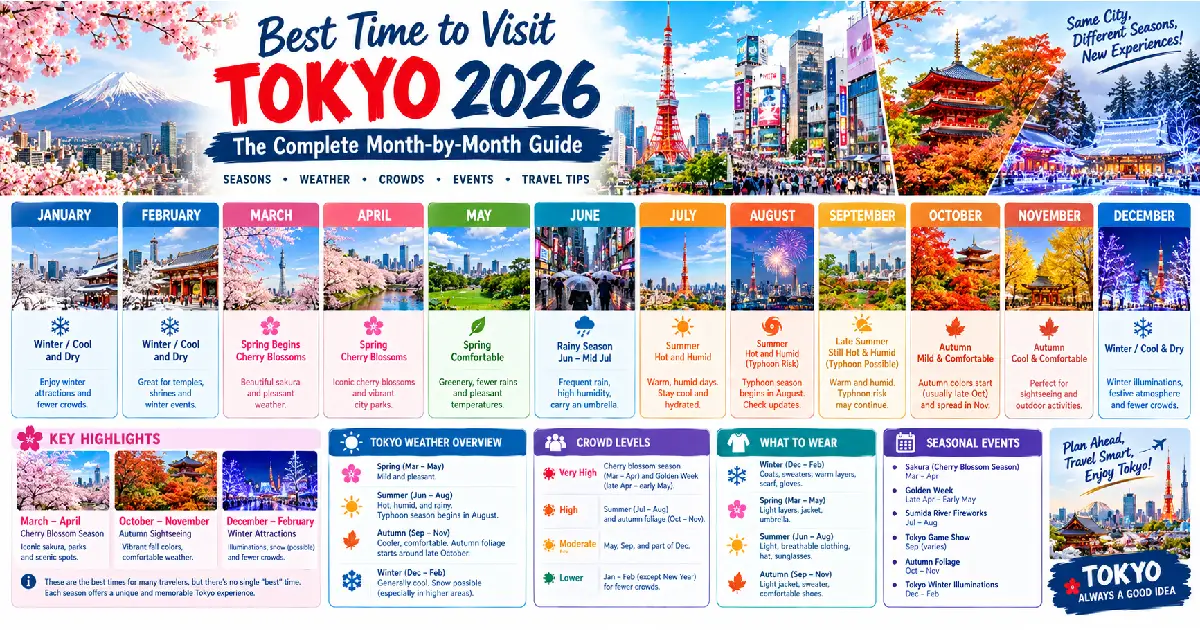
The best time to visit Tokyo is late March to early April (cherry blossoms) or October to November (autumn foliage) — Tokyo’s two shoulder seasons, offering the city’s most comfortable temperatures alongside its most visually striking natural moments. Both windows come with the highest crowds and prices of the year, so a visitor prioritizing value and comfort over blossoms or foliage specifically should look instead to late April–May or early-to-mid autumn (September–early October), which retain good weather with noticeably thinner crowds. Tokyo genuinely has no bad time to visit — even the humid summer and cold winter each have real, specific reasons to go — but this guide breaks down exactly what to expect month by month so you can match your trip to what actually matters to you: weather comfort, cherry blossoms, budget, or fewer crowds.
| Season | Months | Avg. Temp | Crowd Level | Price Level | Highlight |
|---|---|---|---|---|---|
| Spring | March–May | 10–20°C (50–68°F) | Highest (Mar–Apr) | Highest (Mar–Apr) | Cherry blossoms |
| Summer | June–August | 24–31°C (75–88°F), humid | Moderate | Moderate–High | Fireworks festivals, Obon |
| Autumn | September–November | 15–24°C (59–75°F) | High (Nov) | High (Nov) | Autumn foliage, comfortable weather |
| Winter | December–February | 3–10°C (37–50°F), dry | Low | Lowest | Illuminations, thin crowds, clear Fuji views |
| Month | Avg. High/Low | Rainfall | What’s Happening |
|---|---|---|---|
| January | 10°C / 2°C (50°F / 36°F) | Low | New Year traditions, clearest skies of the year, lowest prices |
| February | 10°C / 2°C (50°F / 36°F) | Low | Plum blossoms, still cold but dry and quiet |
| March | 14°C / 6°C (57°F / 43°F) | Moderate | Cherry blossoms begin late month; crowds start rising |
| April | 19°C / 11°C (66°F / 52°F) | Moderate | Cherry blossom peak (early April); Golden Week approaches (late April) |
| May | 23°C / 15°C (73°F / 59°F) | Moderate | Comfortable, greener; Golden Week (early May) still busy |
| June | 26°C / 19°C (79°F / 66°F) | High (rainy season) | Tsuyu rainy season; humid, fewer tourists |
| July | 30°C / 23°C (86°F / 73°F) | Moderate (rainy season ends) | Hot and humid; Sumida River Fireworks Festival |
| August | 31°C / 24°C (88°F / 75°F) | Moderate | Peak heat; Obon holiday (mid-month, domestic travel surge) |
| September | 27°C / 21°C (81°F / 70°F) | High (typhoon season) | Still warm; typhoon risk peaks; early autumn events |
| October | 22°C / 16°C (72°F / 61°F) | Moderate | Comfortable, clear; foliage begins late month |
| November | 17°C / 10°C (63°F / 50°F) | Low | Peak autumn foliage; illuminations begin |
| December | 12°C / 5°C (54°F / 41°F) | Low | Winter illuminations, Christmas lights, New Year prep |
Spring is Tokyo’s single most popular season, built around the cherry blossom bloom that typically peaks in the city in late March to early April — Chidorigafuchi’s moat-side blossoms and Ueno Park’s crowded, celebratory hanami gatherings are Tokyo’s two most iconic spring scenes. For the full cherry blossom forecast, viewing spots, and hanami etiquette, see our dedicated Japan in Spring 2026 guide. The trade-off: this is Tokyo’s most expensive and crowded window of the year, and Golden Week (April 29–May 5) immediately follows, extending the high-season pricing well into early May.
Tokyo’s summer runs hot and humid, with a distinct rainy season (tsuyu) through most of June bringing frequent, often heavy rain, followed by a hotter, more humid July and August once the rainy season breaks. What summer specifically offers: the Sumida River Fireworks Festival (late July, one of Japan’s largest and oldest fireworks displays, drawing over 900,000 spectators), a full calendar of neighborhood matsuri (summer festivals) with food stalls and traditional dance, and noticeably thinner international tourist crowds than spring or autumn, since most tier-1 visitors specifically avoid the heat. Practical note: August includes Obon, a major domestic holiday period when many Japanese families travel, which can affect train and hotel availability outside Tokyo even though Tokyo itself sees relatively fewer domestic tourists during this specific week.
Autumn foliage in Tokyo peaks later than in Kyoto or northern Japan — typically late November to early December — a useful detail for visitors planning a Tokyo-and-Kyoto trip, since Kyoto’s koyo peak (mid-to-late November) falls slightly earlier than Tokyo’s own. For the full foliage forecast and best viewing spots nationally, see our Japan in Autumn 2026 guide. September and early October offer a genuinely underrated window: comfortable temperatures, thinner crowds than either peak season, though with some typhoon risk that’s worth monitoring in the weeks before travel.
Winter is Tokyo’s best-value and least-crowded season by a clear margin — cold but dry (Tokyo receives very little snow, unlike much of the rest of Japan), with the year’s clearest, least humid air making it the single best season for a reliable Mount Fuji view from the city’s observation decks. December brings Tokyo’s elaborate winter illumination displays (Roppongi Hills, Marunouchi, and Shibuya’s Blue Cave tunnel are among the most celebrated), and New Year itself is a genuinely significant Japanese cultural period — Meiji Shrine’s hatsumode (first shrine visit of the year) draws several million visitors over the first few days of January alone, making it a remarkable, if crowded, cultural experience for visitors in the city at exactly that time.
| Event | Timing | What It Is |
|---|---|---|
| Hatsumode (New Year shrine visits) | Jan 1–3 | Millions visit Meiji Shrine and other major shrines for the year’s first prayer |
| Sanja Matsuri | Mid-May | Asakusa’s largest and rowdiest traditional festival, featuring portable shrine processions |
| Sumida River Fireworks Festival | Late July | One of Japan’s largest fireworks displays, drawing 900,000+ spectators |
| Shibuya Halloween | Oct 31 | An unofficial but massive street gathering of costumed crowds in Shibuya |
| Winter Illuminations | Mid-November–February | City-wide light displays across Roppongi Hills, Marunouchi, and Shibuya |
First-time visitors wanting the classic Tokyo experience: Late March–early April or late October–November, accepting the higher crowds and prices as the trade-off for cherry blossoms or foliage.
Budget-conscious travelers: January–February or June, when hotel rates and flight prices sit at their yearly lows, with the trade-off of cold-and-dry or hot-and-rainy weather respectively.
Visitors prioritizing comfortable weather over blossoms/foliage: Late April–May or late September–early October — genuinely the most pleasant temperature windows in Tokyo, with meaningfully thinner crowds than the two absolute peak weeks.
Photographers chasing Mount Fuji views: December–February, when Tokyo’s dry winter air delivers the year’s clearest long-distance visibility from the city’s observation decks.
About Travel Tourister Travel Tourister’s destination specialists have visited Tokyo across every season — from January’s crystal-clear Fuji views and Meiji Shrine’s crowded hatsumode to July’s Sumida River fireworks and November’s Roppongi illuminations — to deliver an honest, month-by-month guide to the best time to visit Tokyo for 2026.
Posted By : Vinay
Latest Article
2nd Floor, 39, Above Kirti Club, DLF Industrial Area, Kirti Nagar, New Delhi, Delhi 110015



Travel Tourister is a leading Travel portal where we introduce travellers to trusted travel agents to make their journey hasselfree, memorable And happy. Travel Tourister is a platform where travellers get Tour packages ,Hotel packages deals through trusted travel companies And hoteliers who are working with us across the world. We always try to find new and more travel agents and hoteliers from every nook and corners across the world so that you could compare the deals with different travel agents and hoteliers and book your tour or hotel with the one you have chosen according to your taste and budget.
Copyright © Travel Tourister, India. All Rights Reserved

 Call
Call Enquiry