Published on : 30 Sep 2026
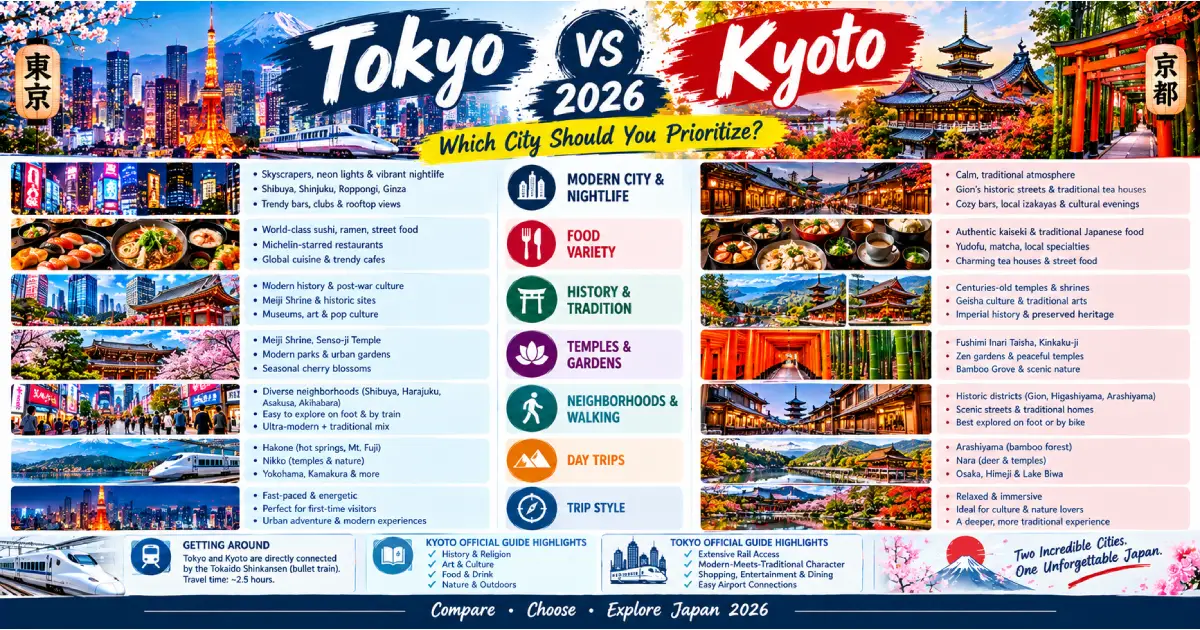
Unlike our Japan vs South Korea comparison, Tokyo and Kyoto aren’t really a pick-one decision for most first-time visitors — both our 7-day and 14-day Japan itineraries include both cities, and the 2-hour-15-minute Shinkansen connecting them is fast, frequent, and genuinely part of the experience rather than a chore. But a specific, common question remains for a visitor with limited time or a tighter budget: if you had to lean one direction — more days in Tokyo, or more days in Kyoto — which city should get the larger share, and why. This comparison answers exactly that, city-planning-specific question.
The short version: Tokyo is the larger, louder, more modern city — the one that delivers on the “Japan is the future” expectation most tier-1 visitors arrive with, built around neon districts, world-class food at every price point, and an almost incomprehensible scale. Kyoto is the smaller, quieter, historically dense city — the one that delivers on “Japan is ancient and considered,” built around roughly 1,600 Buddhist temples, hundreds of Shinto shrines, and preserved traditional streetscapes that Tokyo, largely rebuilt after WWII bombing, simply doesn’t have in comparable quantity.
Tokyo is best for travelers who want scale, modernity, and range within a single city — a place where Shibuya’s neon crossing, Akihabara’s anime culture, Michelin-dense dining, and quiet traditional pockets (Asakusa, Meiji Shrine) all exist within the same metro system.
Kyoto is best for travelers who want depth over breadth — a smaller, walkable city built almost entirely around preserved historical and spiritual sites, where a single afternoon can move from a UNESCO temple to a centuries-old geisha district without a train transfer.
| Category | Winner | Why |
|---|---|---|
| 💰 Cost | Kyoto (slightly) | Comparable hotel rates, marginally cheaper dining on average |
| 🍜 Food Scene | Tokyo | Greater range and density, though Kyoto’s kaiseki is unmatched |
| ⛩️ Culture & History | Kyoto | Far higher density of preserved pre-modern sites |
| 🌃 Nightlife | Tokyo | Bigger, louder, later-running scene |
| 🏙️ Modernity & Pop Culture | Tokyo | Shibuya, Akihabara, teamLab — no contest |
| 🚶 Walkability | Kyoto | Compact core; many sights reachable without transit |
| 🏞️ Day Trip Options | Tie | Tokyo: Hakone, Nikko. Kyoto: Nara, Osaka, Arashiyama |
| 😌 Pace / Vibe | Kyoto | Deliberately calmer, less overwhelming for a first Japan trip |
| 👨👩👧 Family-Friendly | Tokyo | More theme parks and family-specific attractions |
Overall: Tokyo wins on scale, modernity, and food range; Kyoto wins on culture, walkability, and pace. Most visitors need both — the real question is which gets more days.
Tokyo holds the world’s largest concentration of Michelin-starred restaurants and covers a genuinely wider range of cuisine and price point than any other city in Japan — from Tsukiji/Toyosu market sushi to Shinjuku’s Omoide Yokocho yakitori alleys to internationally influential fine dining. Kyoto’s specific strength is kaiseki — the traditional multi-course seasonal tasting format that reaches its most historically rigorous expression in Kyoto specifically, at restaurants like Kikunoi, using Kyoto-grown vegetables and centuries-old preparation techniques Tokyo’s more modern kaiseki scene doesn’t fully replicate. See our 25 Best Restaurants in Japan for specific picks in both cities.
This is Kyoto’s clearest, least debatable win. As Japan’s imperial capital for over a thousand years (794–1868) and one of the only major Japanese cities spared widespread WWII bombing, Kyoto retains a density of intact pre-modern architecture — roughly 1,600 Buddhist temples, hundreds of Shinto shrines, 17 UNESCO World Heritage Sites — that Tokyo, rebuilt largely from scratch after 1945, cannot match regardless of how many individual historic sites (Meiji Shrine, Senso-ji) it preserves.
Tokyo is the world’s most populous metropolitan area, and it shows in a way no other Japanese city replicates: Shibuya Crossing’s raw pedestrian volume, Akihabara’s electronics-and-otaku density, and a skyline and transit system built at a scale Kyoto — a city of under 1.5 million compared to Tokyo’s greater metro area of over 37 million — was never intended to match. Visitors specifically seeking the “hyper-modern Japan” experience should weight their itinerary toward Tokyo.
Kyoto’s compact historical core allows a genuinely different travel rhythm than Tokyo’s — many of the city’s most important sites (Gion, Kiyomizu-dera, the Higashiyama preserved lanes) sit within a single walkable district, and even sites requiring transit (Fushimi Inari, Arashiyama) are short single-line trips rather than Tokyo’s often multi-transfer cross-city journeys. Visitors who find Tokyo’s scale and pace overwhelming by day 2 or 3 of a trip consistently describe Kyoto as the more restorative, easier-to-love city on arrival.
Tokyo’s nightlife operates at a scale and duration Kyoto doesn’t attempt to match — Golden Gai’s tiny themed bars, Roppongi’s international scene, and a late-night train and taxi infrastructure built for a 24-hour city. Kyoto’s evening scene (Gion, Pontocho) is genuinely atmospheric but noticeably quieter and earlier-closing, more suited to a considered dinner and a walk than a late night out.
| Expense | Tokyo | Kyoto |
|---|---|---|
| 3-star hotel, per night | ¥8,000–¥28,000 | ¥7,000–¥25,000 |
| Mid-range dinner for one | ¥3,000–¥6,000 | ¥3,000–¥5,500 |
| Subway/bus single ride | ¥180–¥330 | ¥230 flat (bus) |
| Peak season (cherry blossom/autumn) hotel premium | High | Higher — tighter supply |
Kyoto’s hotel prices run marginally lower than Tokyo’s on average, but its limited hotel supply relative to demand makes it the tighter booking constraint during cherry blossom (late March–early April) and autumn foliage (mid-November) peaks specifically — see our Japan in Spring and Japan in Autumn guides for exact peak dates.
On a 7-day trip: 3 nights Tokyo, 3 nights Kyoto (with Nara and Osaka as Kyoto-based day trips) is the balanced default — see our full Japan 7-Day Itinerary for the exact day-by-day plan.
On a 14-day trip: 5 nights Tokyo (including a Hakone day trip), 3 nights Kyoto, plus Hiroshima, Miyajima, and Osaka rounding out the back half — see our full Japan 14-Day Itinerary.
If you have to choose only one city: Choose Tokyo if this is a broader “experience modern Japan” trip, you have a strong interest in food, shopping, or pop culture, or you’re combining Japan with other countries on a shorter regional trip. Choose Kyoto if culture, temples, and a calmer pace are the priority, or if you’ve already visited Tokyo on a previous trip and want a different side of Japan this time.
If you’re torn: Lean slightly toward Kyoto for a first trip specifically during cherry blossom or autumn foliage season, when Kyoto’s temple grounds are at their most spectacular; lean toward Tokyo for a first trip in any other season, since Tokyo’s appeal is less seasonally dependent.
About Travel Tourister Travel Tourister’s destination specialists have split dozens of itineraries between these two cities — from Shibuya’s crossing and Akihabara’s neon to Fushimi Inari’s dawn torii gates and Gion’s quiet evening lanes — to give first-time visitors a genuinely practical answer to how to divide a limited number of days between Japan’s two most essential cities.
Posted By : Vinay
Latest Article
2nd Floor, 39, Above Kirti Club, DLF Industrial Area, Kirti Nagar, New Delhi, Delhi 110015



Travel Tourister is a leading Travel portal where we introduce travellers to trusted travel agents to make their journey hasselfree, memorable And happy. Travel Tourister is a platform where travellers get Tour packages ,Hotel packages deals through trusted travel companies And hoteliers who are working with us across the world. We always try to find new and more travel agents and hoteliers from every nook and corners across the world so that you could compare the deals with different travel agents and hoteliers and book your tour or hotel with the one you have chosen according to your taste and budget.
Copyright © Travel Tourister, India. All Rights Reserved

 Call
Call Enquiry