Published on : 01 Oct 2026
By Travel Tourister | Updated Oct 2026
Miami is the American city that most consistently surprises the first-time visitor who arrives expecting the South Beach of the 1990s nightlife mythology and discovers instead the most internationally diverse major American city south of New York — a metropolitan area of 6.2 million people where 70% of the population is Hispanic or Latino (the largest proportion of any major US metro), where Spanish and English operate interchangeably on the same block, and where the specific convergence of Cuban exile culture (Little Havana), Venezuelan and Colombian immigration (Doral and Brickell), Brazilian and Argentine presence (South Beach), and the global wealth concentration that the city’s specific tax advantages and climate have attracted creates the most specifically cosmopolitan single American city experience outside of Manhattan. The Miami that the tourist marketing has always sold — the Art Deco hotels on Ocean Drive, the South Beach nightclub scene, the celebrity-spotting at the pool bars — is real and genuinely extraordinary; the Miami that the visitor discovers on day three, when the Wynwood Walls’ morning murals are empty of tourists, when the Little Havana café cubano comes from the ventanita window at 7 AM, and when the Key Biscayne beach has the clearest water in Florida — is the Miami that makes the city genuinely worth the trip.
Planning a Miami visit in 2026 requires understanding several things that standard travel resources frequently underemphasize: the neighborhood dispersal (Miami is not a walkable city in the New York or Philadelphia sense — the South Beach pedestrian zone is its own walkable island but the broader Miami experience [Little Havana, Wynwood, Brickell, Coral Gables, Design District] requires either a car or rideshare for every inter-neighborhood move), the Uber economy (Miami’s most practical transport for the visitor is the combination of walking within South Beach and rideshare between neighborhoods — the Miami-Dade Transit Metrorail serves a limited corridor and doesn’t connect most visitor-relevant neighborhoods), and the seasonal character (the December–April dry season is genuinely the most recommendable single US coastal winter destination, the specific winter warmth [77°F/25°C January average] alongside the most reliably blue Atlantic creating conditions that no other major American East Coast city can approach).
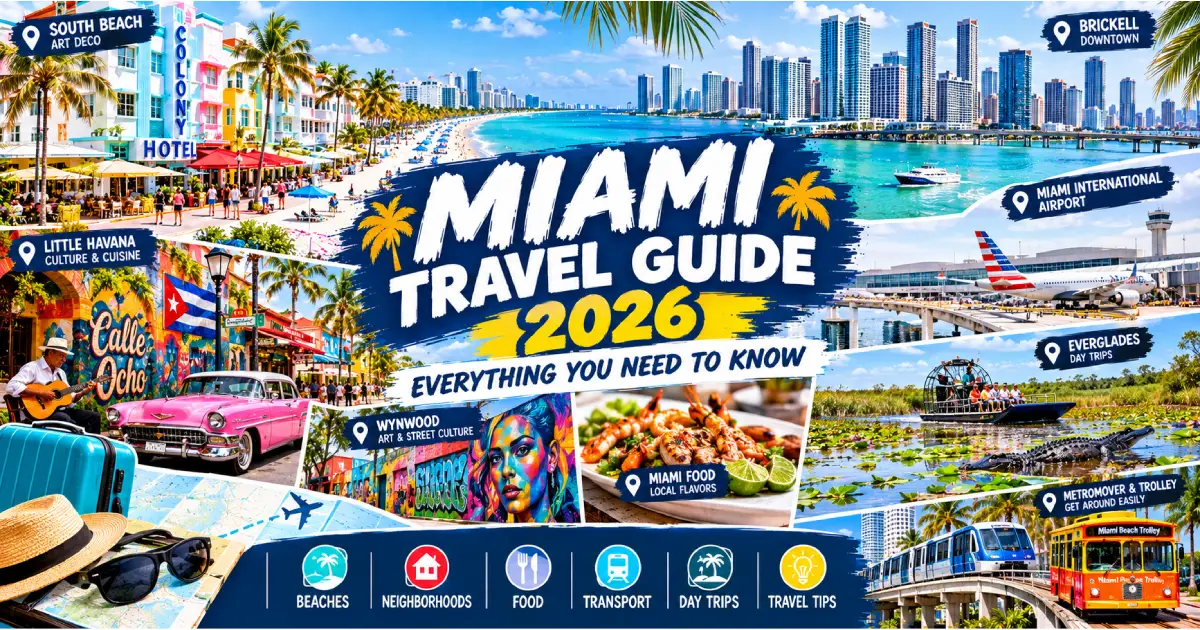
This complete Miami Travel Guide for 2026 covers everything from getting there and getting around through neighborhood orientation, budget planning, seasonal advice, and the specific insider knowledge that transforms a Miami visit from an Ocean Drive selfie exercise into the most genuinely rewarding and most genuinely surprising major American subtropical city experience.
For related guides, see our Orlando vs Miami 2026 and New Orleans vs Miami 2026.
| Category | Details |
|---|---|
| Nickname | The Magic City; The American Riviera; 305 |
| Population | 470,000 (city); 6.2 million (metro) |
| Founded | 1896 |
| State | Florida |
| Elevation | 6 feet (1.8 meters) — among the lowest major US cities |
| Airport | Miami International Airport (MIA) — 8 miles northwest of downtown |
| Second airport | Fort Lauderdale-Hollywood International (FLL) — 30 miles north |
| Time zone | Eastern Time (ET) — UTC-5 standard; UTC-4 DST |
| Currency | US Dollar (USD) |
| Language | English and Spanish equally (the most bilingual major US city) |
| Best neighborhoods | South Beach, Wynwood, Little Havana, Brickell, Coral Gables, Design District |
| Best season | December–April (dry season, ideal weather) |
| Worst season | August–October (hurricane season peak, maximum humidity) |
| Mid-range hotel | $180–$350/night (South Beach); $120–$200 (Miami proper) |
| Car necessary? | Not for South Beach; yes for Little Havana, Wynwood, Coral Gables |
| Transit | Metrorail (limited corridor); Metromover (downtown free); rideshare primary |
| Ocean temperature | 75–82°F (24–28°C) summer; 68–72°F (20–22°C) winter |
Airport code: MIA | Distance: 8 miles northwest of downtown Miami | Drive time: 20–40 minutes (traffic-dependent) | Website: miami-airport.com
Miami International Airport handles approximately 52 million annual passengers and serves as a major hub for American Airlines (the primary MIA carrier with the most extensive single-carrier domestic and Latin American network) alongside all major US carriers and extensive international service (the most comprehensively Latin America-connected single US airport, with direct routes to virtually every major Latin American city alongside strong European service from British Airways, Iberia, Lufthansa, Air France, and various others).
Getting from MIA to South Beach / downtown:
Miami-Dade Transit Metrorail + Metromover: The most cost-effective transfer — the MIA Mover (the free automated people mover connecting all MIA terminals to the Miami Intermodal Center adjacent to the airport) connects to the Metrorail Orange Line at the Miami Airport Station. The Metrorail to Government Center (downtown Miami) takes approximately 15 minutes ($2.25). From Government Center, the free Metromover circulates through downtown Brickell. For South Beach, a transfer to a Miami Beach bus or rideshare from Government Center is required. Total cost MIA to South Beach via transit: approximately $5–$8, 45–60 minutes.
Rideshare (Uber/Lyft): $25–$45 to South Beach in standard conditions; $40–$65 during surge (the Dolphin Expressway and MacArthur Causeway traffic creating the most variable single Miami rideshare pricing). Pickup at MIA (the designated rideshare staging area on the lower level) typically 5–10 minutes.
Taxi: $35–$55 to South Beach (metered fare with airport surcharge). The most consistent non-surge Miami airport transfer.
Rental car: The MIA rental car center (accessible via shuttle) provides all major companies. A rental car is most specifically useful for visiting the Everglades, the Florida Keys, and Coral Gables/Coconut Grove — South Beach is walkable without a car, and Wynwood and Brickell are efficiently served by rideshare.
Distance from Miami Beach: 35 miles north | Drive time: 40–60 minutes | For budget carrier flights (Spirit, Frontier, Southwest) that serve FLL more extensively than MIA — the $15–$25 rideshare premium relative to MIA is more than offset by the typical FLL budget fare savings.
Miami is the most car-dependent major American coastal city. The Miami-Dade Metrorail (the elevated rail system) serves a useful but limited corridor (the downtown/Brickell/Coconut Grove/Coral Gables/Hialeah axis) but misses the most visitor-relevant neighborhoods — no rail service to South Beach, Wynwood, Little Havana, or the Design District. The visitor’s most practical Miami transport strategy:
South Beach: Walk everywhere within the Beach. The Lincoln Road Mall, Ocean Drive, Collins Avenue, and the beach itself are all walkable from any South Beach hotel. The South Beach Local (the free circulator bus on Washington and Collins Avenues) covers the main South Beach axis at no cost.
Between neighborhoods: Rideshare (Uber/Lyft) is the most practical single Miami inter-neighborhood transport. The typical Wynwood-to-South Beach rideshare ($15–$22) and the Little Havana-to-Wynwood rideshare ($12–$18) are the most frequently used visitor transport segments.
Downtown/Brickell: The free Metromover (the automated downtown loop connecting downtown Miami stations, Government Center, and the Brickell neighborhood) provides the most convenient and most cost-effective single Miami downtown transport.
Typical Miami rideshare costs:
Character: The iconic Art Deco district; Ocean Drive; the most internationally famous American beach; the 1990s-celebrity-culture mythology; the best people-watching in Florida | Best for: First-time visitors; the beach; the Art Deco architecture; Ocean Drive evening walks | Transit: Walk everywhere within SoBe; South Beach Local free circulator
South Beach (the southernmost portion of Miami Beach — the barrier island separated from mainland Miami by Biscayne Bay, the specific South Beach 25-block area between 5th Street and 23rd Street whose specific character [the 800+ Art Deco buildings in the Art Deco Historic District, the world’s largest surviving Art Deco neighborhood], the 3.5-mile white sand Atlantic beach, and the specific Ocean Drive evening culture [the outdoor restaurant terraces facing the beach, the Art Deco hotel facades illuminated in the evening, and the specific South Beach social energy] creates the most internationally recognizable single American beachfront neighborhood) is the non-negotiable first Miami experience.
The Art Deco Historic District: The most concentrated surviving Art Deco architectural neighborhood in the world — the specific pastel-painted facades (the aqua, the coral, the yellow, and the pink that the specific Miami Beach architectural restoration program has maintained since Barbara Capitman’s 1976 Miami Design Preservation League founding), the porthole windows, the racing stripes, the eyebrows (the horizontal projections above windows providing shade in the Florida climate), and the specific neon sign restorations create the most specifically 1930s-Hollywood-South-Florida single American streetscape. The evening Art Deco walk (Ocean Drive from 5th to 15th Streets between 7–10 PM when the neon signs illuminate and the restaurant terraces fill) is the single most specifically Miami-identity single evening experience.
Lincoln Road Mall: The pedestrian commercial street 2 blocks west of the beach — the most vibrant single South Beach daytime commercial experience, the outdoor cafés, the boutiques, the Sunday farmers market, and the specific Lincoln Road people-watching culture providing the most specifically South Beach-neighborhood-character single commercial walk.
Character: The most comprehensively street-art-muraled single American neighborhood; the most dynamic current Miami arts district; the most specifically Instagram-famous single Miami neighborhood | Best for: The Wynwood Walls; galleries; the most contemporary Miami cultural experience | Transit: Rideshare from South Beach (15–20 min); Wynwood is walkable within the neighborhood
Wynwood (the former garment district north of downtown — the most dramatically transformed single Miami neighborhood of the current era, the specific Wynwood transformation [the 2009 Goldman Properties installation of the Wynwood Walls [the most comprehensively curated and most internationally celebrated single American street art destination, the 50,000+ square feet of outdoor murals by the world’s most specifically celebrated street artists including Os Gemeos, Shepard Fairey, and the various other artists whose specific Wynwood Walls contributions represent the most concentrated single outdoor art collection in any American commercial neighborhood], the subsequent gallery and restaurant colonization, and the specific Wynwood 2026 character [the most restaurant-and-bar-dense single Miami neighborhood outside of South Beach]) provides the most specifically contemporary and most specifically visually extraordinary single Miami neighborhood experience.
The Wynwood Walls: The most specifically celebrated single Wynwood destination — the outdoor museum of curated large-scale murals in the Wynwood Walls compound (open daily, free to walk the exterior walls; $5–$10 for the interior compound access). The specific Wynwood Walls morning visit (8–10 AM on weekdays) provides the most uncrowded single Wynwood photography opportunity — the murals in the morning light without the social-media crowd that develops by 11 AM.
Wynwood dining and nightlife: The most restaurant- and bar-dense single Miami outside-of-South-Beach neighborhood — the Wynwood Kitchen & Bar, the KYU (the wood-fire Asian restaurant consistently ranked among Miami’s best), the Alter (the most specifically Wynwood fine dining restaurant), and the various other Wynwood restaurants and bars creating the most specifically arts-district-character Miami evening dining and nightlife experience.
Character: The most authentically Cuban-American single US neighborhood; the ventanita café cubano culture; Calle Ocho; the most specifically Miami cultural heritage district | Best for: Cuban food; the café cubano culture; the most specifically Latin-American Miami cultural experience | Transit: Rideshare required (20 min from South Beach)
Little Havana (the SW Miami neighborhood centered on SW 8th Street [Calle Ocho] — the most specifically Cuban-American single US neighborhood, the specific Little Havana character [the ventanita windows [the walk-up Cuban coffee service windows serving café cubano [the intensely sweet espresso shot] and cortadito [the café cubano with a small amount of evaporated milk] to the neighborhood’s residents throughout the day — the most specifically Cuban-American single American urban coffee-service format], the Domino Park [Maximo Gomez Park where the neighborhood’s elder Cuban-American community plays dominoes under the shade trees in the most specifically neighborhood-character single Miami park], the Versailles Restaurant [the most celebrated single Miami Cuban restaurant since 1971, the wood-paneled dining room and the specific Cuban comfort food [the ropa vieja, the picadillo, the lechon asado] at the most specific exile-community institution in Miami], and the SW 8th Street gallery corridor and cigar shops creating the most specifically Cuban-heritage single Miami cultural walk.
The café cubano experience: The single most specifically Miami-identity single food and beverage ritual — the specific café cubano (the Cuban espresso with the specific espresso-and-demerara-sugar emulsion [the espuma — the thick, sweet foam created by whipping the first drops of espresso with sugar before the full shot is extracted, the most specifically Cuban single coffee preparation technique whose specific result [the intensely sweet, intensely concentrated, almost syrup-like single espresso shot] distinguishes it from any other American espresso tradition) at the ventanita window of any Little Havana café for $1.50–$2.00 is the single most democratic and most specifically Miami cultural experience available at any price point.
Character: Miami’s financial center; the most specifically high-rise-residential single Miami neighborhood; the best cocktail bar concentration in mainland Miami; the Metromover’s most useful corridor | Best for: Business travelers; the best mainland Miami hotel value; the most specifically contemporary-urban single Miami experience | Transit: Metromover (free, Downtown)
Brickell (the downtown Miami financial district south of the Miami River — the most specifically vertical and most specifically contemporary-luxury single Miami neighborhood, the specific Brickell character [the concentration of luxury high-rise condominiums, the Mary Brickell Village retail center, and the specific Brickell City Centre [the most comprehensively programmed single mainland Miami shopping and dining center] creating the most specifically international-financial-center single Miami neighborhood character) provides the most convenient and most value-optimized single mainland Miami hotel base for visitors who want the urban Miami experience at below-South-Beach hotel rates.
Character: The most specifically architecturally distinguished single Miami suburb; the Mediterranean Revival architecture; the Venetian Pool; the University of Miami; the best upscale Miami restaurant dining | Best for: Architecture enthusiasts; the Venetian Pool; the most European-feeling single Miami neighborhood | Transit: Metrorail (Douglas Road or University stations); rideshare
Coral Gables (the planned city within Miami-Dade County — the most specifically Mediterranean Revival-architecture-concentrated single Florida municipality, the specific Coral Gables character [the George Merrick 1920s-designed community whose specific Spanish-Baroque and Venetian influences [the Biltmore Hotel [the 1926 Mediterranean Revival hotel tower — the most dramatically historic single Miami hotel building, the specific Coral Gables Biltmore tower visible from throughout the neighborhood creating the most specifically European-influenced single Miami skyline element], the Venetian Pool [the 1923 public swimming pool carved from a coral rock quarry — the most specifically extraordinary single American public pool, the 820,000-gallon spring-fed pool with the coral rock grottos, the waterfalls, and the Mediterranean village architecture surrounding the most dramatically beautiful single American municipal pool], and the Miracle Mile [the Coral Gables main commercial street with the most specifically independent-restaurant single Miami dining corridor outside of South Beach]) providing the most specifically architecturally distinguished and most specifically European-character single Miami neighborhood.
Character: Miami’s luxury fashion and design neighborhood; the most specifically gallery-and-flagship-store single Miami commercial area; the most specifically contemporary-architecture single Miami street | Best for: Luxury shopping; gallery visits; the most specifically architecture-forward single Miami commercial neighborhood experience | Transit: Rideshare (15–20 min from South Beach)
The Design District (the neighborhood north of Wynwood centered on NW 2nd Avenue and NE 38th Street — the most specifically luxury-retail and most specifically contemporary-architecture single Miami neighborhood, the specific Design District character [the Hermès, the Louis Vuitton, the Prada flagship stores alongside the Dacra-developed buildings [the most specifically architecturally ambitious single Miami commercial development project, the custom-designed buildings by Sou Fujimoto, Aranda/Lasch, and various other internationally-recognized architects creating the most specifically architectural-tourism single Miami commercial neighborhood], and the Institute of Contemporary Art Miami [the most specifically contemporary-art single Miami museum, the ICA’s free admission and the specific programming providing the most accessible single Miami contemporary art museum experience]) provides the most specifically luxury-and-architecture-focused single Miami neighborhood experience.
| Type | Cost Per Night | Notes |
|---|---|---|
| Budget hostel | $35–$65 | South Beach and Miami Beach options |
| Budget hotel | $90–$150 | North Miami Beach; airport area |
| Mid-range South Beach | $180–$350 | The specific South Beach hotel premium |
| Mid-range mainland | $120–$200 | Brickell; Coral Gables; Design District area |
| Boutique hotel | $200–$400 | The Betsy; Soho Beach House; The Catalina |
| Luxury hotel | $400–$1,200+ | Faena Hotel; 1 Hotel South Beach; The Standard |
| Vacation rental | $150–$400 | Most value in Mid-Beach and Surfside |
The South Beach hotel premium reality: The specific South Beach hotel premium (the Art Deco neighborhood’s specific combination of beach adjacency, architectural character, and brand association creates the most dramatically price-elevated single American beach hotel market outside of Manhattan and Hawaii) means that equivalent-quality accommodation in Brickell or Coral Gables costs 30–50% less than the South Beach equivalent. For budget-conscious visitors, the Brickell hotel + rideshare-to-South-Beach strategy frequently produces better total value than the South Beach hotel at a premium.
| Category | Cost Per Person | Examples |
|---|---|---|
| Café cubano (ventanita) | $1.50–$2 | Little Havana — the best single value in Miami |
| Cuban lunch (counter service) | $10–$18 | Versailles lunch counter; various Little Havana spots |
| Wynwood casual | $18–$35 | Wynwood Kitchen, various food trucks |
| South Beach casual | $25–$45 | Lincoln Road restaurants, mid-range Ocean Drive |
| Mid-range restaurant | $45–$75 | KYU, Alter, Los Fuegos |
| Fine dining | $80–$180+ | Stubborn Seed, Le Jardinier, Cote Miami |
| Joe’s Stone Crab (in season) | $40–$120 | The most specifically Miami single dining splurge |
| Activity | Cost |
|---|---|
| South Beach (beach access) | Free |
| Wynwood Walls exterior | Free |
| Wynwood Walls interior compound | $5–$10 |
| Art Deco walking tour (self-guided) | Free |
| Art Deco tour (MDPL guided) | $25 |
| Pérez Art Museum Miami (PAMM) | $16 |
| Institute of Contemporary Art | Free |
| Vizcaya Museum and Gardens | $25 |
| Everglades National Park (day trip) | $35/vehicle |
| Key West day trip (drive) | Free (highway); $30–$50 (parking) |
| Dolphin/snorkeling excursion (Biscayne Bay) | $40–$80 |
| Miami Design Preservation League tour | $25 |
Miami’s dry season is the most reliably excellent American winter beach weather: the January average high of 77°F/25°C, the low humidity (relative humidity 65–70% vs. the summer’s 80%+), and the crystal-clear Atlantic (the winter ocean clarity in the specific Miami Beach offshore zone is at its annual maximum due to the reduced summer rainfall runoff) create conditions that make Miami the most compelling single American winter destination. December–April is simultaneously the most crowded and most expensive single Miami visiting period — the specific winter visitor concentration driving both the social energy (Art Basel in December, the Super Bowl rotation, the South Beach Wine & Food Festival in February) and the hotel premium.
The Atlantic hurricane season (June 1–November 30) creates the most practically important single Miami trip planning variable. Miami’s specific coastal position makes it more directly hurricane-exposed than any other major American city. The most practically relevant planning steps:
Miami’s summer (the 88–90°F/31–32°C temperatures with 80%+ humidity and the specific afternoon thunderstorm pattern [the daily 2–5 PM convective storms creating an outdoor-activity disruption pattern similar to Orlando’s]) is the most challenging single Miami visiting season for most visitor types but the most affordable (the lowest single Miami hotel rates of the year, typically 30–40% below the December–April peak) and the most socially active for the specific nightlife-focused visitor (the South Beach summer nightclub season running at its most intensive July–August).
Cost: $35/vehicle (7-day pass) | Best experience: Anhinga Trail, Shark Valley tram tour, airboat tours (private operators near the park) | Season: December–April for the most accessible wildlife viewing (the dry season concentrating wildlife around remaining water sources)
The Everglades National Park (the 1.5-million-acre subtropical wilderness — the largest tropical wilderness in the United States, the specific Everglades character [the sawgrass prairies, the cypress swamps, the mangrove estuaries, and the specific wildlife [the American alligator, the anhinga, the roseate spoonbill, the Florida panther (rare), and the specific Everglades ecosystem species] creating the most specifically extraordinary natural landscape accessible within 45 minutes of any major American city) is the most specifically extraordinary day trip from Miami and the most underused single Miami day trip by the typical South Beach visitor.
Route: US-1 (the Overseas Highway) south from Miami through the Keys to Key West | The Seven Mile Bridge: The most specifically dramatic single Florida driving moment — the 7-mile causeway over open ocean, the most dramatically oceanic single American highway segment
The Florida Keys day trip (the 112-mile drive from Miami to Key West via the Overseas Highway, the specific Overseas Highway character [the 42 bridges connecting the 1,700 islands and islets of the Florida Keys, the specific Seven Mile Bridge whose specific 7-mile open-ocean crossing provides the most dramatically seascape single American highway drive]) provides the most specifically Florida-unique single Miami day trip: the Key West character (the most specifically Caribbean-feeling single American city, the specific Duval Street, the Ernest Hemingway Home and Museum, and the Mallory Square sunset celebration [the specific Key West sunset ritual — the gathering of the entire Key West visitor and resident community at Mallory Square for the nightly sunset, the most specifically communal single American daily public event] creating the most specifically end-of-the-road single American city experience).
The most consistently confused single Miami geographic distinction — Miami Beach (the barrier island including South Beach, Mid-Beach, North Beach, Surfside, and Bal Harbour) and Miami (the mainland city including Downtown, Brickell, Wynwood, Little Havana, Coral Gables, and the Coconut Grove) are separate municipalities connected by causeways. Most visitors stay in Miami Beach (South Beach specifically) while wanting to visit Miami (Wynwood, Little Havana). The rideshare between them (the MacArthur or Julia Tuttle Causeways) takes 15–25 minutes in standard conditions.
Miami’s subtropical latitude (25.8°N) and the specific South Beach sun (the beach-reflected UV amplification, the 6–8 hours of direct sun exposure typical of a full beach day) create the most dramatically sunburn-producing single American outdoor environment outside of Hawaii. SPF 50+ sunscreen applied every 2 hours is the most specifically Miami beach-day-success single practical requirement.
For any June–November Miami visit: purchase travel insurance with hurricane cancellation coverage, download the Miami-Dade Emergency Management app, and identify the specific evacuation route from your hotel (available on the Miami-Dade County emergency management website). This is standard Florida preparedness rather than exceptional concern.
Day 1 — South Beach: Morning: Ocean Drive Art Deco walk (7–9 AM for the most uncrowded street) Beach: 9 AM–noon at the South Beach public beach (between 12th and 14th Streets — the most specifically uncrowded South Beach public beach access point) Afternoon: PAMM (Pérez Art Museum Miami) + Bayside Marketplace waterfront Evening: Wynwood Walls (the evening murals, the galleries open until 8–9 PM)
Day 2 — Little Havana and the Culture: Morning: Little Havana café cubano at ventanita + Domino Park Midday: Versailles Restaurant lunch (the ropa vieja; the Cuban sandwich) Afternoon: Vizcaya Museum and Gardens (the most specifically Miami architectural experience) Evening: South Beach Lincoln Road dinner + Ocean Drive sunset walk
Day 3 — Day Trip or Biscayne: Option A: Everglades National Park day trip (depart 8 AM; the Anhinga Trail + Shark Valley) Option B: Key Biscayne beach day (the clearest Miami-area water; Bill Baggs Cape Florida State Park) Evening: Design District or Brickell dinner
Days 1–3 as above, plus:
Day 4 — Coral Gables and the Venetian Pool: Morning: Coral Gables Venetian Pool (open 10 AM; most uncrowded on weekdays) Midday: Miracle Mile lunch + Coral Gables architecture walk Afternoon: Coconut Grove (CocoWalk, the Barnacle Historic State Park) Evening: Brickell dinner and cocktail bar circuit
Day 5 — Art Basel Week (December) or Beach Day: December: Art Basel Miami Beach (the Convention Center exhibitions, the satellite fairs in Wynwood and throughout Miami Beach) Other months: Full Key West day trip departure 7 AM
Posted By : Vinay
Latest Article
2nd Floor, 39, Above Kirti Club, DLF Industrial Area, Kirti Nagar, New Delhi, Delhi 110015



Travel Tourister is a leading Travel portal where we introduce travellers to trusted travel agents to make their journey hasselfree, memorable And happy. Travel Tourister is a platform where travellers get Tour packages ,Hotel packages deals through trusted travel companies And hoteliers who are working with us across the world. We always try to find new and more travel agents and hoteliers from every nook and corners across the world so that you could compare the deals with different travel agents and hoteliers and book your tour or hotel with the one you have chosen according to your taste and budget.
Copyright © Travel Tourister, India. All Rights Reserved

 Call
Call Enquiry