50 Best Things to Do in Puerto Rico 2026: Ultimate Activities Guide
Published on : 01 Apr 2026
Things to Do in Puerto Rico — From El Morro to Bioluminescent Bays, Rainforests to Wild Horse Beaches
By Travel Tourister | Updated March 2026
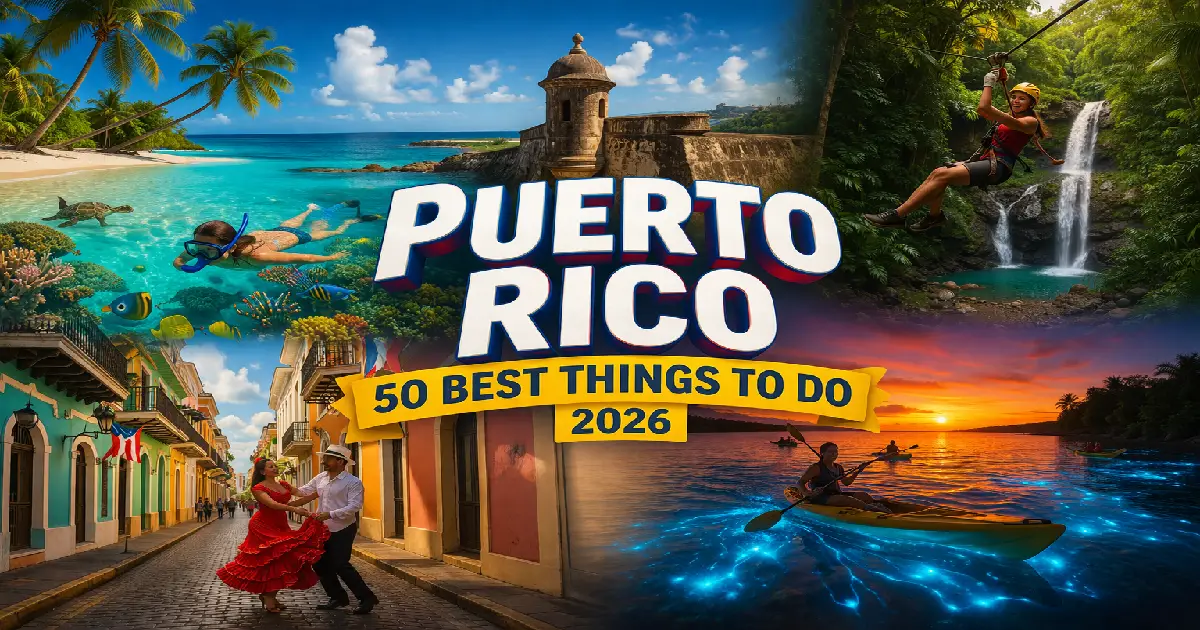
Puerto Rico is the most activity-dense island in the Caribbean — a place where you can walk 500-year-old Spanish colonial cobblestone streets in Old San Juan in the morning, hike to a waterfall in the only tropical rainforest in the US National Forest system by noon, kayak through a bioluminescent bay where every paddle stroke produces a glow of blue-green dinoflagellates visible only on a moonless night by evening, snorkel a pristine coral reef in the clearest Caribbean water accessible from any US territory the following morning, watch wild horses run on a white sand beach in Vieques the afternoon after, and attend the most festive public street festival in the Caribbean — the San Sebastián Street Festival — in January when the entire island’s population is celebrating simultaneously in the blue cobblestone streets of the most architecturally beautiful city in the Caribbean. No other island in the hemisphere delivers this geographic and cultural range within a territory the size of Connecticut.
I’ve experienced Puerto Rico’s activities across multiple visits and every region — the El Morro dawn walk when the Atlantic fog is still on the bay and the fortress walls glow orange in the first light, the Flamenco Beach morning in April when the Caribbean was so turquoise it required empirical verification, the Mosquito Bay bioluminescent kayak tour on a July new moon night when the water glowed blue-green around every paddle stroke and the Milky Way and the bioluminescence were the only light sources visible between the horizon and the sky, the El Yunque La Mina waterfall hike in February when the 35-foot falls were at full flow from the dry season’s accumulated mountain moisture, the Loíza patron saint festival in July when the African-heritage community’s vejigante masks and bomba dancing filled the plaza with the most specifically Caribbean cultural expression I’d encountered in any island territory, and the Old San Juan evening walk when the blue-tinted cobblestones of Calle Fortaleza in the last golden light made the city look exactly like the painting that every island visitor imagines before they arrive and finds, for once, accurately represented. Each activity confirmed the same truth: Puerto Rico’s finest experiences are available to any visitor willing to take the ferry to Culebra, the night kayak to the bio bay, and the morning walk along the El Morro sea wall — activities that require reservation rather than money and intention rather than luxury.
This comprehensive 2026 guide breaks down Puerto Rico’s 50 best activities using verified information from Discover Puerto Rico, the National Park Service, and years of on-the-ground expertise. We organize activities by category — Old San Juan and history, beaches and water activities, nature and hiking, cultural and festivals, food and drink, island day trips, family activities, and unique Puerto Rico — with realistic costs, timing, and strategic advice for experiencing the most multidimensional island in the Caribbean.
Puerto Rico Activities by Category
Category
Top Activities
Best Location
Cost Range
Old San Juan & History
El Morro, La Fortaleza, blue cobblestone walk
Old San Juan
Free–$10
Beaches & Water
Flamenco Beach, Vieques beaches, snorkeling
Culebra, Vieques, Luquillo
Free–$80
Nature & Hiking
El Yunque, La Mina Falls, bioluminescent bay
El Yunque, Vieques, Fajardo
Free–$75
Culture & Festivals
San Sebastián Festival, Loíza, Ponce Carnival
Old San Juan, Loíza, Ponce
Free–$30
Food & Drink
Mofongo, lechón, rum tour, piraguas
Old San Juan, Guavate, Barranquitas
$5–$95
Island Day Trips
Culebra ferry, Vieques wild horses, Ponce
Island-wide
$4.50–$130
Old San Juan & Historical Activities
1. Walk Old San Juan’s Blue Cobblestone Streets — MUST DO
Why It’s Puerto Rico’s Essential Activity: Old San Juan — the 500-year-old walled city on a small island connected to mainland Puerto Rico by bridges, with 400+ historically preserved buildings painted in every Caribbean color (indigo, salmon, ochre, mint, cobalt) along narrow streets paved in blue-tinted adoquín cobblestones (volcanic bluestone ballast from Spanish ships) — is the most architecturally beautiful and the most historically layered city in the Caribbean. The walk from the Paseo de la Princesa promenade along the city walls, up the Calle Norzagaray to El Morro, across the Ballajá neighborhood to the Convento de los Dominicos, down Calle Cristo to the Cathedral of San Juan Bautista, and along Calle Fortaleza to the La Fortaleza executive mansion is the finest single urban walk accessible in any Caribbean island.
The blue cobblestones: Adoquín — volcanic bluestone blocks that arrived as ship ballast from Spain in the 16th century and were repurposed as street paving; the color is most vivid in the late afternoon golden light and most atmospheric in the evening when the streetlamps illuminate the blue-grey surface
The color palate: The 400+ historical buildings in the Old City are painted in a Caribbean color palette regulated by the Institute of Puerto Rican Culture — the colors are specific to the colonial tradition and change with every block
Best time: Evening (6–9 PM) when the golden light is on the buildings and the street temperature has dropped to 78°F; or early morning (7–9 AM) before the tourist day-trippers from the cruise ships arrive
The Paseo de la Princesa: The promenade along the bay-facing city wall — the most beautiful free walk in Puerto Rico, with the La Princesa fountain, the bay view, and the La Fortaleza’s south wall lit at night
Cost: FREE; Old San Juan, San Juan; open 24 hours; most accessible from the cruise ship piers at the west end of the old city
2. Visit Castillo San Felipe del Morro (El Morro)
Why It’s the Most Important Historical Site in Puerto Rico: El Morro — the six-level Spanish colonial fortress at the northwest tip of Old San Juan, built between 1539 and 1783 to defend the harbor entrance against Dutch, British, and French naval attack — is the most architecturally extraordinary and the most historically significant military structure in the Caribbean. The 140-foot cliff above the Atlantic, the six defensive levels descending to the sea level batteries, the sentry boxes (garitas) that have been photographed from every angle for 150 years, and the morning light on the fortress walls from the El Morro esplanade combine to produce the most consistently beautiful free-wind morning experience accessible in Puerto Rico.
The garitas: The sentry box turrets on El Morro’s sea-facing walls — the most photographed architectural feature in Puerto Rico; the northeast garita with the Atlantic in the background is the image that defines Puerto Rico in most travel photography
The esplanade: The grassy field between Old San Juan’s city walls and El Morro — the most popular kite-flying location in Puerto Rico, particularly on Saturday and Sunday afternoons when the trade winds are consistent; free to walk at all hours
The interior: Six levels of galleries, magazines, cisterns, and lookout positions — the most complete Spanish colonial fortress interior accessible in the Caribbean ($10/adult, valid for both El Morro and San Cristóbal)
Sunrise walk: El Morro at dawn, when the fog is on the Atlantic and the fortress walls catch the first orange light, is the single finest free morning experience accessible in Puerto Rico
Cost: $10/adult (combined El Morro + San Cristóbal); nps.gov/saju; Old San Juan; open daily 9 AM–6 PM
3. Explore Castillo San Cristóbal
The largest Spanish colonial fortification in the Americas — San Cristóbal covers 27 acres of Old San Juan’s eastern approach (compared to El Morro’s 74-acre western approach) and its five independent units connected by dry moats represent the most militarily sophisticated Spanish colonial defensive architecture in the Western Hemisphere. The views from the main battery looking over the Condado resort district, the Atlantic, and Old San Juan’s city walls produce the finest elevated view of the full San Juan metropolitan area accessible from any historical structure.
The main battery: The highest point of San Cristóbal — the 150-foot elevated cannon position with 360-degree views of San Juan Bay, the Atlantic, and the Caribbean
Combined admission: The $10 NPS fee covers both El Morro and San Cristóbal — the finest historical attraction value in Puerto Rico
Cost: $10/adult (combined with El Morro); nps.gov/saju; eastern entrance to Old San Juan; open daily 9 AM–6 PM
4. Visit La Fortaleza (Governor’s Mansion)
The oldest executive mansion in continuous use in the Western Hemisphere — La Fortaleza (The Fortress) was built as a military fortification in 1533, converted to the Governor’s Palace in 1640, and has housed every Puerto Rican governor since then. The building’s interior (accessible via free guided tours on weekdays) is the most historically layered single building in Puerto Rico: 500 years of Spanish and American governance visible in the architecture, the gardens, and the Moorish-influenced decorative program.
Free tours: Monday–Friday, hourly from 9 AM–3 PM; the only way to access the interior; the garden with the Moorish fountain is the most specifically beautiful space in the building
The exterior: Calle Fortaleza’s view of the mansion’s southern face and the bay behind it is the most photographed building exterior in Old San Juan
Cost: FREE; Monday–Friday guided tours 9 AM–3 PM; Calle Fortaleza, Old San Juan
5. Attend the San Sebastián Street Festival (January)
Why It’s Puerto Rico’s Most Essential Cultural Experience: The Fiestas de la Calle San Sebastián — four days in mid-January in Old San Juan’s historic streets — is the most attended annual event in Puerto Rico and the most festive public celebration in the Caribbean. The blue cobblestone streets of Old San Juan close to traffic while the island’s full population celebrates with live salsa, bomba, and plena music on every corner simultaneously, traditional street foods (lechón, alcapurrias, mofongo, piraguas), artisan craft vendors, and the specific joyful chaos that 500-year-old colonial streets at maximum festive capacity produce. The San Sebastián Festival is free to attend, impossible to recreate, and available only once per year.
Live music on every corner: Salsa stages, bomba circles, plena processions, and brass bands compete for attention simultaneously along Calle San Sebastián, Calle Sol, and Calle Cristo — the most concentrated live music per city block available at any Caribbean festival
Traditional foods: Lechón (whole roasted pig), alcapurrias (fritters), tembleque (coconut pudding), piraguas (shaved ice with tropical syrups), and the full range of Puerto Rican street food tradition in a single festival corridor
The vejigante masks: The multicolored papier-mâché masks from the Ponce carnival tradition and the coconut shell masks from the Loíza tradition are both on sale — the most specific Puerto Rican artisan craft accessible at any single event
2026 dates: January 15–18, 2026
Cost: FREE admission; Old San Juan; January 15–18, 2026; book hotels 12+ weeks ahead
6. Walk the City Walls (Murallas)
The 3-mile perimeter of Spanish colonial city walls surrounding Old San Juan — the most complete surviving Spanish colonial fortification system in the Americas, with the Paseo de la Princesa promenade along the southern bay-facing wall providing the finest free outdoor walk in Puerto Rico. The north wall walk (accessible from El Morro’s esplanade) along the Norzagaray cliff offers the most dramatic Atlantic view accessible from any Old San Juan free outdoor area.
The Paseo de la Princesa: A tree-lined promenade between the old city’s south wall and the bay — the La Princesa fountain at the promenade’s western end is the most photographed outdoor sculpture in Old San Juan
Cost: FREE; Old San Juan perimeter; open 24 hours
Beaches & Water Activities
7. Swim at Flamenco Beach (Culebra) — FINEST BEACH IN PUERTO RICO
Why It’s Puerto Rico’s Best Beach: Flamenco Beach — a 1-mile horseshoe of powder-white coral sand on the northwest shore of Culebra Island, accessible via a 1-hour ferry from Ceiba (1 hour east of San Juan) — is consistently rated among the top 10 beaches in the world and the finest beach in Puerto Rico: a Caribbean crescent of exceptional sand quality, turquoise water of incomparable clarity, a natural horseshoe bay providing calm swimming conditions, and the specific geographical luck of facing northwest into the prevailing trade wind so that the water’s surface is always slightly textured but never rough. The water’s color — produced by the white sand bottom, the 4–8 feet depth, and the specific angle of Caribbean light — is the most purely Caribbean blue-green available at any beach in the territory.
The water color: The specific turquoise of Flamenco Beach — photographs consistently misrepresent it as too saturated because the actual color is genuinely that specific
Swimming conditions: Protected by the horseshoe bay — generally calm Caribbean surface conditions year-round; the trade wind creates pleasant surface texture without significant wave action
Snorkeling at the beach’s rocky ends: The rocky outcroppings at both ends of the horseshoe contain reef fish and occasional sea turtle sightings accessible without a boat
Getting there: Ferry from Ceiba ($4.50/person one way) or island-hopper flight from Isla Grande Airport ($90–$130 one way); the morning ferry (6–7 AM departure) delivers the best beach position; arrive early
Cost: Free beach; ferry $4.50 one way from Ceiba; open daily; Culebra Island
8. Visit Vieques and See Wild Horses on the Beach
Why Vieques Is Irreplaceable: Vieques — the 21-mile island east of the Puerto Rico mainland, accessible by 30-minute ferry from Ceiba — is the most specifically extraordinary island in Puerto Rico for the combination of the wild Puerto Rican paso fino horses that roam the beaches freely (particularly at Sun Bay Beach/Balneario de Sun Bay and the more remote Red Beach and Blue Beach on the former US Navy lands), the bioluminescent Mosquito Bay (the most vivid bio bay in the world), and the pristine beaches of the Vieques National Wildlife Refuge (the former US Navy bombing range, now the largest nature reserve in the Caribbean managed by the US Fish and Wildlife Service).
Wild horses: The Puerto Rican paso fino horses (descendants of Spanish colonial horses that became feral on the island) roam the beaches freely — most reliably seen at sunrise and sunset on the beaches of the former Navy lands (Red Beach, Blue Beach, and the Mosquito Bay area)
Red Beach (Playa Caracas): The most beautiful beach on Vieques — a secluded cove of orange-tinted sand (the reddish volcanic mineral content of the sand produces the specific color) with consistently calm, clear water and frequent wild horse appearances
Blue Beach (Playa de la Chiva): The most pristine beach on Vieques — a long crescent of white sand accessible only by unpaved road on the former Navy lands, completely undeveloped, the most private beach experience accessible in Puerto Rico
Getting there: Ferry from Ceiba ($4.50/person, 30 minutes); rent a golf cart ($75–$95/day, the most appropriate Vieques transport) upon arrival
Cost: Free beaches; ferry $4.50 from Ceiba; golf cart rental $75–$95/day on Vieques
9. Kayak the Bioluminescent Bay (Mosquito Bay, Vieques) — MOST MAGICAL ACTIVITY
Why It’s the Most Extraordinary Experience in Puerto Rico: Mosquito Bay (Bahía Mosquito) on the south shore of Vieques — the Guinness World Record holder for the brightest bioluminescent bay in the world — is the most specifically magical natural light experience accessible in the Western Hemisphere. On a moonless night, the bay’s microscopic dinoflagellates (Pyrodinium bahamense) produce a blue-green bioluminescent glow visible around every movement in the water: every paddle stroke, every hand trailing in the water, every fish disturbed by the kayak — the entire bay comes alive with light that is produced by the living organisms’ chemical response to agitation. The glow is real, biological, and impossible to adequately describe or photograph.
The bioluminescence: Mosquito Bay contains the highest concentration of Pyrodinium bahamense dinoflagellates of any bay in the world — the density (up to 720,000 organisms per gallon) produces a glow visible in daylight in conditions of maximum concentration
The experience: A 2–2.5 hour guided kayak tour departing after dark — the guides cut the kayak lights at the bay’s entrance and the darkness is complete before the bioluminescence becomes visible; every paddle stroke produces a blue-green wake visible in the water around the kayak
Timing: The experience is best on the 3–5 nights around the new moon (maximum darkness) — book specifically around the lunar calendar’s new moon dates for any given month
Operators: The most reputable operators (Bioluminescent Bay Tours Vieques, Sharon Grasso Bio Bay Tours) use non-motorized electric kayaks — the absence of any petroleum product in the water protects the dinoflagellates; avoid any operator offering motorized tours
Cost: $50–$75/person; book 2–4 weeks ahead in peak season; biobaypr.com; departs from Isabel Segunda or Esperanza, Vieques
10. Snorkel at Carlos Rosario Beach (Culebra)
The finest shore snorkeling in Puerto Rico — Carlos Rosario Beach, accessible via a 15-minute hike from Flamenco Beach over a rocky headland trail, is a protected snorkeling reserve with the most diverse and the most intact coral reef accessible by shore entry in Puerto Rico. Elkhorn coral, brain coral, and the full range of Caribbean reef fish (parrotfish, blue tang, queen angelfish, and the occasional sea turtle) are visible in 4–15 feet of crystal-clear water.
The reef: One of the healthiest surviving elkhorn coral formations in Puerto Rico — protected by the Culebra National Wildlife Refuge’s no-fishing, no-anchoring regulations
Getting there: 15-minute trail from the west end of Flamenco Beach; bring snorkel gear from mainland Puerto Rico or rent in Dewey (Culebra’s main town)
Cost: FREE; 15-minute trail from Flamenco Beach; bring own gear
11. Visit Luquillo Beach (Balneario de Luquillo)
The finest beach accessible without a ferry from San Juan — Luquillo’s 1-mile crescent of palm-shaded white sand on the northeast coast (45 minutes from San Juan) is protected by a coral reef creating calm swimming conditions, backed by the El Yunque rainforest’s green mountains providing the most dramatic beach backdrop available from the mainland, and serviced by the Luquillo kiosks (the most celebrated beachside food vendor corridor in Puerto Rico)
The kiosks: 60 food vendor kiosks along the Luquillo beachfront — alcapurrias, bacalaítos (codfish fritters), chicharrones, and the full range of Puerto Rican beach food in the most accessible and the most complete beachside food corridor in the island
Cost: $5 parking; kiosks $3–$12 per item; 45 minutes from San Juan on Highway 3
12. Take a Sailing or Catamaran Day Trip
Full-day catamaran trips from San Juan and Fajardo to Culebra, Vieques, or the Icacos and Palominos cays (the islets off the northeast coast) — the most efficient single-day combination of sailing, snorkeling, and Caribbean open-water experience accessible without the ferry logistics. Erin Go Bragh and East Island Excursions operate the most consistently reviewed full-day catamaran snorkeling trips from Fajardo.
The Culebra day trip by catamaran: Departs Fajardo at 9 AM, arrives Culebra by noon, 3 hours at Flamenco Beach and Carlos Rosario snorkeling, departs 4 PM — the most efficiently organized Culebra day trip without managing the ferry schedule ($125–$150/person including snorkel gear and lunch)
Cost: $125–$150/person for full day; multiple operators from Fajardo
13. Surf at Rincón
Puerto Rico’s surfing capital — the town of Rincón on the northwest coast hosts the finest Caribbean surfing in the Atlantic swell season (November–April), with multiple breaks ranging from the beginner-friendly Sandy Beach to the heavy winter-wave Domes break that has hosted international professional competitions. Puerto Rico’s surf history includes the 1968 World Surfing Championships held at Rincón — the first world championship held outside of Australia or California.
Best breaks: María’s Beach (consistent, intermediate), Domes (powerful, experienced surfers), Sandy Beach (beginner/intermediate), Dogman’s (long ride, intermediate)
Surf lessons: Rincón Surf School and multiple local operators offer lessons at Sandy Beach ($65–$80/person for 2-hour group lesson) during the November–April season
Cost: Free to surf your own board; lessons $65–$80; Rincón, northwest Puerto Rico; 2-hour drive from San Juan
Nature & Hiking Activities
14. Hike El Yunque National Forest — THE ONLY TROPICAL US RAINFOREST
Why It’s Essential: El Yunque National Forest in the Sierra de Luquillo mountains (45 minutes east of San Juan) is the only tropical rainforest in the US National Forest system — 28,000 acres of the Caribbean National Forest, with more than 240 tree species, 50 orchid species, and the Puerto Rican parrot (one of the most endangered birds in the world), receiving 240 inches of rain annually in the upper elevations and producing the most biologically diverse single forest area accessible from any major Caribbean city. The La Mina Falls trail and the El Toro peak trail deliver the most specific El Yunque experiences available.
La Mina Falls Trail (1.8 miles round trip): The most popular El Yunque hike — a moderate trail through dense rainforest to the 35-foot La Mina waterfall and its swimming pool. The trail is wet and rooted; closed-toe shoes are essential; the waterfall pool is cold (72°F) and genuinely refreshing after the humid trail
La Coca Falls: The roadside waterfall visible from Route 191 — the most accessible El Yunque waterfall without a trail hike; the most photographed single El Yunque feature from a car
El Toro Peak (3,532 feet): The highest point in El Yunque — the summit trail (8.4 miles round trip) through elfin cloud forest to the highest accessible point in Puerto Rico; experienced hikers only; the view on clear days extends to the Virgin Islands
Reservations required: recreation.gov; $2/vehicle reservation fee; the most affordable entry to any US National Forest site
Cost: $2 vehicle reservation fee; recreation.gov; 45 minutes from San Juan on Route 191; open daily 7:30 AM–6 PM
15. Kayak Laguna Grande (Fajardo Bioluminescent Bay)
The most accessible bioluminescent bay to San Juan — Laguna Grande in Fajardo (1 hour from San Juan) is the second most vivid bioluminescent bay in Puerto Rico after Mosquito Bay in Vieques, accessible without a ferry through a mangrove channel (the 20-minute kayak paddle through the mangroves to reach the bay is part of the experience). The Caribbean Kayaking and Las Tortugas operators run the most consistently reviewed Laguna Grande bio bay tours.
Timing: New moon nights for maximum visibility — the same lunar cycle strategy as Mosquito Bay applies
San Juan proximity advantage: The most practical bio bay choice for visitors based in San Juan who cannot afford the Vieques overnight
Cost: $50–$65/person; multiple Fajardo operators; 1 hour from San Juan; book 1–2 weeks ahead
16. Hike to the Cueva del Indio (Arecibo)
The cliff-edge Taíno Indian petroglyphs at Cueva del Indio on Puerto Rico’s north coast — ancient Taíno rock carvings accessible via a short cliff walk through privately owned land (a small entry fee supports the landowner who maintains access), with the petroglyphs on the coastal cave walls representing some of the finest surviving examples of pre-Columbian Caribbean rock art accessible in Puerto Rico
The location: The cave is accessible via a short trail through private property to the coast — the dramatic combination of Taíno petroglyphs and the waves crashing at the cave’s base is the most specifically archaeological and the most dramatically scenic coastal site in Puerto Rico
Cost: $3–$5/person private land access fee; Highway 681, Arecibo; 1.5 hours from San Juan
17. Visit the Arecibo Observatory (Now Renovating)
The legendary Arecibo Observatory — the world’s most famous radio telescope from its 1963 construction until the 305-meter dish’s collapse in December 2020 — is currently in a rebuilding phase, with the surrounding science center (the Angel Ramos Foundation Visitor Center) remaining accessible. The site’s significance to astronomy, the GoldenEye and Contact filming locations, and the science center’s displays make it the most historically significant scientific site accessible in Puerto Rico regardless of the dish’s current status. Check naic.edu for current access information before visiting.
Cost: $15/adult; naic.edu; Route 625, Arecibo; 1.5 hours from San Juan; check website for current access status
18. Explore the Camuy River Cave Park
The most impressive cave system in Puerto Rico — the Rio Camuy Cave Park protects a network of caves carved by the Rio Camuy (one of the world’s largest underground rivers) through the northern karst limestone plateau, accessible via tram and walking tours to the Tres Pueblos Sinkhole (the most dramatic single geological feature in Puerto Rico) and the Clara Cave (the 170-foot-high cave chamber through which the underground river flows). The most geologically specific and the most dramatically scaled natural feature accessible by guided tour in Puerto Rico.
The Tres Pueblos Sinkhole: The 400-foot diameter, 400-foot deep sinkhole visible from the observation platform — the most specifically dramatic scale feature at the park; requires no cave entry to view
Cost: $18/adult; parquesnacionalespr.com; Route 129, Km 18.9, Camuy; 1.5 hours from San Juan; check current operating schedule
Cultural & Festival Activities
19. Attend the Loíza Patron Saint Festival (July)
Why It’s Puerto Rico’s Most Culturally Specific Festival: The patron saint festival of Santiago Apóstol in Loíza — the coastal municipality east of San Juan that is the most concentrated center of Afro-Puerto Rican culture in the island — is the most specifically African-heritage cultural celebration accessible in Puerto Rico: the bomba (the African-derived drum and dance tradition) performances, the coconut shell vejigante masks (the most specific Loíza contribution to Puerto Rican festival tradition, distinct from Ponce’s papier-mâché versions), and the procession of the three saints’ statues (each representing a different social stratum of colonial Loíza’s population) constitute the most authentic Afro-Caribbean cultural expression accessible at any Puerto Rico festival.
The bomba: The African-derived drum and dance tradition — a circular improvisation between the drummer and a dancer where the dancer controls the rhythm by directing the drum with body movement. The Loíza bomba is the finest and the most authentic expression of this tradition in Puerto Rico.
Coconut shell vejigante masks: The Loíza tradition’s distinctive mask — coconut shells carved and painted in geometric patterns, worn by the vejigante character who pursues children through the festival streets
2026 dates: Late July (the last week of July) in Loíza, 30 minutes east of San Juan
Cost: FREE admission; Loíza; late July annually; 30-minute drive from San Juan
20. Visit the Ponce Museum of Art and Historic Center
Puerto Rico’s second city and the most historically beautiful city outside Old San Juan — Ponce’s historic center (the Plaza Las Delicias, the Parque de Bombas firehouse, and the Catedral de Nuestra Señora de Guadalupe) is the finest colonial city plaza in Puerto Rico outside Old San Juan, and the Ponce Museum of Art (the finest art museum in Puerto Rico, with a permanent collection of 4,500+ works including European Baroque, Pre-Raphaelite, and Latin American art) is the most culturally ambitious museum accessible outside San Juan.
Parque de Bombas: The 1882 red-and-black striped firehouse (the most photographed building in Ponce) — now a museum documenting Ponce firefighting history ($2 admission)
Ponce Museum of Art: The most important art museum in Puerto Rico — the Pre-Raphaelite collection is particularly significant, with works unavailable at any other Caribbean museum ($7/adult)
Cost: Museum $7/adult; Parque de Bombas $2; Plaza Las Delicias, Ponce; 1.5-hour drive from San Juan
21. Experience the Ponce Carnival (February)
The most elaborate and the most specifically Puerto Rican carnival in the island — the pre-Lent Ponce Carnival features the vejigante (the masked character with the multicolored papier-mâché mask, sometimes with 30+ horns radiating from the mask’s crown) who pursues children through the streets of Ponce’s historic center with a vegetable bladder (vejiga). The Ponce Carnival tradition is the most African-influenced folk tradition in Ponce’s Spanish colonial heritage, predating the Spanish conquest by the indigenous Taíno carnival elements incorporated into the tradition.
The vejigante masks: The most elaborate handmade masks in Puerto Rico — papier-mâché with multiple horns, each mask requiring weeks of construction; the finest examples are sold at the carnival’s artisan market
Cost: FREE admission; Ponce historic center; February pre-Lent annually
22. Attend a Fiestas Patronales (Patron Saint Festival)
Puerto Rico’s 78 municipalities each celebrate their patron saint with 10 days of festivities — live music (salsa, merengue, reggaeton, and the traditional plena and bomba), carnival rides, traditional food vendors, artisan crafts, and the most authentic Puerto Rican community cultural experience accessible to any visitor. The fiestas patronales run year-round on a rotating municipal calendar; the most celebrated include Loíza (July), Bayamón (December), Caguas (November), and Arecibo (June).
Finding the current patron saint festival: puertorico.com/events and the Puerto Rico Tourism Company’s event calendar list the current municipality celebrating; the visitor who times their island trip to coincide with a fiestas patronales will experience a Puerto Rico that is genuinely different from the tourist-season Old San Juan experience
Cost: FREE admission; island-wide rotating calendar; check puertorico.com for current dates
23. Visit the Taíno Ceremonial Ball Courts (Caguana)
The Centro Ceremonial Indígena de Caguana near Utuado — the most important pre-Columbian Taíno ceremonial site accessible in Puerto Rico: 10 ceremonial ball courts (bateys) bordered by monolithic stone and petroglyph-carved boulders, constructed between 1200–1500 AD by the Taíno people who inhabited Puerto Rico before Columbus arrived in 1493. The most significant Taíno archaeological site in the Caribbean, with the finest collection of Taíno petroglyphs accessible at any single site in Puerto Rico.
The petroglyphs: The carved stones bordering the ceremonial courts — zoomorphic and anthropomorphic figures representing the Taíno spiritual world; the most significant pre-Columbian art accessible in the Caribbean
Cost: $3/adult; Route 111, Km 12.3, Utuado; 1.5 hours from San Juan
Food & Drink Activities
24. Eat Mofongo in Old San Juan — THE MOST PUERTO RICAN FOOD ACTIVITY
Why Essential: Mofongo — plantains fried and then mashed in a wooden pilón (mortar) with garlic, olive oil, and chicharrón (pork skin), formed into a ball or bowl and served with meat, seafood, or broth — is the most specifically Puerto Rican dish and the most honest expression of the island’s African, Spanish, and Taíno culinary heritage in a single preparation. The plantain came to Puerto Rico with African enslaved people; the garlic and olive oil from Spain; the chicharrón from the Spanish pork tradition; the pilón from the Taíno grinding tradition. Eating mofongo in Old San Juan — specifically at a traditional restaurant that uses a wooden pilón and fries the plantains in lard rather than vegetable oil — is the most specific Puerto Rican food experience accessible to any visitor.
Where to eat it: Restaurante Raíces (Calle San Francisco, Old San Juan) — the most dedicated mofongo restaurant in Old San Juan, with the widest range of mofongo preparations from the traditional garlic-chicharrón to the shrimp and seafood versions ($18–$28)
La Familia restaurant (Old San Juan): The most casual and the most local-facing mofongo in the Old City — cash only, no tourist menu, the most honest preparation
Mofongo con camarones al ajillo: Mofongo with garlic shrimp — the most ordered combination in San Juan’s tourist-facing restaurants and justifiably so
Cost: $16–$28/plate; Old San Juan restaurants
25. Do a Rum Distillery Tour
Puerto Rico produces 70% of the rum consumed in the United States — the Bacardí distillery in Cataño (accessible by ferry from Old San Juan’s Pier 2, $0.50 each way) is the most visited distillery in the world and the largest rum distillery in the United States, offering free tours of the production facility and a paid tasting ($5 for samples). The Casa Bacardí tour delivers the most accessible introduction to Puerto Rican rum culture, but the island’s artisan rum distilleries (Ron del Barrilito in Bayamón and Destilería Serrallés in Ponce) provide the more culturally specific rum experience.
Casa Bacardí (Cataño): Free tour of the world’s most visited distillery — accessible by the Cataño ferry from Old San Juan Pier 2 ($0.50 each way); the most affordable and the most iconic rum tourism experience in Puerto Rico
Destilería Serrallés (Ponce): The most historically significant Puerto Rican rum distillery — producer of Don Q, the most consumed rum brand on the island, at a Victorian mansion overlooking Ponce ($15 tour with tasting)
Cost: Bacardí tour free (tasting $5); Serrallés $15; ferry to Cataño $0.50; multiple locations
26. Eat Lechón at the Guavate Lechoneras (La Ruta del Lechón)
Why Essential: The lechón (whole roasted pig) corridor along Route 184 in Guavate (the Cayey municipality mountain region 45 minutes south of San Juan) — known as La Ruta del Lechón — is the most specifically Puerto Rican food destination on the mainland island: a 6-mile corridor of open-air lechoneras (whole-pig roasting restaurants) where the pigs roast on open wood spits from Friday through Sunday, the music is live salsa and plena, and the specific combination of slow-roasted pork, Puerto Rican side dishes (arroz con gandules, tostones, pasteles), and mountain roadside atmosphere produces the most authentic Puerto Rican Sunday afternoon experience accessible anywhere on the island.
The lechón: The whole pig roasted 8–10 hours over a wood fire — the crispy skin (cuerito) is the most prized element; Lechonera Los Pinos and La Guardarraya are the most consistently praised operators
Best day to visit: Sunday (the most active day, with full lechoneras, live music, and the maximum festive atmosphere); arrive by noon before the best lechón cuts sell out
La Ruta del Lechón: Route 184, Guavate, Cayey; 45-minute drive from San Juan via Route 52
Cost: $12–$20/plate; Route 184, Guavate; Friday–Sunday; 45 minutes from San Juan
27. Try a Piragua from a Street Cart
The piragua — Puerto Rico’s traditional shaved ice street treat, with a pyramid of hand-shaved ice soaked in tropical fruit syrups (tamarind, passion fruit, cherry, coconut, and the house specialty of any given cart) sold from the brightly painted triangular cart-vendor stations that line the Paseo de la Princesa in Old San Juan and the beach access points around the island — is the most accessible and the most specifically Puerto Rican street food experience available at $1.50–$3. The piragua cart at the east end of the Paseo de la Princesa is the most photographed street food vendor in Old San Juan.
Cost: $1.50–$3; street carts throughout Old San Juan and beach areas; the most affordable authentic Puerto Rican food experience
28. Eat at the Luquillo Beach Kiosks
The 60 food vendor kiosks along the Luquillo beachfront — the most celebrated beachside food corridor in Puerto Rico — serve the full range of Puerto Rican beach food: alcapurrias (yuca and meat fritters, the most specific Luquillo kiosk item), bacalaítos (salted codfish fritters), chicharrones de pollo (fried chicken), tostones (twice-fried plantains), and piraguas. The combination of Luquillo Beach’s sheltered swimming and the kiosk corridor’s Puerto Rican food range makes this the most complete single-location Puerto Rican beach-and-food experience accessible without a ferry from San Juan.
Cost: $3–$12/item; Luquillo kiosk corridor; 45 minutes from San Juan; open daily from mid-morning
Island Day Trip Activities
29. Take the Ferry to Culebra
The 1-hour ferry from Ceiba to Culebra ($4.50/person one way) — the most consequential $4.50 transportation investment in any Caribbean trip, delivering the visitor to Flamenco Beach (consistently rated one of the world’s finest beaches) and the Carlos Rosario reef snorkeling (the finest shore snorkeling in Puerto Rico) at a price that is the single most underpriced major travel experience accessible from any US city. The morning ferry (6–7 AM departure) positions the visitor at Flamenco Beach before 8 AM — the finest 2 hours of Caribbean beach available to any visitor who plans ahead.
Strategy: Book ferry tickets online at the ATM transportation app; morning departure (6–7 AM from Ceiba) + full beach day + afternoon return (4 PM ferry) = the finest $10 round-trip transportation value in US Caribbean travel
Cost: $4.50/person one way; ATM app or website; Ceiba terminal (1 hour from San Juan); morning departures most popular
30. Explore Ponce and the South Coast
Puerto Rico’s second city — Ponce’s historic center (the Plaza Las Delicias, the Parque de Bombas, and the Cathedral), the Ponce Museum of Art, and the Tibes Indigenous Ceremonial Center (the largest pre-Taíno ceremonial site in the Caribbean, with ball courts from the Igneri people who preceded the Taíno) produce the most historically layered day trip accessible from San Juan outside the island communities of Culebra and Vieques. The 1.5-hour drive south on Route 52 through the central mountain corridor also delivers the finest single inland Puerto Rico landscape drive accessible from San Juan.
Cost: Museum $7; Tibes $3; driving day trip from San Juan; Route 52 south via the mountains
31. Visit the Phosphorescent Bay (La Parguera)
The third bioluminescent bay in Puerto Rico — La Parguera in Lajas on the southwest coast, accessible by motorized boat tour from the La Parguera village waterfront, is the most accessible bioluminescent bay for visitors staying in Ponce or exploring the south coast. Less vivid than Mosquito Bay or Laguna Grande in normal conditions, but the boat tour format (motorized rather than kayak) makes it the most accessible bio bay experience for visitors who cannot kayak.
Cost: $10–$20/person for motorized boat tours; La Parguera village, Lajas; 30 minutes from Ponce
32. Drive the Mountain Route (La Ruta Panorámica)
La Ruta Panorámica — a 165-mile mountain highway system connecting the east coast mountains to the west coast through the central Cordillera mountain range — is the most scenic driving route in Puerto Rico: the Toro Negro State Forest (the highest point accessible by car in Puerto Rico at 3,900 feet), the Maricao State Forest (the most remote and the most native-tree-species-rich forest accessible by car), and the panoramic views of both the Atlantic coast and the Caribbean Sea from the ridge between them constitute the most comprehensive single-day Puerto Rico landscape drive accessible to any visitor with a rental car.
Cost: FREE road; 2–3 day full route; accessible from San Juan east toward Maunabo
More Essential Puerto Rico Activities
33. Watch the Sunset from El Morro
The most beautiful free daily event in Puerto Rico — the sunset from El Morro’s northwest garitas, when the Atlantic turns orange and gold and the fortress walls glow in the last horizontal light, is the single most specific and the most freely available Puerto Rico experience. The kite flyers on the esplanade, the fortress walls’ shadow extending east across the old city, and the specific light quality of the Caribbean sunset from a 500-year-old military fortification are the most quintessentially San Juan version of a daily event that occurs everywhere but is available in this specific form only here.
Cost: FREE after museum hours; El Morro esplanade, Old San Juan; best 30–60 minutes before sunset
34. Take a Horse-Drawn Carriage Ride in Old San Juan
The coches (horse-drawn carriages) that circulate through Old San Juan’s cobblestone streets — the most specifically colonial and the most tourism-forward transportation in the old city, available for 30-minute and 1-hour rides through the historic district’s major streets and plazas. The most romantically atmospheric Old San Juan experience available to any visitor regardless of budget.
Cost: $50–$80 for 30-minute ride; Old San Juan; evenings most atmospheric
35. Visit the Museo de Arte de Puerto Rico (Santurce)
The most important art museum in Puerto Rico — the Museo de Arte de Puerto Rico in Santurce houses the most comprehensive collection of Puerto Rican art at any single institution, from the 17th-century religious paintings of José Campeche (Puerto Rico’s first great painter) through the 20th-century social realism of Rafael Tufiño and the contemporary work of the island’s current generation. The 130,000-square-foot building (a converted neoclassical hospital wing with a contemporary glass-and-steel addition) is the finest museum architecture accessible in Puerto Rico outside Old San Juan.
Cost: $12/adult; mapr.org; 299 De Diego Avenue, Santurce; 15 minutes from Old San Juan; closed Monday
36. Drink Coffee at a Mountain Hacienda (Yauco/Lares)
Puerto Rican coffee — grown in the central mountain municipalities of Yauco, Lares, and Maricao, historically rated among the finest coffees in the world and served to the Vatican exclusively for decades — is the most specifically Puerto Rican agricultural product accessible to visitors. The Hacienda San Pedro (Jayuya) and the Hacienda Gripinas (Jayuya) offer the most complete coffee farm tour and tasting experiences, producing the finest single-origin Puerto Rican coffee accessible at the source.
Cost: Farm tours $15–$25; Jayuya, 1.5 hours from San Juan; check hacienda operating schedules ahead of visit
37. Explore Condado and Isla Verde Beaches (San Juan)
The resort beaches of metropolitan San Juan — Condado’s urban beach (adjacent to the Condado hotel corridor) and Isla Verde’s palm-shaded strand (adjacent to the Isla Verde hotel strip near the airport) are the most accessible mainland San Juan beaches, without the ferry required for Culebra or Vieques. Less pristine than the outer island beaches but the most convenient for visitors staying in the Condado or Isla Verde hotel districts.
Cost: FREE; Condado and Isla Verde, San Juan; public beach access at multiple points
38. Visit the Castillo del San Juan Bautista Cathedral
The oldest cathedral in continuous use in the US territory system — the Catedral de San Juan Bautista on Calle Cristo in Old San Juan, built on this location since 1521, contains the tomb of Ponce de León (the first European governor of Puerto Rico) and the relics of San Pío, a Roman Christian martyr whose silver-encased remains recline in a glass case in the north aisle. The most historically significant active religious building in Puerto Rico.
Cost: FREE; Calle Cristo 153, Old San Juan; open daily; modest dress required
39. Take Salsa Dance Lessons (San Juan)
Puerto Rico is one of the birthplaces of salsa — the Afro-Caribbean dance and music tradition that synthesized Cuban son, Puerto Rican bomba and plena, and New York jazz influences in the 1960s and 1970s. Salsa lessons in San Juan (multiple studios offer single-class visitor sessions in Old San Juan and Santurce) provide the most culturally specific active cultural engagement available to any Puerto Rico visitor — and the most applicable souvenir from any Caribbean trip.
La Casita Puerto Rico (Old San Juan): The most visitor-accessible salsa lesson venue in the old city — walk-in classes, no prior dance experience required ($25–$40/person for 90-minute class)
Cost: $25–$40/person; Old San Juan studios; no prior dance experience required
40. Kayak in the San Juan Bay Estuary
The San Juan Bay Estuary — the mangrove estuary on the south side of Old San Juan, accessible by kayak from the Condado or Miramar launch points — is the finest urban paddling experience in Puerto Rico: the mangrove channels, the egret and heron colonies visible from the kayak, and the Old San Juan city wall as the backdrop produce the most accessible nature-within-the-city experience available in metropolitan San Juan without driving to El Yunque.
Cost: $45–$65/person for guided tour; multiple San Juan operators; 2-hour tours available
Family Activities in Puerto Rico
41. Visit the Puerto Rico Science, Technology, and Research Trust
The most interactive science museum in Puerto Rico — the Museo de las Américas at the Cuartel de Ballajá (the former 19th-century Spanish barracks adjacent to El Morro) and the Puerto Rico Museum of History, Anthropology, and Art provide the most accessible cultural education about Puerto Rican history for families with children. Free admission makes the Cuartel de Ballajá the most affordable historical education in Old San Juan.
Cost: Museum of the Americas FREE; Cuartel de Ballajá, Old San Juan; closed Monday
42. Swimming at Balneario de Boquerón (Southwest Coast)
Puerto Rico’s finest public beach on the southwest coast — Boquerón in the Cabo Rojo municipality features the calmest Caribbean swimming waters on the south coast, the most complete public beach facilities (lifeguards, restrooms, food vendors, parking), and the specific combination of shallow, warm Caribbean water and white sand that makes it the finest family swimming beach accessible by car on the mainland island.
Cost: $5 parking; Boquerón, Cabo Rojo; 2-hour drive from San Juan; daily facilities
43. Parque Nacional Las Cabezas de San Juan (El Faro)
The lighthouse nature reserve on the northeast tip of Puerto Rico — the Cabezas de San Juan Nature Reserve (accessible only by guided tour, $12/adult) contains the finest assembled variety of Puerto Rico ecosystems in the smallest geographic area: dry forest, sandy beach, coral reef, rocky coast, and mangrove lagoon, with the 1882 El Faro lighthouse at the reserve’s tip providing the finest panoramic view of the El Yunque mountains, the Fajardo coast, and the Atlantic accessible from any guided nature tour in Puerto Rico.
Cost: $12/adult guided tour; Route 987, Las Cabezas, Fajardo; 1 hour from San Juan; reservations at 787-722-5882
44. Surfing Lesson at Condado Beach (Beginners)
The most accessible beginner surfing location in metropolitan San Juan — the small, consistent Caribbean swells at Condado Beach (in front of the Condado hotel corridor) produce the most beginner-appropriate surf conditions accessible without driving to Rincón. Multiple surf schools operate at Condado ($55–$75 for 2-hour group lesson) and Isla Verde ($55–$75), making Puerto Rico’s urban beach the most accessible first-surf experience on the island for visitors who cannot commit to the 2-hour Rincón drive.
Cost: $55–$75/person for 2-hour group lesson; Condado or Isla Verde, San Juan
Unique Puerto Rico Activities
45. Watch the Midnight Ocean Tradition on St. John’s Eve (June 23)
The Puerto Rican tradition of walking backward into the ocean on the night of June 23 (la víspera de San Juan, the eve of the patron saint of San Juan) — believed to bring good luck for the following year — fills the beaches of metropolitan San Juan (Condado, Isla Verde, Piñones) and the Old San Juan waterfront at midnight with thousands of Puerto Rican residents performing the tradition simultaneously. The most specifically Puerto Rican public ritual accessible at any time of year, free to observe and participate in, available only once annually on the eve of June 23.
Cost: FREE; San Juan beaches; June 23 at midnight annually; the most specifically Puerto Rican public ritual of the year
46. Drive Piñones and the Piñones Kiosk Food Corridor
The Loíza coastal road east of Isla Verde — the Piñones strip is Puerto Rico’s most specifically Afro-Puerto Rican food and music corridor: a 5-mile stretch of kiosks, open-air bars, and informal food vendors along the beach road (Route 187) where the weekends produce live bomba and plena music from the kiosk speakers, alcapurrias are sold from individual vendors directly from their home fryers, and the specific cultural character of the Loíza coast is accessible in its most natural and least tourist-facing form.
Best day: Saturday or Sunday afternoon — the maximum food vendor and live music activity; arrive after 2 PM for the full scene
Cost: Free to drive; kiosk food $2–$8/item; Route 187 east of Isla Verde; 20 minutes from San Juan
47. Visit Hacienda Buena Vista (Ponce Area)
The most complete surviving 19th-century Puerto Rican coffee and corn processing hacienda — the Hacienda Buena Vista in the Ponce mountain district (managed by the Puerto Rico Conservation Trust) is a working restoration of an 1833 coffee and corn hacienda, with the original hydraulic machinery powered by the diverted Canas River, the drying platforms, and the worker housing all accessible via guided tours. The most specific single-site introduction to Puerto Rico’s 19th-century plantation agricultural economy.
The La Placita de Santurce — the public market and surrounding neighborhood in Santurce that constitutes the most active local social scene in metropolitan San Juan outside Old San Juan. The Friday and Saturday evening La Placita scene (the farmers market stalls surrounded by open-air bars and restaurants, the salsa music from the adjacent bars, and the Santurce arts community’s weekend gathering) is the most authentically contemporary Puerto Rican urban social experience accessible to any visitor in metropolitan San Juan.
Cost: Free to walk; La Placita, Santurce; Friday–Saturday evenings most active
49. Swim at Playa Sucia (Cabo Rojo Lighthouse)
The most dramatically positioned beach on the Puerto Rico mainland — the 30-minute hike from the Cabo Rojo Salt Flats parking area to the Cabo Rojo Lighthouse (the 1882 lighthouse at Puerto Rico’s southwesternmost point) delivers a panoramic view of the Caribbean from the most remote accessible promontory on the mainland island, with the turquoise Playa Sucia beach in the cove below the lighthouse accessible via a separate trail. The most specifically dramatic combination of hiking, lighthouse, and Caribbean swimming accessible without a ferry from the Puerto Rico mainland.
Cost: FREE; Cabo Rojo Salt Flats parking area; 2-hour drive from San Juan; 30-minute hike to lighthouse
50. Watch the Las Navidades Parrandas (December)
The Puerto Rican Christmas tradition of parrandas — groups of friends and family arriving unannounced at friends’ homes in the middle of the night with musical instruments (güiro, cuatro, maracas, and pandero), performing the traditional aguinaldos (Puerto Rican Christmas songs) until the hosts wake, serve food and drinks, and join the parranda group moving to the next house — is the most specifically Puerto Rican cultural tradition of the holiday season and the most genuinely community-embedded cultural activity accessible to any visitor who develops local friendships in December. The Las Navidades season (December 1–January 6) transforms Puerto Rico into the most festively musical version of itself, with parrandas audible from neighborhoods across the island on any December Friday or Saturday night.
Cost: FREE (by invitation or street observation); December–January; Puerto Rico island-wide
Puerto Rico Activities: Practical Tips
Topic
What to Know
Getting Around
Puerto Rico requires a car for most activities outside Old San Juan and the Condado/Isla Verde resort corridor. Rent at Luis Muñoz Marín Airport ($35–$60/day); GPS is essential (many rural roads are not in standard GPS databases — download Google Maps offline for Puerto Rico before arrival). Old San Juan: free trolley (La Coquí shuttle) runs between the cruise ship piers and the main sights; Old San Juan is entirely walkable once inside the walls. Ferry to Culebra/Vieques: from Ceiba terminal (1 hour from San Juan via Route 53); book online via the ATM app. Taxis/Uber: reliable in metropolitan San Juan; limited availability in rural areas and on Culebra/Vieques. Do NOT transport a mainland rental car to Culebra or Vieques — rent golf carts or scooters on arrival ($40–$95/day).
Bioluminescent Bay Strategy
The bioluminescent bay experience is moon-phase dependent: (1) Find your visit dates; (2) Find the nearest new moon date at timeanddate.com/moon/puerto-rico; (3) Book the bio bay tour for the 2–3 nights around the new moon for maximum darkness and maximum glow intensity; (4) Choose the right bay: Mosquito Bay in Vieques (most vivid, requires ferry/flight to Vieques) > Laguna Grande in Fajardo (second most vivid, accessible from San Juan by 1-hour drive) > La Parguera in Lajas (least vivid, accessible by motorized boat, useful for south coast visitors). Never book a bio bay tour using motorized boats with gasoline engines — the petroleum damages the dinoflagellates; electric kayaks and non-motorized kayaks are the only responsible and most effective tour formats. Book 2–4 weeks ahead in January–April; same-week availability usually possible in May–November.
Activity Clustering
Group activities geographically: Day 1 — Old San Juan (El Morro, La Fortaleza, city wall walk, cobblestone evening, mofongo dinner). Day 2 — El Yunque + Luquillo Beach (morning rainforest hike, afternoon kiosk lunch and beach). Day 3 — Culebra (6 AM ferry from Ceiba, Flamenco Beach + Carlos Rosario snorkeling, evening return). Day 4 — Vieques (morning ferry, wild horses, Red/Blue Beach, Mosquito Bay bioluminescent kayak at night on new moon). Day 5 — Ponce day trip (historic center, Museum of Art, lechoneras at Guavate on the return drive). Day 6 — Rincón surf (2-hour drive, full day west coast). Day 7 — Fajardo bio bay or La Ruta del Lechón in Guavate. The Culebra and Vieques days require advance ferry booking; the Mosquito Bay night requires lunar calendar planning.
No Passport Required
Puerto Rico is a US territory — American citizens do not need a passport to visit. A valid US driver’s license or state ID is sufficient for entry. Currency is the US dollar. All US carriers fly direct to Luis Muñoz Marín International Airport (SJU) from all major US cities. US cell phone plans work without roaming charges. US credit and debit cards are accepted everywhere. This is the most important logistical fact for the American traveler who has been intimidated by the idea of an “international” trip: Puerto Rico provides the Caribbean experience without any of the international travel documentation requirements.
Free Activities
Puerto Rico has an exceptional free activity portfolio: Old San Juan cobblestone walk (free 24 hours), El Morro esplanade and kite flying (free), La Fortaleza exterior and Paseo de la Princesa (free), city wall walk (free), Condado and Isla Verde beaches (free), Culebra and Vieques beaches (free; ferry $4.50 one way), San Sebastián Street Festival (January, free admission), Loíza patron saint festival (July, free), Fiestas Patronales at any municipality (free), Piñones food and music corridor (free to walk), Luquillo Beach public access (free; $5 parking), midnight ocean tradition on St. John’s Eve (June 23, free), parrandas observation (December, free), El Yunque La Coca Falls from the road (free). The paid activities — El Morro/San Cristóbal ($10), El Yunque ($2 vehicle), bio bay kayak tour ($50–$75) — provide the most value-per-dollar of any paid activities in the Caribbean.
Tipping
Puerto Rico follows US tipping customs: 20% standard at sit-down restaurants. 15–18% at casual dining. Bio bay kayak tour guides: $10–$15/person tip — the guides’ knowledge of the lunar calendar, the dinoflagellate ecology, and the mangrove navigation makes the bio bay experience as good as the bioluminescence itself. El Yunque hiking guides (if hired): $10–$15/person. Rum distillery tour guides (Serrallés, Bacardí): $3–$5/person tip is appreciated at family-operated distilleries. Piragua carts and kiosk vendors: Round up to the nearest dollar; the $1.75 piragua deserves a $0.25 tip minimum. Luquillo kiosk vendors: No tipping expected; the kiosk prices are already honest.
Frequently Asked Questions: Things to Do in Puerto Rico
What is the #1 thing to do in Puerto Rico?
Walking Old San Juan’s blue cobblestone streets — specifically the sunset walk from the Paseo de la Princesa along the city walls to El Morro and back through the colored buildings of Calle Fortaleza — is the single most irreplaceable Puerto Rico experience available free to any visitor. It delivers 500 years of Spanish colonial history, the most beautiful urban architecture in the Caribbean, and the specific golden-light evening character of a city that was built to last and has. For nature activities, the Mosquito Bay bioluminescent kayak tour on a Vieques new moon night is equally irreplaceable — the experience of kayaking through water that glows blue-green around every paddle stroke is available at only a handful of locations on earth and nowhere more vividly than Mosquito Bay. For beaches, Flamenco Beach in Culebra is the most consistently praised beach in the Caribbean and accessible for $4.50 each way on the ferry. All three are genuinely #1 for different visitor priorities.
What can you do for free in Puerto Rico?
An exceptional amount: Old San Juan walk (free 24 hours — the finest free activity in the Caribbean), El Morro esplanade and kite flying (free), city wall promenade (free), all beaches in Puerto Rico (constitutionally free — no beach in Puerto Rico can be legally closed to the public, a constitutional provision unique to the island), Luquillo Beach public access (free), Culebra and Vieques beaches (free — ferry is $4.50 one way), the San Sebastián Street Festival (free admission in January), the Loíza patron saint festival (free in July), any fiestas patronales at any municipality (free), Piñones food and music corridor (free to walk), La Coca Falls viewpoint at El Yunque from the road (free), La Fortaleza exterior and Paseo de la Princesa (free), the midnight ocean tradition on June 23 (free), and the parrandas Christmas caroling tradition (free to observe in December). Puerto Rico’s constitutional provision guaranteeing free beach access makes every beach on the island — from Flamenco Beach to Blue Beach in Vieques — legally and freely accessible to any visitor at any time, regardless of adjacent private development.
How many days do you need in Puerto Rico?
Five to seven days covers Puerto Rico’s essential experiences: Day 1 — Old San Juan orientation (El Morro, La Fortaleza, cobblestone evening walk, mofongo dinner); Day 2 — El Yunque and Luquillo Beach (morning rainforest hike, kiosk lunch, afternoon beach); Day 3 — Culebra day trip (6 AM ferry, Flamenco Beach, Carlos Rosario snorkeling); Day 4 — Vieques (ferry, wild horses, Red and Blue beaches, Mosquito Bay bio bay at night on new moon); Day 5 — Ponce and south coast (historic center, Museum of Art, La Ruta del Lechón at Guavate on the return). Seven days adds Rincón surfing (day 6) and a second Old San Juan evening (day 7). Ten days adds the full La Ruta Panorámica mountain drive, the Camuy River caves, the Caguana Taíno ceremonial site, and the Piñones cultural corridor. The minimum meaningful Puerto Rico visit is 4 days (Old San Juan, El Yunque, one ferry island, and one bioluminescent bay night). The maximum rewarding visit extends to 3 weeks across all the island’s regions.
Is the bioluminescent bay worth visiting?
Yes — unambiguously, enthusiastically, completely. The Mosquito Bay bioluminescent kayak tour in Vieques is the most specifically extraordinary natural experience accessible in the United States territory system, and there is no experience comparable to it in the continental United States. The dinoflagellates in Mosquito Bay produce the brightest bioluminescence of any bay in the world; on a new moon night, the blue-green glow visible around every paddle stroke in complete darkness is not something that photographs or videos can accurately represent, and it is the activity that most Puerto Rico visitors rate as the most memorable single experience of their trip. The caveats that matter: book specifically around the new moon date (the lunar calendar determines 80% of the experience quality); choose a non-motorized electric kayak operator (gasoline engines damage the dinoflagellates); and accept that Laguna Grande in Fajardo (1 hour from San Juan) is a genuinely good alternative if the Vieques logistics are not feasible for your itinerary. The answer to “is it worth it” is: the $60–$75 kayak tour to Mosquito Bay on a new moon night in Vieques is the finest value-per-dollar experience in the Caribbean.
Should I visit Culebra or Vieques?
Visit both if the itinerary allows — they offer genuinely different experiences. Culebra for Flamenco Beach: the finest beach in Puerto Rico and one of the finest in the world, accessible in a day trip from San Juan (6 AM ferry from Ceiba, full beach day, 4 PM return). Vieques for the bioluminescent bay and wild horses: the most vivid bio bay in the world (Mosquito Bay), wild Puerto Rican paso fino horses on pristine beaches (Red Beach, Blue Beach), and the Vieques National Wildlife Refuge’s extensive undeveloped shoreline. If you can only choose one: go to Vieques and overnight for the Mosquito Bay new moon tour. If you can only do a day trip without overnighting: Culebra delivers Flamenco Beach as the finest accessible single-day beach excursion in the Caribbean. Both islands require the ferry from Ceiba ($4.50/person) or the island-hopper flight from Isla Grande Airport ($90–$130 one way). Do not miss either.
Final Thoughts: Puerto Rico Rewards the Curious Visitor
After mapping Puerto Rico’s activities across multiple visits — El Morro at dawn, Flamenco Beach in April, Mosquito Bay on a July new moon, the Loíza patron saint festival in the third week of that same July, the Guavate lechoneras on a Sunday afternoon when the pig had been on the spit since 4 AM and the music started at noon — three principles emerge for experiencing the most activity-dense and the most culturally layered island in the Caribbean:
1. The Flamenco Beach ferry from Ceiba at 6 AM costs $4.50 and delivers the finest beach in the Caribbean by 7:30 AM — and the fact that it costs $4.50 is the most important single piece of Puerto Rico travel intelligence available, because the visitor who doesn’t know about the ferry pays $125 for a catamaran tour to the same beach and arrives at 11 AM instead of 7:30 AM. Flamenco Beach is free. The ferry costs $4.50. The taxi from Dewey to the beach costs $3. The beach chair costs nothing. The Caribbean water is 82°F. The sand is powdered coral. This is not a budget hack or a travel secret — it is the publicly priced, publicly documented, publicly accessed ferry to the publicly constitutionally guaranteed free public beach in Culebra. It is the finest $10 round-trip transportation value in US Caribbean travel, and the visitor who takes the 6 AM ferry and arrives at Flamenco Beach in the early morning quiet will find the finest version of the finest beach in the Caribbean before the catamaran tours arrive at 11 AM. Take the ferry. Go at 6 AM. This is the most important practical sentence in this guide.
2. The Mosquito Bay bioluminescent kayak tour on a Vieques new moon night is the single most extraordinary natural experience accessible in the United States territory system, and the lunar calendar planning required to experience it at maximum intensity is the most productive 10 minutes of pre-trip research available for any Puerto Rico visit. Go to timeanddate.com/moon/puerto-rico. Find the new moon date nearest your visit dates. Book the Mosquito Bay kayak tour for that specific date. Do not book it on the full moon. This single piece of lunar scheduling will determine whether the bioluminescence appears as a faint shimmer around the paddle (full moon) or as a vivid blue-green glow that illuminates the entire water surface around the kayak and makes the fish visible as shooting blue stars below the surface (new moon). The tour costs $60–$75 regardless of the moon phase. The experience is incomparably different depending on which moon phase you choose. Choose the new moon. This is the second most important practical sentence in this guide.
3. The San Sebastián Street Festival in January is the most festive public space experience in the Caribbean and the most specifically Puerto Rican cultural event in the annual calendar — and attending it is the single fastest way to understand what Puerto Rico actually is, as opposed to what the resort-beach Caribbean marketing suggests it might be. The blue cobblestone streets of Old San Juan on a San Sebastián Festival Saturday evening, when the salsa from one stage and the bomba from the next and the plena from the street corner and the brass band from the plaza are all audible simultaneously, and the alcapurria vendor and the piragua cart and the vejigante mask seller and the grandmother who has been coming to this street for 60 years and the first-time visitor from New York City are all eating from the same food vendor at the same time — this is the most specifically and the most joyfully Puerto Rican experience available at any price in any month. The festival is free. The hotel costs more in January. Book it 12 weeks ahead. Go on the Thursday when it’s most local. Come back on Saturday when it’s most festive. This is why the island is called La Isla del Encanto, and the San Sebastián Festival is the evening when the enchantment is most fully and most generously present in every direction simultaneously.
Puerto Rico is the most underestimated destination available to the American traveler — a place that requires no passport, accepts the dollar, and delivers a Caribbean experience that is simultaneously more historically layered, more culturally specific, more geographically varied, and more activity-rich than any other island in the hemisphere. The El Morro at dawn and the Mosquito Bay at new moon midnight are available to any American with a flight ticket and a $4.50 ferry reservation. The Flamenco Beach is free by constitutional right. The mofongo is $18 and made with real pilón. The San Sebastián Festival is in January, costs nothing to attend, and fills the most beautiful colonial city in the Caribbean with the island’s entire population at maximum festive capacity. This is La Isla del Encanto. The enchantment requires the ferry to Culebra, the kayak to Vieques, and the dawn walk along the El Morro sea wall. All of it is available. All of it is affordable. All of it is worth the trip.
For current activity listings, attraction hours, and Puerto Rico visitor information, consult Discover Puerto Rico, National Park Service San Juan for El Morro and San Cristóbal, and Recreation.gov for El Yunque timed entry reservations.
—
—
About Travel TouristerTravel Tourister’s Puerto Rico specialists provide honest activity recommendations based on extensive exploration across every Puerto Rico region, island, cultural event, and natural experience the territory offers — from the El Morro dawn walk and the Flamenco Beach 6 AM ferry to the Mosquito Bay new moon kayak tour and the Loíza patron saint festival. We understand that Puerto Rico’s finest activities require the ferry to Culebra, the lunar calendar for Mosquito Bay, and the willingness to be in Old San Juan for the San Sebastián Festival.Need help planning your Puerto Rico activities itinerary? Contact our specialists who can recommend optimal activity clustering, Culebra and Vieques ferry timing, Mosquito Bay lunar calendar planning, San Sebastián Festival hotel strategy, El Yunque trail selection, and cultural festival calendar alignment for any visit length or travel style. We help travelers find the full Puerto Rico — from the finest beach in the Caribbean to the brightest bioluminescent bay in the world.
Posted By : Vinay
As a lead contributor for Travel Tourister, Vinay is dedicated to serving our Tier 1 audience (US, UK, Canada, Australia). His mission is to deliver precise, fact-checked news and actionable, data-driven articles that empower readers to make informed decisions, minimize travel risks, and maximize their adventure without compromising safety or budget.
Travel Tourister is a leading Travel portal where we introduce travellers to trusted travel agents to make their journey hasselfree, memorable And happy. Travel Tourister is a platform where travellers get Tour packages ,Hotel packages deals through trusted travel companies And hoteliers who are working with us across the world. We always try to find new and more travel agents and hoteliers from every nook and corners across the world so that you could compare the deals with different travel agents and hoteliers and book your tour or hotel with the one you have chosen according to your taste and budget.




 Call
Call Enquiry