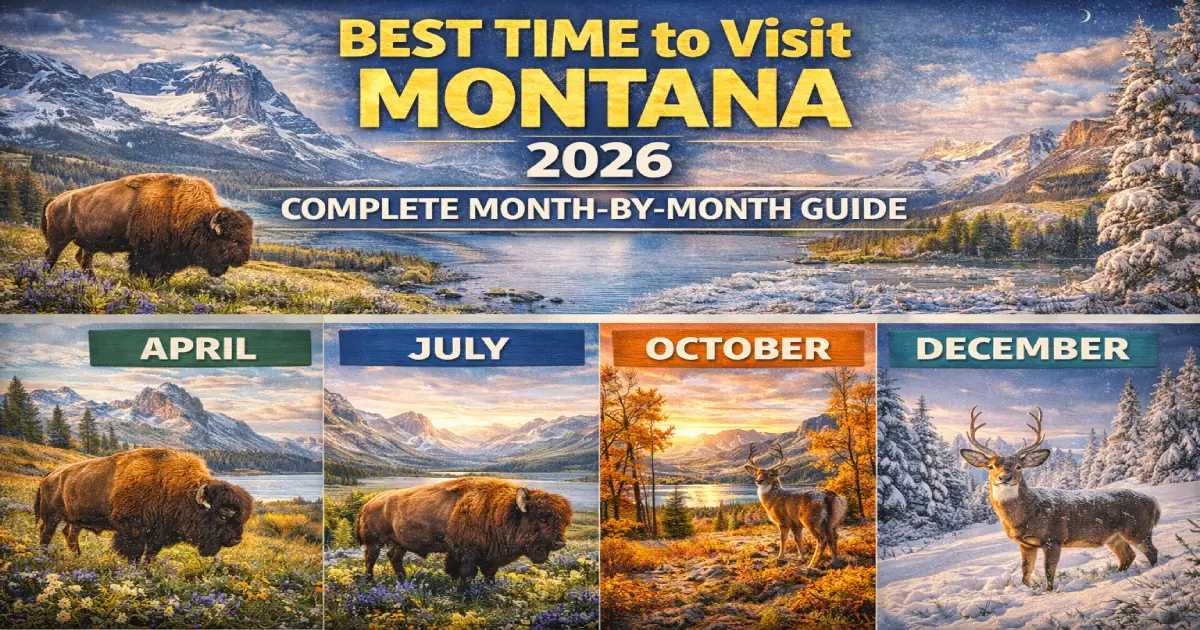
Best Time to Visit Montana 2026: Complete Month-by-Month Guide
Published on : 03 Apr 2026
Best Time to Visit Montana — America’s Last Best Place Has Seasons That Demand Respect
By Travel Tourister | Updated March 2026
Montana’s seasons are not a matter of preference — they are a matter of access. The Going-to-the-Sun Road in Glacier National Park is buried under 60 feet of snowpack in January and does not fully open until early July in most years; the Madison River’s salmonfly hatch lasts approximately two weeks in late May to early June and produces the finest dry fly fishing in America during that specific window and only during that window; the larch trees in Glacier’s forests turn gold between September 20 and October 10 in most years and have dropped their needles by Halloween; the grizzly bears in Many Glacier are most reliably visible at the Swiftcurrent Lake shoreline in July and August and have retreated to winter dens by November. Montana’s finest activities are not available year-round — they are available in specific seasonal windows that reward the visitor who plans around them and disappoint the one who doesn’t.
I’ve visited Montana in every season — the July morning when the Going-to-the-Sun Road was fully open and the wildflowers at Logan Pass were at peak and the mountain goats were on the road’s edge and the parking lot was full by 10 AM and the shuttle was the most useful transportation decision I made all trip, the late September week when the larch trees were gold and the elk were bugling in the Madison Valley and the Glacier crowds had evaporated and the hotel in Whitefish cost $90 less per night than it did in August, the February Big Sky morning when 18 inches of new snow had fallen overnight and the Lone Mountain tram was running and the powder on the Headwaters terrain was the most specifically joyful skiing I’ve had anywhere in the West, and the late May afternoon at Quake Lake when the river guide said “the salmonflies are coming tomorrow” and the following morning the entire Madison River was covered in 3-inch stoneflies and every trout in the system was feeding on the surface. Each visit confirmed that Montana’s seasonal intelligence — knowing which window to target and which to avoid — determines the quality of the trip more decisively than any other planning decision available.
This comprehensive 2026 guide breaks down Montana’s best and worst visiting times using verified weather data from Montana Climate Office, National Park Service seasonal records, and years of on-the-ground seasonal expertise. We cover every month in detail, identify the best times for specific activities, flag the major annual events and natural phenomena that make specific windows irreplaceable, and give you the complete strategic intelligence to choose the right Montana season for your priorities.
Montana: Quick Season Overview
Season / Month
Weather (Missoula/Bozeman)
Crowds
Hotel Prices
Key Activities Open
January
20–32°F, deep snow, cold
Low (ski resorts moderate)
$95–$145 (Missoula/Bozeman); $185–$285 (Big Sky)
Skiing, snowshoeing, indoor museums
February
24–36°F, prime ski season
Low–Moderate (Presidents’ Week)
$100–$155; ski resorts higher
Skiing, snowshoeing, Izaak Walton cross-country
March
28–45°F, variable, mud season
Low
$90–$140
Skiing (late season), Russell Art Show Great Falls
April
35–55°F, wet, muddy, warming
Very Low
$85–$130
Lower elevation hikes, early season fishing
May
45–65°F, warming, wildflowers
Low
$95–$145
Salmonfly hatch (Madison), Freezout Lake birds
June
55–75°F, pleasant, some rain
Moderate
$115–$175
Rafting, fishing, partial Glacier road opening
July
70–88°F, warm, dry, sunny
Very High
$155–$245
Everything open: Glacier, Beartooth, all hiking
August
68–86°F, warm, fire smoke risk
Very High
$165–$255
Peak season all activities; wildfire smoke occasional
September
50–72°F, excellent, cooling
Moderate
$125–$185
Best overall: elk rut, Glacier, fly fishing, larches
October
35–58°F, larch color, early snow
Low
$105–$155
Larch gold (early Oct), elk rut, budget fishing
November
22–40°F, early winter, cold
Very Low
$85–$125
Early skiing, hunting, wildlife viewing Lamar Valley
December
15–30°F, ski season opens, cold
Moderate (holidays)
$110–$175; ski resorts higher
Big Sky and Whitefish ski season, Yellowstone winter
Best Overall Times to Visit Montana
1. September — THE BEST OVERALL MONTH TO VISIT MONTANA
Why September Is Montana’s Finest Month: September is the month when Montana is most completely itself — the Going-to-the-Sun Road is fully open without July’s crowd pressure, the Glacier larch forests begin turning gold in the final week (the most specifically beautiful natural event in the Montana calendar), the elk rut is beginning in the Madison and Gallatin valleys (bull elk bugling at dawn and dusk, audible from pullouts on US-287 north of Ennis without binoculars), the Madison River’s brown trout are the most actively feeding of any September month in a season that produces the finest dry fly fishing available in the American West, and the Glacier crowd levels have dropped by 40–60% from the August peak while the temperatures remain excellent for hiking (50–72°F daytime, 35–45°F overnight). September is the month that Montana residents treat as their own — the month when they reclaim the trails, the rivers, and the mountain roads from the summer tourist peak and inhabit them in the most specific and the most rewarding version of Montana life.
September Highlights:
Glacier crowds reduced 40–60%: The same Going-to-the-Sun Road, the same Grinnell Glacier trail, the same Many Glacier grizzly viewing — at dramatically reduced parking pressure and without the Logan Pass mid-day crowd that makes July logistics challenging
Larch trees turning gold (late September): The western larch — Montana’s only deciduous conifer — turns brilliant gold between September 20 and October 10 in most years, producing the most specifically beautiful Glacier National Park color available at any season and the most unexpected display of fall color in a landscape most visitors associate with evergreen forests
Elk rut (mid-September–early October): The most aurally and behaviorally specific wildlife event in Montana — bull elk bugling at dawn and dusk in the Madison Valley, the Gallatin Valley, and the Yellowstone river corridor; audible without spotting scopes from roadside pullouts along US-287 and US-191
Fly fishing at its finest: September’s cooler water temperatures (48–55°F) activate brown trout feeding behavior on the Madison, Gallatin, and Bighorn Rivers — the finest month for experienced anglers on any Montana blue-ribbon trout stream
Hotel pricing down from peak: $125–$185/night in Whitefish and Bozeman — a 25–35% reduction from August’s peak pricing with comparable or superior outdoor conditions
Weather: 50–72°F daytime; 35–45°F overnight; the most reliably clear and smoke-free weather of the summer-fall transition; occasional early-season snow possible at high elevations after September 20
Average temperatures: 50–72°F daytime; 35–45°F overnight; high elevations (Logan Pass) can see snow after September 15
Hotel rates: $125–$185/night Bozeman/Whitefish midrange; Big Sky $185–$275/night
2. July — Best for Full Access to All Montana Activities
Why July Is Montana’s Most Comprehensively Accessible Month: July is the only month when everything in Montana is simultaneously open and accessible — the Going-to-the-Sun Road is fully open to Logan Pass (typically the first week of July in most years), the Beartooth Highway is reliably clear of snow, the Grinnell Glacier trail is snow-free and accessible, the Madison River’s summer hatches are active, Glacier’s wildflowers are at peak bloom in the alpine meadows, the grizzly bears are visible in Many Glacier, and the temperatures in the valley floors (70–88°F) are the most comfortable for extended outdoor activity without the heat that makes some August afternoons oppressive. July is the most logistically straightforward Montana month for a first-time visitor — everything is open and accessible without the specific knowledge that makes September’s combination of experiences so rewarding.
Going-to-the-Sun Road fully open: Typically fully open to the full 50-mile length by the first week of July — the most reliable window for the complete road experience without snow closures or partial access restrictions
Glacier wildflowers at Logan Pass (mid-July): The alpine meadows at Logan Pass are the most flower-dense anywhere in the Glacier NP system in mid-July — beargrass, glacier lilies, Indian paintbrush, and the specific purple-and-white combination of Lewis’s monkeyflower in the seeps below the snowfields
Grizzly bears visible in Many Glacier: Early July is the most reliably productive grizzly viewing in Many Glacier — the bears are feeding on glacier lily bulbs and early berries on the slopes above Swiftcurrent Lake, visible from the hotel’s back porch and the parking area
July 4th events: The Livingston Roundup Rodeo (July 4th weekend) and the statewide July 4th celebrations — the most festive and the most community-specific Montana events accessible in any summer month
Hotel pricing at peak: $155–$245/night in Bozeman and Whitefish — the highest pricing of any non-ski month; book 3–4 months ahead for July accommodation in Glacier-adjacent towns
Hotel rates: $155–$245/night; book 3–4 months ahead for Whitefish, East Glacier, and West Glacier area lodging
3. Late May to Early June — Best for Fly Fishing and the Salmonfly Hatch
Why the Salmonfly Window Is Worth Planning a Trip Around: The salmonfly hatch on the Madison River — the annual emergence of Pteronarcys californica, the largest stonefly in North America (adults reach 3 inches in length), from the river’s gravel beds in late May to early June — is the single most anticipated natural event in the American fly fishing calendar. For approximately 2 weeks each year, the Madison River’s surface is covered with these enormous insects, every trout in the river is feeding aggressively on the surface, and the fishing conditions produce the most sustained dry fly action available at any trout fishery in the continental United States. Anglers plan trips 12 months ahead specifically around this window.
The salmonfly hatch (late May–early June): The emergence moves upriver from Ennis Lake toward Quake Lake — beginning at the downstream end around May 20–25 and moving upstream over 10–14 days; the hotline for current hatch position: call local fly shops in Ennis daily as the date approaches
Weather: 45–65°F daytime — cool enough for wading comfort, warm enough for outdoor enjoyment; the most pleasant temperature range for a full day of wading the Madison
Wildflowers in the Flathead Valley: The May bloom in the Mission Valley and the Flathead Lake area produces the most spectacular wildflower display in lowland Montana — the balsamroot and arrowleaf sunflower fields visible from US-93 between Missoula and Kalispell
Hotel pricing low: $95–$145/night — among the lowest pricing available in any active outdoor season
Limitations: The Going-to-the-Sun Road is not yet fully open in May (typically only the lower sections are accessible); the alpine hiking trails are still snow-covered; Glacier’s backcountry is accessible only to experienced mountaineers
Hotel rates: $95–$145/night — excellent value for the most anticipated fishing event of the year
4. February — Best for Skiing
Why February Is Montana’s Finest Ski Month: February delivers the best combination of snowpack depth, snow quality, and daylight length of any Montana ski month — the snowpack has been building since November and has reached its seasonal maximum at Big Sky and Whitefish, the coldest temperatures of mid-winter have produced the finest powder snow quality of the season, and the 10+ hours of daylight make full ski days possible without the shortened light of December and early January. Big Sky’s Headwaters terrain (open only when the snowpack is sufficient — typically not until January) is at its most reliably accessible in February, and Whitefish Mountain Resort’s snowghost trees (the rime ice formations on the summit trees) are at their most photogenically specific.
Big Sky February: The most reliable month for the full Big Sky terrain to be open — the Lone Mountain Summit Tram, the Headwaters expert chutes, and the intermediate terrain on Andesite and Flat Iron all typically operating at full capacity
Whitefish February: The snowghost trees are most reliably visible and most photographically dramatic in February — the rime ice formations require specific Pacific moisture events combined with below-freezing temperatures to form
Presidents’ Week: The third week of February brings the most concentrated ski traffic of the season — book 6–8 weeks ahead for Presidents’ Week accommodation at Big Sky and Whitefish; prices spike 30–50% for this specific week
Yellowstone snowcoach tours (January–March): The Old Faithful snowcoach tours and the winter wildlife viewing programs in Yellowstone’s interior (accessible only by snowcoach or snowmobile in winter) produce the most dramatically specific winter Yellowstone experience — bison in the geyser basins’ steam, wolves in the Lamar Valley in pristine snow conditions
Hotel rates: $100–$155/night Missoula/Bozeman; Big Sky $225–$395/night; Whitefish $165–$285/night; Presidents’ Week significantly higher
Month-by-Month Breakdown
January: Deep Winter — Montana’s Most Purely Cold Month
Weather: 20–32°F average highs in Missoula and Bozeman; -5 to -20°F on cold snaps in the mountain valleys; the Flathead Valley regularly records -20°F; Big Sky averages -5°F overnight in January; 9.5 hours of daylight; snowpack at mountain elevations typically 60–100+ inches by late January
What’s Great:
Big Sky and Whitefish skiing: January is the beginning of the prime skiing window — the snowpack is building toward its seasonal maximum; Big Sky’s powder days are the most celebrated of the season; the Lone Mountain tram is running and the terrain is predominantly open
Montana Pro Rodeo Circuit Finals (Great Falls, January): The indoor rodeo championship that brings the finest professional rodeo competition to Montana’s largest open indoor arena — the most winter-specific Montana cultural event accessible in any January
Yellowstone winter wildlife: January is the finest month for Yellowstone’s winter wildlife viewing — the wolves in the Lamar Valley are most active and most visible in pristine snow conditions; the Old Faithful area’s steam and snow combination is the most photographically dramatic of any Yellowstone season
Lowest hotel prices of the year (non-ski areas): $95–$145/night in Missoula and Bozeman — the finest value for museum visits, the C.M. Russell Museum in Great Falls, and the Lewis and Clark Interpretive Center
Izaak Walton Inn cross-country skiing: The historic Great Northern Railway hotel near Essex (accessible by Amtrak Empire Builder) provides the most romantically remote Montana winter lodging, with cross-country ski trails into Glacier National Park’s winter wilderness
What’s Challenging: January cold in Montana is genuinely serious — not a matter of dressing warmly but of understanding that -20°F overnight temperatures in the mountain valleys freeze vehicle diesel fuel, require engine block heaters, and make tire pressure management essential. The Going-to-the-Sun Road is inaccessible by car from November through late June in its upper sections. Most Glacier National Park hiking trails are under 4–8 feet of snow. The challenge is real; the skiing reward is equally real.
Verdict: Montana’s finest winter recreation month for skiers; genuinely challenging for non-skiing visitors; the most cold-specific and the most appropriately humbling version of Montana
Average hotel rate: $95–$145/night (Missoula/Bozeman); $185–$295/night (Big Sky)
February: Prime Ski Season and the Finest Powder
Weather: 24–36°F average highs; the coldest overnight lows of the season in some years (-15 to -25°F in valley bottoms on cold snaps); snowpack at maximum depth; 10.5 hours of daylight; the most consistent powder conditions of any ski month
What’s Great:
Big Sky Headwaters terrain fully open (typically): The most expert terrain at Big Sky — the Big Couloir and the multiple steep chutes accessible from the Lone Peak Tram — requires a minimum snowpack depth that is most reliably achieved in February; the finest skiing accessible at any Montana resort is on Lone Mountain’s Headwaters in deep February snow
Whitefish snowghost trees: The rime ice formations on Big Mountain’s summit trees — most reliably present in February’s combination of Pacific moisture and sustained cold temperatures
Yellowstone snowcoach tours: The interior of Yellowstone accessible only by snowcoach in winter — the Old Faithful snowcoach tour ($125–$175/person from West Yellowstone) delivers the geothermal landscape in the most dramatically steam-and-snow-specific conditions of any season
Valentine’s Day at Lone Mountain Ranch (Big Sky): The most romantically positioned cross-country ski resort in Montana — the Nordic trail system through the Madison Range snow, combined with the ranch’s dining and lodging, produces the most specifically Montana Valentine’s experience accessible anywhere in the state
What’s Challenging: Presidents’ Week (third week of February) is the most crowded and the most expensive ski week in Montana — Big Sky’s lift lines are at their longest and the Whitefish accommodation is the most difficult to secure without advance booking. Book Presidents’ Week accommodation 8–10 weeks ahead or expect significant premium pricing and limited availability.
Verdict: Montana’s finest skiing month; the most consistently excellent powder conditions; Presidents’ Week requires advance planning
Average hotel rate: $100–$155/night (Bozeman); Big Sky $225–$395/night; Presidents’ Week $275–$450/night Big Sky
March: Late Ski Season and Mud Season Transition
Weather: 28–45°F average highs; variable — March can deliver blizzard conditions in the first week and 55°F sunshine in the last; the transition from winter to spring mud season begins in the valley floors by mid-March; ski resorts remain viable through late March or early April in most years; 12 hours of daylight
What’s Great:
Charlie Russell Art Show and Auction (Great Falls, mid-March): The most commercially significant Western art event in Montana — the annual Russell Art Show in Great Falls produces the most concentrated gathering of Western artists and collectors accessible in the state, with gallery exhibitions, an auction, and the most specifically Montana art-week experience available in any month
Late-season skiing: Big Sky and Whitefish remain open through late March (Big Sky sometimes into mid-April) — the spring skiing conditions (corn snow on warmer days, powder after spring storms) appeal to the most experienced skiers who appreciate variable spring conditions over the consistent cold of mid-winter
Lowest hotel prices of the active seasons: $90–$140/night — March non-ski shoulder pricing is the lowest available in any month with accessible outdoor recreation
What’s Challenging: March is Montana’s most seasonally indeterminate month — the valley floors are mud-season wet and the mountain roads are still under snow; neither skiing nor hiking nor fishing is at its best; the Going-to-the-Sun Road won’t open for another 3–4 months; and the overall visitor experience is the most compromised of any Montana month. The Russell Art Show is the specific reason to target Great Falls in March; without it, the month’s limitations outweigh its advantages for most visitor types.
Verdict: Good for late-season skiers and the Russell Art Show; the weakest outdoor recreation month in the annual Montana calendar
Average hotel rate: $90–$140/night
April: Mud Season — Montana’s Least Recommended Month
Weather: 35–55°F average highs; wet, muddy, variable; the valley floors are transitioning from winter to spring but producing the mud conditions that give “mud season” its name; mountain passes still snowed in; ski resorts closed or closing; most hiking trails inaccessible; 13.5 hours of daylight
What’s Great:
Lower-elevation hiking returning: The valley-floor and foothill trails (the Rattlesnake Wilderness near Missoula, the M Trail above Bozeman) are accessible in April — muddy but hikeable; the first wildflowers of the season (buttercups, shooting stars) are appearing on south-facing slopes
Lowest hotel prices of the year: $85–$130/night — the most affordable Montana accommodation available at any time of year, reflecting the genuinely limited outdoor recreation available
Antler sheds visible: Elk, moose, and deer shed their antlers in early spring — the most productive season for backcountry shed hunting on the national forests and public lands accessible in April’s lower-elevation snow conditions
What’s Challenging: April is Montana’s least recommended visiting month for most visitor types — the outdoor recreation range is the narrowest of any active season, the mountain roads and alpine trails are impassable, the rivers are in runoff flood stage (not yet fishable in most years), and the valley-floor mud conditions make most unpaved roads impassable to standard vehicles. The most honest advice: if you must visit Montana in April, base yourself in Missoula (the most culturally active city in Montana when the outdoor season is limited) and enjoy the Clark Fork River trail, the Rattlesnake Wilderness lower trails, and the university town culture that makes Missoula genuinely enjoyable in any season.
Verdict: Montana’s least recommended month for most visitor types; fine for Missoula culture; the mud season reality is the most significant outdoor recreation limitation of any Montana month
Average hotel rate: $85–$130/night — the cheapest of the year
May: Spring Awakening and the Salmonfly Hatch
Weather: 45–65°F average highs; the most variable month — warm sunny days can reach 70°F while late spring snowstorms can produce 6–12 inches of snow in the mountain passes; valley floors green and blooming by mid-May; rivers running high with snowmelt; 14.5 hours of daylight
What’s Great:
Madison River salmonfly hatch (late May–early June): The most anticipated event in American fly fishing — the 2-week window when Pteronarcys californica stoneflies emerge from the Madison’s gravel beds and every brown and rainbow trout in the river is feeding aggressively on the surface. The hatch begins downstream near Ennis Lake around May 20–25 and moves upriver over 10–14 days. The specific daily position of the hatch is tracked by the Ennis Fly Shop and Madison River Outfitters — call them in the week before your visit for the most current hatch position
Freezout Lake WMA snow geese migration (March–April peak, extending into May): The largest snow goose concentration on the Pacific Flyway (300,000+ birds) stages at Freezout Lake WMA north of Choteau — peak migration in March–April but spectacular numbers can persist into early May
Flathead Valley wildflower bloom: The Mission Valley’s balsamroot and arrowleaf sunflower bloom — the most spectacular lowland wildflower display in Montana, visible from US-93 between Missoula and Kalispell from mid-May through early June
National Bison Range calving season: May is the most active calving month at the National Bison Range near Moiese — newborn bison calves (the most specifically appealing wildlife sight in any Montana spring) are most visible in the first two weeks of May
What’s Challenging: The Going-to-the-Sun Road’s upper section is still closed by snowpack in May (typically only the lower sections — Lake McDonald corridor and the St. Mary Lake area — are accessible). The high country trails are under snow. The rivers are in high-water runoff that makes most wading dangerous. The salmonfly hatch is the specific activity that justifies a May visit; without it, the month’s limitations outweigh its advantages for most visitor types.
Verdict: Essential for fly fishing visitors targeting the salmonfly hatch; limited for Glacier and alpine hiking visitors; the most affordable and the least crowded month with a genuinely world-class specific activity window
Average hotel rate: $95–$145/night
June: The Season Opens
Weather: 55–75°F average highs; the most reliably pleasant temperatures of the outdoor season; some afternoon thunderstorms in the mountain parks; snowmelt rivers at their most dramatic (whitewater season peak); 15.5 hours of daylight; the Going-to-the-Sun Road opening progressively through the month
What’s Great:
Going-to-the-Sun Road partial opening: The lower sections of the Going-to-the-Sun Road (Lake McDonald to the Avalanche Creek area on the west side; St. Mary Lake area on the east side) are accessible by mid-June in most years; Logan Pass typically opens by late June to early July
Whitewater rafting at peak: The June snowmelt produces the highest water levels of the season on the Flathead, Gallatin, and Clark Fork Rivers — the most technically demanding and the most adrenaline-specific whitewater accessible in Montana is concentrated in the June high-water window
Fishing improving: The rivers begin dropping from spring runoff levels in June, with the Gallatin and smaller Madison tributaries becoming wadeable by mid-June — the caddis and PMD (Pale Morning Dun) hatches on the Gallatin are the first significant summer hatches
Grizzly bears in Many Glacier: June is the first month when grizzly bears are reliably visible in the Many Glacier Valley — fresh from winter dens and feeding actively on glacier lily bulbs at lower elevations
What’s Challenging: June’s Going-to-the-Sun Road is still partially restricted through mid-month — the Logan Pass section is typically the last to open, usually late June to early July. Some high-country hiking trails remain snow-covered through June. The shoulder season pricing and the partial park access make June a transitional month rather than a primary visiting window for most visitor types.
Verdict: Excellent for whitewater rafting, early-season fishing, and Glacier’s lower-elevation areas; transitional for the full Going-to-the-Sun Road experience; the best shoulder month before the July peak
Average hotel rate: $115–$175/night
July: Peak Season — Everything Is Open
Weather: 70–88°F average highs in Bozeman and Missoula; cooler at elevation (55–70°F at Logan Pass); the driest and the sunniest month; afternoon thunderstorm risk in the mountain parks (typical pattern: clear mornings, clouds building by noon, afternoon thunder and lightning at elevation, clearing by evening); 15.5 hours of daylight
What’s Great:
Everything is open: The Going-to-the-Sun Road is fully accessible to Logan Pass (typically fully open by the first week of July); the Beartooth Highway is open; all Glacier hiking trails are snow-free; the Madison River is fishing well; the National Bison Range is fully operational
Glacier wildflowers at peak (mid-July): Logan Pass’s alpine meadows — beargrass, Indian paintbrush, glacier lily, and Lewis’s monkeyflower — are the most flower-dense in the park system in the second and third weeks of July
Livingston Roundup Rodeo (July 4th weekend): The most festive and the most community-specific Montana rodeo event — the Crazy Mountains visible from the arena, the full Livingston community participating in the most Independence Day-specific rural Western event in the state
Montana Folk Festival (Butte, mid-July): The largest free folk festival in the western United States — three days of traditional music on the streets of historic Butte; free admission
What’s Challenging: July is Montana’s most crowded month — the Going-to-the-Sun Road’s Logan Pass parking lot fills by 10 AM on most days (use the free shuttle); the Grinnell Glacier trailhead has the most consistent crowd pressure of any Glacier trail; and the Lamar Valley’s early-morning wildlife viewing is shared with the most other visitors of any Yellowstone month. The wildfire smoke risk increases in late July — some years produce significant smoke from Idaho and eastern Montana fires. Book July accommodation 3–4 months ahead in Glacier-adjacent towns.
Verdict: The most comprehensively accessible Montana month; the most logistically straightforward for first-time visitors; the most crowded and the most expensive non-ski month
Average hotel rate: $155–$245/night; West Glacier, Whitefish, and East Glacier $165–$275/night
August: High Season with Wildfire Smoke Risk
Weather: 68–86°F average highs; the driest month; wildfire smoke is the most significant August weather variable — some years produce clear skies throughout the month; other years (particularly drought years) produce smoke that dramatically reduces visibility in Glacier and the mountain parks for days or weeks; 13.5 hours of daylight
What’s Great:
All activities continue at full capacity: Glacier, Beartooth, Yellowstone, all hiking, all fishing — August provides no access limitations beyond the wildfire smoke risk
Huckleberry season: Montana’s wild huckleberries (the most specifically Montana summer fruit, the basis for the state’s most beloved jam, pie, and ice cream) ripen in August — roadside stands along US-2 near Glacier and US-93 near the Flathead Lake produce the most authentic Montana summer food experience
Mountain bike season at peak: The Whitefish Trail system and the Big Sky lift-served mountain biking are at their most consistently accessible in August — the dry conditions and the extended daylight make August the finest mountain biking month in Montana
Flathead Lake sailing and kayaking at their warmest: The lake reaches its warmest temperatures in August (65–70°F surface) — the most comfortable open-water paddling and sailing of the season
What’s Challenging: Wildfire smoke is August’s most significant visitor experience risk — in drought years, the Glacier mountains can be completely invisible from the Going-to-the-Sun Road for days at a time, and the air quality can reach unhealthy levels for sensitive groups. The smoke risk is impossible to predict more than 48–72 hours ahead; purchase travel insurance that covers smoke-related activity cancellations and check AirNow.gov daily during August Montana visits. August also carries the year’s highest hotel prices in Glacier-adjacent towns and the most pressure on the park’s timed entry reservation system.
Verdict: Full access to all Montana activities at the highest prices; wildfire smoke is the specific and uncontrollable variable that makes August more risky than July or September for the visitor whose primary activity requires clear mountain visibility
Average hotel rate: $165–$255/night — the highest of any non-ski month
September: The Best Month — Montana’s Finest Season
Weather: 50–72°F average highs in Bozeman and Missoula; 35–45°F overnight; the most consistently clear and smoke-free weather of the summer-fall transition; early-season snow possible at Logan Pass (6,646 feet) after September 15; the Going-to-the-Sun Road typically remains open through early to mid-October; 12 hours of daylight
What’s Great:
Larch trees turning gold (late September): The western larch begins turning gold in the higher elevations of Glacier’s forests between September 20 and October 10 in most years — the Highline Trail corridor, the Many Glacier valley sides, and the Two Medicine area produce the most dramatic and the most specifically unexpected fall color accessible in Montana. The larch gold against the dark green subalpine fir and the grey granite of the Garden Wall is the most specifically beautiful Montana landscape visible at any season.
Elk rut beginning (mid-September): The bull elk’s bugling — the most aurally specific wildlife sound in North America — begins in the Madison Valley, the Gallatin Valley, and the Yellowstone river corridor in mid-September; the peak bugling activity (dawn and dusk) is audible from pullouts on US-287 north of Ennis without binoculars or spotting equipment
Glacier crowds reduced 40–60% from August: The same trails, the same wildlife, the same scenic road — at dramatically reduced parking pressure and logistical friction
Madison River brown trout fishing at peak: September’s cooler water temperatures activate brown trout feeding behavior — the most experienced fly fishing visitors target September specifically for the brown trout, whose fall feeding preparation for winter produces the most aggressive surface feeding of any Madison River month
Hotel pricing drops from August peak: A 25–35% reduction from August’s peak pricing in the first week of September as the summer-tourist demand falls away
Verdict: Montana’s finest overall month — the most rewarding combination of activities, conditions, pricing, and crowd levels available in the annual calendar; the month Montana residents reclaim as their own
Average hotel rate: $125–$185/night
October: Larch Color and Value Pricing
Weather: 35–58°F average highs; overnight temperatures dropping toward freezing by mid-month; early-season snow possible at any elevation after October 1 and increasingly likely after October 15; the Going-to-the-Sun Road typically closes by mid-October (weather dependent — closures can come earlier in heavy snow years); 11 hours of daylight
What’s Great:
Larch gold peak (first two weeks of October): The most vivid and the most accessible larch color display in Glacier National Park — the western larch forests in Many Glacier, along the Highline Trail corridor, and in the Two Medicine Valley are brilliant gold in the first two weeks of October, with the color persisting until the first significant October snowfall that strips the needles
Elk rut continuing (early October): The elk rut peaks in the first two weeks of October before declining; the most dramatic single-bull territorial displays are most frequently observed in this window
Lamar Valley wolf and bison viewing: October is one of the finest months for Lamar Valley wildlife viewing — the elk rut draws predators to the valley, wolf activity increases around elk herds, and the bison begin congregating for the approaching winter
Budget pricing: $105–$155/night — a significant drop from September and August pricing with comparable or superior fall color conditions in the early part of the month
What’s Challenging: The Going-to-the-Sun Road closes to vehicles at Logan Pass by mid-October in most years — the upper sections of the road can close any time after October 1 with significant snowfall. The Beartooth Highway typically closes by mid-October. Check current road conditions at nps.gov/glac before planning any October Glacier visit around specific high-elevation activities.
Verdict: Excellent for the first two weeks (larch color peak, elk rut, good weather, low prices); uncertain for the second two weeks (early snow closures possible at high elevation); the finest budget month with genuine natural spectacle
Average hotel rate: $105–$155/night
November: Early Winter — Montana Goes Local
Weather: 22–40°F average highs; the first significant snowfall in the mountain valleys; Big Sky and Whitefish ski resorts typically opening in late November; Glacier National Park’s road network largely closed to vehicles; 9.5 hours of daylight
What’s Great:
Early ski season at Big Sky and Whitefish: The first significant snowfall typically arrives at Big Sky and Whitefish Mountain Resort between November 15 and December 1 — early-season skiers who are willing to accept limited terrain access in exchange for fewer crowds and lower lift ticket prices find November’s first weeks appealing
Lamar Valley wolf watching in snow conditions: November’s first snowfall produces the most dramatically scenic wolf watching conditions in Yellowstone — wolves visible on white snow at 400+ yards with the Lamar Valley’s distinctive golden grassland now white; the most photographically specific wolf watching of any season
Hunting season (rifle season for elk, deer, and antelope): Montana’s rifle hunting seasons (typically late October through early December) fill the public lands with hunters and fill the state’s small-town diners and outfitter shops with the most specifically Montana social culture accessible at any time of year
What’s Challenging: November is Montana’s most transitional month — the ski resorts haven’t fully opened, the outdoor recreation that makes summer and fall so rewarding is largely unavailable, and the cold is genuine without the deep snow that makes winter beautiful. The most honest advice: November is a month for winter preparation, hunting culture, and early ski season reconnaissance rather than the primary Montana outdoor experience.
Verdict: Limited outdoor recreation; good for hunters, early skiers, and Lamar Valley winter wildlife; the most locally authentic and the least tourist-facing month in Montana
Average hotel rate: $85–$125/night — second-cheapest of the year
December: Ski Season Begins and Winter Settles
Weather: 15–30°F average highs in Bozeman and Missoula; 0 to -15°F in the mountain valleys on cold snaps; Big Sky and Whitefish ski resorts fully operational by mid-December in most years; Yellowstone accessible by snowcoach from December 15 through March; 8.5 hours of daylight (shortest days of the year)
What’s Great:
Big Sky ski season in full operation: By the third week of December, Big Sky’s full trail map is typically accessible — the most terrain and the longest days of the early ski season are concentrated in the last week of December
Yellowstone winter opening (December 15): The interior of Yellowstone — inaccessible by car from November through mid-March — opens to snowcoach and snowmobile tours on approximately December 15 each year; the Old Faithful snowcoach tour ($125–$175/person from West Yellowstone) produces the most dramatically winter-specific Yellowstone experience
Holiday week at Big Sky: The Christmas-New Year’s week (December 24–January 2) produces the most festive and the most fully subscribed ski resort week in Montana — the most socially active and the most expensive single week of the ski season
Christmas culture in Montana’s small towns: Whitefish and Bozeman’s downtown Christmas celebrations are the most specifically small-city festive events accessible in Montana — the Whitefish Winter Carnival (January) launches from a December of decoration that makes the downtown the most decorated Christmas streetscape in northwest Montana
What’s Challenging: The Christmas-New Year’s week is the most expensive single week of the Montana ski season — Big Sky accommodation reaches $350–$500/night and the resort’s lift lines are at maximum length; book 4–6 months ahead for this specific week or expect the most limited remaining availability at the highest prices. Early December (before December 20) offers the opening ski season excitement without the holiday pricing and crowd pressure.
Verdict: Excellent for ski resort visitors; the holiday week requires advance planning; the Yellowstone winter opening on December 15 is the most specifically extraordinary winter wildlife access available in the national park system
Average hotel rate: $110–$175/night (Bozeman); Big Sky $245–$395/night; holiday week $350–$500+ Big Sky
Best Times for Specific Montana Activities
Best Time for Glacier National Park
Going-to-the-Sun Road fully open: Early July through mid-October (weather dependent; the road typically opens fully to Logan Pass in the first week of July and closes progressively with snowfall in October). The road’s opening date varies by 1–3 weeks annually depending on winter snowpack — check nps.gov/glac for the current-year opening schedule, which is posted as snowplowing progresses through spring.
Best crowd management: September (first two weeks) — the road is fully open, crowds are 40–60% below the August peak, the larch trees begin turning gold in the final week, and the hotel pricing has dropped from the summer peak. The finest single Glacier National Park visiting window for most visitor priorities.
Timed entry reservations (2026): Timed vehicle entry reservations for the Going-to-the-Sun Road corridor are required from approximately late May through mid-September. Reservations open at recreation.gov 60 days ahead for the primary allocation and 1 day ahead for the remainder. The most popular July dates (July 4th week, mid-July to mid-August) sell out within minutes of opening — set an alarm and be online at 8 AM MST on the day the 60-day window opens for your visit date.
Avoid: Visiting without a vehicle reservation in peak season (the park’s timed entry system turns away hundreds of vehicles daily during July–August); arriving at Logan Pass after 9 AM on any July or August day without shuttle access.
Best Time for Fly Fishing
Salmonfly hatch (Madison River): Late May to early June — the most anticipated single event in American fly fishing; the specific 10–14 day window moves upriver from Ennis Lake toward Quake Lake; track the hatch’s daily position by calling the Ennis Fly Shop (406-682-4263) or Madison River Outfitters in West Yellowstone.
Summer fishing (June–August): The Madison, Gallatin, and Bighorn Rivers all fish well through the summer — the caddis hatches in June–July and the terrestrial (hoppers and beetles) season in August produce the most consistent dry fly action after the salmonfly hatch.
Fall fishing (September–October): September is the finest month for experienced anglers targeting brown trout on the Madison and Gallatin — the falling water temperatures activate fall feeding behavior; the most trophy-size brown trout are caught in September–October on any Montana blue-ribbon stream.
Smith River permit lottery: Applications open in November for the following spring’s float season; results announced in January; book the outfitter or self-guided equipment immediately upon receiving a permit.
Best Time for Skiing
Optimal: January and February produce the finest powder conditions and the most open terrain at Big Sky and Whitefish Mountain Resort — the snowpack has reached maximum depth and the cold temperatures have preserved the snow quality from November’s base-building phase. Big Sky’s Headwaters terrain (the most expert and the most coveted) is most reliably accessible in January–February.
Presidents’ Week (third week of February): The most crowded and the most expensive single ski week in Montana — book accommodation 8–10 weeks ahead; expect lift line waits of 10–25 minutes on the most popular runs; the resort’s social energy is the most festive of any week in the ski season.
Spring skiing (March–early April): The most relaxed and the most technically varied ski conditions — corn snow on warm afternoons, powder after spring storms, and the most laid-back resort atmosphere of any ski period. Big Sky’s spring skiing (March through the resort’s closing, typically mid-April) delivers the most terrain at the lowest lift ticket pricing of the season.
Best Time for Wildlife Watching
Grizzly bears in Glacier (Many Glacier): June through September — most reliably visible in early July when feeding on glacier lily bulbs at lower elevations; the Many Glacier Valley’s slopes above Swiftcurrent Lake are the most productive viewing area.
Wolves and bison in Lamar Valley (Yellowstone): Year-round, but the finest viewing in May–June (wolf pup season; bear emergence) and September–October (elk rut draws wolves to prey; fall bison congregation). November–February in snow conditions produces the most dramatically photogenic wolf viewing.
Elk rut: Mid-September through mid-October — the Madison Valley north of Ennis (US-287) and the Gallatin Valley north of Bozeman (US-191 at the 4-Corners area) produce the most audible and the most accessible roadside elk rut viewing in Montana without entering a national park.
Freezout Lake snow geese: March–April (peak; the March window is most reliably spectacular with 300,000+ birds) extending into early May. The most spectacular free wildlife event in Montana is the Freezout Lake snow goose migration — an experience that produces no adequate verbal description and requires personal observation to understand.
Montana Timing: Practical Tips
Topic
What to Know
Glacier NP Road Opening Schedule
The Going-to-the-Sun Road opens progressively from both ends as snowplowing proceeds through spring — the lower sections (Lake McDonald corridor on the west; St. Mary Lake on the east) open in May–June; Logan Pass typically opens fully in the first week of July (varies 1–3 weeks annually). The road closes progressively in fall with the first significant snowfall — typically mid-October but can close as early as late September in heavy snow years. Current road status at nps.gov/glac/planyourvisit/roads.htm. The most critical planning fact: do not purchase non-refundable flights and accommodation for a first-week-of-July Going-to-the-Sun Road visit without checking the current-year opening schedule, as late snowpack years can delay the full opening by 2+ weeks.
Wildfire Smoke Strategy
Montana’s wildfire smoke is the most consequential uncontrollable variable in the August–early September Montana visitor experience — drought years (2017, 2018, 2021, 2023 were particularly smoky) can produce weeks of haze that makes the Glacier mountains entirely invisible from the Going-to-the-Sun Road and the Beartooth Highway’s alpine views obscured. Strategy: (1) Purchase travel insurance that covers activity cancellation due to air quality; (2) Check AirNow.gov and the Montana Department of Environmental Quality fire smoke map (quality.montana.gov) daily during August visits; (3) The most smoke-resilient Montana activities are the river-based ones (fly fishing, whitewater rafting) and the valley-floor wildlife watching (Lamar Valley), which remain rewarding even in smoky conditions when mountain views are compromised; (4) The most smoke-vulnerable activities are the Going-to-the-Sun Road drive and the Beartooth Highway — both require clear days for their full visual impact. September is significantly more reliable for smoke-free conditions than August in most years.
Hotel Booking Strategy
Montana’s hotel market is the most seasonally specific of any outdoor destination state — the price differential between peak (July–August) and off-season (April, November) can reach 60–70% at Glacier-adjacent properties. Booking strategy: For July visits, book accommodation in Whitefish, East Glacier, West Glacier, and Bozeman 3–4 months ahead — the most popular properties (Glacier Park Lodge, Many Glacier Hotel, Lake McDonald Lodge, Whitefish downtown boutique hotels) sell out at full price 3–4 months ahead in most years. For September, book 4–6 weeks ahead — the crowds have thinned but popular properties still fill on weekends. For ski season (December–March), book Big Sky and Whitefish accommodation 2–3 months ahead for regular weekends; Presidents’ Week requires 8–10 weeks advance booking. The annual Montana Folk Festival in Butte (mid-July) and the Livingston Roundup (July 4th) produce local accommodation spikes — book the nearest hotels in the week of those events 6–8 weeks ahead.
Weather Packing by Season
Summer (June–August): Layering system essential — Logan Pass at 6,646 feet is 20–30°F cooler than Bozeman or Missoula on the same day; morning temperatures at elevation can be 40°F when valley floors are 75°F; pack a fleece mid-layer and a waterproof shell for any alpine activity regardless of the valley-floor forecast. Rain gear: afternoon thunderstorms at elevation are common June–August; waterproof jacket mandatory for any Glacier hiking. Sun protection: Montana’s 45–49 degrees north latitude receives intense UV at elevation; SPF 50+ and a sun hat are the most underestimated summer essentials. Fall (September–October): Early-season snow at elevation possible after September 15; pack the full layering system with winter hat and gloves for any Glacier activity. Winter (November–March): The most serious seasonal clothing requirement in any contiguous US state — -20°F overnight temperatures require genuine Arctic-grade outerwear; automotive preparations (block heater, winter tires, extra fuel) are not optional; carry emergency supplies in any vehicle for any winter backcountry access.
The Salmonfly Hatch Logistics
The Madison River salmonfly hatch is the most logistically specific Montana activity — successful fishing during the hatch requires: (1) Correct timing: the hatch typically begins near Ennis Lake around May 20–25 and moves upriver over 10–14 days; call the Ennis Fly Shop (406-682-4263) or Madison River Outfitters in the week before your visit for the current hatch position; (2) Guide service: booking a guided trip ($475–$600/full day float from Ennis) with an established guide who knows the hatch’s daily progression is the most efficient way to intercept the peak activity; self-guided anglers should ask the same guides where the hatch was yesterday and fish one section upriver; (3) Fly selection: Salmonfly dry patterns (Kaufmann’s Stone, the Double Humpy, Clark’s Stone) in sizes 4–6 are the most productive; have foam patterns available for the specific surface-flush presentation the feeding fish prefer; (4) Book guide trips 6–12 months ahead — the most experienced Madison River guides are fully booked for the salmonfly window by October–November of the prior year.
Frequently Asked Questions: Best Time to Visit Montana
What is the best month to visit Montana?
September is the finest overall month for most Montana visitors — the Going-to-the-Sun Road is fully open without July’s crowd pressure, the Glacier larch forests begin turning gold in the final week (the most specifically beautiful natural event in the Montana calendar), the elk rut is audible in the Madison and Gallatin valleys, the Madison River’s brown trout are at their most aggressively feeding, the hotel prices have dropped 25–35% from August’s peak, and the wildfire smoke risk that complicates August has typically cleared with September’s cooler temperatures. July is the most comprehensively accessible month — everything open, wildflowers at peak, best grizzly bear viewing — but at the highest prices and the most crowd pressure. Late May to early June is the best month for fly fishing visitors targeting the salmonfly hatch. January–February is best for skiing. The single question that determines the best month most reliably: what is the primary activity? The answer to that question points directly to the optimal window.
What is the best time to visit Glacier National Park?
Mid-July to early September provides the best balance of access and conditions for Glacier National Park. The Going-to-the-Sun Road is fully open (Logan Pass accessible), all hiking trails are snow-free, grizzly bears are visible in Many Glacier, and the wildflowers are past peak but still visible through late July. The specific finest window for each major Glacier experience: wildflowers at Logan Pass peak in mid-July; grizzly bears are most visible in early July and early September; larch trees turn gold between September 20 and October 10; the crowds are lowest in the last two weeks of September. The first two weeks of September deliver the most favorable combination of all these factors — reduced crowds, open roads, active wildlife, and the beginning of fall color — making early September the single finest Glacier National Park visiting window in most years.
Does Montana get too hot in summer?
Montana summers (July–August) are genuinely warm in the valley floors — Bozeman and Missoula average 80–88°F highs in July, and 90°F+ days occur annually in most years. However, the heat in the valley floors is not the Montana outdoor experience — the Going-to-the-Sun Road at Logan Pass is 20–30°F cooler than Bozeman on the same day, and the Madison River’s canyon temperatures rarely exceed 75°F even in August. The practical answer: Montana valley-floor temperatures in July and August are warm but not extreme by national standards; the mountain elevations where most Montana outdoor recreation occurs are reliably cool; and the wildfire smoke risk (not the heat) is the more significant August visitor experience variable. Montana does not get “too hot” in the sense that Florida or Texas summer heat makes outdoor activity dangerous or uncomfortable — it gets warm enough that the elevation advantage of Glacier and the Beartooth becomes the most practically relevant Montana temperature fact.
Is Montana worth visiting in winter?
Montana in winter (December through March) is worth visiting specifically for skiing and for the Yellowstone winter wildlife experience — the two activities that are genuinely only available in winter and that represent genuinely extraordinary experiences unavailable at any other season. Big Sky Resort’s 5,850 acres (the largest ski terrain in the US) in January powder conditions is the most specific and the most rewarding winter Montana activity; the Yellowstone interior snowcoach tour (Old Faithful in the steam-and-snow winter conditions, wolves in the Lamar Valley on white snow) produces the most dramatically specific Yellowstone experience of any season. For visitors whose primary interest is Glacier National Park, hiking, fly fishing, or wildlife watching in the summer sense — winter Montana delivers none of these and the cold is genuinely serious; this is not a compromised version of summer Montana but an entirely different and specifically rewarding winter experience for visitors who arrive for the right reasons.
What major events should I plan my Montana visit around?
The major Montana events worth specifically targeting: (1) Madison River salmonfly hatch (late May–early June, specific date varies annually — track via Ennis Fly Shop); (2) Livingston Roundup Rodeo (July 4th weekend, the most festive and the most community-specific Montana rodeo); (3) Montana Folk Festival in Butte (mid-July, the largest free folk festival in the western US, entirely free admission); (4) Glacier larch color peak (September 20–October 10 in most years, the most specifically beautiful natural event in Montana); (5) Elk rut in Madison Valley (mid-September–mid-October, audible from roadside pullouts without optics); (6) Charlie Russell Art Show and Auction in Great Falls (mid-March, the most important Western art event in Montana); (7) Whitefish Winter Carnival (late January, the most festive and the most community-specific winter event in northwest Montana). The salmonfly hatch and the larch color peak are the two natural events whose specific annual timing cannot be precisely predicted 12 months ahead — both require tracking the current-year conditions in the week before your visit to optimize the specific experience.
Final Thoughts: Choosing Your Montana Season
After visiting Montana in every season — the Going-to-the-Sun Road in July when everything was open and the wildflowers were at peak and the parking lot was full by 10 AM, the Madison River in late May when the salmonfly hatch arrived the morning after the guide said it would and the fishing was as good as any I’ve had anywhere, the Glacier Valley in late September when the larch trees were gold and the elk were bugling at dusk from the Madison Valley pullouts and the hotel cost $90 less than it had in August, and the Big Sky Resort in February when 18 inches of new powder on the Headwaters terrain was the most specifically joyful skiing I’ve had in the American West — three principles emerge for choosing the right Montana window:
1. September is the month when Montana delivers its most complete and its most rewarding experience for the most visitor types simultaneously — and the visitor who chooses September over July will pay less for accommodation, share the landscape with dramatically fewer people, watch elk bugling in the Madison Valley at dawn, and witness the Glacier larch trees turning gold in a natural display that most Montana visitors have never seen because they always arrive in July or August when the larches are indistinguishable from the surrounding conifers. The western larch’s gold — the most dramatically unexpected fall color event in a landscape that most visitors associate entirely with evergreen forest — occurs in a 2–3 week window between September 20 and October 10 in most years, at no cost, at dramatically reduced crowd levels, and at hotel prices 25–35% below the August peak. The same Going-to-the-Sun Road. The same grizzly bears in Many Glacier. The same Grinnell Glacier trail. The same Madison River. At fewer people, less money, and with the added gift of golden larch and bugling elk. September is the answer to the question of which Montana month is best for most visitors. It is the month that Montana residents save for themselves. Arrive in September.
2. The Madison River salmonfly hatch in late May is the single most anticipated natural event in American fly fishing, available for approximately 2 weeks per year, and worth planning a Montana trip around specifically if fly fishing is the primary purpose — because the 10-day window when Pteronarcys californica covers the Madison’s surface and every trout in the river is feeding aggressively on the dry fly is the most productive and the most specifically thrilling dry fly fishing accessible anywhere in the continental United States, and it is available only in late May and only on the Madison River. The hatch is not predictable to a specific date 12 months ahead — it moves upriver from Ennis Lake over 10–14 days beginning around May 20 in most years, varying by 7–10 days depending on water temperature. The logistics: book a guide 6–12 months ahead from the Ennis Fly Shop or Madison River Outfitters; call them in the week before your trip for the current hatch position; arrive when they say the hatch is active; fish from 9 AM to dusk on the day the guide tells you to fish. This is the most specific and the most rewarding fly fishing planning available in America. The salmonfly hatch is real. The trout are real. The two-week window is genuinely the only window. Plan around it.
3. Big Sky Resort in January powder conditions is the most terrain-generous ski experience in the United States — 5,850 acres at a single resort is more terrain than any other ski area in the country, and the January powder quality (the most consistently cold and dry snow in the American West outside Utah’s best snow years) combined with the smaller crowds than comparable Colorado resorts produces the most rewarding skiing-per-dollar accessible in the continental US at comparable terrain ambition. The Lone Mountain Summit Tram (11,166 feet, 4,350 vertical feet) in January powder is the most specifically excellent ski experience in Montana, and the absence of the Vail/Aspen premium that charges $350+/day for comparable mountain scale makes Big Sky the most intelligent choice for the visitor who measures ski trip value in acres of terrain, vertical feet, and powder days per dollar of lift ticket. Ski Big Sky in January. Ski in the Headwaters on a powder day. This is what Montana’s winter is for.
Montana’s seasons are consequential in a way that most travel destinations’ seasons are not — the difference between arriving in September versus July is not a matter of preference but a matter of which Montana you will encounter: the crowded peak-season Montana of July with its full-access logistics and its parking lot pressure, or the Montana-residents’ Montana of September with its golden larches, bugling elk, and dramatically reduced human presence. Both are real. Both are rewarding. The visitor who chooses deliberately will encounter the one they came for. The visitor who chooses September will encounter the one that most visitors miss entirely. That one is worth the choosing.
For current road conditions, timed entry reservations, and Montana visitor information, consult Montana Office of Tourism, Glacier National Park for current road opening schedules and timed entry requirements, and Recreation.gov for Going-to-the-Sun Road timed vehicle entry reservations.
—
—
About Travel TouristerTravel Tourister’s Montana specialists provide honest seasonal guidance based on extensive year-round visits across every Montana season — the July Going-to-the-Sun Road at full wildflower peak, the late May Madison River salmonfly hatch, the September larch gold and elk rut, and the February Big Sky powder morning. We understand that Montana’s seasons are the most consequential of any outdoor destination state, and that choosing the right window determines which Montana you encounter.Need help choosing the right time for your Montana visit? Contact our specialists who can recommend optimal travel windows based on your specific priorities — from Glacier timed entry strategy to salmonfly hatch timing to larch color peak forecasting to Big Sky powder season planning. We help travelers find their perfect Montana season.
Posted By : Vinay
As a lead contributor for Travel Tourister, Vinay is dedicated to serving our Tier 1 audience (US, UK, Canada, Australia). His mission is to deliver precise, fact-checked news and actionable, data-driven articles that empower readers to make informed decisions, minimize travel risks, and maximize their adventure without compromising safety or budget.
Travel Tourister is a leading Travel portal where we introduce travellers to trusted travel agents to make their journey hasselfree, memorable And happy. Travel Tourister is a platform where travellers get Tour packages ,Hotel packages deals through trusted travel companies And hoteliers who are working with us across the world. We always try to find new and more travel agents and hoteliers from every nook and corners across the world so that you could compare the deals with different travel agents and hoteliers and book your tour or hotel with the one you have chosen according to your taste and budget.




 Call
Call Enquiry