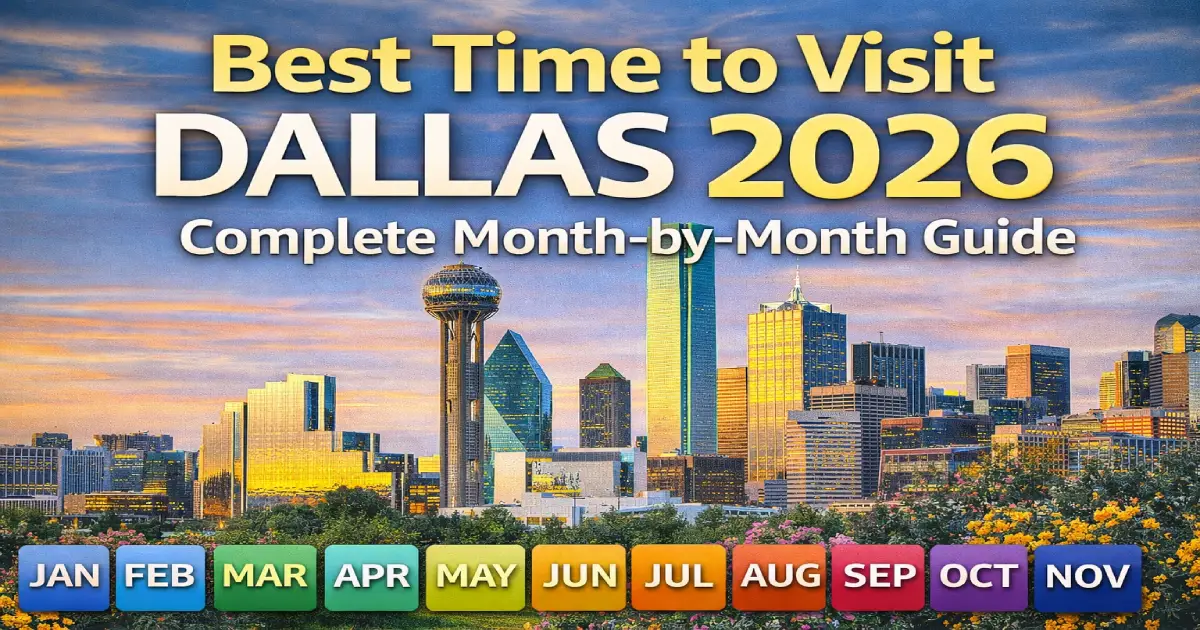
Best Time to Visit Dallas 2026: Complete Month-by-Month Guide
Published on : 31 Mar 2026
Best Time to Visit Dallas — Big D Has Real Seasons, and Choosing the Right One Matters
By Travel Tourister | Updated March 2026
Dallas is a city with genuine seasons — and unlike the Sunbelt reputation suggests, those seasons matter significantly for the visitor’s experience. The difference between a March Dallas visit (the Dallas Arboretum’s 500,000 tulips in synchronized bloom, outdoor dining temperatures in the high 60s, the Katy Trail at its most pleasant, and hotel prices below summer peak) and an August Dallas visit (103°F average highs, outdoor activities confined to the early morning and evening hours, hotel prices at their peak, and Klyde Warren Park’s food trucks operating exclusively in the shade) is one of the most dramatic seasonal contrasts available in any major American city outside the extreme climates of the Mountain West and the Deep South. Choosing the right Dallas season does not merely affect comfort — it determines which version of the city you encounter, which activities are genuinely available, and how much you pay for the experience.
I’ve visited Dallas across all four seasons — the March Arboretum when the tulip fields make the city’s most visited botanical garden look like the Keukenhof transplanted to North Texas, the October State Fair when Big Tex presides over the most attended annual event in Texas and the Arboretum’s Pumpkin Village covers three acres of the garden’s main lawn simultaneously, the February evening when the Arts District’s Winspear Opera House is running its finest programming of the year and the hotel room across the street is $40 cheaper than it was in July, and the July afternoon when the temperature on the Katy Trail’s exposed surface reaches 108°F and the only sensible outdoor activity is the shade of the Nasher Sculpture Center’s live oak garden. Each visit added to a comprehensive seasonal understanding of a city that has more to offer in the right season than most visitors arriving in the wrong one will ever discover.
This comprehensive 2026 guide breaks down Dallas’s best and worst visiting times using verified weather data from National Weather Service Fort Worth/Dallas, event calendars, hotel pricing patterns, and honest assessments of what each month actually delivers. We cover every month in detail, identify the best times for specific activities, flag the major annual events that make specific weeks uniquely rewarding, and give you the complete strategic intelligence to choose the right Dallas window for your trip priorities.
Dallas: Quick Season Overview
Season / Month
Weather
Crowds
Hotel Prices (Midrange)
Best For
January
45–56°F, occasional ice/freeze, gray
Low
$95–$145
Budget travel, indoor museums
February
50–62°F, variable, warming
Low–Moderate
$100–$155
Arts season peak, budget value
March
58–72°F, pleasant, some storms
Moderate
$115–$175
Arboretum spring blooms, outdoor dining
April
65–78°F, excellent, mild storms
Moderate–High
$125–$185
Best overall month, all outdoor activities
May
73–85°F, warm, storm season
Moderate
$120–$175
Warm outdoor activities, pre-summer value
June
83–94°F, hot, humid early
Moderate–High
$130–$195
Rangers baseball, pools, early morning outdoor
July
90–100°F+, very hot, dry
High
$145–$215
Indoor museums, Cowboys preseason, July 4th
August
92–103°F, hottest month, dry
High
$140–$210
Indoor activities only midday; avoid outdoor
September
82–95°F, cooling slowly, storm risk
Moderate
$120–$175
Post-summer value, Cowboys opening, Rangers
October
65–80°F, excellent, crisp
Very High (State Fair)
$155–$235
State Fair, Arboretum Pumpkin Village, best weather
November
54–68°F, cooling, pleasant
Moderate
$115–$170
Cowboys season, fall foliage, good value
December
44–58°F, cool, holiday lights
Moderate–High (holidays)
$120–$185
Zoo Lights, holiday events, Mavericks/Stars
Best Overall Times to Visit Dallas
1. April — THE BEST OVERALL MONTH TO VISIT DALLAS
Why April Is Dallas’s Finest Month: April delivers the ideal balance of every factor that determines a Dallas visit’s quality — temperatures between 65°F and 78°F that make every outdoor activity comfortable and every outdoor dining experience genuinely pleasant, the Dallas Arboretum’s spring bloom at or near its peak (the 500,000-tulip synchronized display typically peaks in late March to mid-April, and the Arboretum’s secondary spring plantings carry the bloom through the full month), hotel prices below the summer peak by 15–20%, the Katy Trail at maximum pleasantness for cycling and running, the Bishop Arts District at its most outdoor-dining-active, and none of the summer heat that closes Dallas’s outdoor life to the early morning and the evening hours from June through September.
April Highlights:
Weather: 65–78°F average highs; 45–55°F overnight; low humidity; occasional afternoon thunderstorms (Dallas’s spring storm season runs March–May) — pack a light rain layer but expect mostly clear skies
Dallas Arboretum spring bloom: The 500,000-tulip A-Mazeing Marigold display and the secondary spring plantings make April the most consistently beautiful month in the garden; the Easter weekend is the most attended single weekend of the Arboretum’s spring season
Outdoor dining season at peak: The McKinney Avenue restaurant patios, the Klyde Warren Park food trucks, and the Bishop Arts District sidewalk tables are all at maximum social activity in April’s ideal temperatures
Hotel pricing: $125–$185/night midrange — above January–February but below summer and October State Fair peaks; the best pricing available during a comfortable outdoor month
The Katy Trail: April is the most popular month for the Katy Trail’s cycling and running community — the trail’s social energy at its annual peak
Average temperatures: 65–78°F daytime; 47–55°F overnight
Hotel rates: $125–$185/night midrange; $250–$400 luxury
2. October — Best for Events (State Fair, Arboretum Pumpkin Village)
Why October Is Dallas’s Most Event-Filled Month: October is the most event-concentrated month in the Dallas calendar — the State Fair of Texas (the largest state fair in the United States, running from late September through mid-October at Fair Park) overlaps with the Dallas Arboretum’s Pumpkin Village (90,000 pumpkins covering the main garden lawn), the Dallas Cowboys’ home season in full swing, and the return of comfortable outdoor temperatures after the summer’s oppressive heat. The combination of events makes October Dallas’s most visited month — hotel prices reflect this reality — but the quality of the experience available is the highest of any Dallas month for visitors who enjoy major events and comfortable autumn weather.
State Fair of Texas (late September–mid-October): The most attended annual event in Texas — 2+ million visitors over 24 days at Fair Park, with the Red River Rivalry (Texas vs. Oklahoma, second Saturday of October), Big Tex (the 55-foot talking cowboy mascot), fried food competition winners, and the Cotton Bowl Classic as the most specifically Dallas version of the most specifically Texas annual event
Dallas Arboretum Pumpkin Village (October): 90,000 pumpkins, gourds, and squash covering the main garden lawn — the most photographed seasonal display in Dallas and the highest-attended Arboretum month of the year
Weather excellence: 65–80°F daytime, 48–58°F overnight — the finest outdoor weather available in Dallas after April; the specific quality of North Texas autumn light makes October the finest month for the Nasher Sculpture Center’s outdoor garden
Hotel pricing: $155–$235/night — the highest of any non-holidays month; book 6–8 weeks ahead for State Fair weekend availability
Hotel rates: $155–$235/night; State Fair weekends $185–$275
3. March — Best for the Arboretum and Spring Outdoor Activities
Why March Is Worth Planning Around: March is the month when Dallas’s finest seasonal display arrives — the Dallas Arboretum’s 500,000-tulip synchronized bloom (typically peaking mid-March to early April, varying 1–2 weeks annually by winter temperatures) transforms the 66-acre White Rock Lake garden into the most spectacular spring botanical display in Texas. The outdoor temperatures (58–72°F average) are the most comfortable available before the summer heat arrives, the McKinney Avenue restaurant patios are filling again after winter, and the hotel prices are transitioning from winter discount to spring shoulder pricing — good value with excellent conditions.
Dallas Arboretum Dallas Blooms (mid-March to mid-April): The tulip bloom and the spring planting program that makes the Arboretum’s spring season the most visited of the year; arrive on a weekday to avoid the peak weekend crowds
Weather: 58–72°F with warm-up through the month; March is the beginning of Dallas’s spring storm season — occasional afternoon thunderstorms possible but rarely day-long disruptions
Deep Ellum Arts Festival (late March): The outdoor visual arts, music, and craft festival in Deep Ellum — the most attended spring neighborhood event in Dallas
Hotel pricing: $115–$175/night — the final pre-spring-peak pricing before April’s higher rates
Hotel rates: $115–$175/night; Easter weekend significantly higher
4. November — Best Value Month with Good Weather
Why November Is the Best Value: November delivers a genuinely favorable combination — temperatures cooling pleasantly from October’s summer aftermath (54–68°F average, the most comfortable outdoor range after April), the Cowboys’ home season at its most engaging, the State Fair crowds have cleared, hotel prices drop from October’s elevated levels, and the Arts District’s performing arts season is running its most interesting programming of the year. November is the month that Dallas locals treat as their own after the summer tourists and the State Fair crowds have finished.
Post-State Fair hotel drop: November pricing ($115–$170/night) drops 20–30% from October’s State Fair peak — the finest value available after the summer and fall event periods
Cowboys home games: The NFL midseason produces the most consistently intense home game atmosphere at AT&T Stadium — tickets more available than opening weekend
Fall foliage (limited but present): Dallas’s tree canopy turns in November — the White Rock Lake park and the Katy Trail’s deciduous sections produce the finest North Texas fall color accessible without driving 2 hours to the Hill Country
Arts District peak programming: The Dallas Symphony, Dallas Opera, and Dallas Theater Center all have their most ambitious programming of the season in November
Hotel rates: $115–$170/night; Thanksgiving week $130–$195
Month-by-Month Breakdown
January: Budget Month and Indoor Arts Season
Weather: 45–56°F average highs; 28–38°F overnight lows; Dallas’s coldest month, with occasional ice storms (Dallas ices rather than snows — a thin ice layer on roads and surfaces from overnight freezing rain is more common than snow accumulation); 10 hours of daylight
What’s Great:
Lowest hotel prices of the year: $95–$145/night midrange — the finest budget window for exploring Dallas’s free museum cluster (DMA, Crow Museum, African American Museum, Holocaust Museum) without the summer heat or event premiums
Mavericks and Stars in full season: January is the peak of the NBA and NHL regular seasons — the most consistent game availability at American Airlines Center, with tickets more accessible than playoff-adjacent months
Arts District programming: The Dallas Symphony and Dallas Opera January programming is among the season’s most significant — major visiting artists and the most ambitious productions of the winter period
Cotton Bowl Classic (January 1): The New Year’s Day College Football Playoff game at Fair Park’s Cotton Bowl stadium — one of the most historically significant bowl game venues in America, with 92,000 capacity and the most festive single-day event at Fair Park outside the State Fair
Zero crowds at most attractions: January weekday visits to the Sixth Floor Museum, the Nasher, and the Bishop Arts District are the least crowded of any month — the most contemplative versions of Dallas’s finest experiences
What’s Challenging: January cold and occasional ice events can close roads and disrupt plans — Dallas is genuinely unprepared for ice (the 2021 winter storm that caused widespread power outages is the extreme example of a recurring vulnerability). The outdoor restaurant patios and the Klyde Warren Park social scene are significantly reduced. Daylight is shortest. The Arboretum is in its winter dormancy.
Verdict: Excellent for budget travelers, Mavericks/Stars fans, and indoor museum visitors; challenging for outdoor activities and neighborhood dining
Average hotel rate: $95–$145/night — the lowest of the year
February: Warming Up and Arts Season Peak
Weather: 50–62°F average highs; 32–42°F overnight; variable — February can produce Dallas’s finest individual days of the year (65°F sunshine) alongside its harshest ice events; storm risk increasing toward month’s end
What’s Great:
Early tulip emergence at the Arboretum (late February): The first early tulip varieties begin emerging in the Arboretum’s beds — not the full bloom, but the earliest visible sign of the spring season
Valentine’s Day: The most romantic version of the River Walk restaurants, the Adolphus Hotel’s Friday evening jazz series, and the Arts District’s performing arts programming
Hotel value still excellent: $100–$155/night — the second cheapest month, with the Mavericks/Stars season at its midpoint providing consistent entertainment
Super Bowl Week (February, if Dallas/Arlington is hosting): AT&T Stadium has hosted multiple Super Bowls — when the game is in Arlington, the entire DFW area transforms for the week preceding the game, with free outdoor concerts, Super Bowl Experience, and the most energized Dallas February in any hosting year
What’s Challenging: February weather is the most variable of any Dallas month — a visitor can experience 68°F and sunshine on February 14 and 28°F with freezing rain on February 20 in the same trip. The cold risk is real and the ice risk (rare but disruptive) warrants travel insurance for February bookings.
Verdict: Good for budget value and indoor/performing arts; weather unpredictability requires flexibility
Average hotel rate: $100–$155/night
March: Spring Arrives and the Arboretum Blooms
Weather: 58–72°F average highs; 40–50°F overnight; spring storm season beginning (March–May is North Texas’s most active severe weather period — afternoon thunderstorms, occasionally severe, require weather app monitoring); 12 hours of daylight
What’s Great:
Dallas Arboretum Dallas Blooms: The spring tulip and wildflower display — the most visited single event in the Dallas Arboretum’s annual calendar, with 500,000 bulbs planted in synchronized display. Peak bloom varies annually (mid-March to mid-April); check dallasarboretum.org’s current-season bloom report for the exact peak window each year
Deep Ellum Arts Festival (last weekend of March): The outdoor visual arts, live music, and craft festival covering the Deep Ellum streets — the most attended spring outdoor festival in Dallas, free to walk, with cover charges only at the music stages ($10–$15)
Outdoor dining fully open: The McKinney Avenue patios, the Bishop Arts District sidewalk tables, and the Klyde Warren Park food trucks are all operating at spring capacity — the first month of the year when outdoor Dallas feels fully alive
Rangers’ spring training conclusion: The Texas Rangers’ spring training in Arizona concludes in late March, with the regular season home opener at Globe Life Field typically in late March or early April
What’s Challenging: March’s spring storm season requires daily weather monitoring — severe thunderstorm warnings are common in the DFW area from mid-March through May. The storms are typically fast-moving and afternoon-focused, leaving mornings clear for outdoor activities in most cases. Easter weekend drives significant hotel price spikes and Arboretum crowd peaks.
Verdict: Excellent for the Arboretum bloom and outdoor spring activities; monitor weather and book Easter weekend significantly ahead
Average hotel rate: $115–$175/night; Easter weekend $155–$225
April: The Best Month — Perfect Conditions Across Every Category
Weather: 65–78°F average highs; 47–55°F overnight; pleasant low humidity; occasional afternoon thunderstorms (less frequent than March); 13 hours of daylight
What’s Great:
Arboretum spring bloom continuing: The secondary spring plantings (pansies, snapdragons, stock, larkspur) keep the Arboretum’s color active through the full month even as the primary tulip display fades in mid-April
Rangers baseball fully underway: Globe Life Field’s April games are the most comfortable of the season — 70–78°F game temperatures versus the August 100°F alternative; the most pleasant baseball experience in DFW is an April evening game
Mavericks playoff push: April begins the NBA playoff picture crystallization — if the Mavericks are in playoff position (which recent seasons have produced), April tickets at American Airlines Center produce the most intense home game atmosphere of the year
Outdoor activities peak: The Katy Trail, White Rock Lake, Klyde Warren Park, and the Bishop Arts District outdoor scene are all at annual peak activity levels — the most socially active outdoor Dallas month
Hotel value: $125–$185/night — excellent pricing given the conditions; the best value month among Dallas’s comfortable outdoor weather windows
Verdict: The strongest single-month recommendation for most Dallas visitors — the best weather, the most outdoor activity, the Arboretum at or near peak, Rangers baseball in comfortable conditions, and pricing below summer and October peaks
Average hotel rate: $125–$185/night
May: Warm and Pre-Summer Value
Weather: 73–85°F average highs; 55–63°F overnight; humidity increasing; spring storm season at its most active (May is North Texas’s most statistically active severe weather month); 13.5 hours of daylight
What’s Great:
Pre-summer pricing: $120–$175/night — the last month of pre-summer hotel rates before June’s price increase
Rangers baseball in comfortable conditions: May temperatures (73–85°F) are the warmest comfortable baseball-watching conditions before the summer heat arrives
Outdoor restaurant season fully active: All McKinney Avenue patios, Klyde Warren Park, and Bishop Arts District outdoor seating at maximum spring activity
Memorial Day weekend: The traditional start of Dallas summer — hotel prices spike 30–50% for the Memorial Day weekend specifically; book well ahead or budget for the premium
What’s Challenging: May is Dallas’s most severe weather month statistically — tornado watches, hail events, and flash flooding are more common in May than any other month. The DFW area’s storm shelter infrastructure is excellent (shopping centers, hotels, and public buildings all have designated shelter areas) but outdoor plans require daily weather app monitoring.
Verdict: Good conditions with value pricing; the storm season requires flexibility and weather monitoring
Average hotel rate: $120–$175/night; Memorial Day weekend $160–$240
June: Summer Begins
Weather: 83–94°F average highs; 65–72°F overnight; humidity dropping through the month as the dry Texas summer establishes; 14 hours of daylight
What’s Great:
Rangers baseball evening games: Globe Life Field’s retractable roof eliminates the weather variable — evening games (7:05 PM first pitch) are played in 85–90°F conditions under the roof’s climate management
Morning outdoor activities: The Katy Trail and White Rock Lake before 9 AM are genuinely pleasant in June — the 70°F morning temperatures and 14 hours of daylight make early morning outdoor Dallas the most reward-per-discomfort-unit activity of the summer
Pool and water park season: NRH2O (North Richland Hills) and Six Flags Hurricane Harbor (Arlington) are both open through June — the finest outdoor water activity accessible from Dallas in summer heat
Mavericks/Stars: Both Dallas franchises’ playoff runs (if applicable) conclude in June — the most dramatic Dallas sports events of the year happen in June playoff basketball and hockey
What’s Challenging: June midday heat (85–94°F) limits outdoor sightseeing to before 10 AM and after 6 PM — the afternoon hours are best spent in the DMA, Nasher, Perot Museum, and other air-conditioned indoor venues.
Verdict: Good for Rangers baseball, morning outdoor activities, and indoor museums; plan outdoor activities around the morning/evening temperature windows
Average hotel rate: $130–$195/night
July: Peak Summer Heat
Weather: 90–100°F+ average highs; 72–78°F overnight (the summer overnight lows provide limited relief); very low humidity (Dallas’s dry summer is significantly more comfortable than Houston’s humid summer at the same temperature); occasional heat advisories; 14.5 hours of daylight
What’s Great:
July 4th in Dallas: The Addison Kaboom Town! fireworks show (Addison, 15 miles north of Dallas) is consistently ranked among the top 10 fireworks displays in the United States — the pyrotechnics synchronized to music from the adjacent Addison Airport runways produce the most spectacular free fireworks accessible from Dallas ($0 from multiple Addison viewing areas)
Rangers baseball: Globe Life Field’s climate management makes July baseball viable — midday is hot even indoors, but the evening games from 7 PM are comfortable under the retractable roof
Indoor Dallas at maximum accessibility: July is the finest month for uninterrupted museum time — the DMA, Nasher (indoor galleries), Crow Museum, Sixth Floor Museum, and Perot Museum are all climate-controlled and less crowded on weekday mornings than in the spring and fall
Cowboys preseason (late July/August): AT&T Stadium training camp observation (late July) — the most accessible way to watch Cowboys practice without a regular season ticket cost
What’s Challenging: July is Dallas’s most consistently hot month — the average daily high of 96°F (with heat index sometimes exceeding 105°F) makes sustained outdoor activity genuinely uncomfortable and occasionally dangerous. The Katy Trail, Klyde Warren Park, and White Rock Lake are best limited to before 8 AM or after 7 PM. Outdoor dining on restaurant patios is functional in the evening but uncomfortable at midday.
Verdict: Viable for indoor-focused visitors and sports fans; challenging for outdoor-activity-focused visitors; plan all outdoor activities before 9 AM or after 6:30 PM
Average hotel rate: $145–$215/night; July 4th weekend significantly higher
August: Hottest Month — Indoor Strategy Essential
Weather: 92–103°F average highs; 73–79°F overnight; Dallas’s hottest month, with the highest frequency of 100°F+ days; very low humidity; heat advisories common; occasional late-summer thunderstorms providing temporary relief
What’s Great:
Hotel prices beginning to drop from July peak: Late August pricing softens slightly as summer demand decreases before the fall event season builds
Rangers baseball (indoor conditions): Globe Life Field’s retractable roof makes August baseball viable — the summer-evening fan atmosphere at Rangers games is the most reliably consistent sports entertainment in Dallas in August
State Fair preparation and preshow events: The Fair Park grounds begin activating in late August for the late September State Fair opening — the Texas Star Ferris wheel test runs and the exhibitor setup produce a specific Fair Park anticipation energy
Back-to-school family deals: Many Dallas hotel packages in late August target families returning to routine — the best August hotel pricing available
What’s Challenging: August is the most heat-challenging Dallas month for visitors — the 100°F+ temperatures on multiple consecutive days eliminate most outdoor activities between 9 AM and 7 PM. The Klyde Warren Park food trucks operate in reduced hours. White Rock Lake and the Katy Trail are genuinely dangerous for extended midday use. The most honest advice: if you must visit Dallas in August, build your itinerary around the DMA, Nasher, Perot Museum, Sixth Floor Museum, Crow Museum, and air-conditioned indoor venues, with outdoor activity windows limited to early morning (6–9 AM) and evening (7–9 PM).
Verdict: The most challenging Dallas month for outdoor visitors; perfectly fine for indoor-focused museum and sports visitors who understand the heat reality
Average hotel rate: $140–$210/night
September: The Transition Month
Weather: 82–95°F early September dropping to 68–80°F by month’s end; humidity declining; Dallas’s transition from summer to fall begins (typically September 15–October 1); occasional late-season thunderstorms; 12.5 hours of daylight
What’s Great:
Post-Labor Day hotel pricing drops: $120–$175/night — a 15–20% drop from August that makes September the first genuinely good value month since May
Dallas Cowboys opening season (early September): The NFL season’s first home games at AT&T Stadium — the most energized fan atmosphere of the Cowboys’ full season, with the season-opening excitement producing the most intense Arlington experience of any regular season game
State Fair of Texas opening (late September): The State Fair typically opens the last Friday of September — the opening weekend produces the most energized Fair Park atmosphere of the full 24-day run
Outdoor activities resuming (late September): As temperatures drop below 85°F in the final week of September, the Katy Trail, Klyde Warren Park, and the outdoor restaurant patios begin operating at pre-summer social capacity
What’s Challenging: Early September (the first two weeks) maintains August-level heat in most years — the outdoor activity limitations of August apply through approximately September 14 in average years. The State Fair opening weekend produces significant traffic and parking challenges around Fair Park and the surrounding East Dallas neighborhoods.
Verdict: Good for Cowboys season openers and value pricing; transitional for outdoor activities — early September is still hot, late September is excellent
Average hotel rate: $120–$175/night
October: The Most Event-Packed Month
Weather: 65–80°F average highs; 48–58°F overnight; the finest outdoor weather available in Dallas after April; low humidity; clear skies; 11.5 hours of daylight; the specific quality of North Texas autumn light makes October the most beautiful month in the Dallas Arboretum’s garden
What’s Great:
State Fair of Texas (late September to mid-October): The largest state fair in the United States — 2+ million visitors over 24 days at Fair Park, Big Tex, the Red River Rivalry football game (Texas vs. Oklahoma, second Saturday of October in the Cotton Bowl), the most creative fried food competition in America, and the most specifically Dallas version of the most specifically Texas annual event
Dallas Arboretum Pumpkin Village (full October): 90,000 pumpkins, gourds, and squash covering the main garden lawn — the most photographed seasonal display in Dallas, the highest-attended Arboretum month of the year, and the most elaborate fall botanical display in the American South
Perfect outdoor weather: 65–80°F with low humidity — every outdoor activity in Dallas at its most comfortable; the Katy Trail, White Rock Lake, the Nasher garden, Klyde Warren Park, and the Bishop Arts District all at seasonal peaks
Cowboys and Rangers simultaneously: The NFL season and the MLB postseason overlap in October — if the Rangers are in the playoffs (2023 World Series champions), October produces the most sports-dense two weeks in Dallas
What’s Challenging: October is Dallas’s most expensive and most crowded month — hotel prices at $155–$235/night reflect the demand created by the State Fair, the Arboretum, and the fall weather. Book 8–10 weeks ahead for State Fair weekend availability. The Red River Rivalry weekend (second Saturday of October) produces the highest single-weekend hotel prices of the entire year.
Verdict: The finest Dallas month for events and weather; the most expensive and the most crowded — plan ahead and budget accordingly
Average hotel rate: $155–$235/night; Red River Rivalry weekend $200–$300+
November: Post-Fair Value and Cowboys Season
Weather: 54–68°F average highs; 37–47°F overnight; cooling through the month; occasional cold fronts bringing temperatures to 40°F daytime; first frost possible late November; 10.5 hours of daylight
What’s Great:
Post-State Fair hotel drop: $115–$170/night — the single most dramatic month-to-month hotel price decrease in the Dallas annual calendar; November is the best value month for outdoor-comfortable weather
Cowboys home games (peak NFL season): November produces the most consequential Cowboys home games of the regular season — the NFC East division games and the national broadcast matchups that draw the most engaged crowds to AT&T Stadium
Arts District peak programming: The Dallas Symphony, Dallas Opera, and Dallas Theater Center run their most ambitious November programming — visiting artists and major productions that the January–September seasons build toward
Fall foliage (limited): The White Rock Lake park, the Katy Trail’s deciduous section, and the Arboretum’s Japanese maple collection produce the finest fall color accessible in Dallas in mid-to-late November
Thanksgiving week: Dallas’s Thanksgiving is the most family-destination week of the fall — hotel prices increase 15–20% for Thanksgiving week specifically, but the parades (the Children’s Medical Center Holiday Parade on Thanksgiving morning is the largest in North Texas) and the Cowboys Thanksgiving Day game (Dallas has played on Thanksgiving every year since 1966) make it the most specifically traditional Dallas week of the year
Verdict: The finest value month combining good weather and post-event pricing; excellent for Cowboys fans and performing arts visitors
Average hotel rate: $115–$170/night; Thanksgiving week $130–$195
December: Holiday Season and Winter Arts
Weather: 44–58°F average highs; 30–40°F overnight; Dallas’s second coldest month; occasional ice events; holiday lights throughout the city; 10 hours of daylight
What’s Great:
Dallas Zoo Lights (November through January): The annual holiday light display at the Dallas Zoo — 2+ million lights, illuminated animal sculptures, the most family-attended Dallas December event; advance tickets recommended for peak evenings (dallaszoo.com)
Mavericks and Stars (peak season): December produces the NBA and NHL regular season’s highest-profile home games — the most visited months at American Airlines Center outside the playoffs
Holiday events in the Arts District: The Dallas Symphony’s holiday performances (Handel’s Messiah, holiday pops concerts), the AT&T Performing Arts Center’s holiday programming, and the Nasher Sculpture Center’s holiday events make the Arts District the most festively programmed December destination in Dallas
Northpark Center holiday display: The most elaborate department store holiday display in North Texas — NorthPark Center’s annual art-integrated holiday display (featuring works by artists from the DMA’s collection) is the most aesthetically sophisticated shopping center holiday program in Dallas
Hotel value (non-holiday weeks): December pricing outside the Christmas-New Year’s week ($120–$185/night) is moderate — the first two weeks of December offer reasonable rates before the holiday premium arrives
What’s Challenging: December outdoor activities are limited by cool temperatures (44–58°F daytime) — not severely cold by national standards, but cool enough to move the primary Dallas experience indoors. The Christmas-New Year’s week (December 20–January 2) drives hotel prices above $180–$250/night and produces airport and highway congestion comparable to the State Fair period.
Verdict: Good for holiday events, Mavericks/Stars fans, and performing arts; limit outdoor expectations to the mild midday windows
Average hotel rate: $120–$185/night; Christmas-New Year’s week $155–$250
Best Times for Specific Dallas Activities
Best Time for the Dallas Arboretum
Spring (Dallas Blooms): Mid-March to mid-April — the 500,000-tulip synchronized display and the full spring planting make this the most visited period in the Arboretum’s annual calendar. The exact peak varies annually by 1–2 weeks depending on winter temperatures — follow @dallasarboretum on social media for the current-season bloom peak announcement. Buy tickets online in advance for spring bloom weekend visits; the Arboretum reaches capacity on peak weekends and closes online ticket sales when full.
Fall (Pumpkin Village): First week of October through the last week of October — 90,000 pumpkins, gourds, and squash in the main garden, the most photographed single Dallas seasonal event, and the finest autumn light quality in North Texas. The third week of October (after the State Fair’s most intense first weekend and before the final Columbus Day weekend) produces the best pumpkin display with the most manageable crowd levels.
Avoid: July–August (summer dormancy reduces the garden’s visual appeal significantly; the heat makes the 66-acre outdoor space genuinely uncomfortable); January–February (winter dormancy with limited flowering)
Best Time for Dallas Cowboys Games
Optimal: September (opening month, most energized fan atmosphere), October (NFC East division games, most consequential for playoff positioning), November (peak playoff push games). The AT&T Stadium Art Tour ($30/adult, non-game days) is available year-round and is independent of the football schedule.
Ticket availability: Opening weekend (first home game of September) and division rivalry games (Eagles, Giants, Commanders) sell out fastest. Late-season November and December games against non-division opponents typically have the best ticket availability and value.
Best Time for Outdoor Activities (Katy Trail, White Rock Lake, Klyde Warren Park)
Optimal: April (finest overall conditions — 65–78°F, consistent trade wind analog, full park activity), October (second-finest outdoor weather, the Arboretum light quality, fall foliage beginning), and March (spring bloom energy, 58–72°F, outdoor dining reopening). November is also excellent for outdoor activities in the first half of the month before temperatures consistently drop below 55°F.
Avoid for outdoor activities: July and August midday (10 AM–6 PM) — the 95–103°F heat index makes extended outdoor activity genuinely dangerous. Morning outdoor activities (before 9 AM) and evening activities (after 7 PM) are viable in summer; sustained midday outdoor activities are not.
Best Time for Budget Travel
Optimal: January (the cheapest month, $95–$145/night midrange, zero event premiums), February (second cheapest, good arts programming), and the week immediately following the State Fair closing (mid-October — prices drop 25–30% from the State Fair peak within days of the Fair’s close). The best combination of value and comfortable weather is mid-November (post-State Fair pricing with October-level outdoor temperatures).
Avoid if budget-sensitive: Red River Rivalry weekend (second Saturday of October — highest hotel prices of the year), Cotton Bowl Classic (January 1), Thanksgiving week, Christmas-New Year’s week, and State Fair weekends (any weekend during the Fair’s 24-day run in late September to mid-October).
Best Time for the State Fair of Texas
Exact timing: The State Fair runs 24 consecutive days from the last Friday of September through the second Sunday of October. In 2026, the State Fair runs from September 25 through October 18, 2026. The Red River Rivalry (Texas vs. Oklahoma football) falls on the second Saturday of the Fair — in 2026, October 10, 2026.
Best Fair visit days: Weekday mornings (Tuesday–Thursday, 10 AM–1 PM) produce the shortest lines, the most accessible food vendors, and the most comfortable Fair experience. Weekend afternoon visits during the Fair’s middle two weeks (not the opening weekend or the Rivalry game weekend) are the best weekend option. Avoid: Red River Rivalry Saturday (92,000 football fans plus Fair visitors), opening weekend (highest energy but highest crowds), and Columbus Day weekend (historically the highest non-Rivalry weekend attendance).
Dallas Timing: Practical Tips
Topic
What to Know
Dallas Weather Reality
Dallas weather is genuinely variable in three ways that visitors consistently underestimate: (1) Summer heat is serious — 100°F+ days in July and August are common and genuinely limit outdoor activity; this is not a minor inconvenience but a planning constraint that should determine the entire summer itinerary structure. (2) Spring storm season (March–May) is real — North Texas produces more severe thunderstorm events per year than almost any other region in the US; monitor weather apps daily in spring and identify shelter locations before each outdoor plan. (3) Winter ice events — Dallas ices rather than snows; even 0.25 inches of ice on roads can close the city for 1–2 days; the 2021 winter storm was extreme but the underlying vulnerability to ice is structural and recurring.
Hotel Booking Strategy
Dallas hotel pricing is the most event-driven of any Texas city — the State Fair (24 days in late September to mid-October), Cowboys home games (8–9 home games September–January), major conventions at the Kay Bailey Hutchison Convention Center (check the convention schedule when booking), and the Cotton Bowl Classic (January 1) all drive significant price spikes. Book strategy: For the State Fair, book 8–10 weeks ahead; the hotels closest to Fair Park (East Dallas) see the largest premiums. For Cowboys games, book as soon as tickets are confirmed — hotel prices spike 30–50% within 2 miles of AT&T Stadium on game Saturdays/Sundays. For the Red River Rivalry specifically (second Saturday of October), the DFW hotel market is genuinely constrained — book 10–12 weeks ahead or expect premium pricing at every tier.
Dallas vs. Fort Worth Seasonal Timing
Fort Worth’s major annual events have limited overlap with Dallas’s: Fort Worth Stock Show and Rodeo (17 days in late January–early February) is the most significant Fort Worth-specific event that Dallas visitors should incorporate into a winter visit; it produces significant Fort Worth hotel pricing and provides a genuine Western heritage experience during the most otherwise quiet travel period. The Fort Worth Zoo and the Cultural District’s museums (Kimbell, Modern, Amon Carter) are year-round and season-independent in a way that Dallas’s outdoor-dependent activities are not — Fort Worth is a genuinely excellent winter day trip from Dallas when outdoor Dallas activities are limited.
Summer Strategy
If visiting Dallas in July or August, build the itinerary around this thermal reality: Morning window (6–9 AM): Outdoor activities — Katy Trail, White Rock Lake loop, Klyde Warren Park, outdoor photography. Morning-to-afternoon indoor (9 AM–5 PM): Museums (DMA, Nasher, Crow Museum, Sixth Floor Museum, Perot Museum), indoor shopping (NorthPark Center, Northpark Mall), air-conditioned coffee shops in Bishop Arts or Deep Ellum. Evening outdoor (7–9 PM): Outdoor dining on restaurant patios (temperatures drop to 80°F by 8 PM in most July evenings), Klyde Warren Park evening programming, Deep Ellum mural walk after dark. Globe Life Field evening Rangers games (7:05 PM first pitch under the retractable roof): The finest summer outdoor event that summer heat cannot meaningfully disrupt.
Packing by Season
Spring (March–May): Light layers (55°F morning to 80°F afternoon transition requires both a light jacket and short sleeves accessible simultaneously); rain layer for afternoon thunderstorm probability; closed-toe shoes for outdoor activities. Summer (June–August): Lightweight breathable fabrics only; sun protection (hat, SPF 50+ sunscreen — the North Texas sun at 32 degrees latitude is significantly more intense than northern cities); multiple water bottles for outdoor segments; indoor-comfortable layers (Dallas’s aggressive air conditioning makes indoor spaces cold in summer — carry a light sweater for museums and restaurants). Fall (September–October): Light jacket for evenings; layering system for 50°F mornings and 78°F afternoons in October. Winter (November–February): Medium-weight coat (Dallas winters are cold but not extreme); ice-gripping footwear for January–February visits; waterproof layer for the occasional ice or cold rain event.
Frequently Asked Questions: Best Time to Visit Dallas
What is the best month to visit Dallas?
April is the best single month to visit Dallas — delivering the finest balance of comfortable outdoor weather (65–78°F, low humidity), the Dallas Arboretum at or near its spring bloom peak, the Rangers baseball season in its most comfortable conditions, hotel pricing below both the October State Fair peak and the summer months, and every outdoor Dallas activity (Katy Trail, White Rock Lake, Klyde Warren Park, Bishop Arts District outdoor dining, the Nasher Sculpture Center garden) at seasonal maximum pleasantness. October is the most event-filled month — the State Fair, the Arboretum’s Pumpkin Village, and excellent outdoor weather combine to make it Dallas’s most visited and most expensive month. March delivers the Arboretum bloom and the spring outdoor awakening. November delivers the best post-summer value. For the combination of weather comfort, value, and comprehensive activity access, April is the recommendation that the largest number of visitor types will find most rewarding.
What is the cheapest time to visit Dallas?
January is consistently the cheapest month — midrange hotels at $95–$145/night, virtually no event premiums outside the Cotton Bowl Classic on January 1, and the full indoor cultural infrastructure (DMA free, Crow Museum free, Sixth Floor Museum $18, Nasher $10, Perot Museum $25) operating at normal capacity without summer crowds. February is the second-cheapest month. The best combination of low price and comfortable weather is the week after the State Fair closes (mid-to-late October) — prices drop 25–30% within days of the Fair’s closing, but the October weather excellence and the Arboretum’s remaining fall programming continue through the month. The specific dates to avoid if budget-sensitive: Red River Rivalry weekend (second Saturday of October — the most expensive single weekend in Dallas), Cowboys division rivalry home games, the State Fair’s opening weekend, and the Christmas-New Year’s week.
Is Dallas too hot to visit in summer?
Dallas in summer (June–August) is genuinely hot — not theoretically hot in the way that visitors to temperate cities use the word, but consistently and specifically hot in a way that requires planning adjustments. The average August high of 100°F, with heat index occasionally exceeding 110°F, limits sustained outdoor activity to the morning (before 9 AM) and evening (after 7 PM) windows. The good news: Dallas’s summer is dry (unlike Houston’s humid summer at the same temperature, which would be genuinely difficult) — 100°F in Dallas’s low humidity feels significantly more comfortable than 90°F in 90% humidity. And Dallas’s indoor cultural infrastructure (DMA, Nasher indoor galleries, Perot Museum, Sixth Floor Museum, Crow Museum) is world-class and air-conditioned. The most honest answer: Dallas in summer is entirely manageable for visitors whose primary interests are museums, sports venues, and indoor dining, and genuinely challenging for visitors whose primary interests are outdoor activities, hiking, and neighborhood walking. Build the summer itinerary around the indoor morning-to-afternoon block and the evening outdoor window, and Dallas in summer delivers everything the city’s indoor excellence offers at pricing 20–30% below the spring and fall peaks.
What is the State Fair of Texas and when should I visit?
The State Fair of Texas is the largest state fair in the United States — 2+ million visitors over 24 consecutive days at Fair Park in East Dallas, featuring Big Tex (the 55-foot talking cowboy mascot who has been greeting visitors since 1952), the most creative fried food competition in America (the annual fried food contest winner is announced at the Fair and reliably makes national food news), the Cotton Bowl football game (including the Red River Rivalry, the Texas vs. Oklahoma game that is one of the most attended single-game college football events in the country), carnival rides, livestock exhibitions, a midway, and concerts across multiple stages. In 2026, the State Fair runs September 25 through October 18. The best visit days are Tuesday–Thursday mornings (fewest crowds, shortest food and ride lines). The Red River Rivalry game weekend (October 10, 2026) is the most intense single Fair weekend — book fair tickets and hotels 8–10 weeks ahead for that specific weekend. General admission is $18/adult at bigtex.com; individual ride and food tickets are additional.
When is the Dallas Arboretum best to visit?
The Dallas Arboretum has two peak seasons: Spring (mid-March through mid-April) — the 500,000-tulip Dallas Blooms display is the most spectacular single botanical event in Texas, with the synchronized bloom of multiple tulip varieties in the garden’s main beds producing a color concentration that makes the 66-acre garden look like the Keukenhof on a smaller scale. The exact peak varies annually by 1–2 weeks depending on winter temperatures; monitor dallasarboretum.org’s bloom status page in March for the current-year peak timing. Buy tickets online in advance for any spring bloom weekend — the Arboretum reaches capacity on peak weekends and closes online sales when full. Fall (October) — the Pumpkin Village covers the main garden lawn with 90,000 pumpkins and gourds in the most elaborate fall seasonal display in the South; the October light quality in the garden’s mature tree canopy is the finest of any Arboretum season. Avoid July and August (summer dormancy and dangerous outdoor heat).
What events should I plan my Dallas visit around?
The major Dallas events worth building a trip around: (1) Dallas Blooms at the Arboretum (mid-March to mid-April) — book 2–3 weeks ahead for specific bloom-peak weekend tickets; (2) Deep Ellum Arts Festival (last weekend of March) — free outdoor street festival, no advance booking required; (3) Dallas Cowboys home opener (first home game of September) — the most energized single Cowboys game experience of the year; book tickets 4–6 weeks ahead; (4) State Fair of Texas (late September to mid-October) — the most specifically Dallas annual event; book fair tickets online and hotel 8–10 weeks ahead; (5) Red River Rivalry at the Cotton Bowl (second Saturday of October) — the most intense single-day sports event in Dallas; tickets through the university athletic departments and secondary market only; hotel booking 10–12 weeks ahead essential; (6) Arboretum Pumpkin Village (full October) — no advance ticket required beyond general Arboretum admission; (7) Cotton Bowl Classic (January 1) — excellent value for a major college football bowl game at one of America’s most historic stadiums.
Final Thoughts: Choosing Your Dallas Season
After visiting Dallas across all four seasons — the April Arboretum at tulip peak, the October State Fair when Big Tex presides over Fair Park, the February Arts District when the Symphony is running its finest programming and the hotel room costs $60 less than it did in August, and the August Museum marathon when the DMA and the Nasher and the Crow Museum and the Sixth Floor are all visited in the same day without stepping outside in the midday heat — three principles emerge for choosing the right Dallas window:
1. April and October are the months Dallas keeps for visitors who pay attention — and they each deliver a different version of the city’s best character. April delivers the most complete and the most balanced Dallas — comfortable outdoor temperatures, the Arboretum bloom, Rangers baseball in the finest conditions of the season, the Katy Trail at maximum social energy, and hotel pricing that acknowledges you’re visiting before the summer premium arrives. October delivers the most event-concentrated Dallas — the State Fair (the largest in the US, the most specifically Texan, the most irreplaceable annual experience in DFW), the Arboretum’s Pumpkin Village (the most photographed single seasonal display in the city), and the finest outdoor weather available after April. April is the month for the visitor who wants the best of Dallas with the least friction. October is the month for the visitor who wants the most of Dallas with the highest energy. Both reward the visitor who chooses them deliberately.
2. The Dallas summer is genuinely hot — 100°F is not a figure of speech but an average — and the visitor who arrives in August expecting to walk the Bishop Arts District at 2 PM or cycle the Katy Trail at noon will find a genuinely different city than the visitor who arrives in April. Dallas’s summer heat is specific and consistent in a way that requires acceptance rather than planning workarounds. The acceptance that unlocks a genuinely excellent summer Dallas visit: the Sixth Floor Museum, the DMA, the Nasher indoor galleries, the Crow Museum, the Perot Museum, and the Majestic Theatre are all air-conditioned, world-class, and less crowded on weekday summer mornings than at any other time of year. The morning outdoor window (6–9 AM) and the evening outdoor window (7–9 PM) are genuinely pleasant even in August. Globe Life Field’s retractable roof makes Rangers baseball viable at any summer temperature. And the summer hotel rates ($140–$215/night) reflect the demand correctly — you are paying for the air-conditioned Dallas, which is a genuinely excellent Dallas.
3. The State Fair’s Red River Rivalry weekend (second Saturday of October, when 92,000 Texas and Oklahoma fans fill the Cotton Bowl alongside the Fair’s regular attendance) is the single most expensive and the single most irreplaceable single-day event in the Dallas annual calendar — and the visitor who builds a trip around it will encounter Dallas at its most specifically itself. The Red River Rivalry is not merely a football game — it is the annual convergence of the two most passionate college football cultures in the state of Texas (and the largest state outside the South for Oklahoma expats) in the historic Cotton Bowl stadium at the most beloved annual event in the DFW area. The Fair’s midway, the fried food competition winners, the Big Tex announcements, and the football game in the Cotton Bowl produce an October Saturday that is the most concentrated single-day expression of what Dallas does most specifically well: the intersection of spectacle, food, sports, and civic identity in the largest version of the most Texas event that Texas produces. Book the hotel 10–12 weeks ahead. Buy the Fair tickets online. Watch the game from the end zone if you can get the tickets. This is the Dallas October that the other 23 days of the State Fair are building toward.
Dallas’s seasons are real, consequential, and worth choosing deliberately. The April tulip bloom at the Arboretum and the October State Fair at Fair Park are each extraordinary on their own terms and together constitute the best two arguments for planning a Dallas visit around a specific event rather than a general availability. The summer museums are world-class and accessible at the most affordable summer prices in any Texas city. The November value and Cowboys season is the most consistently underused visitor window in Dallas’s annual calendar. The February Arts District programming is the finest performing arts access at the lowest hotel pricing of any performing-arts-focused visit. Choose the season that matches what you came for. Dallas will be itself in any month you find it. The question is which version of itself you’re most ready to encounter.
For current event schedules, hotel availability, and Dallas visitor information, consult Visit Dallas, State Fair of Texas for the current-year Fair dates and ticket information, and Dallas Arboretum for current-season bloom status and event calendar.
—
—
About Travel TouristerTravel Tourister’s Dallas specialists provide honest seasonal guidance based on extensive year-round visits across every Dallas season — the April Arboretum bloom, the October State Fair, the summer museum marathon, and the February Arts District performing arts peak. We understand that Dallas’s seasons are genuinely consequential for the visitor experience and that the right month makes the difference between a good Dallas visit and an extraordinary one.Need help choosing the right time for your Dallas visit? Contact our specialists who can recommend optimal travel windows based on your specific priorities — from State Fair and Red River Rivalry timing to Arboretum bloom peak windows to Cowboys game ticket strategies to summer indoor activity planning. We help travelers find their perfect Dallas season.
Posted By : Vinay
As a lead contributor for Travel Tourister, Vinay is dedicated to serving our Tier 1 audience (US, UK, Canada, Australia). His mission is to deliver precise, fact-checked news and actionable, data-driven articles that empower readers to make informed decisions, minimize travel risks, and maximize their adventure without compromising safety or budget.
Travel Tourister is a leading Travel portal where we introduce travellers to trusted travel agents to make their journey hasselfree, memorable And happy. Travel Tourister is a platform where travellers get Tour packages ,Hotel packages deals through trusted travel companies And hoteliers who are working with us across the world. We always try to find new and more travel agents and hoteliers from every nook and corners across the world so that you could compare the deals with different travel agents and hoteliers and book your tour or hotel with the one you have chosen according to your taste and budget.




 Call
Call Enquiry