Published on : 20 Jun 2026
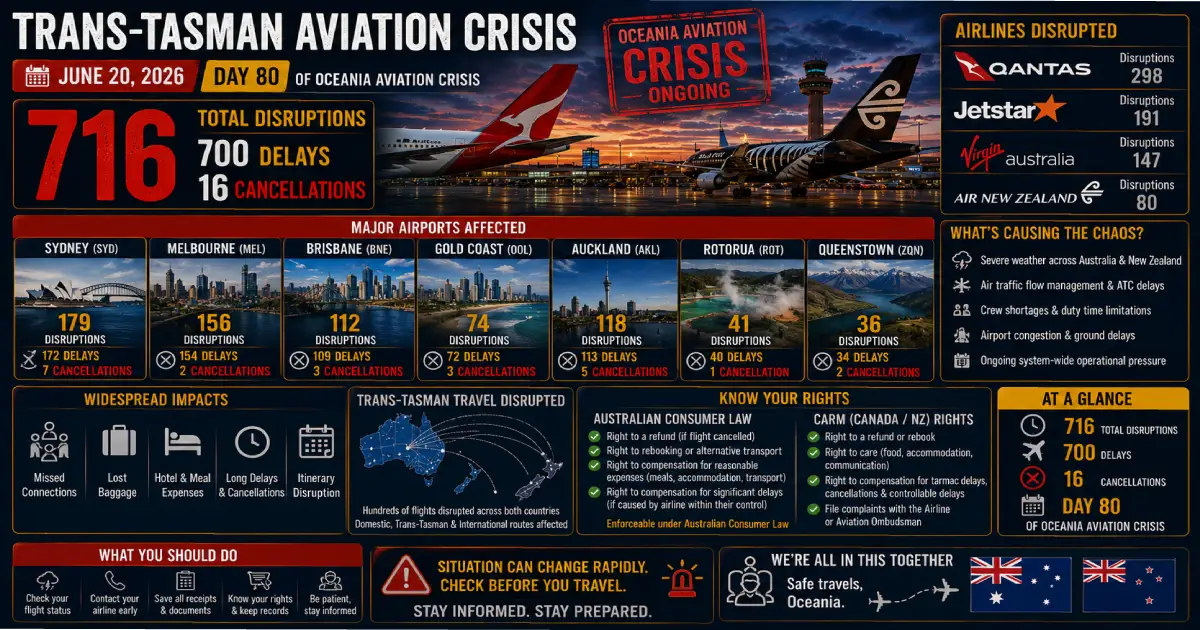
Published: June 20, 2026 — Saturday (Day 80 of Oceania Aviation Crisis · Trans-Tasman Network · Data: June 19 FlightAware — Reported June 20)
Seven hundred flight delays. Sixteen outright cancellations. Seven airports across two countries simultaneously disrupted. And four of the most widely used carriers in the Southern Hemisphere — Qantas, Jetstar, Virgin Australia, and Air New Zealand — all recording significant disruption on the same day.
June 19, 2026 was the worst single day of trans-Tasman disruption this month — and it is only being fully absorbed today, June 20, as passengers who were stranded yesterday scramble for rebooking, refunds, and answers.
The 716 combined disruptions recorded across Australia and New Zealand on June 19 represent the highest single-day total in what is now an 80-day running aviation crisis for the Oceania region. The airports hit span both sides of the Tasman Sea: Sydney, Melbourne, Brisbane, and Gold Coast on the Australian side; Auckland, Rotorua, and Queenstown on the New Zealand side. The trans-Tasman corridor — the critical international air link between the two nations, and one of the world’s busiest short-haul international markets — has been severed or severely degraded for the third time in four days.
This is the Day 80 update. Here is the full picture: what happened, which airports and carriers were worst hit, the June 2026 crisis pattern in full, and exactly what you are owed under Australian Consumer Law, the Australian Competition and Consumer Commission framework, and New Zealand’s Civil Aviation Rules and Consumer Guarantees Act.
Published: June 20, 2026 — Day 80 of Oceania Aviation Crisis Disruption date: June 19, 2026 (data reported June 20) Total delays: 700 flights ✈️⏱️ Total cancellations: 16 flights ✈️❌ Combined disruptions: 716 Airports hit — Australia: Sydney (SYD) · Melbourne Tullamarine (MEL) · Brisbane (BNE) · Gold Coast (OOL) Airports hit — New Zealand: Auckland (AKL) · Rotorua (ROT) · Queenstown (ZQN) Carriers disrupted: Qantas ✅ | Jetstar ✅ | Virgin Australia ✅ | Air New Zealand ✅ Trans-Tasman corridor status: ⚠️ Severely degraded — third disruption in four days Source: FlightAware official tracking data — June 19, 2026 — verified by Travel and Tour World
June 2026 Oceania crisis timeline (verified data):
Australian Consumer Law: ✅ Carrier-caused delay/cancel → refund + rebooking rights ACCC airline guidance: accc.gov.au/consumers/travelling/flying New Zealand Consumer Guarantees Act: ✅ Services must be provided with reasonable care and skill Civil Aviation Rules (NZ): ✅ Carrier obligations for delay and cancellation Qantas rebooking: qantas.com → Manage Booking Virgin Australia rebooking: virginaustralia.com → Manage Booking Jetstar rebooking: jetstar.com → Manage Booking Air New Zealand rebooking: airnewzealand.com → Manage Booking Travel insurance — act now: ⚠️ Once a disruption event is publicly reported, insurers may exclude it as a pre-existing event for new policies. If you are travelling in the next 7 days and do not have insurance — buy it today before coverage closes.
June 19, 2026 produced the highest combined disruption total recorded in Oceania this month. Flight disruptions were experienced across the aviation networks of Australia and New Zealand on June 19, 2026, as a combined total of 16 flight cancellations and 700 flight delays were officially recorded across airports in Sydney, Melbourne, Brisbane, Gold Coast, Auckland, Rotorua, and Queenstown.
The structure of Oceania’s aviation network makes it acutely vulnerable to cascading disruption. Australia’s east coast — Sydney, Melbourne, Brisbane — operates as a tightly interconnected domestic triangle. Every major domestic carrier operates multiple daily frequencies between these three cities, which means aircraft, crew, and scheduling buffers are stretched to zero. A delay at Sydney in the morning becomes a delay at Melbourne by mid-morning and a delay at Brisbane by afternoon. By the time the network tries to recover, crew duty time limits have been hit, aircraft are out of position, and the evening bank of flights is already compromised.
Add the trans-Tasman dimension — the high-frequency Sydney–Auckland, Melbourne–Auckland, and Brisbane–Auckland services operated by Qantas, Jetstar, Virgin Australia, and Air New Zealand — and the domestic disruption on the Australian side instantly becomes an international disruption on the New Zealand side. The widespread scheduling difficulties affected multiple key aviation hubs across both nations, causing extensive interruptions for thousands of travellers. Major regional carriers, including Qantas, Virgin Australia, Jetstar and Air New Zealand, operate heavily within these sectors, meaning substantial scheduling pressures were felt across the board.
Rotorua and Queenstown — both appearing in today’s disruption list — are New Zealand’s two primary tourist airports. Rotorua is the gateway to Māori culture, geothermal landscapes, and the Rotorua lakes. Queenstown is the gateway to the South Island ski fields, now entering peak winter season. Both cities have high proportions of passengers who are tourists with tight onward connections, pre-booked accommodation, and no local support network — making disruption at these airports disproportionately damaging.
Sydney Airport (SYD) — Australia’s primary gateway
Sydney is consistently the highest-volume disruption airport in the Oceania crisis. On June 14, Sydney Airport absorbed the highest disruption volume with 111 delays and 4 flight cancellations, crippling Qantas, Virgin Australia, and Jetstar. On June 12, Sydney recorded 201 delays and 8 cancellations. June 19’s Sydney total is within the 700-flight network-wide figure — the airport contributes the largest single share of the overall disruption.
Sydney is Qantas’s primary hub, Virgin Australia’s largest base, and Jetstar’s primary Australian operational centre. Every departure delay at Sydney creates pressure on inbound aircraft that were supposed to turn around quickly — the gap between scheduled and actual departure widens through the day, and by evening the network has lost multiple hours of schedule recovery opportunity.
Melbourne Tullamarine (MEL) — the Golden Triangle hub
Melbourne Tullamarine is the third leg of Australia’s critical “Golden Triangle” domestic route network (Sydney–Melbourne–Brisbane — three of the highest-frequency routes on earth). On June 12, Melbourne Tullamarine experienced 150 delays and 9 cancellations that completely disrupted the highly utilised Golden Triangle domestic routes. Melbourne is Jetstar’s home base — the carrier operates dozens of daily services from Tullamarine to Sydney, Brisbane, Gold Coast, and trans-Tasman destinations.
Brisbane Airport (BNE) — Queensland’s gateway
Brisbane has been the hardest-hit airport in the Oceania crisis by cancellations in the worst single event this month. On June 12, Brisbane Airport suffered the heaviest operational damage with 233 delays and 9 cancellations, severely disrupting QantasLink and Virgin Australia. Brisbane is the primary gateway for Queensland tourism — the Great Barrier Reef, the Whitsundays, and the Sunshine Coast are all connected through BNE’s domestic network.
Gold Coast Airport (OOL)
Gold Coast appears in today’s disruption list alongside Sydney, Melbourne, and Brisbane — consistent with its role as one of Australia’s primary leisure airports, served by Jetstar, Virgin Australia, and QantasLink on high-frequency domestic routes and trans-Tasman services.
Auckland Airport (AKL) — New Zealand’s primary international gateway
Auckland is New Zealand’s largest and busiest airport and the primary trans-Tasman entry point for Australian travellers. On June 14, Auckland recorded 77 delays, with Christchurch and Wellington logging a combined 4 cancellations and 71 delays, crippling Air New Zealand. Auckland is Air New Zealand’s global hub — every significant disruption at AKL reverberates through the carrier’s entire domestic and regional network, including connections to Wellington, Christchurch, Dunedin, Hamilton, Napier, and the smaller regional airports.
Rotorua (ROT) and Queenstown (ZQN) — peak winter season disruption
Rotorua and Queenstown are both in peak winter season demand. Queenstown in particular is one of the world’s premium ski destinations, with the Coronet Peak, The Remarkables, and Cardrona ski fields all in full winter operation. Disruption at Queenstown during ski season hits an audience of international skiers with pre-paid lift passes, accommodation bookings, and rental equipment — all non-refundable, and all at risk when flights are delayed or cancelled.
Qantas
Qantas is the carrier most consistently disrupted throughout the June 2026 Oceania crisis. As Australia’s flag carrier and primary domestic operator, Qantas operates across every affected airport on the June 19 list — Sydney, Melbourne, Brisbane, Gold Coast, and Auckland. On June 16, Qantas logged 16 delays while its regional arm QantasLink suffered 2 cancellations and 13 delays.
Qantas’s obligations to disrupted passengers are governed by the Qantas Customer Commitment and, where applicable, Australian Consumer Law. For domestic disruptions within the carrier’s control, Qantas is required to provide rebooking on the next available Qantas service and to compensate for documented out-of-pocket expenses. For international trans-Tasman services, additional protections apply under the Montreal Convention.
What to do if your Qantas flight is affected: Open the Qantas app and check for a rebooking offer before approaching a desk. Qantas → Manage Booking → Check Flights. Qantas customer service: 13 13 13 (within Australia) / +61 2 9691 3636 (international).
Jetstar
Jetstar — Qantas Group’s low-cost carrier — has been the most disrupted carrier by volume throughout the Oceania crisis, consistent with its high-frequency operation across the Golden Triangle and trans-Tasman routes. On June 16, Jetstar was disrupted by 25 delays representing 21% of its scheduled operations. On June 14, Jetstar recorded delay volumes across Melbourne (34), Brisbane (20), and Sydney (20) simultaneously.
Jetstar’s low-cost model means its standard fare terms offer significantly less flexibility than Qantas mainline. Passengers on the lowest Starter fare should understand that their rebooking rights may differ from higher-fare categories. However, Australian Consumer Law applies regardless of fare type — if Jetstar cancels your flight for a carrier-caused reason, your ACL rights are independent of the fare rules in Jetstar’s contract.
What to do if your Jetstar flight is affected: jetstar.com → Manage Booking. Jetstar customer service: 131 538 (within Australia). Check the specific cause of your cancellation — carrier-caused versus weather — as this determines your compensation entitlement.
Virgin Australia
Virgin Australia operates across Sydney, Melbourne, Brisbane, and Gold Coast domestically and on trans-Tasman routes including Sydney–Auckland and Brisbane–Auckland. On June 16, Virgin Australia absorbed 1 cancellation and 22 delays representing 16% of affected operations. Virgin Australia has been consistently disrupted throughout June, with the carrier recording cancellations and significant delays across every major disruption event this month.
Virgin Australia’s Guest Promise outlines rebooking and care commitments for disrupted passengers. For cancellations within Virgin’s control, the carrier will rebook on the next available Virgin Australia service at no charge.
What to do if your Virgin Australia flight is affected: virginaustralia.com → Manage Booking. Virgin Australia customer service: 13 67 89 (within Australia).
Air New Zealand
Air New Zealand is New Zealand’s flag carrier and the dominant operator on the Auckland–Sydney, Auckland–Melbourne, and Auckland–Brisbane trans-Tasman corridors. The carrier has been disrupted on every significant trans-Tasman disruption day in June, with Auckland consistently recording high delay volumes when the Australian side of the network is under pressure.
Air New Zealand’s disruption at Rotorua and Queenstown today is particularly significant for the winter leisure market. The carrier operates the primary services from Auckland to both airports, and with ski season demand at peak, rebooking availability for cancelled services can be extremely limited.
What to do if your Air New Zealand flight is affected: airnewzealand.com → Manage Booking. Air New Zealand customer service: 0800 737 000 (within New Zealand) / 13 24 76 (within Australia).
The June 19 figure of 716 disruptions does not exist in isolation. The Oceania aviation network has been operating in a state of persistent elevated disruption since the start of June 2026 — and the trend is worsening, not improving.
The verified day-by-day data:
June 7: The Oceania aviation network suffered exactly 28 flight cancellations and 243 severe delays. Sydney faced the highest volume of scheduling setbacks with 80 delays, while Brisbane suffered the heaviest cancellation hit on the Australian side with 7 flights axed.
June 9: A total of 249 flight delays and 3 cancellations were logged across the region, affecting operations for major carriers such as Virgin Australia, Jetstar, Qantas and Air New Zealand.
June 11: Sydney Airport reported no cancellations but 80 delayed flights across multiple domestic and international carriers including Qantas, Jetstar, Virgin Australia, Air New Zealand, American Airlines, and Etihad Airways, with disruptions extending to routes linking Sydney with Asia, North America, the Middle East, and the Pacific.
June 12: Brisbane Airport suffered the heaviest operational damage with 233 delays and 9 cancellations — Melbourne recorded 150 delays and 9 cancellations — while Sydney faced 201 delays and 8 cancellations — producing a combined 792 severe flight delays and 40 outright cancellations across the network, with Qantas, Jetstar, Virgin Australia, and Air New Zealand all heavily affected.
June 14: Airlines operating throughout Australia and New Zealand faced a combined total of 411 flight delays and 14 cancellations, with Auckland recording 77 delays, and Melbourne, Sydney, Brisbane, Adelaide, Christchurch, Wellington, and Hamilton all affected.
June 16: Catastrophic schedule instability triggered 257 flight delays and 10 outright cancellations across Melbourne, Perth, Devonport, Sydney, and Adelaide, with QantasLink, Virgin Australia, Airnorth Regional, and Jetstar all scrambling to recover their stranded fleets.
June 18: Terminal departure boards reflected 18 outright flight cancellations alongside 514 severe airport disruptions, with QantasLink, Virgin Australia, Jetstar, Network Aviation, and Air New Zealand all severely impacted across Melbourne, Sydney, Perth, Christchurch, and Wellington.
June 19 (TODAY): 700 delays + 16 cancellations = 716 total — the month’s highest single-day figure.
The escalating pattern is clear: June 7 (271 total) → June 12 (832 total) → June 18 (532 total) → June 19 (716 total). The network has not achieved a clean recovery day in over two weeks.
The key distinction: carrier-caused vs outside control
Your compensation entitlement under Australian Consumer Law hinges on whether your disruption was caused by the airline (within their control) or by an external event outside their control (such as severe weather, ATC-ordered ground stops, or security incidents).
If your delay or cancellation was carrier-caused (mechanical fault, crew unavailability, scheduling error, operational decisions):
✅ Refund: You are entitled to a full refund to your original payment method if your flight is cancelled. Under ACL, airlines cannot substitute a travel credit or voucher without your agreement.
✅ Rebooking: The airline must rebook you on the next available service to your destination at no additional cost.
✅ Reasonable out-of-pocket expenses: You may be entitled to claim reasonable expenses incurred as a result of the delay — meals, accommodation if stranded overnight, and transport. Keep every receipt. The airline must reimburse documented, reasonable expenses.
✅ Consequential losses: Under the ACL consumer guarantee framework, you may also be entitled to claim consequential losses — pre-paid non-refundable accommodation, tour bookings, or events that you missed because of the carrier-caused delay. This is less commonly enforced but legally valid. Escalate to the Airline Customer Advocate if the carrier refuses.
If your delay or cancellation was caused by weather or ATC:
Your right to a full refund still applies if your flight is cancelled — ACL refund rights are not negated by weather. However, the airline’s obligation to cover your meals and accommodation expenses is reduced or removed when the cause is genuinely outside their control.
Critically: the burden of proof that an event was outside their control rests with the airline. If an airline tells you weather caused your cancellation but you have reason to believe it was actually a crew or scheduling issue, you can request written confirmation of the cancellation reason and escalate through the Airline Customer Advocate if the explanation does not hold up.
The 3-step claim process:
New Zealand passengers — Consumer Guarantees Act and Civil Aviation Rules:
New Zealand passengers have parallel protections under the Consumer Guarantees Act 1993 and Air New Zealand’s Conditions of Carriage. Air New Zealand is required to provide rebooking and care for disrupted passengers, and the Consumer Guarantees Act requires that services — including flights — are provided with reasonable care and skill. The Aviation Dispute Resolution scheme (aviationdr.co.nz) is the equivalent of Australia’s ACA for New Zealand passengers with unresolved complaints against Air New Zealand or Jetstar New Zealand.
If you are stranded in Australia trying to reach New Zealand:
The Sydney–Auckland, Melbourne–Auckland, Brisbane–Auckland, and Gold Coast–Auckland routes are all operated by Qantas, Jetstar, Virgin Australia, and Air New Zealand with multiple daily frequencies. On a high-disruption day like June 19, with 16 cancellations across the network, available rebooking options may be limited to the following day or later.
Priority action: Open all four carrier apps simultaneously and check availability. Do not wait in one airline’s queue while another has available seats. If your ticket is on Qantas and Qantas has no availability, ask specifically whether they will rebook you on Air New Zealand or Virgin Australia under their rebooking obligation — many airlines will do this on heavily disrupted days.
Alternative routing: If direct trans-Tasman services are fully booked for the next 24–48 hours, consider indirect routings — Sydney–Fiji–Auckland (Fiji Airways), Melbourne–Christchurch (Air New Zealand), or Brisbane–Wellington (Air New Zealand). These are longer journeys but may have availability when direct routes are sold out.
If you are stranded in New Zealand trying to reach Australia:
The same principle applies. Auckland–Sydney is the highest-frequency trans-Tasman route and typically recovers faster than lower-frequency routes like Auckland–Brisbane. If you are stranded in Queenstown or Rotorua, prioritise getting to Auckland on the first available Air New Zealand domestic service — you will have more rebooking options from AKL than from a secondary airport.
For ski season passengers stranded in Queenstown:
Queenstown in June–July is typically near 100% hotel occupancy during peak ski season. If you are stranded overnight in Queenstown due to a carrier-caused cancellation, the airline’s obligation to provide hotel accommodation may be difficult to fulfil simply due to room availability. In this scenario: contact the airline and get written confirmation that they acknowledge the obligation, even if they cannot fulfil it directly. This documentation supports your subsequent expense claim.
If your flight is delayed today (June 20) as a knock-on from June 19 disruptions:
If your flight is cancelled:
If you have travel insurance:
Contact your insurer as soon as possible. Most comprehensive policies cover trip interruption due to flight cancellations — but check your specific policy for the minimum delay threshold (typically 4–6 hours for meal claims, overnight for accommodation). Keep all receipts.
| Tool | What It Shows | Link |
|---|---|---|
| FlightAware | Live delay/cancel status | flightaware.com |
| FlightRadar24 | Live aircraft positions | flightradar24.com |
| Sydney Airport | SYD departures/arrivals | sydneyairport.com.au |
| Melbourne Airport | MEL departures/arrivals | melbourneairport.com.au |
| Brisbane Airport | BNE departures/arrivals | bne.com.au |
| Auckland Airport | AKL departures/arrivals | aucklandairport.co.nz |
| Queenstown Airport | ZQN departures/arrivals | queenstownairport.co.nz |
| Carrier | Rebooking | Customer Service | Claim |
|---|---|---|---|
| Qantas | qantas.com → Manage Booking | 13 13 13 (AU) | qantas.com/customercare |
| Jetstar | jetstar.com → Manage Booking | 131 538 (AU) | jetstar.com/help |
| Virgin Australia | virginaustralia.com → Manage | 13 67 89 (AU) | virginaustralia.com/help |
| Air New Zealand | airnewzealand.com → Manage | 0800 737 000 (NZ) / 13 24 76 (AU) | airnewzealand.com/help |
| Airline Customer Advocate (AU) | airtravelclaims.com.au | Independent — free | Lodge complaint online |
| ACCC (AU consumer rights) | accc.gov.au | General guidance | accc.gov.au/complaint |
| Aviation DR (NZ) | aviationdr.co.nz | NZ dispute resolution | Lodge complaint online |
| Sydney Airport | sydneyairport.com.au | +61 2 9667 9111 | Terminal assistance |
| Auckland Airport | aucklandairport.co.nz | +64 9 275 0789 | Terminal assistance |
Related Articles:
Posted By : Vinay
This article is provided for general informational purposes only and is based on information available at the time of publication. Travel advisories, airline schedules, airport operations, visa requirements, government regulations, and other travel-related information are subject to change without prior notice. While Travel Tourister makes reasonable efforts to verify information using official announcements, government publications, airline and airport communications, and other reliable sources, we cannot guarantee that all information remains complete, accurate, or up to date at all times. Readers should independently verify any information that may affect their travel plans with the relevant airline, airport authority, government agency, embassy, or other official source before making travel, financial, or other decisions. Travel Tourister shall not be liable for any direct or indirect loss, inconvenience, or damages arising from the use of or reliance on the information contained in this article. Nothing in this publication constitutes legal, immigration, financial, or professional travel advice. If you believe any information in this article is inaccurate or outdated, please contact our editorial team. We review all credible correction requests promptly and update our content whenever appropriate.
Lastest News
2nd Floor, 39, Above Kirti Club, DLF Industrial Area, Kirti Nagar, New Delhi, Delhi 110015



Travel Tourister is a leading Travel portal where we introduce travellers to trusted travel agents to make their journey hasselfree, memorable And happy. Travel Tourister is a platform where travellers get Tour packages ,Hotel packages deals through trusted travel companies And hoteliers who are working with us across the world. We always try to find new and more travel agents and hoteliers from every nook and corners across the world so that you could compare the deals with different travel agents and hoteliers and book your tour or hotel with the one you have chosen according to your taste and budget.
Copyright © Travel Tourister, India. All Rights Reserved

 Call
Call Enquiry