Published on : 05 Sep 2026
By Travel Tourister | Updated Sep 2026
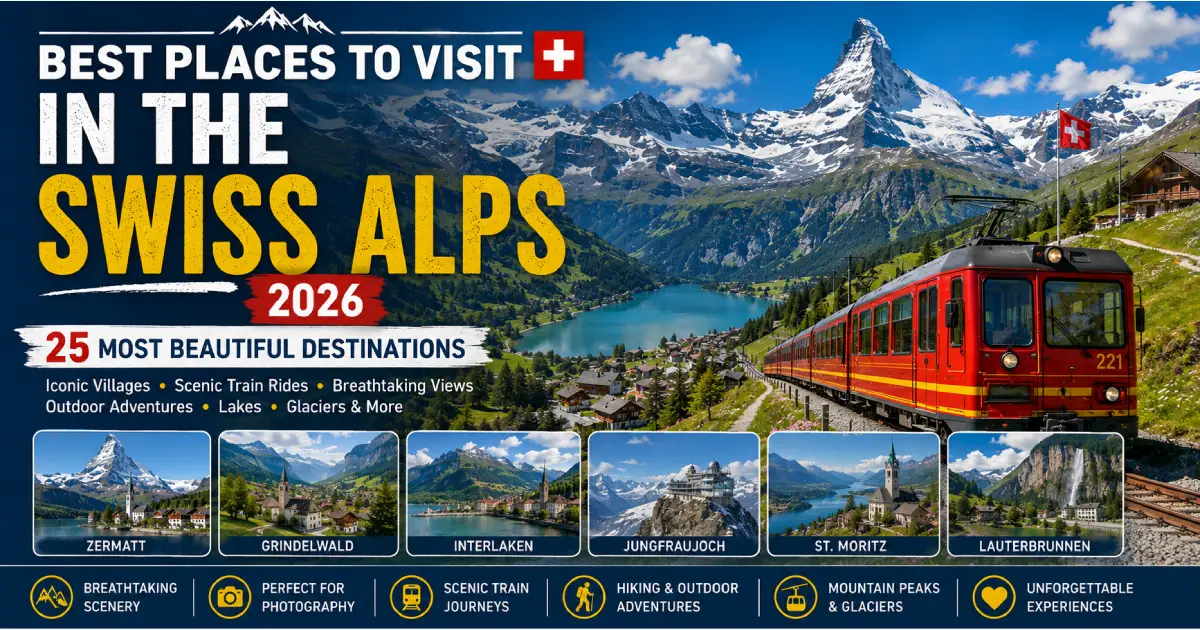
The Swiss Alps occupy approximately 60% of Switzerland’s total land area — a mountain system extending from the canton of Valais in the southwest (where the Matterhorn, the Monte Rosa, and the Grand Combin achieve the most concentrated clustering of 4,000-meter peaks anywhere in the Alps) through the Bernese Oberland in the center (where the Jungfrau, Eiger, and Mönch form the most recognizable Alpine triple-summit in the world and where the Aletsch Glacier stretches 23 kilometers as the longest in the Alps) to Graubünden in the east (where the Bernina massif, the Engadin valley’s lake chain, and the specific cultural landscape of Romansh-speaking Switzerland create the most distinct regional Alpine character available). Within this Alpine zone live approximately 500,000 permanent residents in communities that range from internationally famous resort villages (Zermatt, St. Moritz, Grindelwald, Verbier, Saas-Fee) through historically significant mountain towns (Sion, Chur, Andermatt) to villages so small and so remote that most Swiss people could not locate them on a map — yet whose specific character (the architecture, the local dialect, the traditional economy, and the relationship with the specific mountain landscape surrounding them) represents the most authentic encounter with Alpine Switzerland available.
The best places to visit in the Swiss Alps are not exclusively the most famous — the Matterhorn’s view from Zermatt’s Bahnhofstrasse is genuinely extraordinary and genuinely worth experiencing, but so is the first morning view of the Aletsch Glacier from the Jungfraujoch’s Sphinx terrace, the specific silence of the Muottas Muragl at dawn above St. Moritz, the Lauterbrunnen Valley’s 72-waterfall landscape in spring snowmelt, and the unvisited Romansh villages of the Albula Valley that the Bernina Express passes through without most passengers noticing. This guide covers 25 of the best places to visit in the Swiss Alps — from the world-famous to the genuinely overlooked — with the practical information that makes each destination accessible and the insider perspective that makes each worthwhile.
For comprehensive planning, see our Switzerland Travel Guide 2026, Best Places to Visit in Switzerland 2026, Swiss Travel Pass Guide 2026, Glacier Express: Complete Guide 2026, and Bernina Express: Complete Guide 2026 guides.
| Place | Region | Altitude | Access | Best For | Season |
|---|---|---|---|---|---|
| Zermatt | Valais | 1,608m | Train (MGB) — car-free | Matterhorn, skiing, car-free village | Year-round |
| Jungfraujoch | Bernese Oberland | 3,454m | Mountain railway | Top of Europe, Aletsch Glacier | Year-round |
| Grindelwald | Bernese Oberland | 1,034m | BOB train | Eiger north face, First Cliff Walk | Year-round |
| Lauterbrunnen Valley | Bernese Oberland | 796m | BOB train | 72 waterfalls, Trümmelbach Falls | May–Oct |
| St. Moritz | Graubünden | 1,856m | RhB/SBB train | Luxury skiing, Bernina Express | Year-round |
| Mürren | Bernese Oberland | 1,650m | Cable car + rack | Car-free cliff village, Eiger views | Year-round |
| Saas-Fee | Valais | 1,800m | Bus (car-free from Saas-Grund) | Car-free, crown of Alps, glacier | Year-round |
| Engelberg | Central Switzerland | 1,000m | SBB train | Mount Titlis glacier, Benedictine Abbey | Year-round |
| Pontresina | Graubünden | 1,805m | RhB train | Quieter Engadin base, Bernina Express | Year-round |
| Andermatt | Uri | 1,444m | MGB/SBB train | Historic pass junction, ski resort | Year-round |
| Wengen | Bernese Oberland | 1,274m | BOB rack railway | Car-free, Lauberhorn skiing, sun | Year-round |
| Arosa | Graubünden | 1,775m | RhB train (mountain line) | Family skiing, bear sanctuary | Year-round |
| Leukerbad | Valais | 1,411m | Bus | Largest Alpine thermal spa | Year-round |
| Champéry | Valais | 1,054m | MOB train | Dents du Midi views, Portes du Soleil | Year-round |
| Verbier | Valais | 1,500m | Road + cable car | Extreme skiing, off-piste, party | Dec–April, Jul–Sep |
| Kleine Scheidegg | Bernese Oberland | 2,061m | Wengernalpbahn | Eiger base, Jungfraujoch connection | Year-round |
| Gruyères | Pre-Alps (Fribourg) | 830m | Train + regional | Medieval castle, cheese, HR Giger | Year-round |
| Aletsch Glacier | Valais/Bernese Oberland | 1,900–4,160m | Via Jungfraujoch or hiking | Longest glacier in Alps, UNESCO | June–Oct (hiking); year-round (Jungfraujoch) |
| Stein am Rhein | Rhine Valley | 428m | SBB train | Most painted medieval village Switzerland | April–Oct |
| Muottas Muragl | Graubünden | 2,453m | Funicular (from Pontresina area) | Finest Engadin sunrise viewpoint | Year-round |
| Sils Maria | Graubünden | 1,800m | PostBus | Nietzsche village, Engadin architecture | Year-round |
| Täsch / Randa | Valais | 1,460m | Train | Gateway to Zermatt, Matterhal character | Year-round |
| Bettmeralp | Valais | 1,950m | Cable car (car-free) | Aletsch Glacier access, car-free village | Year-round |
| Gstaad | Bernese Oberland | 1,050m | MOB Golden Pass | Luxury resort, skiing, summer | Year-round |
| Splügen | Graubünden | 1,457m | PostBus | Historic pass village, unchanged character | Year-round |
Region: Valais | Altitude: 1,608 meters | Access: Train only (MGB from Visp or Brig — car-free since 1947) | Best For: Matterhorn views, skiing, car-free Alpine atmosphere | Season: Year-round | See: Zermatt Travel Guide 2026
Zermatt is the single most visually iconic Alpine village in the world — its identity defined by the Matterhorn (4,478 meters, the most recognizable mountain silhouette on Earth, visible from virtually every street in the car-free village) in a way that no other Alpine community is defined by a single peak. The car-free character (private motor vehicles prohibited since 1947 — electric taxis and horse-drawn carriages providing the only motorized transport), the specific quietness this creates (the sound of horse hooves rather than engines on the main Bahnhofstrasse), and the extraordinary concentration of Matterhorn views from the village’s streets and from the cable car and railway infrastructure above (the Matterhorn Glacier Paradise at 3,883 meters — Europe’s highest cable car station; the Gornergrat railway to 3,089 meters — the most comprehensive Matterhorn panorama railway viewpoint) create a destination whose specific combination is unavailable anywhere else.
The pre-sunrise alpenglow (the Matterhorn’s summit turning deep red-orange 20–30 minutes before sunrise, visible from the Ried neighborhood above the village center) is Zermatt’s single most extraordinary free daily event — and the one most consistently missed by visitors who sleep through the alarm. See our Best Places to Visit in Zermatt 2026 guide for the complete Zermatt attraction coverage.
Insider tips: The Matterhorn Glacier Paradise ascent (the cable car sequence from Zermatt to Klein Matterhorn at 3,883 meters) provides the most extraordinary single mountain access experience in the Alps — arriving at the highest cable car station in Europe, with 38 peaks above 4,000 meters visible simultaneously across the Gorner Glacier basin, delivers an Alpine panorama that no other cable car-accessible destination in Europe provides.
Region: Bernese Oberland | Altitude: 3,454 meters | Access: BOB + Wengernalpbahn + Jungfrau Railway from Interlaken (2 hours) | Best For: Aletsch Glacier, glacier walk, Sphinx Observatory | Season: Year-round | See: Jungfraujoch: Complete Visitor Guide 2026
The Jungfraujoch (see our complete guide for full detail) provides access to the Aletsch Glacier — the most massive single piece of glacial ice in the Alps, 23 kilometers long and containing 27 cubic kilometers of ice. At the Sphinx Observatory terrace (3,571 meters — the highest publicly accessible viewpoint in Europe), the glacier’s full extent and the surrounding 4,000-meter peaks create an Alpine landscape encounter that no other publicly accessible point in Europe provides. The weather check (jungfrau.ch summit webcam) remains the most important single planning action.
Region: Bernese Oberland | Altitude: 1,034 meters | Access: BOB train from Interlaken Ost (35 min) | Best For: Eiger north face at close range, First Cliff Walk, Bachalpsee | Season: Year-round | See: Things to Do in Grindelwald 2026
Grindelwald’s specific identity — a village where the Eiger’s 1,800-meter north face rises directly above the main street, creating a visual presence impossible to ignore and impossible to adequately photograph — creates the most intensely mountain-adjacent village experience available in the Bernese Oberland. The First Cliff Walk (glass-floor viewpoint bolted to the cliff face above the First gondola station), the Bachalpsee reflection lake (45 minutes above First, the Eiger-Mönch-Jungfrau reflected in the lake surface on calm mornings), and the Männlichen Ridge Walk (6 km of panoramic ridgewalking with the Eiger visible throughout) constitute Grindelwald’s specific activity landscape.
Region: Bernese Oberland | Altitude: 796 meters (valley floor) | Access: BOB from Interlaken Ost (22 min) | Best For: 72 waterfalls, Trümmelbach Falls, cliff villages | Season: Year-round; peak waterfall April–June
The Lauterbrunnen Valley — the U-shaped glacial gorge whose 300-meter vertical cliff walls host 72 named waterfalls (the Staubbachfall at 297 meters the most visible, the Trümmelbach Falls inside the mountain the most extraordinary), the car-free cliff villages of Mürren and Wengen accessible from the valley floor only by cable car and rack railway, and the specific sound environment (the waterfalls audible from the valley floor throughout) — is Switzerland’s most specifically dramatic valley. The Trümmelbach Falls (CHF 13, inside the mountain — ten glacial meltwater cataracts carrying 20,000 liters per second at spring peak, illuminated and walkable by internal tunnel access) is the single most surprising specific experience in the Bernese Oberland.
Region: Bernese Oberland | Altitude: 1,650 meters | Access: Cable car from Lauterbrunnen to Grütschalp + rack railway | Best For: Most dramatic car-free village, Eiger-Mönch-Jungfrau at eye level, Schilthorn | Season: Year-round
Mürren (population 450 permanent residents, no road access, no private motor vehicles) provides the Jungfrau Region’s most specifically atmospheric village experience — the Eiger-Mönch-Jungfrau triumvirate appearing at eye level directly across the Lauterbrunnen Valley from the village’s south-facing terrace position, and the 854-meter drop to the valley floor creating a vertiginous relationship with the landscape below that the region’s lower-altitude villages don’t possess. The Schilthornbahn (cable car to 2,970 meters, the Piz Gloria revolving restaurant, and the James Bond on Her Majesty’s Secret Service filming location) extends the Mürren visit into one of the Bernese Oberland’s finest summit panoramas.
Region: Graubünden | Altitude: 1,856 meters | Access: RhB train from Chur (2 hrs); Glacier Express from Zermatt | Best For: Luxury skiing, Bernina Express, Engadin lakes, White Turf | Season: Year-round | See: Things to Do in St. Moritz 2026
St. Moritz (see our complete St. Moritz guide) established modern winter tourism through Johannes Badrutt’s 1864 wager with British summer guests — the bet that the Engadin winter was beautiful enough to justify a return visit that proved correct and launched the global luxury ski resort industry. The resort’s specific identity (the chain of Upper Engadin lakes visible from the Corviglia ski slopes, the White Turf horse races on the frozen lake in February, the Bernina Express departure toward Italy across the world’s highest transalpine railway crossing, and the Badrutt’s Palace as the most historically significant hotel in the history of winter tourism) creates a destination that functions simultaneously as an active resort and as a living monument to Alpine tourism history.
Region: Valais | Altitude: 1,800 meters | Access: Car to Saas-Grund, then bus (car-free within Saas-Fee) | Best For: Car-free village, “Crown of the Alps” 13-peak panorama, year-round glacier skiing | Season: Year-round
Saas-Fee (the car-free village in the Saas Valley of the Valais, approximately 14 kilometers from Zermatt by road but separated by the Allalin massif — the two villages invisible to each other despite their proximity) sits beneath what the local tourism describes as the “Crown of the Alps” — 13 peaks exceeding 4,000 meters arranged in a semicircle around the village, including the Dom (4,545 meters — the highest mountain entirely within Switzerland, the Matterhorn’s summit crossing the Italian border making it technically not purely Swiss). The year-round glacier skiing on the Fee Glacier (accessible by the Metro Alpin — the world’s highest underground funicular, ascending within the mountain to 3,500 meters) and the car-free village’s preserved traditional character (the characteristic Valais stone-pillar granaries visible throughout the village center) distinguish Saas-Fee from Zermatt’s more internationally famous but more resort-developed equivalent.
Insider tips: The Saas-Fee village’s traditional character (the preserved Valais Mazots — the raised-on-stone-pillar storage buildings that pepper the village among the more recent hotel development) is most visually complete in the central village lanes that run between the hotel infrastructure — walking specifically these lanes rather than the main shopping street provides the most authentic Saas-Fee village encounter.
Region: Central Switzerland | Altitude: 1,000 meters | Access: SBB train from Lucerne (45 min) | Best For: Mount Titlis glacier, Benedictine Abbey, year-round glacier skiing | Season: Year-round
Engelberg (the “Angel Mountain” — a community whose original settlement was a 12th-century Benedictine monastery, the Kloster Engelberg, whose monks chose this exceptionally remote valley for its specific isolation) provides Central Switzerland’s most complete single destination — the Titlis cable car sequence (including the Rotair, the world’s first rotating aerial cable car, ascending to 3,238 meters through a 360-degree rotation) for the glacier and mountain experience, and the Kloster Engelberg (one of Switzerland’s most significant active Baroque monasteries, guided tours covering the medieval library and the Baroque church) for the cultural dimension.
The combination of an 800-year-old working monastery and a year-round glacier accessible by rotating cable car within the same valley is specifically Engelberg’s identity — a range of experiences available nowhere else in Switzerland within a single community.
Insider tips: The Kloster Engelberg’s cheese production (the monastery maintains active cheese and chocolate production as part of its economic operations — the Engelberg Klosterkäse is produced from the surrounding farm’s milk using traditional methods that the monastic tradition maintains) makes the monastery shop (open to visitors, no tour required) one of the most specifically authentic food-purchase opportunities in Central Switzerland.
Region: Uri | Altitude: 1,444 meters | Access: MGB train from Visp/Zermatt or Chur; SBB from Göschenen (Gotthard route) | Best For: Historic pass junction, growing ski resort, Schöllenen Gorge | Season: Year-round
Andermatt (at the confluence of the Gotthard, Furka, and Oberalp passes — the most strategically significant Alpine junction in Switzerland, where the north-south and east-west Alpine crossing routes intersect) has undergone the Swiss Alps’ most significant resort development project of the past decade: the Andermatt-Sedrun ski area, developed since 2013 by Egyptian billionaire Samih Sawiris, has added the infrastructure of a major modern ski resort to a traditional military-garrison Alpine village whose previous century consisted primarily of Swiss Army barracks and the transit traffic of the Gotthard and Furka routes.
The Schöllenen Gorge (the dramatic limestone canyon carved by the Reuss River between Andermatt and Göschenen, traversed by the historic Devil’s Bridge — the medieval bridge whose construction in the 14th century opened the Gotthard route to commercial traffic) represents Andermatt’s single most visually extraordinary specific element — the funicular (Schöllenbahn, included in Swiss Travel Pass with discount) and the walking path provide access to the gorge’s most dramatic section.
Insider tips: Andermatt’s role as a Glacier Express transit point (the train passes through Andermatt on the Oberalp Pass approach, with a brief station stop) allows a specific Glacier Express itinerary variation — alighting at Andermatt, spending a day exploring the Schöllenen Gorge and the village, then boarding the next Glacier Express for the continuing journey — without requiring a separate side trip from another base.
Region: Graubünden | Altitude: 1,805 meters | Access: RhB train from St. Moritz (6 min) | Best For: Quieter Engadin base, Bernina Express alternative start, Morteratsch Glacier hike | Season: Year-round
Pontresina (6 minutes by RhB train from St. Moritz, at the entrance to the Bernina Valley) provides the Upper Engadin’s most accessible alternative to St. Moritz’s specific glamour and pricing — a village of approximately 2,000 permanent residents whose traditional Engadin architecture (the sgraffito-decorated farmhouses preserved throughout the village center), quieter commercial character, and lower accommodation prices (consistently 20–30% below equivalent St. Moritz properties) create the most practical Engadin base for visitors whose priorities are the natural landscape (the Bernina Express departure from Pontresina, the Morteratsch Glacier walk 20 minutes by train, and the Diavolezza cable car access all within range) rather than the resort’s specific social scene.
Insider tips: The Pontresina Mountain Guides (pontresina.ch) provide the Upper Engadin’s most comprehensive guided mountain activity program — the guided glacier crossing from Diavolezza to the Morteratsch valley, the Piz Languard summit guided hike, and various other Bernina area activities are specifically coordinated through the Pontresina guide operation rather than St. Moritz’s more resort-focused alternative.
Region: Valais | Altitude: 1,411 meters | Access: Bus from Leuk railway station (30 min) | Best For: Largest Alpine thermal spa, dramatic limestone cliffs above, Gemmi Pass walking | Season: Year-round
Leukerbad (in the upper Dala Valley of the Valais, surrounded by dramatic limestone cliff walls — the Daubenhorn and the Gemmi Pass cliffs towering 700–800 meters directly above the village on three sides) hosts the largest Alpine thermal spa resort in Europe — 3.9 million liters of natural thermal water (at 51°C at the source, cooled to various bathing temperatures) flowing daily through the Burgerbad and Alpentherme spa complexes. The thermal water’s specific mineral composition (calcium, sulfate, and magnesium-rich, naturally odorless unlike many European sulfur spas) and the dramatic cliff landscape surrounding the village (creating a specific enclosed grandeur — the village appears to sit in a bowl with vertical limestone walls on three sides) create a spa destination of extraordinary setting.
The Gemmi Pass cable car (ascending from Leukerbad to the 2,322-meter Gemmi Pass above the cliff walls) provides the most dramatic elevation transition available at any Swiss spa destination — the cable car rising 800 meters vertically in approximately 8 minutes, emerging from the valley’s enclosed cliff bowl onto the open high-Alpine plateau above.
Insider tips: The Leukerbad thermal bathing experience is most specifically rewarding in winter (December–March) — outdoor thermal pools at 36–40°C surrounded by deep snow and the cliff walls (with occasional snowfall occurring while bathers soak) create the specific contrast experience (extreme warmth in extreme cold landscape) that defines the Leukerbad winter identity. The pools operate year-round but the winter-outdoor version is uniquely atmospheric.
Region: Graubünden | Altitude: 1,775 meters | Access: RhB mountain railway from Chur (1 hour — the Arosa Line, a scenic mountain railway in its own right) | Best For: Family-friendly skiing, Bear Sanctuary, quiet resort character | Season: December–April (skiing); June–October (hiking)
Arosa (in the Schanfigg Valley above Chur, accessible by the Arosa Line — a narrow-gauge mountain railway that ascends 1,200 meters in 26 kilometers through a series of viaducts and tight mountain curves that constitute a scenic railway journey of genuine quality in themselves) provides Graubünden’s most specifically family-oriented resort — the Arosa-Lenzerheide ski area (currently Switzerland’s fourth-largest by piste kilometers, 225 km marked runs connected since 2013 by a new gondola across the Urdenfürggli pass) at winter pricing meaningfully below St. Moritz, and the Arosa Bear Sanctuary (the permanent residence of rescued European brown bears — bears that were previously kept in unsuitable conditions elsewhere, now in a naturalistic 4-hectare forest enclosure at 1,800 meters altitude, observable from above and from viewing platforms) as a specific summer attraction unavailable at any comparable Swiss Alpine resort.
Insider tips: The Arosa Line railway (from Chur through Langwies — with the Langwies Viaduct, a 287-meter concrete arch bridge completed 1914 that was the world’s longest single-span concrete arch bridge at its completion, visible briefly from the train) is a scenic railway of genuine quality between the celebrated Rhaetian Railway connections — the journey from Chur to Arosa in the RhB’s narrow-gauge cars through increasingly dramatic mountain terrain provides a specific introduction to the destination unavailable by road.
Region: Valais | Altitude: 1,950 meters | Access: Cable car from Betten station (SBB mainline Brig–Andermatt) — car-free | Best For: Aletsch Glacier viewpoint from the “Great Aletsch Arena,” car-free village | Season: Year-round
Bettmeralp (the car-free village above the Aletsch Glacier’s UNESCO World Heritage “Great Aletsch Arena” — the specific landscape section where the glacier is most directly visible from the inhabited Alpine plateau above) provides the most directly glacier-adjacent overnight accommodation available in the Swiss Alps without mountaineering equipment. The Villa Cassel viewpoint (the former villa of English financier Sir Ernest Cassel, now the Pro Natura environmental center, at 2,006 meters on the plateau above Bettmeralp) provides the most directly face-on view of the Aletsch Glacier’s upper section available at any accessible Swiss Alps viewpoint — the glacier visible 400 meters below, its 4-kilometer width and 23-kilometer length comprehensible from this elevated perspective in a way that neither the Jungfraujoch (looking down onto the glacier from above) nor the valley level (looking up toward the glacier from below) fully provides.
Insider tips: The Bettmerhorn cable car (from Bettmeralp to the 2,857-meter Bettmerhorn summit) provides the Great Aletsch Arena’s highest viewpoint accessible by cable car — the glacier visible in its full 23-kilometer extent on clear days from the summit, with the glacier’s tributary streams (the Jungfraufirn, Ewigschneefeld, and Konkordiaplatz visible as distinct ice streams converging into the main glacier body) making the glacier’s complex structure comprehensible from this elevated position.
Region: Graubünden | Altitude: 1,800 meters | Access: PostBus from St. Moritz (20 min, Swiss Travel Pass covered) | Best For: Engadin architecture, Nietzsche House museum, Lake Sils walk, village quiet | Season: Year-round
Sils Maria (at the southwestern end of Lake Sils, the chain’s largest lake) provides the Upper Engadin’s most culturally specific single destination — the village where Friedrich Nietzsche spent six productive summers (1881–1889), the Nietzsche-Haus (the preserved rooms where “Also Sprach Zarathustra” and “Beyond Good and Evil” were conceived, CHF 5, open June–October) providing one of Europe’s most specific intellectual heritage encounters, and the Lake Sils shoreline walk (around the lake’s 13-kilometer perimeter, the Bernina peaks visible above the southern shore throughout) providing the Engadin’s most extended single lake walk.
Region: Bernese Oberland | Altitude: 2,061 meters | Access: Wengernalpbahn from Wengen or Grindelwald Grund | Best For: Closest non-climbing position to Eiger north face, Jungfraujoch connection, sunrise photography | Season: Year-round
Kleine Scheidegg (the mountain pass station at 2,061 meters where the Wengernalpbahn from both Wengen and Grindelwald converges, and where the Jungfrau Railway begins its tunnel ascent toward the Jungfraujoch) deserves recognition as a destination rather than merely a transit point — the platform provides the closest non-climber encounter with the Eiger north face (200 meters horizontal distance from the wall’s base), the surrounding panorama (Eiger, Mönch, and Jungfrau simultaneously visible with the Grindelwald and Lauterbrunnen valleys visible below in opposite directions) is one of the Bernese Oberland’s finest elevated viewpoints, and the overnight accommodation (the small Bahnhof Hotel and Grindelwaldblick) places photographers at the north face during the golden-hour light that dawn and dusk create on the limestone wall.
Region: Graubünden | Altitude: 2,453 meters | Access: Funicular from Punt Muragl (bus/train from St. Moritz or Pontresina, 10 min) | Best For: Most complete Engadin lake chain sunrise view, quiet, less visited than Corviglia | Season: Year-round
Muottas Muragl (2,453 meters, reached by the historic Muottas Muragl funicular — a 1907 rack-and-pinion funicular from the Punt Muragl valley station, ascending 720 meters in 15 minutes) provides the Upper Engadin’s finest single sunrise viewpoint — the entire chain of Upper Engadin lakes (Sils, Silvaplana, Champfèr, St. Moritz, and smaller) visible simultaneously in the valley below, the Bernina massif lit in the first golden light to the south, and the Corviglia and Piz Nair ridges above St. Moritz visible to the west. The Romantik Hotel Muottas Muragl (the small hotel at the funicular’s upper station, one of the few mountain hotels in Graubünden at this altitude — advance booking essential) provides sunrise access without the morning funicular’s schedule constraints.
Insider tips: The Muottas Muragl-to-Alp Languard hiking descent (the “Philosophers’ Path” — a marked trail connecting the Muottas Muragl with the Alp Languard above Pontresina, approximately 2 hours walking through the high-altitude terrain above the Engadin valley) provides the most complete Above-the-Valley Engadin hiking experience available without the Diavolezza or Corvatsch cable car costs — free trail access from the funicular station through genuinely wild terrain above the resort zone.
Region: Graubünden | Altitude: 1,457 meters | Access: PostBus from Thusis (45 min, Swiss Travel Pass covered) | Best For: Most authentically unchanged medieval Alpine village in Graubünden | Season: Year-round
Splügen (at the foot of the Splügen Pass — the historic Roman and medieval trade route between the Rhine Valley and the Italian Lago di Como) is Switzerland’s most unchanged historic Alpine pass village: the main street of 16th–18th century patrician houses (built from the prosperity of the transit trade that made Splügen wealthy before the St. Gotthard route superseded the Splügen as the primary north-south Alpine crossing) is maintained with such minimal modern intervention that walking its central axis in 2026 produces a genuinely disorienting sense of temporal compression — the building facades, the street proportions, and the spatial relationship between buildings and mountain backdrop essentially identical to their appearance in historical photographs from 100+ years ago.
Insider tips: Splügen’s specific value for the visitor — the authentic, un-curated character of a village that has maintained its historic fabric not as heritage tourism but simply through lack of development pressure — is most accessible to visitors who arrive without specific expectations of the “typical Swiss village” postcard. Splügen is too austere, too quiet, and too devoid of tourist infrastructure to appeal to visitors who want the fondue-and-schnapps picture-book experience — but exactly right for those who specifically want to encounter the Swiss Alps before the resort era.
Region: Bernese Oberland (Saanenland) | Altitude: 1,050 meters | Access: GoldenPass Line from Montreux (2.5 hours) or Zweisimmen | Best For: Alternative luxury resort, Saanenland landscape, celebrity visitors, summer music festival | Season: December–April (skiing); July–August (Menuhin Festival)
Gstaad (in the Saanenland — the valley between the Fribourg pre-Alps and the Bernese Oberland proper, accessible via the GoldenPass scenic railway from Montreux) provides a specific alternative to St. Moritz’s Graubünden-based luxury: a Bernese Oberland character (the local architecture is traditional Bernese chalet style rather than Engadin stone-and-sgraffito), a specifically French-Swiss-German-Swiss cultural boundary position (the Saanenland sits at the linguistic frontier), and the Menuhin Festival (founded by violinist Yehudi Menuhin in 1956, now one of the world’s most prestigious summer chamber music festivals — held in the Gstaad church and various outdoor venues in late July and August) as the summer cultural programming anchor.
Insider tips: The Gstaad Palace Hotel (Switzerland’s most consistently celebrity-attended single hotel — a specific property rather than a brand, operating since 1913 and maintaining a guest roster across generations that represents the most concentrated intersection of international wealth and public recognition in the Alps) is worth passing on foot for its architectural presence and the specific atmosphere of its public entrance area regardless of whether accommodation or dining is planned.
Region: Valais | Altitude: 1,500 meters | Access: Road to Le Châble, then cable car; or SBB to Martigny + regional train | Best For: Expert skiing, Freeride World Tour, off-piste, après-ski | Season: December–April; July (festivals)
Verbier (in the Val de Bagnes above Martigny, accessible by road or by train to Le Châble and cable car) is Switzerland’s most expert-skier-oriented resort — the 4 Vallées ski area (400 km of marked runs, connected to Nendaz, Veysonnaz, Thyon, and La Tzoumaz) and the specific off-piste and freeride terrain (Mont Fort at 3,330 meters with genuine glacier skiing and the legendary “Stairway to Heaven” descent) attract the world’s most technically advanced skiers alongside the specific party atmosphere (the Farinet Bar and the overall Verbier après-ski intensity) that makes the resort internationally notorious as the Alps’ wildest nightlife alongside the finest expert terrain.
Insider tips: The Freeride World Tour event at Verbier (typically late March or early April — check current 2026 dates at freerideworldtour.com) provides the world’s finest extreme skiing competition viewable free from specific mountain positions — riders descending cliffs and through avalanche-release zones on Mont Fort’s specific competition faces, with the best viewing positions reachable on skis or snowshoes from the Mont Fort lift system.
Region: Valais (Chablais) | Altitude: 1,054 meters | Access: TPC railway from Monthey (SBB mainline Lausanne–Brig); or Golden Pass route connection | Best For: Dents du Midi panorama, Portes du Soleil ski area (Franco-Swiss), traditional Valaisian character | Season: December–April; June–October
Champéry (at the head of the Val d’Illiez, the western Valais valley extending south from the Chablais region toward the French border) sits directly below the Dents du Midi — a 7-summit massif (highest point 3,257 meters) whose distinctive serrated profile defines the valley’s visual horizon and provides one of the most recognizable peak silhouettes in the western Alps. The village’s traditional Valaisian character (the wooden chalets in the specific Chablais style, the Val d’Illiez valley’s specific semi-Mediterranean microclimate warming the slopes above the valley floor) and the Portes du Soleil ski area connection (650 km of marked pistes across the French-Swiss border, including several ski runs that cross the international frontier in mid-descent) create a resort experience more specifically character-rich than the larger, more internationally marketed Valais resorts.
Insider tips: The specific Portes du Soleil cross-border skiing (the ski run “Pas de Chavanette” — known as the “Swiss Wall,” a steep descent from the Swiss territory into Avoriaz on the French side — represents the most specifically intimidating individual ski trail in the connected ski area, classified black in France but colloquially described as beyond standard classification by regulars) and the Franco-Swiss frontier crossing mid-descent (no passport control — the Schengen Area eliminates border formality for Champéry-to-Avoriaz skiers) provide Champéry with its most specifically unique skiing experience.
About Travel Tourister Travel Tourister’s destination specialists have visited every destination in this guide — from Zermatt Matterhorn alpenglow mornings and Jungfraujoch winter clarity sessions through Lauterbrunnen spring waterfall peaks and Mürren cliff-village sunsets to Bettmeralp Aletsch Glacier sunrises, Splügen medieval street walks, and Muottas Muragl dawn lake-chain panoramas — to deliver the most comprehensive and practically honest guide to the Swiss Alps’ best destinations for 2026 visitors.
Posted By : Vinay
Latest Article
2nd Floor, 39, Above Kirti Club, DLF Industrial Area, Kirti Nagar, New Delhi, Delhi 110015



Travel Tourister is a leading Travel portal where we introduce travellers to trusted travel agents to make their journey hasselfree, memorable And happy. Travel Tourister is a platform where travellers get Tour packages ,Hotel packages deals through trusted travel companies And hoteliers who are working with us across the world. We always try to find new and more travel agents and hoteliers from every nook and corners across the world so that you could compare the deals with different travel agents and hoteliers and book your tour or hotel with the one you have chosen according to your taste and budget.
Copyright © Travel Tourister, India. All Rights Reserved

 Call
Call Enquiry