Published on : 10 Sep 2026
By Travel Tourister | Updated Sep 2026
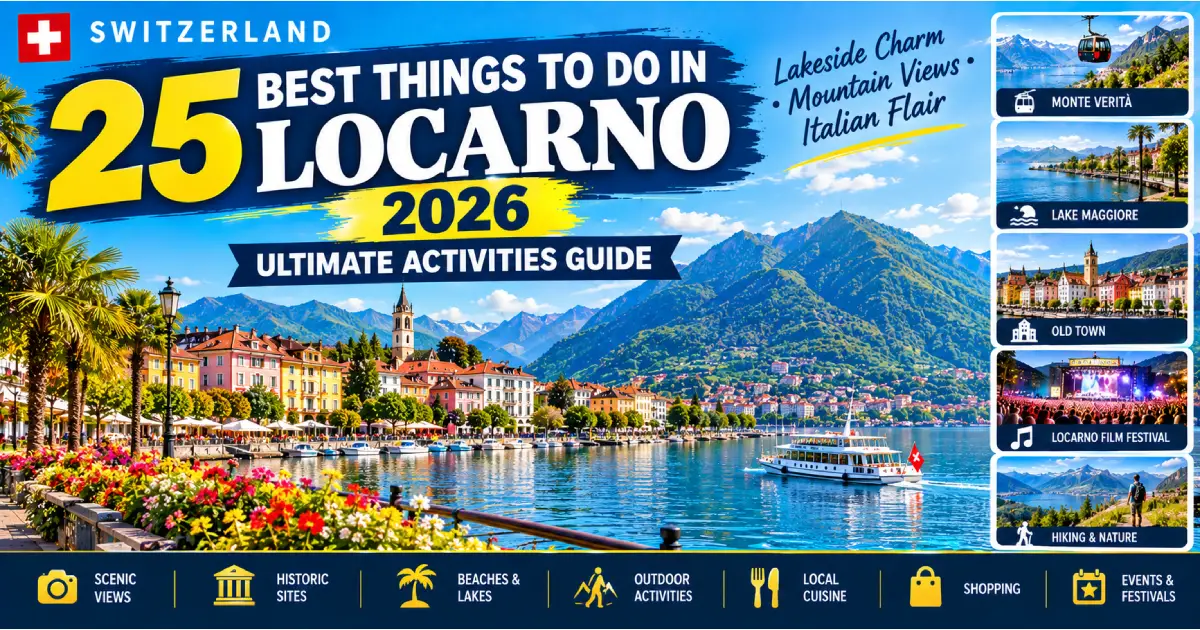
Locarno is Switzerland’s sunniest city — a statistical fact (Locarno holds the Swiss record for annual sunshine hours, averaging 2,300 per year, approximately 60% more than Zurich and approaching the Mediterranean average) that explains everything about the city’s specific character. At the northern end of Lake Maggiore (Lago Maggiore — the second-largest lake in Italy and Switzerland’s most Mediterranean lake, extending 64 kilometers southward from Locarno into the Piedmont of northern Italy), 196 meters above sea level in the canton of Ticino, Locarno’s warmth and light create a genuinely southern European urban character in a Swiss municipal context: the palm trees and camellia bushes lining the lakeside promenade, the piazzas where Italian-language café culture operates in outdoor settings from February through November, the vineyards of the Ticino’s red wine country visible on the valley slopes above the lake, and the Madonna del Sasso pilgrimage sanctuary on its cliff above the city providing the most dramatically positioned church accessible from any Swiss urban center.
The best things to do in Locarno in 2026 reflect this specific Mediterranean-Swiss character: the August Film Festival (the Locarno International Film Festival — one of the world’s oldest and most prestigious, running since 1946, whose open-air screening in the Piazza Grande — the world’s largest outdoor cinema, seating 8,000+ under the Ticino stars — is Switzerland’s single most extraordinary annual cultural event), the Madonna del Sasso sanctuary and its funicular approach, the Lago Maggiore boat excursions (to the Brissago Islands’ subtropical botanical garden, to the Centovalli railway’s Italian border connections, and to the southern lake’s Italian resort towns), the Piazza Grande’s everyday café culture (the most genuinely Italian public square character in Switzerland, the large piazza designed specifically for the outdoor cinema but functioning as Locarno’s civic heart throughout the year), and the surrounding valley excursions (the Centovalli scenic railway, the Valle Maggia and Valle Verzasca hiking territories, and the Cardada-Cimetta cable car for the highest viewpoint above the lake). This guide covers all 25 best things to do in Locarno for 2026 visitors.
For related guides, see our Places to Visit in Lugano 2026, Switzerland Travel Guide 2026, Best Places to Visit in Switzerland 2026, and Swiss Travel Pass Guide 2026.
| # | Activity | Category | Cost | Season | Book Ahead? |
|---|---|---|---|---|---|
| 1 | Locarno International Film Festival | Film/Event | CHF 20–60/screening | August (16 days) | Yes (months) |
| 2 | Madonna del Sasso Sanctuary | Religious/Views | Free (funicular CHF 12) | Year-round | No |
| 3 | Piazza Grande — Café Life | Culture | Free to sit; coffee CHF 4–6 | Year-round | No |
| 4 | Lago Maggiore Boat Trip | Boat | Swiss Travel Pass | April–October | No |
| 5 | Brissago Islands Botanical Garden | Garden | CHF 10 + boat | April–October | No |
| 6 | Cardada-Cimetta Cable Car and Views | Mountain | CHF 32–45 return | Year-round | No |
| 7 | Centovalli Scenic Railway | Train | CHF 36–48; Swiss Travel Pass covered | Year-round | Yes (seats) |
| 8 | Valle Verzasca and Verzasca Dam | Nature | Free; bus access | May–October | No |
| 9 | Old Town (Città Vecchia) Walk | Culture | Free | Year-round | No |
| 10 | Castle Visconteo | Museum | CHF 8 | March–November | No |
| 11 | Ascona Day Trip | Village | Swiss Travel Pass (bus/boat) | Year-round | No |
| 12 | Swimming at Lido di Locarno | Swimming | CHF 8 | May–September | No |
| 13 | Tenero Camping and Maggia Delta | Nature | Free (trail) | April–October | No |
| 14 | Camelie di Locarno (Camellia Exhibition) | Garden | Free | February–March | No |
| 15 | Valle Maggia Hike | Hiking | Free + bus access | May–October | No |
| 16 | Fondazione Branca (Contemporary Art) | Museum | CHF 8–12 | Year-round | No |
| 17 | San Francesco Church | Architecture | Free | Year-round | No |
| 18 | Lago Maggiore Full Circuit (Boat) | Boat | Swiss Travel Pass + Italian portion | April–October | No |
| 19 | Gordola and Bezonzo Gorge | Nature | CHF 5 | April–October | No |
| 20 | Locarno Cantonal Museum | Museum | CHF 10 | Year-round | No |
| 21 | Gambarogno Botanical Garden | Garden | CHF 8 | March–November | No |
| 22 | Mergoscia Village Hike | Hiking | Free | May–October | No |
| 23 | Cardada Sunrise Walk | Hiking | Free (cable car CHF 32) | Year-round | No |
| 24 | Piazza Grande Aperitivo Evening | Food/Drink | CHF 10–20 | Year-round (best May–Oct) | No |
| 25 | Intragna Village and Centovalli Bridge | Sightseeing | Free + Centovalli train | Year-round | No |
Dates: August annually (approximately August 5–15 — check locarnofestival.ch for current 2026 dates) | Location: Piazza Grande, Locarno center | Tickets: CHF 20–60 per screening (Piazza Grande); CHF 15–40 (other venues) | Capacity: 8,000+ (Piazza Grande) | Book: Essential for Piazza Grande screenings — at locarnofestival.ch, typically from May
The Locarno International Film Festival (founded 1946 — the same year as Cannes, making Locarno one of the oldest surviving major international film festivals in the world, alongside Cannes, Venice, and Berlin) is Switzerland’s most significant single annual cultural event and one of the world’s most cinematically serious festivals: the festival’s specific curatorial identity (a strong preference for auteur cinema, non-Western film traditions, experimental works, and the discovery of genuinely new filmmakers rather than the glamour-premiere-of-commercial-studio-films that some competing festivals prioritize) combined with the Piazza Grande’s specific physical format (8,000+ spectators on the piazza seats and surrounding standing areas, the 26-meter-wide screen erected at the piazza’s east end, and the specific atmosphere of watching cinema under the Ticino stars in one of Switzerland’s most beautiful public squares) creates a festival experience that its regular attendees describe as unlike any other in the world.
The Piazza Grande experience: The specific combination of the scale (8,000 simultaneous viewers on the same piazza), the setting (the Piazza Grande’s specific architecture — the plastered facades of the surrounding buildings, the palms visible above the rooflines, and the Ticinese night air at 20–25°C in August), and the programming (the Piazza Grande typically hosts the festival’s most accessible selections — retrospectives, restorations of classic films, and contemporary works with broad appeal alongside the more challenging fare of the competition venues) creates the world’s most atmospheric large-format outdoor cinema. Watching a film in the Piazza Grande on a warm August night, surrounded by 8,000 other filmgoers from 100+ nationalities, remains one of the most specifically extraordinary cultural experiences that Switzerland offers.
Planning for the festival: Locarno accommodation during the festival (typically August 5–15) books out 3–6 months ahead — hotel and apartment options in Locarno itself disappear earliest, with Ascona (3 km, connected by bus and boat) providing the most accessible alternative base. The festival’s opening and closing ceremonies (the golden Leopard Award presentations — the Pardo d’Oro being the festival’s top prize, the golden leopard symbol appearing throughout the festival’s visual identity) and the major competition screenings at the Palexpo indoor venue are ticketed separately from the Piazza Grande.
The film passport: The festival’s multi-screening pass (the “passport” option — available for festival duration or specific day blocks at locarnofestival.ch) provides the most cost-effective access for visitors planning to attend multiple screenings across the festival days.
Insider tips: The Piazza Grande screenings begin after dark (approximately 9:30–10 PM in August, when the Ticino sky’s light has faded sufficiently for the screen to be visible) — arriving at the Piazza by 8:30–9 PM provides good seating position in the allocated open seating area. The evening atmosphere before screening (the piazza filling with the international film-world audience, the café terraces surrounding the square active with pre-screening aperitivos, and the specific energy of the festival’s gathering week) constitutes an experience in its own right before the film begins.
Cost: Free (sanctuary); CHF 12 return (Funicolare Locarno–Madonna del Sasso, departs from the Old Town at Via al Sasso 4) | Hours: Sanctuary open daily; funicular hours vary seasonally — check mds-locarno.ch | Duration: 1.5–2 hours | Year-round | Swiss Travel Pass: 50% discount on funicular
The Madonna del Sasso (Our Lady of the Rock — the Franciscan pilgrimage sanctuary on the cliff 356 meters above Locarno, founded 1487 after the Franciscan friar Bartolomeo d’Ivrea reported a Marian apparition on the rocky promontory above the town, the current church building dating primarily from the 1616 Baroque reconstruction) is simultaneously Locarno’s most dramatically positioned building and its most enduring religious institution — the pilgrimage tradition maintained across 500 years of continuous devotion, the funicular service (opened 1909) making the sanctuary accessible to visitors without the steep footpath ascent that pilgrims historically made on their knees.
The view from the sanctuary: The terrace in front of the Madonna del Sasso church (the balcony above the cliff face, with the drop to Locarno’s rooftops 100+ meters below and Lake Maggiore’s full northern section visible in the southward direction) provides the finest elevated view of the Locarno-Lago Maggiore landscape: the lake stretching southward into Italy (the Brissago Islands visible in the lake’s middle section, the Italian lake towns of Cannobio and Verbania visible on the southern lake on clear days), the Locarno city plan visible directly below (the Piazza Grande’s specific rectangular form legible from above), and the Valle Maggia and Valle Verzasca valley openings visible to the north.
The Via Sacra footpath: The steep cobbled path ascending from Locarno’s Largo Zorzi through a series of devotional chapels (14 Stations of the Cross chapels, each dating from the 17th–18th century, the Via Sacra constituting one of the finest surviving pilgrimage path environments in Ticino) provides the most historically complete pilgrimage experience — the 30-minute ascent through the chapels creating a sacred route that the funicular ride cannot replicate in spiritual or historical terms.
The church interior: The Madonna del Sasso church interior (the Baroque nave with the specific venerated image — the 1480 fresco of the Madonna and Child that is the sanctuary’s founding devotional object), the church’s collection of ex-votos (the votive offerings of miraculous-cure petitioners — paintings, silver plaques, and various objects left by pilgrims whose petitions were reportedly answered, accumulated across 500 years of pilgrimage and constituting one of the most extensive ex-voto collections in Swiss religious heritage), and the specific atmosphere of an active pilgrimage church in the 21st century create a religious-cultural experience of genuine depth.
Insider tips: The Madonna del Sasso’s best view condition is the early morning (arriving by the first funicular departure in clear conditions — the lake still, the early light on the water and the surrounding mountains, and the Locarno city below in the specific clarity of pre-tourist-hour air). The evening funicular (in summer, specific later departures allow watching the Ticino sunset from the sanctuary terrace — checking the current evening funicular schedule before planning this specific visit avoids arriving to find the last funicular has departed).
Cost: CHF 10 (island entry) + boat ticket (Swiss Travel Pass covered for Navigazione Lago Maggiore Swiss section) | Access: Navigazione Lago Maggiore boats from Locarno landing stage (30 min) | Hours: Daily April–October | Duration: 2 hours on islands | Season: April–October
The Isole di Brissago (the Brissago Islands — two small islands in Lake Maggiore approximately 8 km south of Locarno, the larger island [Isola Grande or Isola San Pancrazio] hosting the Parco Botanico del Canton Ticino, one of the finest subtropical botanical gardens in the Alpine region) provide the most specifically unexpected natural experience available from Locarno: a lake island at 193 meters altitude in Switzerland whose specific microclimate (the island’s full southerly exposure, the lake’s thermal mass, and the shelter from northern winds creating the warmest microclimate in Switzerland) supports species ranging from Japanese banana trees and papyrus to South American agaves and Australian tree ferns — plants that cannot survive outdoors in any other Swiss location.
The island’s botanical collection (established by Antoinette de Saint-Léger, the Russian-born Irish baroness who purchased the island in 1885 and systematically developed its garden over four decades before the canton of Ticino purchased the estate in 1949) contains approximately 1,500 plant species in a layout that traces the botanical geography of the subtropical world through the specific planting zones. The island walk (a complete circuit of approximately 45 minutes at a comfortable pace) provides the most dramatically compressed botanical-diversity experience available in Switzerland — the transition from the north-shore conifer-forest that most Swiss visitors know to the subtropical island garden creating a specific disorientation of season (visiting in October, when Switzerland above 500 meters is already in autumn, the Brissago Islands remain in green-leafed summer conditions) that the boat approach begins to establish even before landing.
Insider tips: The Brissago Islands in the magnolia and camellia flowering period (February–April, varying by year — the island’s protected microclimate advancing the flowering calendar 3–4 weeks ahead of the mainland) provides the most dramatically colorful version of the island garden, with subtropical flowering species at their peak in conditions that correspond to mid-winter on the Swiss Mittelland. The specific sight of magnolia trees in full bloom against Lake Maggiore’s blue surface in February (when Zurich has snow on the ground) is the most concentrated expression of Ticino’s climatic advantage available in a single landscape.
Cost: Swiss Travel Pass covers Navigazione Lago Maggiore’s Swiss section (Locarno to Italian border area); Italian section requires separate Italian ticket | Duration: Full circuit approximately 4–6 hours | Season: April–October | Access: Navigazione Lago Maggiore boats from Locarno landing stage
The Lake Maggiore boat circuit (the Navigazione Lago Maggiore’s services connecting Locarno with Ascona, the Brissago Islands, Cannobio (Italy), Cannero (Italy), Verbania (Italy), and Stresa (Italy, adjacent to the Borromean Islands)) provides the Swiss-to-Italian lake transit that makes Lake Maggiore specifically different from Switzerland’s other major lakes — the ability to travel from Switzerland into Italy on the same boat journey without changing transport mode, the cultural and linguistic shift from Swiss-Italian (Ticino) to mainland Italian (Piedmont) occurring mid-lake as the border is crossed.
The Borromean Islands (Isole Borromee): The three Borromean Islands on Lake Maggiore’s Italian section (Isola Bella, Isola Madre, and Isola dei Pescatori) — accessible from Stresa on the lake’s Italian shore — constitute one of northern Italy’s most celebrated cultural landscapes: the 17th-century Baroque palace and terraced gardens of Isola Bella (built for Count Vitaliano VI Borromeo, the island transformed from a bare rock to a multi-terrace formal garden cascading toward the lake with a theatrical ambition that the Italian Baroque applied to landscape architecture as completely as to church interiors), the Isola Madre botanical garden, and the fishing village of Isola dei Pescatori (the only Borromean island with permanent residents — a community of approximately 50 people who fish the lake in the traditional manner) are most accessible from the Swiss side via the Lake Maggiore full-circuit boat in a full-day excursion from Locarno.
Insider tips: The Lake Maggiore full circuit to Stresa and the Borromean Islands requires a full day from Locarno (boat to Stresa approximately 2 hours, island visits 2–3 hours, return boat 2 hours) — departing on the first morning boat from Locarno (typically 8 AM, check navigazionelaghi.it for current 2026 schedule) and returning on the last afternoon boat provides the maximum island time without overnight in Italy.
Cost: CHF 8 (adults); CHF 5 (children) | Location: Lago Maggiore shore, Locarno | Season: May–September (pool season); lake swimming year-round from shore access | Hours: Daily 9 AM–7 PM in season | Duration: 2 hours
The Lido di Locarno (the Lake Maggiore public swimming complex on the lake shore, with outdoor pools, a children’s pool, lawn areas, and direct lake access) provides the most organized version of Lake Maggiore swimming in Locarno — the lake’s specific warmth (Lake Maggiore’s water temperature reaching 26–28°C in July–August, Switzerland’s warmest lake-swimming water, the large body of water’s thermal mass accumulating summer heat more effectively than the smaller Alpine lakes) and the Lido’s infrastructure (changing rooms, food kiosk, rental equipment) making it the most practically complete swimming facility in the Swiss-Italian lake zone.
Insider tips: Lake Maggiore’s water in late summer (August–September) provides the warmest lake swimming in Switzerland by a consistent margin — the 26–28°C temperature producing a genuinely warm lake experience that the colder Alpine lakes (Lake Brienz, Lake Thun, Lake Lucerne) at 18–22°C don’t approach. The specific pleasure of warm lake swimming in a Ticinese setting (the palm trees above the shore, the Italian mountains across the water, and the Ticino sun’s specific intensity at 196 meters altitude) creates an experience more closely resembling an Italian lake resort than anything available elsewhere in Switzerland.
Cost: CHF 36–48 one-way (Locarno → Domodossola, Italy); Swiss Travel Pass covers Swiss section | Duration: 1 hour 40 minutes (Locarno → Domodossola) | Season: Year-round | Access: Ferrovia Centovallina station adjacent to Locarno Piazza Grande | Book: Seat reservation recommended
The Centovalli Railway (the Ferrovia Centovallina — connecting Locarno with Domodossola in Italy via the Centovalli valley and its Italian continuation the Vigezzina, together 52 km of narrow-gauge railway through one of Switzerland’s and northern Italy’s finest valley landscapes) is Locarno’s most specifically celebrated scenic train journey: the route traversing the Centovalli (“Hundred Valleys” — the valley’s specific topography of deep lateral ravines cutting into the main valley walls, creating the impression of countless valley branches) on bridges and viaducts above the Melezza River, through villages of extreme medieval character (Intragna, Verdasio, Camedo), and into the Italian Valle Vigezzo (the “Valley of Painters” — a valley whose specific quality of light attracted a colony of 19th-century landscape painters and that maintains a painting tradition today).
The Intragna stop: Intragna (the Centovalli village approximately 15 minutes from Locarno) hosts the highest campanile (church tower) in the canton of Ticino (65 meters, built 1775 — the specific Baroque tower whose silhouette defines the Centovalli’s valley character for the approaching train) and provides the most accessible single Centovalli village experience for visitors who want to experience the valley without committing to the full Domodossola crossing. The Intragna stop (walking the village, the specific 18th-century stone houses and the campanile, and returning by the next train) provides a specific 2-hour Centovalli experience from Locarno.
The Domodossola circuit: The full Centovalli–Vigezzina round trip (Locarno → Domodossola by Centovalli Railway, then return from Domodossola to Locarno by SBB through the Simplon Tunnel) creates the “Centovalli Circuit” — a famous Swiss day excursion using two completely different railway routes and passing through two countries (Switzerland and Italy) in a single day.
Insider tips: The Centovalli in autumn (October–November — the chestnut forests that cover the valley’s lower slopes turning gold, the chestnuts falling and the valley communities collecting them for the traditional Ticinese chestnut festivals, and the specific October light quality through the bare-branching trees illuminating the valley’s stone villages) provides the most dramatically colorful version of the Centovalli journey and coincides with the festival season (the Sagra della Castagna in various Centovalli villages celebrates the chestnut harvest in October).
Cost: Free (valley); bus from Locarno covered by Swiss Travel Pass (PostBus); bungee jump CHF 220 (Trekking Team) | Access: PostBus from Locarno to Lavertezzo and beyond | Duration: Half day to full day | Season: May–October for swimming; year-round for valley
The Valle Verzasca (the valley extending northward from Lake Maggiore at Tenero, carved by the Verzasca River through the specific green-streaked metamorphic rock that gives the river its characteristic emerald-green clarity) provides the Locarno area’s most specifically extraordinary natural landscape: the Verzasca River’s glacially-clear water (transparency of 4–5 meters visible in the deeper pools, the specific green coloration from the mineral-laden but completely unpolluted glacial meltwater source creating the river color visible throughout the valley), the Lavertezzo double-arched bridge (the “Ponte dei Salti” — the medieval twin-arch bridge over the Verzasca at Lavertezzo, the most photographed single landscape element in the Ticino, the specific composition of the ancient stone arch bridge with the emerald river below and the sun-warmed granite slabs beside it creating Switzerland’s most sought-after single river-swimming location), and the Verzasca Dam (the 220-meter concrete dam at Vogorno that James Bond bungee-jumps from in the 1995 “GoldenEye” opening sequence — the real dam, whose specific 220-meter drop Trekking Team operates as an active bungee jump site).
The Ponte dei Salti and river swimming: The Lavertezzo double-arch medieval bridge and the river pools below it (the emerald-green, crystal-clear water pooling between the sun-warmed granite slabs in a setting of specific natural beauty) constitute Switzerland’s most specifically celebrated river-swimming location — the combination of the water clarity, the temperature (surprisingly warm in July–August despite the glacial source, the dark granite slabs absorbing and radiating solar heat into the pools), and the specific landscape setting (the valley walls, the medieval bridge, and the absolute clarity of the water below) creating an outdoor swimming experience without equal in Switzerland.
The GoldenEye Dam jump: The Verzasca Dam bungee jump (220 meters, Trekking Team’s operation at the dam base) is specifically famous as the location of the “GoldenEye” film’s opening sequence — James Bond’s bungee jump from the dam wall into the valley below. Trekking Team’s commercial operation at the same dam provides the same jump to non-fictional visitors (CHF 220, book well in advance — trekking-team.ch).
Insider tips: The Lavertezzo Ponte dei Salti in the early morning (arriving by the first PostBus from Locarno, before 9 AM in summer) provides the bridge and pools in the most uncrowded conditions — the combination’s specific fame creates genuinely crowded conditions from mid-morning in July and August, the early morning providing both the photography and the swimming in near-solitude.
Cost: Free | Best Time: Aperitivo hour (6–8 PM) and Film Festival August | Duration: 30 minutes to 1 hour | Year-round
The Piazza Grande (the large rectangular piazza at the center of Locarno’s Old Town — the largest piazza in the canton of Ticino, the site of the Film Festival’s 8,000-seat open-air cinema in August, and the city’s primary civic gathering space throughout the year) provides the most complete expression of Locarno’s specific Italian-Swiss piazza culture. The specific Piazza Grande character: the arcade-lined ground floors of the surrounding buildings (the covered loggias housing shops and cafés whose terraces extend into the piazza space), the morning market (Monday and Thursday mornings — fresh produce, cheese, and Ticinese specialty foods from the surrounding villages), and the aperitivo hour (the Italian pre-dinner drink culture maintaining its most genuinely Ticinese expression in the piazza’s café terraces, the Spritz and Negroni the most ordered drinks, the piazza filling from 6 PM onward with a specifically relaxed southern European social energy).
The Film Festival transformation: In August, the Piazza Grande is transformed into the world’s largest outdoor cinema (8,000 seats covering the full piazza surface, the 26-meter-wide screen erected at the piazza’s east end) — the specific metamorphosis of Locarno’s most ordinary daily civic space into Switzerland’s most extraordinary annual cultural venue creating the Festival’s most specifically powerful contextual effect: the same piazza where residents buy vegetables on Thursday morning becomes, two weeks later, the site of a globally-attended cultural event of the highest cinematic ambition.
Cost: Free | Duration: 1.5–2 hours | Best Time: Morning for quiet exploration
Locarno’s Città Vecchia (the Old Town — the medieval and Renaissance city fabric immediately surrounding the Piazza Grande, the stepped lanes and covered passages connecting the main square with the San Francesco church, the Castle Visconteo, and the Via Cittadella) provides the most specifically Ticinese historic streetscape in the northern Lago Maggiore area: the characteristic plastered building facades in ochre, terracotta, and pale yellow (the Ticinese palette that reflects the specific lime plaster and natural pigment tradition of the Italian-Swiss region), the vaulted passages connecting parallel lanes, and the specific scale of the buildings (4–5 story street frontages creating the enclosed spatial character of northern Italian urban fabric) creating an Old Town atmosphere immediately distinguishable from the German-Swiss cities’ different architectural tradition.
Key Old Town elements:
San Francesco Church (13th–14th century): The former Franciscan church (1538 secularization during the Reformation, now used for cultural events and exhibitions) provides Locarno’s most architecturally complete single medieval building — the Gothic nave (intact despite the secularization), the Renaissance cloister (the most beautiful single architectural space in Locarno, accessible from the church exterior during open hours), and the specific stone construction quality that distinguishes the medieval fabric from the later plaster-covered buildings of the surrounding streets.
Castle Visconteo: The medieval castle on the Old Town’s western edge (the Castello Visconteo — built in the 13th–15th centuries by the Visconti duchy of Milan who ruled Locarno before the Swiss Confederation’s conquest in 1512, substantially demolished after the Swiss takeover with the remaining structures now housing the Archaeological and Cultural Museum) provides the most historically resonant single structure in Locarno — the Visconti tower and the remaining castle walls visible from the Piazza Grande area create the specific medieval-civic visual anchor that the piazza’s commercial character requires.
Cost: Free (public gardens and various villa gardens) | Dates: Mid-February to early April | Location: Throughout Locarno and Ascona | Character: Switzerland’s only subtropical-flowering February display
The Locarno camellia flowering season (the Camelie di Locarno — the specific annual event when the Lago Maggiore region’s camellia bushes, protected by the Mediterranean-adjacent microclimate from the frosts that kill camellias throughout the rest of Switzerland, produce their flowering display while Switzerland above 500 meters is still in winter conditions) is one of the Swiss calendar’s most specifically remarkable seasonal events. The Locarno and Ascona area maintains some of the largest mature camellia specimens in Europe — single bushes reaching 8–10 meters height and 70–80 years of age, producing thousands of simultaneous blossoms in the specific deep red, pink, and white of the camellia’s limited color range.
The specific Locarno camellia locations (the Villa Taranto and Palazzo Vergottini gardens in the Locarno-Muralto area, the Parco Pallavicini, and the historic villa gardens throughout the Ascona–Locarno lake shore corridor) are accessible during the flowering period through specific visiting programs organized by Locarno Tourism — the most dramatic individual specimens require advance contact with the private villa owners whose gardens are opened specifically for the Camelie di Locarno season.
Cost: CHF 8 | Location: Vairano, Gambarogno (opposite bank of Lake Maggiore from Locarno) | Access: Navigazione Lago Maggiore boat from Locarno to Vairano (30 min) | Season: March–November | Duration: 1.5 hours | Best Time: Camellia season (February–April)
The Gambarogno Botanical Garden (on the eastern shore of Lake Maggiore, opposite Locarno, accessible by boat in 30 minutes) maintains Switzerland’s most significant collection of mature camellias — the 500+ specimens (some over 100 years old, reaching 10+ meters height) in a specific garden design that creates a structured encounter with the camellia’s extraordinary variety (over 200 camellia varieties, the species range covering both the Camellia japonica and Camellia sinensis traditions). The garden’s elevated position above the lake’s eastern shore (the Gambarogno promontory providing views across Lake Maggiore toward Locarno’s skyline and the Madonna del Sasso cliff) combines the botanical collection with a lake panorama of specific quality.
Cost: Bus/boat from Locarno (Swiss Travel Pass covered) | Duration: Half day | Access: PostBus 10 from Locarno or Navigazione Lago Maggiore boat | Character: Lake village, artists’ history, Monte Verità utopian commune site
Ascona (the lakeside village 3 km south of Locarno — connected by postbus and lake boat, the most accessible single day-trip destination from Locarno) provides the specific historical dimension that Locarno’s more commercially active center doesn’t emphasize: the village’s role as one of Europe’s most significant utopian experiment sites (the Monte Verità — Mountain of Truth — commune founded 1900 on the hill above Ascona, whose early 20th-century residents included Rudolf Laban [modern dance pioneer], Carl Jung [for a period], Hermann Hesse, Franz Kafka, and dozens of other significant European cultural figures who came to the Ticinese lakeside seeking alternative community, health, and spiritual renewal) alongside the village’s lakeside artistic community (the specifically Mediterranean-quality light that has attracted painters to Ascona since the 19th century, the village’s concentration of galleries and the specific cultural infrastructure that the Monte Verità tradition established).
Monte Verità: The hill above Ascona (accessible by steep footpath or via the Monte Verità Hotel and cultural center — the former commune buildings now operated as a hotel and cultural venue hosting specific Monte Verità-related programming) provides the most historically resonant single site in the Locarno-Ascona area: the specific buildings where the early 20th-century alternative community’s experiments in communal living, vegetarian diet, nudism, and organic agriculture occurred (the remaining Monte Verità buildings maintained as cultural-heritage sites) and the panoramic view of Lake Maggiore from the hill’s summit creating a specifically charged landscape visit.
The Ascona Old Town (Borgo): Ascona’s lakeside borgo (the specific compact historic center of plastered Ticinese buildings, the most densely painted village street facades in the Ticino, and the particular concentration of galleries and cultural venues that the artistic tradition established) provides 30–45 minutes of specifically atmospheric Old Town walking that enhances the Monte Verità visit into a complete Ascona half-day.
Cost: CHF 32 (cable car Locarno → Cardada) + CHF 13 (chairlift Cardada → Cimetta) = CHF 45 return full circuit | Access: Cable car from Orselina (above Madonna del Sasso, reachable by funicular or bus) | Summit: Cimetta 1,672 meters | Duration: 2–3 hours | Season: Year-round | Swiss Travel Pass: 50% discount
The Cardada-Cimetta cable car ascent (from Orselina above the Madonna del Sasso, up to the Cardada plateau at 1,340 meters in 5 minutes by Tecnovia [the innovative Leitner wire-rope system], then by chairlift to the Cimetta summit at 1,672 meters) provides Locarno’s highest accessible viewpoint and its most dramatically comprehensive landscape panorama: Lake Maggiore visible in its full length (the lake stretching 64 km from the Locarno shoreline visible directly below to the southern Italian shore near Arona), the Swiss Alpine panorama to the north (the Bernese Oberland peaks visible on the clearest days 150+ km distant), and the specific geography of the Valle Maggia, Valle Verzasca, and the Centovalli visible as deep northward-running valley systems carved into the Alps’ southern face.
The Cardada ecological path: The Sentiero Naturalistico (the ecological walking path at the Cardada plateau level — 1,340 meters, accessible from the cable car station) provides 2–3 hours of walking through the specific transition zone between the Ticino’s sub-Mediterranean flora (below 1,000 meters) and the Alpine vegetation (above 1,500 meters), the path crossing biotopes of specific ecological interest including the Cardada wetland (a high-altitude bog maintained by the local conservation authority) and the pasture landscape of the plateau.
Insider tips: The Cardada-Cimetta in early morning (the cable car’s first departure, typically 8–8:30 AM — check current 2026 timetable at cardada.ch) provides the lake-and-Alps panorama in the most specifically clear conditions of the day, before the valley haze that develops from mid-morning in summer progressively reduces the distance visibility. The specific Lago Maggiore mirror-calm of early morning (the lake surface reflecting the surrounding mountains before the afternoon winds develop) is the most photogenically precise single Locarno panoramic condition and is available only in the pre-10 AM window.
About Travel Tourister Travel Tourister’s destination specialists have experienced Locarno across all seasons — from Film Festival Piazza Grande August evenings and Madonna del Sasso sunrise funicular visits through Valle Verzasca Lavertezzo bridge river swims and Centovalli railway autumn chestnut journeys to Brissago Islands February camellia visits, Cardada-Cimetta dawn panoramas, and Ascona Monte Verità historical walks — to deliver the most practical and honest guide to the best things to do in Locarno for every type of 2026 visitor.
Posted By : Vinay
Latest Article
2nd Floor, 39, Above Kirti Club, DLF Industrial Area, Kirti Nagar, New Delhi, Delhi 110015



Travel Tourister is a leading Travel portal where we introduce travellers to trusted travel agents to make their journey hasselfree, memorable And happy. Travel Tourister is a platform where travellers get Tour packages ,Hotel packages deals through trusted travel companies And hoteliers who are working with us across the world. We always try to find new and more travel agents and hoteliers from every nook and corners across the world so that you could compare the deals with different travel agents and hoteliers and book your tour or hotel with the one you have chosen according to your taste and budget.
Copyright © Travel Tourister, India. All Rights Reserved

 Call
Call Enquiry