Published on : 08 Sep 2026
By Travel Tourister | Updated Sep 2026
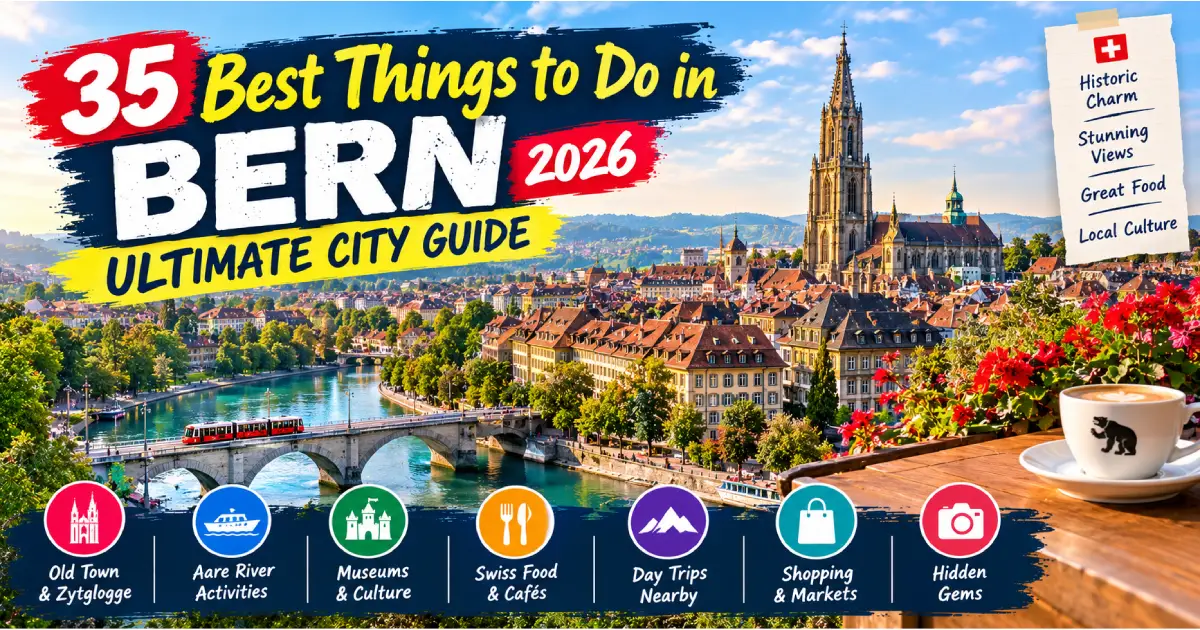
Bern is Switzerland’s federal capital and simultaneously its most consistently underrated major city — a place that visitors pass through on the train from Zurich to Interlaken or Geneva without stopping, failing to discover that the city whose Old Town is a UNESCO World Heritage Site contains the most architecturally coherent medieval city center in Switzerland (six kilometers of continuous covered arcades — the Lauben — that line virtually every Old Town street at ground level, making Bern the most reliably weather-protected city walking experience in Europe regardless of rain or snow), the finest collection of Paul Klee’s work in the world (the Zentrum Paul Klee, designed by Renzo Piano, housing over 4,000 Klee works in a purpose-built museum of extraordinary architectural quality), one of the most visited single attractions in Switzerland (the Bear Park — the Bernese Bären, the bears that have been kept in Bern since 1513 as living embodiments of the city’s heraldic symbol), and the Old Town’s specific urban character (the arcaded streets, the 16th-century sandstone facades, the Renaissance fountains, and the Zytglogge astronomical clock tower that constitute the most complete preserved medieval street environment available in any Swiss city).
The best things to do in Bern in 2026 recognize this underestimation and specifically address it — covering the Old Town’s architectural riches (the Bern Minster, the Zytglogge, the Federal Palace, and the specific arcade-and-fountain streetscape that UNESCO recognized in 1983), the museum landscape (Paul Klee, Bern Historical Museum including Einstein’s apartment, Swiss Alpine Club Museum, Kunstmuseum Bern’s Old Masters through contemporary range), the outdoor pleasures (the Rose Garden’s panoramic Old Town view, the Bear Park’s forested river bank enclosure, and the Aare River’s famous wild swimming tradition), and the specific food culture (the Bernese Rösti tradition that gives the Swiss-German/Swiss-French linguistic boundary its informal name — the “Rösti ditch” — and the local bakery and confiserie tradition that differentiates Bern from Zurich’s more cosmopolitan eating culture). This guide covers 35 of the best things to do in Bern for every type of 2026 visitor.
For related Switzerland guides, see our Best Places to Visit in Switzerland 2026, Switzerland Travel Guide 2026, Best Time to Visit Switzerland 2026, and Things to Do in Lucerne 2026.
| # | Activity | Category | Cost | Duration | Book Ahead? |
|---|---|---|---|---|---|
| 1 | Walk the UNESCO Old Town Arcades | Architecture/Free | Free | 2–3 hrs | No |
| 2 | Zentrum Paul Klee | Museum | CHF 20 | 2–3 hrs | No |
| 3 | Bern Minster (Cathedral) | Architecture | Free (tower CHF 5) | 1–2 hrs | No |
| 4 | Bear Park (Bärenpark) | Wildlife | Free | 1 hr | No |
| 5 | Zytglogge Astronomical Clock | Sightseeing | Free (guided tour CHF 20) | 30 min–1 hr | Yes (for tower) |
| 6 | Rose Garden (Rosengarten) Panorama | Garden/View | Free | 45 min | No |
| 7 | Federal Palace (Bundeshaus) | Architecture | Free (guided tour) | 1 hr | Yes (for interior) |
| 8 | Bern Historical Museum | Museum | CHF 13 | 2 hrs | No |
| 9 | Einstein Museum (within Historical Museum) | Museum | Included with Historical | 1 hr | No |
| 10 | Swim in the Aare River | Swimming | Free | 2 hrs | No |
| 11 | Kunstmuseum Bern | Museum | CHF 15–22 | 2–3 hrs | No |
| 12 | Münsterplatz (Cathedral Square) | Sightseeing | Free | 30 min | No |
| 13 | Kornhaus Cellar (Kornhauskeller) | Dining | CHF 35–70/person | 1.5–2 hrs | Yes |
| 14 | Old Town Fountains (11 historic) | Sightseeing | Free | 1 hr | No |
| 15 | Aare River Walk | Walking | Free | 1–2 hrs | No |
| 16 | Gurten Hill — Bern’s Local Mountain | Viewpoint | CHF 10 (funicular return) | 2 hrs | No |
| 17 | Einstein’s Former Apartment | Museum | CHF 6 | 45 min | No |
| 18 | Bern Market — Waisenhausplatz | Market | Free | 1 hr | No (Tue/Sat AM) |
| 19 | Bern Casino (Kursaal) Gardens | Gardens | Free | 30 min | No |
| 20 | Museum of Communication | Museum | CHF 12 | 1.5 hrs | No |
| 21 | Natural History Museum | Museum | CHF 8 | 1.5 hrs | No |
| 22 | Old Town Wine Bars (Weinstuben) | Food/Drink | CHF 10–30 | 1–2 hrs | No |
| 23 | Bern Tropenhaus (Tropical Greenhouse) | Nature | CHF 12 | 1 hr | No |
| 24 | Helvetiaplatz Museum Quarter | Culture | Various | Half day | No |
| 25 | Bern Old Town at Night | Photography | Free | 1–2 hrs | No |
| 26 | Loeb Department Store (Confiserie) | Shopping/Food | CHF 5–30 | 30 min | No |
| 27 | Visit the Arcade Street Markets | Shopping | Free to browse | 1 hr | No |
| 28 | Crêperie in the Old Town Lanes | Food | CHF 10–20 | 45 min | No |
| 29 | Bern Museum of Fine Arts (Kunsthalle) | Museum | CHF 10–15 | 1.5 hrs | No |
| 30 | Day Trip to Gruyères | Day Trip | Train + entry | Full day | No |
| 31 | Bernisches Historisches Museum (Specific Collections) | Museum | Included | 1 hr | No |
| 32 | Bern Clock Tower (Zytglogge) Mechanism Tour | Architecture | CHF 20 | 1 hr | Yes |
| 33 | Bern Old Town Rösti Lunch | Food | CHF 25–45 | 1 hr | No |
| 34 | Parliamentary Debate Observation | Culture | Free | 1–3 hrs | Yes (advance) |
| 35 | Bern Altstadt Evening Walk | Evening | Free | 1.5 hrs | No |
Cost: Free | Location: Throughout Bern Old Town | Best Time: Any weather, any hour | Duration: Full exploration 2–3 hours; can be done in sections
The Lauben (the continuous system of covered arcades that lines virtually every street in Bern’s Old Town, creating approximately 6 kilometers of roofed pedestrian walkway through the medieval city center) are Bern’s most specifically extraordinary urban feature and the primary reason that the city’s Old Town received UNESCO World Heritage designation in 1983. The arcades (typically 3–4 meters wide, the vaulted stone ceiling providing complete weather protection at ground level while the buildings’ upper floors extend to the street level above) were systematically built after the 1405 fire that destroyed the original wooden Old Town, the stone rebuild specifically incorporating the arcade system that has made Bern uniquely weather-resistant among European medieval cities for 600 years.
The specific Lauben experience: walking the full length of Bern’s major Old Town streets (the Kramgasse, the Gerechtigkeitsgasse, the Marktgasse, and their connecting lanes) entirely under cover regardless of weather — the specific experience of window-shopping, cafe sitting, and street observation in a space that is simultaneously outdoors (open to the street at its front edge) and fully sheltered from rain, snow, and direct sun creates an urban atmosphere available at no equivalent location in Switzerland or indeed in Europe. The arcades’ specific character varies by street — some sections host retail shops (the Kramgasse’s jewelry and specialty retail, the Marktgasse’s mix of retail and food), others the restaurant and café frontages that extend tables into the arcade space in fine weather, and others simply the pedestrian flow of daily Bern life.
The fountain sequence: Bern’s 11 historically significant Renaissance and Baroque public fountains (each with a specifically decorated pillar — the most famous being the Child-Eater Fountain on the Kornhausplatz, a 1545 figure of an ogre consuming a child whose specific iconography has been interpreted variously as anti-Semitic propaganda, Carnival grotesque, and political allegory across centuries of scholarship without consensus) are distributed through the Old Town’s arcade streets, the fountain basins integrated into the arcade streetscape in a way that makes them part of the daily pedestrian experience rather than isolated monuments.
Insider tips: The arcade’s oldest sections (the Kramgasse near the Zytglogge, where the vaulted ceilings are lower and the stone more weathered than the more recently rebuilt sections) are the most specifically medieval in character — the specific sound quality of footsteps on the medieval stone pavement, audible in the vaulted acoustic environment, creating the most tangible connection with the Old Town’s 600-year inhabited history.
Cost: Free to view; guided tower tours CHF 20 (English tours at specific hours — check berninfo.com) | Location: Kramgasse, Old Town center | Duration: 30 minutes exterior; 1 hour with tower tour | Best Time: Just before the hour for the mechanical performance
The Zytglogge (literally “time bell” in Bernese German — the astronomical clock tower that has marked the center of Bern’s Old Town since the 13th century, the current tower structure incorporating elements from the 1250s original while the clock mechanism dates from 1530) is Bern’s most internationally recognized single architectural element: a tower whose west face carries one of Switzerland’s most complex astronomical clock displays (showing the hour, the minute, the day of the week, the date, the month, the zodiac position, the moon phase, and the solar position in a single integrated mechanism) and whose automated mechanical performance (the figures — jester, bear parade, knight, and crowing cock — activating 4 minutes before every full hour and performing a 1-minute sequence before the bell strikes) is the single most watched free attraction in Bern.
The tower mechanism tour: The guided interior tour (departing from the Zytglogge base at specific hours — the 12:00 PM English-language tour the most convenient for most visitors, book in advance at berninfo.com or at the Bern Tourist Information at the main station) provides access to the clock’s interior mechanism (the 16th-century clockwork — weights, escapements, and drive shafts creating the automated performance from pure mechanical energy rather than electrical assistance) visible from the tower’s interior galleries. The specific encounter with 500-year-old precision mechanical engineering at close range — the gears and levers visible and in motion during the tour — is one of Bern’s most specifically extraordinary available experiences.
Insider tips: Position for the hourly performance (the west face of the Zytglogge, looking east from the Kramgasse, approximately 10 meters of distance providing the best view of the complete mechanism display) at least 10 minutes before the hour in summer to secure an unobstructed front position — the performance attracts significant crowds at midday and afternoon hours. The 8 AM or 9 AM performance (when the tour groups haven’t yet assembled and the Kramgasse morning light illuminates the clock face in low-angle detail) is the most aesthetically and logistically rewarding viewing.
Cost: Free (cathedral); CHF 5 (tower ascent) | Location: Münsterplatz, Old Town | Hours: Monday–Saturday 10 AM–5 PM, Sunday from noon | Tower: Same hours, last ascent 45 min before closing | Duration: 1–2 hours
The Bern Minster (the Reformed Protestant cathedral whose construction began in 1421 and continued over 500 years — the tower, at 100.6 meters the tallest cathedral tower in Switzerland, completed only in 1893) provides the Old Town’s most significant single ecclesiastical monument and its most elevated accessible viewpoint. The cathedral’s Late Gothic architecture (the main portal’s tympanum — the Last Judgment sculpture in the central doorway arch, one of the finest Late Gothic figurative portals in Central Europe, the 234 painted figures (including Hell’s mouth and the Resurrection of the Dead) in exceptional preservation) represents Switzerland’s most important single work of medieval sculpture.
The tower ascent: The Minster tower’s 344 stairs lead to the belfry platform at 63 meters (an intermediate open-air gallery before the final spire) and to the higher observation platform at the top — the most elevated viewpoint in Bern’s Old Town, with the 360-degree panorama encompassing the Old Town’s sandstone roofscape (the specific warm yellow-orange of the local sandstone that gives Bern its characteristic color), the Aare River’s loop around the Old Town peninsula, and on clear days the Bernese Alps (the Jungfrau massif and surrounding peaks visible to the southeast, approximately 80 kilometers distant).
Insider tips: The Minster crypt (beneath the main nave floor, accessible during open hours — the original foundation stones and the 15th-century construction sequence visible in the archaeological layers) provides the most specifically historical Minster encounter — the 600-year construction timeline comprehensible in the crypt’s visible stratification. The specific medieval stained glass (the three oldest windows in the choir, installed 1441–1450 — among the finest surviving Late Gothic stained glass in Switzerland) rewards close attention in the morning when east-facing windows catch the light directly.
Cost: Free guided tours (booking required at parlament.ch) | Location: Bundesplatz, Old Town | Tours: Monday–Saturday (parliament not in session) | Duration: 1 hour guided tour | Book: Required, 2–4 weeks ahead for English tours
The Bundeshaus (the Federal Palace — Switzerland’s parliament building, completed 1902 in the Italian Renaissance Revival style, the green copper dome visible from multiple Old Town viewpoints) provides one of Switzerland’s most specifically civic experiences: a free guided tour of the actual working parliament building (the National Council chamber, the States Council chamber, the Federal Assembly Hall under the dome, and the various connecting spaces of the constitutional government of one of the world’s oldest continuous democracies).
The specific Swiss parliamentary system (the Federal Council of seven co-equal members who share executive authority, the bicameral parliament, and the direct democracy mechanisms — the referendum and initiative rights that allow Swiss citizens to challenge virtually any parliamentary decision) is explained during the tour in the specific physical spaces where these processes operate — the National Council chamber’s voting system (electronic buttons at each of the 200 council member seats, the voting results displayed on the chamber’s LED boards), the States Council’s smaller and more formally European chamber style, and the Federal Assembly Hall where the two chambers meet jointly under the dome.
Parliamentary sessions: During parliamentary sessions (typically the two-week plenary sessions in March, June, September, and December — check parlament.ch for current 2026 calendar), public gallery access to observe the actual parliamentary debate is available (free, no booking required — first-come-first-served gallery seats) — the most specifically democratic civic experience available in any Swiss city.
Insider tips: The Bundesplatz (the large open square in front of the Bundeshaus) hosts Bern’s most atmospheric public events — the water fountains (33 fountains that operate seasonally, synchronized musical programs in summer evenings), the Christmas market in December, and the farmers’ market on specific weekday mornings. The Bundesplatz at night (the Bundeshaus facade illuminated, the square’s fountain activity creating the most cinematic Bern setting) rewards the evening return for visitors who tour during the day.
Cost: Free | Self-guided route: Kramgasse → Gerechtigkeitsgasse → Kornhausplatz → Waisenhausplatz | Duration: 1 hour for the complete sequence | Year-round
Bern’s 11 historically significant public fountains (the Renaissance and Baroque pillared fountains distributed throughout the Old Town, each with a distinctively decorated central pillar figure and a stone basin — historically functional drinking water infrastructure, now ornamental) constitute a distributed outdoor sculpture collection of exceptional quality whose completeness and condition (most original figures replaced with copies in the 19th century, the originals in the Bernisches Historisches Museum) make them the most comprehensive Renaissance fountain sequence available in any Swiss city.
The most significant individual fountains:
The Kindlifresserbrunnen (Child-Eater Fountain, 1545): On the Kornhausplatz — the most discussed and most controversial of the 11, depicting an ogre consuming a child while three more children await in a bag. The iconographic interpretation (political allegory, Carnival grotesque, or anti-Semitic symbol — scholars disagree) adds a specifically dark historical dimension to what is otherwise an aesthetically accomplished 16th-century public monument.
The Gerechtigkeitsbrunnen (Justice Fountain, 1543): On the Gerechtigkeitsgasse — Justice blindfolded and holding scales, flanked by figures of the Pope, Emperor, Sultan, and Mayor (symbolizing Justice’s authority above all temporal and spiritual power). The figure’s specific political statement (justice above all human authority) in a 16th-century Swiss Reformed context represents one of the most specifically charged public sculptures in Swiss history.
The Simsonbrunnen (Samson Fountain, 1527): On the Kramgasse — the Biblical Samson tearing open a lion’s mouth, the earliest of Bern’s major fountains. The fountain’s position near the Zytglogge places it in the specific visual company of Bern’s other major architectural monuments at the Old Town’s western entrance.
Cost: CHF 20 (adults); CHF 10 (children); combined tickets available | Location: Monument im Fruchtland 3, Bern (3 km east of Old Town — tram or bus from center) | Hours: Tuesday–Sunday 10 AM–5 PM | Duration: 2–3 hours | Book: No reservation required; check zpk.org for special exhibitions
The Zentrum Paul Klee (the dedicated Paul Klee museum designed by Renzo Piano and opened 2005, its three grass-covered wave-form architectural volumes visible from the eastern Bern highway approach) houses more than 4,000 works by Paul Klee (1879–1940) — the Swiss-German artist whose specific contribution to 20th-century art (the integration of music theory, children’s art, color theory, and Bauhaus design into a uniquely personal figurative-abstract visual language) represents one of the most individually distinctive artistic visions in modern European art. The Klee collection’s comprehensiveness (approximately 40% of his entire known output, the largest single-artist collection of any museum in Switzerland) allows an engagement with Klee’s artistic development unavailable at any other location — the chronological hang moving from his Pre-World War I figurative period through the Bauhaus years (1921–1931, the period of his most celebrated works including “Angelus Novus” and the various fish and architecture themes) to the late works produced in Bern during his final illness.
The architectural experience: Renzo Piano’s three-wave building (the undulating grassed roofs designed to echo the Swiss agricultural landscape visible behind the building, the interior spaces lit by the specific clerestory window system that provides north-facing diffused light to the gallery spaces without direct sun that would damage the works) is itself one of the most architecturally accomplished single museum buildings in Switzerland — worth visiting for the building’s quality independently of the collection’s appeal.
What to prioritize: The Klee collection rotates displays (the full 4,000-work collection too large to display simultaneously — approximately 200–250 works on display at any given time), making repeat visits consistently different. For first-time visitors: the chronological permanent collection galleries (providing the developmental narrative), the temporary exhibition space (Klee-related thematic programming of exceptional consistent quality), and the KindMuseum Creaviva (the children’s creative workshop integrated into the museum — one of Switzerland’s finest museum-based children’s programs).
Insider tips: The Zentrum Paul Klee’s combined ticket with the Kunstmuseum Bern (CHF 28 — the two museums 3 km apart, the Kunstmuseum in the Old Town) provides the most comprehensive engagement with Bern’s visual arts landscape in a single day. The Paul Klee Center’s restaurant (the Museum Café — views over the agricultural landscape behind the museum, seasonal menu focused on local Bernese ingredients) provides one of Bern’s most architecturally distinctive lunch settings.
Cost: CHF 13 (includes all permanent collections, including Einstein Museum) | Location: Helvetiaplatz 5, Bernisches Historisches Museum | Hours: Tuesday–Sunday 10 AM–5 PM | Duration: 2 hours (combined Historical Museum and Einstein)
The Bernisches Historisches Museum (the Bern Historical Museum, in a deliberately imposing neo-Gothic castle-palace building on the Helvetiaplatz — the museum quarter south of the Aare River) houses two primary collections of exceptional quality: the permanent historical collection covering the pre-Roman through 20th-century history of the Bernese lands (the specific Burgundian tapestries from the 15th century — the “Morat Tapestries,” captured by Swiss Confederation forces at the Battle of Murten in 1476 and among the finest surviving examples of late-medieval Flemish tapestry weaving — are the collection’s single most significant individual holding), and the Einstein Museum (the biography exhibition covering Albert Einstein’s life in Bern, where he lived from 1902 to 1909 during the period when he developed the Special Theory of Relativity, photoelectric effect, Brownian motion, and E=mc² in what physics historians describe as the most productive single period of scientific discovery by a single individual in history).
The Einstein Museum: The museum’s Einstein exhibition (covering the 1905 “Annus Mirabilis” — the miraculous year when Einstein published five papers from his Bern apartment that revolutionized physics from classical Newtonian mechanics) provides the most complete narrative treatment of Einstein’s Bern years available, including the physical models, historical documents, and interactive demonstrations that make the specific concepts (special relativity’s time dilation, the photoelectric effect, Brownian motion’s molecular proof) accessible without advanced physics knowledge.
The Morat Tapestries: The Burgundian tapestries (six surviving from the original larger collection, their specific imagery of aristocratic and hunting scenes in the specific late-medieval Flemish style that was Europe’s most technically accomplished textile art form) represent the Historical Museum’s most internationally significant single holding — objects of art-historical importance comparable to major European national collection holdings, displayed in Bern as a consequence of military history rather than conventional collecting.
Cost: CHF 15–22 (varies by exhibition) | Location: Hodlerstrasse 8–12, Old Town | Hours: Tuesday 10 AM–9 PM; Wednesday–Sunday 10 AM–5 PM; Monday closed | Duration: 2–3 hours
The Kunstmuseum Bern (the Bern Museum of Fine Arts — the oldest Swiss art museum with continuous collections since 1879, significantly expanded after receiving the controversial Cornelius Gurlitt estate of approximately 1,600 works in 2014) maintains the most historically comprehensive art collection in Bern: Swiss painting from the 15th century through the Hodler-dominated 19th century (Ferdinand Hodler’s large-format allegorical paintings are the collection’s most specifically Swiss content — the Bern-born painter whose specific Symbolist-inflected naturalism created the visual identity of Swiss national painting in the late 19th century), the significant Klee holdings (works not at the Zentrum Paul Klee), and the contemporary collection (international contemporary art of consistent curatorial quality).
The Hodler rooms: The Kunstmuseum’s most specifically Swiss rooms — Ferdinand Hodler’s large-format paintings (the Lake Geneva and Lake Thun landscapes, the allegorical works “Eurythmy” and “Night,” and the specific portraits of Swiss political figures that his Bern commissions produced) provide the most complete available engagement with the painter who more than any other defined Swiss visual identity for international audiences in the early 20th century.
Insider tips: The Kunstmuseum’s Tuesday evening (open until 9 PM — the most relaxed visiting conditions of the week, the daytime museum crowds absent and the gallery lighting specifically adjusted for evening ambiance) provides the most contemplative engagement with the collection. The combined Kunstmuseum–Zentrum Paul Klee ticket (CHF 28) is the most efficient single-day Bern visual arts investment.
Cost: Free | Location: Grosser Muristalden 6, adjacent to the Nydeggbrücke | Hours: Bears visible year-round (hibernation December–February may reduce activity); park always open | Duration: 45 min–1 hour
The Bärenpark (the Bear Park where Bern’s official bears — the Bernese bear being the city’s heraldic symbol and the origin of the city’s name in the most widely accepted etymological account) provides the most specifically Bernese single outdoor experience: the live bears in a naturalistic riverside enclosure (opened 2009, replacing the controversial traditional Bern bear pit with a 6,000-square-meter forested, riverside environment that allows the bears natural behavioral expression), directly adjacent to the old bear pit (the Bärengraben — the circular pit that housed Bern’s bears for 500 years, now maintained as a heritage structure and sometimes used for specific demonstrations) and connected to the Old Town by the Nydeggbrücke.
The park’s specific setting (on the forested riverbank of the Aare, directly below the Old Town’s eastern cliff edge) integrates the bear experience with the Aare River landscape in a way that the old pit never allowed — the bears swimming in the Aare, climbing the slope’s forest trees, and moving through the meadow sections in natural behavioral patterns rather than the confined pacing that the pit historically produced. The connection between the bear’s naturalistic behavior and the Bern city landscape (the Old Town visible above, the river below) creates a specifically Bernese experience unavailable at any more conventional zoo facility.
Insider tips: The bears’ activity schedule is partially seasonal — summer mornings (8–11 AM before the midday heat reduces activity) and late afternoon (4–6 PM when the day’s heat begins to diminish) typically provide the most active observation. The hibernation period (December through February, varying by year based on the specific bears’ individual behavior) reduces but does not eliminate the bears’ visibility — even in “hibernation,” Bern’s urban-habituated bears often remain partially active in mild winter periods.
Cost: Free | Location: Alter Aargauerstalden 31B, above the Bear Park | Access: 10-minute walk from Bear Park up the hill, or bus 10 to Rosengarten stop | Hours: Park open year-round; roses in bloom May–September | Duration: 30–45 minutes
The Rosengarten (the public rose garden on the hillside above the Bear Park, on the elevated northern bank of the Aare River) provides Bern’s finest single panoramic viewpoint of the Old Town — the medieval city visible across the Aare River bend from the garden’s elevated terrace (approximately 30 meters above the river level), the sandstone roofscape and the Minster tower forming the most comprehensive available Old Town overview. The rose garden itself (220 rose varieties, approximately 200 irises, and 28 rhododendron varieties in formal planting beds arranged on the terraced slope) is in full bloom from May through September, with the specific June–July peak providing the densest bloom alongside the best Old Town photography conditions.
The panorama’s specific value: Bern’s Old Town sits on a peninsula created by the Aare River’s near-complete loop (the river surrounding the Old Town on three sides, the land connection only to the west), and the Rosengarten’s elevated north-bank position provides the only urban-accessible elevated view of this specific topography — the complete island-peninsula character of the Old Town visible as a coherent whole rather than the fragmented street-level view that the Old Town interior provides.
Insider tips: The Rosengarten restaurant (the café-restaurant at the garden’s highest terrace — the terrace with the Old Town panorama as its backdrop) provides Bern’s most specifically atmospheric café experience in the summer season, the panorama visible from every outdoor table. The morning coffee timing (the restaurant opens for breakfast, typically from 8–9 AM — arriving before the city’s mid-morning tourist peak provides the panorama with morning light and minimal table competition).
Cost: Free | Location: Multiple access points along the Aare — Schwellenmätteli and Marzilibrücke area most popular | Season: June–September (water temperature 18–24°C in peak summer) | Duration: 2 hours (swim + drying time) | Best Time: Afternoon (warmest water)
The Aare River swimming tradition (Bern residents entering the Aare at specific upstream points and floating downstream with the current — the river’s specific speed in the city section [approximately 2–3 km/h] carrying swimmers from the entry point to the downstream exit in 20–30 minutes without significant swimming effort) is Bern’s most characteristically local summer activity and the most specifically Bernese outdoor pleasure available to visitors. The current-floating format (entering at the Schwellenmätteli area, floating downstream with the current past the Old Town’s cliff wall, and exiting near the Marzilibrücke or lower points) creates a river experience unique to Bern — the Old Town visible from the water surface throughout the float, the medieval city appearing from a river-level perspective unavailable from any bridge or bank.
Practical swimming details:
Insider tips: The Aare swimming tradition’s social dimension (the riverbanks at the Schwellenmätteli on a July afternoon host hundreds of Bern residents, the river float a communal experience rather than a solitary activity) is as specifically Bernese as the Old Town architecture — the city’s residents’ casual assumption that jumping into the river is a standard workday evening activity creates a specifically democratic urban outdoor culture that the more-famous Swiss cities don’t replicate.
Cost: CHF 10 (funicular return, covered by Swiss Travel Pass) | Access: Tram 9 to Gurtenbahn, then funicular (5 min) | Summit: 858 meters | Duration: 2 hours | Season: Year-round | Best Time: Clear days for Alps view
Gurten (the 858-meter forested hill immediately south of Bern, accessible by the Gurtenbahn funicular from the Wabern terminal) provides the city’s most accessible elevated viewpoint — the summit panorama encompassing Bern’s Old Town (visible in its Aare River peninsula geography from the north-facing summit), the Bernese Oberland Alps (the Jungfrau massif visible to the southeast in clear conditions, approximately 80 kilometers distant), and the Mittelland plain extending northward toward the Jura range. The specific Bern-from-above view (the Old Town’s medieval street grid, the river’s loop, and the characteristic sandstone roofscape visible as a coherent architectural composition from the elevated southeast position) creates a city understanding that the street-level experience doesn’t provide.
Gurten Festival: The Gurten Festival (the annual Bern open-air music festival, held annually in July on the Gurten summit — one of Switzerland’s most beloved outdoor music events, attracting 30,000+ visitors over 4 days, with a lineup historically balancing international headliners and Swiss acts) is the Gurten’s most specifically celebrated single event. The festival’s specific setting (the forested summit, the Old Town visible below, and the Alps in the distance creating an outdoor venue of exceptional visual context) makes it one of Switzerland’s most atmospherically distinguished single outdoor music experiences.
Cost: CHF 35–70/person | Location: Kornhausplatz 18, Old Town | Reservation: Yes, required | Hours: Monday–Saturday (dinner); lunch select days | Season: Year-round
The Kornhauskeller (the restaurant in the vaulted cellar of Bern’s 1711 granary — the Kornhaus — whose specific architectural character, a multi-level vaulted sandstone cellar with soaring arches rising to the cellar ceiling, decorative frescoes on the vault surfaces, and the specific acoustic warmth of a large stone vaulted space, creates the most specifically dramatic single restaurant interior in Bern and one of the most exceptional in Switzerland) provides Bern’s most architecturally significant dining experience. The food (a contemporary Swiss-European menu using Bernese Oberland seasonal ingredients alongside international influences) is good rather than extraordinary — the Kornhauskeller’s irreplaceable element is the room, whose architecture would make even mediocre food an extraordinary experience.
What to order: The Bernese Rösti (the classic potato pancake in its most canonical form, the Bernese preparation the original from which all Swiss Rösti variations derive — clarified butter, raw-grated potato, the specific thickness and crust that the Kornhauskeller maintains as a culinary position), the seasonal game during autumn, and whatever the chef’s current Bernese Oberland ingredient focus produces as the evening’s most specifically regional offering.
Insider tips: The Kornhauskeller’s upstairs café (the Kornhausbistro — the ground-floor and upper gallery area of the same building, accessible without the downstairs restaurant reservation and with a shorter, less formal menu) provides the Kornhaus building’s architectural experience at lower cost and without advance booking. The café’s terrace (overlooking the Kornhausplatz and the nearby Child-Eater Fountain) provides one of Bern’s most pleasant outdoor café settings.
Cost: CHF 18–35 (Rösti as main course) | Multiple Old Town restaurants | Best establishments: Restaurant Lötschberg (Innere Enge Strasse), Altes Tramdepot (adjacent to Bear Park), Restaurant Kornhaus (see above)
The Rösti (fried grated potato pancake — Switzerland’s most genuinely national dish and specifically Bernese in origin, the “Röstibräbe” — the “Rösti border” or Rösti ditch — being the colloquial name for the linguistic boundary between German-speaking and French-speaking Switzerland that runs through Bern’s canton) deserves specific ordering attention in Bern rather than the generic treatment it receives in tourist-facing restaurant menus elsewhere in Switzerland.
The authentic Bernese Rösti (raw-grated mature potatoes — the specific starch content of mature rather than new potatoes being the key variable, creating the distinctive crust that fresh-potato preparations don’t achieve — fried in clarified butter in a specific cast-iron or copper pan, turned once to create the two-sided crust, served as a substantial golden disk approximately 2 centimeters thick) is fundamentally different from the hash-brown-style preparations found outside Switzerland. The restaurants that maintain the authentic preparation (specified by the single-sided turnover, the use of raw rather than pre-cooked potato, and the clarified butter rather than oil) are identifiable by asking specifically — “ist das echtes Berner Rösti?” (Is this authentic Bernese Rösti?) provides the response that identifies whether the kitchen takes the preparation seriously.
About Travel Tourister Travel Tourister’s destination specialists have explored Bern across all seasons — from Zytglogge morning performances and Minster tower climbs through Zentrum Paul Klee full-collection days and Kornhauskeller dinner evenings to Aare River summer swims, Rosengarten panorama mornings, and Bear Park forested enclosure visits — to deliver the most practical and honest guide to the best things to do in Bern for every type of 2026 visitor.
Posted By : Vinay
Latest Article
2nd Floor, 39, Above Kirti Club, DLF Industrial Area, Kirti Nagar, New Delhi, Delhi 110015



Travel Tourister is a leading Travel portal where we introduce travellers to trusted travel agents to make their journey hasselfree, memorable And happy. Travel Tourister is a platform where travellers get Tour packages ,Hotel packages deals through trusted travel companies And hoteliers who are working with us across the world. We always try to find new and more travel agents and hoteliers from every nook and corners across the world so that you could compare the deals with different travel agents and hoteliers and book your tour or hotel with the one you have chosen according to your taste and budget.
Copyright © Travel Tourister, India. All Rights Reserved

 Call
Call Enquiry