Published on : 08 Sep 2026
By Travel Tourister | Updated Sep 2026
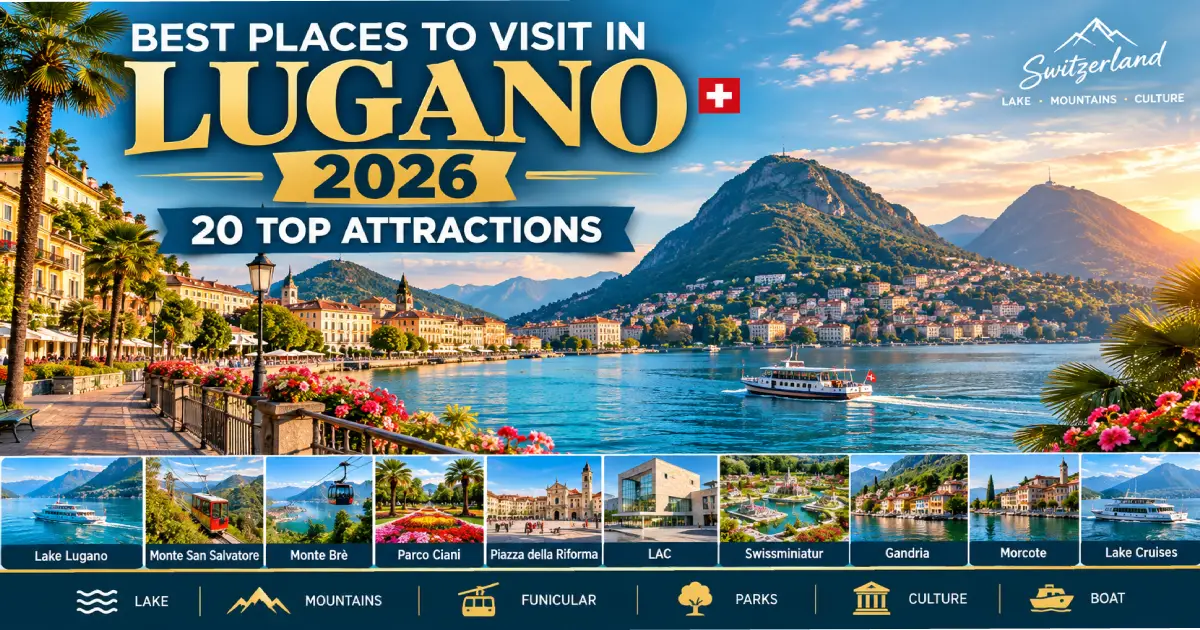
Lugano is Switzerland’s most surprising major city — a place that consistently contradicts expectations formed by the country’s other urban centers. Where Zurich is banking towers and Old Town, Geneva is international organizations and lakefront formality, and Bern is sandstone arcades and government buildings, Lugano is Mediterranean light on an Alpine lake, Italian language in a Swiss canton, palm trees at 271 meters altitude, and the specific combination of Swiss institutional solidity with Ticinese cultural warmth that makes the city simultaneously the most relaxed and most visually dramatic of Switzerland’s significant cities. The best places to visit in Lugano span the lakefront promenade (the Lungolago, the Italian-style lakeside walkway lined with flowering oleanders and cafés whose terraces face Lake Lugano’s specific turquoise-blue water), the Old Town lanes (the Città Vecchia, whose stepped pedestrian alleys, Renaissance churches, and the specific ochre-and-terracotta building color of Ticino’s architectural tradition create a streetscape entirely unlike anything in German-speaking Switzerland), the surrounding mountains (Monte San Salvatore and Monte Brè accessible by funicular and providing the finest lake panoramas in the region), and the extraordinary museum landscape (the Thyssen-Bornemisza art collection at Villa Favorita, the LAC cultural center on the waterfront, and the Museum of Extraterrestrial Art in the Villa dei Cedri).
What makes Lugano distinctive within Switzerland is specifically this Italian-cultural dimension — the Ticino (Tessin in German) is Switzerland’s southernmost canton, linguistically Italian (Italian being the sole official language of the canton, with the specific Ticinese dialect adding further regional character), climatically sub-Mediterranean (palm trees, camellias, and azaleas growing outdoors year-round in Lugano’s lakeside microclimate, the average annual temperature approximately 5°C above the Swiss Mittelland), and architecturally southern European (the plastered and painted building facades, the piazza-oriented public spaces, and the specific relationship between indoor and outdoor life that warm-climate architecture enables). For visitors coming from the German-Swiss cities of Zurich, Bern, or Lucerne, arriving in Lugano by the Gotthard Base Tunnel (the world’s longest railway tunnel) after 2 hours of travel produces an immediate and complete cultural landscape change — from northern European to southern European — that the geography alone cannot explain as dramatically as the cultural dimensions do.
For complete guides, see our Switzerland Travel Guide 2026, Best Places to Visit in Switzerland 2026, Bernina Express: Complete Guide 2026, and Swiss Travel Pass Guide 2026.
| Place | Type | Cost | Best For | Duration |
|---|---|---|---|---|
| Lungolago (Lake Promenade) | Lakefront | Free | Walking, cafés, lake views | 1–2 hrs |
| Piazza della Riforma | Piazza | Free | Café culture, Old Town center | 30 min–1 hr |
| Monte San Salvatore | Mountain | CHF 30 return (funicular) | Best lake panorama | 2–3 hrs |
| Monte Brè | Mountain | CHF 22 return (funicular) | Sunrise views, wine hamlet | 2–3 hrs |
| LAC Lugano Arte e Cultura | Museum | CHF 12–20 | Contemporary art, waterfront | 1.5–2 hrs |
| Città Vecchia (Old Town) | Historic Quarter | Free | Italian-Swiss architecture | 1.5–2 hrs |
| Ceresio Boat Trip | Lake Boat | CHF 20–35 (Swiss Travel Pass covered) | Complete lake circuit | 2–4 hrs |
| Parco Civico | Park | Free | Villa Ciani, lakeside gardens | 1 hr |
| Villa Favorita (Thyssen Collection) | Museum | CHF 12 (when open) | Old Masters, Renaissance art | 2 hrs |
| Santa Maria degli Angioli | Church | Free | Bernardino Luini frescoes | 30 min |
| San Lorenzo Cathedral | Church | Free | Facade, Old Town architecture | 30 min |
| Gandria Fishing Village | Village | Swiss Travel Pass (boat) | Most picturesque lake village | 2 hrs |
| Ceresio Expresso (Swissboat Day Trip) | Boat | Swiss Travel Pass | All Lugano lake stops | Half day |
| Morcote Village | Village | Swiss Travel Pass (boat) | Most beautiful Swiss village vote | 2 hrs |
| MASI Lugano | Museum | CHF 10 | Swiss art, changing exhibitions | 1.5 hrs |
| Parco Botanico del Cantone Ticino | Botanic Garden | Free | Mediterranean flora, lake views | 1 hr |
| Muralto and Locarno (Day Trip) | Day Trip | Swiss Travel Pass | Lago Maggiore, film festival site | Full day |
| Lugano’s Covered Market (Mercato) | Market | Free | Tuesday and Friday mornings | 45 min |
| Swissminiatur (Melide) | Theme Attraction | CHF 18 | Switzerland in miniature | 1.5 hrs |
| Monte Generoso | Mountain | CHF 36 return (rack railway) | Most dramatic panorama in region | Half day |
Cost: Free | Location: Lake Lugano waterfront, running 1.8 km from Paradiso to Lugano center | Best Time: Morning and evening | Duration: 1–2 hours full walk
The Lungolago (the Italian term for the lakeside promenade — Lugano’s waterfront walkway running along Lake Lugano’s northern shore, lined with oleanders, magnolias, and camellias, the lake surface immediately beside the path and the surrounding mountains visible in multiple directions across the water) is Lugano’s most immediately recognizable urban pleasure and its most distinctively Mediterranean element. The promenade’s specific character — the Italian-style café terraces facing the lake, the horse-chestnut trees providing dappled shade over the lakeside benches, the Lake Lugano’s specific blue-green color (the lake’s particular shade varies dramatically with season and weather — most intensely turquoise in summer, more silver-grey in winter, and the specific afternoon light creating a gold-and-blue lake surface in the hour before sunset) — creates an urban waterfront experience that the German-speaking Swiss cities’ lake promenades don’t replicate in atmosphere despite comparable or superior lake quality.
The Lungolago connects Lugano’s most important waterfront elements: the landing stages for the lake boats (LSC — Lugano’s steamer service, covered by Swiss Travel Pass) at the Piazza Manzoni area, the Parco Civico (the lakeside public park with the Villa Ciani at its center), the Cassarate River mouth (where the river meets the lake, with the specific water-mixing visible in the color transition), and the Paradiso cable car station (at the Lungolago’s southern end, the Monte San Salvatore funicular ascending from this point).
The flowering season: The Lugano Lungolago’s specific seasonal highlight is the camellia and azalea flowering period (February through April in most years — the sub-Mediterranean microclimate allowing these winter-sensitive plants to flower outdoors while most of Switzerland is still in winter conditions), when the lakeside flower beds produce a flowering display unprecedented in any other Swiss city for this period. The Lugano tourist calendar specifically marks the flowering weeks (luganolake.com publishes seasonal flowering conditions) — a specifically winter-to-spring visit reward unavailable elsewhere in Switzerland.
Insider tips: The Lungolago in the early morning (6–8 AM before the city’s commercial activity begins and the lake boat service starts for the day) provides the most contemplative version of the promenade — the lake surface often mirror-calm at this hour, the reflections of the surrounding mountains in the water, and the morning light on the Ceresio mountains creating the most photogenically precise Lugano conditions of the day.
Cost: Free | Location: Old Town center, 5 minutes’ walk from the lake | Best Time: Morning and evening | Duration: 30 minutes to 1 hour for café sitting
The Piazza della Riforma (the rectangular piazza that serves as Lugano’s primary public gathering space — the Italian piazza tradition fully expressed in Switzerland’s most southern significant city, with the surrounding café terraces [the Gran Caffè al Porto’s terrace, the most historically significant single café in Lugano, in continuous operation since 1803] extending chairs and tables into the piazza space in all but the coldest months) provides the most complete engagement with Lugano’s specifically Italian-urban character. The piazza’s central function (the gathering and sitting culture that the Italian public-space tradition maintains, distinguishing Lugano’s public life from the more through-traffic-oriented public spaces of the German-speaking cities) creates an urban atmosphere that visitors from Zurich or Bern consistently describe as surprising — the specific relaxedness of café culture in an outdoor public space, the people-watching oriented chair placement, and the piazza’s enclosing buildings (the 19th-century Neoclassical Municipio — the town hall — at the piazza’s north end, the café-lined east and west facades) creating the most complete southern-European urban space in Switzerland.
What to do: Order a caffè at the Gran Caffè al Porto (the traditional Italian espresso or cappuccino, served standing at the bar in the Italian style or sitting at a terrace table — the bar-standing option approximately 30% cheaper than the terrace service, a specifically Italian institution maintained in this specifically Italian-culture Swiss city) and observe the piazza’s daily rhythm — the morning market setup on Tuesdays and Fridays (the Lugano covered market extending its outdoor component into the piazza space on market days), the midday office-lunch crowd, and the evening aperitivo culture (the Italian “happy hour” tradition of a pre-dinner drink with small snacks, the Negroni or Aperol Spritz the most commonly ordered aperitivo beverages at Lugano’s piazza cafés).
Insider tips: The Piazza della Riforma’s most specifically atmospheric time is the Tuesday and Friday morning market (from approximately 7 AM to 1 PM) — the covered market (the Mercato Coperto adjacent to the piazza) and its outdoor extensions filling the surrounding lanes with Ticinese produce (the specific seasonal vegetables of the Italian-Swiss agricultural tradition, local Ticinese wines, and the fresh pasta and local cheese products that distinguish the Ticino market from German-Swiss equivalents), creating the most specifically Italian-Swiss food experience available in Lugano without restaurant booking.
Cost: Free | Location: Piazza Luini, adjacent to the Lungolago | Hours: Daily 7 AM–6 PM | Duration: 30 minutes
The Church of Santa Maria degli Angioli (the former Franciscan convent church of 1499, surviving from the dissolution of the religious orders in a specifically well-preserved form in Lugano’s lakeside zone) contains the Ticino’s most significant single artwork: Bernardino Luini’s monumental fresco of the Passion of Christ (1529) covering the church’s entire internal dividing wall — 17 meters wide and 8 meters high, the single largest fresco surface in Switzerland, painted by a pupil of Leonardo da Vinci in a specific Leonardesque style (the sfumato shading, the specific figure typology, and the compositional clarity that Leonardo’s circle maintained across multiple painters’ work) that makes Luini’s Lugano fresco one of the finest examples of High Renaissance painting in any Alpine church.
The fresco’s specific content (the Crucifixion at center, the Passion narrative in sequential panels on both sides, and the subsidiary figure groups in the lower sections) and the specific Luini style (the characteristically gentle faces, the precise landscape backgrounds, and the specific blue-and-gold palette that Luini’s Milanese training produced in the Swiss-Italian border zone) create a religious artwork of genuinely international art-historical significance that most visitors to Lugano either don’t know exists or don’t stop to experience.
Insider tips: The Santa Maria degli Angioli fresco’s most rewarding viewing condition is the morning light (the church’s east-west orientation means morning light enters directly through the entrance facade, illuminating the fresco wall’s full surface without the shadows that afternoon side-light creates). Spending 20–30 minutes at the fresco (rather than the 5-minute glance that most visitors give it) allows the specific Luini technique — the detail in the subsidiary figure groups, the landscape backgrounds that prefigure the Northern Italian Renaissance’s specific contribution to Western painting — to become apparent.
Cost: Free | Access: From Piazza della Riforma, walk uphill on the stepped lanes | Best Time: Morning for quietest exploration | Duration: 1.5–2 hours
Lugano’s Città Vecchia (Old Town — the stepped lane network ascending the hillside above the Piazza della Riforma, the buildings’ characteristic ochre, terracotta, and pale-yellow painted plaster facades, the Renaissance church facades visible at lane intersections, and the specific Italian-urban topography of uphill alley network connecting the piazza below with the San Lorenzo Cathedral above) provides the most specifically southern-European urban-walking experience available in Switzerland — the lane system’s spatial compression (alleys 2–3 meters wide between building facades 4–5 stories high), the terrace gardens visible above the lane-level building tops, and the characteristic absence of motorized traffic (the steepest lanes accessible only on foot) creating an urban atmosphere that the flatland German-Swiss cities with their broader boulevards don’t approach.
Key Old Town elements:
Insider tips: The Old Town’s evening character (the early-evening aperitivo hours from approximately 6–8 PM, when the Via Cattedrale’s bars and the Piazza della Riforma’s café terraces fill with Lugano residents beginning the Italian dinner-delay ritual with a Negroni or prosecco) provides the most complete engagement with Lugano’s social life as lived by its residents rather than as performed for its visitors.
Cost: CHF 30 (funicular return, from Paradiso) | Access: LSC boat or walk to Paradiso, then funicular | Summit: 912 meters | Duration: 2–3 hours | Season: March–November | Swiss Travel Pass: 50% discount on funicular
Monte San Salvatore (912 meters, rising directly from the lake shore at Paradiso immediately south of Lugano center, accessible by the Funicolare San Salvatore from the Paradiso funicular station in approximately 12 minutes) is the most immediately recognizable element of Lugano’s visual identity — the distinctive triangular rocky summit visible from virtually every lakeside position in Lugano, its specific geological profile (a limestone pyramid rising from the lake with near-vertical faces on the lake-facing sides) providing both the most dramatic natural visual anchor in the Lugano landscape and the most accessible mountain summit viewpoint in the region.
The summit panorama (from the church at 912 meters and from the observation terrace) encompasses Lake Lugano in its full complexity (the lake’s specific angular shape — like a crooked finger extending south into Italy — visible in its entirety from this elevation), the pre-Alpine mountains of the Ticino and Lombardy surrounding the lake on all sides, and on clear days the Monte Rosa massif (the second-highest Alpine group after Mont Blanc) visible to the northwest across the Po Valley haze. The specific Lugano lake topography is most comprehensible from the San Salvatore summit — the lake’s shape (carved by Alpine glaciation into a specific branching form, the two southern lake arms extending into Italian territory) and its relationship with the surrounding mountains (the lake surface at 271 meters altitude, the surrounding summits reaching 800–1,800 meters above it) visible as a complete geographic system.
The summit church: The San Salvatore summit hosts a small pilgrimage church (dating to the 14th century in its current form, with earlier foundations — the specific pilgrimage tradition to this site continuing across 700 years of Lugano religious life) and the San Salvatore Museum (a small museum of sacred art in the church complex, covering the summit’s religious history and the geological/natural history of the specific limestone formation).
Insider tips: The Monte San Salvatore sunrise (requiring an overnight in a Lugano hotel and the first funicular departure — check current 2026 operating hours, as early-morning funicular departures may be limited to specific days or seasons at sanSalvatore.ch) provides the most dramatically atmospheric summit visit — the lake below in morning mist, the surrounding peaks appearing as the sun rises above the eastern ridge, and the specific golden quality of early-morning light on the limestone summit creating photography conditions unavailable later in the day.
Cost: CHF 22 return (funicular from Cassarate) | Access: Bus or walk to Cassarate, then funicular | Summit: 925 meters | Duration: 2–3 hours | Swiss Travel Pass: 50% discount | Special: Highest point accessible by funicular in Ticino
Monte Brè (925 meters — 13 meters higher than San Salvatore, accessible by the Funicolare di Brè from the Cassarate district of Lugano in approximately 12 minutes) provides the quieter alternative to San Salvatore’s more visited summit — the Monte Brè’s north-facing orientation (looking directly across Lake Lugano toward Lugano city center and the surrounding mountains) providing a complementary rather than duplicate view from San Salvatore. Where San Salvatore looks down into the lake from the south, Monte Brè looks across the lake from the north — the Lugano city center visible directly below, the San Salvatore profile visible across the water, and the Monte San Giorgio UNESCO World Heritage Site (the paleontological site containing the world’s most significant Middle Triassic marine fossil deposits, a UNESCO natural heritage site since 2003) visible to the south.
The Brè village: Halfway up the Monte Brè funicular route, the hamlet of Brè (780 meters) provides the most complete small traditional Ticinese village experience accessible from Lugano — the granite stone houses (the specific Ticinese mountain village construction using local pietra di Brè grey granite rather than the painted plaster of the lowland villages), the frescoed chapel, and the village’s specific artistic association (the Brè hamlet has been an artist colony since the early 20th century, several studios maintained by resident artists visible during the village walk) create a genuinely atmospheric 30-minute detour from the funicular route.
Insider tips: The Monte Brè’s specific photographic value — the morning light (the east-northeast orientation receiving direct sun from early morning, illuminating the Lugano city view from Brè in specifically favorable conditions from approximately 7–11 AM before the sun moves to overhead position) makes the Brè the preferred Lugano panorama sunrise destination for photographers who find the San Salvatore’s more dramatic rocky summit less practically comfortable for extended photography sessions.
Cost: CHF 36 return (rack railway from Capolago) | Access: SBB to Capolago (25 min from Lugano, Swiss Travel Pass covered) + rack railway (40 min) | Summit: 1,704 meters | Duration: Half day | Season: April–November | Special Feature: Mario Botta’s “Flower of Stone” summit building (2017)
Monte Generoso (1,704 meters, reached by the historic rack railway from Capolago on Lake Lugano’s southern shore in approximately 40 minutes) provides the most dramatically elevated and most panoramically comprehensive summit accessible from Lugano — the 360-degree panorama encompassing Lake Lugano (visible in its full angular extent below), the Po Valley extending to the south (in clear conditions visible to the horizon, the flat agricultural plain of Lombardy extending 100 km+ from the Alpine foothills), the Monte Rosa massif (4,634 meters, the highest point visible from the Monte Generoso on clear days), and the full arc of the Alps from Monte Viso to the Bernese Oberland.
The Fiore di Pietra (“Flower of Stone”): The summit building designed by Ticino-born architect Mario Botta (opened 2017, the building designed as a “flower of stone” — a concrete petal-form structure emerging from the summit’s limestone rock, housing a restaurant, observation deck, and geological museum) provides Monte Generoso’s most specifically contemporary architectural element — a significant Mario Botta building (the Ticino-born architect whose work includes the Beaubourg’s IRCAM extension, the San Francisco MOMA, and numerous other internationally significant commissions) in its most specifically dramatic natural setting.
Insider tips: The Monte Generoso rack railway (the Ferrovia Monte Generoso — one of Switzerland’s most historic mountain railways, operating since 1890) uses a specific steam locomotive for occasional heritage departures (check mgeneroso.ch for current 2026 steam schedule — the steam departures from Capolago creating a specifically atmospheric alternative to the standard diesel traction). The summit in October (the autumn clarity producing the finest Po Valley visibility and the Alpine panorama’s most extended views) is the most specifically recommended single-visit timing.
Cost: Swiss Travel Pass covers LSC boat (CHF 7–10 without pass) | Access: LSC boat from Lugano landing stage (15 min) | Duration: 2 hours | Season: Year-round (boat schedule varies by season — check lugano-lake.com)
Gandria (the fishing village of approximately 150 permanent residents on a steep rocky promontory directly on Lake Lugano’s northern shore, 4 kilometers east of Lugano center, accessible only by boat or by a steeply climbing footpath — no road access to the waterfront village level) provides the most specifically picturesque single destination in the Lugano lake circuit. The village’s specific character: the characteristic Ticinese building stacking (houses built directly on the rocky lakeside slope, the lower-floor foundations at water level and the upper floors reaching the footpath level 10–15 meters above, the buildings connected by stepped stone alleys rather than any road system), the fishing boat landing platforms directly on the lake, and the village restaurants’ waterfront terraces (the trout and lake perch preparations that the lakeside restaurants maintain using the traditional Ticinese fresh-water fish recipes) create a lakeside community of specific aesthetic completeness.
What to do: The Gandria village walk (the stepped stone alleys through the village from the boat landing to the upper footpath level — approximately 20 minutes) and the lakeside restaurant lunch (the perch filets, risotto, and polenta that the traditional Ticinese lake cuisine maintains — Ristorante Antico di Gandria and Ristorante Miralago both serving authentic preparations) constitute the complete Gandria visit. The village’s small scale (15 minutes covers the full accessible area) and the boat accessibility (no car-driving required) make Gandria the most efficiently enjoyable single Lake Lugano excursion.
Insider tips: The Gandria waterfront at the specific moment when the LSC boat departs after the stop (the boat’s wake spreading across the lake surface, the village facade visible from the receding boat, the specific boat-from-water perspective on the stacked Ticinese buildings) creates the most photographically complete Gandria composition — positioning at the boat’s stern on departure provides this specific image.
Cost: Swiss Travel Pass covers LSC boat | Access: LSC boat from Lugano (40 min) | Duration: 2 hours | Season: Year-round
Morcote (on the southern arm of Lake Lugano’s Ceresio section, the former fishing village that was voted “Switzerland’s Most Beautiful Village” in a Swiss national television competition — a designation that both reflects and has amplified its visitor profile) provides the most classically picturesque lake village available from Lugano. The 15th-century church of Santa Maria del Sasso (perched on the hillside above the village on a stepped stone path lined with cypress trees, the church facade and the cemetery’s baroque monuments visible from the lake below), the arcaded main street (the specific Ticinese village arcade system, similar to Bern’s Lauben but in a specifically Mediterranean scale and material), and the lakeside landing platform surrounded by oleander provide the composition that made Morcote’s reputation.
Insider tips: Morcote’s most atmospheric time is the early morning (the first LSC boat from Lugano on weekdays, arriving before 9 AM) when the village’s famous beauty is available without the day-visitor concentration that the later boats bring in summer. The church ascent (134 steps from the village arcade level to the church terrace) provides the best elevated lake view available at Morcote — the specific composition of the lake below, the surrounding mountains, and the cypress-lined cemetery path creating the visual combination that the village-level photographs don’t capture.
Cost: Swiss Travel Pass covers LSC boats | Duration: Full circuit approximately 4 hours | Season: Full fleet April–October | Access: LSC boat services from Lugano landing stages
The Lake Lugano full circuit (the complete LSC lake steamer route connecting Lugano with all the lake’s significant stops — Paradiso, Melide, Carona, Morcote, Brusino Arsizio, Porto Ceresio [Italy], Riva San Vitale, Bissone, Maroggia, Capolago, and the return via the northern shore stops including Gandria) constitutes one of Switzerland’s finest free-with-Swiss-Travel-Pass lake excursions — the lake’s specific topography (the branching shape, the steep mountain slopes rising directly from the water surface in most sections, and the Swiss-Italian border crossing mid-lake) creating the most varied single lake circuit available in Switzerland below the Lake Lucerne’s more dramatic Alpine surrounding.
The Italian border: The LSC boat circuit crosses into Italian territory (the lake’s southern arm extending into Italy, with the Porto Ceresio stop on the Italian shore) — making it the only Swiss lake steamer service that routinely crosses an international border. The Schengen Area eliminates formal passport control for the crossing, but the cultural shift (the Italian lakeside communities’ distinct architecture and the Italian language signage replacing Swiss road infrastructure) is immediately perceptible.
Cost: CHF 12–20 (varies by exhibition) | Location: Piazza Bernardino Luini 6, waterfront | Hours: Tuesday–Sunday (check luganoartecultura.ch for current 2026 hours) | Duration: 1.5–2 hours
The LAC (Lugano Arte e Cultura — Lugano’s principal contemporary arts and cultural center, opened 2015 in a purpose-built lakefront building designed by Ivano Gianola that integrates the historic Villa Malpensata and a new waterfront wing) provides the most significant contemporary arts program in Ticino — the permanent collection (MASI Lugano — the Museum of Art of Lugano, covering Swiss and international 20th–21st century art) and the rotating temporary exhibitions (a programming calendar of international quality, the LAC having quickly established itself as one of Switzerland’s most serious contemporary art institutions) in a building whose lakefront position and architectural quality make it one of the more worthwhile cultural destinations in the Italian-speaking Switzerland.
The MASI Lugano collection: The permanent MASI collection (Swiss art with specific Ticinese focus — the tradition of Ticinese painters who worked between the Italian and German Swiss artistic traditions across the 19th and 20th centuries, alongside the Swiss modern and contemporary holdings) provides the most complete single engagement with the specifically Ticinese contribution to Swiss visual arts available in the region.
Cost: CHF 10 | Location: Via Canova 10, Old Town | Hours: Tuesday–Sunday | Duration: 1.5 hours | Note: MASI operates at two locations — the LAC and the Palazzo Reali
MASI Lugano at the Palazzo Reali (the Old Town satellite exhibition space of the Museum of Art of Lugano, occupying the 18th-century Palazzo Reali whose rooms provide a specifically atmospheric historical building context for the contemporary art it houses) provides MASI’s most specifically intimate exhibition environment — the smaller scale of the Palazzo Reali rooms creating a different relationship between visitor and artwork from the LAC’s larger contemporary gallery spaces.
Cost: CHF 18 (adults); CHF 12 (children) | Location: Melide (on the lake, accessible by Swiss Travel Pass boat or train) | Hours: Daily March–November | Duration: 1.5 hours | Access: LSC boat from Lugano to Melide (15 min, Swiss Travel Pass covered) or SBB regional train
Swissminiatur (the outdoor miniature park in Melide on Lake Lugano’s southern shore, featuring scale models at 1:25 scale of Switzerland’s most significant architectural and infrastructural monuments — approximately 120 models including the Matterhorn, the Jungfraujoch railway, the Lucerne Chapel Bridge, the Gotthard tunnels, and various Swiss landmarks — with operational trains, cable cars, and boats in the miniature landscape) provides Switzerland’s most specifically playful single attraction — a genuinely entertaining combination of the architectural-model tradition’s craft pleasure and the landscape overview’s geographic coherence.
The specific Swissminiatur appeal: the 1:25 scale models (large enough to show significant architectural detail while small enough to allow full buildings to be seen in a single view) of Switzerland’s most significant structures placed in topographically appropriate miniature landscape settings, with the Lake Lugano visible immediately beyond the park boundary — the real Lugano landscape providing an involuntary scale comparison with the miniature version throughout the visit.
Insider tips: Swissminiatur is most specifically rewarding for visitors who have already seen some of the full-scale originals — the Matterhorn model (viewed after visiting Zermatt), the Jungfraujoch railway model (viewed after using the actual railway), and the Lucerne bridge model (viewed after walking the actual bridge) each gaining specific meaning from the comparison between model and reality that first-time visitors to those destinations can’t access.
Cost: Free | Location: Viale Carlo Cattaneo 4, between the Lungolago and the casino | Hours: Dawn to dusk | Duration: 1 hour
The Parco Civico (Lugano’s principal public lakeside park — 63,000 square meters of gardens on the lake shore between the city center and the Lugano Casino, containing the Villa Ciani at its center and the city’s finest collection of exotic and Mediterranean trees) provides Lugano’s most complete garden experience: the Villa Ciani (a 19th-century neoclassical villa now housing temporary art exhibitions, the exterior visible throughout the park as an architectural focal point), the lakeside lawn (directly on the lake shore, with the Monte San Salvatore profile dominating the southern view), and the specific arboricultural collection (the park’s tree collection includes century-old Lebanon cedars, exotic Asian bamboos, and the Mediterranean species that Lugano’s specific climate allows outdoors that German-Swiss cities must keep under glass).
Insider tips: The Parco Civico in spring (March–April — the camellia season when the park’s specific camellia and magnolia plantings produce the most concentrated flowering display in Lugano’s official green spaces) provides the most dramatically colorful version of the park — the specific combination of the subtropical flowering (camellias, magnolias, and rhododendrons in full bloom while most of Switzerland is still in winter color) with the lake backdrop creates Lugano’s most specifically photographic garden-and-lake composition.
Cost: Free | Location: Swissminiatur area, Melide | Hours: Daily year-round | Duration: 1 hour
The Parco Botanico del Cantone Ticino (the Canton Ticino Botanical Garden at Melide, immediately adjacent to Swissminiatur on the Lake Lugano southern shore) provides a specifically Mediterranean botanical collection — the Ticino’s sub-Mediterranean climate allowing outdoor cultivation of plants that Swiss Mittelland botanical gardens must maintain under glass, the specific collection focused on the botanical heritage of the Canton Ticino’s four distinct climate zones (the lake zone, the subalpine zone, the Alpine zone, and the specific Insubric zone in the southern lake area where the Mediterranean flora reaches its northernmost natural limit).
About Travel Tourister Travel Tourister’s destination specialists have explored Lugano across all seasons — from Lungolago camellia-flowering spring mornings and Monte San Salvatore summit sunrise visits through Gandria boat excursion afternoons and Morcote cypress-path church ascents to Piazza della Riforma aperitivo evenings, Santa Maria degli Angioli Luini fresco morning visits, and Monte Generoso Fiore di Pietra autumn clarity panoramas — to deliver the most practical and honest guide to the best places to visit in Lugano for every type of 2026 visitor.
Posted By : Vinay
Latest Article
2nd Floor, 39, Above Kirti Club, DLF Industrial Area, Kirti Nagar, New Delhi, Delhi 110015



Travel Tourister is a leading Travel portal where we introduce travellers to trusted travel agents to make their journey hasselfree, memorable And happy. Travel Tourister is a platform where travellers get Tour packages ,Hotel packages deals through trusted travel companies And hoteliers who are working with us across the world. We always try to find new and more travel agents and hoteliers from every nook and corners across the world so that you could compare the deals with different travel agents and hoteliers and book your tour or hotel with the one you have chosen according to your taste and budget.
Copyright © Travel Tourister, India. All Rights Reserved

 Call
Call Enquiry