Published on : 10 Sep 2026
By Travel Tourister | Updated Sep 2026
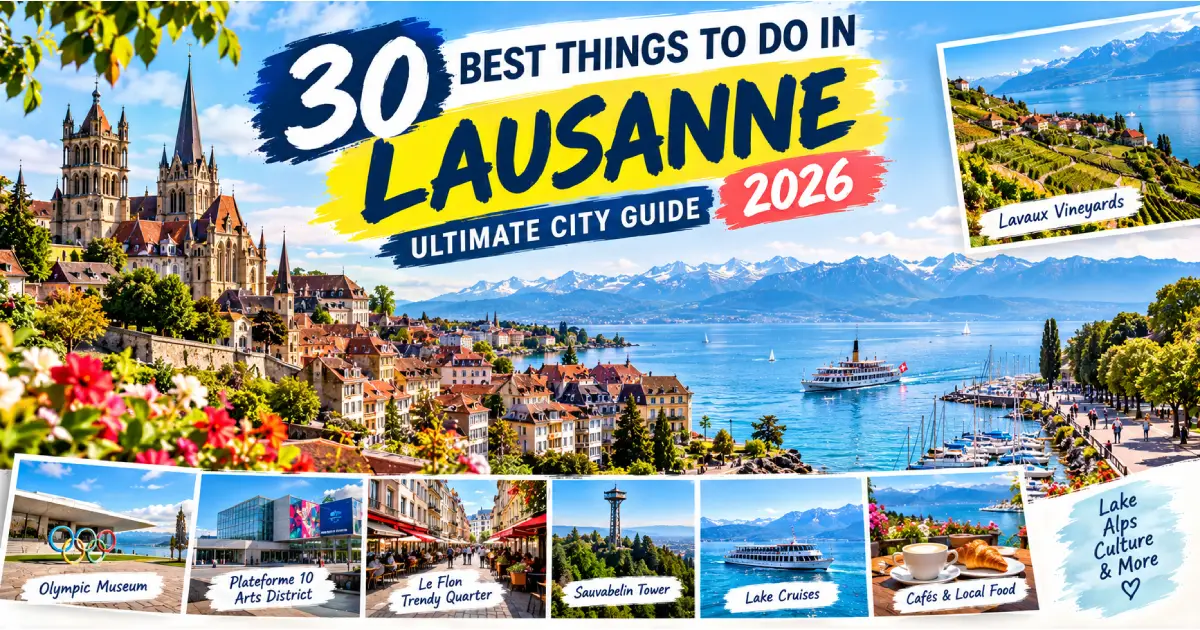
Lausanne is Switzerland’s most dynamic mid-sized city — a steeply terraced lakeside city of approximately 140,000 residents that climbs from the Lake Geneva shore at 375 meters to the Cathedral Quarter at 517 meters, where the medieval city’s Gothic cathedral presides over the Old Town’s specific topography (Lausanne is the only Swiss city built primarily on hills rather than on a flat urban plain, its character defined by the staircases, funiculars, and stepped lanes that connect the lake level with the upper city). The best things to do in Lausanne in 2026 span the internationally significant (the Olympic Museum — the definitive repository of Olympic Games history, located in Ouchy on the lake shore, one of Switzerland’s most visited attractions; the Collection de l’Art Brut — the world’s most important single collection of outsider art, a museum category that Lausanne invented; and the Cathédrale Notre-Dame, the finest Gothic cathedral in Switzerland), the specifically regional (the Lavaux UNESCO vineyard walk departing directly from the Lausanne railway station along the lake shore, the CGN lake steamers connecting Lausanne with Geneva and Montreux, and the unique Lausanne métro system — the world’s longest fully automated urban metro and the only metro system in Switzerland), and the genuinely unexpected (the underground MUDAC design museum, the Place de la Palud’s historic clock-carousel, and the specific quartier culture of the Flon district — the former industrial valley converted into Lausanne’s most specifically contemporary cultural and nightlife district).
What specifically distinguishes Lausanne from Switzerland’s other major cities is the concentration of international organizations and the energy they create — the IOC (International Olympic Committee) headquarters in Ouchy, the CAS (Court of Arbitration for Sport), the Swiss Federal Supreme Court, the University of Lausanne and EPFL (the École Polytechnique Fédérale de Lausanne, consistently ranked among the world’s top 20 universities), and over 60 other international sports federations all headquartered in or near the city create a genuinely cosmopolitan academic and institutional culture that makes Lausanne simultaneously Switzerland’s most international non-Geneva city and its most surprisingly youthful (the combined university population of approximately 50,000 students providing the demographic energy that the student-heavy neighborhoods of Chailly, Flonrieu, and the EPFL campus area express most specifically).
For related guides, see our Best Restaurants in Geneva 2026, Lavaux Wine Region: Complete Guide 2026, Switzerland Travel Guide 2026, and Things to Do in Montreux 2026.
| # | Activity | Category | Cost | Duration | Book Ahead? |
|---|---|---|---|---|---|
| 1 | Olympic Museum | Museum | CHF 20 | 2–3 hrs | No |
| 2 | Cathédrale Notre-Dame | Architecture | Free (tower CHF 4) | 1–2 hrs | No |
| 3 | Collection de l’Art Brut | Museum | CHF 10 | 1.5–2 hrs | No |
| 4 | Lavaux Vineyard Walk | Hiking/Wine | Free | Half day | No |
| 5 | Ouchy Lakefront | Walking | Free | 1 hr | No |
| 6 | Place de la Palud | Sightseeing | Free | 30 min | No |
| 7 | Flon District | Culture/Nightlife | Free to explore | 1–2 hrs | No |
| 8 | Lausanne Métro (Ride for the Experience) | Transport | CHF 3.70 | 20 min circuit | No |
| 9 | MUDAC (Museum of Design) | Museum | CHF 10 | 1 hr | No |
| 10 | CGN Boat to Montreux or Geneva | Boat | Swiss Travel Pass | 1–4 hrs | No |
| 11 | Musée Cantonal des Beaux-Arts (MCBA) | Museum | CHF 15 | 1.5–2 hrs | No |
| 12 | Old Town Walking Tour | Architecture | Free | 1.5 hrs | No |
| 13 | Palais de Rumine | Museum | Free | 1 hr | No |
| 14 | Sauvabelin Lake and Forest | Nature | Free | 1.5 hrs | No |
| 15 | Signal de Sauvabelin Tower | Viewpoint | Free | 30 min | No |
| 16 | EPFL Campus + Rolex Learning Center | Architecture | Free | 1 hr | No |
| 17 | Lausanne Market (La Riponne) | Market | Free | 1 hr | Wed/Sat |
| 18 | Musée de la Main | Museum | CHF 12 | 1 hr | No |
| 19 | Escaliers du Marché | Architecture | Free | 15 min | No |
| 20 | Cinémathèque Suisse | Film/Culture | CHF 10–15 | 2 hrs | No |
| 21 | Lausanne Caves Wine Bar | Wine | CHF 10–25 | 1 hr | No |
| 22 | Elysée Museum (Photography) | Museum | CHF 10–12 | 1.5 hrs | No |
| 23 | Museum of Contemporary Design (mudac) | Museum | CHF 10 | 1 hr | No |
| 24 | Pontaise and Vidy Sports Areas | Sports | Various | Half day | No |
| 25 | Walk to Lutry (Lavaux Start) | Walking | Free | 1.5 hrs | No |
| 26 | Fondation de l’Hermitage | Museum | CHF 15 | 1.5 hrs | No |
| 27 | Lausanne Lausanne Underground — Cave Bars | Nightlife | CHF 10–20 | Evening | No |
| 28 | Vidy Beach Swimming | Swimming | Free | 2 hrs | No |
| 29 | Lausanne Cathedral Night Watch | Unique | Free to hear | 10 PM–2 AM nightly | No |
| 30 | Day Trip to Nyon (Roman Ruins) | Day Trip | Swiss Travel Pass | Half day | No |
Cost: CHF 20 (adults), CHF 12 (children 6–17) | Location: Quai d’Ouchy 1, Lausanne-Ouchy | Hours: Tuesday–Sunday 9 AM–6 PM (May–October); Monday closed November–April | Duration: 2–3 hours | Access: Lausanne Métro M2 to Ouchy, then 5-minute walk | Book: No reservation required
The Olympic Museum (the International Olympic Committee’s official museum on the Lausanne-Ouchy lakefront, reopened in its current form in 2013 after a major renovation and expansion) is simultaneously Switzerland’s most internationally famous single museum and one of the world’s most consistently visited sports museums — the definitive repository of Olympic Games history, artifact collection, and visual documentation, whose permanent collection (covering both the ancient Hellenic Games origin through the modern Olympic movement from Pierre de Coubertin’s 1896 Athens revival to the present) and rotating special exhibitions make it a genuinely engaging museum rather than simply a prestige institutional facility.
The permanent collection: The Olympic Museum’s permanent collection is organized chronologically and thematically across three floors:
Floor 1 — Olympic Origins and Movement History: The ancient Olympics (Greek artifacts, the specific archaeological evidence from Olympia and Delphi, and the historical documentation of the games’ 1,000+ year history before the Roman closure), and the modern Olympic revival (Coubertin’s specific achievement in creating the institutional framework for international athletic competition at a moment when European nationalism was the dominant geopolitical force, and the fragility of the early Games’s survival).
Floor 2 — The Games: The sequential history of every Summer and Winter Olympics from Athens 1896 through the most recent Games — the specific artifacts (the torches, the medals, the equipment and clothing of specific athletes in specific moments), the photographic documentation, and the immersive media installations covering key historical Olympic moments (Jesse Owens’s 1936 Berlin performance, the 1968 Mexico City Black Power salute, the 1972 Munich massacre, and hundreds of other events whose Olympic context gives them specific meaning).
Floor 3 — Athletes and Values: The specific stories of individual athletes whose Olympic careers illuminate the broader Olympic narrative — the collection’s most emotionally engaging floor, where the focus shifts from institutional history to individual human achievement.
The Olympic flame: The permanent Olympic flame installation (burning continuously in the museum’s outdoor terrace, fed by natural gas — one of only a handful of permanent Olympic flames outside Olympic venues) provides the museum’s most specifically symbolic outdoor element.
Insider tips: The Olympic Museum’s least crowded visiting window is the Tuesday through Thursday morning (9–11 AM) — the school group visits and tourist family weekend flows avoid this window, providing the most contemplative engagement with the collection. The museum’s café (the Brasserie du Musée Olympique, with the lake terrace facing Lake Geneva and the French Alps) provides one of Ouchy’s most specifically atmospheric lunch settings, extending the museum visit naturally into a half-day Ouchy experience.
Cost: Free (cathedral); CHF 4 (tower) | Location: Place de la Cathédrale, Old Town | Hours: Monday–Friday 9 AM–7 PM; Saturday–Sunday until 5:30 PM | Tower: April–September, Monday–Saturday | Duration: 1–2 hours | Night Watch: Nightly 10 PM–2 AM (on the hour)
The Cathédrale Notre-Dame de Lausanne (construction begun 1170, consecrated by Pope Gregory X in 1275 in the presence of Holy Roman Emperor Rudolf I — the most significant single papal ceremony held in Switzerland in the medieval period — and substantially unchanged in its main fabric since the late 13th century, making it Switzerland’s finest example of pure Gothic cathedral architecture) provides Lausanne’s most architecturally significant single experience. The cathedral’s specific distinction: the original Gothic polychrome decoration (the exterior rose window’s 13th-century stone tracery, the Last Judgment portal’s figurative sculpture, and the interior nave’s specific proportions — the height-to-width ratio creating the soaring vertical emphasis that Gothic architecture specifically achieves at its best) is preserved in more complete and more authentic form here than at any other Swiss cathedral, the Protestant Reformation’s iconoclasm (which destroyed interior figurative art in most Swiss Reformed churches) having been modified in Lausanne to preserve the building fabric while stripping the movable furnishings.
The South Portal’s polychrome decoration: The most specifically distinguished external feature — the medieval polychrome paint surviving in traces on the tympanum sculptural figures (the Last Judgment composition, with Christ in Majesty at center and the saved and damned flanking him, painted in the specific medieval palette of red, blue, ochre, and white) is visible in its surviving traces under specific lighting conditions, creating one of Switzerland’s most specifically medieval art experiences at a cathedral that most visitors approach primarily for the Gothic architecture rather than the painting fragments.
The Night Watch (Le Guet): Lausanne’s most extraordinary single cultural peculiarity — from 10 PM until 2 AM every night, the cathedral’s appointed guardian (the guet) calls out the hour from the tower’s four cardinal windows, shouting “C’est le guet, il a sonné l’heure” (This is the watchman, the hour has struck) in each direction across the city. This tradition has continued uninterrupted since the 14th century and makes Lausanne the only city in Switzerland (and one of only a handful in the world) still maintaining an active night watch in the medieval tradition. Positioning in the cathedral square at precisely 10 PM, 11 PM, midnight, 1 AM, or 2 AM to hear the call provides the most specifically extraordinary free cultural experience available in any Swiss city — a genuine 14th-century tradition operating in 2026 without theatrical modification.
The tower: The cathedral tower (open April–September) ascends 224 steps to the first gallery at 54 meters — the most elevated point in the Lausanne Old Town, with a panoramic view across the city and down toward Lake Geneva (the specific compressed urban topography of Lausanne’s terraced hillside visible from above in its complete geographic logic, the lake appearing at the bottom of the visual slope that the city occupies between 375 and 517 meters altitude).
Insider tips: The cathedral interior in morning light (the east-facing clerestory windows in the choir illuminated by the rising sun from approximately 7–10 AM) provides the most dramatically lit version of the Gothic nave — the specific quality of the early-morning light through the rose window and the choir’s lancet windows creating the colored-light environment that Gothic architecture specifically designed for, and that afternoon’s flatter, whiter light diminishes.
Cost: CHF 10 | Location: Avenue des Bergières 11, Beaulieu district | Hours: Tuesday–Sunday 11 AM–6 PM | Duration: 1.5–2 hours | Access: Bus 2 to Beaulieu
The Collection de l’Art Brut (Lausanne) is both the world’s most important single collection of outsider art (art made by self-taught artists working outside the mainstream art world — prisoners, psychiatric patients, autodidacts, visionaries, and people in extreme social marginality whose creative work the French artist Jean Dubuffet began collecting in 1945, eventually donating the entire 5,000-work collection to the City of Lausanne in 1971 — a donation whose terms required Lausanne to establish a dedicated museum, leading to the 1976 opening of this specific institution) and the museum that essentially created the art historical category it represents: Dubuffet coined the term “Art Brut” specifically for this collection, and the subsequent global interest in outsider and self-taught art derives directly from this Lausanne collection’s influence.
The specific Collection de l’Art Brut works — the Wölfli drawings (Adolf Wölfli’s intricate, densely-patterned large-format drawings produced during his 35-year confinement in the Waldau psychiatric hospital in Bern, covering every surface with a specific visual system of musical notation, narrative text, and figurative imagery that occupied him completely until his death), the Darger illustrations (Henry Darger’s thousands of large-format watercolor illustrations for his 15,000-page unpublished novel, discovered after his death in his Chicago room where no one had been admitted during his lifetime), and the specific works by artists as diverse as Guillaume Pujolle (a French psychiatric patient whose drawings anticipate Pop Art by 20 years without any knowledge of it), Aloïse Corbaz (whose drawings of operatic fantasy scenes were produced with materials ranging from grass juice to toothpaste in the psychiatric hospital where she lived for 60 years) — represent the most concentrated single encounter with art made at the absolute margins of social and psychological experience available anywhere in the world.
Insider tips: The Collection de l’Art Brut’s permanent collection (which changes its displayed selection, approximately 600 of the 65,000 total collection works on display at any time) rewards return visits more than any other single Lausanne museum — the rotation policy means that the collection always includes unfamiliar works even for visitors who have been before, and the works’ individual power consistently reasserts itself rather than diminishing with repetition.
Cost: CHF 15 | Location: Plateforme 10, Place de la Gare, Lausanne | Hours: Tuesday–Sunday 10 AM–6 PM | Duration: 1.5–2 hours | Access: 2-minute walk from Lausanne train station
The MCBA (Musée Cantonal des Beaux-Arts — the Vaud cantonal fine arts museum, relocated to the spectacular new Plateforme 10 arts campus adjacent to the Lausanne main station in 2019, designed by Barcelona architects Barozzi Veiga) houses the Vaud canton’s fine arts collection — Swiss painting from the 16th century through the 20th century, with specific strength in the 19th-century Vaudois and Swiss Romanticist and Realist traditions (the collection’s Ferdinand Hodler holdings being among the most significant outside Bern), alongside the permanent collection’s contemporary acquisitions and the rotating special exhibition program.
The Plateforme 10 arts campus: The MCBA is the anchor institution of the Plateforme 10 arts campus — a purpose-designed cultural quarter adjacent to the Lausanne train station combining the MCBA with the Photo Elysée (the photography museum, relocated to Plateforme 10 from its former Montbenon location) and the MUDAC (the applied arts and design museum). The campus’s specific architectural coherence (three museums in dialogue, sharing a public square and café infrastructure) and the radical departure from the traditional museum-in-historic-building format create the most convincing contemporary cultural campus in Switzerland outside Zurich’s Zürich West area.
Cost: CHF 12 | Location: Plateforme 10, Place de la Gare | Hours: Tuesday–Sunday 10 AM–6 PM | Duration: 1 hour | Access: Adjacent to Lausanne train station
Photo Elysée (the Swiss museum of photography — one of the few dedicated photography museums in the world, relocated to the Plateforme 10 campus in 2022 with an expanded exhibition program and a permanent collection of approximately 100,000 photographic works spanning the medium’s entire history from Daguerre to contemporary digital practice) provides the most specifically focused single encounter with photography as an art form and historical document available in Switzerland. The collection’s breadth (the 19th-century historical photography holdings, the 20th-century reportage and art photography, and the contemporary work that the museum’s acquisitions program specifically targets) and the exhibition program’s consistent quality (the Photography Museum having established itself among European photography institutions as a venue of genuine curatorial ambition rather than simply a permanent-collection repository) make Photo Elysée one of the Plateforme 10 campus’s strongest individual draws.
Cost: CHF 10 | Location: Plateforme 10, Place de la Gare | Hours: Tuesday–Sunday 10 AM–6 PM | Duration: 1 hour | Access: Adjacent to Lausanne train station
MUDAC (Museum of Contemporary Design and Applied Arts) covers the full spectrum of designed objects — from furniture and textiles through industrial design to digital and interactive design — in a program that distinguishes design as a category of cultural production deserving museum treatment equivalent to fine arts. The specific MUDAC approach (the temporary exhibition program engaging with contemporary design practice, the permanent collection’s historical depth in Swiss and European applied arts, and the specific Lausanne context of a city with EPFL’s design and engineering culture providing the local intellectual environment) creates one of Switzerland’s most specifically engaged design museum programs.
Cost: CHF 15 | Location: Route du Signal 2, Hermitage (above the Old Town) | Hours: Tuesday–Sunday 10 AM–6 PM | Access: Bus 16 from Place de la Palud | Duration: 1.5 hours
The Fondation de l’Hermitage (housed in a 19th-century villa on the forested hillside above Lausanne’s Old Town, with a garden terrace providing specific lake views in the southward direction) specializes in French Impressionism and Post-Impressionism alongside Swiss art of the same period — the most specifically French-art-focused institution in Switzerland outside Geneva, reflecting Lausanne’s linguistic and cultural position as a French-Swiss city with deep cultural ties to the French artistic tradition. The temporary exhibition program (typically 2–3 major exhibitions per year, each drawing from European museum collections for specific thematic or artist-retrospective presentations) provides the most consistently high quality per exhibition of any Lausanne museum.
Cost: Free | Location: Place de la Palud, Old Town center | Best Time: On the hour (9 AM–7 PM) for the animated clock performance | Duration: 30 minutes
The Place de la Palud (the Old Town’s primary civic square — the location of Lausanne’s Hôtel de Ville [City Hall], the covered market on Wednesday and Saturday mornings, and the animated mechanical clock on the City Hall facade) provides the most specifically Lausanne Old Town atmosphere: the medieval-to-19th century building mix surrounding the square, the specific fountain at the center (the Justice Fountain of 1585, the allegorical figure of Justice with its specific iconography maintaining the same political statement as Bern’s equivalent fountain), and the clock (the mechanical carousel-style animated clock on the City Hall facade, the figures moving through their programmed sequence on the hour from 9 AM to 7 PM) creating a specific Old Town civic square of genuine character.
The Escaliers du Marché: The covered medieval staircase connecting the Place de la Palud with the Cathedral Quarter above — a timber-roofed stepped passageway whose specific wooden construction (dating to the 16th century in its current form, the wood weathered to near-black over five centuries of continuous use) and the specific quality of the light filtering through the roof timbers create the most specifically medieval single architectural element in Lausanne’s Old Town.
Cost: CHF 3.70 (single journey, covered by Lausanne hotel guest cards and Swiss Travel Pass within the zone) | Route: M1 (UNIL-Flon to Renens) and M2 (Ouchy to Croisettes) | Duration: Full circuit approximately 20 minutes each line | Special: World’s longest fully automated urban metro
The Lausanne Métro system (the M1 and M2 lines — the M2 specifically being the world’s longest fully automated metro system at 5.9 km, a rubber-tyred underground railway connecting the Ouchy lakefront at 375 meters with the Croisettes suburb at approximately 620 meters in a single continuous underground run that traverses 245 meters of vertical change, making it the world’s most steeply gradated underground metro) provides a specifically Lausanne urban experience — the metro’s role in connecting the city’s radically different altitude zones (the lakefront, the Old Town midpoint, and the upper university districts) making it both a practical transport tool and a specifically interesting piece of infrastructure for visitors who notice it.
The M2 line specifically: The M2’s gradient (parts of the line ascending at 6% — beyond the capacity of standard wheeled metro systems, requiring the specific rubber-tyred technology) and its fully automated operation (no driver — the train operated by computer control throughout, one of the earliest and longest fully-automated metro systems in the world outside Japan’s automated people-movers) make it the most technically interesting piece of urban public transport in Switzerland. Riding the M2 from Ouchy (the lake station) to Lausanne-Gare (the main station) provides 8 minutes of ascent through the specific geology and urban stratigraphy of Lausanne’s hillside in a fully automated train — a minor but specifically Lausanne infrastructure pleasure.
Cost: Free (trail); SBB trains to villages covered by Swiss Travel Pass | Access: SBB from Lausanne to Lutry (10 min) or Cully (20 min) | Duration: Half day or full day | See: Lavaux Wine Region: Complete Guide
The Lavaux UNESCO vineyards begin immediately east of Lausanne — the village of Lutry (the Lavaux’s western gateway, 10 minutes by SBB from Lausanne station, covered by Swiss Travel Pass) providing the most convenient single starting point for the vineyard terrace walk. The specific Lausanne-based Lavaux day (SBB to Lutry in the morning, walking east along the UNESCO terrace trail through Villette, Grandvaux, Cully, Epesses, and Rivaz, with wine cave tastings at Cully and a lunch in Saint-Saphorin, returning by SBB from Chexbres or Saint-Saphorin) provides Lausanne’s finest regional excursion day.
The harvest advantage: Lausanne’s position at the Lavaux’s western end makes it the closest major city to the harvest activity — a September or October morning departure from Lausanne (8 AM SBB to Lutry) arrives in the vineyard zone during the harvest’s active morning hours, the grape-picking visible in the terraces above the trail and the specific harvest-season smell (fermenting must from the cave entrances) most concentrated in the early-morning before the day’s warmth fully develops.
Cost: Free | Location: Lausanne-Ouchy, 15 minutes by Métro M2 from Lausanne-Gare | Best Time: Morning and late afternoon | Duration: 1–2 hours
Ouchy (Lausanne’s lakefront district — separated from the Old Town by the steep hillside that the Métro M2 traverses in 7 minutes, with a completely different character from the city’s upper districts: flat, Mediterranean-influenced, palm-tree-lined, and lake-oriented) provides Lausanne’s most directly lakeside experience: the Ouchy quay with the Lake Geneva immediately at the promenade edge, the CGN steamer landing stage, the specific Belle Époque hotel architecture (the Beau-Rivage Palace Hotel — one of Switzerland’s grandest lake hotels, continuously operating on the Ouchy shore since 1861), and the Olympic Museum on the promenade’s eastern end.
The Beau-Rivage Palace: One of Switzerland’s finest grand hotels (continuously operating since 1861 — the specific Beau-Rivage’s lakefront position and its role in Lausanne diplomatic history, including the 1923 Treaty of Lausanne negotiations and numerous other significant events in 20th-century European diplomatic history, giving it an institutional weight comparable to Zurich’s Baur au Lac or Geneva’s Beau-Rivage) provides afternoon tea (CHF 40–65) and restaurant dining (various restaurants at different price points within the hotel) accessible without overnight accommodation — the lakefront terrace during summer providing one of Switzerland’s finest single outdoor dining settings.
Insider tips: The Ouchy promenade in the early morning (before the Olympic Museum opens and before the city’s tourist flow descends by Métro) provides the most specifically lakeside contemplative experience available in Lausanne — the Lake Geneva surface in morning calm, the French Alps visible across the water in the specific clearness of pre-tourist-hour light, and the promenade essentially private for the early-rising visitor.
Cost: Swiss Travel Pass covered | Duration: Lausanne to Montreux: 1 hour; Lausanne to Geneva: 3 hours | Season: April–October full service; limited winter | Access: CGN landing stage, Ouchy
The CGN lake steamers from Lausanne provide the most specifically scenic lake transport available in the Lake Geneva basin — the boats connecting Lausanne with Montreux (1 hour east), Vevey (45 min), Geneva (3 hours west), Nyon (1.5 hours), and various French shore stops. The specific Lausanne CGN value: the journey from Lausanne to Montreux specifically (the CGN steamer leaving Lausanne and traveling east along the Lavaux shore — the UNESCO vineyard terraces visible from the water throughout the journey, the terraces showing their most complete north-facing lake-view character from the lake surface — before arriving at Montreux for the Château de Chillon and promenade) provides a specifically Lavaux-from-the-water experience that the train and hiking trail don’t replicate.
Cost: Free | Access: Bus or 45-minute walk from the Old Town | Duration: 1.5 hours | Season: Year-round | Character: Lausanne’s most local woodland retreat
The Sauvabelin domain (the forested plateau above Lausanne’s Old Town, accessible by bus or a 45-minute uphill walk from the cathedral level — the specific woodland path through the residential Prélaz district ascending to the forested plateau above) provides Lausanne’s most specifically local outdoor experience: the 5-hectare Sauvabelin Lake (a natural plateau lake in the forest clearing, with a children’s farmyard adjacent and the Signal de Sauvabelin watchtower at the forest’s high point), the forest walking trails (the specific mixed forest of beech, oak, and chestnut that covers the plateau, with the specific Lausanne suburban-forest character of maintained paths and benches alongside the wilder sections), and the animal park (a small collection of local wildlife — deer, ibex, and various Alpine animals in a semi-naturalistic enclosure that Lausanne children specifically visit).
The Signal de Sauvabelin Tower: The wooden observation tower at the Sauvabelin plateau’s highest point (the Signal, 643 meters) — a spiral staircase tower whose summit platform provides the highest accessible viewpoint in Lausanne proper (above the Cathedral Quarter’s 517 meters, above the university’s 600 meters), with a 360-degree panorama encompassing the lake, the Old Town below, and the forested plateau’s own woodland canopy.
Cost: Free to explore | Location: Flon valley, between the Old Town and Lausanne-Gare | Best Time: Thursday–Saturday evenings | Season: Year-round
The Flon (the former industrial valley separating Lausanne’s Old Town from the railway station area, previously occupied by warehouses and light industry and systematically converted from the 1990s onward into Lausanne’s most specifically contemporary cultural and entertainment district) provides the most distinctively non-historic Lausanne urban experience — a district whose converted warehouse architecture, street art, independent boutiques, design studios, nightclubs, and restaurant concentration creates the specific urban culture that the city’s 50,000+ student population sustains and that distinguishes Lausanne from Switzerland’s other major cities in nightlife and creative-industry density.
Key Flon addresses:
Cost: CHF 10–15 per screening | Location: Place de la Gare 1, Lausanne (Plateforme 10 area) | Hours: Daily screenings | Program: Check cinematheque.ch for current 2026 screenings
The Cinémathèque Suisse (the Swiss Film Archive — the national institution responsible for the preservation of the Swiss cinematic heritage and the projection of both Swiss and international classic cinema) maintains a continuous public screening program of archive, classic, and cinematheque-quality films that provides Lausanne’s most specifically cinephile single entertainment offering. The archive’s specific Swiss collection (the most complete record of Swiss cinematic production from the silent era onward, including works by Swiss directors whose reputation has rarely extended internationally but whose regional significance is substantial — Charles-Félix Vaucher’s early silents, Alain Tanner’s Swiss-political-cinema period, and the contemporary Swiss directors whose work the Cinémathèque specifically supports) makes the screening program different from any commercial cinema.
Cost: Free to hear from the Place de la Cathédrale | Time: Nightly, 10 PM–2 AM (on the hour) | Location: Cathedral Square, Old Town | Duration: 5 minutes per hour-call
The Night Watch (Le Guet de Lausanne) — the cathedral’s appointed guardian calling out the hour from the tower’s four windows, nightly from 10 PM to 2 AM, in a tradition uninterrupted since the 14th century — provides the most extraordinary free unique cultural experience available in any Swiss city. The specific ceremony (the guet calling “C’est le guet, il a sonné l’heure, il a sonné l’heure” — followed by the hour number — from each of the four cardinal windows in turn, the voice carrying across the Old Town in the quiet of night) is audible from the Cathedral Square and from large areas of the upper Old Town, and is most powerfully experienced from the Place de la Cathédrale directly below the tower.
Practical Night Watch visit: Positioning in the Cathedral Square at 5 minutes before the designated hour (10 PM, 11 PM, midnight, 1 AM, or 2 AM — the 10 PM call being the earliest and most practically convenient for most visitors), the night quiet of the Old Town making the watchman’s voice clearly audible from the square, and the specific atmosphere of a medieval tradition operating in 2026 without alteration creates one of Europe’s most specifically extraordinary free cultural experiences. The 10 PM call (the earliest, the evening still active, the café terraces of the surrounding streets still serving) is the most practically accessible; the midnight call (the city quieter, the cathedral quarter more atmospheric, the tradition more palpably connecting the 14th century with the present) is the most specifically atmospheric.
About Travel Tourister Travel Tourister’s destination specialists have explored Lausanne across all seasons — from Olympic Museum morning visits and Cathedral night watch midnight sessions through Art Brut Collection Wölfli room encounters and Lavaux harvest vineyard walks to Ouchy promenade CGN steamer departures, Flon district evening culture, and Sauvabelin forest Signal de Sauvabelin tower panoramas — to deliver the most practical and honest guide to the best things to do in Lausanne for every type of 2026 visitor.
Posted By : Vinay
Latest Article
2nd Floor, 39, Above Kirti Club, DLF Industrial Area, Kirti Nagar, New Delhi, Delhi 110015



Travel Tourister is a leading Travel portal where we introduce travellers to trusted travel agents to make their journey hasselfree, memorable And happy. Travel Tourister is a platform where travellers get Tour packages ,Hotel packages deals through trusted travel companies And hoteliers who are working with us across the world. We always try to find new and more travel agents and hoteliers from every nook and corners across the world so that you could compare the deals with different travel agents and hoteliers and book your tour or hotel with the one you have chosen according to your taste and budget.
Copyright © Travel Tourister, India. All Rights Reserved

 Call
Call Enquiry