Published on : 12 Sep 2026
By Travel Tourister | Updated Sep 2026
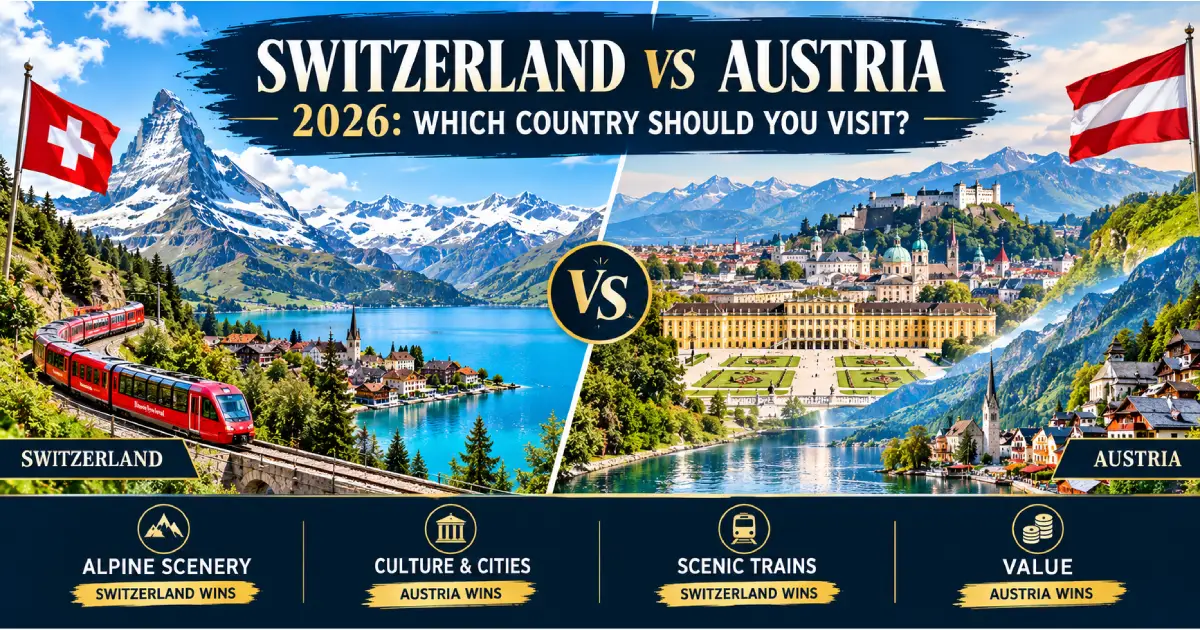
Switzerland and Austria are Europe’s two most precisely Alpine nations — countries whose identities, economies, and tourist landscapes are defined more fundamentally by the Alps than any other pair of neighboring countries on Earth. Yet despite the shared mountain geography (both countries span the central Alpine chain, both operate world-class mountain railway systems, both maintain strong winter skiing cultures and equally strong summer hiking traditions), Switzerland and Austria produce travel experiences of genuinely different characters — differences rooted in language diversity (Switzerland’s four official languages versus Austria’s predominantly German-speaking single-language character), price level (Switzerland being consistently among the world’s three most expensive travel destinations while Austria operates at significantly lower cost), mountain access philosophy (Switzerland’s extraordinary concentration of publicly accessible high-Alpine viewpoints versus Austria’s emphasis on authentic village character and less-commercialized mountain terrain), and cultural identity (Switzerland’s specific confederation character — the deliberate political construction of a multi-ethnic, multi-linguistic national identity — versus Austria’s more unified Germanic cultural tradition with its specific Habsburg imperial history permeating every major city’s architecture, food culture, and self-presentation).
This comparison guide addresses the specific decision that visitors planning an Alpine-focused European trip face: whether to visit Switzerland, Austria, or both — with complete honesty about each country’s specific strengths, weaknesses, costs, and the visitor types who most benefit from each choice. Neither country is universally superior — the right choice depends entirely on priorities that vary fundamentally between visitors seeking the most dramatic mountain infrastructure (Switzerland), the most affordable Alpine experience (Austria), the most culturally rich imperial city (Vienna, no Swiss equivalent), or the most authentic village character (both countries offer this but in distinctly different registers).
For Switzerland-specific planning, see our Switzerland Travel Guide 2026, Best Places to Visit in Switzerland 2026, and Swiss Travel Pass Guide 2026.
| Category | Switzerland | Austria |
|---|---|---|
| Capital | Bern (federal) | Vienna |
| Currency | Swiss Franc (CHF) | Euro (€) |
| Languages | German, French, Italian, Romansh | German (primarily) |
| Population | 8.7 million | 9.1 million |
| Area | 41,285 km² | 83,871 km² |
| Daily Budget (mid-range) | CHF 200–350/person | €80–150/person |
| Highest Peak | Dufourspitze, 4,634m | Grossglockner, 3,798m |
| Most Famous Mountain | Matterhorn (4,478m) | Grossglockner (3,798m) |
| Most Famous City | Zurich / Geneva | Vienna |
| Best Mountain Railway | Jungfraujoch (3,454m) | Schafberg (1,783m) |
| Best Ski Resort | Zermatt, Verbier, St. Moritz | St. Anton, Kitzbühel, Ischgl |
| UNESCO Natural Sites | Jungfrau-Aletsch, Swiss Alps | Hallstatt-Dachstein |
| Climate | Alpine and sub-Mediterranean (Ticino) | Alpine and Pannonian (Vienna basin) |
| Rail Pass | Swiss Travel Pass (CHF 420–500/week) | Eurail Austria Pass (€200–280/week) |
| Best Season | June–October; December–March | June–September; December–March |
Switzerland operates the world’s most developed public mountain access infrastructure — the specific combination of the Jungfrau Railways (the Jungfraujoch at 3,454 meters by rack railway, Europe’s highest railway station), the Matterhorn Glacier Paradise (3,883 meters by cable car, Europe’s highest cable car station), the Pilatus-Bahn (48% gradient, world’s steepest rack railway), and dozens of other mountain railways, funiculars, and cable cars creates a mountain access network that no other country in the world — including Austria — approaches in density and public accessibility.
The specific Swiss mountain experience: the ability to ascend from a village at 1,600 meters to a summit at 3,500+ meters on a Swiss Travel Pass-included railway, walk on an actual glacier with marked trail infrastructure, and return for dinner in a car-free village — all without any specialized equipment, technical skills, or physical fitness beyond moderate — is Switzerland’s most specifically extraordinary offering and the primary reason that Switzerland receives three times as many international tourists as Austria despite being half the land area.
Switzerland’s mountain highlights that Austria cannot match:
Austria’s mountains are less dramatically height-capped than Switzerland’s (the Grossglockner at 3,798 meters is Austria’s highest peak, 836 meters lower than Switzerland’s highest, and the Austrian Alps’ generally lower summit elevations mean glacier access and 4,000-meter terrain are less available) but provide a specific character that the Swiss mountain experience occasionally obscures: genuine village-agricultural authenticity. The Austrian mountain village tradition (the Tyrolean village character of communities like Hallstatt, Zell am See, Mayrhofen, and the smaller communities throughout the Salzburg and Styrian alps) has maintained more of the pre-tourism agricultural identity than many equivalent Swiss mountain communities, where the tourism infrastructure’s dominance has transformed the village economies more completely.
Austria’s mountain highlights that Switzerland cannot match:
This is where Switzerland and Austria diverge most dramatically — and where the specific honest comparison most helps visitor decision-making.
Switzerland is consistently ranked among the world’s three most expensive travel destinations (alongside Norway and Iceland) — a pricing reality that reflects the country’s specific economic conditions (the world’s highest average wages, the Swiss franc’s specific strength, and the mountain resort infrastructure’s inherent cost from building and maintaining facilities at 3,000+ meter altitude) rather than simple tourism exploitation.
Realistic Switzerland daily costs (per person, mid-range):
Switzerland’s cost-mitigation strategies:
Austria operates at a significantly lower cost level than Switzerland — the Euro currency (approximately 0.95 to the Swiss Franc at recent rates, making the mathematical comparison almost direct), lower baseline wages in the tourism sector, and less concentrated resort infrastructure creates a genuinely more affordable mid-range travel experience.
Realistic Austria daily costs (per person, mid-range):
The cost comparison summary: Austria is approximately 40–60% cheaper than Switzerland for equivalent travel quality. A 7-day mid-range Switzerland trip (approximately CHF 2,100–2,800 per person including STP and accommodation) translates to approximately €1,200–1,700 for an equivalent-quality Austria trip — a saving of €900–1,100 per person that materially affects the accessible trip duration and experience scope.
Vienna is Austria’s single most specifically irreplaceable offering — a city whose Habsburg imperial inheritance (the Hofburg Palace complex, the Kunsthistorisches Museum’s incomparable art collection, the Belvedere Palace’s Klimt holdings, the Vienna State Opera, and the specific coffee house culture [the Viennese Kaffeehaus — UNESCO-listed as cultural heritage, the specific tradition of the long-sitting, the newspaper on the reading stick, and the Melange coffee format that no Swiss café exactly replicates]) creates a cultural density and historical depth unavailable in any Swiss city.
Vienna’s specific advantages over any Swiss city:
Swiss cities’ advantages over Vienna:
Switzerland’s ski resorts are consistently ranked among the world’s finest — Zermatt (350+ km of pistes, car-free, the Matterhorn directly overhead), Verbier (330 km, the 4 Vallées connection, extreme off-piste reputation), St. Moritz (350 km of skiing, the birthplace of winter sports tourism, two Winter Olympics), and the Jungfrau Ski Region (213 km, the Lauberhorn Downhill course, Grindelwald and Wengen car-free villages) providing the most specifically dramatic and most internationally famous ski experiences available in the Alps.
The specific Swiss skiing advantage: the combination of the highest resorts (Zermatt’s skiing extends to 3,883 meters at the Glacier Paradise, ensuring early-season and late-season snow quality unavailable at lower Austrian resorts), the car-free resort character (Zermatt, Wengen, Mürren, and Saas-Fee all car-free — eliminating the resort village noise and pollution that the Austrian equivalents’ road access maintains), and the specific mountain dramatics (the Matterhorn above Zermatt, the Eiger above Kleine Scheidegg, the Schilthorn above Mürren) create a skiing environment whose visual character exceeds any Austrian equivalent.
Swiss ski resort pricing (approximate day pass 2026):
Austria’s ski resorts provide the most cost-effective equivalent Alpine skiing available in Europe — St. Anton am Arlberg (305 km, the Arlberg connection, legendary off-piste reputation), Kitzbühel (170 km, the Hahnenkamm Downhill race, the most prestigious single ski racing event after Wengen), Ischgl (238 km, the Silvretta Arena connecting to Switzerland, the most specifically party-oriented resort in the Alps), and the Zillertal and Ötztal glacier resorts providing excellent skiing at 30–40% lower cost than the Swiss equivalents.
Austrian ski resort pricing (approximate day pass 2026):
The skiing verdict: Switzerland provides the most dramatic, most visually stunning, and most high-altitude skiing — at 30–40% higher cost. Austria provides skiing of excellent quality at a more accessible price point, with specific advantages in resort nightlife (Ischgl, Sölden) and race-culture heritage (Kitzbühel). For pure skiing value, Austria wins; for the specific combination of mountain scenery, car-free village character, and altitude, Switzerland wins decisively.
Switzerland’s food identity is fundamentally dairy-based — the cheese (Gruyère, Emmental, Appenzeller, Raclette du Valais, Vacherin Fribourgeois) and the chocolate (Lindt, Cailler, Läderach, and dozens of artisan producers) whose quality and regional specificity create a food tourism landscape organized around dairy products and their derivatives. The fondue and raclette traditions (both specifically Swiss, both deeply regionally varied between the Valais, Fribourg, Valais, and Bernese formulas) provide the most specifically Swiss dining experiences — the communal cheese-melting format that Switzerland invented and that neighboring countries have borrowed without fully replicating the specific regional authenticity.
Swiss food highlights:
Swiss food weakness: The quality ceiling is very high but the price ceiling is higher — a restaurant dinner in Switzerland (CHF 35–70 for a main course with drinks) consistently represents significantly more financial commitment than equivalent-quality meals in Austria or most other European countries.
Austria’s food identity is more historically layered than Switzerland’s — the Habsburg empire’s culinary influence (the specific absorption of Hungarian, Bohemian, Italian, and other imperial territory food traditions into the Viennese kitchen) creates a food culture of greater diversity: the Wiener Schnitzel (the veal schnitzel in breadcrumb crust that is Austria’s single most internationally exported dish), the Tafelspitz (boiled beef in beef broth, the most specifically Viennese main course — served with apple horseradish, chive sauce, and bone marrow), the Kaiserschmarrn (the fluffy torn pancake dessert, Austria’s most characteristically imperial confectionery), and the Sachertorte (the Hotel Sacher’s chocolate cake, whose specific recipe is legally protected and whose Vienna-only original remains the most specifically Viennese single confectionery experience).
Austrian food highlights:
Austrian food value: Gasthof-level dining in Austria (the traditional inn restaurant format serving Schnitzel, Gulasch, and regional preparations) typically costs €15–25 for a main course with drink — approximately 50% of the equivalent Swiss restaurant cost, with no significant quality reduction.
Austria’s imperial history (the Habsburg dynasty ruling from Vienna across an empire spanning modern Austria, Hungary, Czech Republic, Slovakia, Slovenia, Croatia, northern Italy, and parts of Poland and Romania for approximately 600 years until 1918) created a cultural legacy of extraordinary richness and extraordinary specific density: the Kunsthistorisches Museum’s encyclopedic collections assembled from the empire’s breadth, the Vienna Philharmonic’s specific orchestral tradition (the most celebrated single orchestra in the world, whose New Year’s Concert is watched by 50 million people annually), and the architectural coherence of Vienna’s imperial city center create a cultural experience of a kind that no Swiss city — despite Switzerland’s own cultural sophistication — provides.
Austria’s specific cultural advantages:
Switzerland’s cultural identity is built on a different foundation — not imperial legacy but the specific achievement of creating a stable, prosperous, multi-ethnic confederation from four language regions that might easily have pursued separate national identities. The specific Swiss cultural confidence (the willingness to maintain four national languages, the direct democracy tradition, the deliberate political neutrality in two world wars that preserved the cultural infrastructure that surrounding countries lost) creates cultural institutions of genuine quality — the Kunstmuseum Basel’s Holbein collection, the Fondation Beyeler’s Impressionist masterworks, the Zentrum Paul Klee’s comprehensive Klee archive, and the Collection de l’Art Brut’s outsider art pioneering — without the imperial drama that Vienna specifically provides.
Switzerland’s specific cultural advantages:
For visitors with 14+ days and the budget for both, Switzerland and Austria combine naturally into a single Alpine circuit — the standard combination routing:
Zurich (Switzerland) → Lucerne → Interlaken → Zermatt → [Glacier Express] → St. Moritz → [Bernina Express] → Innsbruck (Austria) → Salzburg → Vienna → home
This circuit (approximately 14 days) provides:
The rail pass question: the Swiss Travel Pass covers Switzerland comprehensively; the Eurail Global Pass (covering both Switzerland and Austria) provides the most cost-effective single-pass solution for visitors combining both countries, though the Swiss Travel Pass provides meaningfully better Switzerland mountain railway discounts than the Eurail Global Pass’s equivalent coverage.
✅ The mountain railways and viewpoints are your primary priority — the Jungfraujoch, Glacier Express, and Bernina Express have no Austrian equivalents in scale or infrastructure ✅ You want car-free mountain villages — Zermatt, Wengen, Mürren, and Saas-Fee provide a village-without-cars atmosphere unavailable in Austria’s road-accessible ski resorts ✅ You’re visiting in winter for skiing and want the highest altitude and most dramatic mountain backdrop — the Matterhorn above Zermatt and the Eiger above Kleine Scheidegg are ski-area visual backdrops without Austrian equivalent ✅ You want the most convenient multi-lingual and multi-cultural European experience — four national languages, the most concentrated international organization presence outside Brussels, and the specific Swiss-French/Swiss-German/Swiss-Italian cultural variety ✅ Budget is secondary to experience quality — Switzerland’s premium pricing consistently delivers premium quality that justifies the cost for visitors without hard budget constraints
✅ Vienna’s imperial cultural depth is your primary priority — no Swiss city approaches Vienna’s specific combination of art museums, musical tradition, Kaffeehauskultur, and Habsburg architectural heritage ✅ Budget is a significant constraint — Austria at 40–60% of Switzerland’s cost allows meaningfully longer stays, more nights in better hotels, and more restaurant meals for the same budget ✅ Authentic village character matters more than mountain railway infrastructure — Hallstatt, Hall in Tirol, and the smaller Salzburg and Styrian villages maintain pre-tourism village character more completely than the Swiss equivalents ✅ You want skiing at competitive cost — St. Anton, Kitzbühel, and Ischgl provide excellent skiing at 30–40% below Swiss resort lift-pass pricing ✅ Salzburg and its music festival are on the list — the Mozart birthplace, the Salzburg Festival, and the specific Baroque city character is an Austrian-only experience
✅ You have 14+ days and the budget for both — the natural circuit combining Switzerland’s Alpine infrastructure with Austria’s cultural depth provides the most complete Central European mountain travel experience available ✅ You’re returning to Europe and have already seen one country — visitors who have already done Switzerland’s mountains can focus on Austria’s cities and culture (and vice versa) without the anxiety of “missing” the other country’s primary experiences
About Travel Tourister Travel Tourister’s destination specialists have traveled extensively in both Switzerland and Austria across all seasons — comparing Jungfraujoch railway access with Grossglockner road scenery, Zermatt car-free skiing with St. Anton’s après-ski culture, Zurich’s lake promenade with Vienna’s Ringstrasse, Geneva’s international character with Vienna’s imperial depth, and Gruyères fondue with Wiener Schnitzel at Figlmüller — to deliver the most practically honest Switzerland vs Austria comparison for 2026 visitors making this specific travel decision.
Posted By : Vinay
Latest Article
2nd Floor, 39, Above Kirti Club, DLF Industrial Area, Kirti Nagar, New Delhi, Delhi 110015



Travel Tourister is a leading Travel portal where we introduce travellers to trusted travel agents to make their journey hasselfree, memorable And happy. Travel Tourister is a platform where travellers get Tour packages ,Hotel packages deals through trusted travel companies And hoteliers who are working with us across the world. We always try to find new and more travel agents and hoteliers from every nook and corners across the world so that you could compare the deals with different travel agents and hoteliers and book your tour or hotel with the one you have chosen according to your taste and budget.
Copyright © Travel Tourister, India. All Rights Reserved

 Call
Call Enquiry