Published on : 11 Sep 2026
By Travel Tourister | Updated Sep 2026
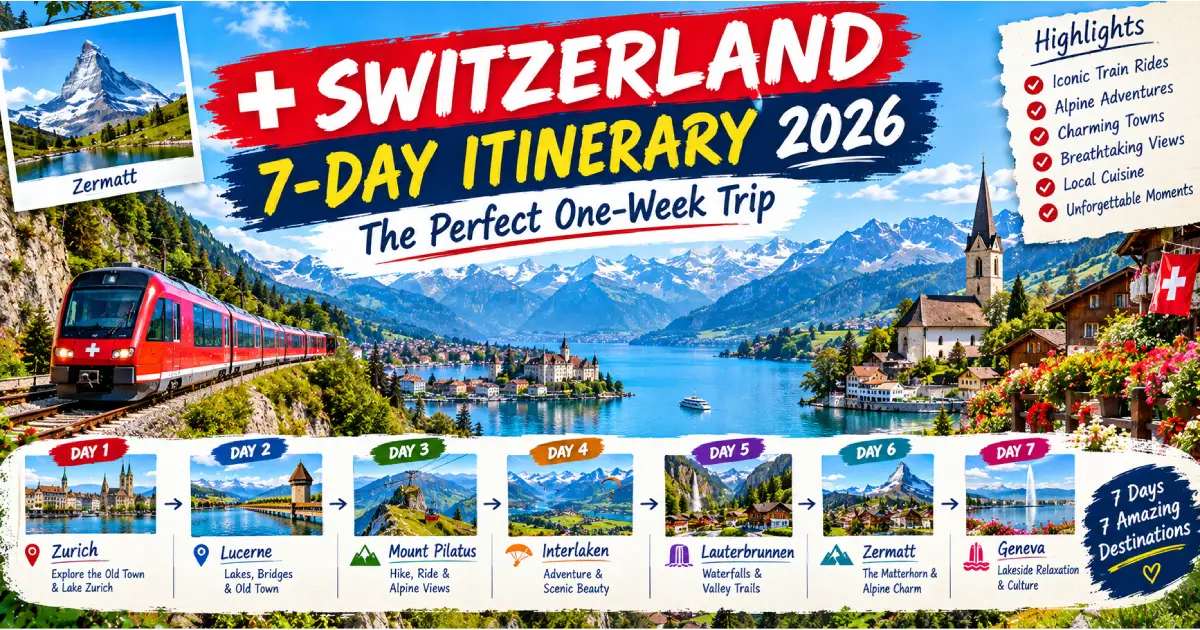
Seven days in Switzerland is enough time to experience the country’s four most compelling landscapes — the German-Swiss city culture of Zurich and Lucerne, the Bernese Oberland’s mountain world of the Jungfrau Region and Interlaken, the Valais’s Matterhorn country around Zermatt, and the French-Swiss elegance of Lake Geneva and Geneva — without the rushed transit that shorter itineraries require or the depth that longer ones provide. The specific challenge of a 7-day Switzerland itinerary is not finding enough to fill the days (Switzerland’s extraordinary density of world-class experiences means the opposite problem — editing ruthlessly from among too many genuine options) but rather sequencing those days into a logical geographic circuit that minimizes backtracking, maximizes each location’s most specific character, and allows the Swiss Travel Pass’s comprehensive coverage to eliminate the transport cost friction that individual ticketing creates.
This 7-day Switzerland itinerary has been designed around four specific planning principles: the mountain excursions (Jungfraujoch, Matterhorn Glacier Paradise) are scheduled for the days with the statistically highest probability of clear summit conditions rather than on fixed calendar positions; the scenic railway journeys (Glacier Express, Goldenpass connections) are integrated as travel-day experiences rather than dedicated excursion days; the urban days (Zurich, Lucerne, Geneva) are concentrated at the beginning and end of the circuit when mountain-withdrawal after the Alpine section is most natural; and the Swiss Travel Pass’s coverage is maximized by routing all travel through included transport modes rather than requiring car rental or paid add-ons. The result is a circuit that flows geographically (Zurich → Lucerne → Interlaken → Zermatt → Geneva → home) without repetition, covers Switzerland’s most iconic experiences without feeling rushed, and provides genuine depth in each location rather than the superficial monument-collection that the least-considered Switzerland itineraries produce.
For specific destination planning, see our Zurich Travel Guide 2026, Lucerne Travel Guide, Interlaken Travel Guide 2026, Jungfrau Region Travel Guide 2026, Zermatt Travel Guide 2026, and Switzerland Travel Guide 2026.
| Day | Base | Primary Experience | Travel | Approx. Cost Beyond STP |
|---|---|---|---|---|
| Day 1 | Zurich | Arrival, Old Town, lake | — | CHF 0–20 |
| Day 2 | Lucerne | Chapel Bridge, Mount Pilatus | Zurich → Lucerne (50 min, STP) | CHF 21 (Pilatus 50%) |
| Day 3 | Interlaken | Scenic transfer via GoldenPass, Harder Kulm | Lucerne → Interlaken (Brünig, STP) | CHF 0–17 |
| Day 4 | Interlaken/Grindelwald | Jungfraujoch (weather-dependent) | Local BOB trains (STP) | CHF 47–98 |
| Day 5 | Zermatt | Matterhorn views, village, Gornergrat | Interlaken → Zermatt via Bern/Visp | CHF 25 (Gornergrat 50%) |
| Day 6 | Zermatt/Geneva | Matterhorn Glacier Paradise or Five Lakes Walk; transfer | Zermatt → Geneva via Visp/Lausanne | CHF 30–45 |
| Day 7 | Geneva | Old Town, Jet d’Eau, Lake Geneva departure | Geneva → Airport | CHF 0–15 |
Swiss Travel Pass (7-day consecutive, 2nd class): Approximately CHF 420 (confirm current 2026 pricing at sbb.ch) Additional mountain railway costs (with STP discounts): CHF 123–181 for Jungfraujoch, Pilatus, Gornergrat, Glacier Paradise Total mountain access beyond STP cost: Approximately CHF 150–230 over the week
The 7-day consecutive Swiss Travel Pass (covering all SBB intercity trains, the Brünig Route Lucerne–Interlaken, the MGB Visp–Zermatt train, the Jungfrau BOB and Wengernalpbahn, Lake Lucerne steamers, and 50% discounts on all major mountain railways) provides approximately CHF 350–450 in transport value for this specific itinerary at full-price individual ticketing, against a 2026 pass price of approximately CHF 420. The break-even is close — the specific value comes from the mountain railway discounts (Jungfraujoch 50% saving alone is approximately CHF 48) and the flexibility to take spontaneous trains and boats without per-journey ticket calculation.
Alternative for budget travelers: The Swiss Half Fare Card (CHF 120 for one month) provides 50% discount on all SBB trains and mountain railways without unlimited free journeys — potentially better value for a 7-day trip with fewer train journeys but more mountain railway emphasis. Run the specific calculation for your planned itinerary at sbb.ch before purchasing.
Base: Zurich | Type: Urban arrival day | Primary experiences: Old Town (Altstadt), Lake Zurich promenade, Kunsthaus Zurich | Best accommodation area: Zurich HB area or Old Town
Most international flights to Switzerland arrive at Zurich Airport (ZRH) — the airport’s direct SBB connection to Zurich HB (10 minutes, S-Bahn line S2/S16, CHF 6.90 without Swiss Travel Pass — worth buying the full 7-day pass on arrival to cover this transfer) makes hotel check-in and afternoon Old Town exploration achievable even on an arrival day with a midday or early-afternoon flight.
Afternoon (after check-in and orientation):
The Zurich Altstadt: Cross from the west-bank Lindenhügel to the east-bank Niederdorf — the two halves of the Old Town connected by the Münsterbrücke and Rathausbrücke bridges over the Limmat River. The specific Zurich Altstadt pleasure: walking without a specific list (the narrow lanes of the Niederdorf, the guild houses of the Münstergasse, and the Grossmünster’s twin towers visible from multiple angles throughout the area) and sitting at a café on the Limmatquai (the east-bank riverside promenade whose café terraces face the Fraumünster’s distinctive blue-green tower across the water — Zurich’s most specifically atmospheric single café position).
The Fraumünster: The west-bank minster whose specific distinction (five Marc Chagall stained-glass windows installed 1970, the most significant single stained-glass program in Switzerland — the saturated blue-and-green light that the windows produce in the nave when the sun is in the west is among the most specifically beautiful single interior light effects in Swiss ecclesiastical art) deserves 30 minutes of specific attention rather than the passing glance that most first-day visitors allocate.
Lake Zurich Promenade: The 15-minute walk from the Old Town to the Bürkliplatz lakefront (the embarkation point for ZSG lake steamers — covered by Swiss Travel Pass — if an evening lake cruise appeals) and the general Quaianlagen (the lakeside promenade connecting the opera house area with the Bellevueplatz) provides the most complete Zurich geography overview: the lake extending southward, the Alps visible in the distance on clear days, and the late-19th-century promenade architecture providing the specific civic grandeur that the medieval Old Town’s narrower lanes don’t allow.
Evening: Dinner in the Niederdorf (the Old Town’s dining quarter — the concentration of restaurants, wine bars, and the specific Zurich Beizli tradition in the narrow lanes east of the Limmat provides the easiest good-dinner solution for arrival-day tiredness) or a glass of wine at a Lindenhügel terrace bar with the lake view.
Accommodation: Central Zurich (HB station area, Niederdorf, or Seefeld/Bellevue) provides the most walkable access to Day 1’s destinations. Hotel rates: CHF 150–300 (mid-range double); CHF 300–600+ (upper-end).
Base: Lucerne (overnight) | Travel: Zurich → Lucerne (SBB InterCity, 50 min, STP covered) | Primary experiences: Chapel Bridge, Lake Lucerne, Pilatus Golden Round Trip | Mountain excursion cost: CHF 21 (Pilatus rack railway 50% STP discount on top of included boat)
8:00 AM — SBB from Zurich HB to Lucerne (InterCity, 50 minutes — run every 30 minutes, no reservation required, fully covered by Swiss Travel Pass). The Lucerne arrival (the station sitting directly on Lake Lucerne with the covered wooden Chapel Bridge visible from the station exit — the immediate visual impact of Lucerne’s lakeside geography available from the first moments after exiting the train) provides the most dramatically staged arrival of any Swiss city from Zurich.
9:00 AM — Chapel Bridge walk (the Kapellbrücke — the 1333 wooden covered bridge, Switzerland’s most photographed single structure, the octagonal water tower and the 17th-century ceiling paintings above the bridge walkway providing the most specifically Lucerne-identity concentrated single experience available in 20 minutes of walking). The morning light (the east-facing Reuss River reflecting the morning sun into the bridge’s interior) provides the most photographically complete version of the bridge-and-tower composition.
10:00 AM — Old Town walk (the Kornmarkt, the Weinmarkt with its painted guild house facades, and the specific Lucerne painted-building tradition [distinct from Appenzell’s but equally regional] visible throughout the lanes of the south-bank Old Town).
12:00 PM — Lunch at a lakefront café before the afternoon mountain excursion.
1:15 PM — SGV lake steamer from the Lucerne central pier to Alpnachstad (approximately 1 hour, covered by Swiss Travel Pass — the specific lake scenery showing the Pilatus massif approaching from the water providing the most dramatically staged mountain approach available by lake). Check current 2026 steamer schedule at lakelucerne.ch — the specific departure times vary seasonally.
2:30 PM — Alpnachstad: board the Pilatus-Bahn (the world’s steepest rack railway — 48% maximum gradient, 50% Swiss Travel Pass discount) for the 30-minute ascent to Pilatus Kulm (2,132 meters). The gradient’s physical effect (the carriage’s 45-degree tilt at the steepest sections, the valley floor appearing to fall away beneath the window at an alarming angle) creates a specifically vertiginous ascent unlike any other Swiss mountain railway.
3:00 PM–4:30 PM — Pilatus Kulm summit (the 360-degree panorama covering Lake Lucerne in its full branching extent, the Bernese Oberland visible to the south, and the specific Swiss Mittelland plain extending northward toward the Jura range). Summit restaurant for hot chocolate or Glühwein (the altitude-appropriate warming drink at 2,132 meters regardless of season).
4:30 PM — Descent by aerial gondola (Pilatus Bahnen gondola system, 50% Swiss Travel Pass discount, descent to Krienseregg then Kriens — note: the gondola is a DIFFERENT system from the rack railway, providing a completely different visual experience on the descent). Bus from Krienseregg to Lucerne center (approximately 15 minutes — the bus is usually a City-Bus, check coverage with Swiss Travel Pass for the Lucerne urban zone).
The complete Pilatus Golden Round Trip (boat up, rack railway to summit, gondola down, bus return) represents one of Switzerland’s most specifically varied single excursion circuits — four entirely different transport modes providing four entirely different visual experiences of the same mountain in a 4-hour afternoon.
Evening: Dinner in Lucerne — the Old Town’s restaurants in the Hirschenplatz and Weinmarkt area provide the most atmospheric settings. Overnight in Lucerne.
Base: Interlaken (overnight) | Travel: Lucerne → Interlaken Ost (Brünig scenic route, 2 hours, STP covered) | Primary experiences: The Brünig scenic train journey, Interlaken Harder Kulm, lake promenade | Mountain cost: CHF 0 (Harder Kulm funicular included in STP)
9:00 AM — SBB BLS from Lucerne to Interlaken Ost via the Brünig Pass (the only Swiss intercity railway that crosses an Alpine pass without a tunnel — the specific rack-assisted ascent through the Brünig Pass at 1,002 meters, the Lake Brienz’s turquoise water appearing as the descent begins on the Bernese Oberland side, and the full 2-hour journey through progressively dramatic mountain terrain). The Brünig Route is a scenic railway journey of genuine quality that most itineraries treat as pure transit — sit by the window.
Key Brünig moments to watch:
11:00 AM — Arrive Interlaken Ost (the eastern station — the primary Interlaken hub for mountain railways and lake steamers). Hotel check-in (if early check-in available) or luggage storage at the station.
11:30 AM — The Höheweg walk (the Interlaken promenade connecting the two stations — the Eiger-Mönch-Jungfrau triumvirate visible across the open Höhematte meadow to the south, the Victoria-Jungfrau Grand Hotel’s facade on the north side, and the specific afternoon light on the three peaks in their most saturated form in clear weather). This is the day’s most important 30 minutes of landscape orientation — establishing the visual relationship between Interlaken’s valley position and the surrounding Alpine world that the following two days will explore in detail.
12:30 PM — Lunch in Interlaken (Old Town area or the various restaurants along the Höheweg).
2:00 PM — Harder Kulm funicular (fully included in Swiss Travel Pass — depart from the Harderbahn station near Interlaken Ost, 10-minute walk). The 10-minute funicular ascent to 1,322 meters provides the “Two Lakes” view — Lake Thun to the west and Lake Brienz to the east visible simultaneously, with the Jungfrau massif directly south. The Two Lakes Bridge (the glass-floor viewing platform extending over the valley) is the day’s most specifically vertiginous single experience.
4:00 PM — Return to Interlaken (last funicular, check current schedule) → BLS Lake Brienz steamer (from Interlaken Ost pier, fully covered by Swiss Travel Pass) for an afternoon lake circuit — the turquoise water’s color in afternoon light, the Giessbach Falls visible on the lake’s southern shore, and the return to Interlaken by early evening.
Evening: Dinner at Hüsi Bierhaus in the Unterseen medieval village (10-minute walk from Interlaken West) — the most specifically traditional Bernese Oberland dinner available in the Interlaken area.
Base: Interlaken (or switch to Grindelwald overnight for Day 5 efficiency) | Primary experience: Jungfraujoch “Top of Europe” | Mountain cost: CHF 47–98 (50% STP discount on Jungfrau Railway section) | Weather dependency: HIGH — check summit webcam before committing
7:00 AM — Check the Jungfraujoch summit webcam (jungfrau.ch/en-gb/planning/webcams) BEFORE making any commitment. Clear webcam = proceed. Cloudy/white-out webcam = implement the cloudy-day alternative.
If clear: The Jungfraujoch day (see below) If cloudy: The Lauterbrunnen Valley alternative (see below)
7:30 AM — Depart Interlaken Ost by BOB (first morning departure) toward Lauterbrunnen (22 min) then Wengen (14 min) then Wengernalpbahn to Kleine Scheidegg (38 min) → Jungfrau Railway to Jungfraujoch (33 min). Total ascent approximately 1 hour 50 minutes from Interlaken Ost.
Note on the Good Morning Ticket: The discounted first-departure Jungfrau Railway ticket (saving CHF 15–25 on top of the STP 50% discount) requires boarding the Jungfrau Railway at Kleine Scheidegg before a specific first-departure time — check jungfrau.ch for current 2026 Good Morning Ticket validity window, as the timing changes by season.
9:00–11:30 AM — Summit experience: Sphinx Observatory terrace (3,571 meters — the Aletsch Glacier visible in its full 23-kilometer extent, the surrounding 4,000-meter peaks), Ice Palace, glacier walk (10–15 minutes on the marked glacier path), Crystal Restaurant for a hot drink.
Altitude management: Move slowly. If headache develops, it’s normal — sit and rest rather than pushing through. Most visitors feel normal within 30–60 minutes of arrival as acclimatization begins.
11:30 AM — Begin descent: Jungfrau Railway → Kleine Scheidegg (33 min).
12:00 PM — Kleine Scheidegg (the mandatory 20-minute pause that every return itinerary should include): the Eiger north face rising directly above the station platform, the restaurant terrace with fondue or Rösti available, and the specific visual of the world’s most legendary climbing wall at 200 meters horizontal distance. This pause is the journey’s most emotionally powerful single moment for most visitors.
12:30 PM — Wengernalpbahn toward Grindelwald (the descent via the Grindelwald side for variety — providing the Eiger north face increasingly directly above as the train descends toward Grindelwald). The Eiger Express gondola at Eigergletscher provides the fastest return to Grindelwald.
2:00 PM — Grindelwald (the Eiger village, 35 minutes by BOB to Interlaken Ost): options include the Glacier Gorge walk (CHF 8, 1 hour — the limestone canyon carved by the Lower Grindelwald Glacier’s retreat, one of Switzerland’s finest geological close-encounter experiences), the village center walk, or the First Cliff Walk (if time and energy permit — First gondola 50% STP discount, approximately CHF 21).
4:00 PM — BOB from Grindelwald to Interlaken Ost (35 min).
Evening: Hotel switch option — consider moving to Zermatt-bound accommodation tonight (Bern or Spiez) for efficient Day 5 travel, or remain in Interlaken for the morning departure.
If the Jungfraujoch summit is in cloud, the Lauterbrunnen Valley provides a fully covered and genuinely extraordinary alternative:
9:00 AM — BOB from Interlaken Ost to Lauterbrunnen (22 min). 9:30–10:00 AM — Staubbachfall cave path (the 297-meter free-falling waterfall, 15-minute walk from the station — the path to the cave behind the falls providing the most dramatically close-range viewing position for the falls). 10:15 AM — Bus from Lauterbrunnen to Trümmelbach Falls (5 min) → Trümmelbach Falls (CHF 13, the single most underrated Bernese Oberland experience — 10 glacial meltwater cataracts inside the mountain, 1 hour). 12:00 PM — Valley floor walk toward Stechelberg (the pastoral southern valley section, the waterfalls on both cliff walls visible throughout). 1:30 PM — Cable car from Lauterbrunnen to Grütschalp → rack railway to Mürren (35 min, fully STP covered) — the car-free cliff village at 1,650 meters, the Eiger-Mönch-Jungfrau directly across the valley at eye level. 3:30 PM — Return to Interlaken.
Note: If the cloudy-day alternative is used, reschedule the Jungfraujoch attempt for Day 4 and use Day 5’s evening flexibility if the mountains clear.
Base: Zermatt (overnight) | Travel: Interlaken Ost → Bern → Visp → Zermatt (approximately 2.5–3 hours, fully STP covered) | Primary experience: Zermatt arrival, Matterhorn first view, village walk | Mountain cost: CHF 0 (no mountain railway today — save for Day 6)
9:00 AM — Depart Interlaken Ost (RegioExpress toward Bern, 57 min, STP covered) — the route toward Bern passes through Spiez (where Lake Thun provides a final Bernese Oberland lake view), the Lötschberg tunnel approach, and Bern itself (the arcaded Old Town briefly visible from the train as it passes through Bern HB).
10:00 AM — Bern HB (optional 1-hour stop if time allows — the 10-minute walk from Bern HB to the Zytglogge clock tower provides the most efficient Bern Old Town glimpse available in a transit stop. The clock tower’s automated performance occurs at the top of every hour — timing the stop for 10 minutes before the hour provides both the performance and the Old Town orientation in minimal time).
11:30 AM — Bern HB → Visp (IC, 1 hour, STP covered) → Visp: change to MGB (Matterhorn Gotthard Bahn) for the Zermatt train.
12:30 PM — MGB from Visp to Zermatt (1 hour 22 min, STP covered — the narrow-gauge rack railway ascending the Mattertal, the valley narrowing progressively and the mountains pressing closer as Zermatt approaches, the specific character of the car-free resort’s approach being the complete absence of car headlights or road traffic sounds for the final 35 km of approach).
2:00 PM — Arrive Zermatt station. The Matterhorn’s first appearance (the pyramid summit visible through the valley frame as the station area is exited toward the main Bahnhofstrasse) is Zermatt’s most anticipation-satisfying single moment — the mountain appearing above the roofline as the station forecourt opens toward the south.
The specific Zermatt first-afternoon ritual:
4:00 PM — Set the alarm: the Matterhorn’s alpenglow (pre-sunrise color on the summit, occurring approximately 30 minutes before sunrise) is Day 6’s most specifically extraordinary free experience — 5:15–5:30 AM timing in summer, later in spring and autumn.
Evening: Dinner at Chez Vrony (the mountain restaurant above the village — either book ahead for the summer season or take the alternative of the village’s lower restaurants). Overnight in Zermatt.
Base: Zermatt, then transfer to Geneva | Primary experiences: Matterhorn alpenglow at dawn, Matterhorn Glacier Paradise OR Five Lakes Walk (choose based on weather and preference) | Transfer: Zermatt → Geneva via Visp → Lausanne (approximately 3.5 hours, STP covered)
5:15 AM (summer) / later in spring/autumn — Position at the Ried neighborhood viewpoint above the village (20-minute walk uphill from the Bahnhofstrasse) for the Matterhorn alpenglow. The pre-sunrise reddening of the summit snow (from approximately 30 minutes before sunrise, the color deepening from pale orange through red-orange to the mountain’s specific pre-dawn summit flame before sunrise proper begins) is the single most extraordinary free natural event in Switzerland and one of the most specifically powerful on Earth. Set the alarm.
Option A — Matterhorn Glacier Paradise (Cable Car): The Matterhorn Glacier Paradise (from Zermatt, sequential cable car ascent to 3,883 meters — the highest cable car station in Europe; 50% STP discount on the cable car). The panorama (38 peaks above 4,000 meters visible simultaneously from the Glacier Paradise viewing platform — the Monte Rosa, Grand Combin, Dom, Weisshorn, and dozens of other Valais 4,000-meter peaks visible in a single 360-degree scan) constitutes the most comprehensive Alpine summit panorama available at any European cable car–accessible point.
Cost with STP 50% discount: Approximately CHF 35–40 per person one-way (check current 2026 pricing at matterhornparadise.ch)
Option B — Five Lakes Walk (Hiking): The Sunnegga funicular (50% STP discount, CHF 18 return) to 2,288 meters, then the 9.6 km Five Lakes Walk connecting the Leisee, Grindjisee, Grünsee, Moosjisee, and Stellisee — each lake reflecting the Matterhorn at a different angle and in a different foreground setting. The Stellisee morning reflection (the Matterhorn in the lake surface on calm mornings before 10 AM) is Switzerland’s most specifically sought-after single landscape photograph.
Duration: 4–5 hours; moderate difficulty
1:30 PM (after mountain activity) — MGB from Zermatt to Visp (1 hour 22 min, STP covered). 3:00 PM — Visp → Lausanne (IC through the Valais, 1 hour 45 min, STP covered — the Rhône Valley visible throughout, the Valais vineyards on the south-facing slopes above the river, and the Lake Geneva appearance as the train rounds the Vevey headland providing another Swiss travel-day visual highlight). 4:45 PM — Lausanne (optional 30-minute transfer stop — the Lausanne lakefront at Ouchy visible from the taxi or tram to the station, the lake’s scale apparent even in transit). 5:15 PM — Lausanne → Geneva Cornavin (RegioExpress, 33 min, STP covered). 6:00 PM — Arrive Geneva. Hotel check-in.
Evening: Geneva Old Town (the 10-minute walk from Cornavin station) for dinner — the Bourg-de-Four square (Geneva’s finest historic piazza, ringed with restaurants) provides the most immediately atmospheric Geneva first-evening dining position.
Base: Geneva (departure day) | Primary experiences: Jet d’Eau, Old Town, Lake Geneva promenade | Transport: Geneva → Geneva Airport (SBB to airport, 8 min, STP covered)
8:30 AM — The Lake Geneva promenade (the Quai du Mont-Blanc and Quai des Bergues — the Jet d’Eau visible from the east bank promenade at its best in morning light, the 140-meter water jet appearing against the Jura mountains’ morning silhouette). The specific Jet d’Eau timing: the fountain operates approximately 9 AM–sunset in summer (check current 2026 operating hours at geneve.ch), making a morning visit immediately after it begins to operate the most photogenically fresh encounter.
9:30 AM — Old Town Geneva (the Vieille Ville — the Cathédrale Saint-Pierre’s tower climb providing the finest elevated Geneva panorama [CHF 5, 158 steps], the Cour Saint-Pierre’s Reformation Monument visible directly below from the tower, and the specific compressed medieval and 18th-century urban texture of the Old Town’s lanes providing the most historically dense 30-minute walk available in Geneva).
11:00 AM — The Bains des Pâquis (the outdoor lake bath house on the Lac Léman — the most characteristically Genevois single address: the café on the wooden pier, the lake swimming access [June–September], and if it’s between September and May, the fondue [CHF 20–25, the most specifically excellent-value fondue in Switzerland] served on the pier terrace above the lake).
12:30 PM — The Palais des Nations (the United Nations European Headquarters — the guided tour [pre-booking essential at ungeneva.org, CHF 15, approximately 1 hour] of the art deco-to-modernist complex that has hosted international diplomacy since 1936 provides the most specifically Geneva-as-international-capital experience available to visitors, the Council Chamber and the Assembly Hall contextualizing the city’s unique role in global governance). OR the International Red Cross Museum (Musée International de la Croix-Rouge, CHF 15 — one of the finest humanitarian-history museums in the world, covering the Geneva Conventions, humanitarian law, and the Red Cross’s global operations in a permanent exhibition of exceptional quality).
2:30 PM — Final lake promenade walk, souvenir shopping (the Swiss chocolate at the Confiserie Auer in the Old Town — the most specifically Geneva artisan chocolate purchase available — or the various Bahnhofstrasse-equivalent shopping on the Rue du Rhône).
4:00 PM — SBB from Geneva Cornavin to Geneva Airport (8 minutes, STP covered) for evening flight.
| City | Budget Double (CHF/night) | Mid-Range (CHF/night) | Luxury (CHF/night) |
|---|---|---|---|
| Zurich | 120–180 | 200–350 | 350–700+ |
| Lucerne | 110–170 | 190–320 | 300–600+ |
| Interlaken | 90–160 | 160–280 | 280–500+ |
| Zermatt | 150–220 | 240–400 | 400–800+ |
| Geneva | 130–200 | 220–380 | 380–700+ |
Booking timing for peak season (July–August): 3–5 months ahead for mid-range; 6+ months for luxury. The specific Jungfraujoch Good Morning Ticket-dependent Day 4 means that Interlaken accommodation should be booked for flexibility (hotels with free cancellation up to 24 hours) rather than the cheapest non-refundable rate.
For this specific itinerary, the 7-day consecutive Swiss Travel Pass (approximately CHF 420, 2nd class) covers all of the following at no additional cost:
✅ Zurich Airport → Zurich HB (with pass extension) ✅ All SBB intercity trains (Zurich–Lucerne, Lucerne–Interlaken, Interlaken–Bern–Visp, Visp–Zermatt, Zermatt–Visp–Lausanne–Geneva, Geneva–Airport) ✅ Lake Lucerne SGV steamers (including the Pilatus Golden Round Trip boat portion) ✅ BLS Lake Brienz steamer from Interlaken ✅ BOB (Interlaken ↔ Grindelwald, Interlaken ↔ Lauterbrunnen) ✅ Wengernalpbahn (Lauterbrunnen ↔ Wengen ↔ Kleine Scheidegg) ✅ Harder Kulm funicular, Interlaken ✅ MGB (Visp/Brig ↔ Zermatt)
50% discount (half price) covers:
The SBB mobile app (available for iOS and Android) provides real-time timetables, platform information, live disruption updates, and can store the Swiss Travel Pass digitally — eliminating the need to queue at ticket windows for any journey covered by the pass. The SBB app is the single most practically valuable tool for navigating Switzerland’s rail network efficiently.
Swiss luggage forwarding (CHF 12–18 per bag, next-day delivery to the destination hotel) allows sending suitcases between cities while traveling with just a day pack — particularly useful for the Zermatt stage (the car-free resort means all luggage arrives by train, and heavy luggage on mountain hiking days is avoidable by forwarding). Book at any SBB ticket counter or through sbb.ch/reisegepaeck.
The Jungfraujoch and Matterhorn Glacier Paradise are both weather-dependent experiences where a cloudy summit eliminates the primary reason for the significant cost. Build flexibility into Days 4 and 6 by:
Check the weather forecast (MeteoSwiss.ch → specific mountain location) the evening before each mountain excursion day. A clear evening forecast for the following morning allows confident early-morning departure timing (the 7 AM BOB to Lauterbrunnen for the Jungfraujoch Good Morning Ticket, the pre-dawn walk to the Matterhorn alpenglow position). A poor forecast the evening before allows rebooking around the weather without the disruption of discovering this at 7 AM at the station.
All high-mountain visits in this itinerary (Jungfraujoch [3,454m], Pilatus [2,132m], Glacier Paradise [3,883m]) require warm clothing regardless of valley temperatures:
Substitute Basel for Zurich on arrival day — the Kunstmuseum Basel (world’s oldest public art museum), Fondation Beyeler in Riehen (Switzerland’s finest single art experience), and the Basel Old Town’s Marktplatz-Rathaus composition provide a more culturally concentrated arrival day than Zurich for visitors prioritizing art. Day 2 travel (Basel → Lucerne, approximately 1.5 hours by SBB, fully STP covered) is straightforward and the remaining itinerary identical.
Replace the Day 3 transit (Lucerne → Interlaken via Brünig) with a longer circuit: Lucerne → Lausanne → Lavaux wine villages (half day of cave tastings and vineyard walking) → overnight Lausanne or Montreux → Interlaken the following morning via GoldenPass. This adds one day to the itinerary (making it 8 days) but provides the Lavaux UNESCO vineyard terrace experience that the 7-day version omits.
Move the Day 5 overnight to Zermatt and spend both Days 5 and 6 in the Zermatt area — the Five Lakes Walk on Day 5 (arriving in the afternoon and immediately heading up the Sunnegga gondola for the sunset on the lakes) and the Matterhorn Glacier Paradise on Day 6 morning before the afternoon Geneva transfer. This adds one day but provides both the Five Lakes Walk and the Glacier Paradise rather than choosing between them.
Replacing the Jungfraujoch (CHF 47–98 with STP) with the Schynige Platte rack railway (fully included in STP — no additional cost) and the Matterhorn Glacier Paradise (CHF 35) with the Zermatt Sunnegga + Rottenboden Matterhorn reflection walk (CHF 9 with STP 50% discount) reduces the mountain railway costs by approximately CHF 73–124 without eliminating any specific mountain experience — the Schynige Platte’s double-lake panorama and the Rottenboden’s Matterhorn reflection in the Riffelsee are respectively extraordinary without the Jungfraujoch’s specific glacier and altitude.
About Travel Tourister Travel Tourister’s destination specialists have walked every day of this 7-day itinerary across multiple seasons — from Zurich Altstadt dawn photography and Lucerne Pilatus Golden Round Trip sunsets through Brünig route Lake Brienz first-sight moments and Jungfraujoch Good Morning Ticket glacier walks to Zermatt alpenglow pre-sunrise Ried positions, Five Lakes Walk Stellisee reflections, and Geneva Bains des Pâquis lakeside fondue evenings — to deliver the most practical and enjoyable one-week Switzerland itinerary for 2026 visitors.
Posted By : Vinay
Latest Article
2nd Floor, 39, Above Kirti Club, DLF Industrial Area, Kirti Nagar, New Delhi, Delhi 110015



Travel Tourister is a leading Travel portal where we introduce travellers to trusted travel agents to make their journey hasselfree, memorable And happy. Travel Tourister is a platform where travellers get Tour packages ,Hotel packages deals through trusted travel companies And hoteliers who are working with us across the world. We always try to find new and more travel agents and hoteliers from every nook and corners across the world so that you could compare the deals with different travel agents and hoteliers and book your tour or hotel with the one you have chosen according to your taste and budget.
Copyright © Travel Tourister, India. All Rights Reserved

 Call
Call Enquiry