Published on : 12 Sep 2026
By Travel Tourister | Updated Sep 2026
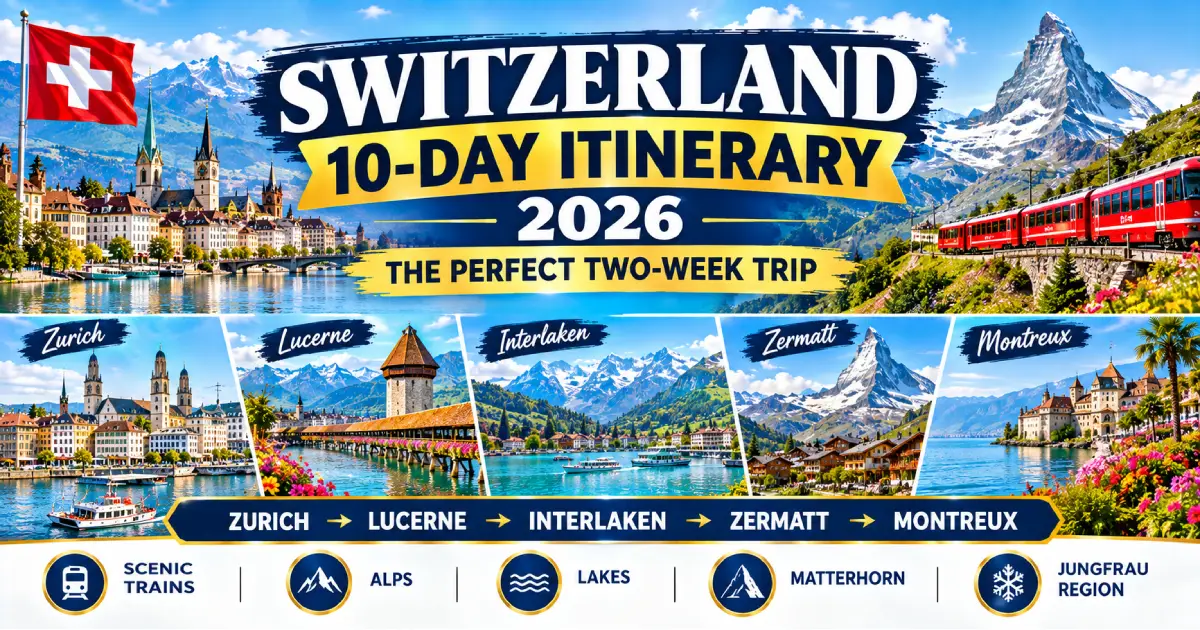
Ten days in Switzerland is the threshold at which the country’s extraordinary geographic and cultural variety becomes fully accessible — the number of days that allows a properly paced circuit covering all four of Switzerland’s major landscape types (the German-Swiss city culture, the Bernese Oberland’s Alpine world, the Valais’s Matterhorn country, and the Ticino’s Mediterranean south) alongside the specific experiences that distinguish the 10-day trip from the 7-day version: the Glacier Express in its full Zermatt-to-St.-Moritz grandeur as a dedicated scenic railway day rather than a rushed transit, the Bernina Express’s Switzerland-to-Italy crossing with time to explore Tirano, and the Ticino’s Lake Lugano and Locarno as genuine overnight destinations rather than afternoon-only stops.
This 10-day Switzerland itinerary has been designed for visitors who want to experience Switzerland in depth rather than in breadth — fewer cities than a 10-day list-ticking approach would attempt, more time in the Alpine and mountain environments that make Switzerland specifically extraordinary, and the specific patience in each location (two nights in Zermatt, two nights in the Bernese Oberland, two nights in the Ticino) that allows the mountain weather flexibility and the relaxed exploratory pace that rushed single-night stops eliminate. The circuit flows geographically (Zurich → Rhine Falls → Lucerne → Bernese Oberland/Interlaken → Zermatt → Glacier Express → St. Moritz → Bernina Express → Lugano → Geneva → home) without retracing, uses the Swiss Travel Pass comprehensively, and provides specific guidance on the weather-dependent mountain days that separate a truly memorable Switzerland visit from an expensive cloudy-summit disappointment.
For specific destination planning, see our complete guides for Zurich, Lucerne, Interlaken, Jungfrau Region, Zermatt, Glacier Express, Bernina Express, and Switzerland Travel Guide 2026.
| Day | Base | Primary Experience | Travel | Cost Beyond STP |
|---|---|---|---|---|
| Day 1 | Zurich | Arrival, Altstadt, lake promenade | — | CHF 0 |
| Day 2 | Zurich | Rhine Falls day trip + Stein am Rhein | SBB day trip (STP) | CHF 5 (Schloss Laufen) + CHF 14 (boat) |
| Day 3 | Lucerne | Chapel Bridge, lake, Rigi | Zurich → Lucerne (50 min, STP) | CHF 15 (Rigi 50%) |
| Day 4 | Interlaken | Brünig scenic transfer, Harder Kulm | Lucerne → Interlaken (2 hrs, STP) | CHF 0 |
| Day 5 | Interlaken | Jungfraujoch (weather day 1) | Local BOB trains (STP) | CHF 47–98 |
| Day 6 | Interlaken | Lauterbrunnen + Mürren OR Jungfraujoch (weather day 2) | Local (STP) | CHF 0–98 |
| Day 7 | Zermatt | Transfer, Matterhorn alpenglow | Interlaken → Zermatt (2.5 hrs, STP) | CHF 0 |
| Day 8 | Zermatt | Five Lakes Walk + Glacier Paradise | Local cable cars (50% STP) | CHF 44–53 |
| Day 9 | St. Moritz | Glacier Express (full day scenic journey) | Zermatt → St. Moritz (7h45, STP + CHF 13–49) | CHF 13–49 (reservation) |
| Day 10 | Lugano/Geneva | Bernina Express + Lake Lugano + transfer | St. Moritz → Tirano → Lugano → Geneva | CHF 14 (BEX reservation) |
Swiss Travel Pass (10-day consecutive, 2nd class): Approximately CHF 500 (confirm at sbb.ch for current 2026 pricing) Total additional mountain/activity costs: Approximately CHF 138–279 depending on choices
The 10-day Swiss Travel Pass (approximately CHF 500 at 2026 pricing, 2nd class) covers this itinerary’s transport more comprehensively than any other Switzerland travel format — the Glacier Express rail fare, the Bernina Express Swiss section, the MGB Visp–Zermatt, the entire Jungfrau BOB network, the Lake Lucerne steamers, the Brünig scenic route, and all SBB intercity segments are fully included. The remaining costs (mountain railway 50% discounts, scenic railway reservations) add approximately CHF 150–280 over 10 days.
The critical booking action: The Glacier Express mandatory seat reservation (CHF 13 for 2nd class) and the Bernina Express seat reservation (CHF 14) should be booked simultaneously with the Swiss Travel Pass purchase — both are mandatory regardless of pass coverage and sell out in peak season (July–August) 4–6 weeks ahead.
Base: Zurich | Type: Arrival and orientation | Overnight: Zurich (2 nights)
Most international visitors arrive at Zurich Airport (ZRH) — the 10-minute SBB connection to Zurich HB (S-Bahn, CHF 6.90 if not yet activating the Swiss Travel Pass, or covered if activating the pass on arrival day) makes afternoon Old Town exploration possible even with midday arrivals.
Afternoon orientation (arrive, check in, then walk):
The most efficient Zurich first-afternoon circuit: Zurich HB → Bahnhofstrasse (the luxury shopping street running south from the station — worth walking as an architectural and retail promenade rather than a shopping destination) → Bürkliplatz (the lake embarkation point, Lake Zurich visible southward, the Alps on clear days visible above the southern shoreline) → Lindenhügel (the hill west of the Fraumünster, with the best elevated view of the Limmat River junction with Lake Zurich) → Fraumünster (Marc Chagall’s five stained-glass windows, 1970 — 30 minutes specifically for the window viewing in afternoon light when the west-facing windows are backlit) → Grossmünster (the twin-towered cathedral visible across the Limmatquai from the Fraumünster — the tower climb [CHF 5] provides the best elevated view of the Old Town) → Niederdorf (the east-bank Old Town, the most concentrated Zurich café and restaurant quarter for dinner).
Evening: Dinner in the Niederdorf or the Langstrasse quarter (Langstrasse — 10 minutes west of the HB — is Zurich’s most specifically contemporary-local food and nightlife street, the restaurant range from Vietnamese to Italian to Turkish providing the non-Swiss evening alternative that the first-night tiredness often makes more appealing than a formal Swiss restaurant).
Base: Zurich (night 2) | Type: Day trip north of Zurich | Travel: SBB to Schaffhausen + bus to Rhine Falls (STP covered)
The Rhine Falls day trip (Europe’s largest waterfall — see our Rhine Falls Guide 2026 for complete detail) adds the dimension that the 7-day itinerary omits: the geological spectacle of the Rhine’s 150-meter-wide, 23-meter drop, the rock-landing boat excursion (the most immediately powerful natural-force experience in northern Switzerland), and the companion visits to Schaffhausen’s Old Town and Stein am Rhein.
Morning — Rhine Falls:
8:30 AM — SBB from Zurich HB toward Schaffhausen (45 min, STP covered — S-Bahn line 9 or direct IR). From Schaffhausen, bus to Rhine Falls south bank (10 min) — alight at “Schloss Laufen” for the south bank or “Rheinfall” for the north bank.
9:30 AM–12:00 PM — Rhine Falls experience:
Afternoon — Stein am Rhein:
1:00 PM — SBB from Schaffhausen to Stein am Rhein (30 min, STP covered).
1:30–4:00 PM — Stein am Rhein: the Rathausplatz (the most comprehensively preserved medieval painted building-facade ensemble in Switzerland — the entire east and south sides of the market square lined with 15th and 16th century buildings whose facade paintings cover the complete external surfaces in figurative, heraldic, and decorative programs ranging from the Romanesque to Renaissance), the Kloster St. Georgen (the former Benedictine monastery, now a museum — the specific medieval carved and painted wooden paneling of the refectory and the knight’s hall is among the finest surviving Romanesque interior decorative woodwork in the German-speaking Swiss region), and the Rhine bank (the Rhine visible from the town’s waterfront in its specific Hochrhein character — the wide Alpine Rhine flowing at the base of the town’s medieval walls).
4:30 PM — SBB from Stein am Rhein to Zurich (approximately 1.5 hours via Schaffhausen or direct, STP covered).
Evening: Second Zurich evening — now that the orientation is complete, the Zurich neighborhoods more specifically: the Zürich West district (the converted industrial area west of the Hauptbahnhof — the Viadukt’s arched restaurant and bar strip, the Freitag Tower [the recycled-bag fashion brand’s specific tower store, visible from the street and worth 10 minutes of investigation], and the neighborhood’s specific energy as Zurich’s most explicitly contemporary cultural district) for dinner and the evening.
Base: Lucerne | Travel: Zurich → Lucerne (50 min SBB, STP) | Mountain cost: CHF 15 (Rigi rack railway 50% discount)
8:30 AM — SBB from Zurich HB to Lucerne (50 min, STP — InterCity departing approximately every 30 minutes). The Lucerne arrival (the station’s direct lake-front position, the Chapel Bridge visible from the station exit before any navigation is required) provides Switzerland’s finest single train-arrival landscape impact.
9:30–11:30 AM — Lucerne Old Town:
11:30 AM — Quick lunch before the afternoon mountain excursion.
12:30 PM — SGV lake steamer from Lucerne central pier to Vitznau (approximately 1 hour, STP covered — the lake steamer providing the approach to the Rigi’s base from the water, Mount Pilatus visible across the lake, and the specific Lake Lucerne geography [the four-armed shape carved by Alpine glaciation into one of Switzerland’s most intricately beautiful lake forms] visible in the steamer’s course). Check current SGV timetable at lakelucerne.ch — lake steamers run approximately hourly in peak season.
1:45 PM — Vitznau: Rigi Vitznau–Rigi Kulm rack railway (Europe’s first mountain railway, 1871 — the specific historical significance [every Alpine rack railway subsequently built is a descendant of the engineering principles demonstrated here first] combined with the specific Rigi panorama [the 360-degree view encompassing Lake Lucerne, Lake Zug, Lake Lauerz, the Bernese Alps, and on clear days Mount Säntis to the northeast]. 50% STP discount — approximately CHF 15 saving on the rack railway.
2:30–4:30 PM — Rigi Kulm (1,797 meters): the summit panorama, the specific Lake Lucerne view (the lake visible in its four-arm complexity from this elevated position, the arms extending in four directions below the summit), and the Rigi plateau hiking trails (the summit area’s flat terrain allows 1–2 hours of walking without technical difficulty, the views maintained throughout).
4:30 PM — Descent: Rigi Goldau rack railway (the alternative line descending the Rigi’s south face to Goldau — providing a different visual on the descent from the ascent’s Vitznau side, the Zuger See [Lake Zug] and the central Swiss plateau visible on the south-facing descent) or return by the same Vitznau line. At Goldau, SBB to Lucerne (approximately 20 min, STP covered) or directly to Lucerne via the Rigi Kaltbad–Weggis gondola (another descent option, providing a third visual approach to the lake).
Evening: Dinner in Lucerne — the Schiffrestaurant Wilhelm Tell (the restaurant boat moored on the Reuss directly below the Chapel Bridge, serving Swiss cuisine with the bridge visible from the terrace) provides the most specifically Lucerne-atmospheric single dining position. Overnight in Lucerne.
Base: Interlaken | Travel: Lucerne → Interlaken Ost (Brünig scenic route, 2 hrs, STP) | Evening activity: Lake Brienz steamer or Harder Kulm
9:00 AM — SBB BLS from Lucerne to Interlaken Ost (the Brünig route — see the 7-Day Itinerary’s Day 3 for the key Brünig moments to watch). Sit at a window and watch.
11:00 AM — Arrive Interlaken Ost. Hotel check-in or luggage storage.
11:30 AM — The Höheweg walk (the Interlaken promenade — the Eiger-Mönch-Jungfrau visible across the Höhematte meadow, the specific mountain-valley geography establishing the Bernese Oberland context for the following two days’ mountain excursions).
1:00 PM — Lunch in Interlaken.
2:30 PM — BLS Lake Brienz steamer (from Interlaken Ost pier, fully STP covered) east toward Giessbach Falls (the multi-stage waterfall on the lake’s southern shore, accessible from the steamer stop via the 1879 funicular — CHF 5 — with the Grand Hotel Giessbach at the falls’ midpoint providing one of the Bernese Oberland’s most atmospheric afternoon terrace settings). Return steamer to Interlaken by 5:30 PM.
OR (if arriving earlier):
2:30 PM — Harder Kulm funicular (fully STP covered, departs near Interlaken Ost) for the Two-Lakes panorama — Lake Thun and Lake Brienz simultaneously visible from 1,322 meters, with the Two Lakes Bridge’s glass floor providing the most immediately dramatic elevated experience available from Interlaken without mountain railway cost.
Evening: Dinner at Hüsi Bierhaus in the Unterseen medieval village (Berner Platte, fondue in season, the most specifically traditional Bernese Oberland restaurant atmosphere in the Interlaken area). Overnight in Interlaken.
Base: Interlaken | Mountain cost: CHF 47–98 (50% STP on Jungfrau Railway) | Weather dependency: CRITICAL
7:00 AM — Check the Jungfraujoch summit webcam (jungfrau.ch/en-gb/planning/webcams). If clear: proceed. If cloudy: implement Day 5 alternative (see below) and attempt Jungfraujoch on Day 6.
If Clear — The Jungfraujoch:
7:30 AM — BOB from Interlaken Ost toward Grindelwald (35 min, STP) → Eiger Express gondola (50% STP) → Eigergletscher → Jungfrau Railway (50% STP) → Jungfraujoch.
OR for the Good Morning Ticket timing: BOB toward Lauterbrunnen (22 min) → Wengen (14 min) → Wengernalpbahn to Kleine Scheidegg (38 min) → Jungfrau Railway first departure to Jungfraujoch.
9:00–11:30 AM — Summit: Sphinx Observatory terrace (3,571 meters — the Aletsch Glacier in its 23-km extent, the 4,000-meter peaks surrounding), Ice Palace, glacier walk on marked path (15 minutes on actual glacier ice, the blue-white ice visible at close range), Crystal Restaurant.
11:30 AM — Descent via the alternate route (if ascending via Lauterbrunnen, descend via Grindelwald and Eiger Express — or vice versa). The descent via the Wengernalpbahn (from Kleine Scheidegg toward Wengen and Lauterbrunnen) provides the most scenic descent option, the valley visible 900 meters below throughout.
2:00 PM — Kleine Scheidegg pause (mandatory 20-minute stop — the Eiger north face at 200 meters horizontal distance, the station terrace for Rösti or fondue, the specific mountain atmosphere of the Jungfrau Region’s central junction point).
3:30 PM — Return to Interlaken by BOB.
If Cloudy on Day 5 — Alternative:
Day 5 alternative (cloudy Jungfraujoch): BOB to Lauterbrunnen → Trümmelbach Falls (CHF 13) → valley floor walk → cable car to Grütschalp → rack railway to Mürren (all STP covered) → Schilthornbahn to Schilthorn summit (50% STP discount, CHF 25–32) for the Piz Gloria revolving restaurant, James Bond location, and Bernese Oberland panorama at 2,970 meters. The Schilthorn frequently has different weather from the Jungfraujoch (the western exposure vs. the Jungfraujoch’s southern position means clearing patterns can differ significantly). Return to Interlaken by late afternoon.
Base: Interlaken | Mountain cost: CHF 0–98 depending on activity choice
Option A — Jungfraujoch (if cloud prevented it on Day 5): Repeat the Day 5 summit attempt with the benefit of a second weather window. The 10-day itinerary’s two Interlaken days specifically provide this weather flexibility that the 7-day version’s single day doesn’t allow.
Option B — Männlichen Ridge Walk + Grindelwald First (Clear Day):
9:00 AM — BOB from Interlaken Ost to Grindelwald Grund (35 min) → Gondelbahn Grindelwald-Männlichen (50% STP, approximately CHF 17.50) to Männlichen (2,230 meters).
10:00 AM — Männlichen summit (15 min ascent from the gondola station) → Ridge Walk to Kleine Scheidegg (6 km, 1.5–2 hours, the finest panoramic ridge walk in the Bernese Oberland — the Eiger-Mönch-Jungfrau visible throughout, the Grindelwald Valley right and the Lauterbrunnen Valley left, the sustained mountain panorama at the most accessible moderate-difficulty trail in the region).
12:30 PM — Kleine Scheidegg (lunch + Eiger north face) → Wengernalpbahn to Wengen or Grindelwald (STP covered).
2:30 PM — First Cliff Walk (if enough energy — First gondola from Grindelwald, 50% STP, approximately CHF 21; the glass-floor walkway on the cliff face, the Bachalpsee reflection lake 45 min above First by trail).
Option C — Schynige Platte Alpine Garden (Free with STP):
The most underrated free experience in the Bernese Oberland: the Schynige Platte Bahn from Wilderswil (one BOB stop from Interlaken Ost, STP fully covered) ascending to 1,967 meters, the Alpine Botanical Garden (600+ mountain plant species, June–October flowering), and the finest simultaneously-two-lakes panorama (both Lake Thun and Lake Brienz visible below, the Jungfrau massif directly across). Fully free with Swiss Travel Pass — the best single value day in the entire Bernese Oberland itinerary.
Evening (both nights Interlaken): Second Interlaken evening — the lakeside restaurants near the BLS Interlaken West pier or the Victoria-Jungfrau Grand Hotel’s Rotisserie (the Berner Rösti in the grand hotel’s brasserie format, a specifically Interlaken-atmosphere dinner at a price between the tourist restaurants and the La Terrasse fine dining).
Base: Zermatt (2 nights) | Travel: Interlaken Ost → Bern → Visp → Zermatt (3.5 hours, STP covered) | Cost beyond STP: CHF 0
9:00 AM — RegioExpress from Interlaken Ost toward Bern (57 min, STP) — the specific route passing through Spiez (Lake Thun’s most dramatic castle promontory visible from the train window), the Lötschberg tunnel approach, and Bern.
10:00 AM — Optional Bern pause (30–45 min): the Zytglogge clock tower (the automated mechanism performs 4 minutes before each hour — time the Bern stop for 10 minutes before the hour), the Bundeshausplatz, and the specific Federal Palace facade visible from the square. This is the 10-day itinerary’s only Bern encounter — worth a short stop rather than a transit.
11:30 AM — Bern → Visp (InterCity, 1 hour, STP) — the Valais begins at Visp, the Rhine Valley’s specifically Valais character (the vineyard terraces on the south-facing canyon walls above the Rhône, the increasing mountain scale as the valley narrows toward Visp) visible throughout.
12:30 PM — Visp: change to MGB (Matterhorn Gotthard Bahn) narrow-gauge for Zermatt.
1:50 PM — Arrive Zermatt. The Matterhorn’s first appearance from the station forecourt — the pyramid summit visible through the valley frame as the street opens toward the south — is the specific Zermatt arrival moment that makes every Zermatt first-timer stop and stare.
Zermatt first afternoon ritual:
Set the alarm: The Matterhorn alpenglow (the pre-sunrise coloring of the summit snow, beginning approximately 30 minutes before sunrise and deepening to the specific red-orange that makes Zermatt’s dawn its most extraordinary single daily event) requires early positioning — 5:15–5:30 AM in summer, later in spring/autumn.
Evening: Dinner at Walliserkanne (Zermatt’s most traditional Valais restaurant — the Raclette du Valais AOP service, the half-wheel of mountain cheese held before the infrared lamp and scraped onto the plate with boiled potatoes and cornichons) or the Brown Cow pub (the Zermatt institution — the après-ski and evening gathering space that has served the Zermatt climbing and skiing community since the 1960s).
Base: Zermatt | Mountain cost: CHF 44–53 (Sunnegga funicular + Glacier Paradise cable cars, 50% STP)
7:30 AM — Sunnegga funicular from the underground station (3 minutes from the Bahnhofstrasse, 50% STP discount — approximately CHF 9 saving) to 2,288 meters. The first morning cable car provides the lake walk in its most optimal conditions: the Stellisee’s Matterhorn reflection available before the wind that afternoon thermals generate, the clarity of the morning before haze builds, and the minimum visitor density of any point in the day.
8:00 AM–12:30 PM — Five Lakes Walk (9.6 km, 4–5 hours, moderate difficulty): the counterclockwise circuit (Leisee → Grindjisee → Grünsee → Moosjisee → Stellisee) connecting the five high-altitude lakes each reflecting the Matterhorn at a different angle and in a different foreground environment. The Stellisee (the fourth and finest lake — the Matterhorn reflected directly in the surface on calm mornings, the surrounding high-Alpine wildflower meadows in June-July providing the most botanical completeness of any Five Lakes stop) is the walk’s emotional and photographic peak.
12:30 PM — Return to Zermatt by cable car or by hiking the descent trail (approximately 1.5 hours additional walking — the descent trail providing the Findeln hamlet’s characteristic Valais wooden chalets and the Chez Vrony restaurant [the most celebrated mountain restaurant above Zermatt — booking essential in summer] for a post-walk lunch).
2:30 PM — Matterhorn Glacier Paradise cable car sequence (from Zermatt: Cable Car to Furi → Trockener Steg → Klein Matterhorn/Glacier Paradise, 3,883 meters — Europe’s highest cable car station; 50% STP discount, approximately CHF 35 saving on the cable car sequence). The summit view (38 peaks above 4,000 meters simultaneously visible — the Monte Rosa, the Dom, the Weisshorn, the Dent Blanche, and the full Valais Alpine assembly) is the most comprehensive single Alpine summit panorama accessible by cable car in Europe.
The summer ski possibility: The Glacier Paradise maintains year-round skiing on the Klein Matterhorn glacier — in summer, the runs above 3,500 meters (accessed by the cable car) provide the highest skiing available in Switzerland, with specific summer skiing passes available at the summit station for those specifically seeking the experience.
4:30 PM — Cable car descent.
Evening: Celebration dinner (the two Zermatt nights allow the finest dining choice the visit includes — booking 2–4 weeks ahead for Chez Vrony, Zum See, or the Riffelhaus 1853 at Riffelberg [2,582 meters, accessible by Gornergrat railway, with the Matterhorn directly visible from the restaurant terrace in the specific elevated position that no village-level Zermatt restaurant achieves]).
Base: St. Moritz | Travel: Glacier Express Zermatt → St. Moritz (7 hours 45 min, STP covered + CHF 13–49 mandatory reservation) | See: Glacier Express Complete Guide 2026
8:52 AM (or 9:52 AM — check current 2026 timetable at glacierexpress.ch) — The Glacier Express departs Zermatt station. The first 5–10 minutes provide the Matterhorn’s retreating northeastern profile visible through the right-side window as the train moves northward through the Mattertal — one final Matterhorn view before the valley curves and the mountain disappears.
Key Glacier Express moments to watch (see our complete Glacier Express guide for full seat-selection strategy):
Restaurant car: The fixed lunch menu (approximately CHF 45–65, served between 12 PM and 2 PM — reservation recommended at glacierexpress.ch when booking the seat reservation) allows experiencing the Glacier Express’s most specifically luxury dimension while the Rhine Gorge and Albula sections are visible through the panoramic windows.
5:00 PM (approximately) — Arrive St. Moritz. Hotel check-in. The specific St. Moritz evening first ritual: the Corvatsch gondola base area walk, the Via Serlas (the luxury shopping street, the Bulgari and Chanel windows in an Alpine village confirming the resort’s specific identity), and the St. Moritz Lake promenade at sunset (the Engadin lake chain’s golden-hour surface and the Bernina peaks above in alpenglow creating the most dramatically beautiful single evening view in Graubünden).
Overnight: St. Moritz (one night — the most expensive single overnight in this itinerary, but the specific St. Moritz accommodation experience [even in mid-range properties, the Engadin lake view and the resort’s specific energy] justifies the single night rather than substituting a cheaper nearby alternative).
Base: Geneva (arrival) | Travel: St. Moritz → Tirano (Italy) by Bernina Express (2h25, STP + CHF 14) → Tirano → Lugano (by regional train or bus, Italian rail) → Lugano → Geneva (SBB, 3 hours) | See: Bernina Express Complete Guide 2026
8:55 AM (or 10:09 AM — check current 2026 rhb.ch timetable) — Bernina Express departs St. Moritz (the most glamorous departure point of any Swiss scenic railway — the Palace Hotel visible through the station windows as the train leaves).
Key Bernina Express moments:
11:20 AM (approximately) — Arrive Tirano, Italy. The transition is immediate — palm trees, Italian language, a different pace entirely.
11:30 AM–1:00 PM — Tirano:
Option A — Direct to Geneva via Lugano:
1:15 PM — Trenord regional train from Tirano toward Sondrio → Lecco (approximately 2 hours, Italian rail not STP covered — purchase Trenord ticket at Tirano station, approximately CHF 18/€18) → connection to Lugano via Bellinzona by Swiss train (approximately 1.5 hours) → SBB from Lugano to Geneva (approximately 3 hours, STP covered).
Lugano stop (2 hours if routing allows): The Lungolago promenade, the Piazza della Riforma aperitivo, and the Monte San Salvatore view (if time allows the funicular ascent, 50% STP — CHF 15 saving).
Option B — Bernina Express Bus Tirano → Lugano:
The Bernina Express Bus (the dedicated scenic bus connecting Tirano with Lugano via the Maloja, Splügen, and various mountain passes — approximately 4 hours, STP discount applies, check rhb.ch for current 2026 schedule and pricing) provides a specifically scenic alternative to the Trenord train — the bus crossing three mountain passes through the specifically varied Graubünden and Italian landscape, arriving in Lugano for the evening. From Lugano, SBB to Geneva (3 hours, STP covered) — this option requires either an overnight in Lugano (extending the trip to 11 days) or a late Geneva arrival (8–9 PM, acceptable for a departure-eve evening).
Evening arrival Geneva: Check in, final fondue or raclette dinner in Geneva’s Old Town (Les Armures on the Rue du Puits-Saint-Pierre — the most specifically medieval Geneva restaurant setting, the Valais cheese fondue serving as a specifically appropriate final Switzerland food memory), and the preparation for the following morning’s airport departure.
| Category | Approximate Cost (CHF) |
|---|---|
| Swiss Travel Pass (10-day, 2nd class) | 500 |
| Mountain railways (Jungfraujoch 50%, Pilatus 50%, Glacier Paradise 50%, Rigi 50%, Sunnegga 50%) | 120–180 |
| Glacier Express reservation | 13–49 |
| Bernina Express reservation | 14 |
| Rhine Falls entry + boat | 19 |
| Schaffhausen + Stein am Rhein | 0 |
| Accommodation (10 nights, mid-range, solo) | 1,800–2,800 |
| Accommodation (10 nights, mid-range, per person sharing double) | 1,000–1,600 |
| Meals (10 days, 3 meals/day, mid-range restaurants + occasional supermarket) | 500–700 |
| Museum entries, misc. (Löwendenkmal free; paid museums CHF 10–30 each) | 60–100 |
| Total approximate per person (sharing double room) | CHF 2,226–3,163 |
| Experience | 7-Day Itinerary | 10-Day Itinerary |
|---|---|---|
| Rhine Falls | Not included | Full day trip + Stein am Rhein |
| Rigi | Not included | Afternoon visit |
| Second Jungfraujoch weather window | No (single attempt) | Yes (two days flexibility) |
| Männlichen Ridge Walk | Not included | Day 6 option |
| Glacier Express | Not included | Full Zermatt → St. Moritz |
| St. Moritz | Not included | Overnight |
| Bernina Express | Not included | St. Moritz → Tirano |
| Ticino / Lugano | Not included | En route |
| Pace of mountain days | Rushed (single day) | Relaxed (2 days each location) |
| Weather flexibility | Limited | Significant |
About Travel Tourister Travel Tourister’s destination specialists have traveled every day of this 10-day itinerary across multiple seasons — testing the Rhine Falls rock-landing boat in spring high flow and autumn calm, walking the Männlichen Ridge in September’s finest light, riding the Glacier Express’s full Zermatt-to-St.-Moritz arc in June’s wildflower Goms Valley, photographing the Stellisee reflection before 9 AM in July, and eating pizzoccheri in Tirano after the Bernina Express’s Brusio Circular Viaduct passage — to deliver Switzerland’s most complete and honestly planned 10-day itinerary for 2026 visitors.
Posted By : Vinay
Latest Article
2nd Floor, 39, Above Kirti Club, DLF Industrial Area, Kirti Nagar, New Delhi, Delhi 110015



Travel Tourister is a leading Travel portal where we introduce travellers to trusted travel agents to make their journey hasselfree, memorable And happy. Travel Tourister is a platform where travellers get Tour packages ,Hotel packages deals through trusted travel companies And hoteliers who are working with us across the world. We always try to find new and more travel agents and hoteliers from every nook and corners across the world so that you could compare the deals with different travel agents and hoteliers and book your tour or hotel with the one you have chosen according to your taste and budget.
Copyright © Travel Tourister, India. All Rights Reserved

 Call
Call Enquiry