Published on : 18 Sep 2026
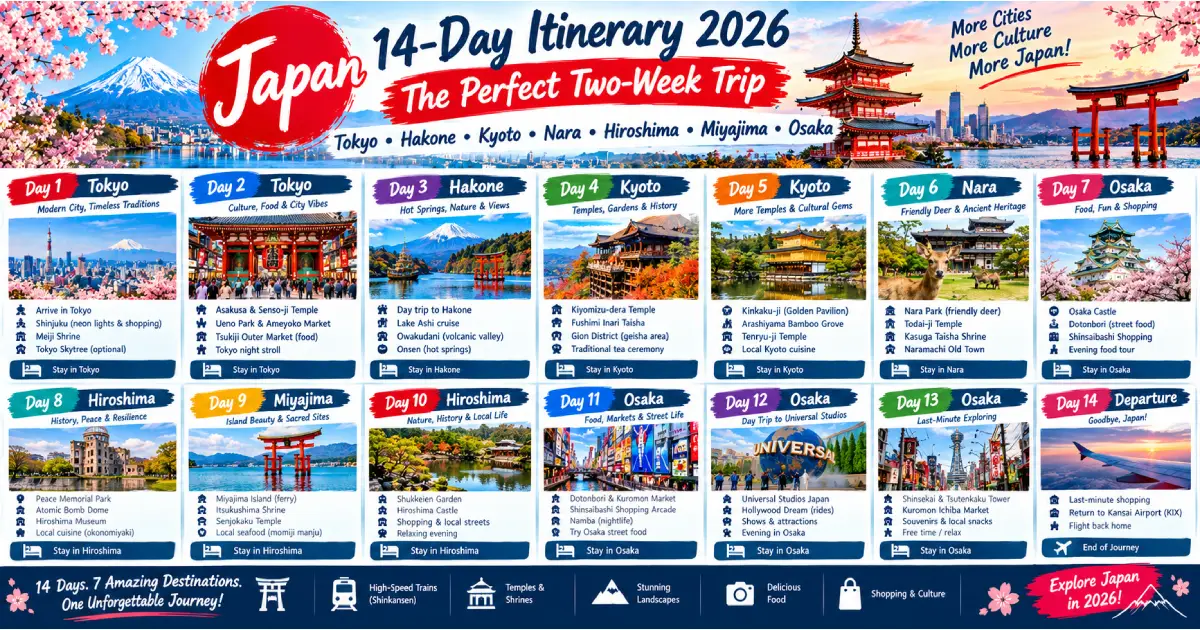
Fourteen days in Japan is the specific threshold where a first-time visitor stops merely sampling the country and starts genuinely experiencing its range — long enough to add the Mount Fuji country around Hakone, the atomic history and inland-sea beauty of Hiroshima and Miyajima, and a full base in Osaka rather than the single rushed day trip that a 7-day itinerary forces, while still moving at a pace that leaves real time in each place rather than the moving-hotel-every-night exhaustion that longer, more ambitious itineraries produce. Where our Japan 7-Day Itinerary compresses Tokyo and Kyoto into the essential first-timer highlights, this 14-day version adds the three destinations most frequently named as regret-inducing omissions by visitors who did the shorter trip first: Hakone’s Mount Fuji views, Hiroshima’s Peace Memorial Park, and Miyajima’s floating torii gate.
This itinerary is built around four specific planning principles: Tokyo gets five full days rather than three, enough to add the Tsukiji/Toyosu fish market and Odaiba’s teamLab digital art museum without cutting Asakusa or Harajuku short; a full-day Hakone excursion is inserted as a genuine overnight or long day trip rather than skipped, since Mount Fuji is visible from nowhere else on this route with comparable reliability; Kyoto retains its three-night base with Nara as a day trip, but Osaka is upgraded from a single day trip to a proper two-night base of its own; and Hiroshima and Miyajima are added as a dedicated two-day extension via Shinkansen, reachable in under 2 hours from Kyoto/Osaka and genuinely essential rather than optional for any visitor with two weeks to spend. The result is a 14-day circuit (Tokyo → Hakone → Kyoto → Nara → Hiroshima → Miyajima → Osaka) that covers Japan’s most important first-and-second-time visitor experiences without ever feeling rushed.
For specific destination planning, see our Japan 7-Day Itinerary 2026, Japan Travel Guide 2026 (publishing soon), and 25 Best Restaurants in Japan 2026.
| Day | Base | Primary Experience | Travel |
|---|---|---|---|
| Day 1 | Tokyo | Arrival, Shinjuku orientation | Narita/Haneda → Tokyo |
| Day 2 | Tokyo | Asakusa, Ueno, Akihabara | Tokyo Metro |
| Day 3 | Tokyo | Shibuya, Harajuku, Meiji Shrine | Tokyo Metro |
| Day 4 | Hakone (day trip or overnight) | Mount Fuji views, Owakudani, Lake Ashi | Tokyo → Hakone (Odakyu Romancecar) |
| Day 5 | Tokyo | Tsukiji/Toyosu Market, teamLab, Odaiba; evening Shinkansen to Kyoto | Hakone → Tokyo → Kyoto (JR Pass) |
| Day 6 | Kyoto | Fushimi Inari, Kiyomizu-dera, Gion | Kyoto City Bus |
| Day 7 | Kyoto | Arashiyama, Kinkaku-ji, Nijo Castle | JR Sagano Line + bus |
| Day 8 | Kyoto/Nara (day trip) | Nara Park deer, Todai-ji, Kasuga Taisha | JR Nara Line (JR Pass) |
| Day 9 | Hiroshima | Peace Memorial Park & Museum, Shukkeien Garden | Kyoto → Hiroshima (Shinkansen, JR Pass) |
| Day 10 | Miyajima (day trip from Hiroshima) | Itsukushima Shrine floating torii, Mt Misen | Ferry (JR Pass covers JR ferry) |
| Day 11 | Osaka | Osaka Castle, Kuromon Ichiba Market | Hiroshima → Osaka (Shinkansen, JR Pass) |
| Day 12 | Osaka | Dotonbori, Shinsekai, Umeda Sky Building | Osaka Metro |
| Day 13 | Osaka/Kobe (day trip) | Kobe beef, Nunobiki Falls, Kitano district; OR Universal Studios Japan | JR Kobe Line (JR Pass) |
| Day 14 | Osaka | Final shopping, departure via Kansai Airport | Osaka → KIX |
14-Day Japan Rail Pass (2026 pricing): Approximately ¥81,000 (confirm current pricing at jrpass.com) Point-to-point equivalent for this exact itinerary: Approximately ¥70,000–¥85,000 (Narita Express + Odakyu Romancecar to Hakone + Tokyo–Kyoto Shinkansen + Kyoto–Nara + Kyoto–Hiroshima Shinkansen + Miyajima ferry + Hiroshima–Osaka Shinkansen + Kobe day trip + Osaka–KIX) Verdict: Roughly break-even to a modest saving for this specific 14-day, three-region itinerary — the Pass wins clearly once Hiroshima is added, since the Kyoto–Hiroshima–Osaka Shinkansen legs alone approach half the Pass’s cost.
Unlike the 7-day itinerary, where the JR Pass calculation is genuinely close, a 14-day itinerary that includes Hiroshima tips the math more clearly in the Pass’s favor: the Kyoto–Hiroshima–Osaka Shinkansen round trip alone runs approximately ¥24,000–¥28,000 point-to-point, and combined with the Tokyo–Kyoto leg and the Hakone Odakyu connection (not JR-operated, so paid separately either way), most 14-day, three-region itineraries clear the Pass’s break-even point.
Practical note on the Hakone day: The Odakyu Romancecar to Hakone is not a JR line and is never covered by the JR Pass regardless of duration — budget this separately (~¥2,470 one-way) whether or not you buy the Pass for the rest of the trip.
Practical note on splitting the Pass: Since the JR Pass is sold in 7, 14, and 21-day consecutive blocks, and this itinerary’s first three Tokyo days (Days 1–3) use no JR trains at all (Tokyo Metro isn’t Pass-covered), some experienced visitors start their 14-day Pass validity on Day 4 (the Hakone/Kyoto transfer begins) rather than Day 1 — check the exact math for your dates, since a Pass that starts too early “wastes” its most expensive days on Tokyo Metro-only travel.
Base: Tokyo | Primary experiences: Hotel check-in, Shinjuku evening walk, Omoide Yokocho
Arrive via Narita (60–90 min to central Tokyo via Narita Express, JR Pass-covered if your Pass validity has started) or Haneda (30–45 min, generally more convenient). Keep the afternoon deliberately light given jet lag from most tier-1 departure points. In the evening, Omoide Yokocho beside Shinjuku Station’s west exit — a narrow, lantern-lit alley of tiny yakitori and ramen stalls — makes an easy, no-reservation first dinner. Accommodation: Shinjuku or Shibuya, for five nights.
Primary experiences: Senso-ji Temple, Ueno Park, Akihabara
Arrive at Senso-ji, Tokyo’s oldest temple, before 9:30 AM via the Kaminarimon gate and Nakamise-dori shopping street to beat the crowds. Walk the quieter backstreets east of the temple, then take the Sumida River waterfront for a Tokyo Skytree view. In the afternoon, Ueno Park (the Tokyo National Museum, Japan’s oldest and largest, is worth 90 minutes) followed by Akihabara — Tokyo’s electronics-and-otaku-culture district, worth experiencing after dark for the neon density alone.
Primary experiences: Meiji Jingu, Takeshita Street, Shibuya Crossing
Meiji Jingu’s forested approach (170 acres, planted by citizen donation after Emperor Meiji’s 1912 death) is a genuinely calming counterpoint to Tokyo’s density, and a useful introduction to Shinto shrine etiquette. Takeshita Street immediately outside Harajuku Station provides the loud contrast — Tokyo’s most concentrated teen fashion and street-food strip. In the afternoon, Shibuya Crossing (up to 3,000 pedestrians per light cycle) viewed both at street level and from above (Shibuya Sky or a café overlooking the intersection).
Primary experiences: Owakudani volcanic valley, Lake Ashi cruise, Mount Fuji views | Travel: Odakyu Romancecar, Shinjuku → Hakone-Yumoto (85 min, not JR Pass-covered)
Hakone, roughly 90 minutes from Shinjuku by direct limited express, is the single best non-Kyoto day addition to a Tokyo-based itinerary, built around the Hakone Round Course: a circuit combining the Hakone Tozan switchback railway, the Hakone Ropeway cable car over the active volcanic valley of Owakudani (sulfur vents, black eggs boiled in the volcanic hot springs and sold as a local specialty said to add years to your life), and a pirate-ship-styled sightseeing cruise across Lake Ashi, with Mount Fuji visible across the water on clear days — check the forecast the evening before, since Fuji’s visibility rate from Hakone runs roughly 40–50% depending on season, best in winter’s clear, dry air. Option: stay overnight at a Hakone ryokan with an onsen hot spring bath (a genuinely worthwhile splurge, ¥20,000–¥40,000/night, and this itinerary’s best single onsen opportunity) rather than a same-day return, using the extra morning for the Hakone Open-Air Museum (sculpture park with a dedicated Picasso pavilion) before returning to Tokyo.
Primary experiences: Toyosu Market, teamLab digital art, Odaiba | Travel: Tokyo → Kyoto Shinkansen (2h15m, JR Pass-covered on Hikari/Kodama)
Morning at Toyosu Market (Tsukiji’s relocated wholesale fish market successor — the famous pre-dawn tuna auction requires advance lottery registration, but the market’s sushi restaurants and observation deck over the auction floor are open to walk-in visitors from opening). Cross to Odaiba, Tokyo Bay’s reclaimed-island entertainment district, for teamLab Planets or teamLab Borderless (Tokyo’s immersive digital art museums, among the most Instagrammed single attractions in the city and worth pre-booking timed tickets well in advance). Return to central Tokyo by late afternoon, collect luggage, and board the Tokaido Shinkansen for Kyoto (2h15m on Hikari; sit right-side-facing-forward for a Mount Fuji view roughly 45 minutes in on clear days). Arrive Kyoto by early evening.
Primary experiences: Fushimi Inari’s thousand torii gates, Kiyomizu-dera, Gion
Arrive at Fushimi Inari by 7:30–8 AM — the single most important timing decision of the trip’s Kyoto section, since the lower gates become nearly impassable for photography by mid-morning. The first 30–40 minutes of the trail, up to the Yotsutsuji viewpoint, captures the experience for most time budgets. In the afternoon, Kiyomizu-dera’s wooden stage (built without a single nail) and the connecting Sannenzaka/Ninenzaka preserved lanes toward Gion, then Gion itself in the early evening for Hanami-koji street and Yasaka Shrine.
Primary experiences: Bamboo Grove, Golden Pavilion, Nijo Castle
Arashiyama Bamboo Grove before 9 AM (JR Sagano Line, 15 min from Kyoto Station) for the calmest light and thinnest crowds, followed by Tenryu-ji’s UNESCO-listed garden next door. In the afternoon, Kinkaku-ji, the gold leaf-covered Golden Pavilion reflected in its pond — Japan’s single most photographed building. With the extra day this 14-day itinerary allows versus the 7-day version, add Nijo Castle in the late afternoon: a UNESCO World Heritage former shogun residence famous for its “nightingale floors,” designed to squeak audibly under footsteps as a defense against silent intruders.
Primary experiences: Nara Park’s free-roaming deer, Todai-ji’s Great Buddha, Kasuga Taisha | Travel: JR Nara Line (JR Pass-covered, 45 min)
Nara Park is home to over 1,000 sika deer, considered divine messengers in Shinto belief, that bow for “shika senbei” crackers (¥200/pack). Todai-ji Temple houses a 15-meter bronze Great Buddha inside what remains the largest wooden building on Earth despite reconstruction at two-thirds its original scale. Kasuga Taisha’s forested approach, lined with thousands of stone and bronze lanterns, rounds out the afternoon before the return to Kyoto by early evening.
Base: Hiroshima (overnight) | Primary experiences: Peace Memorial Park & Museum, Atomic Bomb Dome, Shukkeien Garden | Travel: Kyoto → Hiroshima Shinkansen (JR Pass-covered, 1h40m)
Hiroshima is the itinerary’s most emotionally significant single day. The Atomic Bomb Dome (Genbaku Dome), the skeletal ruin of the former Industrial Promotion Hall left deliberately unrepaired as the closest surviving structure to the August 6, 1945 hypocenter, anchors the Peace Memorial Park across the river — the Children’s Peace Monument (covered in thousands of visitor-folded paper cranes, inspired by Sadako Sasaki’s story), the Cenotaph, and the Peace Memorial Museum itself, whose exhibits (personal effects, photographs, and firsthand accounts) are handled with a directness that most tier-1 visitors find more affecting than they anticipated — budget a minimum of 90 minutes, and expect the visit to be genuinely heavy rather than a routine sightseeing stop. In the afternoon, Shukkeien Garden (a traditional landscape garden dating to 1620, rebuilt after 1945) offers a deliberately calmer, restorative contrast. Accommodation: Hiroshima city center, for one night, positioned for the Day 10 Miyajima ferry.
Base: Hiroshima → onward to Osaka in the evening | Primary experiences: Itsukushima Shrine’s floating torii gate, Mount Misen | Travel: JR ferry from Miyajimaguchi (JR Pass-covered), then Hiroshima → Osaka Shinkansen in the evening
Miyajima Island, a 10-minute JR-covered ferry from Miyajimaguchi station, is built around Itsukushima Shrine’s vermilion torii gate, which appears to float on the water at high tide — check the tide chart in advance (available at the ferry terminal or online), since low tide instead allows walking directly out to the gate’s base, a genuinely different and equally worthwhile experience rather than a lesser one. Beyond the shrine, the island’s free-roaming (and notably bolder than Nara’s) sika deer, the Omotesando shopping street’s grilled oysters and maple-leaf-shaped momiji manju pastries, and — for those with time — the Mount Misen ropeway (two-stage cable car to a summit shrine with views across the Seto Inland Sea) round out the day. Return to Hiroshima by mid-afternoon, collect luggage, and take the Shinkansen onward to Osaka (approximately 1h20m, JR Pass-covered) to begin the itinerary’s final section.
Base: Osaka (three nights) | Primary experiences: Osaka Castle, Kuromon Ichiba Market
Osaka Castle’s surrounding park (the current 1931 concrete reconstruction sits atop the site of the original 16th-century castle) is especially striking under cherry blossoms in late March/early April but worthwhile year-round for the museum and park alone. In the afternoon, Kuromon Ichiba Market (“Osaka’s Kitchen”) for grazing — grilled scallops, wagyu skewers, fresh oysters, and uni sampled stall-by-stall standing at the counters.
Primary experiences: Dotonbori canal, Shinsekai’s retro-futurist district, Umeda Sky Building
Dotonbori’s Glico Running Man sign and dense neon signage anchor Osaka’s most famous entertainment district — try two or three different takoyaki stalls for comparison, a standard Dotonbori activity. Shinsekai, an early-20th-century district built to evoke Paris and Coney Island simultaneously, centers on the Tsutenkaku Tower and is Osaka’s home of kushikatsu (skewered, breaded, deep-fried food) — the specific local rule (no double-dipping skewers in the shared sauce) is worth knowing before the first bite. In the evening, the Umeda Sky Building’s Floating Garden Observatory (a connected rooftop platform between two towers, 173 meters up) provides Osaka’s best night skyline view.
Primary experiences: Kobe beef, Nunobiki Falls, Kitano foreign settlement district | Travel: JR Kobe Line (JR Pass-covered, 20–30 min)
Kobe, a short JR ride from Osaka, is the correct destination for tier-1 visitors specifically curious about genuine Kobe beef in its city of origin (a proper teppanyaki Kobe beef lunch runs ¥8,000–¥20,000+ depending on cut and restaurant — book ahead for well-known counters). The Kitano district’s late-19th-century Western-style merchant houses (a legacy of Kobe’s early status as a treaty port) provide a specifically different architectural texture from anywhere else on this itinerary, and the Shin-Kobe Ropeway up to Nunobiki Falls and the Nunobiki Herb Garden offers an easy half-day nature escape within the city limits. Family/theme-park alternative: Universal Studios Japan, Osaka’s major theme park (home to the Super Nintendo World expansion, a significant draw for visitors traveling with children or Nintendo enthusiasts of any age) makes a full and worthwhile substitute for this day — pre-book Express Pass tickets during peak seasons given routinely long queue times.
Primary experiences: Final souvenir shopping | Travel: Osaka → Kansai Airport (JR Pass-covered)
A final morning in Namba or Umeda’s department store basements (depachika) for last-minute food gifts, or the Shinsaibashi covered shopping arcade for general souvenirs, before heading to Kansai International Airport (KIX) — the JR Kansai Airport Line runs directly from Osaka Station, with a Haruka Express option from Kyoto/Shin-Osaka if a final Kyoto stop is preferred instead. Budget at least 3 hours before an international check-in.
| City | Nights | Budget Double (¥/night) | Mid-Range (¥/night) | Luxury (¥/night) |
|---|---|---|---|---|
| Tokyo | 5 | 8,000–14,000 | 15,000–28,000 | 30,000–60,000+ |
| Hakone (optional overnight) | 0–1 | 15,000–25,000 (ryokan w/ onsen) | 25,000–40,000 | 45,000+ |
| Kyoto | 3 | 7,000–13,000 | 14,000–25,000 | 28,000–55,000+ |
| Hiroshima | 1 | 7,000–12,000 | 12,000–20,000 | 22,000+ |
| Osaka | 3 | 7,000–13,000 | 13,000–24,000 | 26,000–50,000+ |
Booking timing for peak season (cherry blossom late March–early April; autumn foliage mid-November): Book Kyoto first (the tightest single constraint on this route), 4–6 months ahead; Hiroshima and Osaka accommodation is comparatively easier to secure even 2–3 months out.
Both sell out or hit capacity limits during peak seasons — book teamLab timed-entry tickets for Day 5 and any Universal Studios Japan Express Pass for Day 13 at least 4–6 weeks ahead, longer for cherry blossom or Golden Week (late April–early May) travel.
Among visitors who’ve done a shorter Japan trip first, Hiroshima and Miyajima are consistently the most-cited “wish we’d added that” destinations — the Peace Memorial Park’s significance and Miyajima’s torii gate are genuinely different in character from anything in Tokyo or Kyoto, which is the specific reason this 14-day itinerary prioritizes them over a longer Tokyo or Kyoto stay.
A Suica or Pasmo IC card covers Tokyo Metro, Osaka Metro, buses, and konbini purchases throughout the trip. A rented pocket WiFi device (collected at the airport, ¥500–¥1,000/day) or a Japan-specific eSIM keeps Google Maps and translation apps running continuously — genuinely more valuable over 14 days across five regions than a 7-day trip confined to two cities.
Japan’s Takkyubin luggage forwarding service (¥2,000–¥3,000 per large bag, next-day delivery) is worth using at least twice on this route — Tokyo to Kyoto, and Kyoto/Hiroshima to Osaka — to travel the Shinkansen legs with only a day bag, particularly valuable given the additional Hakone and Hiroshima/Miyajima segments this itinerary adds versus the 7-day version.
Two weeks of continuous sightseeing across five regions is meaningfully more tiring than most first-time visitors expect. Consider treating Day 13 (Kobe/Universal Studios) as optional and using a spare half-day around Day 8 or Day 11 for laundry, rest, or simply revisiting a favorite spot rather than adding a new one.
Visitors who prefer to prioritize depth in Tokyo, Kyoto, and Osaka over breadth can compress Hiroshima and Miyajima into a single very long day trip from Kyoto or Osaka (roughly 12 hours door-to-door, feasible but rushed) rather than an overnight stay, freeing a full extra day for Tokyo or Kyoto instead.
Inserting a 2-day Kamikochi or Takayama extension (accessible via Nagoya, roughly between the Tokyo and Kyoto sections) adds pristine Japan Alps scenery and the beautifully preserved Edo-period streets of Takayama’s old town — the best single addition for visitors whose primary interest is nature and traditional rural Japan over cities and temples, extending this to a 16-day itinerary.
Families should treat Day 13’s Universal Studios Japan as mandatory rather than optional, and consider trimming one Kyoto temple day (Day 7’s Nijo Castle addition is the easiest to cut) in favor of a second, unhurried Universal Studios day or a Tokyo Disneyland/DisneySea day inserted after Day 3.
The single largest cost variable in this itinerary is the optional Hakone ryokan overnight (¥20,000–¥40,000+ for one night) — a same-day Hakone round trip from Tokyo, returning to the same Shinjuku/Shibuya hotel, removes this cost entirely while still covering the Owakudani and Lake Ashi highlights.
About Travel Tourister Travel Tourister’s destination specialists have run this exact 14-day circuit across multiple seasons — from Hakone’s Owakudani sulfur-vent black eggs and Kyoto’s pre-dawn Fushimi Inari torii gates through the Peace Memorial Park’s quiet weight in Hiroshima and Miyajima’s tide-dependent floating torii, to Dotonbori’s neon-lit takoyaki crawls and Kobe’s teppanyaki counters — to deliver the most complete and honestly paced two-week Japan itinerary for 2026 visitors.
Posted By : Vinay
Latest Article
2nd Floor, 39, Above Kirti Club, DLF Industrial Area, Kirti Nagar, New Delhi, Delhi 110015



Travel Tourister is a leading Travel portal where we introduce travellers to trusted travel agents to make their journey hasselfree, memorable And happy. Travel Tourister is a platform where travellers get Tour packages ,Hotel packages deals through trusted travel companies And hoteliers who are working with us across the world. We always try to find new and more travel agents and hoteliers from every nook and corners across the world so that you could compare the deals with different travel agents and hoteliers and book your tour or hotel with the one you have chosen according to your taste and budget.
Copyright © Travel Tourister, India. All Rights Reserved

 Call
Call Enquiry