Published on : 30 Sep 2026
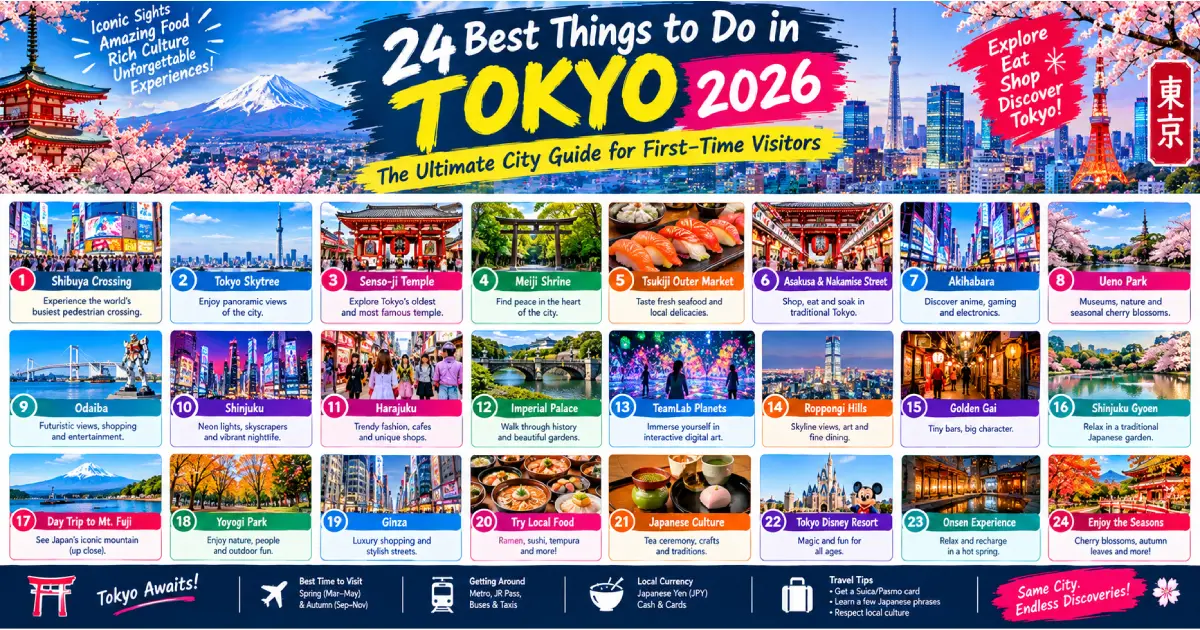
Tokyo doesn’t organize itself around a single downtown or a handful of must-see landmarks the way most tier-1 travelers’ home cities do — it’s a genuinely polycentric metropolis where a dozen or more districts (Shinjuku, Shibuya, Asakusa, Ginza, Akihabara, Harajuku, and beyond) each function as a complete, self-contained city center with its own train station, its own shopping streets, and its own specific character, which means the best things to do in Tokyo aren’t a single checklist so much as a set of genuinely different experiences depending on which side of the city’s personality you’re chasing: the centuries-old (Senso-ji’s incense-filled temple grounds), the futuristic (teamLab’s room-scale digital art), the subculture-specific (Akihabara’s otaku density), and the quietly residential (Yanaka’s old wooden shopping streets, spared the wartime bombing that leveled most of the rest of the city).
The 24 experiences in this guide span all of those registers, organized by category so a first-time visitor with limited days can pick a coherent slice of Tokyo rather than scattering across the map — and paired, where it matters, with the specific timing detail (opening hours, best time of day, whether a reservation matters) that turns a good Tokyo day into a genuinely great one.
| # | Activity | Category | Cost | Time Needed |
|---|---|---|---|---|
| 1 | Shibuya Crossing & Shibuya Sky | Landmark | Free–¥2,000 | 1–2 hours |
| 2 | Tokyo Skytree | Landmark | ¥2,100–¥3,400 | 1.5–2 hours |
| 3 | Tokyo Tower | Landmark | ¥1,200–¥3,000 | 1–1.5 hours |
| 4 | Tokyo Metropolitan Gov’t Building | Landmark | Free | 45 min–1 hour |
| 5 | Senso-ji Temple & Asakusa | Temple | Free | 1.5–2 hours |
| 6 | Meiji Shrine | Shrine | Free | 1–1.5 hours |
| 7 | Imperial Palace East Gardens | Garden | Free | 1–1.5 hours |
| 8 | Shinjuku Gyoen National Garden | Garden | ¥500 | 1.5–2 hours |
| 9 | teamLab Planets / Borderless | Digital Art | ¥3,800–¥4,800 | 2–3 hours |
| 10 | Tokyo National Museum | Museum | ¥1,000 | 1.5–2 hours |
| 11 | Ghibli Museum (Mitaka) | Museum | ¥1,000 | 2 hours |
| 12 | Mori Art Museum & Roppongi Hills | Museum | ¥2,000–¥2,500 | 1.5–2 hours |
| 13 | Akihabara Electric Town | Pop Culture | Free (browsing) | 2–3 hours |
| 14 | Harajuku & Takeshita Street | Fashion/Street Food | Free (browsing) | 1.5–2 hours |
| 15 | Shimokitazawa | Vintage/Indie | Free (browsing) | 2 hours |
| 16 | Kappabashi Kitchen Town | Specialty Shopping | Free (browsing) | 1 hour |
| 17 | Toyosu Fish Market | Food/Market | Free–¥5,000 (meal) | 2 hours |
| 18 | Shinjuku Omoide Yokocho | Food/Nightlife | ¥2,000–¥4,000 | 1.5–2 hours |
| 19 | Ameya-Yokocho Market (Ueno) | Market | Free (browsing) | 1 hour |
| 20 | Depachika Food Halls | Food | ¥1,000–¥3,000 | 45 min–1 hour |
| 21 | Golden Gai Bar Hopping | Nightlife | ¥1,500–¥3,000/bar | 2–3 hours |
| 22 | Kabukicho Evening Walk | Nightlife | Free (browsing) | 1 hour |
| 23 | Tokyo Disneyland/DisneySea | Family/Theme Park | ¥8,900–¥10,900 | Full day |
| 24 | Odaiba | Family/Entertainment | Free–¥3,000 | 3–4 hours |
Cost: Free (crossing); ¥2,000 (Shibuya Sky observation deck) | Location: Shibuya | Best Time: Evening for neon; sunset for Shibuya Sky | Duration: 1–2 hours
Shibuya Crossing — the world’s busiest pedestrian intersection, with up to 3,000 people crossing per light cycle at peak times — is worth experiencing from both ground level (cross it at least once) and from above, where Shibuya Sky’s open-air rooftop observation deck delivers Tokyo’s most photographed skyline view, particularly at sunset as the city’s lights begin switching on below.
Cost: ¥2,100–¥3,400 depending on deck level | Location: Sumida, near Asakusa | Best Time: Late afternoon into evening for a day-to-night transition | Duration: 1.5–2 hours
At 634 meters, Tokyo Skytree is the tallest structure in Japan and the world’s tallest freestanding tower, offering panoramic views that stretch to Mount Fuji on clear days — pairing it with an Asakusa/Senso-ji visit earlier the same day makes for an efficient combined itinerary given their proximity.
Cost: ¥1,200–¥3,000 | Location: Minato | Best Time: Evening, when the tower itself is illuminated | Duration: 1–1.5 hours
Tokyo Tower — the 1958 Eiffel Tower-inspired structure that served as Tokyo’s primary broadcast tower before Skytree’s construction — has aged into a specifically nostalgic Tokyo icon, its orange-and-white illumination visible across much of the city at night, and its lower observation deck offers a genuinely different skyline angle from Skytree’s.
Cost: Free | Location: Shinjuku | Best Time: Clear days for Mount Fuji visibility | Duration: 45 minutes–1 hour
The Tokyo Metropolitan Government Building’s twin observation decks, 202 meters up, offer a view comparable to Skytree’s paid decks at zero cost — the single best free skyline view in the city, and on a clear winter day, one of the more reliable spots to see Mount Fuji from within Tokyo itself.
Cost: Free | Location: Asakusa | Best Time: Before 9:30 AM to beat crowds | Duration: 1.5–2 hours
Tokyo’s oldest Buddhist temple (founded 645 AD), approached through the giant red Kaminarimon “Thunder Gate” lantern and the Nakamise-dori shopping street, remains the single most essential temple visit in the city — arrive early for a meaningfully calmer experience before tour groups arrive mid-morning.
Cost: Free | Location: Shibuya, adjacent to Harajuku | Best Time: Morning, for a quiet forest walk before Harajuku’s crowds pick up | Duration: 1–1.5 hours
Set inside a 170-acre forest donated and planted by citizens nationwide after Emperor Meiji’s 1912 death, Meiji Jingu’s gravel approach beneath towering wooden torii gates offers a genuinely calming contrast to Tokyo’s density elsewhere — and sits close enough to Harajuku’s Takeshita Street to pair a peaceful morning with a loud afternoon.
Cost: Free | Location: Chiyoda | Best Time: Spring for cherry blossoms, otherwise any clear morning | Duration: 1–1.5 hours
The publicly accessible East Gardens of the Imperial Palace grounds — the former site of Edo Castle, Japan’s largest feudal-era fortress — offer a genuinely peaceful landscaped garden walk in the heart of the city, with the palace’s outer stone walls and moat providing some of central Tokyo’s most striking traditional architecture against a modern skyline backdrop.
Cost: ¥500 | Location: Shinjuku | Best Time: Cherry blossom season (late March–early April) | Duration: 1.5–2 hours
One of Tokyo’s largest and most beautifully landscaped parks, combining traditional Japanese, French formal, and English landscape garden styles across 144 acres — among Tokyo’s most celebrated hanami (cherry blossom viewing) spots, and a genuinely restorative green escape from Shinjuku’s surrounding density year-round.
Cost: ¥3,800–¥4,800 | Location: Toyosu (Planets) / Azabudai Hills (Borderless) | Best Time: Book a specific timed-entry slot well in advance | Duration: 2–3 hours
Tokyo’s immersive digital art museums — room-scale projected installations you walk, and at Planets, wade through barefoot — are among the most Instagrammed single attractions in the city and genuinely disorienting-in-a-good-way experiences rather than a gimmick; timed tickets sell out weeks ahead during peak season, so book before arrival rather than planning to walk up.
Cost: ¥1,000 | Location: Ueno Park | Best Time: Weekday mornings for thinner crowds | Duration: 1.5–2 hours
Japan’s oldest and largest museum houses the country’s most significant collection of samurai armor, ukiyo-e woodblock prints, and Buddhist sculpture — an essential stop for any visitor with even a passing interest in Japanese art and history, set within Ueno Park’s broader museum and garden complex.
Cost: ¥1,000 | Location: Mitaka (western Tokyo suburbs) | Best Time: Book tickets exactly one month ahead via the official portal | Duration: 2 hours
Studio Ghibli’s whimsical, deliberately non-linear museum (designed by director Hayao Miyazaki himself) is one of Tokyo’s most beloved family attractions — tickets are notoriously difficult to secure, sold in monthly batches that often sell out within minutes, making advance planning essential rather than optional for this specific entry.
Cost: ¥2,000–¥2,500 | Location: Roppongi | Best Time: Evening, combined with the Tokyo City View observation deck | Duration: 1.5–2 hours
The Mori Art Museum’s rotating contemporary exhibitions, on the 53rd floor of Roppongi Hills’ Mori Tower, pair naturally with the building’s own Tokyo City View observation deck — a single combined-ticket visit that works well as an evening activity given Roppongi’s surrounding nightlife district.
Cost: Free to browse | Location: Akihabara | Best Time: After dark for the full neon effect | Duration: 2–3 hours
Tokyo’s electronics-and-otaku-culture district — a dense grid of multi-floor electronics retailers, anime and manga specialty stores, and retro and modern video game shops — is worth experiencing even for visitors with no specific interest in anime culture, purely for the density and visual overload of the main strip after dark.
Cost: Free to browse | Location: Harajuku | Best Time: Weekday afternoons to avoid the heaviest weekend crowds | Duration: 1.5–2 hours
Tokyo’s most concentrated youth fashion and street-food strip — crepe stands, cheap accessory shops, and Japan’s youth fashion culture in its most commercially concentrated form — makes a loud, energetic contrast to nearby Meiji Shrine’s calm.
Cost: Free to browse | Location: Setagaya, southwest Tokyo | Best Time: Afternoon into evening | Duration: 2 hours
Tokyo’s indie, vintage-fashion, and live-music neighborhood — narrow lanes of secondhand clothing shops, small record stores, and independent theaters — offers the specific “young, artsy Tokyo” register that the more tourist-heavy districts don’t quite capture, popular with locals more than visitors.
Cost: Free to browse | Location: Between Asakusa and Ueno | Best Time: Weekday mornings, shops close relatively early | Duration: 1 hour
A single street lined with wholesale kitchen-supply shops — professional Japanese knives, the famously realistic plastic food replicas (sampuru) displayed outside restaurants nationwide, and specialty cookware — worth a stop for both serious cooks and anyone wanting a genuinely unusual Tokyo souvenir.
Cost: Free to browse; ¥2,000–¥5,000 for a sushi breakfast | Location: Toyosu | Best Time: Early morning (market opens around 5 AM) | Duration: 2 hours
Tsukiji’s relocated wholesale fish market successor — the famous pre-dawn tuna auction requires advance lottery registration, but the observation deck and the market’s excellent sushi restaurants are open to walk-in visitors from opening, making an early-morning sushi breakfast here one of Tokyo’s most memorable food experiences.
Cost: ¥2,000–¥4,000 | Location: Shinjuku, beside the station’s west exit | Best Time: Evening | Duration: 1.5–2 hours
A narrow, lantern-lit alley of tiny yakitori and ramen stalls, seating a handful of diners each — Tokyo’s most atmospheric budget dining district, and one of the easiest, most jet-lag-friendly first dinners in the city.
Cost: Free to browse | Location: Ueno | Best Time: Afternoon | Duration: 1 hour
A bustling street market running alongside the JR tracks near Ueno Station — fresh seafood, dried goods, clothing, and street snacks sold at prices noticeably below department store rates, offering a specifically local, less tourist-polished market experience than Tsukiji’s outer market once provided.
Cost: ¥1,000–¥3,000 | Location: Basement floors of major department stores (Isetan Shinjuku, Ginza’s Mitsukoshi) | Best Time: Any time; early evening for discounted end-of-day bento | Duration: 45 minutes–1 hour
The elaborate basement food halls beneath Tokyo’s major department stores sell restaurant-quality bento boxes, wagashi sweets, and prepared dishes without a reservation or language barrier — genuinely one of the best quality-to-effort meals available anywhere in the city.
Cost: ¥1,500–¥3,000 per bar (often including a seating charge) | Location: Shinjuku | Best Time: After 9 PM | Duration: 2–3 hours
A warren of roughly 200 tiny bars packed into six narrow alleys, each seating just a handful of patrons, many with a specific theme (jazz, punk rock, horror movies) reflecting the individual owner’s taste — a genuinely unique Tokyo nightlife experience, though some bars charge foreign visitors a cover or “seating charge” not always clearly posted, so confirming price before sitting down is worthwhile.
Cost: Free to walk through | Location: Shinjuku | Best Time: Early evening | Duration: 1 hour
Tokyo’s largest and most neon-dense entertainment district, adjacent to Golden Gai — worth a walk-through for the sheer visual density even without engaging with the area’s nightlife venues directly; solo visitors, particularly at night, should politely decline the touts common in the area and stick to well-lit main streets.
Cost: ¥8,900–¥10,900 | Location: Urayasu, Chiba (just outside Tokyo proper, easily reached by train) | Best Time: Weekdays outside Japanese school holidays | Duration: Full day
Tokyo DisneySea in particular — a uniquely Japan-only Disney park built around a nautical exploration theme found nowhere else in the world — is consistently rated among the best Disney parks globally, and a worthwhile full-day addition for families or Disney enthusiasts of any age.
Cost: Free to browse; ¥2,000–¥3,000 for attractions | Location: Tokyo Bay, reclaimed island | Best Time: Late afternoon into evening for the Rainbow Bridge lit up | Duration: 3–4 hours
A reclaimed island purpose-built as an entertainment and shopping district — teamLab’s museums, a large Ferris wheel, waterfront shopping malls, and a view back across the bay toward the illuminated Rainbow Bridge — makes an efficient combined half-day for families or anyone wanting a single, comprehensive Tokyo Bay experience.
About Travel Tourister Travel Tourister’s destination specialists have covered Tokyo end to end — from pre-dawn Toyosu sushi breakfasts and Senso-ji’s morning calm to Golden Gai’s tiny themed bars and teamLab’s disorienting digital rooms — to deliver the most complete and practically useful guide to things to do in Tokyo for 2026 visitors.
Posted By : Vinay
Latest Article
2nd Floor, 39, Above Kirti Club, DLF Industrial Area, Kirti Nagar, New Delhi, Delhi 110015



Travel Tourister is a leading Travel portal where we introduce travellers to trusted travel agents to make their journey hasselfree, memorable And happy. Travel Tourister is a platform where travellers get Tour packages ,Hotel packages deals through trusted travel companies And hoteliers who are working with us across the world. We always try to find new and more travel agents and hoteliers from every nook and corners across the world so that you could compare the deals with different travel agents and hoteliers and book your tour or hotel with the one you have chosen according to your taste and budget.
Copyright © Travel Tourister, India. All Rights Reserved

 Call
Call Enquiry