Published on : 01 Oct 2026
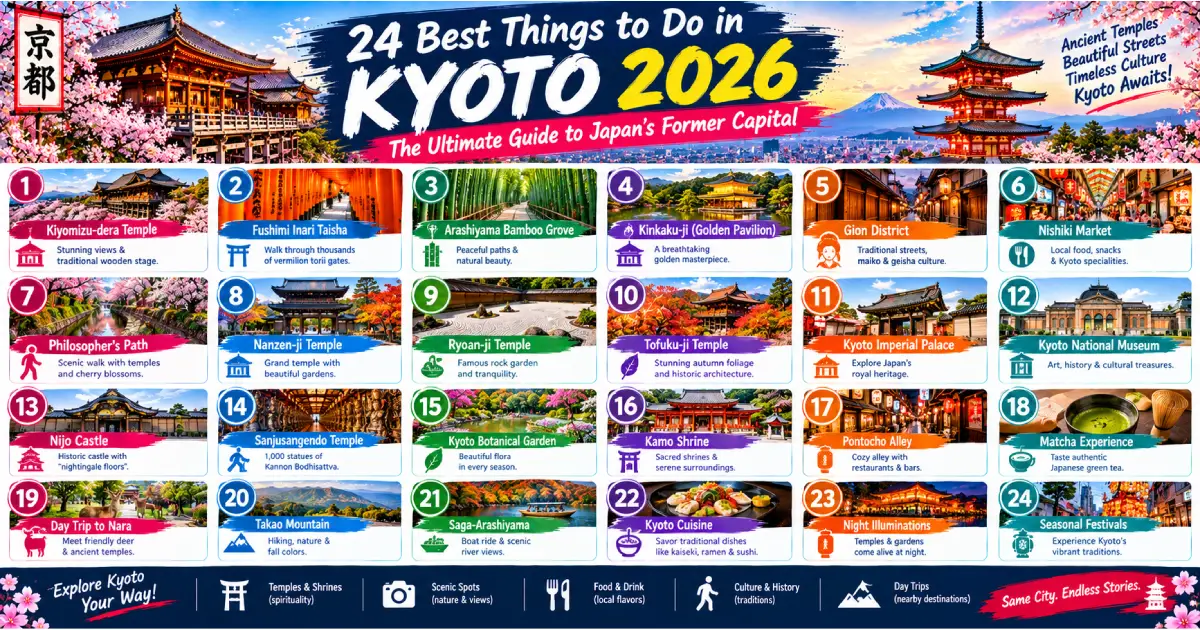
Kyoto holds more UNESCO World Heritage Sites (17) than any other city in Japan, and roughly 1,600 Buddhist temples alongside hundreds of Shinto shrines, which means the practical challenge for a first-time visitor isn’t finding things to do but choosing among a genuinely overwhelming number of excellent options — most visitors with limited time end up seeing a handful of the most famous sites (Fushimi Inari, Kinkaku-ji, Kiyomizu-dera) while missing equally worthwhile experiences one or two steps off the standard list. This guide covers 24 specific things to do in Kyoto, organized by category, mixing the essential headline sites with a handful of genuinely worthwhile additions — a stone garden of 1,200 individually carved, uniquely expressive statues that barely any foreign visitor reaches, a monkey park with a panoramic city view, a scenic steam-era railway through a river gorge — for a visitor who wants more than the standard checklist.
| # | Activity | Category | Cost | Time Needed |
|---|---|---|---|---|
| 1 | Fushimi Inari Taisha | Shrine | Free | 1.5–3 hours |
| 2 | Kiyomizu-dera | Temple | ¥500 | 1.5–2 hours |
| 3 | Kinkaku-ji (Golden Pavilion) | Temple | ¥500 | 30–45 min |
| 4 | Ginkaku-ji (Silver Pavilion) | Temple | ¥500 | 45 min–1 hour |
| 5 | Ryoan-ji Rock Garden | Temple | ¥600 | 30–45 min |
| 6 | Sanjusangendo | Temple | ¥600 | 45 min–1 hour |
| 7 | Gion Evening Walk | Historic district | Free | 1–1.5 hours |
| 8 | Gion Corner Cultural Show | Performance | ¥5,000 | 1 hour |
| 9 | Traditional Tea Ceremony | Cultural experience | ¥3,000–¥8,000 | 45 min–1 hour |
| 10 | Kimono Rental & Photo Walk | Cultural experience | ¥4,000–¥8,000 | Half day |
| 11 | Arashiyama Bamboo Grove | Nature | Free | 30–45 min |
| 12 | Tenryu-ji Temple Garden | Temple/Garden | ¥500 | 45 min–1 hour |
| 13 | Sagano Scenic Railway | Scenic train | ¥880 | 1 hour (round trip) |
| 14 | Philosopher’s Path | Walk | Free | 1–1.5 hours |
| 15 | Nijo Castle | Castle | ¥800–¥1,300 | 1.5–2 hours |
| 16 | Kyoto Imperial Palace | Historic site | Free (register) | 1 hour |
| 17 | Nishiki Market | Market | Free–¥2,000 (food) | 1–1.5 hours |
| 18 | Pontocho Alley | Dining district | Varies | 1.5–2 hours |
| 19 | Fushimi Sake District | Cultural/Food | Free–¥1,500 (tastings) | 1.5–2 hours |
| 20 | Arashiyama Monkey Park | Nature/Wildlife | ¥550 | 1–1.5 hours |
| 21 | Kurama-Kibune Hike & Onsen | Nature/Hike | Free–¥1,500 (onsen) | 3–4 hours |
| 22 | Kyoto Railway Museum | Museum | ¥1,500 | 2 hours |
| 23 | Kodai-ji Temple (Night Illumination) | Temple | ¥600 | 45 min |
| 24 | Otagi Nenbutsu-ji | Temple | ¥300 | 30–45 min |
Cost: Free | Location: Fushimi ward | Best Time: 7:00–8:00 AM | Duration: 1.5–3 hours
Kyoto’s most photographed single site — thousands of vermilion torii gates climbing the wooded slopes of Mount Inari along a 2–3 hour round-trip trail — rewards an early arrival above almost anything else in this guide; by 9 AM the lower gates (the most photographed Senbon Torii tunnel) become nearly impassable for photography.
Cost: ¥500 | Location: Higashiyama | Best Time: Early morning or late afternoon | Duration: 1.5–2 hours
A UNESCO World Heritage wooden temple famous for its massive stage, built without a single nail, extending over the hillside on wooden pillars with panoramic city views — pair it with a walk down through the preserved Sannenzaka and Ninenzaka lanes toward Gion.
Cost: ¥500 | Location: Northwest Kyoto | Best Time: Opening time (9 AM) | Duration: 30–45 minutes
Japan’s single most photographed building — a Zen temple whose top two floors are covered entirely in gold leaf, reflected in its still pond — moves visitors through a one-directional path efficiently even during busy periods, making it manageable despite consistently heavy crowds.
Cost: ¥500 | Location: Northern Higashiyama, at the start of the Philosopher’s Path | Best Time: Morning | Duration: 45 minutes–1 hour
Despite its name, Ginkaku-ji was never actually covered in silver — its understated wooden exterior and meticulously raked sand garden (the Sea of Silver Sand) represent a deliberately more restrained aesthetic philosophy than Kinkaku-ji’s gold, and the temple pairs naturally with a Philosopher’s Path walk immediately after.
Cost: ¥600 | Location: Northwest Kyoto, near Kinkaku-ji | Best Time: Early morning for quiet contemplation | Duration: 30–45 minutes
Japan’s most famous karesansui (dry rock garden) — 15 stones arranged in raked white gravel, positioned so that no viewing angle from the temple veranda reveals all 15 simultaneously — is a genuinely meditative stop, best appreciated by simply sitting on the veranda for several unhurried minutes rather than rushing through.
Cost: ¥600 | Location: Southern Higashiyama | Best Time: Any time, indoor | Duration: 45 minutes–1 hour
A temple hall housing 1,001 life-sized wooden statues of Kannon, the Buddhist goddess of mercy, each individually carved with subtly different facial features — an overwhelming, genuinely awe-inducing visual experience and one of Kyoto’s most underrated major sites relative to its crowd levels.
Cost: Free | Location: Gion | Best Time: Dusk, around 5:30–6:30 PM | Duration: 1–1.5 hours
A respectful evening walk through Hanami-koji street and the surrounding lanes, past wooden machiya teahouses, carries a real (though not guaranteed) chance of spotting a geiko or maiko moving between evening appointments — see our Japan Etiquette Guide for the specific photography etiquette that applies here.
Cost: ¥5,000 | Location: Gion | Best Time: Evening performance | Duration: 1 hour
A condensed one-hour performance covering seven traditional Japanese art forms — including a maiko dance, tea ceremony demonstration, and traditional court music — offers a structured, guaranteed introduction to traditional culture for visitors who want more certainty than an evening Gion walk alone provides.
Cost: ¥3,000–¥8,000 | Location: Several dedicated tea houses throughout Kyoto | Best Time: Book in advance | Duration: 45 minutes–1 hour
Kyoto is the most appropriate city in Japan to experience a formal tea ceremony (chado), given its historical role as the birthplace of much of Japanese traditional culture — a guided, English-accommodating ceremony walks visitors through the specific choreography of preparation, presentation, and etiquette behind what looks, from the outside, like simply making tea.
Cost: ¥4,000–¥8,000 | Location: Rental shops concentrated near Kiyomizu-dera and Gion | Best Time: Morning, for a full day’s wear | Duration: Half day
Renting a kimono (or yukata in warmer months) for a day of temple-hopping is a genuinely popular activity among both Japanese and international visitors — Kyoto’s historic streetscapes provide an unusually fitting backdrop, and most rental shops include basic hair styling in the package price.
Cost: Free | Location: Arashiyama | Best Time: Before 9 AM | Duration: 30–45 minutes
A few hundred meters of towering bamboo stalks arching over a narrow path — one of Japan’s officially recognized “100 Soundscapes to Preserve” for the sound of the stalks creaking in the wind — at its calmest and most photogenic before the day-trip crowds arrive.
Cost: ¥500 | Location: Arashiyama, adjacent to the Bamboo Grove | Best Time: Morning | Duration: 45 minutes–1 hour
A UNESCO World Heritage Zen temple with one of Japan’s finest traditional gardens, using the Arashiyama mountains as “borrowed scenery” extending the garden’s apparent boundaries beyond its own pond and grounds.
Cost: ¥880 | Location: Arashiyama, departing from Torokko Saga Station | Best Time: Autumn for foliage, spring for cherry blossoms | Duration: 1 hour round trip
A slow, open-window sightseeing train running along the Hozugawa River gorge between Arashiyama and Kameoka — a genuinely scenic alternative to walking, particularly rewarding during cherry blossom or autumn foliage season when the gorge’s forested slopes turn vivid color.
Cost: Free | Location: Northern Higashiyama, between Ginkaku-ji and Nanzen-ji | Best Time: Cherry blossom season, or any quiet morning | Duration: 1–1.5 hours
A stone walkway following a canal lined with hundreds of cherry trees, named for a 20th-century Kyoto University philosopher who walked it daily while meditating — the more contemplative, walkable version of Kyoto’s cherry blossom experience, with meaningfully thinner crowds than Maruyama Park if visited before 8 AM.
Cost: ¥800–¥1,300 | Location: Central Kyoto | Best Time: Morning | Duration: 1.5–2 hours
A UNESCO World Heritage former shogun residence famous for its “nightingale floors,” engineered to squeak audibly underfoot as a defense against silent intruders — the castle’s elaborate painted sliding doors and surrounding gardens make it one of Kyoto’s most significant non-religious historic sites.
Cost: Free (advance online registration or same-day in-person registration required) | Location: Central Kyoto | Best Time: Morning | Duration: 1 hour
The former residence of Japan’s Imperial family until the 1868 move to Tokyo, set within the large, parklike Kyoto Gyoen National Garden — a somewhat less visited major historic site given its registration requirement, which keeps crowds noticeably thinner than Nijo Castle’s.
Cost: Free to browse, ¥500–¥2,000 for food | Location: Central Kyoto | Best Time: Mid-morning to early afternoon | Duration: 1–1.5 hours
Kyoto’s five-century-old “kitchen,” a covered shopping street for grazing rather than a sit-down meal — yuba (tofu skin), Kyoto-style pickles, matcha sweets, and skewered baby octopus stuffed with a whole quail egg, Nishiki’s signature novelty item.
Cost: Varies widely by restaurant | Location: Central Kyoto, parallel to the Kamo River | Best Time: Evening | Duration: 1.5–2 hours
A narrow, atmospheric dining alley running the length of a single Kyoto block, lined with restaurants ranging from affordable yakitori to high-end kaiseki, many with riverside seating (kawadoko) available during the warmer months — one of Kyoto’s most photogenic dinner settings.
Cost: Free to walk; ¥500–¥1,500 for tastings | Location: Fushimi ward, near Fushimi Inari | Best Time: Afternoon, combined with a Fushimi Inari visit | Duration: 1.5–2 hours
One of Japan’s most historically significant sake-brewing districts, thanks to the area’s naturally pure groundwater — several breweries (including the Gekkeikan Okura Sake Museum) offer tastings and tours, making for a natural afternoon pairing with a morning Fushimi Inari visit given their shared neighborhood.
Cost: ¥550 | Location: Arashiyama, up a short hillside trail | Best Time: Any time, weather-dependent | Duration: 1–1.5 hours
A roughly 20-minute uphill walk from the Arashiyama Bamboo Grove leads to a park home to over 100 free-roaming Japanese macaques, with a summit viewpoint offering one of the best panoramic views over Kyoto available anywhere in the city.
Cost: Free (hike); ¥1,000–¥1,500 (onsen) | Location: Northern outskirts of Kyoto | Best Time: Spring or autumn | Duration: 3–4 hours
A roughly 2-hour forested hiking trail connects the mountain village of Kurama (home to Kurama-dera temple) with the riverside village of Kibune — a genuinely peaceful, far-less-crowded half-day escape from central Kyoto, with an onsen hot spring available in Kurama to soak tired legs afterward.
Cost: ¥1,500 | Location: Near Kyoto Station | Best Time: Any time | Duration: 2 hours
One of Japan’s largest railway museums, housing retired steam locomotives and Shinkansen train sets alongside interactive exhibits — a strong family-friendly option, and conveniently located within walking distance of Kyoto Station for visitors with limited time.
Cost: ¥600 | Location: Higashiyama, near Gion | Best Time: Evening during spring and autumn illumination periods | Duration: 45 minutes
Kodai-ji’s seasonal evening illuminations — the temple’s garden and bamboo grove lit dramatically after dark during specific spring and autumn windows — offer a genuinely different, more theatrical version of a Kyoto temple visit than the standard daytime experience.
Cost: ¥300 | Location: Far Arashiyama, beyond the main bamboo grove crowds | Best Time: Any time | Duration: 30–45 minutes
A small, little-visited temple on Arashiyama’s outer edge, home to roughly 1,200 individually carved stone rakan statues — each with a distinct, often humorous facial expression, carved over several decades by amateur sculptors under a 20th-century restoration project — genuinely one of Kyoto’s most charming and least internationally known sites.
About Travel Tourister Travel Tourister’s destination specialists have covered Kyoto end to end — from dawn Fushimi Inari torii gates and Arashiyama’s early-morning bamboo calm to the quiet stone faces of Otagi Nenbutsu-ji and Gion’s evening lanes — to deliver the most complete and practically useful guide to things to do in Kyoto for 2026 visitors.
Posted By : Vinay
Latest Article
2nd Floor, 39, Above Kirti Club, DLF Industrial Area, Kirti Nagar, New Delhi, Delhi 110015



Travel Tourister is a leading Travel portal where we introduce travellers to trusted travel agents to make their journey hasselfree, memorable And happy. Travel Tourister is a platform where travellers get Tour packages ,Hotel packages deals through trusted travel companies And hoteliers who are working with us across the world. We always try to find new and more travel agents and hoteliers from every nook and corners across the world so that you could compare the deals with different travel agents and hoteliers and book your tour or hotel with the one you have chosen according to your taste and budget.
Copyright © Travel Tourister, India. All Rights Reserved

 Call
Call Enquiry