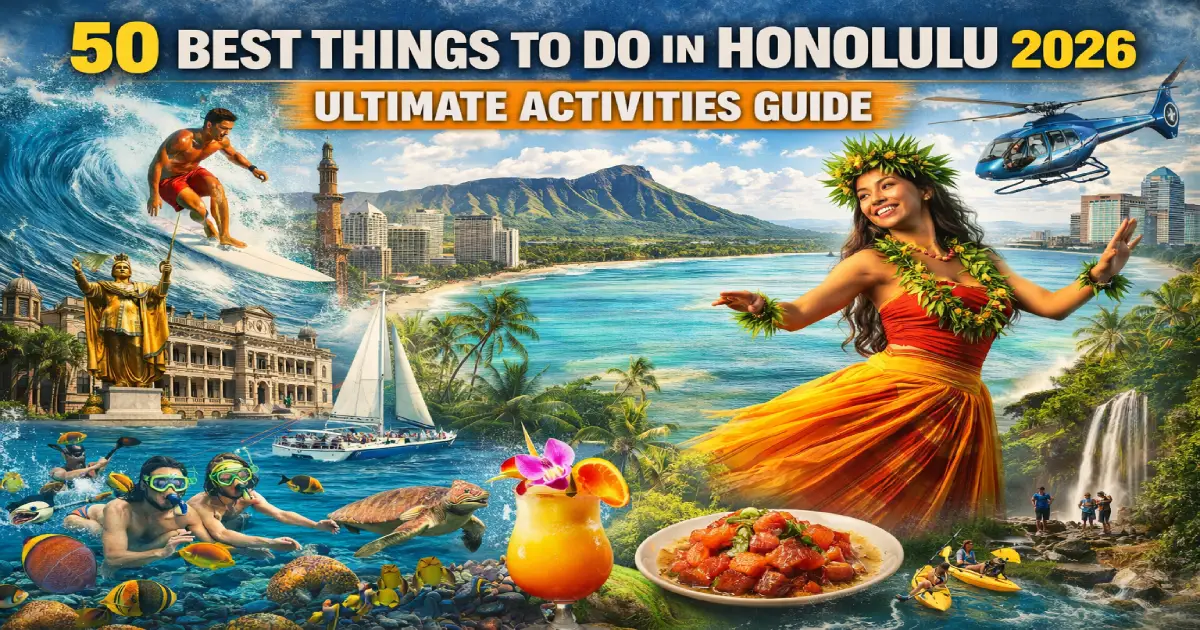
50 Best Things to Do in Honolulu 2026: Ultimate Activities Guide
Published on : 25 Mar 2026
Things to Do in Honolulu — Waikiki, Pearl Harbor, the North Shore, and Everything Between
By Travel Tourister | Updated March 2026
Honolulu is the most geographically versatile city in America — a place where the world’s most iconic urban beach (Waikiki) sits 8 miles from a nature reserve where green sea turtles outnumber tourists (Hanauma Bay), where Pearl Harbor’s USS Arizona Memorial and the Bishop Museum’s feathered cloaks of Hawaiian royalty occupy the same island as the world’s best shave ice at Matsumoto’s in Haleiwa, where you can surf a gentle Waikiki wave at 9 AM, hike to a World War II bunker overlooking the Pacific by noon, eat a plate lunch at a Chinatown market by 1 PM, and watch 30-foot Pipeline barrels from a beach chair by 3 PM on a single December day. No other American city produces this range of activity within a 40-mile driving radius, and no other American city does it in 83°F trade-wind perfection.
I’ve explored Honolulu’s activities across multiple visits and seasons — the Diamond Head summit at 6:30 AM when the Pacific horizon is turning from violet to gold and the city below is still dark, the Pearl Harbor audio tour in November when the silence in the USS Arizona Memorial’s water chamber is the most specific silence in America, the Hanauma Bay snorkel in April when the parrotfish are so close you can almost touch them and the hawksbill turtles are basking in the shallows, the Waikiki sunset catamaran when the Ko’olau mountains catch the last light and the ocean turns every shade of orange simultaneously, and the Manoa Falls trail in February when the jungle is dripping wet and the waterfall is full and the city below feels as distant as another planet. Each activity confirmed that Honolulu’s finest experiences are distributed between the globally famous and the specifically extraordinary — and that the visitor who ventures beyond Waikiki’s hotel corridor to the North Shore, the windward coast, the Chinatown district, and the Koolau trailheads will find a Honolulu that is larger, wilder, and more genuinely Hawaiian than any beach resort brochure suggests.
This comprehensive 2026 guide breaks down Honolulu’s 50 best activities using verified information from Hawaii Tourism Authority, years of on-the-ground expertise, and honest assessments of what delivers genuinely memorable experiences. We organize activities by category — iconic Honolulu, beaches and water activities, hiking and nature, history and culture, food and drink, day trips and island exploration, family activities, and unique Honolulu — with realistic costs, timing, and strategic advice for experiencing the most multifaceted island city in America.
Whether planning a first visit built around Pearl Harbor, Waikiki, and Diamond Head, a week-long outdoor adventure spanning the North Shore surf, the Ko’olau hiking trails, and whale watching season, a family trip combining Hanauma Bay with the Polynesian Cultural Center, or a food lover’s tour of Chinatown’s lei shops and plate lunch institutions, this guide gives you the honest intelligence to experience Honolulu brilliantly.
Honolulu Activities by Category
Category
Top Activities
Best Location
Cost Range
Iconic Honolulu
Diamond Head, Pearl Harbor, Waikiki Beach
Waikiki, Pearl City, Diamond Head
Free–$35
Beaches & Water
Hanauma Bay, North Shore, Kailua Beach, surfing
East Oahu, North Shore, Windward
Free–$45
Hiking & Nature
Diamond Head, Manoa Falls, Makapu’u Lighthouse
Ko’olau Range, East Oahu, Nu’uanu
Free–$10
History & Culture
Pearl Harbor, Bishop Museum, Iolani Palace
Pearl City, Kalihi, Downtown
Free–$30
Food & Drink
Shave ice, plate lunch, Chinatown, luau
Haleiwa, Chinatown, citywide
$3–$125
Day Trips
Polynesian Cultural Center, Kailua, Circle Island
Windward, North Shore, island-wide
Free–$60
Iconic Honolulu Experiences
1. Hike Diamond Head Crater — MUST DO
Why It’s Honolulu’s Essential Activity: The Diamond Head State Monument — the 760-foot tuff cone volcanic crater visible from everywhere in Waikiki — is the most iconic single hike in Hawaii and one of the most rewarding 90-minute outdoor experiences in any American city. The 1.6-mile round-trip trail from the crater floor to the summit traverses a series of WWII-era military tunnels, 99 steps cut into the crater wall, and a final spiral staircase to the Fire Control Station at the summit, delivering a 360-degree panoramic view of Waikiki, the Ko’olau Range, the Pacific Ocean, and the Koko Head crater to the east that is the finest freely accessible view in Honolulu.
Trail Details:
Distance: 1.6 miles round trip; 560-foot elevation gain; 1–1.5 hours total
The WWII tunnels: Two military tunnels cut through the crater wall during the 1908–1943 period of Diamond Head’s use as a coastal defense installation — bring a flashlight (or phone torch) for the 225-foot unlit tunnel
The 99 steps: The steepest section of the trail — cut directly into the crater wall, with handrails; the most physically demanding 3 minutes of the hike
The summit view: 360 degrees — Waikiki’s hotel towers to the west, the Manoa Valley to the north, the Ko’olau Range to the northeast, and the Pacific Ocean extending to the horizon in every ocean-facing direction
Timing strategy: Reserve parking or bus in advance at gostateparks.hawaii.gov ($5/person non-resident, $10 parking). Arrive before 7 AM to beat crowds and midday heat — the summit at 7:30 AM with the morning light on the ocean is the finest Diamond Head experience available.
Cost: $5/person non-resident; parking $10; reservations required at gostateparks.hawaii.gov; open daily 6 AM–6 PM (last entry 4 PM)
2. Visit Pearl Harbor — MOST IMPORTANT HISTORICAL EXPERIENCE
Why It’s Essential: The Pearl Harbor National Memorial — the USS Arizona Memorial, the Battleship Missouri, the USS Bowfin submarine, and the Pacific Aviation Museum — is the most historically significant single site in Honolulu and one of the most moving war memorials in the United States. The USS Arizona Memorial, built over the sunken battleship where 1,177 sailors are entombed, delivers the most specific and most consequential historical silence in American tourism — the oil that still rises from the ship’s fuel tanks creates a visible surface sheen on the harbor water that is simultaneously the most sobering and most physically immediate World War II artifact accessible to any visitor anywhere in the country.
USS Arizona Memorial (free): A boat tour to the white memorial structure above the sunken battleship — free tickets, timed entry, book at recreation.gov weeks ahead in summer; the oil still rising from the hull 80+ years after December 7, 1941 is the most powerful single visual in any American war memorial
USS Missouri: The battleship where Japan’s surrender was signed on September 2, 1945, ending WWII — guided tours of the deck where General MacArthur accepted the surrender, the surrender plaque, and the kamikaze impact scar ($36/adult)
USS Bowfin submarine (WWII submarine park): A complete WWII attack submarine open for self-guided tours of the interior — the crew quarters, the torpedo tubes, and the conning tower are all accessible ($18/adult)
Pacific Aviation Museum: WWII aircraft including the only surviving B-25 Mitchell in original configuration and a restored Zero fighter ($30/adult)
Timing: Arrive at the visitor center at 7 AM opening to secure free Arizona Memorial tickets for morning departure; the 8–10 AM boat departures have the smallest crowds
Cost: Arizona Memorial free (book at recreation.gov); Missouri $36; Bowfin $18; full Pearl Harbor Day Pass $89/adult; open daily 7 AM–5 PM
3. Spend Time on Waikiki Beach
Why Essential: Waikiki is the world’s most famous urban beach — 2 miles of coral sand between Diamond Head and the Ala Wai Canal, with the Ko’olau mountains as backdrop and the Pacific horizon as the view, the only beach in the world where you can learn to surf at Canoes and Queens reef in gentle 2–4 foot waves, rent an outrigger canoe from a beach boy stand that has been operating in this exact location since Duke Kahanamoku’s era, and watch the Waikiki sunset from the beachfront of the Royal Hawaiian Hotel in a setting that has been the finest hotel beach in the Pacific since 1927.
Surf lessons: The Waikiki beachboys have been teaching surf lessons at the same beach stands since the 1930s — Hans Hedemann Surf School and Waikiki Beach Services are the most established operators ($65–$85/person for 2-hour group lesson)
Outrigger canoe rides: Traditional Hawaiian outrigger canoes catching the Waikiki waves — $20–$30 for a 3-wave ride with the beach boys, the most specifically Hawaiian water activity available at Waikiki
Sunset at the Royal Hawaiian: The pink palace’s Mai Tai Bar on the beach — $22 for the Mai Tai with the finest sunset view in Waikiki ($22–$30/drink)
Swimming: The Waikiki beach is reliably swimmable year-round — gentle shore break, lifeguards on duty daily, ocean temperature 76–84°F depending on season
4. Snorkel Hanauma Bay — BEST SNORKELING IN HAWAII
Why It’s Hawaii’s Finest Snorkeling: Hanauma Bay Nature Preserve — a collapsed volcanic crater on the southeast coast of Oahu, 8 miles from Waikiki — is the finest marine conservation snorkeling destination in Hawaii and one of the finest in the United States. The protected bay (no fishing, strict no-touch rules, mandatory conservation video before entry) has produced the densest and most approachable reef fish population in Hawaiian waters — Achilles tang, parrotfish, needlefish, and the Hawaiian green sea turtles that cruise the inner reef are so accustomed to human presence that snorkeling in Hanauma feels like swimming in an aquarium designed by evolution.
Reef fish abundance: 400+ species of fish in the protected bay — the humuhumunukunukuapua’a (Hawaii’s state fish), parrotfish, triggerfish, and the dense schools of convict tang that move through the bay in patterns that make individual fish identification impossible
Hawaiian green sea turtles (honu): The protected turtles cruise the inner reef year-round — maintaining 10 feet of distance is required by law; the turtles often approach snorkelers to within arm’s reach on their own
Best snorkeling area: The inner reef (the shallow section directly in front of the beach entrance) — 3–10 feet deep, excellent visibility, the finest concentration of fish for beginners
Reservation required: Book at hanaumabayreservations.com; opens 2 days ahead at midnight HST; fills within minutes in summer ($30/non-resident adult); closed Tuesday
Cost: $30/non-resident adult; free parking or TheBus #22 from Waikiki; open Wednesday–Monday 6:45 AM–4 PM
5. Watch North Shore Pipeline Surf
Why It’s the World’s Most Spectacular Surf Viewing: The Banzai Pipeline at Ehukai Beach Park on Oahu’s North Shore is the world’s most famous and most dangerous surf break — a shallow reef that produces the most perfectly shaped barreling waves in the world, with November–February waves of 15–30 feet that generate a crowd of spectators on the beach and an atmosphere of genuine awe that is available at no other surf break on earth. Standing on the sand at Pipeline when a 25-foot wave pitches over the shallow reef and tubes for 300 feet before exploding in white water is one of the most viscerally impressive sporting spectacles accessible to a casual visitor anywhere in America — and it is entirely free.
Best viewing position: Ehukai Beach Park — parking lot directly adjacent to Pipeline; arrive early (before 8 AM) on big swell days for beach position; the break is 50–80 yards offshore, clearly visible from the sand
Vans Triple Crown contests (November–December): When contests are running, the beach fills with 2,000–5,000 spectators — arrive 2 hours before the scheduled heat to secure beach position
Winter season: November–February; the Eddie Aikau invitational at Waimea Bay is held in January–February only when waves reach 20 feet — check surfline.com for current year holding status
Summer visits: The same Pipeline break is flat and safe for swimming in May–September — an entirely different and equally beautiful version of the world’s most famous surf break
Cost: FREE; Ehukai Beach Park, 59-337 Ke Nui Road, Haleiwa (North Shore); 45-minute drive from Waikiki
6. Attend a Traditional Hawaiian Luau
The traditional Hawaiian luau — the feast and cultural celebration that has been the centerpiece of Hawaiian hospitality since long before Waikiki became a tourist destination — is available at multiple levels of authenticity and quality in Honolulu, from the beachfront productions at the major Waikiki hotels to the more culturally immersive experiences at the Polynesian Cultural Center
Paradise Cove Luau (Ko’Olina, 25 miles west): The most attended luau on Oahu — 600+ guests, Polynesian canoe ceremony at sunset, imu (underground oven) ceremony with the kalua pig, open bar, and full hula show ($115–$180/adult depending on package)
Royal Hawaiian Luau (Waikiki Beach): The most romantically located luau — the pink palace’s Monday evening luau on the Waikiki beachfront, intimate at 200 guests, the finest sunset setting of any Oahu luau ($225/adult)
Ka Wa’a Luau at Aulani (Ko’Olina): Disney’s luau at Aulani Resort — family-friendly, the finest children’s luau experience on Oahu, the only luau that integrates Hawaiian cultural education throughout rather than only at the performance segment ($189/adult, $115/child)
Cost: $115–$225/adult; book 2–4 weeks ahead for summer and holiday season dates
Beaches & Water Activities
7. Snorkel and Kayak at Kailua Beach
Why It’s Oahu’s Finest Non-Hanauma Bay Beach: Kailua Beach on Oahu’s windward coast (45 minutes from Waikiki, accessible by TheBus #56) is consistently rated among the finest beaches in the United States — 2.5 miles of powder-white sand, turquoise water, and the Mokulua Islands (the twin island sea bird sanctuary) offshore as the finest kayak destination accessible from any Oahu beach. The kayak to the Mokes (the Mokulua Islands) — 1.5 miles offshore from Kailua Beach Park — is the finest single kayaking experience available on Oahu, with a sea arch, white sand beaches on each island, and the possibility of spotting Hawaiian monk seals hauled out on the outer island’s rocks.
Kayak to the Mokulua Islands: 1.5 miles offshore from Kailua Beach, a 45-minute paddle each way — rent kayaks from Kailua Beach Adventures ($75–$95/day, guided tours available)
Stand-up paddleboarding: The calm waters inside the Kailua reef produce the finest flatwater stand-up paddleboard conditions on Oahu — rental at the same operators as kayaking
Snorkeling at Lanikai: The adjacent Lanikai Beach has a small reef accessible from the beach with excellent snorkeling visibility
The Waikiki sunset catamaran cruise — sailing from Waikiki Beach on a traditional catamaran (the beach boys’ catamarans have been operating from Waikiki since the 1930s) for 90 minutes along the Waikiki shoreline with cocktails as the Ko’olau mountains catch the final light and the Pacific turns orange — is one of the most specifically beautiful tourism experiences available in any American city
Outrigger Canoe Club catamarans: The oldest Waikiki beach operators, departing directly from the sand in front of the major hotels ($40–$65/adult for 90-minute sunset sail)
Whale watching season (November–May): The sunset catamarans often encounter humpback whales within 1–2 miles of the Waikiki shore during the whale season — the most accessible whale watching available without booking a dedicated whale watch tour
Cost: $40–$65/adult; 90-minute cruise; departs from Waikiki Beach multiple departure times
9. Explore Waimea Bay (North Shore)
Waimea Bay is the most dramatically seasonally variable beach on Oahu — in November through March, the bay receives the largest swells in the Northern Hemisphere (the Eddie Aikau Invitational site, with waves reaching 40+ feet in the bay’s center during the largest swells), and in May through September, the same bay is a flat, protected cove with the calmest water and the most beautiful setting of any beach on the North Shore
The Waimea Bay rock jump (summer): The 25-foot lava rock outcropping at the north end of the bay — generations of locals and visitors have jumped from it into the deep water below, and it remains one of the most accessible adrenaline activities on Oahu ($0, but assess conditions carefully; jump only when the bay is completely flat)
The beach (summer): One of the most beautiful single beach settings on Oahu — the bay’s curved arc of white sand, the valley behind, and the flat blue water make it the finest North Shore beach for photography
Cost: FREE; 61-031 Kamehameha Highway, Haleiwa (North Shore)
10. Learn to Surf in Waikiki
Waikiki is where surfing was essentially introduced to the world by Duke Kahanamoku in the early 20th century — and the Canoes and Queens surf breaks in front of the Waikiki hotels remain the finest location on earth for learning to surf, with gentle 2–4 foot waves breaking over a forgiving sand and reef bottom in 80°F water with trade winds blowing offshore
Group lessons (most accessible): 2-hour group lesson with 4:1 student-to-instructor ratio — the most common format, sufficient for first-timers to stand on the board in the lesson’s first hour ($65–$80/person)
Private lessons: 1.5-hour private lesson — the most efficient path to actual surfing rather than simply standing up ($120–$150/person)
Board rental after lessons: The Waikiki surf schools rent boards by the hour for self-guided practice — $15–$20/hour for a longboard at the beach stands
Cost: Group lesson $65–$80; private $120–$150; board rental $15–$20/hour
11. Snorkel at Shark’s Cove (North Shore)
Shark’s Cove at Pupukea Marine Life Conservation District on the North Shore is the finest shore snorkeling accessible from the roadside on Oahu — a natural lava rock cove with a protected inner area that creates calm conditions even when the outer North Shore is moderately active, with visibility of 40–80 feet in the dry season and a reef fish population of extraordinary density and diversity
Best season: May–September (flat conditions, clearest water, maximum visibility) — the same location becomes dangerous when North Shore winter swells are running
No rental equipment at the cove — bring snorkeling gear from Waikiki rental shops or from ABC Stores throughout Honolulu ($25–$35/set for mask, snorkel, fins)
Cost: FREE; 59-712 Kamehameha Highway, Haleiwa (North Shore); open May–September only
12. Go Whale Watching
Humpback whale watching off the Oahu coast (November–May, peak February–April) — the Pacific Whale Foundation’s whale watching cruises from Honolulu Harbor deliver the most educationally enriched and most reliably productive whale watching accessible from Waikiki, with naturalists providing identification and behavioral commentary throughout the 2.5-hour cruise
Humpback behaviors: Breaching (full body leap), pec slapping (slapping the 15-foot pectoral fin on the water surface), tail lobbing, and spy hopping (vertical rise to look above the surface) — all observed regularly on February and March morning cruises
Best months: February and March for highest probability of dramatic surface behavior; November–January for early season sightings at lower prices
Cost: $50–$75/adult; pacificwhale.org; departs from Honolulu Harbor; book 1–2 weeks ahead in peak season
Hiking & Nature Activities
13. Hike Manoa Falls Trail
Why Essential: The Manoa Falls trail — 1.6 miles round trip through dense tropical rainforest in the Manoa Valley behind the University of Hawaii — is the finest jungle hiking experience accessible from urban Honolulu, ending at an 100-foot waterfall that feeds a plunge pool in the lushest setting on the southern slopes of the Ko’olau Range. The contrast between the Waikiki hotel corridor 5 miles below and the dripping, birdsong-filled jungle canopy above the trail is the most dramatic ecosystem transition available within 30 minutes of any Waikiki hotel.
Trail details: 1.6 miles round trip, 150-foot elevation gain, easy-to-moderate; slippery roots and red mud throughout — wear closed-toe shoes with grip, not sandals
Manoa Falls: A 100-foot waterfall falling into a jungle pool — swimming in the pool is not recommended due to leptospirosis risk (a bacterial infection carried in the water), but the visual and audio experience of the falls is the trail’s reward
Best time: Morning (8–10 AM) before the afternoon clouds build in the valley; the Manoa Valley receives significantly more rain than Waikiki (155+ inches annually versus 17) — check the morning forecast
Oahu Forest NWR birds: ‘Apapane and ‘ōma’o (Hawaiian honeycreepers) are sometimes visible in the upper canopy
Cost: $5 parking (Lyon Arboretum parking area); 2-mile drive from University of Hawaii
14. Hike the Makapu’u Lighthouse Trail
The Makapu’u Lighthouse Trail — 2 miles round trip on a paved switchback road to the 647-foot cliffs above Oahu’s easternmost point — delivers the finest coastal hiking view on the island: the Makapu’u Lighthouse (1909) below, the Rabbit and Manana Islands offshore, and the Pacific Ocean horizon extending in both directions, with the Ko’olau Range rising dramatically to the left. In December–May, humpback whale sightings from the Makapu’u cliffs are frequent — the height advantage makes this the finest free whale watching viewpoint on Oahu.
Whale watching platform: The Makapu’u cliffs at the trail’s summit provide the finest land-based whale watching on Oahu — binoculars are essential (December–April)
Best time: Sunrise (arrive 30 minutes before sunrise for the finest light on the lighthouse and the ocean)
Cost: FREE; parking at end of Kalaniana’ole Highway; open daily
15. Walk the Nu’uanu Pali Lookout
The Nu’uanu Pali Lookout — a 1,200-foot cliffside viewpoint on the Ko’olau Pali (the dramatically sheer windward face of the Ko’olau Range) — delivers the finest panoramic view of Oahu’s windward coast from the mountains: Kaneohe Bay, Kailua, and the windward coast extending to the northeast, with trade winds so strong at the cliff edge (consistently 30–40 mph) that a full-body lean into the wind is entirely possible
Historical significance: The site of the Battle of Nu’uanu (1795), where King Kamehameha I defeated the O’ahu warriors and drove the survivors over the Pali cliffs, unifying the Hawaiian Islands under his rule
The wind: The Pali is the windiest accessible viewpoint on Oahu — all loose items must be secured; the wind is strong enough to blow hats, scarves, and even small children off balance
Cost: $3 parking fee; 10 miles from Waikiki via Pali Highway; open daily
16. Hike the Ka’ena Point Trail
The Ka’ena Point Natural Area Reserve at Oahu’s westernmost tip — a 5-mile round trip trail along the rocky coastline from the end of Farrington Highway — protects Hawaii’s only accessible Hawaiian monk seal haul-out site and one of the only albatross breeding colonies accessible on Oahu
Hawaiian monk seals: The world’s most endangered marine mammal species; Ka’ena Point is the most reliably accessible monk seal haul-out on Oahu — seals are visible year-round in and around the protected colony area
Laysan albatross: The breeding colony within the protected fenced area at Ka’ena Point is active November–July — adult birds and fluffy grey chicks visible from the fence perimeter
Best time: Early morning (6–9 AM) for monk seal activity; November–May for albatross colony
Cost: FREE; end of Farrington Highway (both north and south access points); 5-mile round trip; bring water
17. Explore the Lyon Arboretum
The University of Hawaii’s 194-acre botanical garden in the upper Manoa Valley — one of the finest tropical arboretums in the United States, with 5,000+ exotic plant species from Hawaii and tropical regions worldwide, accessible via a network of trails that extend into the Ko’olau foothills behind the garden
The palm collection: The most comprehensive palm collection in Hawaii — 200+ species from every tropical region
Upper valley trails: The trails extending beyond the formal arboretum into the Ko’olau foothills provide access to native Hawaiian forest that is rare at this elevation — ‘ōhi’a lehua trees and tree ferns in the upper sections
Cost: $5 suggested donation; lyonarboretum.hawaii.edu; 3860 Manoa Road; open Monday–Saturday
History & Culture Activities
18. Visit the Bishop Museum — HAWAII’S FINEST CULTURAL INSTITUTION
Why Essential: The Bernice Pauahi Bishop Museum in Kalihi is the finest museum of Hawaiian and Pacific cultural history in the world — founded in 1889 with the personal collection of Princess Bernice Pauahi Bishop, the last direct descendant of King Kamehameha I, it houses the feathered cloaks and helmets of Hawaiian royalty (the most technically extraordinary artifacts of pre-contact Hawaiian culture, each representing thousands of hours of featherwork), a 55-foot sperm whale skeleton, a complete Hawaiian planetarium, and the most comprehensive collection of Pacific Island cultural objects at any museum in the Western Hemisphere.
Hawaiian Hall: The centerpiece three-story Victorian gallery — the feathered cloaks (kahu’ula) and helmets (mahiole) of Hawaiian ali’i (royalty) are displayed in the upper galleries. Each cloak represents decades of work collecting the yellow and red feathers of endangered honey-creeper birds; the most valuable physical objects of pre-contact Hawaiian culture.
Planetarium: The Science Adventure Center’s full-dome digital planetarium — the finest planetarium in Hawaii, with shows on Hawaiian celestial navigation (the wayfinding tradition that populated the Pacific using star paths)
Hawaiian culture demonstrations: Daily demonstrations of traditional Hawaiian arts — kapa (bark cloth) making, hula, and traditional navigation tools throughout the day
Cost: $27/adult, $19/child; bishopmuseum.org; 1525 Bernice Street, Kalihi; open daily
19. Tour Iolani Palace
‘Iolani Palace — the official residence of the Hawaiian monarchs from 1882 until the overthrow of the Hawaiian Kingdom in 1893 — is the only royal palace in the United States and the most politically significant single building in Hawaii. The palace is where Queen Lili’uokalani was imprisoned for eight months in 1895 after the failed counter-revolution attempt. Walking its restored rooms — the Throne Room where Kalakaua hosted state dinners, the Blue Room where Lili’uokalani composed ‘Aloha ‘Oe during her imprisonment — is the most specifically Hawaiian historical experience in Honolulu.
The throne room: Hawaiian and European throne chairs side by side — the physical expression of the Hawaiian Kingdom’s equal standing with the world’s monarchies
The basement gallery: Where Lili’uokalani was held under house arrest after the 1893 overthrow — the most politically affecting room in the palace
Cost: $29/adult (guided tour); $21/adult (self-guided audio tour); iolanipalace.org; 364 S. King Street, Downtown Honolulu; closed Sunday–Monday
20. Walk Chinatown Honolulu
Honolulu’s Chinatown — the oldest Chinatown in the United States (established 1860) — is a dense, aromatic neighborhood of lei shops, fresh fish markets, dim sum restaurants, and art galleries that represents the most culturally layered single neighborhood in Honolulu. The lei shops on Maunakea Street (operating since the early 20th century) sell the finest plumeria, pikake, and tuberose leis in Hawaii at prices ($5–$15) that make the flower leis at airport gift shops seem absurd by comparison.
Maunakea Street lei shops: The most concentrated flower lei shopping in Hawaii — 10+ family-operated lei shops on a single block, making fresh leis to order from plumeria, pikake, tuberose, and seasonal flowers ($5–$15 per lei)
Oahu Market: The oldest fresh market in Honolulu — fresh fish, Hawaiian fruits, and the specific scent of a market that has been selling the Pacific’s finest produce since 1904
First Friday Gallery Walk (first Friday of each month): The monthly art gallery opening walk through Chinatown’s Nuuanu Avenue gallery district — free, the most accessible Honolulu arts event of the month
Cost: Free to walk; budget $20–$40 for leis, food, and market purchases
21. Visit the USS Arizona Memorial
Already described in the Pearl Harbor entry — worth its own specific emphasis: the USS Arizona Memorial is the most moving free experience in Honolulu, and the free tickets require advance reservation (recreation.gov) weeks ahead during peak season. The 23-minute documentary shown before the boat departure is the finest contextual film at any US war memorial. The silence in the memorial’s open-air chamber above the sunken ship — where the oil rising from the hull has been called the “tears of the Arizona” — is genuinely unlike any other museum silence in the country.
Ticket strategy: Go to recreation.gov at 7 AM on the date 60 days before your intended visit — peak summer tickets release at this specific time and sell out quickly
The Kūhiō Beach Hula Show (Tuesday, Thursday, Saturday evenings at the Kūhiō Beach Hula Mound, 6:30–7:30 PM) is the most accessible free hula performance in Waikiki — a traditional hula and Hawaiian music performance by local schools and halau (hula companies) at the Waikiki beachfront hula mound, free and open to any visitor who arrives by 6 PM for good standing room
Aloha Festivals hula performances (September–October): The most culturally significant free hula events of the year — competitive hula performances at Iolani Palace grounds and Ala Moana Center throughout the festival period
Merrie Monarch Festival (Hilo, Hawaii Island, April): The Olympics of hula — the most prestigious hula competition in the world, held on the Big Island but broadcast live to Honolulu screens; the finals are the most important single cultural event in Hawaiian annual life
The Honolulu Museum of Art — the finest general art museum in Hawaii — houses a permanent collection of 50,000+ works with particular strength in Asian art (the most significant Asian art collection at any Hawaiian museum), European masters, and Pacific Island art, in a 1927 Spanish Mission courtyard building of great architectural beauty
The Asian art collection: Japanese woodblock prints, Chinese scrolls, and Korean ceramics of extraordinary quality — the strongest reason to visit for serious art travelers
The courtyard gardens: Four courtyard gardens connecting the museum’s gallery wings — the most beautiful outdoor museum spaces in Honolulu, free to appreciate with museum admission
Cost: $20/adult; honolulumuseum.org; 900 S. Beretania Street; closed Monday
Food & Drink Activities
24. Eat Shave Ice at Matsumoto’s (Haleiwa) — MUST EAT
Why Matsumoto’s Is the Standard: Matsumoto Shave Ice in Haleiwa on the North Shore has been the benchmark for Hawaiian shave ice since 1951 — an ice so fine it absorbs the flavored syrups like snow rather than deflecting them like a snow cone, served with azuki beans and mochi in the traditional preparation and topped with a scoop of vanilla ice cream in the upgraded version that is the most specific and most beloved cold food experience available in Hawaii. The line at Matsumoto’s runs continuously from 10 AM to 6 PM every day of the year. It is worth every minute of the wait.
The original: Shave ice with three flavors (lilikoi/passion fruit, mango, and lychee is the classic combination) — $4–$5
With ice cream: A scoop of vanilla ice cream at the cone’s base, the shave ice on top — $5–$7, the finest version
With azuki beans: Sweet red beans at the bottom — the most traditional Japanese-Hawaiian preparation
Haleiwa alternatives: Aoki’s Shave Ice (across the street, shorter line, equally good) and Waikiki alternatives (Island Snow in Kailua, Ululani’s in Waikiki) — all excellent, but the Matsumoto’s pilgrimage is specifically worth making
Why Essential: The Hawaii plate lunch — the defining casual meal of Hawaiian food culture, a two-scoop white rice, one scoop macaroni salad, and a protein (kalua pork, chicken katsu, loco moco, or shoyu chicken) that reflects Hawaii’s multi-ethnic history in a single $10–$14 lunch — is the most honest and most specifically Hawaiian food experience available outside a traditional luau. Rainbow Drive-In in Kaimuki has been producing the finest plate lunch in Honolulu since 1961.
Rainbow Drive-In (3308 Kanaina Avenue, Kaimuki): The most celebrated plate lunch institution in Honolulu — open since 1961, serving the loco moco (white rice, hamburger patty, fried egg, brown gravy) and the shoyu chicken plate to generations of Hawaii residents ($10–$14)
Helena’s Hawaiian Food (1240 N. School Street): A James Beard Award winner for its pipikaula short ribs and laulau — the most honored Hawaiian food restaurant in Honolulu, recognized for cooking the traditional Hawaiian preparations that most restaurant menus have eliminated
Highway Inn (94-226 Leoku Street, Waipahu): The finest traditional Hawaiian food restaurant on Oahu — haupia, lomi salmon, poi, and kalua pig in the most culturally specific Hawaiian food experience accessible from Honolulu
Cost: $10–$18/person; cash preferred at most plate lunch institutions
26. Drink a Cocktail at the Royal Hawaiian’s Mai Tai Bar
The Mai Tai Bar at the Royal Hawaiian Hotel — the 1927 “Pink Palace of the Pacific” on Waikiki Beach — is where the Honolulu cocktail culture reaches its most historically layered expression. The original Royal Hawaiian Mai Tai (Bacardi rum, lime juice, orange Curaçao, almond syrup, and a dark rum float) served in the open beachfront bar with the Ko’olau mountains as the backdrop at sunset is the most specifically Waikiki cocktail experience available
The setting: An open-air bar directly on the Royal Hawaiian’s private beach section — the most beautiful cocktail bar setting in Honolulu, accessible to non-hotel guests during bar hours
The sunset: The Waikiki sunset viewed from the Mai Tai Bar terrace — 6:15–7:00 PM depending on season, the finest free (with a cocktail) sunset view in Honolulu
Cost: $18–$26/cocktail; Royal Hawaiian Hotel, 2259 Kalakaua Avenue, Waikiki
27. Take a Honolulu Food Tour
Honolulu’s food tour operators lead guided walks through Chinatown, the Kaimuki neighborhood, and the Kapahulu Avenue restaurant corridor — producing the most efficient and most educational introduction to Hawaii’s multi-ethnic food culture available in a single morning
Honolulu Food Tours (Chinatown): A 3-hour guided walk through Chinatown’s lei shops, dim sum restaurants, fresh fish markets, and Filipino bakeries — the finest single introduction to Honolulu’s food culture geography ($75–$95/person)
Kaimuki food walk (self-guided): The Waialae Avenue corridor in Kaimuki is Honolulu’s most diverse restaurant neighborhood — Mud Hen Water, 12th Avenue Grill, and Koko Head Café within a single walkable block for the DIY food tour experience
Cost: Guided tour $75–$95/person; self-guided free to walk
Day Trips & Island Exploration
28. Visit the Polynesian Cultural Center (Laie)
Why It’s Oahu’s Best Full-Day Excursion: The Polynesian Cultural Center in Laie on Oahu’s North Shore is the most comprehensive Polynesian cultural education experience in the world — six Pacific village recreations (Hawaii, Samoa, Fiji, Tonga, Tahiti, Aotearoa/New Zealand) staffed by students from Brigham Young University–Hawaii who are themselves from the represented island groups, presenting the traditional arts, music, food, and cultural practices of their home communities in genuinely immersive village environments. The evening Ha: Breath of Life theatrical show is the most technically ambitious cultural performance in Hawaii.
Six Pacific villages: Each staffed by university students from the represented Pacific nation — the Samoan fire-making demonstration, the Tongan tapa cloth, the Maori haka, and the Hawaiian outrigger canoe all presented by people for whom these are inherited traditions rather than performance approximations
The canoe pageant: An afternoon river pageant with each village represented — free with admission
Ha: Breath of Life: The evening theatrical show — 90-minute narrative of Pacific Island heritage with fire dancing, hula, and the largest theatrical stage in Hawaii ($75–$120/adult including village access and the show)
Oahu’s complete circumference — approximately 85 miles of coastline — is accessible by rental car in a single day, producing the finest single-day overview of the island’s geographic variety: from Waikiki’s urban beach to the North Shore’s wild coastline, the windward coast’s green mountains, the Polynesian Cultural Center, the Byodo-In Temple in the Ko’olau foothills, and the dramatic Makapu’u Lighthouse overlook on the return to Honolulu
Recommended stops: Waimea Bay, Sunset Beach, Haleiwa town (shave ice at Matsumoto’s), Polynesian Cultural Center, Byodo-In Temple (Valley of the Temples), Kailua Beach, Makapu’u Lighthouse Trail, Hanauma Bay (if not already visited separately)
Best direction: Counterclockwise (Waikiki → North Shore → Windward Coast → return) delivers the finest light on the North Shore in the morning and the windward mountains in the afternoon
Cost: Rental car $60–$90/day; gas $15–$25; all stops free except parking fees
30. Visit Byodo-In Temple (Valley of the Temples)
The Byodo-In Temple in the Valley of the Temples Memorial Park — a 1/3-scale replica of the 900-year-old Byodo-In in Uji, Japan, constructed in 1968 to honor Hawaii’s first Japanese immigrants — sits at the base of the Ko’olau Pali cliffs on the windward coast, with the 2,000-foot sheer vertical wall of the Ko’olau Range as the backdrop and a koi-filled reflecting pool in the foreground, producing the most photogenically dramatic single building on Oahu
The 3-ton sacred brass bell: Ring it for good luck and longevity — the sound echoes off the Pali cliffs and reverberates through the valley in a way no bell in Waikiki can replicate
The peacocks: Free-roaming peacocks inhabit the garden — the most unexpected wildlife encounter accessible by car from Honolulu
Cost: $5/adult; 47-200 Kahekili Highway, Kane’ohe; 30-minute drive from Waikiki
31. Hike to the Lanikai Pillboxes
The Lanikai Pillboxes hike — a 1.8-mile round trip trail from Kaiwa Ridge trailhead in Lanikai (adjacent to Kailua Beach) to two World War II military observation bunkers (pillboxes) on the Ko’olau ridgeline — delivers the finest sunrise view accessible by a short hike on Oahu: the Mokulua Islands offshore in the dawn light, the turquoise Lanikai Beach below, and the Ko’olau Range rising behind in the most photogenic hiking destination on the island
Sunrise timing: Arrive at the trailhead 45 minutes before sunrise — the 20-minute climb to the first pillbox positions you above the ridge for the precise moment the sun clears the ocean horizon over the Mokulua Islands
Difficulty: Moderate — steep and loose in sections, no shade; closed-toe shoes essential
Cost: FREE; Kaiwa Ridge trailhead, Lanikai; arrive at first light for sunrise (limited street parking)
32. Take the Ho’omaluhia Botanical Garden Walk
The Ho’omaluhia Botanical Garden in Kaneohe — a 400-acre botanical garden at the base of the Ko’olau Pali cliffs on the windward coast — provides the finest free botanical walking on Oahu outside the Lyon Arboretum, with plant collections from tropical regions worldwide in a landscape of extraordinary visual drama (the 2,000-foot Ko’olau cliff face rising directly behind the garden)
Free to enter: The most accessible free garden experience on Oahu — open daily, no admission, the Ko’olau backdrop makes it the most photogenic garden in Hawaii
Catch-and-release fishing: The garden’s lake is stocked with bass and catfish — free catch-and-release fishing permits available at the visitor center
The Atlantis Adventures submarine in Waikiki Harbor — a 48-passenger research-grade submarine diving to 100 feet below the surface off the coast of Waikiki — provides the most accessible deep-water reef viewing available without scuba certification in Hawaii, with a sunken WWII fighter aircraft on the tour route and the coral reef and reef fish population visible through 26 viewports at depth
The descent: The most dramatic moment — the submarine floods its ballast tanks and descends from the surface to 100 feet in approximately 2 minutes, producing a visible pressure equalization and the specific underwater silence of 100 feet depth
The Honolulu Zoo in Kapi’olani Park — 42 acres of the finest tropical zoo setting in America, with African Savanna (giraffes, rhinos, hippos), the Reptile House, the Tropical Forest, and the Hawaiian Plants section in a setting where the Pacific Ocean is visible from some exhibits
Wednesday evening concerts (June–August): The Honolulu Zoo’s Twilight on the Lawn summer concert series — live Hawaiian music in the zoo’s outdoor amphitheater, free with zoo admission
The Waikiki Aquarium — the third-oldest public aquarium in the United States (founded 1904), adjacent to Kapi’olani Park — houses the only living chambered nautilus in any American aquarium, the finest Hawaiian reef fish collection in Honolulu, and the Pacific Islands exhibit documenting the relationship between Polynesian cultures and the ocean
The chambered nautilus: The living nautiluses in the Waikiki Aquarium are the only specimens outside the South Pacific viewable at any American institution — the most specifically unique exhibit at any Hawaii aquarium
The Honolulu Marathon (second Sunday of December) course — from Ala Moana through downtown Honolulu to Diamond Head and back along Kalakaua Avenue — is the most beautiful road racing course in the United States, and the 5 AM start in darkness followed by the Diamond Head sunrise makes it one of the most distinctive marathon experiences in the world. The no-cutoff policy means participants of every fitness level are welcomed and celebrated.
Spectating: Free along the entire 26.2-mile course — the Diamond Head turnaround (mile 12.5) at sunrise delivers the most dramatic marathon spectating moment of any American race
Registration: honolulumarathon.org; typically opens in January for the following December
Cost: Registration $135–$175; spectating free; second Sunday of December annually
37. Take a Helicopter Tour
Oahu helicopter tours — departing from the Makaha Airport on the leeward coast or from downtown Honolulu — provide the most comprehensive single-hour overview of Oahu’s geography: Diamond Head from above, the Waikiki hotel corridor, Pearl Harbor and the USS Arizona from the air, the Ko’olau Range’s dramatic pali cliffs, and the windward coast’s pristine coastline accessible only from the air
The Ko’olau Pali from above: The most visually dramatic moment of any Oahu helicopter tour — the 2,000-foot sheer green cliff face is incomprehensible at ground level but intelligible as geography from 1,500 feet
Cost: $185–$350/person for 45–60 minute tour; multiple operators; book at least 1 week ahead
38. Sunrise at the Makapu’u Lighthouse
The Makapu’u Lighthouse Trail (already described in the hiking section) delivers its most remarkable version at sunrise — arriving at the cliff summit at the moment the sun clears the ocean horizon over Rabbit Island, with the lighthouse below and the Pacific Ocean stretching to the horizon in full morning light, is one of the most specifically beautiful free experiences available in Honolulu at any time of year
Seasonal bonus (December–May): The humpback whale sightings from the Makapu’u cliffs at sunrise are the finest free whale watching on Oahu — binoculars essential
Cost: FREE; arrive 30–45 minutes before sunrise for the summit trail
39. Attend the Honolulu Farmers Market
The Honolulu Farmers Market at Blaisdell Arena (Wednesday 4–7 PM) and the KCC Farmers Market at Kapiolani Community College (Saturday 7:30–11 AM) are the finest fresh food markets in Hawaii — the KCC Saturday market is the most diverse and most vibrant, with tropical fruits (rambutan, dragonfruit, starfruit, longan), fresh fish from Honolulu Harbor, prepared foods representing Hawaii’s multi-ethnic cuisines, and the specific morning energy of a farmers market that serves the city’s food community rather than its tourist population
KCC Saturday market: The definitive Honolulu farmers market experience — arrive by 8 AM for the finest selection; the malasadas (Portuguese fried doughnuts) from the Leonard’s Bakery booth sell out by 9 AM
Cost: FREE entry; budget $20–$40 for produce and prepared food; KCC: 4303 Diamond Head Road, Honolulu; Saturday 7:30–11 AM
40. Watch the Sunrise from the Ko’olau Summit
The Tantalus/Round Top Drive — the winding summit road above Makiki Valley behind Honolulu — provides the most accessible above-city sunrise viewpoint in Honolulu: the entire Waikiki hotel corridor, Pearl Harbor, and the Ewa plain visible below while the sun rises over Diamond Head to the east, the specific moment at which Honolulu reveals itself as a city of extraordinary geographic luck
Pu’u ‘Ualaka’a State Park: The summit park at the highest point of Round Top Drive — open 7 AM–7:45 PM; the sunrise from the park’s lookout is the finest above-city view accessible by car in Honolulu ($0)
Cost: FREE; Pu’u ‘Ualaka’a State Park, Round Top Drive; 20-minute drive from Waikiki
Additional Honolulu Activities
41. Outrigger Canoe Surfing
The most specifically Hawaiian water activity available at Waikiki — riding an outrigger canoe with a crew of beachboys into the breaking waves, the same activity Duke Kahanamoku performed in front of Waikiki for visiting royalty and dignitaries in the 1920s. $20–$30 for a three-wave ride from the beach stands in front of the major hotels.
Cost: $20–$30; Waikiki Beach stands; available daily 9 AM–5 PM
42. Explore Kapi’olani Park
The 300-acre beachside park at the base of Diamond Head — the oldest public park in Hawaii (1877), containing the Honolulu Zoo, the Waikiki Aquarium, the Kapiolani Bandstand (free outdoor concerts), the tennis courts, the running track (the Honolulu Marathon passes through), and the finest free public parkland adjacent to Waikiki Beach. The Saturday morning Tai Chi sessions and the Sunday hula performances at the park’s bandstand are the most accessible free cultural events in the Waikiki area.
Cost: FREE; Kapahulu Avenue at Diamond Head Road; open daily
43. Take a Surfboard to Sandy Beach
Sandy Beach Park on the southeast coast — the most powerful shore break accessible from Honolulu — is where experienced bodysurfers and boogie boarders ride the Hawaiian shore break at its most intense. Not appropriate for swimmers or beginners; the beach is nicknamed “Broke-Neck Beach” for the injury history of its shore break. But watching Sandy Beach shore break from the sand is one of the most visually dramatic free beach experiences on Oahu.
Cost: FREE to watch; 8801 Kalaniana’ole Highway, East Oahu
44. Visit Tantalus and the Makiki Valley Trails
The Makiki Valley trail system above Honolulu — accessible from the Makiki Forest Recreation Area — provides the most diverse and most accessible hiking network on Oahu’s southern slopes, with trails ranging from the 30-minute ‘Ualaka’a loop to the 7-mile Tantalus circuit through native Hawaiian forest above the city.
Lei Day (May 1) — the most specifically Hawaiian public holiday — is celebrated with free lei competitions at Thomas Square (the most technically accomplished lei designs in Hawaii, judged by category), hula performances throughout Waikiki and at Ala Moana Center, and the Queen Lili’uokalani lei ceremony at the State Capitol. The entire city smells like plumeria and pikake. It is the most beautiful single free day in the Honolulu annual calendar.
Cost: FREE; citywide; May 1 annually
46. Paddleboard Sunset Along Waikiki
Stand-up paddleboarding from Waikiki Beach along the resort shoreline at sunset — the most peaceful single water activity available in Waikiki, requiring no surfing skill and producing the finest eye-level sunset view of the Waikiki hotel towers from the water. Rentals from the beach stands, $25–$35/hour.
Cost: $25–$35/hour; Waikiki Beach stands; no experience required
47. Sample Hawaiian Coffee at Chinatown Cafes
Honolulu’s Chinatown café scene — anchored by The Curb Kaimuki, Café Kolo, and the cafés of the Nuuanu Avenue gallery corridor — serves single-origin Kona and Ka’u coffee from Hawaii Island’s volcanic slopes at prices significantly below the tourist-facing Waikiki hotel café alternatives. Kona coffee is the only commercially grown coffee in the United States; the Ka’u region produces some of the finest coffee beans grown anywhere in the Pacific.
Cost: $4–$8/cup; Chinatown and Kaimuki neighborhoods
48. Night Snorkeling Tour
Manta ray snorkeling off the Oahu coast (evening tours) — a guided night snorkeling experience in which manta rays (wingspan of 10–14 feet) feed on plankton attracted by the tour’s underwater lights. The Big Island’s Kona coast is more famous for this activity, but Oahu operators offer the night manta experience from the west coast near Ko’Olina. One of the most specifically extraordinary wildlife encounters available in Hawaii.
King Kamehameha Day is Hawaii’s most important state holiday — the King Kamehameha statue at Iolani Palace is draped in 30-foot flower lei garlands, a floral parade moves through downtown Honolulu with floats and mounted riders from every island, and the cultural programming at the Bishop Museum and throughout the city represents the most Hawaii-specific public holiday celebration of the year. Free from the sidewalk.
Cost: FREE; downtown Honolulu parade and Iolani Palace; June 11 annually
50. Sunset at Ala Moana Beach Park
Ala Moana Beach Park — the 76-acre beach park adjacent to Ala Moana Center, the finest free beach in Honolulu proper — delivers the most accessible non-Waikiki sunset experience in the city: a calm, protected lagoon (no waves), a long western-facing beach, and the Ewa plain extending to the horizon where the sun sets. The Friday evening Ala Moana Center Hula Show (free, 6 PM at the Centerstage) combines perfectly with a sunset walk on the adjacent beach.
Cost: FREE; Ala Moana Boulevard, Ala Moana; open daily
Honolulu Activities: Practical Tips
Topic
What to Know
Getting Around
Honolulu is a car city — most activities beyond Waikiki require a rental car. TheBus ($3/ride, daypass $7.50) connects Waikiki to Chinatown, Ala Moana, and the University of Hawaii district. TheBus #22 reaches Hanauma Bay (40 minutes from Waikiki). TheBus #55 or #52 reaches the North Shore (90 minutes). Kailua is accessible by TheBus #56 (45 minutes). For Diamond Head, the paid shuttle from Waikiki ($6 each way) eliminates the parking reservation complexity. Rent a car for the Circle Island Drive, Kailua Beach, Polynesian Cultural Center, and any activity requiring schedule flexibility.
Reef-Safe Sunscreen
Hawaii law bans sunscreens containing oxybenzone and octinoxate — the two most common reef-damaging chemicals in conventional sunscreens. Bring reef-safe sunscreen from home (Thinksport, Raw Elements, Badger, and All Good are commonly available alternatives) or purchase on arrival. Non-compliant sunscreen is technically confiscable at Hanauma Bay and other marine conservation areas. SPF 50+ is recommended — the Hawaiian sun at 20 degrees north latitude is significantly more intense than the continental US.
Activity Clustering
Optimize driving time by grouping activities geographically: Day 1 — Waikiki (surf lesson, catamaran sunset, Royal Hawaiian Mai Tai). Day 2 — Diamond Head + Hanauma Bay + Kapi’olani Park. Day 3 — Pearl Harbor (full day). Day 4 — Circle Island Drive (North Shore shave ice, Polynesian Cultural Center, windward coast, Byodo-In Temple). Day 5 — Manoa Falls + Chinatown + Iolani Palace + Bishop Museum. Day 6 — Kailua Beach + Lanikai Pillboxes sunrise + kayak to Mokulua Islands. Day 7 — North Shore day (Waimea Bay, Shark’s Cove snorkeling, Haleiwa town).
Free Activities
Waikiki Beach, Makapu’u Lighthouse Trail, Nu’uanu Pali Lookout, Ka’ena Point (monk seals + albatross), Kapi’olani Park, Ala Moana Beach Park, Kūhiō Beach Hula Show (Tuesday/Thursday/Saturday evenings), North Shore surf watching (Pipeline, Sunset Beach, Waimea Bay), Chinatown walking, Byodo-In Temple garden (small fee), Manoa Falls trailhead area (parking fee only), Ho’omaluhia Botanical Garden, Pu’u ‘Ualaka’a State Park sunrise, Aloha Festivals events (September–October), Lei Day celebrations (May 1), King Kamehameha Day parade (June 11).
Water Safety
Hawaii’s beaches require specific awareness: (1) Hanauma Bay — no touching reef or marine life; maintain 10 feet from Hawaiian green sea turtles (federal law); (2) North Shore winter — spectate only; never enter the water at Pipeline, Sunset Beach, or Waimea Bay when surf is active (October–April); the shore break at Sandy Beach is dangerous for non-experts year-round; (3) Water entry signs: Green = safe, Yellow = caution, Red = do not enter; respect these signs without exception; (4) Rip currents: If caught in a rip, swim parallel to shore rather than against the current; (5) Always apply reef-safe sunscreen before entering the water.
Tipping
20% standard at sit-down restaurants. Surf instructors: $10–$20/lesson tip in addition to lesson price. Luau servers and performers: $5–$10/person tip appreciated; the performance staff is typically separate from the table service team. Whale watch naturalists: $5–$10/person tip. Helicopter and submarine tour guides: $15–$20 tip. Lei shop operators: Price as listed — tips not typically expected. TheBus drivers: exact change required ($3); no tipping.
Frequently Asked Questions: Things to Do in Honolulu
What is the #1 thing to do in Honolulu?
Pearl Harbor — specifically the USS Arizona Memorial — is the single most important experience in Honolulu for first-time visitors. The free boat tour to the memorial above the sunken battleship, the oil still rising from the hull 80+ years after December 7, 1941, and the silence in the memorial’s open-air chamber deliver the most historically specific and most emotionally affecting experience accessible in the city. For outdoor experiences, Diamond Head crater hike is equally essential — the 360-degree summit view in 90 minutes of hiking effort is the finest freely accessible view in Honolulu. And for beach and water activities, Hanauma Bay snorkeling is the most specifically extraordinary — the 400+ species of reef fish and the Hawaiian green sea turtles in a protected bay of extraordinary clarity. All three are genuinely #1 for different visitors.
What can you do for free in Honolulu?
An extraordinary amount: Waikiki Beach (world-famous, free forever), Makapu’u Lighthouse Trail (free hike with whale watching potential), Nu’uanu Pali Lookout (the Ko’olau Pali panoramic view), Ka’ena Point (Hawaiian monk seals and albatross, 5-mile round trip), the North Shore surf watching (Pipeline, Sunset Beach, Waimea Bay — the world’s finest surf viewing at zero cost), Kapi’olani Park, Ala Moana Beach Park, the Kūhiō Beach Hula Show (Tuesday/Thursday/Saturday evenings), Chinatown walking (Maunakea Street lei shops, Oahu Market), Ho’omaluhia Botanical Garden (Kaneohe, free), Pu’u ‘Ualaka’a State Park sunrise (city panorama), the Aloha Festivals cultural events (September–October), Lei Day (May 1), King Kamehameha Day parade (June 11), and the First Friday gallery walk in Chinatown. A genuinely extraordinary Honolulu week requires minimal admission spending.
How many days do you need in Honolulu?
Five to seven days covers Honolulu’s essential experiences: Day 1 — Waikiki orientation (beach, surf lesson, sunset catamaran, Royal Hawaiian Mai Tai); Day 2 — Diamond Head (morning hike) + Hanauma Bay (afternoon snorkel); Day 3 — Pearl Harbor (full day — Arizona Memorial, Missouri, Bowfin); Day 4 — North Shore (Haleiwa shave ice at Matsumoto’s, Waimea Bay, Pipeline, Shark’s Cove in summer); Day 5 — Chinatown + Bishop Museum + Iolani Palace + plate lunch. Seven days adds Kailua Beach and the Lanikai Pillboxes sunrise, the Polynesian Cultural Center, the Manoa Falls hike, the Byodo-In Temple, and the Makapu’u Lighthouse Trail. Ten days adds the whale watching cruise (November–May), a second North Shore day, the Lyon Arboretum, and a manta ray night snorkel.
Is the North Shore worth visiting?
Yes — absolutely, in either season. The North Shore in November–March is the most dramatic surf coast in the world: Pipeline and Sunset Beach at 20–30 foot wave heights, the Vans Triple Crown professional surf contests (free to watch from the beach), and the Eddie Aikau Invitational holding window at Waimea Bay. The North Shore in May–September is a completely different and equally worth visiting destination: Waimea Bay is flat and swimmable, Shark’s Cove has the finest shore snorkeling on Oahu, Haleiwa town is the finest North Shore town for shave ice (Matsumoto’s), food (Kua Aina burger), and shopping. The 45-minute drive from Waikiki is worth it in either direction. The Circle Island Drive (North Shore → windward coast → return) is the finest single-day Oahu driving excursion regardless of season.
What water activities should I prioritize?
The priority order depends on your timing: If visiting November–March, prioritize whale watching (most active February–April), North Shore surf watching (at its peak), and Waikiki surf lessons (always excellent). If visiting April–October, prioritize Hanauma Bay snorkeling (clearest water April–June), Shark’s Cove snorkeling (North Shore, May–September), Kailua Beach kayaking to the Mokulua Islands (best in calm summer), and the Waikiki sunset catamaran. Year-round essentials: Waikiki surf lessons (the most fun water activity available to any skill level in any month), the sunset catamaran cruise (the finest Waikiki sunset view), and outrigger canoe riding (the most Hawaiian water activity accessible at Waikiki Beach). The submarine tour is the finest non-swimming water activity for visitors who prefer not to enter the ocean.
What should I skip in Honolulu?
Several Honolulu activities consistently disappoint or represent poor value: (1) The commercial snorkel cruises to offshore reef sites — save the money for Hanauma Bay; the reserved-seat snorkel boats charge $80–$110 for reef viewing that Hanauma Bay delivers more reliably at $30; (2) The Waikiki tourist trolley — TheBus covers the same routes at $3 vs $30; (3) Waikiki shopping (Royal Hawaiian Center, International Market Place) as a primary activity — Ala Moana Center (the largest open-air mall in the United States) offers the same brands with more variety and better prices 1 mile from Waikiki; (4) Dinner cruises around Waikiki — the food is tourist-caliber at fine dining prices; the sunset catamaran with a Mai Tai is superior at half the cost; (5) The major hotel’s buffet luaus — the Paradise Cove and Royal Hawaiian luaus are genuinely excellent; the Waikiki hotel buffet luaus at $95–$110 are significantly lower quality for the same price as better alternatives.
Final Thoughts: Honolulu Rewards the Explorer
After multiple visits to Honolulu across every season — the Diamond Head summit at dawn, the Pearl Harbor silence, the Hanauma Bay turtle encounter, the Matsumoto’s shave ice line on a December marathon afternoon, the North Shore Pipeline watch in January, the Kailua Beach kayak to the Mokulua Islands in June — three principles emerge for experiencing the most geographically versatile island city in America:
1. Honolulu’s finest activities are distributed across a 40-mile island, and the visitor who leaves Waikiki will find the best version of nearly every experience. Hanauma Bay is 8 miles east and requires a reservation. The North Shore is 45 minutes north and produces the world’s finest surf viewing. Kailua Beach is 40 minutes on TheBus and is consistently rated a finer beach than Waikiki. The Bishop Museum is 15 minutes west and is the finest Hawaiian cultural institution in the world. The Manoa Falls trail is 20 minutes from Waikiki and delivers the finest 90-minute jungle hike in any American city. Iolani Palace is 20 minutes downtown and is the only royal palace in the United States. The Polynesian Cultural Center is 45 minutes north and is the most comprehensive Pacific cultural education experience on earth. Every genuinely irreplaceable Honolulu experience is within 45 minutes of Waikiki. None of them requires a long drive. All of them reward the visitor who actually makes the trip.
2. Pearl Harbor is not optional — it is the most important single place in Honolulu, and the USS Arizona Memorial is the most moving free experience available in any American city. The oil that still rises from the Arizona’s fuel tanks 80+ years after December 7, 1941 — the rainbow sheen on the water above 1,177 entombed sailors — is the most physically present World War II artifact accessible to any visitor anywhere in the country. Standing in the memorial’s white open-air chamber above the sunken ship, in a silence that the surrounding water seems to demand rather than merely allow, produces the specific emotional experience that no museum exhibit, no documentary, and no history class can replicate. The tickets are free at recreation.gov. The wait requires advance booking in summer. Pearl Harbor is where the modern world began on a Sunday morning in December 1941. Honolulu is where that morning’s context — the physical location, the harbor, the oil on the water — is still present 80 years later. Go.
3. The Matsumoto’s shave ice in Haleiwa — $4–$7, at the end of a 45-minute drive up the North Shore highway — is worth the entire detour, and the North Shore drive is the single best half-day investment available to any Honolulu visitor regardless of season. The shave ice itself is not the point, though it is genuinely the finest cold thing available in any American city. The point is the 45-minute drive up Kamehameha Highway from the H-2 interchange to Haleiwa, through the pineapple and sugarcane fields, past the driftwood beach parks, to the funky North Shore town that has been resisting the Waikiki hotel aesthetic for 50 years. The point is Waimea Bay visible from the highway and Sunset Beach with nobody on it and the Matsumoto’s line with Japanese marathon runners and local high school kids and surf photographers all waiting for the same $4 shave ice. The point is the North Shore’s specific character — wildly beautiful, slightly rough, completely itself — which is the most available and most consistently overlooked aspect of an island that most visitors see only from Waikiki’s controlled perfection. Take the drive. Get the shave ice. Look at the ocean from Waimea Bay. This is also Honolulu. This is the best of Honolulu.
Honolulu is the most forgiving major destination in America — there is no bad weather month, no season that closes the beaches, and no activity that requires exceptional physical fitness or specialized equipment. The trade winds will be blowing. The water will be warm. The plumeria will be in the air somewhere. What distinguishes an extraordinary Honolulu trip from a pleasant one is not the weather or the timing — it is the willingness to leave Waikiki’s hotel corridor and find the Pearl Harbor silence, the Hanauma Bay turtle, the Pipeline wave, the Manoa Falls jungle, and the Matsumoto’s shave ice at the end of the North Shore drive. All of it is within 45 minutes. None of it is optional.
For current activity listings, attraction hours, and Honolulu visitor information, consult Hawaii Tourism Authority (Oahu), Hawaii State Parks for Diamond Head reservations, and Recreation.gov for USS Arizona Memorial ticket booking.
—
Related Articles
50 Best Places to Visit in Honolulu 2026: Ultimate Guide
50 Best Restaurants in Honolulu 2026: Complete Dining Guide
—
About Travel TouristerTravel Tourister’s Honolulu specialists provide honest activity recommendations based on extensive exploration across every neighborhood, beach, hiking trail, cultural institution, and island experience Oahu offers — from the Pearl Harbor silence to the Matsumoto’s shave ice line, from the Diamond Head summit at dawn to the Pipeline barrel at noon. We understand that Honolulu’s finest experiences require leaving Waikiki, and we help travelers find every one of them.Need help planning your Honolulu activities itinerary? Contact our specialists who can recommend optimal activity clustering, Hanauma Bay reservation timing, Pearl Harbor ticket booking strategy, North Shore seasonal planning, whale watching cruise selection, and luau choices for any visit length or travel style. We help travelers experience the full Honolulu — not just the hotel corridor.
Posted By : Vinay
As a lead contributor for Travel Tourister, Vinay is dedicated to serving our Tier 1 audience (US, UK, Canada, Australia). His mission is to deliver precise, fact-checked news and actionable, data-driven articles that empower readers to make informed decisions, minimize travel risks, and maximize their adventure without compromising safety or budget.
Travel Tourister is a leading Travel portal where we introduce travellers to trusted travel agents to make their journey hasselfree, memorable And happy. Travel Tourister is a platform where travellers get Tour packages ,Hotel packages deals through trusted travel companies And hoteliers who are working with us across the world. We always try to find new and more travel agents and hoteliers from every nook and corners across the world so that you could compare the deals with different travel agents and hoteliers and book your tour or hotel with the one you have chosen according to your taste and budget.




 Call
Call Enquiry